
Why PPC Ad Campaign Management Can Make or Break Your Ad Spend
PPC ad campaign management is the ongoing process of overseeing, optimizing, and improving your paid search and paid social advertising campaigns to get the best possible results for every dollar you spend.
Here’s a quick snapshot of what it involves:
| Element | What It Means |
|---|---|
| Keyword Research | Finding the right search terms your customers actually use |
| Ad Creation | Writing compelling ads that earn clicks |
| Bid Management | Controlling how much you pay per click |
| Negative Keywords | Blocking irrelevant searches that waste budget |
| Landing Page Optimization | Making sure clicks turn into leads or sales |
| Performance Tracking | Measuring CTR, CPA, ROAS, and conversion rate |
| Continuous Testing | A/B testing ads and refining what works |
Here’s a sobering fact: less than 25% of PPC ads actually produce conversions. That means most businesses running paid ads are burning through budget without seeing real returns. The difference between those that succeed and those that don’t usually comes down to one thing — how well their campaigns are actively managed.
Simply launching an ad is not the same as managing a campaign. Active PPC management means constant monitoring, tweaking, and improving. Without it, even a generous ad budget can quietly drain away with little to show for it.
This guide is designed for small and medium-sized business owners who want to understand how professional PPC management works — and how to make smarter decisions about their paid advertising.
I’m Robert P. Dickey, President and CEO of AQ Marketing, Inc., and with over 20 years of experience in digital marketing — including hands-on PPC ad campaign management for businesses across New England — I’ve seen what separates campaigns that grow a business from those that just spend money. Let’s walk through everything you need to know.
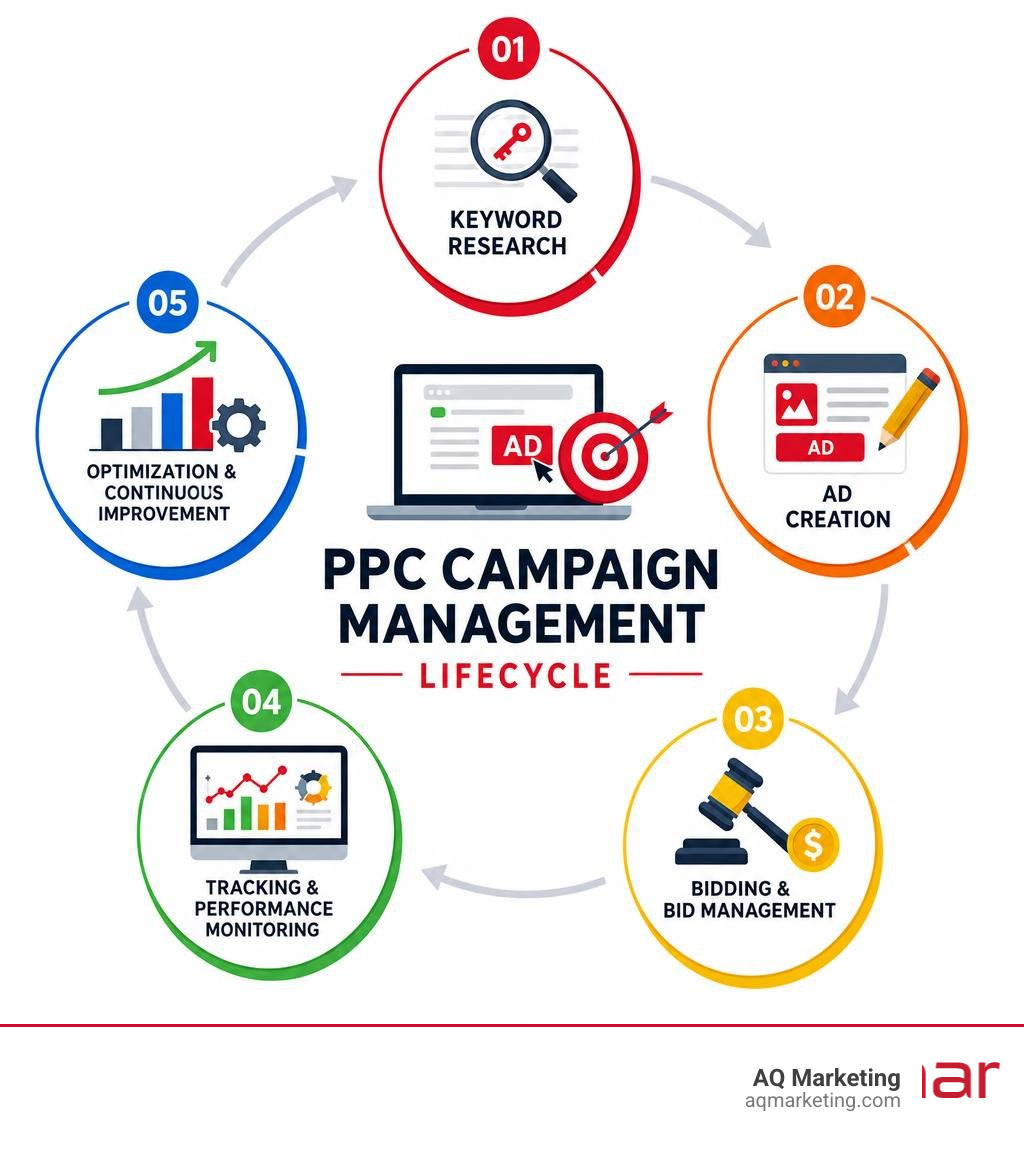
Ppc ad campaign management basics:
- what is pay per click
- targeted ppc advertising
- ppc for hvac companies
What is PPC Ad Campaign Management and Why Does It Matter?
At its core, ppc ad campaign management is the strategic, day-to-day oversight of a company’s pay-per-click advertising budget. It is not a passive task. Instead, it is an evolving art where perfect optimization is the continuous goal. The primary purpose of active management is to determine the most effective budget for your ads, improve your overall return on ad spend (ROAS), and secure top placement in search results without overspending.
When we look at the digital landscape in June 2026, the online marketplace is more crowded than ever. Whether you run a local home services company in Woburn, MA, or an insurance agency in Boston, MA, simply having your ads “show up” is no longer enough. Because less than 25% of PPC ads produce conversions, many businesses find themselves throwing money into a black hole.
Active management addresses this gap. It ensures that every ad dollar is directed toward users who demonstrate genuine purchase intent. By executing strategic keyword research, channel selection, and ongoing performance monitoring, professional management transforms paid search from an expensive gamble into a predictable source of new leads. For a deeper look at how this works on a local level, explore our insights on Targeted Pay Per Click Advertising.
The Difference Between Running Ads and Active PPC Ad Campaign Management
Many business owners believe that launching a Google Ads campaign is a “set-and-forget” project. They log into the platform, select a few keywords, write a basic ad, enter a credit card, and hope for the best. This is simply running ads, and it often leads to silent money burning.
Active ppc ad campaign management is the exact opposite. It is a continuous cycle of measurement, hypothesis, testing, and refinement.

The table below highlights the key differences between these two approaches:
| Passive Ad Running | Active PPC Campaign Management |
|---|---|
| Set-and-forget campaign launching | Continuous daily and weekly optimization |
| Bidding on broad, unmonitored search queries | Regular analysis of search term reports to refine intent |
| Accepting default platform bidding recommendations | Manual or carefully guided automated bid adjustments |
| Letting irrelevant clicks drain your budget | Aggressive use of negative keywords to filter bad traffic |
| Pointing all ads to a generic homepage | Designing targeted landing pages for specific ad groups |
One of the most powerful tools in active campaign management is the search term report. While you might bid on a keyword like “home insurance,” users might actually type in “free home insurance options” or “insurance jobs in Boston.” Without active management to identify and exclude these non-commercial queries using negative match types, you will pay for clicks that have zero chance of converting. Active management isolates competitive gaps — targeting the high-value queries your competitors are overlooking — rather than blindly fighting over the most expensive terms.
Core Components of Effective PPC Ad Campaign Management
An effective PPC strategy relies on several moving parts working in perfect harmony. If any one of these components is neglected, the entire campaign can falter.
To build a high-performing campaign, we must structure it correctly from the ground up. This involves utilizing specialized developer tools like the Campaign | Google Ads API | Google for Developers to structure accounts programmatically, or using modern platforms to keep track of conversion actions.
The core components of any successful campaign include:
- Keyword Strategy: Identifying high-intent search terms.
- Compelling Ad Copy: Writing headlines and descriptions that stand out.
- Landing Page Optimization: Creating a seamless transition from click to conversion.
- Bid and Budget Management: Pacing your spend to maximize ROI.
- Conversion Tracking: Measuring the exact actions users take after clicking.
Strategic Keyword Selection and Match Types
Keywords are the foundation of paid search. However, how you target those keywords matters just as much as the words themselves. Google Ads and Microsoft Ads use match types to determine how closely a user’s search query must match your chosen keyword:
- Broad Match: This offers the widest reach but the lowest control. Your ad can show for searches that are loosely related to your keyword. Without careful monitoring, broad match can quickly drain your budget on irrelevant terms.
- Phrase Match: This strikes a balance between reach and control. Your ad shows for searches that include the meaning of your keyword, offering a safer way to scale.
- Exact Match: This is the most restrictive and highly relevant option. Your ad only shows for searches that match the exact meaning or intent of your keyword, delivering the highest quality traffic.
- Negative Keywords: This is your shield against wasted spend. By adding negative keywords (such as “free,” “DIY,” or “jobs”), you prevent your ads from appearing to users who are unlikely to convert. For example, a premium home remodeling business in Acton, MA, might use income-based and geographic negative matching to focus ad spend strictly on local homeowners looking for professional services.
Landing Page Alignment and Message Match
Getting the click is only half the battle. Once a user clicks your ad, they must land on a page that immediately reassures them they are in the right place. This is known as message match.
If your ad promises “Emergency Plumbing Repair in Woburn” but links to a generic homepage that lists every service from kitchen remodeling to HVAC maintenance, the user is likely to bounce. High bounce rates signal to search engines that your page isn’t relevant, which lowers your Quality Score and increases your cost per click (CPC).
To optimize your conversion rates, your landing pages should feature:
- Consistent headlines that match the ad copy.
- A clear, prominent call-to-action (CTA) such as “Get a Free Quote” or “Call Now.”
- Trust signals like customer reviews, local credentials, and clear contact information.
- Fast load times and a mobile-friendly design.
For more details on streamlining your ad-to-page experience, read our guide on 4 PPC Campaign Best Practices.
Performance Tracking and Key Metrics
To manage a campaign successfully, you must rely on data, not guesswork. Modern tools like Claude Code for Google Ads | AI-Powered PPC Management can assist by analyzing historical account data to identify optimization opportunities.

When reviewing your campaign performance, keep a close eye on these essential key performance indicators (KPIs):
- Impressions: How many times your ad was displayed.
- Click-Through Rate (CTR): The percentage of impressions that resulted in a click (Clicks ÷ Impressions). A high CTR indicates highly relevant ad copy.
- Cost Per Click (CPC): The actual price you pay for each click.
- Conversion Rate: The percentage of clicks that result in a completed lead form, phone call, or purchase.
- Cost Per Acquisition (CPA): How much it costs to acquire a single customer or lead.
- Return on Ad Spend (ROAS): The total revenue generated divided by the total ad spend.
The Business Benefits of Professional PPC Management
For many small to medium-sized businesses in Massachusetts, managing paid media campaigns in-house can be overwhelming. Between running daily operations and serving clients, there is rarely enough time to monitor bidding strategies, perform A/B split testing, and prune search terms.
This is where partnering with a professional management firm yields significant returns. Working with a dedicated specialist typically results in an immediate performance boost of 30% to 50% on existing, underperforming campaigns. Professional managers bring years of platform expertise, specialized software, and strategic insights that prevent costly trial-and-error. If you are wondering whether to make the transition, consider reading Hiring a PPC Management Firm: 5 Reasons Why You Should.
For businesses looking for regional support, partnering with localized specialists—such as those at a Pay-Per Click (PPC) Management Services Agency Boston MA or agencies serving Abington via PPC Services For Lawyers Abington | PPC Advertising For Lawyers —ensures your campaigns are tailored to the unique demographics of the Massachusetts market.
Real-World Success and Case Studies
To understand the true impact of professional ppc ad campaign management, we can look at documented performance benchmarks across various industries. While these results represent broader industry case studies rather than AQ Marketing’s specific client portfolio, they demonstrate what is possible with expert oversight:
- E-commerce Retailer: An online furniture store achieved a 5x ROAS and generated nearly $800,000 in revenue by structuring granular product campaigns and optimizing Google Shopping feeds.
- Corporate Security Firm: By implementing strict negative keyword matching and refining demographic targeting, a security company achieved a 50% increase in conversions alongside a 75% reduction in cost per acquisition (CPA).
- Local Equipment Dealership: A regional tractor and Kubota dealership saw a 300%+ increase in actionable leads and a 20%+ reduction in CPA by shifting to localized geo-targeted campaigns.
- Industrial Maintenance Client: By restructuring underperforming campaigns, an industrial services business improved its cost per conversion by more than 3x (dropping from $94 to $25) while boosting its conversion rate from 0.82% to 10.75% (a 10x improvement).
- Travel Booking Agency: A travel provider improved its clicks-to-call by over 40% on a $50,000 monthly Google Ads budget by optimizing mobile ad extensions and call-only bidding strategies.
Integrating PPC Ad Campaign Management with SEO
PPC does not exist in a vacuum. To build a highly visible online presence, paid search should work hand-in-hand with search engine optimization (SEO).
When you coordinate your paid and organic marketing efforts, you unlock powerful synergies:
- Keyword Intelligence: The high-converting keywords you discover through PPC campaigns can immediately inform your long-term organic SEO content strategy.
- Dominating the SERPs: Appearing in both the paid ad spots and the organic search results increases your brand authority and captures a larger share of search traffic.
- Lowering Blended CAC: While paid search delivers immediate leads, organic SEO builds long-term equity. Together, they lower your blended customer acquisition cost (CAC).
Whether you are working with an agency in Acton via a Digital Marketing Agency in Acton, Massachusetts | SEO, Website … or a specialist in Agawam like the Agawam PPC Agency | EZMarketing , aligning your search strategies is critical. Learn more about balancing these channels by reading Getting Local Paid Search Right: How to Achieve ROAS.
Choosing the Right Partner and Understanding the Costs
Selecting a PPC management partner is a major decision for any business. The right specialist will treat your budget as their own, maintaining complete transparency and focusing on metrics that drive real revenue. To guide your search, you can review our PPC Advertising Services Complete Guide.
How to Evaluate a PPC Specialist or Agency
When interviewing potential agencies or consultants—including national providers like Get Professional PPC Management Services – Netlynx Inc —it is essential to ask the right questions to ensure they align with your business goals.
Keep this evaluation checklist in mind during your discovery calls:
- Account Ownership: Do you retain 100% ownership and access to your Google Ads and Meta accounts? (An ethical agency will never hold your account hostage).
- Fee Transparency: Are management fees billed separately from your direct ad spend?
- Reporting Frequency: Will you receive regular, easy-to-understand reports that connect ad spend to actual leads and revenue, rather than just vanity metrics like impressions?
- Strategic Approach: Do they offer custom strategies tailored to your industry, or do they rely on generic templates?
Typical Costs and Pricing Models
PPC management services are structured under several different pricing models. Because every business has unique needs, understanding these models will help you choose the best fit for your budget.
Please note: The pricing ranges listed below are based on average online industry data in 2026 and do not represent AQ Marketing’s actual pricing. We present these ranges to help you understand typical market rates.
| Pricing Model | Typical Monthly Range (Wide Industry Spread) | Best For |
|---|---|---|
| Flat Monthly Fee | $500 – $5,000+ per month | Businesses with stable, predictable monthly ad budgets. |
| Percentage of Ad Spend | 10% – 30% of monthly ad spend | Scaling campaigns where management complexity grows with budget. |
| Hourly Consulting Rate | $75 – $250+ per hour | One-time audits, campaign setups, or short-term strategy consulting. |
Note: In professional engagements, monthly management fees are billed separately from your actual ad spend, which is paid directly to the advertising platforms (like Google or Meta).
Frequently Asked Questions About PPC Management
What are the most common mistakes businesses make when managing their own PPC?
The most frequent mistake is the “set-and-forget” approach, which leads to significant wasted ad spend. Many self-managed accounts fail to add negative keywords, resulting in paying for irrelevant search queries. Other common errors include directing all ad traffic to a generic homepage instead of a dedicated landing page, and failing to set up proper conversion tracking, which makes it impossible to measure actual ROI.
How long does it take to see results from a managed PPC campaign?
One of the greatest benefits of PPC is its speed. Unlike organic SEO, which can take several months to build momentum, paid ads can start driving traffic immediately. When restructuring an existing, underperforming campaign, initial improvements and “quick wins” are typically visible within 14 to 30 days. Bidding strategies and conversion modeling usually require 60 to 90 days of consistent data to compound and fully stabilize.
Is there a minimum budget required for professional PPC management?
While search engines do not enforce a minimum budget, most professional agencies recommend a starting ad spend of at least $1,000 per month for local campaigns. This budget ensures your ads receive enough impressions and clicks to gather actionable performance data. If your budget is set too low, it will take much longer to determine which keywords and ad creatives are driving real business growth.
Conclusion
Navigating ppc ad campaign management can feel overwhelming, but you don’t have to do it alone. Since 2003, AQ Marketing has been helping small to medium-sized businesses in Woburn, MA, and throughout New England enhance their online presence. We specialize in delivering long-term, impactful results through tailored digital marketing strategies, including professional Google and social media advertising management.
If you are ready to stop wasting ad spend and start driving high-quality leads to your business, we are here to help. Reach out to our team today to discuss how we can support your business growth.
- Ready to scale your paid search? Explore our specialized Pay-Per-Click Advertising services.
- Want to learn more about our history and values? Read About AQ Marketing.
- Let’s discuss your goals: Book a 15-Minute Phone Call with us today!
What Is Pay Per Click? Your Quick Answer First
What is pay per click (PPC) is something millions of business owners search for every day — and the answer is simpler than you might think.
Pay-per-click (PPC) advertising is a digital advertising model where you pay a fee each time someone clicks on your ad. You only pay for actual clicks — not for how many times your ad is shown.
Here’s the core idea at a glance:
| Term | What It Means |
|---|---|
| PPC | Pay-per-click — you pay only when someone clicks your ad |
| CPC | Cost-per-click — the dollar amount you pay per click |
| Ad Auction | The real-time process that decides which ads show up and where |
| Quality Score | A rating (1–10) that measures how relevant your ad is |
| SERP | Search Engine Results Page — where your ads appear |
In plain terms: you set a budget, target the right people, and only pay when someone is interested enough to click. That’s the whole model.
PPC is one of the fastest ways for a small business to get in front of potential customers — right now, not months from now. Whether you run a home services company, an insurance agency, or a fitness studio, PPC puts your business at the top of search results while you’re still building long-term organic visibility.
According to industry data, PPC advertising brings in an average of $2 for every $1 spent — with an average cost per click of just $1.16. Google alone processes over 99,000 search queries every second, which means the opportunity to reach your audience is enormous.
I’m Robert P. Dickey, President and CEO of AQ Marketing, and I’ve spent over 20 years helping small and medium-sized businesses navigate the digital marketing landscape — including what is pay per click and how to make it work without wasting budget. In this guide, I’ll walk you through everything you need to know to understand PPC and use it strategically for your business.
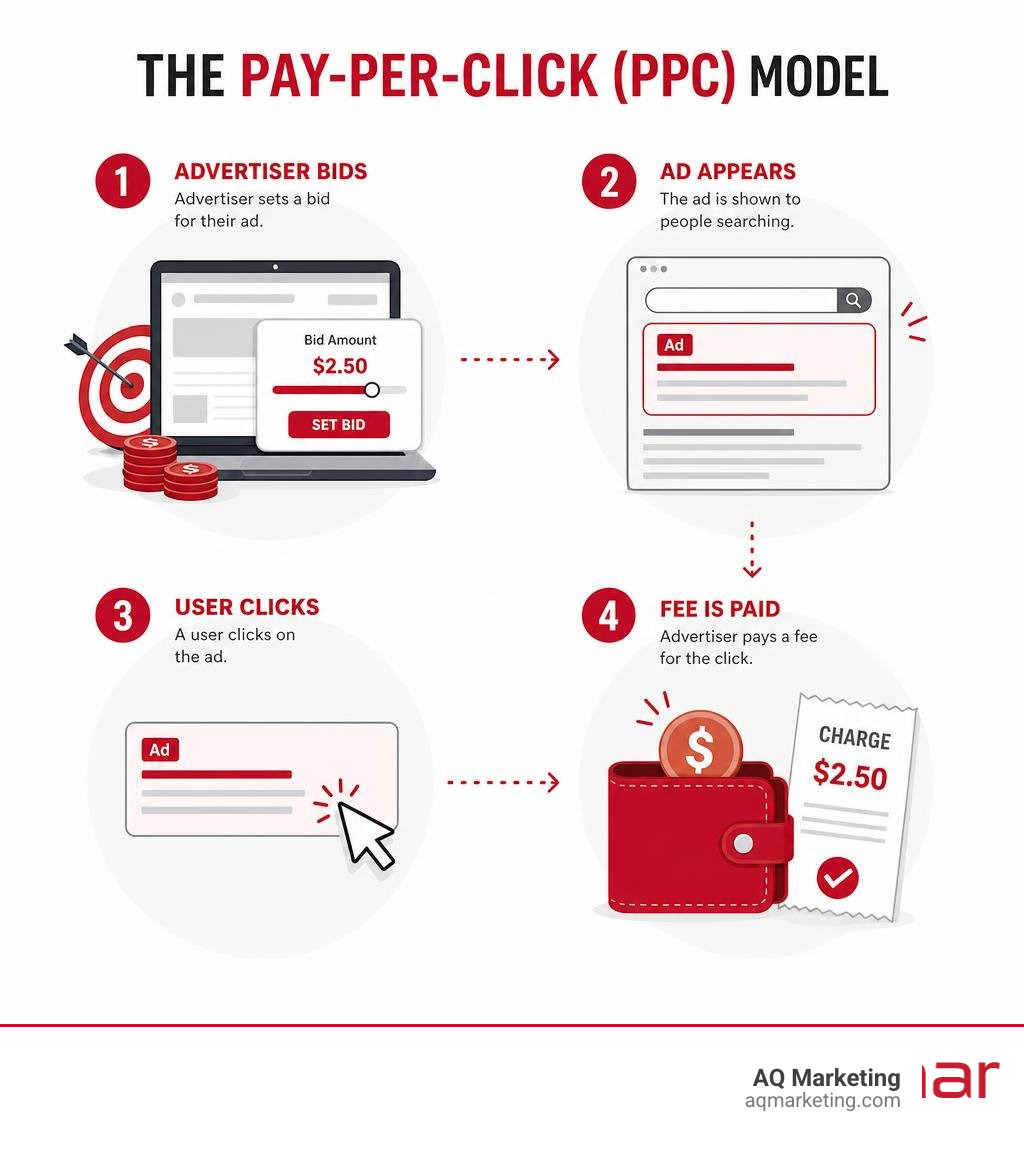
Basic what is pay per click vocab:
- Pay Per Click Advertising
- PPC Targeting Ultimate Guide
- PPC for Start-ups
Demystifying the Basics: What Is Pay Per Click?
To understand how digital advertising drives immediate growth, we must first break down the core mechanics of Pay-per-click (PPC).
At its heart, pay-per-click is a partnership between advertisers and publishers. The advertiser (your business) wants to reach a specific audience. The publisher (a search engine like Google, or a social media network like Facebook) has the audience’s attention. Instead of paying a flat fee to display a banner indefinitely — similar to buying a physical billboard on Route 128 in Massachusetts — you only pay the publisher a fee when a user takes a specific action: clicking on your ad.
This fee is called the cost-per-click (CPC). If 10,000 people see your ad while searching for “plumber in Woburn, MA” but only 10 people click on it, you are only billed for those 10 clicks. This makes PPC an incredibly cost-effective and highly measurable digital advertising model compared to traditional print, radio, or television ads, where you pay for estimated exposure rather than guaranteed engagement.
Understanding What Is Pay Per Click in Modern Marketing
In modern digital marketing, think of PPC as renting highly targeted digital real estate. When you want to find the best local services, you turn to search engines. If a business bids on the search terms you use, their ad appears right at the top of your search results.
By utilizing What Is PPC? Learn the Basics of Pay-Per-Click Marketing, businesses can bypass the waiting game associated with organic growth. Instead of hoping a search engine notices your website, you buy your way to the top of the search engine results page (SERP). This provides a predictable stream of targeted traffic composed of users who are actively searching for exactly what you sell.
For small to medium-sized businesses throughout Massachusetts — from Cape Cod up to Amesbury — this model levels the playing field. A local service provider can stand side-by-side with national brands simply by out-strategizing them on keyword relevance and local intent.
PPC vs. SEO vs. SEM: Knowing the Difference
It is common to hear the terms PPC, SEO, and SEM used interchangeably, but they represent very different pillars of search engine marketing. Understanding how they interact is crucial for building a balanced digital strategy.
- PPC (Pay-Per-Click): A paid model where you purchase immediate traffic. Your ads appear in designated “Sponsored” areas of search results or social media feeds. The moment you pause your budget, the traffic stops.
- SEO (Search Engine Optimization): The practice of optimizing your website’s content, technical setup, and authority to earn high rankings in the organic (unpaid) search results. While SEO takes time and consistent effort, it provides long-term, compounding traffic without a direct cost-per-click. To explore this comparison in detail, read our breakdown of SEO vs PPC What’s the Difference.
- SEM (Search Engine Marketing): An umbrella term that historically encompassed both paid search (PPC) and organic search (SEO). Today, many marketers use SEM specifically to refer to paid search efforts. You can learn more about how we structure these campaigns by visiting our Search Engine Marketing Services page.
By combining immediate paid visibility with steady organic growth, Massachusetts businesses can dominate both the sponsored and organic sections of search results.
How Pay-Per-Click Advertising Works
Many business owners assume that the advertiser who is willing to pay the most money always gets the top spot on search results. Fortunately, that is not how modern search engines operate. Instead, platforms like Google use a highly sophisticated, instantaneous ad auction to determine which ads display and in what order.

Every time a user types a search query into Google, an automated auction takes place in milliseconds. The search engine evaluates all eligible advertisers bidding on those terms and calculates which ads are most likely to provide a high-quality experience for the user. To learn more about how this ecosystem operates, you can read What Is Pay-Per-Click (PPC) Marketing?.
The Mechanics of the Real-Time Ad Auction
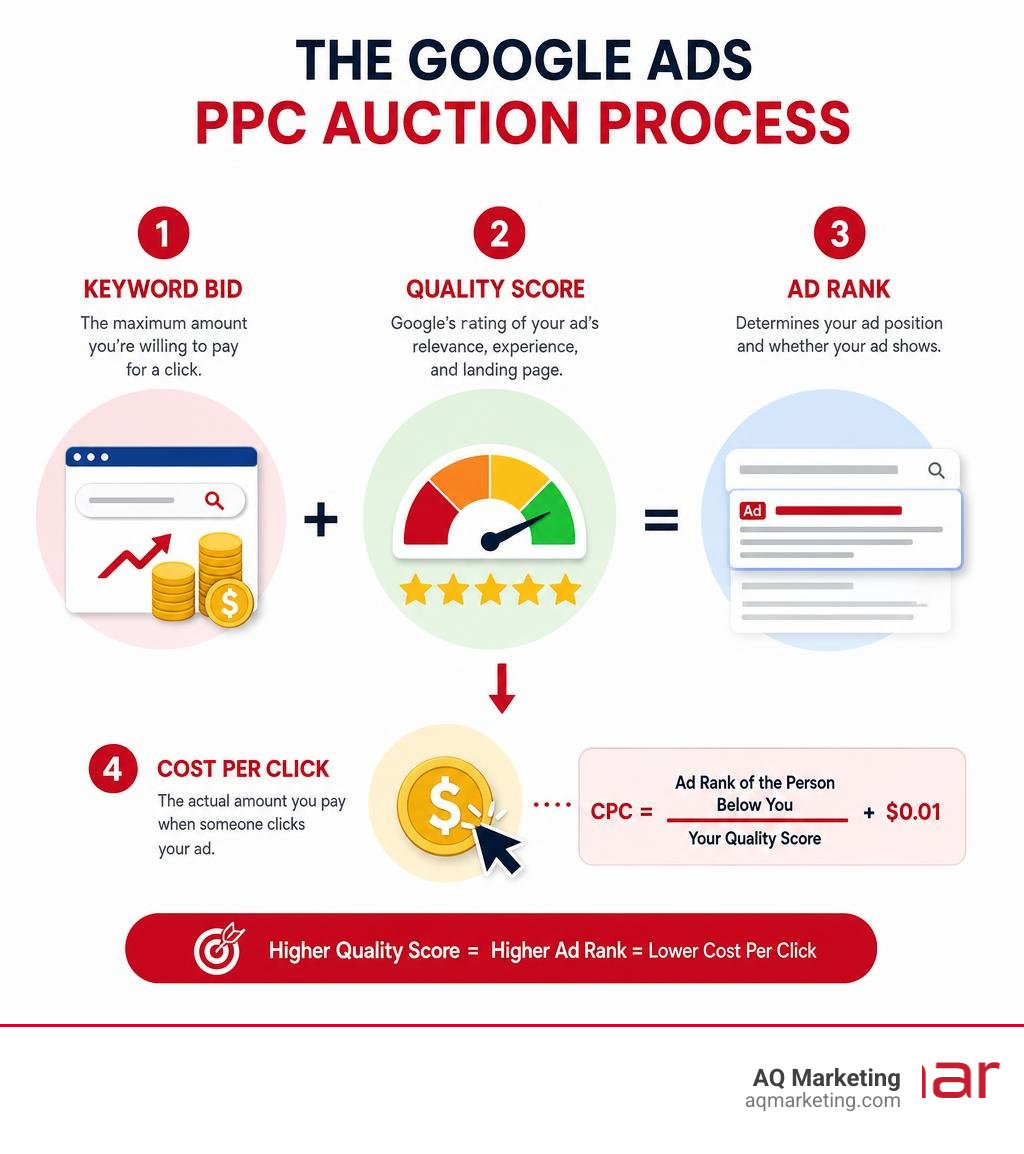
The ad auction begins when a user submits a search query. The search engine’s algorithm instantly pulls all ads targeting keywords matching that query. To decide which ads to display and how to rank them, the platform calculates an Ad Rank for each participant.
Ad Rank is determined by combining several key factors:
- Your Maximum Bid: The highest amount you have specified you are willing to pay for a single click.
- Your Quality Score: A metric measuring the overall quality and relevance of your ad campaign.
- Ad Extensions and Formatting: The expected impact of additional information included in your ad, such as phone numbers, location links, or extra site pages.
Because of this auction formula, a highly relevant ad with a lower bid can easily outrank a poorly written ad with a massive budget.
How Search Engines Determine What Is Pay Per Click Cost
Your actual cost-per-click is calculated dynamically during every single auction. Google uses a generalized second-price auction model, meaning you do not necessarily pay your maximum bid. Instead, you only pay the minimum amount required to beat the Ad Rank of the advertiser directly below you.
The formula generally looks like this:
Your Price = (Ad Rank of the competitor below you / Your Quality Score) + $0.01
As a result, your Quality Score acts as a direct lever for cost control. The higher your Quality Score, the less you have to pay to maintain a top position. This score is evaluated on a scale of 1 to 10 and is heavily influenced by three pillars:
- Expected Click-Through Rate (CTR): How likely Google thinks users are to click your ad.
- Ad Relevance: How closely your ad copy matches the user’s search query.
- Landing Page Experience: How helpful, fast, and easy-to-navigate your website is once a user clicks through.
Flat-Rate vs. Bid-Based PPC Models
While most major search platforms use the bid-based model described above, there are two primary structures for pay-per-click campaigns:
- Bid-Based PPC: Advertisers compete in real-time auctions. Your CPC fluctuates based on competitor activity, search volume, and Quality Score. This is the model used by Google Ads, Microsoft Advertising, and most social media networks.
- Flat-Rate PPC: The advertiser and the publisher agree on a fixed rate for every click. This is common on local directory sites, niche industry comparison portals, and specialized publisher networks. Regardless of search trends or competition, you pay a set fee (e.g., $2.00 per click) for every visitor sent to your site.
The Core Types of PPC Ads and Platforms
PPC is not a one-size-fits-all channel. Depending on where your potential clients spend their time online, you can choose from various ad formats and platforms to maximize your reach.
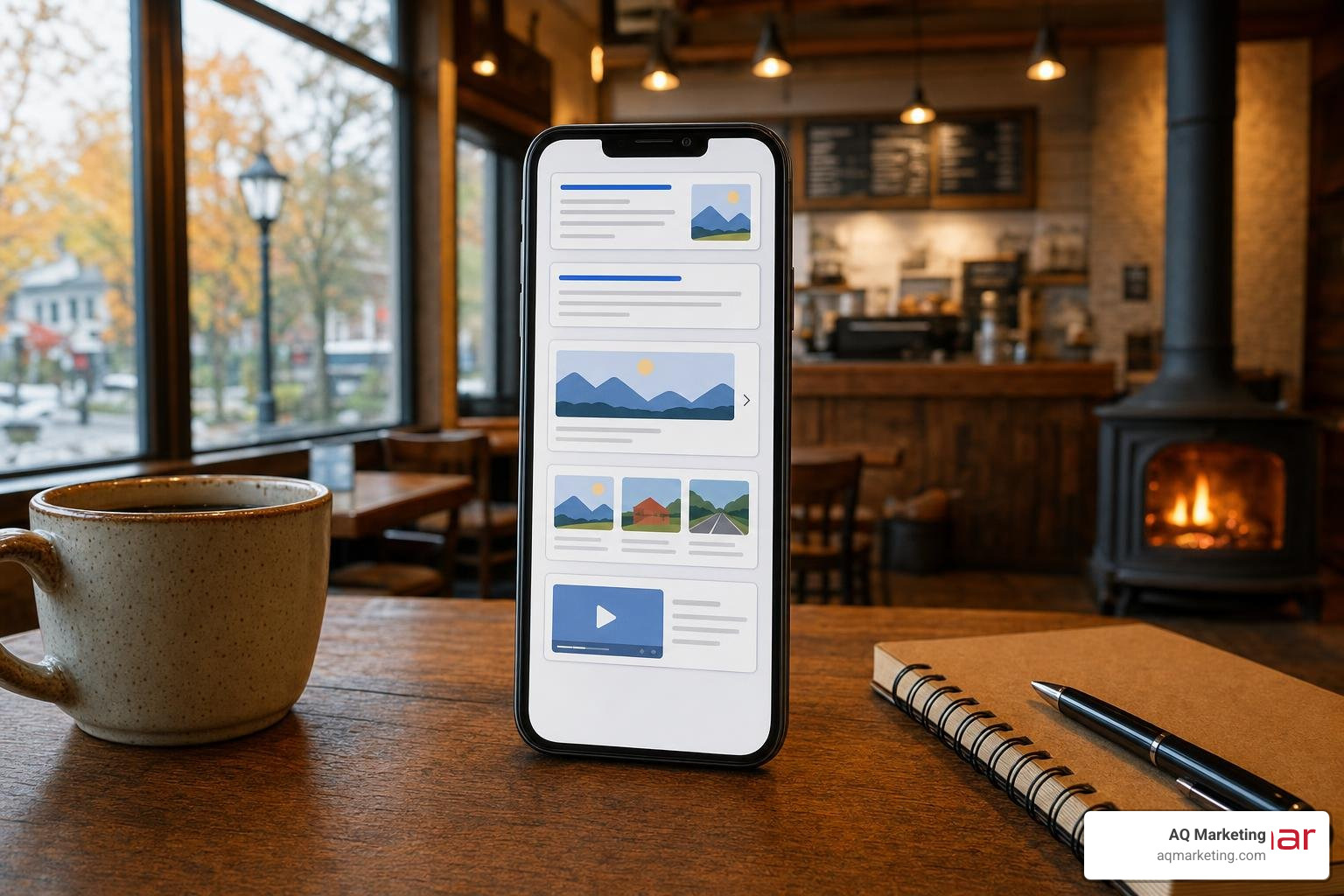
To get a comprehensive overview of how to structure these campaigns across different channels, check out What is PPC? A starter guide to pay-per-click advertising.
Search, Display, and Shopping Ads
These are the three foundational pillars of search-engine-based paid advertising:
- Search Ads: These are traditional text-based ads that appear at the very top and bottom of search engine results pages. They are highly effective because they target users with immediate purchase intent. For instance, someone searching for “emergency roof repair in Andover, MA” is actively looking to hire a professional immediately.
- Display Ads: These visual banner ads appear across millions of partner websites within the Google Display Network. Unlike search ads, display ads are excellent for building brand awareness and introducing your business to prospects who may not be actively searching for you yet.
- Shopping Ads: Crucial for e-commerce brands, shopping ads display a product image, price, and business name directly in search results, allowing users to compare products visually before clicking.
Social Media Ads vs. Search Ads
While search ads capture active intent, social media ads on platforms like Facebook, Instagram, LinkedIn, and TikTok focus on demographic and behavioral targeting.
On social networks, users are not actively searching for a service; instead, they are browsing content. Social media ads slide seamlessly into their feeds based on their interests, job titles, location, and online behavior. For example, an insurance agency in Woburn might target parents within a 15-mile radius with ads about life insurance policies. To understand which approach fits your goals, explore our comparison of Social Media Ads vs Search Ads What’s the Difference.
Strategic Benefits of PPC for Growing Businesses
For small to medium-sized businesses aiming to scale, PPC provides an unparalleled level of control and speed. It acts as a digital catalyst, driving immediate visibility while your long-term organic strategies take root.
Instant Visibility and Targeted Reach
Unlike organic search optimization, which requires months of consistent content creation and technical refinement to rank, a PPC campaign can go live and start sending targeted visitors to your website within hours.
Furthermore, the targeting capabilities of modern PPC platforms are incredibly precise. You can filter your audience by:
- Geography: Target specific cities and towns in Massachusetts, such as Woburn, Boston, Burlington, or Newton.
- Demographics: Filter by age, gender, household income, or parental status.
- Devices: Show your ads only to mobile users, which is highly effective for emergency services like towing or plumbing.
- Timing: Run your ads only during business hours when your staff is available to answer phone calls.
Measurable ROI and Cost Control
One of the greatest advantages of pay-per-click advertising is absolute measurability. With tracking tools like Google Analytics, you can see exactly which keyword led to a click, which ad copy prompted the user to call, and how much it cost to secure that customer.
This transparency allows for strict cost control. You can set a firm daily budget (e.g., $20 per day) and rest assured that you will never spend a penny over that limit. If a campaign is performing exceptionally well and generating a high return on ad spend (ROAS), you can scale your budget upward. If a specific keyword is costing money without generating leads, you can pause it instantly.
Setting Up and Managing a High-Performing Campaign
Building a successful campaign requires a strategic approach that aligns your keywords, your ad copy, and your landing pages. Here is how we structure campaigns to ensure maximum return on investment.
Defining Goals and Audience Targeting
Before writing a single line of ad copy, you must define what success looks like. Are you looking to generate phone calls for a local service business, secure registrations for a local event, or build brand awareness for a new product launch?
Once your goals are set, you can map out your audience targeting. For local service providers in Massachusetts, geo-targeting is critical. If your service area is limited to the North Shore, you do not want to waste budget displaying ads to users in Western Massachusetts. By narrowing your geographic targeting to specific towns like Peabody, Danvers, and Beverly, you protect your budget and ensure every click comes from a viable lead.
Keyword Research and Negative Keywords
Keyword research is the foundation of any search campaign. We focus on identifying high-intent, long-tail keywords—longer, more specific search phrases that indicate a user is close to making a buying decision. For example, instead of bidding on the broad and expensive term “lawyer,” a practice might target “family law attorney in Amherst, MA.”
Equally important is the creation of a robust negative keyword list. Negative keywords prevent your ads from showing up for search terms that are irrelevant to your business. If you are a premium website design agency, you might add negative keywords like “free,” “cheap,” or “DIY.” This prevents you from paying for clicks from users who have no intention of hiring a professional.
For example, local campaigns like those for a Digital Marketing Agency Serving Amesbury Businesses or specialized legal services such as Law Firm PPC Advertising Amherst Center rely heavily on precise keyword filtering to maximize ROI.
Landing Page Optimization and Quality Score
The click is only the first half of the journey. What happens after the click is what determines your conversion rate and your ultimate cost-per-click.
When a user clicks your ad, they should land on a dedicated, highly relevant page designed specifically to answer their search query. Sending paid traffic to your homepage is a common mistake; homepages are often too broad and distract visitors. Instead, send them to a page that matches the exact promise of the ad, featuring:
- A clear, compelling headline.
- A prominent call-to-action (like a phone number or a simple contact form).
- Fast loading times and absolute mobile responsiveness.
- Trust signals, such as local reviews or industry credentials.
By optimizing this post-click experience, you boost your Quality Score, lower your cost-per-click, and convert more casual visitors into paying clients.
Frequently Asked Questions About PPC
To help you gain complete clarity on how to leverage paid search for your business, we have compiled answers to some of the most common questions we receive from business owners in Massachusetts.
What is a good cost per click (CPC) in 2026?
A “good” cost-per-click varies wildly depending on your industry, geographic location, and level of competition. High-value industries (like legal services or commercial HVAC) naturally command higher CPCs because a single converted lead can translate into thousands of dollars in revenue.
The table below outlines average online industry data for CPC ranges across various sectors in 2026.
Please note: This data is based on general online marketing averages and does not represent AQ Marketing’s actual pricing.
| Industry Sector | Average CPC (Online Data) | Typical High-End CPC Range |
|---|---|---|
| Home Services (Plumbing, Electrical) | $4.50 | $15.00 – $25.00+ |
| Professional Services (Legal, Finance) | $6.50 | $20.00 – $45.00+ |
| Local Retail & E-commerce | $1.20 | $4.00 – $8.00+ |
| Real Estate & Property Management | $2.10 | $7.00 – $12.00+ |
As a general rule, a good CPC is one that allows you to maintain a healthy profit margin based on your average customer lifetime value and conversion rates.
How does Quality Score affect my ad spend?
Quality Score is Google’s way of ensuring that searchers see relevant ads. It acts as a discount mechanism for high-quality advertisers.
If your Quality Score is high (e.g., 8 to 10), Google rewards you by lowering your actual cost-per-click and giving your ad better placement on the page. If your Quality Score is low (e.g., 1 to 3), you will be penalized with significantly higher costs-per-click, and your ads may not show up at all. Keeping your keywords, ad copy, and landing pages tightly aligned is the best way to keep this score high and your costs low.
Can small businesses succeed with a small PPC budget?
Absolutely. One of the greatest myths in digital marketing is that you need a multi-million dollar budget to compete in PPC.
Small businesses can succeed on modest budgets by being highly strategic:
- Hyper-Local Targeting: Instead of targeting the entire state of Massachusetts, focus only on the specific zip codes or towns you can easily service.
- Niche Keywords: Avoid broad, highly competitive keywords. Target specific, long-tail search terms that larger competitors might overlook.
- Ad Scheduling: Run your ads only during peak hours of the day when you are ready to answer the phone and close the lead immediately.
Conclusion
Understanding what is pay per click is the first step toward transforming your business’s online presence. When executed with precision, PPC is not an expense—it is a highly controllable, measurable asset that drives immediate visibility, high-quality leads, and long-term business growth.
At AQ Marketing, based in Woburn, MA, we have spent over two decades helping small to medium-sized businesses across Massachusetts navigate the complexities of digital marketing. From professional website design and strategic search engine optimization to high-performing paid advertising campaigns, our mission is to deliver long-term, impactful results that help your business thrive.
Ready to stop guessing and start growing? Book a 15-Minute Phone Call with us today, and let’s build a tailored PPC strategy that works for your business.
Why PPC Google Ads Still Matter for Small Business Growth
PPC Google Ads remain one of the most powerful ways for small and medium-sized businesses to get in front of customers who are actively searching for what they sell — right now, not months from now.
Quick answer: What is PPC Google Ads?
| Term | What it means |
|---|---|
| PPC | Pay-Per-Click — the payment model where you only pay when someone clicks your ad |
| Google Ads | Google’s advertising platform that uses the PPC model across Search, Display, YouTube, Shopping, and more |
| How it works | You bid on keywords → Google runs an auction → your ad shows to relevant searchers → you pay per click |
| Why it works | 63% of people click on Google Ads when they’re ready to buy, and businesses earn an average of $2 for every $1 spent |
Think of PPC as the model and Google Ads as the machine that runs it.
Google processes 8.5 billion searches every day. A well-run Google Ads campaign puts your business directly in front of the people making those searches — specifically the ones looking for exactly what you offer.
But here’s the catch: running ads and running them well are two very different things. Many business owners burn through their budget quickly and walk away thinking Google Ads doesn’t work. Usually, the problem isn’t the platform — it’s the strategy.
I’m Robert P. Dickey, President and CEO of AQ Marketing, Inc., and over my 20+ years in digital marketing I’ve helped countless small and mid-sized businesses turn underperforming PPC Google Ads accounts into consistent lead-generation engines. In this guide, I’ll break down exactly how the platform works and what it takes to stop wasting money and start getting real results.
Ppc google ads vocab to learn:
Demystifying PPC Google Ads: Platform vs. Model
To get the most out of your digital marketing budget, it is critical to understand the distinction between the payment model and the software platform.
Many business owners use “PPC” and “Google Ads” interchangeably, but they are not the same thing. PPC (Pay-Per-Click) is a broad digital advertising model. It is a billing mechanism where you only pay the hosting platform when a user actively clicks on your advertisement. This model is used by various search engines and social media networks.
Google Ads, on the other hand, is Google’s proprietary advertising platform. It is the most widely used PPC engine in the world, serving ads across Google Search, the Google Display Network, YouTube, Google Shopping, and Google Maps.
| Feature | PPC (The Model) | Google Ads (The Platform) |
|---|---|---|
| Definition | An advertising payment mechanism. | A specific advertising tool owned by Google. |
| Scope | Includes Google, Microsoft Advertising, Facebook, LinkedIn, etc. | Limited to Google’s search and partner networks. |
| Control | Dictates how you pay for traffic (cost-per-click). | Dictates where and how your ads appear using targeting algorithms. |
When we talk about targeted PPC advertising, we are talking about using these platforms to match user intent with your business offerings. If you run a local home services business in Woburn, MA, or an insurance agency in Boston, MA, your marketing budget is best spent targeting users who are expressing immediate local search intent rather than casting a wide, expensive net.
How Google Ads Works: Campaigns and Smart Bidding
At its core, Google Ads functions as a lightning-fast, continuous auction. Every single time a user types a query into Google, an auction occurs in milliseconds to determine which ads appear, what order they appear in, and how much each advertiser will pay for a click.

To enter this auction, you must establish a campaign structure, define your target geographic parameters, and choose a bidding strategy. Google has shifted heavily toward automated bidding systems. In fact, in 2026, more than 80% of Google advertisers rely on automated bidding to manage their campaigns.
According to Google’s official documentation on About automated bidding, these machine-learning systems adjust your bids in real time for every single auction based on the likelihood of that specific search resulting in a click or a conversion. This is a game-changer for businesses looking to get local paid search ROAS (Return on Ad Spend) right without spending hours manually tweaking bids.
Understanding the Core Campaign Types in PPC Google Ads
Google Ads offers several campaign types tailored to different business objectives:
- Search Ads: These are the classic text ads that appear at the top of the Search Engine Results Pages (SERPs) marked with an “Ad” or “Sponsored” label. They target high-intent search queries and are highly effective for lead-generation businesses.
- Display Ads: Visual banner ads that appear across more than two million websites and apps within the Google Display Network. These are excellent for building local brand awareness in communities from Worcester, MA, to Cape Cod.
- Shopping Ads: E-commerce-focused ads that display product photos, prices, ratings, and store names directly on the search results page.
- Video Ads: Ads that run before, during, or after YouTube videos, allowing businesses to tell a more dynamic story.
- App Campaigns: Highly automated campaigns designed to drive app downloads across Google properties. If you are launching an app, you can follow Google’s guide on how to Set up an App campaign for installs to streamline your user acquisition.
How AI-Powered Smart Bidding Drives Conversion Value
Smart Bidding is a subset of automated bidding that uses machine learning to optimize specifically for conversions or conversion value. It utilizes a vast array of “auction-time signals”—including the searcher’s physical location, device type, browser, language, operating system, and the exact time of day—to set the optimal bid.
Two of the most common Smart Bidding strategies are:
- Target CPA (Cost Per Acquisition): You set the average amount you are willing to pay for a single conversion (like a phone call or a form submission), and Google’s AI adjusts bids to get as many conversions as possible at that price.
- Target ROAS (Return on Ad Spend): Ideal for e-commerce or businesses tracking precise transaction values. You tell Google you want a specific return (e.g., $4 of revenue for every $1 spent), and the system optimizes bids to find high-value buyers.
According to Google’s data on AI-powered Smart Bidding, advertisers who transition from a Target CPA strategy to a Target ROAS strategy can see an average increase of 14% in conversion value while maintaining a similar return on ad spend.
The Pillars of Campaign Success: Quality Score and Structure
Getting clicks is easy; getting profitable clicks is where the real work begins. To prevent Google from draining your budget, you must understand the Quality Score metric and how to structure your account.
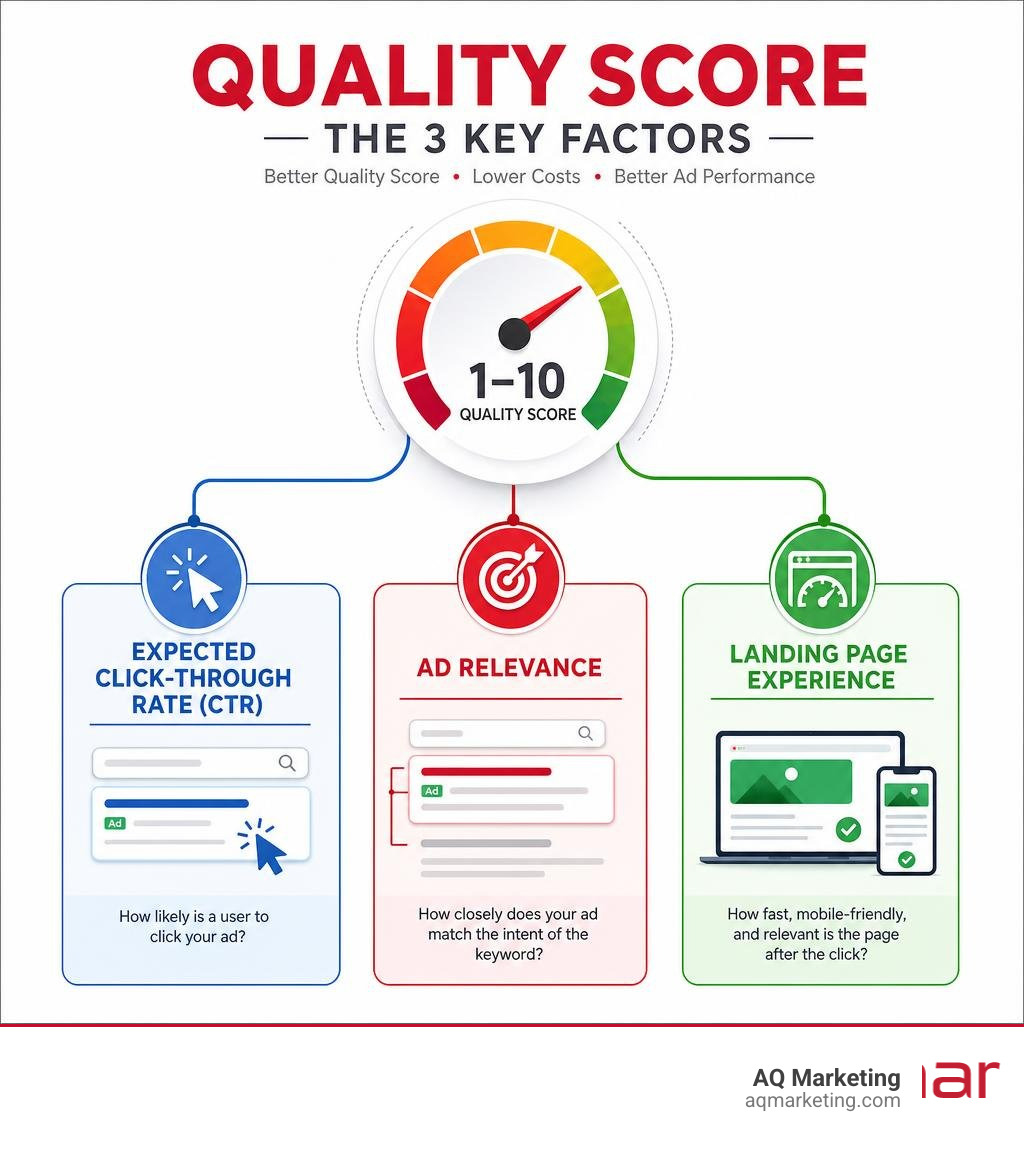
Quality Score is a diagnostic tool graded on a scale from 1 to 10. It is calculated based on three primary factors:
- Expected Click-Through Rate (CTR): How likely is a user to click your ad when it is shown?
- Ad Relevance: How closely does your ad copy match the intent of the keyword the user searched?
- Landing Page Experience: How fast, mobile-friendly, and relevant is the page the user lands on after clicking your ad?
A high Quality Score acts as a discount code. If you have a Quality Score of 10, your actual cost-per-click can be roughly 50% lower than an advertiser with a Quality Score of 5 bidding on the same keyword. To see how to align your targeting with high-quality traffic, review our PPC Targeting Ultimate Guide.
Structuring Your PPC Google Ads Account for Maximum ROI
A disorganized account structure is the primary reason small businesses waste money on Google Ads. If you group all your keywords into a single campaign with one generic ad, Google’s algorithm will struggle to show relevant ads, and your Quality Score will plummet.
Instead, organize your account logically:
- Campaign Level: Grouped by broad business goals, product lines, or major service categories (e.g., “Plumbing Services” vs. “HVAC Services”).
- Ad Group Level: Sub-categories containing a small, tightly themed set of keywords (usually 5 to 20 keywords) and highly specific ads that match those exact terms. For example, if you are a home services contractor in Braintree, MA, you should have separate ad groups for “heating repair” and “AC installation” rather than grouping them together, a strategy we detail in our Cheat Sheet to HVAC PPC Services.
- Keyword Match Types: Use Exact Match and Phrase Match to maintain control over your traffic. Avoid Broad Match unless you have a robust negative keyword list and are utilizing Smart Bidding, otherwise, you run the risk of paying for irrelevant queries.
- Negative Keywords: These are terms you explicitly exclude from your campaigns. If you sell premium, high-end services in Newton, MA, you should add negative keywords like “free,” “cheap,” or “DIY” to prevent your ads from showing to bargain hunters.
For a deeper dive into structuring your accounts properly, academic resources like the Google Ads Essential Training (2020) – SBS Pathways course provide excellent foundational frameworks. Alternatively, you can read our guide on Why Your Business Needs a Google PPC Advertising Agency to understand how professional management prevents structural mistakes, or explore The Ultimate Guide to Google Ad Management Services for a comprehensive look at account optimization.
Performance Max vs. Traditional Search Campaigns
Performance Max (PMax) is Google’s fully automated, AI-driven campaign type. Unlike traditional Search campaigns where you bid on specific keywords and write static text ads, Performance Max allows you to upload a collection of creative assets (headlines, descriptions, logos, images, and videos). Google’s AI then mixes and matches these assets to serve ads across all of Google’s channels, including Search, YouTube, Display, Gmail, Maps, and Discover.
| Feature | Traditional Search Campaigns | Performance Max Campaigns |
|---|---|---|
| Primary Targeting | Keyword-based | Audience signals, customer data, and themes |
| Placements | Google Search SERPs and partner sites | YouTube, Display, Search, Maps, Gmail, Discover |
| Control | High control over exact search queries and ad copy | High automation; Google determines asset combinations |
| Best Used For | Capturing high-intent search traffic | Scaling conversions across multiple networks simultaneously |
While Performance Max can be highly effective for e-commerce brands, local service businesses in Massachusetts should proceed with caution. PMax requires a significant budget to feed the algorithm enough data to learn, and it offers limited search term reporting compared to traditional campaigns.
To ensure your creative assets are optimized for whatever campaign type you choose, review Google’s official Google Ads specs: ad formats, sizes and best practices guide.
Measuring Performance and Avoiding Costly Mistakes
You cannot optimize what you do not track. Without proper conversion tracking, running a ppc google ads campaign is like throwing money into a dark room and hoping some of it finds its way back to you.

To measure your true return on investment, you must track primary conversion actions, such as:
- Form completions on your website
- Inbound phone calls generated directly from your ads
- Online purchases or booked appointments
Once tracking is established, you can monitor the Digital Marketing Metrics That Matter, including Click-Through Rate (CTR), Cost Per Click (CPC), Conversion Rate (CVR), and Return on Ad Spend (ROAS).
Another critical metric to watch is ad fatigue. Over time, searchers in your target local market (whether in Woburn, MA, or surrounding towns like Burlington and Lexington) will grow accustomed to seeing the same ad creative, causing your CTR to drop. Regularly refreshing your headlines, descriptions, and visual assets is essential to keep your campaigns performing at their peak. If you are running app promotion campaigns alongside search, make sure to consult Google’s Tips for maximizing your App campaign to maintain healthy conversion rates across mobile platforms.
Frequently Asked Questions About Google PPC
How much does it cost to run Google Ads in 2026?
The cost of running Google Ads varies widely depending on your industry, geographic targeting, and level of competition. Highly competitive industries, such as legal services or emergency home repairs in major metropolitan areas like Boston, MA, will naturally see much higher costs per click than niche markets.
Based on average online data across the digital marketing industry:
- Small to mid-sized businesses typically spend anywhere from $1,000 to $15,000 per month on Google Ads.
- Average cost-per-click (CPC) ranges from $2.50 on the low end to $45.00+ on the high end for highly competitive, high-value keywords.
Please note: These pricing ranges are based on average online industry data and do not represent AQ Marketing’s actual service pricing or required ad spend budgets.
How long does it take to see results from a PPC campaign?
While your ads can technically go live and start generating clicks within hours of launching a campaign, achieving a stable, optimized ROI typically takes 30 to 90 days.
During the initial 2 to 4 weeks, your campaign enters a “learning phase” where Google’s machine learning algorithms gather performance data to understand which audiences and search queries are most likely to convert. Consistent optimization—including negative keyword updates, ad copy tweaks, and landing page adjustments—is required during this period to refine performance.
Why is my Quality Score low and how do I fix it?
A low Quality Score (typically 4 or below) is usually caused by one of three issues:
- Poor Landing Page Speed and Mobile Experience: Over 60% of Google search traffic comes from mobile devices. If your landing page loads slowly or is difficult to navigate on a smartphone, your Quality Score will suffer. Studies show that pages loading in 1 second convert 2.5x better than pages loading in 5 seconds.
- Irrelevant Ad Copy: If your keyword is “residential roofing repair Woburn MA” but your ad headline simply says “We Do Home Remodeling,” Google will view the ad as irrelevant to the searcher’s intent.
- Low Expected CTR: If your ad copy is boring or lacks a clear call to action, searchers will skip over it, signaling to Google that your ad is not engaging.
Conclusion
Running a successful ppc google ads campaign in 2026 requires a strategic balance of human oversight and AI-powered automation. By structuring your account logically, focusing on high Quality Scores, utilizing Smart Bidding correctly, and constantly monitoring your conversion metrics, you can stop wasting your marketing budget and start generating high-quality leads.
At AQ Marketing, we have spent over two decades helping small and medium-sized businesses in Woburn, MA, and throughout the Commonwealth achieve long-term, impactful results. We handle the technical complexities of campaign structure, keyword research, and conversion tracking so you can focus on running your business.
Ready to stop wasting money and start getting clicks that convert? Book a 15-minute phone call with our team today, or learn more about our professional pay-per-click advertising services to begin your digital marketing transformation.
Why Hiring a Google PPC Advertising Agency Could Be Your Best Business Decision
A google ppc advertising agency helps businesses place ads directly in front of people who are actively searching for their products or services — right at the moment they’re ready to buy.
Here’s a quick snapshot of what a Google PPC advertising agency does:
- Manages paid search campaigns on Google, including Search, Display, Shopping, YouTube, and Performance Max
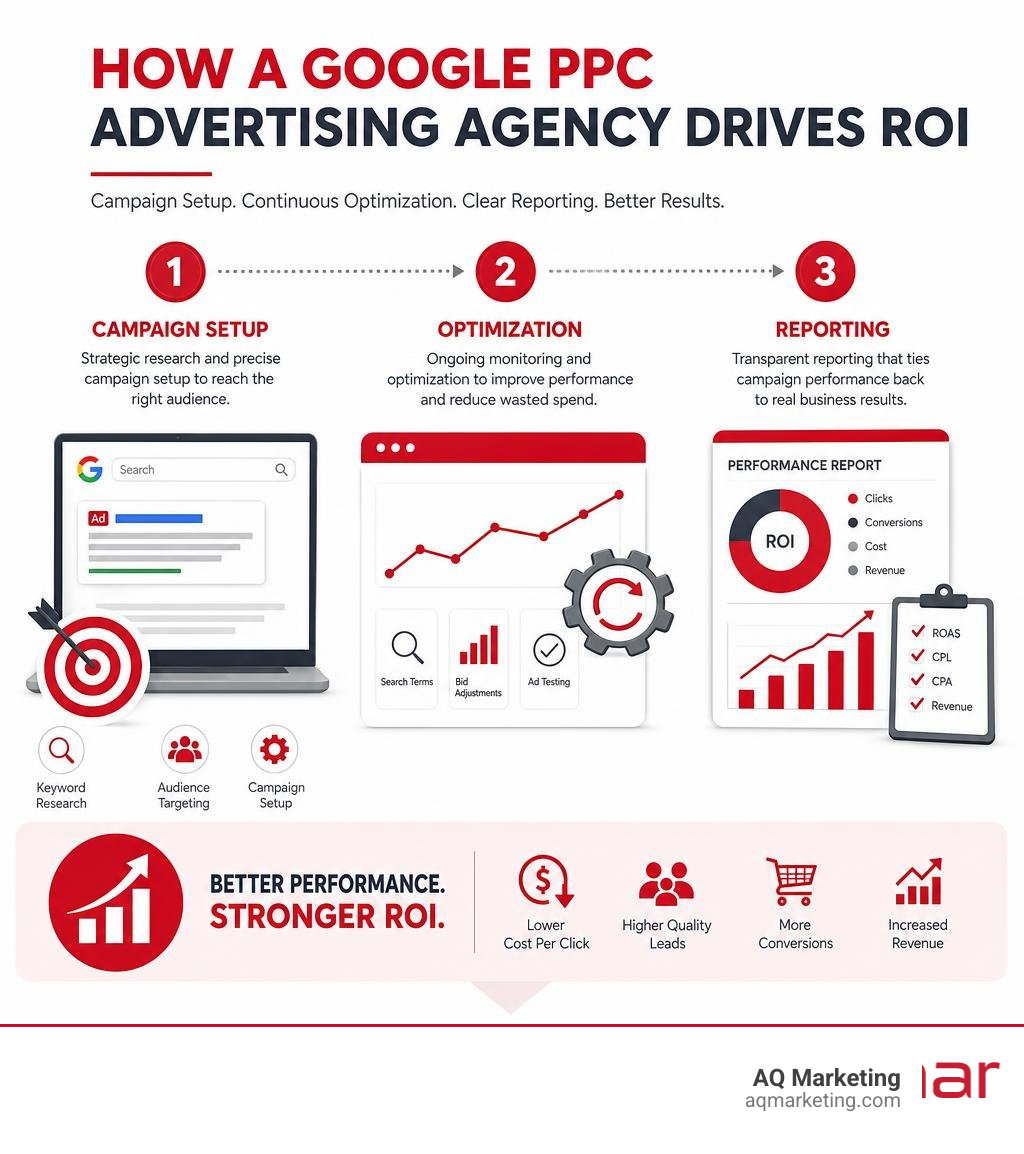
- Handles strategy, setup, and daily optimization so your budget goes further
- Tracks conversions — calls, form fills, purchases — and ties them back to real revenue
- Reports on metrics that matter: ROAS, cost-per-lead (CPL), and cost-per-acquisition (CPA)
- Stays current with Google’s platform changes, algorithm updates, and AI-driven features
Google Ads reaches over 90% of internet users worldwide. It accounts for more than 28% of all global digital ad spend. And businesses earn an average of $2 for every $1 spent — with top performers hitting 8:1 ROAS or better.
But those results don’t happen automatically.
Most businesses that struggle with Google Ads aren’t failing because the platform doesn’t work. They’re failing because the platform is complex — and easy to get wrong. A poorly managed account can waste 40–60% of your budget on the wrong clicks, the wrong audiences, and campaigns that never get optimized.
That’s exactly where a specialized agency makes the difference.
I’m Robert P. Dickey, President and CEO of AQ Marketing, Inc., with over 20 years of experience helping small and medium-sized businesses grow through digital marketing — including google ppc advertising agency management. In that time, I’ve seen how the right paid search strategy can transform a business’s lead flow and bottom line.
Google ppc advertising agency further reading:
- PPC Advertising Services
- Bing Pay Per Click Ads
- Targeted PPC Advertising
What is a Google PPC Advertising Agency?
A google ppc advertising agency is a team of certified marketing professionals who specialize in planning, launching, optimizing, and managing pay-per-click (PPC) campaigns on the Google Ads platform. Instead of trying to navigate the ever-changing maze of online advertising on your own, partnering with an agency allows you to delegate this highly technical task to experts who live and breathe search engine marketing.
At its core, pay-per-click advertising is an auction-based system. Every time a user types a query into Google, an instantaneous auction takes place behind the scenes. Google weighs your bid, the quality and relevance of your ad, and the landing page experience to decide where your ad appears. A specialized agency understands how to balance these factors to secure prime real estate at the top of the search engine results pages (SERPs) without overpaying.

A professional agency does not simply “set and forget” your ads. They manage a diverse suite of campaign types tailored to your business model, including:
- Search Ads: Text-based ads that appear at the very top of Google search results when high-intent buyers look for your services. This is highly effective for local businesses like home services and insurance agencies.
- Shopping Ads: Product-focused ads that display images, prices, and store names directly in search results, which is essential for e-commerce businesses.
- Display Network & Remarketing: Visual banner ads shown across millions of partner websites and apps, designed to keep your brand top-of-mind for users who have previously visited your site.
- YouTube Video Ads: Video advertisements placed before, during, or after streaming content to build brand awareness and capture visual attention.
- Performance Max (PMax): Google’s newer, AI-driven campaign type that automatically runs ads across all available channels (Search, YouTube, Display, Discover, Gmail, and Maps) from a single campaign.
By utilizing these campaign types strategically, an experienced partner ensures that your business is visible throughout the entire customer journey. For a deeper look into how these pieces fit together, check out our PPC Advertising Services Complete Guide.
Core Services Provided by Google Ads Experts
When you hire a specialized agency, you aren’t just paying for someone to adjust your daily budget. You are investing in an end-to-end management workflow. The core services provided by Google Ads experts include:
- Keyword Research: Identifying the exact commercial-intent phrases your potential customers use. This goes beyond simple search volume; it involves finding high-intent, niche long-tail keywords while identifying and excluding negative keywords to prevent wasted spend.
- Ad Copywriting: Crafting compelling, direct-response ad copy that grabs attention, matches user search intent, and maintains high click-through rates (CTR).
- Landing Page Optimization: Designing and refining dedicated landing pages that align perfectly with the message of your ads. Sending paid traffic to a generic homepage is a common pitfall; experts build conversion-focused pages to turn clicks into actual leads.
- Bid and Budget Management: Utilizing manual bidding strategies or properly configuring Google’s automated Smart Bidding algorithms (like Target CPA or Target ROAS) to maximize your return on investment.
- A/B Testing: Continuously testing ad variations, headlines, call-to-actions, and landing page elements to discover what resonates best with your audience.
If you are a business owner operating in Massachusetts, working with a local specialist who understands the regional landscape can give you a distinct advantage. Discover more about local execution with our Boston Google Ads Services — Expert PPC Management.
Key Benefits of Professional PPC Management
Managing an active Google Ads account is a full-time job. The platform receives over 63,000 searches per second, and auction dynamics shift constantly. Professional PPC management ensures that your campaigns are aggressively optimized to capture the highest quality traffic at the lowest possible cost.
One of the most immediate benefits of professional management is the reduction of wasted ad spend. The average unmanaged or self-managed Google Ads account wastes between 25% and 40% of its budget on irrelevant clicks, poor targeting, and incorrect match types. A professional agency implements negative keyword lists, precise geographic targeting, and device-specific bid adjustments to ensure your money is spent only on high-value prospects.

Furthermore, agencies focus heavily on improving your Quality Score—a metric Google uses to rate the relevance and quality of both your keywords and PPC ads. A higher Quality Score (measured on a scale of 1 to 10) directly lowers your cost-per-click (CPC) and improves your ad position. By aligning your keyword targeting, ad copy, and landing pages, a professional agency helps you win the auction for less money.
To learn more about maximizing your campaigns, review our guide on 4 PPC Campaign Best Practices.
Why Choose a Specialized Google PPC Advertising Agency Over In-House Teams
Many business owners wonder if they should simply assign Google Ads management to an existing in-house employee or hire a dedicated internal marketer. While having an in-house team has its benefits, it often falls short when compared to the depth of resources a specialized agency offers.
- Deep Platform Expertise: Google updates its advertising platform constantly. From pushing automation and Performance Max campaigns to shifting how keyword match types behave, staying up-to-date requires constant education. Agencies have direct access to Google support, dedicated account representatives, and ongoing training that individual in-house generalists rarely receive.
- Advanced Tools and Technology: Top-tier agencies invest in premium software for keyword research, competitor analysis, landing page testing, and real-time reporting. For an in-house team, purchasing these individual software licenses can quickly become cost-prohibitive.
- Cross-Industry Insights: Because agencies manage accounts across multiple niches and industries, they possess a broad perspective on what strategies are working in real-time. If a new bidding strategy or ad format performs exceptionally well for one client, an agency can quickly adapt and apply those learnings to your campaigns.
- Resource Redundancy: If your in-house marketing specialist goes on vacation, falls ill, or leaves the company, your campaigns can quickly stall or drift. An agency provides a full team of strategists, copywriters, and analysts to ensure your campaigns are monitored every single day.
To understand how precise targeting can elevate your business growth, read our PPC Targeting Ultimate Guide.
Integrating Google Ads with Other Paid Channels
A truly robust digital marketing strategy does not rely on a single platform. While Google Ads is unparalleled for capturing users with immediate search intent, integrating it with other paid channels creates a highly effective, multi-channel marketing funnel.
For instance, pairing Google Ads with Microsoft Advertising allows you to capture high-value search traffic from users on Bing, Yahoo, and AOL. This audience often skews older, has higher average household incomes, and faces lower competition, resulting in cheaper CPCs. You can explore this alternative in our guide to Bing Pay Per Click Ads.
Additionally, social media advertising on platforms like Facebook and Instagram allows you to build brand awareness and generate demand by targeting users based on demographics, interests, and behaviors rather than search queries. By capturing a prospect’s interest on social media and then retargeting them when they search on Google, you create a cohesive digital presence. Learn how to convert these social audiences with our guide on How to Get Conversions with Facebook Ads.
How to Choose the Right PPC Partner
Selecting the right google ppc advertising agency can make or break your digital marketing success. With thousands of agencies offering similar promises, you must look past basic sales pitches and evaluate potential partners based on verification, performance, and transparency.
Here are the key factors to evaluate when choosing your PPC partner:
- Google Partner Status: Ensure the agency is a certified Google Partner or Premier Partner. This status proves that their team members have passed rigorous Google Ads certification exams, manage a significant volume of ad spend, and consistently deliver strong campaign performance according to Google’s standards.
- Transparent Reporting: You should always have direct, 100% ownership of your Google Ads account and data. Avoid agencies that keep your campaigns locked in their proprietary accounts. A trustworthy partner provides live, real-time reporting dashboards showing key metrics like spend, conversions, cost-per-lead, and ROAS.
- Relevant Case Studies: Ask for case studies or examples of campaigns they have managed within your industry or a similar high-ticket service sector. If you are in the home services or insurance industries, your agency should understand your specific sales cycles and customer acquisition costs.
- Communication Style: Choose an agency that schedules regular strategy calls (bi-weekly or monthly) to explain what the data means, what changes they made, and what the next steps are for scaling your results.
If you are setting up your account for the first time, it helps to know what to expect. Check out The No-Nonsense Guide to Google Ads Account Setup to build a clean foundation.
Red Flags to Avoid When Selecting a Google PPC Advertising Agency
As you research agencies, keep an eye out for common red flags that indicate a provider may not have your best interests at heart:
- Guaranteed Rankings or Clicks: No one can guarantee a specific ad position or click volume on Google because the auction environment changes in real-time. Agencies that make these promises are often using misleading tactics.
- Lack of Account Ownership: If an agency tells you that they own the Google Ads account and you cannot have administrative access, walk away. If you ever decide to part ways, you will lose all of your historical data and campaign structures.
- Sending Traffic to Your Homepage: If an agency plans to send paid traffic directly to your website’s homepage rather than custom, conversion-optimized landing pages, they are likely wasting your budget. Homepages are typically too generic and convert paid traffic at a much lower rate (2-3%) compared to dedicated landing pages (15-25%).
- Vague or “Black Box” Reporting: If your monthly report only lists impressions and clicks without showing actual leads, phone calls, or sales, they are hiding behind vanity metrics. Clicks do not pay the bills; conversions do.
For businesses looking to partner with local experts in Eastern Massachusetts, you can explore the regional approach offered by Pay-Per-Click Advertising | Cape Cod & Plymouth, MA.
Understanding the Cost of Google Ads Management
Hiring a google ppc advertising agency involves two separate costs: your ad spend (which goes directly to Google to pay for clicks) and the agency’s management fee (which pays for their expertise, labor, and tools).
Agency pricing structures typically fall into a few common models. Below is a comparison of how these models generally look across the digital marketing industry.
| Billed Structure | Typical Pricing Range (Average Online Data) | Best Suited For | Key Considerations |
|---|---|---|---|
| Percentage of Ad Spend | 10% to 30% of monthly ad spend | Growing accounts with scaling budgets | Aligns agency work with campaign scale; usually requires a minimum monthly fee. |
| Flat Monthly Fee | $1,000 to $4,500+ per month | Local service businesses with stable budgets | Provides predictable monthly costs; fee may adjust if ad spend crosses specific tiers. |
| Hybrid Model | Flat base fee + percentage of spend (e.g., $1,500 + 12%) | Medium to large enterprises | Covers the base labor of management while scaling with budget complexity. |
Disclaimer: The pricing ranges listed in the table above are based on average online industry data gathered from directories and market research. They represent typical pricing spreads across the United States in June 2026 and do not represent AQ Marketing’s actual pricing structures.
When budgeting for Google Ads, local search competition plays a massive role. In highly competitive service industries, the cost-per-lead can range from $50 to over $100. A professional agency will help you calculate your target cost-per-conversion to ensure your monthly budget is large enough to generate at least 30 to 50 conversions per month, which gives Google’s bidding algorithms enough data to optimize effectively.
For more details on budgeting and targeting strategies, read our guide on Targeted Pay Per Click Advertising.
Frequently Asked Questions About Google Ads Agencies
How long does it take to see results from Google Ads?
Unlike search engine optimization (SEO), which can take several months to build organic momentum, Google Ads can start driving traffic and generating leads the very day your campaigns go live.
However, the first 2 to 4 weeks are typically considered a “learning period.” During this initial phase, the Google Ads algorithm gathers baseline data on user behavior, and your agency works to identify and filter out irrelevant search terms. Most businesses see meaningful, optimized improvements in cost-per-lead and conversion rates within the first 30 to 60 days of launching a professionally managed campaign.
What is a good starting budget for Google Ads?
There is no single “correct” starting budget, as it depends heavily on your industry, geographic targeting, and business goals.
For a local home services business or insurance agency targeting a specific county or town in Massachusetts, we often recommend starting with a budget that allows you to secure at least 30 to 50 conversions per month. If your industry’s average cost-per-conversion is $60, a starting budget of $1,800 to $3,000 per month is a healthy baseline to gather clean data, test ad copy, and begin generating a consistent flow of qualified leads. Once the campaign proves its ROI, you can confidently scale your budget upward.
Do I own my Google Ads account and data?
Yes, you should always retain 100% ownership of your Google Ads account, your Google Tag Manager container, and your Google Analytics (GA4) property.
At AQ Marketing, we believe in total transparency. We build campaigns directly inside your account (or help you set one up in your name) and request access as managers. This ensures that you retain full data portability, complete access to your historical performance, and full control over your billing settings at all times.
Conclusion
Partnering with a specialized google ppc advertising agency is one of the fastest, most reliable ways to scale your business, increase your lead volume, and achieve predictable growth. By handing over the daily complexities of keyword bidding, landing page optimization, and search term mining to dedicated experts, you can focus on what you do best: running your business and serving your customers.
At AQ Marketing, based in Woburn, MA, we have spent over two decades helping small to medium-sized businesses across Massachusetts build powerful, long-term online presences. Whether you are a local contractor in Agawam, a service provider in Boston, or a business owner on Cape Cod, our team is dedicated to delivering transparent, results-driven digital marketing solutions that turn clicks into real conversations.
Are you ready to stop guessing and start growing? Partner with AQ Marketing for Expert PPC Advertising today, and let’s build a campaign strategy that maximizes every single dollar of your ad budget.
Why PPC for HVAC Companies Is One of the Fastest Ways to Fill Your Schedule
PPC for HVAC companies is a pay-per-click digital advertising model where your business pays only when a potential customer clicks your ad — placing you at the top of Google search results the moment someone needs heating or cooling help.
Here’s a quick breakdown of what it is and why it works:
| What It Is | What It Does for You |
|---|---|
| Pay-per-click advertising on Google, Bing, or social platforms | Puts your business in front of high-intent local searchers |
| Keyword-triggered ads that appear above organic results | Generates calls and form fills the same day a campaign launches |
| Budget-controlled bidding on service-specific terms | Lets you scale spend up in summer and winter peaks, pull back in slow months |
| Trackable, measurable lead channel | Shows you exactly which ads drive calls, bookings, and revenue |
The core benefit in one sentence: When a homeowner’s AC fails at 7pm in July and they search “AC repair near me,” a well-run PPC campaign puts your phone number at the top of their screen — before they ever scroll to a competitor.
The numbers back this up. Google estimates businesses earn roughly $2 in revenue for every $1 spent on paid ads. PPC traffic also converts at a significantly higher rate than organic traffic — up to 50% more, according to industry data. And the top three paid ads on Google capture nearly 41% of all clicks on a results page.
For HVAC contractors specifically, this matters because demand is urgent and seasonal. A homeowner with a broken furnace in January is not browsing — they’re ready to book. PPC captures that moment. SEO often can’t move fast enough to compete.
That said, PPC isn’t magic. It rewards smart setup, the right keywords, and landing pages built to convert — not just any ad pointed at a homepage.
I’m Robert P. Dickey, President and CEO of AQ Marketing, with over 20 years of experience helping small and mid-sized businesses grow through digital marketing — including managing PPC for HVAC companies and other home service contractors across the New England market. In the sections below, I’ll walk you through everything you need to run smarter, more profitable paid ad campaigns.
Must-know ppc for hvac companies terms:
What PPC for HVAC Companies Is, How It Works, and Where It Fits
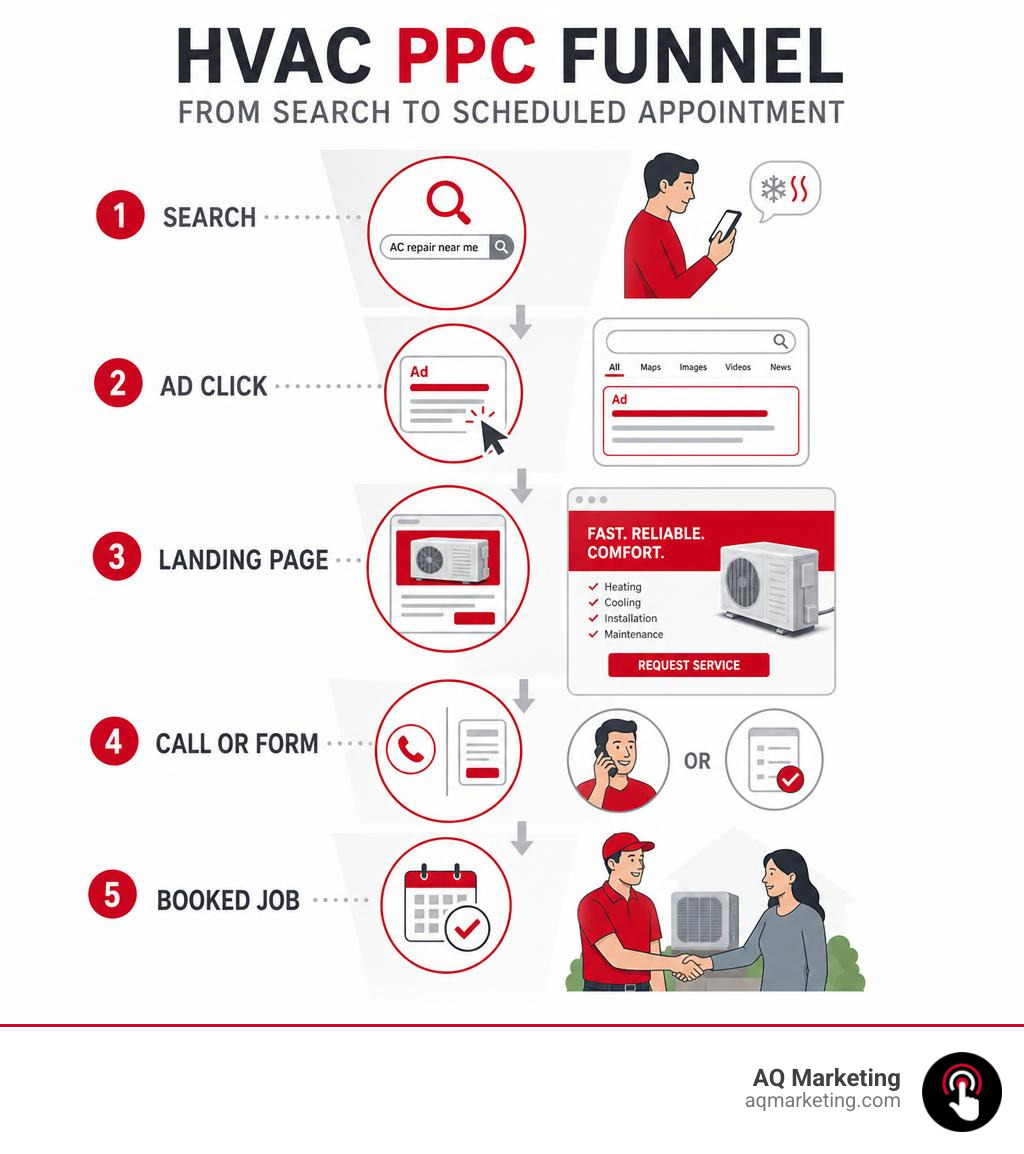
HVAC PPC is paid digital advertising designed to generate calls, form fills, chats, and booked appointments for heating and cooling contractors. The most common version is Google Search Ads, where your ad appears when someone searches for a phrase like:
- “AC repair near me”
- “furnace repair Woburn MA”
- “heat pump installation”
- “emergency HVAC service”
- “HVAC maintenance plan”
The big advantage is timing. PPC reaches people while they are actively looking for help, not six months before or after the problem. For HVAC, that matters because many searches are driven by discomfort: no heat, no cooling, strange noises, leaking equipment, poor airflow, or a system that picked the worst possible weekend to quit.
How HVAC PPC Advertising Works for Contractors
PPC works through an ad auction. You choose keywords, write ads, set a budget, and decide where your ads should appear. When someone searches one of your target terms, Google or another ad platform evaluates your bid, ad quality, landing page, and relevance.
The winning ads usually earn the most visible spots.
Key pieces include:
- Keyword bidding: You bid on searches related to your HVAC services.
- Cost per click: You pay when someone clicks your ad, not when they merely see it.
- Ad rank: Your position depends on bid, Quality Score, expected click-through rate, and landing page experience.
- Call extensions: Searchers can tap to call directly from mobile results.
- Conversion tracking: You measure calls, forms, chats, and booked jobs.
- Budget control: You can set daily and monthly limits.
A well-built campaign does not just buy traffic. It buys targeted opportunities from people in your service area.
PPC vs SEO for HVAC Companies
PPC and SEO solve different problems.
PPC gives you fast visibility. SEO builds long-term organic presence. PPC is ideal when you need leads now; SEO is essential when you want durable visibility that compounds over time.
| Channel | Best For | Timeline | Main Benefit |
|---|---|---|---|
| PPC | Immediate calls, seasonal demand, promotions | Same day to first week | Fast visibility and measurable leads |
| SEO | Long-term rankings, organic trust, lower dependency on ads | Months | Compounding traffic and credibility |
| Both Together | Full search coverage | Ongoing | More SERP real estate and better lead consistency |
For example, an HVAC company in Woburn, Boston, Worcester, Springfield, or Lowell may use PPC to capture urgent repair leads during a heat wave while SEO supports long-term rankings for service pages and blog content.
For more on paid search strategy, see our guide to paid search marketing campaigns. For long-term visibility, explore our SEO support for local visibility.
When HVAC Contractors Should Use PPC
PPC is especially useful when you want to:
- Generate emergency repair calls quickly
- Enter a new service area
- Promote high-margin installations or replacements
- Keep crews busy during slower shoulder seasons
- Test new offers or services
- Expand into nearby Massachusetts towns
- Increase visibility before peak summer or winter demand
- Fill schedule gaps without waiting for SEO rankings
For many HVAC companies, PPC works best as a flexible throttle. Turn it up when demand and capacity are high. Pull it back when schedules are full.
What HVAC PPC Is Not
PPC is powerful, but it is not a vending machine where you insert ad spend and receive guaranteed profits.
HVAC PPC is not:
- A replacement for SEO
- A substitute for reputation management
- A “set it and forget it” channel
- A reason to send every visitor to your homepage
- A guessing game with broad keywords
- A fix for poor phone answering or weak follow-up
- Automatic profit without tracking and optimization
If your ads generate calls but no one answers the phone, the campaign is not the only problem. Sometimes the leak is in the follow-up, not the faucet. Or in this case, the condensate line.
HVAC PPC Ad Types: Which Channels Generate the Best Leads?

Different PPC channels serve different roles. Search ads and Local Services Ads usually produce the strongest immediate lead intent. Display, remarketing, video, and social ads are better for follow-up, awareness, and nurturing homeowners who are not ready to book yet.
| Ad Type | Best Use Case | Cost Model | Lead Intent |
|---|---|---|---|
| Search Ads | Emergency repair, installs, service calls | Pay per click | Very high |
| Local Services Ads | Trust-based local calls | Pay per lead | Very high |
| Display Ads | Awareness and retargeting | Pay per click or impression | Low to medium |
| Remarketing Ads | Re-engaging site visitors | Pay per click or impression | Medium |
| Video Ads | Education and seasonal awareness | Pay per view or impression | Low to medium |
| Social Ads | Offers, reviews, retargeting | Pay per click or impression | Medium |
Search Ads for High-Intent HVAC Leads
Search ads are often the workhorse of ppc for hvac companies because they target people actively searching for help.
Examples include:
- “AC repair near me”
- “furnace repair near me”
- “same day HVAC service”
- “heat pump installation”
- “boiler repair”
- “emergency heating repair”
These clicks can be expensive, but they often carry strong intent. A homeowner searching “furnace not working” during a New England cold snap is not casually researching. They want warmth, fast.
To learn more about audience and keyword precision, see our resource on targeted PPC advertising.
Local Services Ads for Trust-Based Local Calls
Local Services Ads, often called LSAs, appear above traditional search ads for many home service searches. Instead of paying for every click, contractors generally pay for qualified leads such as calls or messages.
LSAs can include trust signals like:
- Google Guaranteed badge, when eligible
- License and insurance verification
- Review ratings
- Service area
- Business hours
- Direct call options
For HVAC companies, LSAs are especially useful because homeowners often want fast confirmation that a contractor is legitimate, nearby, and available.
Important LSA success factors include:
- Accurate service categories
- Strong reviews
- Fast response times
- Correct business hours
- Clean lead tracking
- Disputing invalid leads when appropriate
Display, Remarketing, and Video Ads for Follow-Up Demand
Not every HVAC buyer converts on the first visit. Someone comparing heat pump installation options may visit several websites before calling. Remarketing helps bring those visitors back.
Display and remarketing ads can promote:
- Seasonal tune-up offers
- Financing options
- Maintenance plans
- Replacement consultations
- Reviews and trust messages
Google’s Display Network reaches a huge share of internet users across websites, apps, and YouTube. That reach is useful, but HVAC companies should avoid blasting everyone. Frequency caps, audience segmentation, and clear offers help prevent “why is this ad following me into my recipe blog?” syndrome.
For deeper setup guidance, review our remarketing campaign setup guide.
Social PPC for Residential Awareness and Retargeting
Social ads on Facebook and Instagram are usually not as intent-heavy as Google Search Ads. People scrolling social media are not always looking for furnace repair at that exact second.
But social PPC can work well for:
- Homeowner awareness
- Seasonal tune-up reminders
- Review-based creative
- Before-and-after visuals
- Retargeting website visitors
- Promoting maintenance memberships
- Reaching lookalike homeowner audiences
For residential HVAC, social ads often support the middle of the funnel. They keep your brand visible before the urgent need appears. Learn more about our social media advertising services.
Building PPC for HVAC Companies With Keywords, Geo-Targeting, and Campaign Structure
A profitable HVAC PPC campaign starts with structure. If repair, installation, maintenance, residential, and commercial terms all live in one messy campaign, performance gets cloudy fast.
For more local HVAC strategy, see our guide to 6 local SEM strategies for HVAC companies.
Keyword Strategy for PPC for HVAC Companies
Strong campaigns group keywords by service and intent.
High-intent HVAC keyword groups include:
- Emergency repair: emergency HVAC repair, 24 hour furnace repair, AC stopped working
- Standard repair: AC repair, furnace repair, boiler repair, heat pump repair
- Installation: AC installation, furnace installation, heat pump installation
- Replacement: replace central air, furnace replacement, new HVAC system
- Maintenance: HVAC tune-up, AC maintenance, furnace inspection
- Commercial HVAC: commercial HVAC contractor, rooftop unit repair, HVAC maintenance for buildings
- Residential HVAC: home AC repair, residential furnace service
- Near me terms: HVAC near me, AC repair near me
- City modifiers: HVAC repair Woburn MA, furnace repair Boston MA
- Manufacturer terms: brand-specific repair or installation searches, where appropriate
Long-tail keywords often convert better than broad terms. “Emergency furnace repair in Woburn MA” is more specific than “HVAC,” and specificity usually helps both relevance and lead quality.
Match Types and Negative Keywords
Match types control how closely a search must match your keyword.
- Exact match: Best for your most valuable terms.
- Phrase match: Useful for controlled expansion.
- Broad match: Can work with strong data and negative keywords, but should be used carefully.
Negative keywords are just as important as target keywords. They prevent your ads from showing for searches that are unlikely to become customers.
Common HVAC negative keyword themes include:
- Jobs
- Careers
- Salary
- Training
- Certification
- School
- DIY
- How to
- Parts
- Wholesale
- Manual
- Used equipment
- Free classes
Search term reports should be reviewed regularly, especially in the first 30 to 90 days. That is where you find the odd searches eating budget. Google is smart, but it occasionally needs adult supervision.
Local Geo-Targeting for PPC for HVAC Companies
HVAC is local. Paying for clicks outside your service area is one of the fastest ways to waste money.
Geo-targeting can include:
- Radius around your shop
- Cities and towns
- ZIP codes
- Counties
- Excluded areas
- Location-based keywords
- Mobile bid adjustments
- Weather and seasonal demand patterns
For AQ Marketing clients across Massachusetts communities such as Woburn, Burlington, Lexington, Winchester, Medford, Stoneham, Boston, Worcester, Springfield, and surrounding service areas, local targeting should match real dispatch capacity.
If you do not serve a town, exclude it. If you want more installs in a specific suburb, build campaigns and landing pages around that area.
For more practical local campaign ideas, read our guide to local Google Ads tactics.
Campaign Structure by Service Line and Season
HVAC demand changes with the calendar. In Massachusetts, cooling searches climb in warm months, while heating searches spike in cold weather.
A clean structure might include:
- AC repair campaign
- Furnace repair campaign
- Heat pump campaign
- Installation and replacement campaign
- Maintenance and tune-up campaign
- Emergency HVAC campaign
- Commercial HVAC campaign
- Brand campaign
- Remarketing campaign
Seasonal adjustments matter. Summer budgets may prioritize AC repair and replacement. Winter budgets may shift toward furnaces, boilers, and emergency heating. Shoulder seasons are ideal for tune-ups, maintenance plans, and replacement consultations.
Emergency campaigns may run after hours. Maintenance campaigns may perform better during business hours.
Residential vs Commercial HVAC PPC Strategies
Residential and commercial HVAC PPC require different messaging.
Residential PPC usually targets:
- Homeowners
- Urgent repairs
- Same-day service
- Financing
- Seasonal comfort
- Reviews and trust signals
- Easy online booking or click-to-call
Commercial PPC often targets:
- Facility managers
- Property managers
- Business owners
- Preventive maintenance contracts
- Rooftop units
- Multi-location service
- Longer buying cycles
- Technical service needs
Commercial HVAC keywords may have lower search volume but higher job value. Landing pages should speak to reliability, documentation, maintenance contracts, response times, and experience with commercial systems.
Landing Pages, Quality Score, and Conversion Assets That Turn Clicks Into Calls
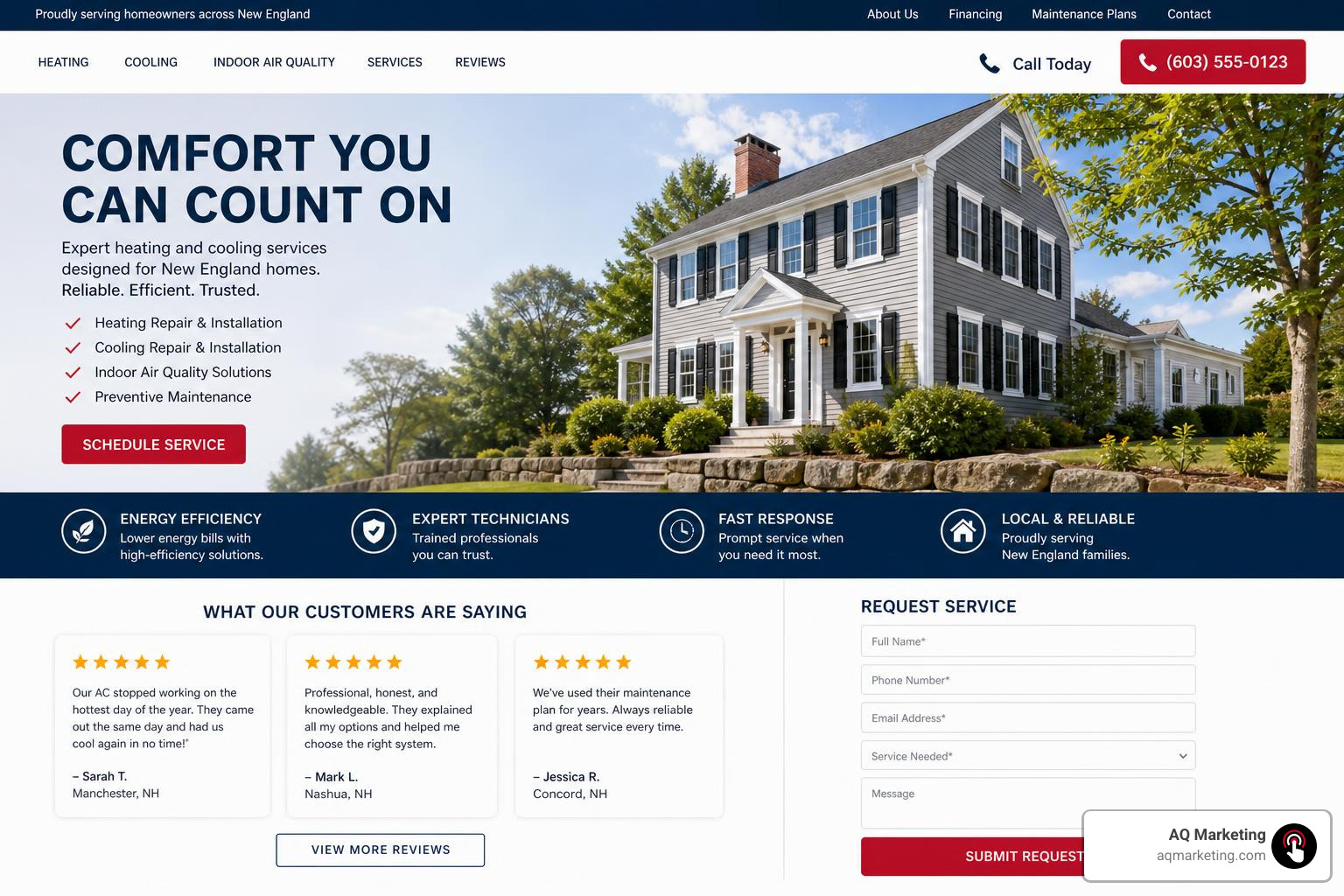
Clicks are not the finish line. Booked jobs are.
A strong PPC campaign needs conversion assets: landing pages, call tracking, fast mobile load times, clear forms, chat options, and follow-up workflows.
Dedicated Landing Pages Beat Generic Homepages
Sending paid traffic to a homepage often weakens conversion rates because the visitor has to hunt for what they need.
A better approach is to use dedicated landing pages by service and location.
A strong HVAC PPC landing page should include:
- Service-specific headline
- City or service-area relevance
- Click-to-call button above the fold
- Short form
- Reviews or testimonials
- License and insurance information, where applicable
- Financing or promotion details
- Clear service benefits
- Fast mobile loading
- One primary call to action
If the ad says “Emergency Furnace Repair,” the landing page should not open with a generic “Welcome to Our Company” message. Match the emergency.
Need better conversion-focused pages? Explore our website design and development services.
Quality Score and Ad Rank for HVAC PPC
Quality Score is Google’s measure of how useful and relevant your ad experience is. It is influenced by:
- Expected click-through rate
- Ad relevance
- Landing page experience
- Keyword alignment
- Page speed
- Search intent match
Higher Quality Scores can help improve ad position and reduce cost per click. In plain English: better relevance can make your budget work harder.
If your keyword is “AC repair Woburn MA,” your ad and landing page should clearly talk about AC repair in that area. Relevance is not fancy. It is just giving people what they searched for.
Ad Copy and Extensions That Increase Calls
Good HVAC ad copy is specific, local, and action-oriented.
Useful elements include:
- Emergency wording for urgent searches
- Same-day or fast-response messaging when accurate
- Local town or region cues
- Financing mentions for replacements
- Review or rating references when eligible
- Clear calls to action
- Service-specific benefits
Ad extensions can improve visibility and calls:
- Call extensions
- Location extensions
- Sitelinks
- Callouts
- Structured snippets
- Review assets, where available
Test multiple CTAs such as “Call Now,” “Schedule Service,” “Book Repair,” and “Request Estimate.” Small copy changes can make a real difference.
Tracking Calls, Forms, Chats, and Booked Jobs
The best PPC reporting goes beyond clicks.
Track:
- Phone calls
- Form submissions
- Chat leads
- Booked appointments
- Canceled or unqualified leads
- Revenue by campaign
- Cost per booked job
- Lead-to-job close rate
Dynamic number insertion can show which keyword or ad drove a phone call. CRM source tags help connect leads to booked revenue. Offline conversion imports can help Google optimize toward real customers, not just button clicks.
If you are preparing a new account, start with proper tracking. Our Google Ads account setup guide explains the basics.
Budgets, ROI, Optimization, and Management Decisions
HVAC PPC performance depends on market competition, season, service mix, landing pages, phone handling, and follow-up. Budget alone does not guarantee results.
For a broader foundation, see our PPC campaign best practices.
Typical HVAC PPC Costs and ROI Expectations
Important pricing note: The ranges below are based on average online industry data and general market observations. They do not represent AQ Marketing’s actual pricing.
Typical HVAC PPC ranges found across industry data include:
| Metric | Common Online Range |
|---|---|
| Cost per click | $5 to $75+ |
| Cost per lead | $50 to $300+ |
| Monthly ad budget | $500 to $10,000+ |
| PPC management fees | Widely variable depending on scope |
| Customer acquisition cost | Often estimated around $200 to $300 in industry references |
Competitive metro areas and peak seasons can push costs higher. Emergency repair clicks may cost more than maintenance clicks, but they may also close faster. Installation leads can be more expensive, yet the job value may be much higher.
Google’s common benchmark says businesses average about $2 in revenue for every $1 spent on ads. That is a helpful reference, not a guarantee. Your true ROI depends on close rate, average ticket, margins, and lead quality.
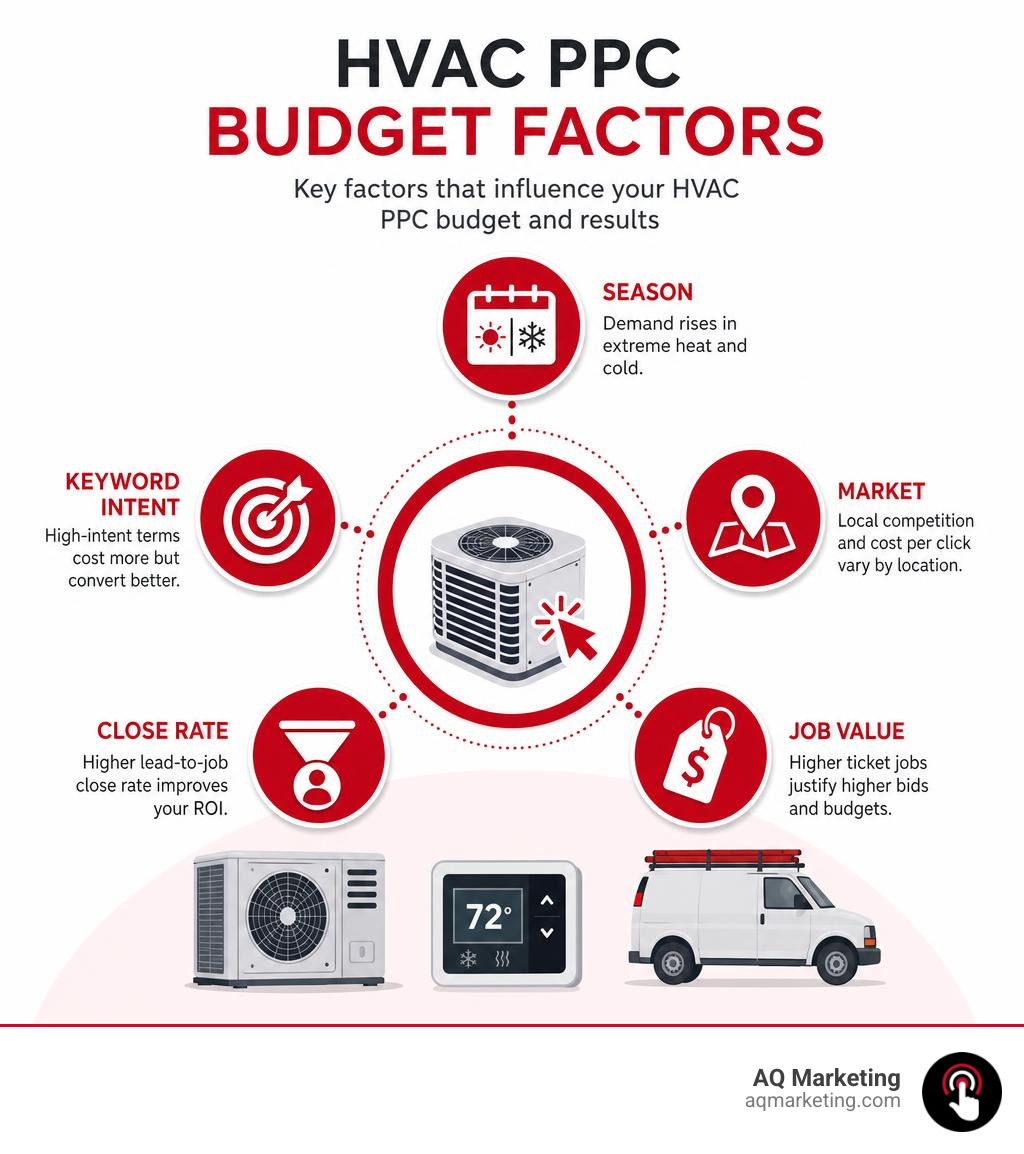
KPIs That Matter Most
Clicks are useful, but they are not the whole story.
Track these KPIs:
- Cost per lead
- Cost per booked job
- Conversion rate
- Click-through rate
- Cost per click
- Impression share
- Quality Score
- Return on ad spend
- Lead-to-job close rate
- Revenue per lead
- Phone answer rate
- Missed call rate
For HVAC companies, phone answer rate is huge. If 70% of urgent leads call and half go unanswered, PPC performance will look worse than it really is.
Negative Keywords, Retargeting, and Automation Tools
Optimization is ongoing.
Use negative keywords to block waste. Use retargeting to bring back non-converting visitors. Use automation carefully once the account has enough conversion data.
Helpful tools and tactics include:
- Weekly search term reviews
- Negative keyword expansion
- Remarketing audiences by page type
- Smart bidding
- Target CPA
- Maximize Conversions
- Automated rules
- Call-only campaigns
- Budget pacing
- Seasonal bid adjustments
Automation works best when tracking is clean. If the system is optimizing toward low-quality form fills, it will happily find more low-quality form fills. Robots are efficient, not psychic.
Before launching, review our checklist of 7 things before launching PPC.
In-House vs Agency PPC Management
You can manage HVAC PPC in-house, but it requires time, platform knowledge, tracking setup, and frequent optimization.
Consider these decision factors:
- Internal marketing time available
- Google Ads experience
- Tracking and analytics knowledge
- Landing page support
- Copywriting ability
- Budget size
- Seasonal strategy needs
- Reporting expectations
- CRM integration needs
- Local market knowledge
- Accountability and communication
- Growth goals
In-house can work for companies with a trained marketer and enough time. An agency can help when you need strategy, technical setup, landing pages, reporting, and ongoing optimization without pulling your team away from operations.
Frequently Asked Questions About HVAC PPC
How quickly can HVAC PPC start producing leads?
HVAC PPC can create visibility as soon as campaigns are approved and launched. Many contractors can begin receiving impressions and clicks within the first week.
However, better performance usually develops over 30 to 90 days as data builds. During that period, we look at search terms, add negative keywords, refine bids, improve ads, and adjust landing pages.
Think of month one as learning, month two as cleanup, and month three as smarter scaling.
Are Google Ads or Facebook Ads better for HVAC leads?
For immediate HVAC leads, Google Search Ads and Local Services Ads usually perform better because they capture active intent. Someone searching “emergency furnace repair near me” is much closer to booking than someone scrolling through vacation photos.
Facebook and Instagram can still be valuable for:
- Retargeting website visitors
- Promoting tune-ups
- Building brand awareness
- Sharing reviews
- Reaching homeowner audiences
- Supporting seasonal offers
The strongest strategy often combines both: Google for urgent demand, social for awareness and follow-up.
Do HVAC companies still need SEO if they run PPC?
Yes. PPC and SEO work best together.
PPC delivers speed. SEO builds long-term visibility and trust. Organic rankings, helpful content, local pages, Google Business Profile optimization, and reviews all support your ability to earn leads without paying for every click.
Over time, strong SEO can reduce dependency on paid ads. PPC can fill the gap while SEO grows, support peak seasons, and test which keywords convert before investing in long-term content.
For local visibility support, see our business profile management services.
Conclusion: Turn Paid Clicks Into Booked HVAC Jobs
PPC for HVAC companies works because it meets homeowners and property decision-makers at the exact moment they need help. The best campaigns are not just ads. They are systems built around keywords, local targeting, landing pages, call tracking, CRM workflows, reviews, and ongoing optimization.
At AQ Marketing, we help small and mid-sized businesses build digital marketing programs designed for long-term, measurable growth. Since 2003, our team has supported businesses with Google Advertising, Social Media Advertising, SEO, website design, content, reputation building, Google Business Profile marketing, CRM workflows, AI webchat, and lead generation systems.
If you want more HVAC leads, better tracking, and a strategy built around booked jobs instead of vanity clicks, we can help.
Start here: Explore PPC advertising services
Why Google Ad Management Services Are the Fastest Path to Qualified Leads in 2026
As we navigate the digital landscape of 2026, the competition for visibility has never been more intense. Google ad management services are professional solutions where certified experts handle every aspect of your Google Ads campaigns — from setup and keyword research to daily optimization and reporting — so your business attracts more qualified leads without wasting budget. In an era where search intent is more nuanced than ever, having a strategic partner to navigate the complexities of paid search is no longer a luxury; it is a necessity for growth.
Here’s what a professional Google Ads management service typically includes:
- Campaign strategy — keyword research, audience targeting, and competitor analysis
- Ad creation — copywriting, ad extensions, and responsive search ads
- Ongoing optimization — bid adjustments, negative keywords, A/B testing
- Conversion tracking — measuring real business outcomes, not just clicks
- Reporting — monthly performance summaries and real-time dashboards
Over 80% of search results now contain Google Ads placements, and the businesses capturing those spots consistently are rarely managing their campaigns alone. The evolution of the Google Ads auction has shifted from simple keyword matching to complex, intent-based modeling that requires constant oversight.
Getting ads live is straightforward. Getting ads that are profitable takes expertise, time, and constant attention — three things most small business owners are already short on. Without professional oversight, it is easy to fall into the trap of high click volume with zero conversion value.
I’m Robert P. Dickey, President and CEO of AQ Marketing, Inc., and with over 20 years of experience helping small and medium-sized businesses grow through digital marketing — including google ad management services — I’ve seen what separates campaigns that drain budgets from those that drive real growth. Let’s break down everything you need to know to make the right decision for your business.
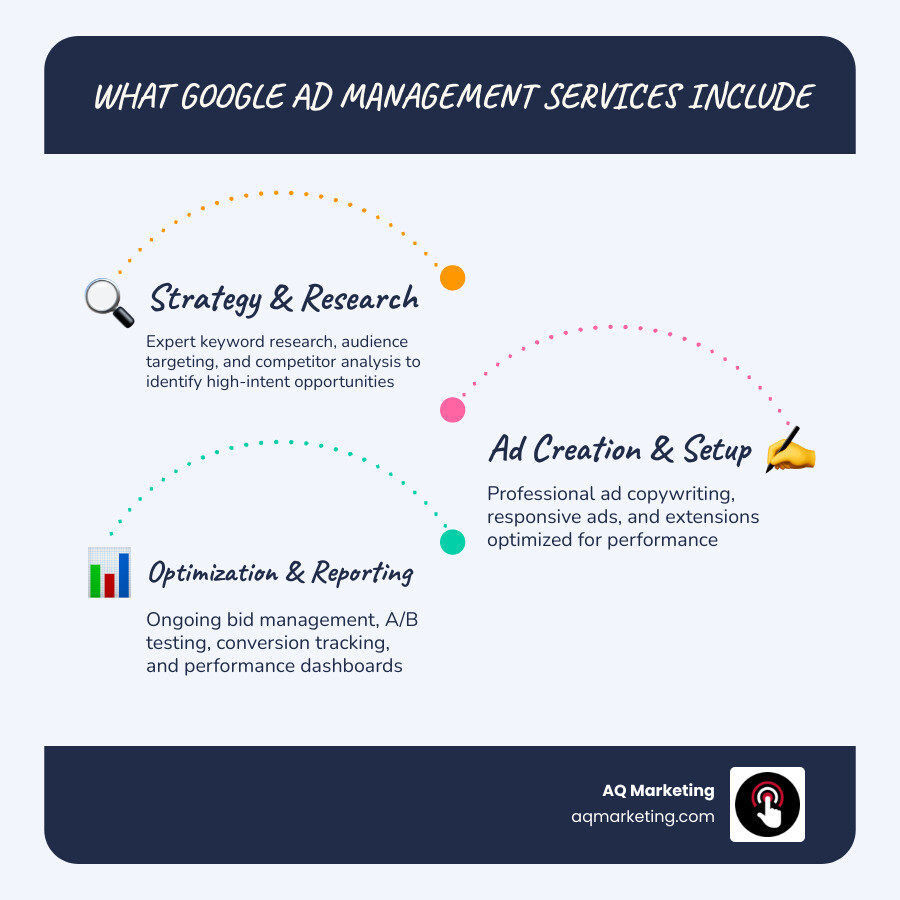
Maximizing ROI with Google Ad Management Services
In the digital landscape of May 2026, the complexity of the Google Ads auction has reached new heights. It is no longer enough to simply “bid on keywords.” Modern google ad management services focus on maximizing Return on Ad Spend (ROAS) by navigating a multi-channel ecosystem that prioritizes user intent over simple search volume.
Industry benchmarks show that accounts managed by professional agencies often see an average of 3.2x ROAS. This isn’t magic; it’s the result of a disciplined approach across various networks, ensuring that every dollar spent is working toward a specific business goal:
- Search Network: Capturing high-intent users at the exact moment they search for services in areas like Woburn, Burlington, or Lexington.
- Display Network: Building brand awareness on visually rich websites across the web, keeping your business top-of-mind.
- Performance Max: Leveraging Google’s latest AI-driven campaign type to find customers across YouTube, Gmail, Search, and Maps using sophisticated audience signals.
By focusing on Pay Per Click Advertising, businesses can achieve immediate scalability. Unlike organic SEO, which is a vital long-term play, Google Ads allows you to turn the “lead faucet” on or off based on your current business capacity. This flexibility is essential for service-based businesses that may need to throttle leads during peak seasons or ramp up during slow periods. For readers who want a neutral overview of the advertising platform itself, Google Ads offers helpful background on how the system has evolved.
The Value of Professional Google Ad Management Services
Why not just do it yourself? While Google makes it easy to spend money, making a profit is harder. Professional management provides certified expertise that saves you from expensive “rookie mistakes.”
Agencies stay ahead of constant algorithm updates and platform changes. We understand how to navigate complex campaign settings-like location targeting for specific Massachusetts towns-ensuring your ads appear for a homeowner in Andover but not a job seeker in another state. This strategic bidding ensures you aren’t overpaying for clicks that will never convert. Furthermore, professional managers understand the “learning phase” of new campaigns, preventing the common mistake of making too many changes too quickly, which can reset the algorithm and waste budget.
Human Strategy vs. AI Precision
As we move further into 2026, machine learning and automated bidding have become standard. However, AI lacks “business sense.” It doesn’t know your profit margins or which specific services (like insurance for high-value homes) are your most lucrative.
The best google ad management services combine AI precision with human oversight. While the algorithm optimizes for clicks, human strategists optimize for profit. We handle the creative nuance and budget allocation that a machine might miss. For those looking to scale, Mastering Google Ads Account Management for Multiple Clients highlights the importance of centralized, expert control in maintaining high performance across diverse service areas.
Core Benefits of Professional Campaign Oversight
The visibility provided by professional management is unparalleled. With ads now occupying up to 85% of above-the-fold space on mobile search results, being invisible on Google is simply not an option for growth-minded businesses. In 2026, the mobile experience is the primary touchpoint for most consumers, making that top-of-page placement more valuable than ever.
When you are Choosing a Google Ads Company, you are investing in:
- Brand Protection: Ensuring competitors aren’t bidding on your business name to steal your loyal customers. This is a common tactic in competitive markets like Greater Boston, and professional management ensures your brand remains yours.
- Remarketing: Staying top-of-mind for people who visited your site but didn’t call the first time. By serving targeted ads to previous visitors, you significantly increase the likelihood of conversion.
- Lead Quality: Using first-party data to tell Google exactly what a “good lead” looks like, so you stop getting calls for services you don’t offer. In a cookieless world, leveraging your own data is the most effective way to train Google’s AI to find your ideal customers.
- Conversion Rate Optimization: Professional managers don’t just look at the ad; they look at where the ad sends the user. Aligning the ad copy with a high-performing landing page is the key to lowering your cost-per-acquisition.
Strategic Components of Professional Oversight
A successful campaign is built on a foundation of data, not guesswork. Professional oversight involves a deep dive into the technical “gears” of the platform to ensure every component is tuned for maximum efficiency.
Key Components of Google Ad Management Services
- Campaign Architecture: We often use the Single Keyword Ad Group (SKAG) methodology or similar tightly-themed structures to ensure your ad copy perfectly matches what the user typed. This relevance is what drives high click-through rates.
- Geo-Targeting: Precision targeting ensures your budget is spent only in the North Shore or Greater Boston areas where you actually work. We can target by zip code, radius, or specific town boundaries to eliminate waste.
- Negative Keywords: This is the “secret sauce.” We tell Google which words not to show your ads for (e.g., “free,” “jobs,” or “how to”), saving you thousands in wasted spend. This is especially critical in high-cost-per-click industries like home services or legal.
- Quality Score Optimization: By aligning your ads with high-converting landing pages and maintaining high relevance, we can actually lower your cost-per-click. Google rewards high-quality advertisers with better placements at lower prices.
The Google Ads Account Setup phase is critical. If the tracking isn’t right from day one, you’re flying blind. Professional services ensure every phone call and form submission is traced back to the specific ad that generated it using tools like Google Tag Manager and GA4.
Transparency and Reporting Standards
You should never have to wonder if your ads are working. A reputable Pay Per Click Advertising Firm provides full-funnel attribution. This means we don’t just report on “clicks”—we report on the value those clicks brought to your business. Expect monthly summaries that explain performance in plain English, paired with real-time dashboards you can check whenever you like. We focus on KPIs that matter to your bottom line, such as cost-per-lead and total conversion value, rather than just vanity metrics.
Understanding the Investment: Industry Pricing and Contracts
Investing in google ad management services involves two costs: your ad spend (paid directly to Google) and the management fee (paid to the agency).
Pricing listed below is based on average online data and does not represent AQ Marketing’s actual pricing.
| Model | Typical Monthly Range | Best For |
|---|---|---|
| Flat Monthly Fee | $500 – $2,500+ | Small businesses with predictable budgets |
| Percentage of Spend | 10% – 20% of ad spend | High-growth companies scaling rapidly |
| Hybrid Model | Base fee + % of spend | Comprehensive management for mid-sized firms |
In the current market, total management costs can range from $500 to $7,500+ per month depending on the complexity and number of locations managed. Most professional agencies have moved away from “hostage-style” long-term contracts, offering month-to-month flexibility to prove their value every 30 days.
Frequently Asked Questions about Google Advertising
How long does it take to see results from professional management?
You will likely see ads live and clicks coming in within the first week. However, “results” in terms of optimized ROI take longer. The first 2–4 weeks are for data accumulation. Most accounts reach their peak performance within 90 days as the “learning phase” concludes and we prune away underperforming elements.
Do agencies require long-term contracts for Google Ads?
While some legacy firms still use annual contracts, most modern google ad management services operate on month-to-month terms. Some may suggest an initial 90-day commitment simply because that is how long it takes to gather enough statistical data to make the campaign truly profitable.
What certifications should a management agency hold?
Look for the Google Premier Partner badge. This signifies the agency is in the top 3% of partners globally. Individual strategists should hold certifications in Google Search, Display, Video, and Measurement.
Conclusion
At AQ Marketing, we believe your advertising budget should be an investment, not an expense. Based in Woburn, MA, we have spent over two decades helping businesses across Massachusetts—from Abington to Worcester—achieve long-term, impactful results. Our deep understanding of the local market, combined with our technical expertise in google ad management services, allows us to build campaigns that don’t just generate traffic, but drive sustainable business growth.
Digital transformation isn’t just a buzzword; it’s the difference between a business that plateaus and one that dominates its local market. In the environment of 2026, staying ahead of the curve requires a partner who is as committed to your success as you are. If you’re ready to stop guessing and start growing, start your journey with professional Pay Per Click Advertising today. Let us handle the algorithms and the constant platform updates while you focus on what you do best: serving your new customers and managing your growing business.
Why Local Google Ads Are the Fastest Way to Grow Your Local Business
Local Google Ads are a powerful set of advertising tools that help businesses with a physical location or service area get discovered by nearby customers at the exact moment they’re searching.
Here’s a quick overview of what you need to know:
| Ad Type | Where It Appears | How You Pay | Best For |
|---|---|---|---|
| Local Services Ads | Top of Google Search | Per lead (call or message) | Home & professional services |
| Standard Local Google Ads | Search, Maps, Waze | Per click (CPC) | Physical storefronts, service areas |
| Performance Max (Local) | Search, Maps, YouTube, Display | Per click or impression | Broad local visibility |
The two main types — Local Services Ads and standard Local Ads — work very differently. Local Services Ads place your business above regular search results and charge you only when a customer actually contacts you. Standard Local Ads run across Google Search, Google Maps, and even Waze, charging per click.
For small and medium-sized businesses in competitive markets, choosing the right format — or combining both — can be the difference between a slow month and a full calendar.
I’m Robert P. Dickey, President and CEO of AQ Marketing, and over my 20+ years in digital marketing I’ve helped countless local businesses across New England build smarter strategies around Local Google Ads to consistently generate qualified leads. In the sections ahead, I’ll walk you through exactly how to use these tools to drive more foot traffic and booked jobs for your business.
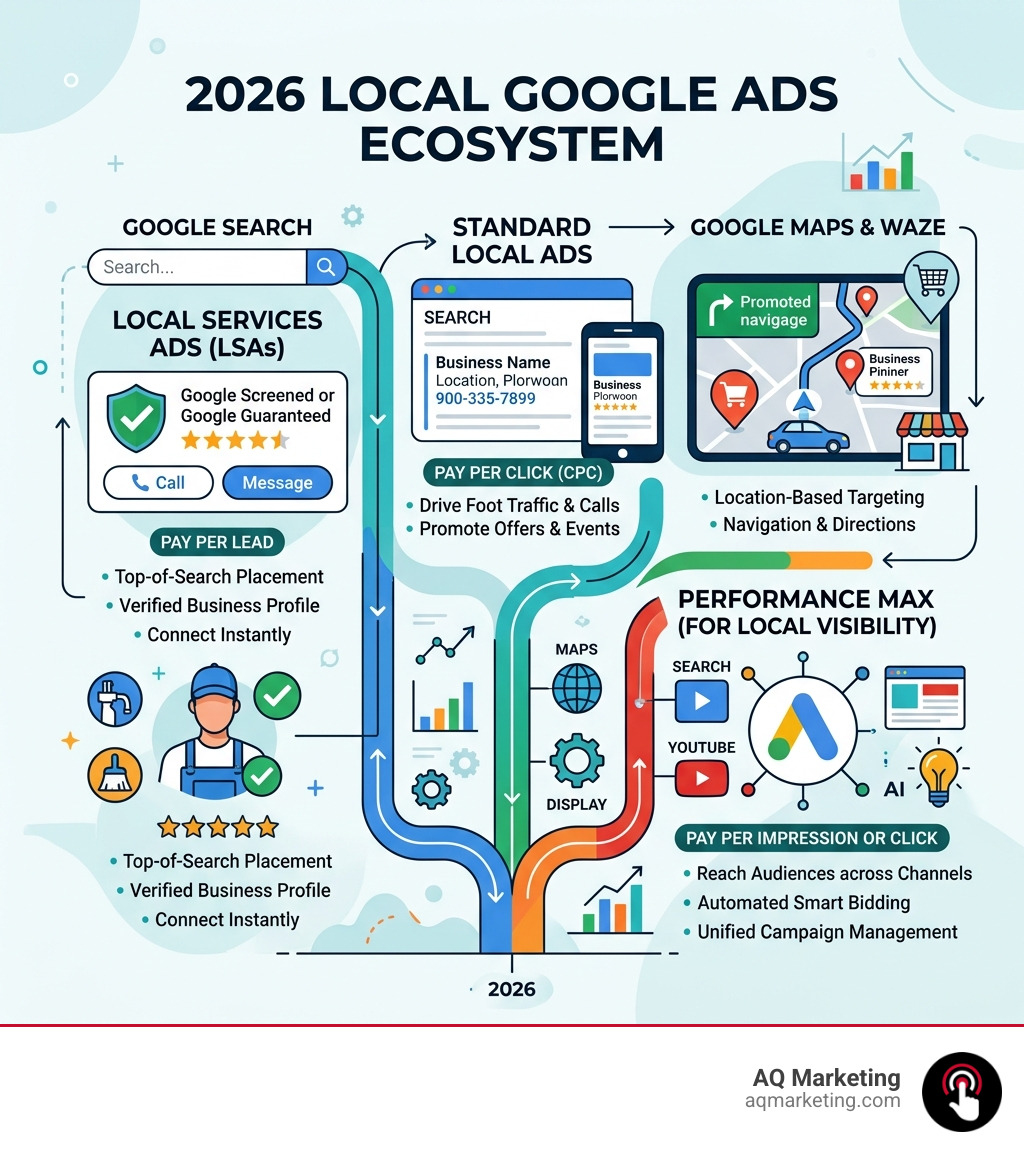
Understanding the Ecosystem of Local Google Ads
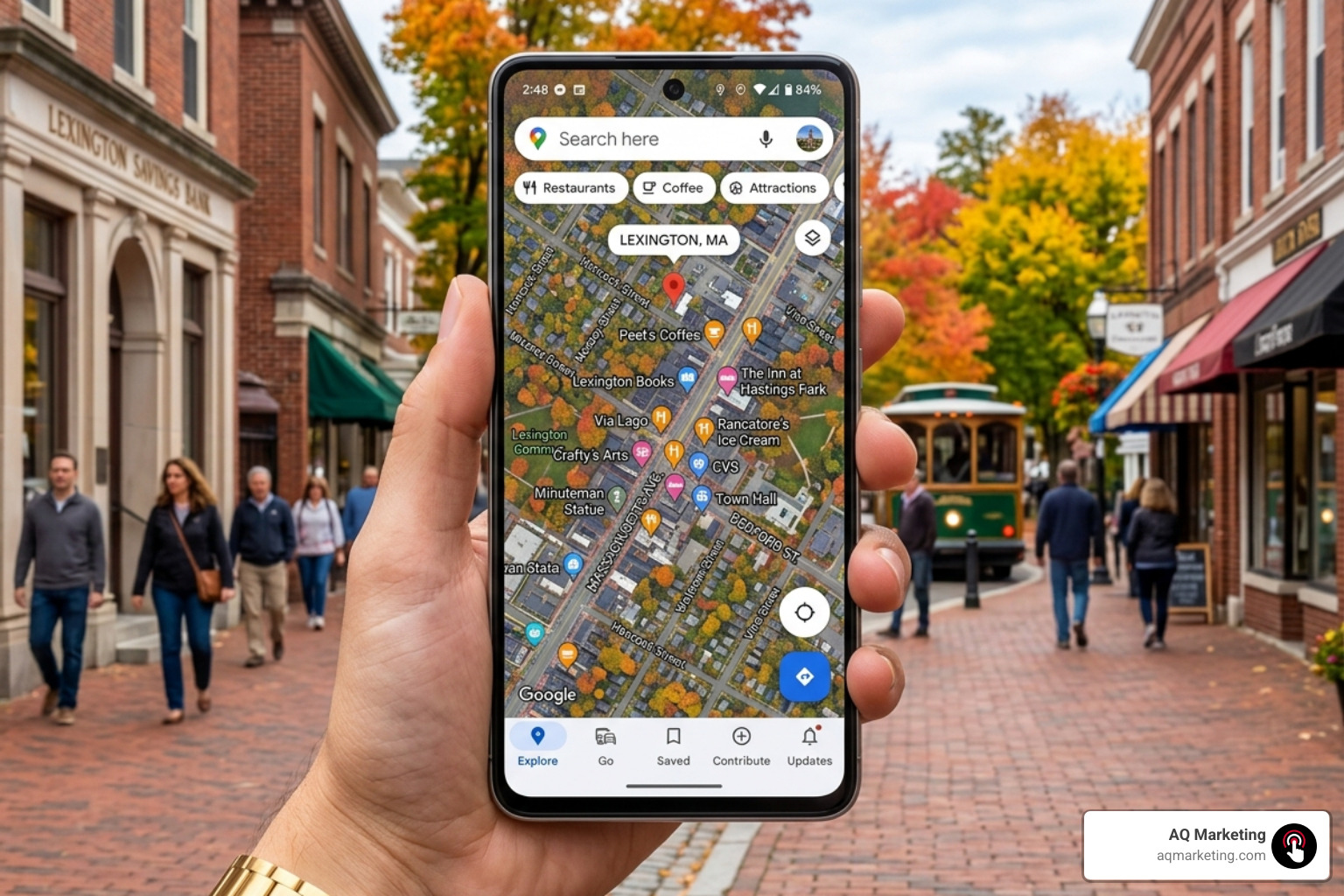
Navigating digital advertising in 2026 feels a bit like driving through the rotary in Concord—it’s fast, a little crowded, but perfectly manageable once you know which lane to be in. To master Local Google Ads, we first need to understand where these ads actually live.
Google has integrated local results into almost every corner of its platform. When a customer in Woburn or Beverly searches for a service, they aren’t just looking at a list of blue links. They are seeing a map, a set of “Guaranteed” badges, and even pins on their GPS.
Google Search and Maps
Standard Local Ads serve primarily on Google Search and Google Maps. These ads help businesses with a physical location reach users to drive store visits, sales, and leads. According to About Local Ads – Google Ads Help, these ads pull media assets directly from your Google Business Profile. This means your address, hours, and photos are automatically baked into the ad.
Performance Max and Waze
In 2026, Performance Max has become the heavy lifter for local visibility. It pushes your local business information across Search, Maps, YouTube, and the Display Network. Furthermore, if you are targeting drivers in the US, Local Ads also appear on Waze as square pins. This is a game-changer for businesses in high-traffic areas like Braintree or Framingham, where a well-timed pin on a commuter’s map can drive immediate foot traffic.
Achieving a high return on investment requires more than just “turning on” ads. As we discuss in our guide on Getting Local Paid Search Right: How to Achieve ROAS, success comes from aligning your campaign settings with actual local intent.
The Role of Proximity in Local Google Ads Ranking
Proximity is perhaps the most critical factor in the Local Google Ads ecosystem. Google’s primary goal is to provide the most relevant answer to a user’s query. If someone in Arlington searches for “emergency plumber,” Google isn’t going to show them a business located in Springfield, no matter how high their bid is.
- User Location: Google uses GPS, IP addresses, and past behavior to pinpoint exactly where the searcher is standing.
- Service Area: For service-based businesses, you define your “service area” (e.g., a 20-mile radius around Woburn). Your ads will only trigger for users within that boundary.
- Geo-fencing: This allows us to get even more granular, showing ads only to people within a specific neighborhood or even near a competitor’s location.
- Search Relevance: Proximity is balanced with relevance. If you are the closest business but your profile is incomplete, Google may skip you in favor of a slightly further business with better reviews.
Maximizing Reach with Standard Local Google Ads
Standard Local Ads are incredibly versatile. Unlike the newer Local Services Ads, these allow for traditional search campaigns where you bid on specific keywords like “best Italian restaurant” or “insurance agency near me.”
One of the best ways to stand out is through branded pins on Google Maps. These pins feature your logo and appear even when a user isn’t actively searching for your business, but is simply navigating near your shop. Additionally, we always recommend using call extensions. On mobile devices, these show up as a “Call” button, allowing a customer in Burlington to contact you with a single tap.
For businesses in our neck of the woods, it pays to have local expertise. Understanding the nuances of North Shore vs. South Shore traffic patterns can help you schedule your ads more effectively. That’s Why Your Burlington Google Ads Strategy Needs a Boston Expert—someone who knows that a “five-mile drive” in Boston can take twenty minutes or an hour depending on the time of day!
Local Services Ads vs. Standard Google Ads: A Strategic Comparison
Choosing between Local Services Ads (LSAs) and standard Local Google Ads is like choosing between a specialized tool and a multi-tool. Both have their place, but they serve different purposes.
| Feature | Local Services Ads (LSAs) | Standard Google Ads |
|---|---|---|
| Pricing Model | Pay-Per-Lead (PPL) | Pay-Per-Click (PPC) |
| Placement | Very top of the page (above PPC) | Top and bottom of search results |
| Verification | Required (Google Guaranteed/Screened) | Optional (Standard verification) |
| Keywords | Automated by Google | Hand-picked by the advertiser |
| Best For | High-intent service calls | Brand awareness & foot traffic |
While standard ads focus on clicks to your website, LSAs are designed for direct lead generation. If you’re looking for a comprehensive overview of how these fit into a broader marketing plan, check out our PPC Advertising Services Complete Guide.
The Pay-Per-Lead Model in Local Services Ads
The biggest draw for LSAs is the Pay-Per-Lead model. You don’t pay when someone looks at your ad. You don’t pay when they click your profile. You only pay when a customer calls, messages, or books a service through the ad.
According to Reach Local Customers with Local Service Ads – Google Ads, this model is designed to minimize “wasted” spend. However, it requires active management.
- Qualified Leads: A lead is considered valid if the customer contacts you about a service you provide in an area you cover.
- Direct Contact: Leads come in via phone calls or the Local Services app.
- Dispute Management: This is a crucial part of the process. If you receive a “junk” lead—like a solicitor or someone looking for a service you clearly don’t offer—you can dispute the charge with Google to get your money back.
Eligibility and the Power of the Google Verified Badge
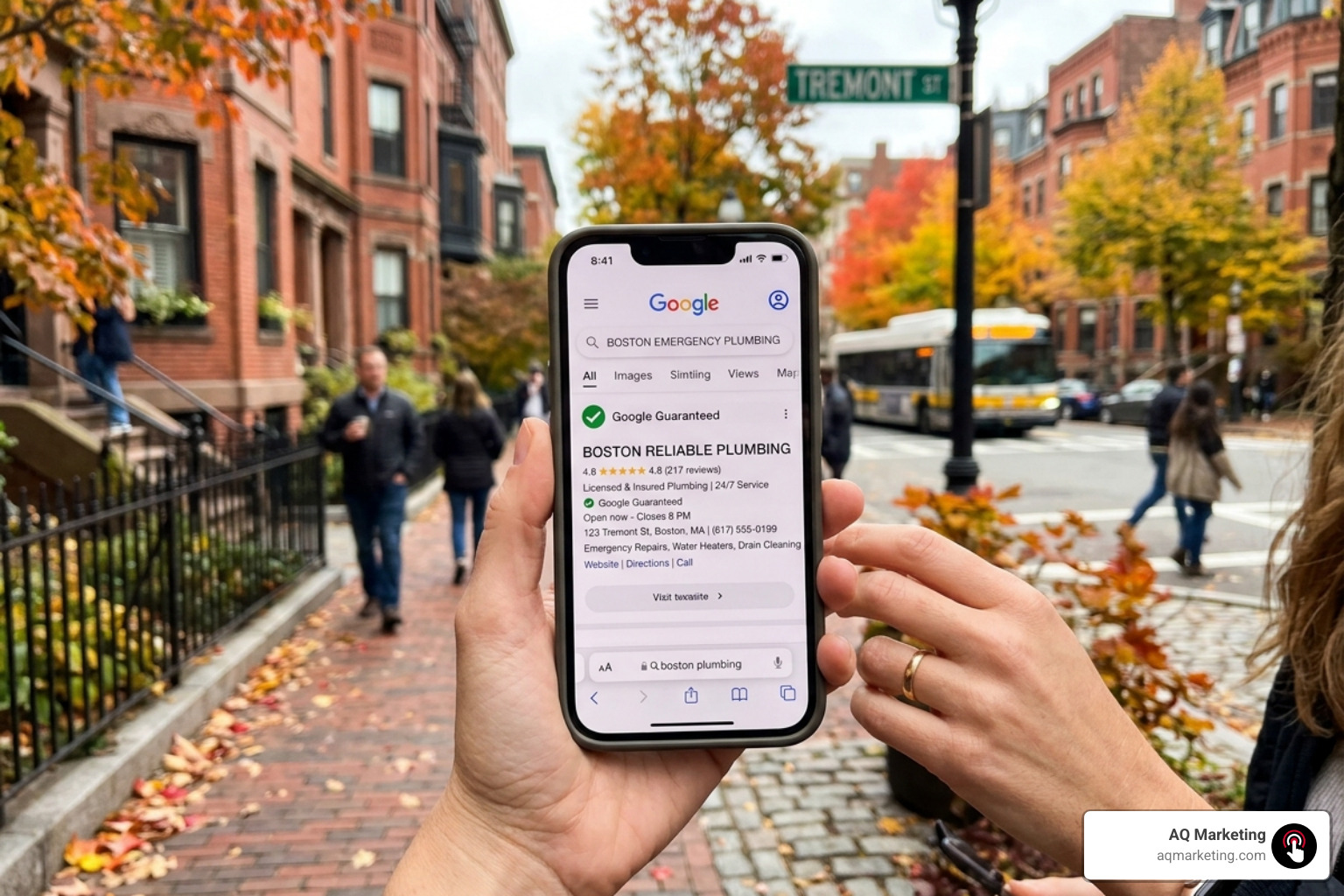
In a world of online scams and “fly-by-night” operations, trust is the ultimate currency. The Google Verified badge—often seen as the Google Guaranteed (green checkmark) or Google Screened badge—is how you prove to your neighbors in Newton or Quincy that you are the real deal.
The Verification Process
Getting this badge isn’t as simple as clicking a button. Google puts businesses through a rigorous screening process that includes:
- Background Checks: Business owners (and sometimes field employees) must pass a background check.
- License Verification: You must provide proof of your professional licenses. For example, a Plumber Google Ads campaign requires current state-level licensing to be eligible for the guarantee.
- Insurance Requirements: You must provide proof of general liability insurance.
The benefit? Google literally “guarantees” your work. If a customer is unsatisfied with the quality of your service, Google may, at its discretion, reimburse the customer up to a lifetime limit (typically $2,000 in the US). This builds massive confidence before the customer even picks up the phone.
Industry Categories for Google Guaranteed and Screened
Not every business is eligible for every badge. The categories have expanded significantly leading into 2026.
- Google Guaranteed: Primarily for home services like plumbing, HVAC, roofing, house cleaning, and appliance repair.
- Google Screened: Aimed at professional services such as legal services, real estate, financial planning, and tax services. These focus more on professional credentialing than on a money-back guarantee.
- License Verified: Used for industries like healthcare or wellness (e.g., acupuncturists or dentists) where the badge signals that the practitioner is properly licensed to practice in Massachusetts.
Using these badges effectively is a core part of Local Audience Targeting. It tells the local community that you have been vetted by the world’s largest search engine.
Strategic Setup and Optimization for Maximum Visibility
Setting up your Local Google Ads is just the beginning. To truly master the platform and outrank your competitors in places like Worcester or Lowell, you need to optimize for Google’s ranking factors.
Profile Completeness and the Google Business Profile
Your ads are only as good as the profile behind them. For standard Local Ads, this means having a robust Google Business Profile. Ensure your name, address, and phone number (NAP) are consistent across the web. Add high-quality photos of your team, your office, and your completed projects.
The “Big Three” Ranking Factors for LSAs
For Local Services Ads, Google uses a specific set of metrics to decide who gets the top spot:
- Review Count and Rating: This is the most important factor. A business with 500 five-star reviews will almost always outrank one with 50 reviews.
- Response Time: How fast do you answer the phone? If you consistently miss calls or take hours to respond to messages, Google will stop showing your ads. They want to send leads to businesses that actually answer.
- Proximity: As mentioned earlier, being closer to the searcher gives you a natural boost.
Budget Allocation
Don’t be afraid to set a competitive budget. In Local Google Ads, your budget isn’t just a limit—it’s a signal of your capacity. If your budget is too low, Google may assume you can’t handle more leads and will throttle your visibility. For a deep dive into the technical side of things, see The No-Nonsense Guide to Google Ads Account Setup.
Budgeting and Managing Your Local Lead Flow
Managing the financial side of Local Google Ads requires a shift in mindset. Instead of thinking about “how much I’m spending,” think about “how much each customer costs.”
Spending Control
Both standard ads and LSAs allow you to set a maximum weekly or monthly budget. You can pause your ads at any time—perfect for when your crew is fully booked for a week or if you’re heading down to the Cape for a vacation.
Lead Management Tools
Google provides a dedicated dashboard for LSAs where you can listen to call recordings, respond to messages, and track the status of every lead (e.g., “Booked,” “Completed,” or “Archive”). This data is gold. By reviewing call recordings, you can see if your front-desk staff is effectively turning callers into customers.
Frequently Asked Questions about Local Google Ads
How much do Local Services Ads cost in 2026?
The cost per lead in 2026 varies significantly based on your industry and location. Based on average online data, typical lead costs range from $20 to over $200 per lead depending on the vertical.
- Lower Competition (e.g., house cleaning): $20 – $50 per lead.
- High Competition (e.g., water damage restoration or legal): $150 – $450+ per lead. Please note: These figures are based on industry averages and do not represent AQ Marketing’s actual pricing.
How do I get the Google Guaranteed badge for my business?
The process involves signing up through the Local Services Ads portal, submitting your business licenses, providing proof of insurance, and undergoing a background check through Google’s third-party partners. It typically takes 2–4 weeks to complete the verification, though this can vary based on how quickly you provide documentation.
Can I run both Local Services Ads and standard Google Ads simultaneously?
Yes—and we often recommend it! This strategy is known as “search dominance.” By running both, you can potentially appear three times on a single search result page: once in the LSAs at the very top, once in the standard PPC ads, and once in the organic map pack. This maximizes your brand visibility and makes it much more likely that a customer will click on your business instead of a competitor’s.
Conclusion
Mastering Local Google Ads is a marathon, not a sprint. It requires a blend of technical setup, local trust-building, and consistent management. By leveraging the power of the Google Guaranteed badge, optimizing your proximity targeting, and choosing the right mix of pay-per-click and pay-per-lead models, you can ensure your business remains the go-to choice for customers in your community.
At AQ Marketing, we’ve spent over two decades helping businesses in Woburn and across Massachusetts navigate these digital transformations. We focus on long-term growth and delivering strategies that actually result in booked jobs and increased foot traffic.
Ready to take the next step? Master your local growth with expert PPC advertising and let’s start building a lead generation engine that works as hard as you do.
Why Most Website Visitors Leave — and How to Bring Them Back
Google remarketing campaign setup is the process of tagging your website, building audience lists of past visitors, and running targeted ads to bring those visitors back to convert.
Here’s a quick overview of the core steps:
- Install your Google tag on every page of your website
- Build remarketing audiences in Google Ads Audience Manager (e.g., all visitors, cart abandoners, product viewers)
- Create a campaign — Display, Search, Video, or Dynamic — and attach your audience lists
- Design your ads with personalized messaging for each audience segment
- Set bidding and frequency rules to maximize conversions without overspending
- Exclude converters so you’re not wasting budget on people who already bought
Think about the last time you browsed a product online and then saw that exact product follow you around the web. That’s remarketing at work.
The numbers behind it are hard to ignore. Only 2% of website visitors make a purchase on their first visit. That means 98% leave without taking any meaningful action. For businesses investing in website traffic — through SEO, paid ads, or social media — that’s a significant amount of potential revenue walking out the door.
Remarketing gives you a second chance. By staying visible to people who already know your brand, you’re targeting the warmest audience possible — people who were already interested enough to visit.
I’m Robert P. Dickey, President and CEO of AQ Marketing, Inc., with over 20 years of experience helping small and medium-sized businesses grow through digital marketing strategies, including Google remarketing campaign setup as part of a broader paid advertising approach. I’ll walk you through everything you need to know to put this strategy to work for your business.
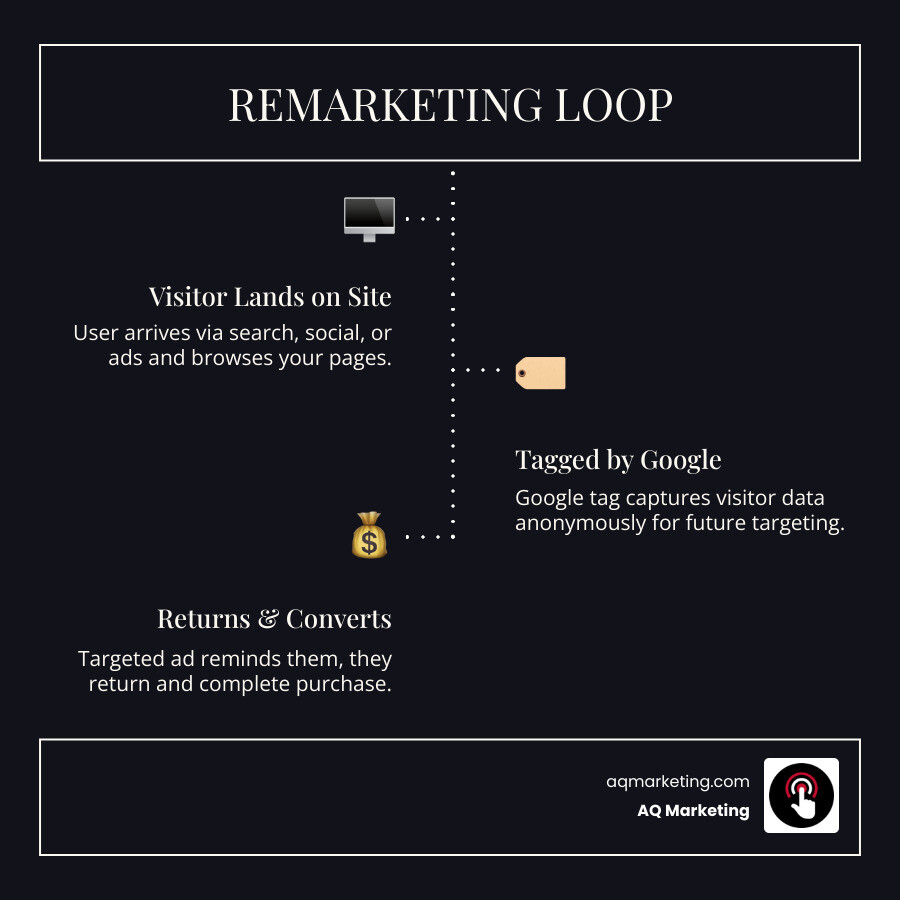
The Strategic Value of Re-Engaging Lost Traffic in 2026
In the current digital landscape of April 2026, the competition for attention in Massachusetts is fiercer than ever. Whether you are a home services contractor in Woburn or an insurance agency in Boston, you likely face the same reality: 98% of your prospective customers leave your site without performing a meaningful action.
This is where the ROI potential of a Google remarketing campaign setup becomes undeniable. Statistics show that retargeting campaigns enjoy 147% higher conversion rates than regular cold-traffic campaigns. Why? Because you aren’t introducing your brand to a stranger; you are reminding a “warm” lead why they visited you in the first place.
For e-commerce businesses, the stakes are even higher. Cart abandonment costs companies a staggering $18 billion annually in lost sales. Without remarketing, only about 8% of those who abandon their carts will return. However, with a strategic remarketing plan, more than one-fourth of those shoppers return to complete their purchase—a massive 225% increase in recovery.
Beyond immediate sales, remarketing is a cornerstone of Digital Advertising Services. It builds brand awareness and keeps your business “top of mind” during the long research phases common in industries like home improvement or professional services. By integrating these efforts into your Paid Search Marketing Campaigns, you ensure that every dollar spent driving initial traffic isn’t wasted when a user clicks away to check a competitor.
Essential Prerequisites for a Google remarketing campaign setup
Before we can start showing ads to previous visitors, we need to lay the technical foundation. This isn’t just about “turning on” a feature; it requires precise implementation to ensure data privacy and tracking accuracy.
The Google Tag and Gtag.js
The first step is installing the Google Tag (formerly known as the global site tag or gtag.js). This snippet of code must be placed on every single page of your website, ideally within the section. This tag is what allows Google to “see” who is visiting and assign them to your various audience lists.
Google Tag Manager (GTM)
For most of our clients from Burlington to Lexington, we recommend using Google Tag Manager. It acts as a container for all your marketing scripts. Instead of manually editing your website’s code every time you want to track a new event, you do it within the GTM interface. This ensures better browser compatibility and allows you to enable the “Conversion Linker,” which is vital for accurate tracking in a world where third-party cookies are increasingly restricted.

GA4 Linkage and Advertising Features
In 2026, Google Analytics 4 (GA4) is the primary engine for audience creation. You must link your Google Ads account to your GA4 property. Once linked, you need to enable “Google Signals” and “Advertising Features” within the GA4 admin settings. This allows Analytics to share granular audience data—like users who spent more than two minutes on a high-value service page—directly with Google Ads.
Privacy and Compliance
Before you launch, review your privacy policy. Google requires that you disclose how you use cookies and third-party tools for advertising. Especially for businesses operating in the New England area, staying transparent about data collection is not just a legal requirement; it’s a best practice for building trust. For more on the groundwork needed, see our guide on 7 Things To Do Before You Launch A Ppc Campaign.
Building High-Intent Audiences in Audience Manager
Once your tags are firing, the real magic happens in the Audience Manager. This is where we sort your traffic into segments based on their behavior. A “one-size-fits-all” ad rarely works; a user who spent five seconds on your homepage needs a different message than someone who looked at your “Kitchen Remodeling Gallery” three times.
Segmenting for a Successful Google remarketing campaign setup
Effective segmentation is the heart of Search Engine Marketing Services. We typically look for the following “High-Intent” groups:
- Cart/Lead Form Abandoners: These are your “low-hanging fruit.” They started the process but didn’t finish.
- High-Value Page Visitors: Users who visited your pricing page, “Contact Us” page, or specific service landing pages.
- Past Converters (for Upselling): If someone hired you for a lawn cleanup in the spring, they might need snow removal in the winter.
- Deep Browsers: Users who visited more than four pages or stayed on the site for more than three minutes.
Membership Duration and Custom Combinations
How long should a user stay on your list? Google allows a membership duration of up to 540 days. However, for most businesses, 30 to 90 days is the sweet spot. If your sales cycle is short (like a sandwich shop in Danvers), a 7-day list might be best. If you are selling luxury homes in Concord, you might want a 180-day list.
We also use custom combinations to refine targeting. For example, we can create a list of users who “Visited the Service Page” AND “Did Not Visit the Thank You Page.” This ensures we are only spending money on people who haven’t converted yet.
Customer Match and First-Party Data
In 2026, first-party data is king. You can upload your own encrypted email lists (Customer Match) to Google Ads. This allows you to show ads specifically to your existing database across Search, YouTube, and Gmail, providing a powerful way to encourage repeat business.
Configuring Advanced Campaign Types and Ad Creatives
With your audiences ready, it’s time to choose the right “vehicle” for your ads. A Google remarketing campaign setup can take several forms depending on your goals.
Standard vs. Dynamic Remarketing
Standard Remarketing shows static or responsive display ads to people as they browse sites across the Google Display Network (GDN). This is excellent for general brand recall.
Dynamic Remarketing takes it a step further. If a user looked at a specific leather bag on an e-commerce site, dynamic remarketing uses a business data feed to show them an ad featuring that exact bag along with its current price. This level of personalization is why dynamic ads often see much higher engagement. For technical details, Google offers a guide on how to Set up dynamic remarketing with Display, Performance ….
RLSA (Remarketing Lists for Search Ads)
RLSA doesn’t show “banner ads.” Instead, it allows you to customize your search ad campaigns for people who have previously visited your site. You can bid more aggressively on keywords when you know the searcher is already familiar with your brand, or even use broader keywords that would normally be too expensive for cold traffic.
Video and App Remarketing
Video remarketing allows you to show ads on YouTube to people who have interacted with your videos or visited your website. Given how much time people in the Boston area spend on YouTube, this is a highly “eye-catching” strategy. If your business has a mobile app, you can also set up app remarketing to drive users back into the app to complete an action.
Bidding Strategies for Google remarketing campaign setup
We generally recommend automated bidding strategies for remarketing. Strategies like Target CPA (Cost Per Acquisition) or Target ROAS (Return on Ad Spend) allow Google’s AI to adjust your bids in real-time based on the likelihood of a conversion.
To avoid “annoying” your potential customers, we always implement frequency capping. We typically start with 3-5 impressions per user per day. This keeps you visible without causing “ad fatigue,” where users start to ignore or even resent your brand. This is especially important for Ppc For Start Ups who are trying to build a positive reputation from scratch.
Frequently Asked Questions about Remarketing
What is the difference between remarketing and retargeting?
Technically, “remarketing” is an umbrella term that includes re-engaging customers via email or offline methods. “Retargeting” usually refers specifically to online display ads. However, in Google Ads, these terms are used interchangeably to describe showing ads to previous website visitors.
How many visitors are required for a remarketing list to be active?
To protect user privacy, Google has minimum list size requirements. For the Display Network, your list must have at least 100 active visitors or users within the last 30 days. For the Search Network (RLSA), the requirement is higher—at least 1,000 active visitors.
How do I troubleshoot a remarketing tag that isn’t firing?
First, check your “Audience Sources” in the Google Ads Audience Manager. If there is an issue, Google will usually flag it there. You can also use the “Google Tag Analyzer” browser extension to see if the tag is loading correctly on your live site. Common issues include tags placed outside the tags or “container” errors in Tag Manager.
Conclusion
A successful Google remarketing campaign setup is one of the most cost-effective ways to grow a small to medium-sized business in 2026. It turns your website from a “leaky bucket” into a conversion engine by recapturing the 98% of traffic that would otherwise be lost forever.
At AQ Marketing, we’ve been helping businesses in Woburn and across Massachusetts achieve long-term results since 2003. We don’t just set up ads; we build comprehensive digital transformation strategies that include SEO, web design, and high-performance lead generation.
Ready to bring your “lost” visitors back to the table? Whether you need a fresh Full-Service Digital Marketing Agency approach or just want to optimize your current PPC spend, we are here to help your business thrive in the New England market.
Is Hiring a Google Ads Company Worth It? Here’s What You Need to Know
A Google Ads company is a professional agency that manages pay-per-click (PPC) advertising campaigns on Google’s platform on behalf of businesses — helping them show up in search results, on YouTube, and across the web to drive leads and sales.
Quick answer for business owners evaluating Google Ads management:
| What You Want | What a Google Ads Company Does | |—|—| | More leads or sales | Builds and optimizes campaigns targeting buyers actively searching | | Better ROI | Manages bids, keywords, and budgets to reduce wasted spend | | Save time | Handles research, setup, tracking, and ongoing optimization | | Measurable results | Provides transparent reporting on conversions, CPA, and ROAS | | Expert strategy | Applies certified knowledge across Search, Display, Shopping, Video, and more |
Google’s own economists estimate that businesses earn an average of $2 for every $1 spent on Google Ads. But that return doesn’t happen automatically. It takes the right strategy, the right targeting, and consistent optimization to get there.
Without professional management, many small businesses overspend on underperforming campaigns — or miss the mark entirely on reaching the right customers.
That’s where choosing the right Google Ads company makes all the difference.
I’m Robert P. Dickey, President and CEO of AQ Marketing, and over my 20+ years in digital marketing I’ve helped small and medium-sized businesses across New England navigate the complexity of finding and working with the right Google Ads company to drive real, measurable growth. In this guide, I’ll walk you through everything you need to make a confident, informed decision.

Understanding the Power of a Google Ads Company for Business Growth
When we talk about growing a business in Massachusetts—whether you are a plumber in Woburn or an insurance agency in Andover—visibility is everything. A Google Ads company acts as the bridge between your services and the customers actively searching for them. Google holds a massive 69% market share in the pay-per-click world, and in 2024 alone, Google earned $237.9 billion in advertising revenue. This isn’t just a trend; it is where the modern marketplace lives.

Google Ads allows us to place your business at the very top of the page exactly when a potential customer is looking for what you offer. This is often referred to as “high-intent” traffic. Unlike a billboard on I-93 that people drive past regardless of their needs, paid search marketing campaigns target people who are ready to take action.
There are several ways a Google Ads company can position your brand:
- Search Ads: These are the classic text ads that appear at the top of search results.
- Display Network: Visually engaging ads that appear while people are browsing relevant websites or apps.
- Shopping Ads: Perfect for e-commerce, showing your product image and price directly in the search results.
- Video Campaigns: Leveraging YouTube, where over 700 million hours of content are watched daily.
- App Promotion: Driving installs for your mobile application across Google’s properties.
To get started, Google often provides incentives for new advertisers. You can learn more about Google Ads terms and conditions regarding these offers, which often include ad credits to jumpstart your first campaign.
Choosing the Right Google Ads Company Strategy
Every business has unique needs. A local HVAC company in Billerica has different goals than a boutique shop in Salem. When we sit down with a client, we first identify the primary objective: is it lead generation, online sales, or general brand awareness?
For local businesses, we often implement 5 local business SEM best practices to ensure you aren’t wasting money on clicks from people outside your service area. A professional Google Ads company will set up “geofencing” so your ads only show to people in specific towns like Lexington, Burlington, or Wilmington, ensuring every dollar of your budget is spent on a local lead.
Leveraging AI and Performance Max
The landscape of digital advertising has shifted heavily toward automation. Google’s AI now plays a massive role in how campaigns are optimized. One of the most powerful tools currently available is Performance Max.
Performance Max is an AI-powered campaign type that allows us to reach customers across all of Google’s channels—Search, YouTube, Display, Discover, Gmail, and Maps—from a single campaign. By using automated bidding and asset optimization, the AI finds the most effective ad combinations to meet your specific goals. However, while the AI is powerful, it still requires a human expert to provide the right “ingredients”—high-quality images, compelling headlines, and accurate conversion tracking—to ensure the machine produces the best possible ROI.
Key Benefits: Why Professional Management Beats Traditional Advertising
Traditional advertising, like print or radio, often feels like casting a wide net and hoping for the best. Google Ads is more like using a laser. The ability to track every single penny spent and see exactly what it produced is a game-changer for small to medium-sized businesses.
When you look at the data, the reach is undeniable. With YouTube alone accounting for 700 million hours of watch time per day, the potential for brand storytelling is vast. But beyond reach, the real benefit of a professional Google Ads company is real-time optimization. If an ad isn’t working on a Tuesday morning in Newton, we can change it by Tuesday afternoon. You can’t do that with a newspaper ad.
There are many reasons why you should hire a PPC management firm. Experts stay on top of the 69% market share shifts and ensure your business is hitting ROI benchmarks that keep you profitable.
Speed and Precision in Targeting
One of the biggest advantages of working with a Google Ads company is the speed of results. While SEO is a vital long-term strategy, it takes time to climb the organic rankings. Google Ads can put you on page one instantly.
We use precise targeting to find qualified leads based on:
- Keyword Intent: Targeting “emergency plumber Woburn” vs. “how to fix a leaky faucet.”
- Audience Insights: Reaching people based on their interests or past browsing habits.
- Geographic Targeting: Focusing on the specific Massachusetts neighborhoods you serve.
Understanding the difference between social media ads and search ads is also crucial. Search ads capture people looking for you, while social ads introduce you to people who might like you. Both have their place, but search ads are often the fastest route to a sale.
Measurable ROI and Scalability
In PPC, we live and die by the numbers. We track metrics like:
- ROAS (Return on Ad Spend): How many dollars did you make for every dollar spent?
- CPA (Cost Per Acquisition): How much did it cost to get that one new customer?
- Conversion Rate: What percentage of people who clicked actually called or bought?
By following 4 PPC campaign best practices, we can scale your success. If we find that a $1,000 budget is consistently returning $4,000 in revenue, we have the data to confidently increase that budget and grow your business further.
Navigating Costs and Budgeting for Your Campaigns
A common question we hear at AQ Marketing is, “How much does Google Ads cost?” The answer is that you are in full control. You set a monthly budget cap, and you only pay when someone actually clicks on your ad (Cost-Per-Click or CPC).
For new advertisers, Google often offers promotional credits. To redeem these, you typically need to sign up and meet specific spend requirements within the first 60 days. This is a great way to “test the waters” with some of Google’s money.
Industry Pricing Standards
While you pay Google for the clicks, a Google Ads company will charge a management fee to handle the strategy and optimization. Based on average online data, management fees can range anywhere from $500 to $7,500+ per month, depending on the complexity of the account and the amount of ad spend being managed.
It is important to note that the high end of the market can be 3x or more than the average, often involving performance-based models for very large corporations. For the small to medium-sized businesses we serve in Massachusetts, we focus on transparent, flat-fee or percentage-based models that align with your growth goals.
Controlling Your Ad Spend
We don’t believe in “set it and forget it.” To protect your budget, we use several tools:
- Negative Keywords: Ensuring your ads don’t show for irrelevant terms (e.g., if you sell “new tires,” we make sure you don’t pay for clicks on “used tires”).
- Bid Adjustments: Bidding more aggressively during your peak business hours.
- Budget Caps: Ensuring you never spend a penny more than you’ve authorized for the month.
Mastering Google Ads account management requires constant vigilance to ensure that “wasted spend” is kept to an absolute minimum.
How to Evaluate a Professional Partner
Choosing a Google Ads company is a big decision. You are handing over your hard-earned marketing budget to someone else. You should look for partners who value transparency and data ownership.
At AQ Marketing, we believe you should always own your Google Ads account. If you ever decide to move on, your data and history should stay with you. We also prioritize becoming a Google Partner to ensure we are always up to date on the latest platform changes.
Identifying a Certified Google Ads Company Partner
Google has a formal program to vet agencies.
- Google Partners: These agencies have passed certification exams (via Skillshop) and meet Google’s performance requirements.
- Premier Partners: This is the top tier, representing the top 3% of participating companies in a given country. They often have higher spend thresholds and direct access to specialized Google support.
When looking for an agency, check for these badges. They signify that the Google Ads company has a proven track record of delivering results and follows Google’s best practices. You can learn more about working with a Google Partner to understand the strategic benefits they bring to your business.
Essential Questions for Your Google Ads Company
Before signing a contract, ask these five questions:
- How often will I receive reports? You should expect detailed monthly reports that explain what happened and what the plan is for next month.
- What is your fee structure? Is it a flat fee, a percentage of spend, or performance-based?
- How do you track conversions? They should be using GA4 (Google Analytics 4) or server-side tracking to ensure every lead is captured.
- Do you work with my competitors? Ensure there isn’t a conflict of interest in your local town.
- Who owns the data? Always ensure you have administrative access to your own account.
Frequently Asked Questions about Google Ads
How long does it take to see results from a campaign?
While your ads can go live almost immediately, there is usually a “learning period” for Google’s AI. We typically tell our clients in Woburn or Burlington to expect a 30-day optimization phase where we gather data and refine the targeting before the campaign truly begins to scale.
Can I manage my own Google Ads account?
Technically, yes. However, it is a significant time investment. Between keyword research, writing ad copy, monitoring bids, and staying on top of platform updates, it can easily become a full-time job. Most business owners find that the “wasted spend” from a DIY account costs more than the fee to hire a professional Google Ads company.
What is the difference between a Partner and a Premier Partner?
A Google Partner meets the basic requirements for spend, performance, and certification. A Premier Partner is recognized as being in the top 3% of agencies in their country. Both are great, but Premier Partners often have access to more advanced training and beta features from Google.
Conclusion
Navigating online advertising doesn’t have to be overwhelming. By choosing a transparent, certified Google Ads company, you can turn search engines into a predictable engine for business growth. At AQ Marketing, we’ve spent two decades helping Massachusetts businesses achieve long-term, impactful results through expert digital strategy.
If you’re ready to stop guessing and start growing, start growing your business with professional pay-per-click advertising today. We are here to help you navigate every click, every conversion, and every milestone along the way.
Why Getting Your Google Ads Account Setup Right Matters From Day One
Google Ads account setup is the foundation of every successful paid search campaign — and getting it wrong from the start can cost you real money.
Here’s a quick overview of how to set up a Google Ads account:
- Sign in to your Google account (or create one)
- Go to ads.google.com and click “Start now”
- Enter your business name and website URL
- Link existing accounts (Google Business Profile, YouTube)
- Switch to Expert Mode to avoid automatic Smart Campaign lock-in
- Choose your time zone, billing country, and currency (these cannot be changed later)
- Set up billing with a credit card, PayPal, or bank account
- Skip or create your first campaign and submit
It sounds straightforward — but there are several settings that are permanent, and a few default options that can quietly limit your control before your first ad ever runs.
Google Ads operates on a pay-per-click (PPC) model, meaning you only pay when someone clicks your ad. Your ads can appear across Google Search, Google Maps, YouTube, Gmail, and millions of partner sites. The system is powerful, but only if your account is configured correctly from the start.
I’m Robert P. Dickey, President and CEO of AQ Marketing — a digital marketing agency with over 20 years of experience helping small and mid-sized businesses navigate Google Ads account setup and paid advertising strategy. I’ll walk you through everything you need to know to get it done right the first time.

Strategic Prerequisites for Google Ads Account Setup
Before we even click “Start Now,” we need to make sure your business is actually ready for the traffic Google is about to send your way. At AQ Marketing, we’ve seen plenty of businesses in Woburn and Burlington rush into Google Ads account setup only to realize their website isn’t prepared to turn those clicks into customers.
Website Readiness and Landing Page Relevance
Your website is your digital storefront. If a customer clicks an ad for “insurance services in Boston” and lands on a generic home page that doesn’t mention insurance, they’ll leave immediately. This is why landing page relevance is critical. A high-converting page should have a clear headline, an obvious call-to-action (CTA), and content that mirrors the ad the user just clicked.
For more on how this fits into a broader strategy, check out our guide on Targeted Pay-Per-Click Advertising.
Conversion Action Definition
What do you want people to do? If you don’t define this, you’re just buying clicks with no way to measure success. Whether it’s a form fill, a phone call, or a direct purchase, you must identify these “conversions” before you launch. If you’re new to these terms, the PPC 101: The Beginner’s Guide to PPC is an excellent resource for getting up to speed.
Google Account Requirements
You’ll need a standard Google account (like a Gmail address) to get started. We recommend using a business-specific email rather than a personal one. This keeps your professional assets separate and makes it easier if you ever need to grant access to an agency or partner.

Defining Your Conversion Goals
We often help home service businesses in towns like Lexington and Concord set up their goals. Common goals include:
- Lead generation: Capturing names and emails via a contact form.
- E-commerce tracking: Measuring direct sales on your site.
- Phone call attribution: Tracking how many people called your business directly from the ad.
Preparing Your Business Information
During the Google Ads account setup, Google will ask for your legal business name and website URL. It’s also highly beneficial to link your Google Business Profile at this stage. This integration allows your ads to show your local address and phone number, which is a game-changer for Getting Local Paid Search Right: How to Achieve ROAS.
Choosing Between Individual and Manager Accounts
One of the first forks in the road is deciding which type of account you actually need. Most small business owners only need a standard individual account. However, if you plan on running multiple businesses or if you are an internal marketer managing several brands, you might consider a Manager account (MCC).
Standard Account vs. Manager Account (MCC)
A standard account is where the actual advertising happens. You create campaigns, set budgets, and write ads here. A Manager Account (or My Client Center) is an umbrella account. It doesn’t run ads itself; instead, it “holds” and manages multiple individual accounts.
| Feature | Individual Account | Manager Account (MCC) |
|---|---|---|
| Primary Use | Running ads for one business | Managing multiple sub-accounts |
| Campaign Creation | Yes | No (only via sub-accounts) |
| Billing | Individual billing profile | Centralized or individual billing |
| Account Limit | 1 per email usually | Up to 20 per email address |
Scaling with a Google Ads Account Setup for Agencies
For those looking to scale, manager accounts allow for centralized reporting and simplified access management. You can even Create Google Ads accounts via API if you’re building custom software integrations.
That manager accounts are included in your limit of 20 Google Ads accounts per email address. Also, be aware of the “use it or lose it” rule: accounts created from manager accounts will be canceled if they’ve been inactive for more than 120 days.
Critical Settings and Expert Mode Configuration
This is where many people get tripped up. Google wants to make things “easy,” but easy often means giving up control over your budget.
The “Expert Mode” Secret
When you first start your Google Ads account setup, Google will likely funnel you into “Smart Mode.” This is a simplified version designed for beginners, but it limits your ability to pick specific keywords or control bidding strategies. We always recommend clicking the link that says “Switch to Expert Mode” at the bottom of the setup screen. This unlocks the full power of the platform.
For a deeper dive into why settings matter, see our 4 PPC Campaign Best Practices.
Permanent Settings You Can’t Change Later
There are three settings you must get right the first time because Google does not allow you to change them later:
- Time Zone: This affects your reporting and when your ads start/stop each day.
- Currency: This is how you will be billed.
- Billing Country: This determines which payment methods are available to you.
If you make a mistake here, you’ll likely have to close the account and start over from scratch, which is a massive headache.
Avoiding Common Pitfalls in Google Ads Account Setup
One common mistake is letting Google “automatically” create your first campaign. Often, these defaults lead to “Smart Campaigns” that cast too wide a net. We suggest skipping the initial campaign creation during the setup flow if you aren’t ready with your keyword research. This prevents you from spending money on poorly targeted traffic while you’re still getting organized.
As we discuss in our article on Why Your Burlington Google Ads Strategy Needs a Boston Expert, local nuances in Massachusetts can make or break your targeting.
Navigating Billing and Payment Methods
Google accepts most major credit cards, PayPal, and in some cases, direct bank transfers. When you add a card, Google may place a temporary authorization charge to verify the account, which usually disappears within a week.
One important thing to understand is the 30.4 day budget cycle. Google will attempt to make your monthly spend average out to your daily budget across 30.4 days. This means on some days, Google might spend up to double your daily budget if it sees high-quality traffic, but it will never exceed your monthly “ceiling.” Always review the Terms and conditions for ad credits if you have a promotional code, as you usually need to spend a certain amount before the credit kicks in.
Post-Setup Verification and Quality Score Foundations
Once the account is created, you aren’t quite “live” yet. Google has become much stricter about security and identity in recent years.
Verification and Security
You will likely be asked to complete Identity Verification. This may involve uploading business documents or responding to a postcard sent to your physical business address in Woburn or elsewhere. Do not ignore these requests! If you fail to verify within the allotted time, Google will pause your account.
We also strongly recommend enabling Two-Factor Authentication (2FA). Given that your credit card is linked to this account, you want to ensure it’s as secure as possible.
Building “Street Cred”
Your account doesn’t start with a perfect reputation. It typically takes 4-6 weeks to establish strong Google “street cred.” During this time, Google is watching how users interact with your ads. If you provide a great experience, your Quality Scores will improve, which actually lowers your cost-per-click (CPC) over time. You can learn more about maximizing your budget in this Hacking Google Ads Guide.
Finalizing Your Google Ads Account Setup with Conversion Tracking
The final step of a professional setup is linking your other Google assets. You should link your Google Analytics account immediately. This allows data to flow back and forth, giving you a much clearer picture of what happens after someone clicks your ad.
If you’re also running social ads, you’ll want to ensure your tracking is consistent across platforms. Our Facebook Ad Campaign Analysis explains why cross-channel data is so valuable.
Frequently Asked Questions about Google Ads Setup
Can I change my account’s time zone or currency after setup?
No. As mentioned earlier, these settings are permanent. They are tied to how Google’s servers calculate your billing and reporting. If you move your business from Boston to London and need to change currencies, you will have to create a brand-new account and migrate your campaigns.
How much does it typically cost to start advertising on Google?
The cost varies wildly based on your industry and location. In the Boston area, highly competitive fields like law or home restoration will have much higher costs than niche retail.
Based on average online data, most small to medium businesses see monthly spends ranging from $1,000 to over $10,000. To provide a realistic spread, some national brands might spend $30,000 or more per month in the same category. Note: This pricing is based on average online data and does not represent AQ Marketing’s actual pricing.
Should I create my first campaign during the initial setup process?
Generally, no—unless you have already done your keyword research and have your ad copy ready. Google’s setup wizard tends to push you toward “Smart” defaults that might not be optimal for your specific goals. It’s better to finish the Google Ads account setup first, switch to Expert Mode, and then build your campaign with a clear strategy in mind.
Conclusion
A successful Google Ads account setup is about more than just filling out a few forms; it’s about building a stable foundation for your business’s digital growth. By choosing Expert Mode, getting your permanent settings right, and ensuring your website is ready for traffic, you’re already ahead of most of your competitors.
At AQ Marketing, we’ve been helping businesses in Woburn and throughout Massachusetts achieve long-term, impactful results since 2003. Whether you’re in home services, insurance, or any other industry, we understand the local market and the technical nuances of PPC.
If you’re ready to stop guessing and start growing, we’re here to help. Explore our Full-Service Digital Marketing Agency options to see how we can take your online presence to the next level.
Is Hiring a Google Advertising Agency Worth It for Your Business?
A google advertising agency helps businesses plan, launch, and manage paid ad campaigns on Google’s platforms — including Search, Display, Shopping, and Performance Max.
Here’s a quick breakdown of what these agencies typically do:
- Campaign strategy — setting goals, budgets, and targeting
- Keyword research — finding high-intent search terms your customers use
- Ad creation — writing copy and building creatives that convert
- Conversion tracking — measuring which clicks turn into leads or sales
- Ongoing optimization — adjusting bids, keywords, and audiences to improve ROI
- Reporting — showing you what’s working and what isn’t
The catch? Top-tier agencies can be expensive. Monthly management fees typically range anywhere from $500 to $15,000+ depending on ad spend, scope, and specialization — and that’s before your actual ad budget.
For small and medium-sized businesses, those costs can add up fast. That’s exactly why it’s worth knowing your options before signing a contract.
I’m Robert P. Dickey, President and CEO of AQ Marketing, and with over 20 years of experience in digital marketing — including managing Google Advertising (PPC) campaigns for small and mid-sized businesses across New England — I’ve seen what works, what doesn’t, and where businesses overpay for a google advertising agency. I’ll walk you through 10 cost-effective alternatives so you can make the smartest choice for your budget and goals.
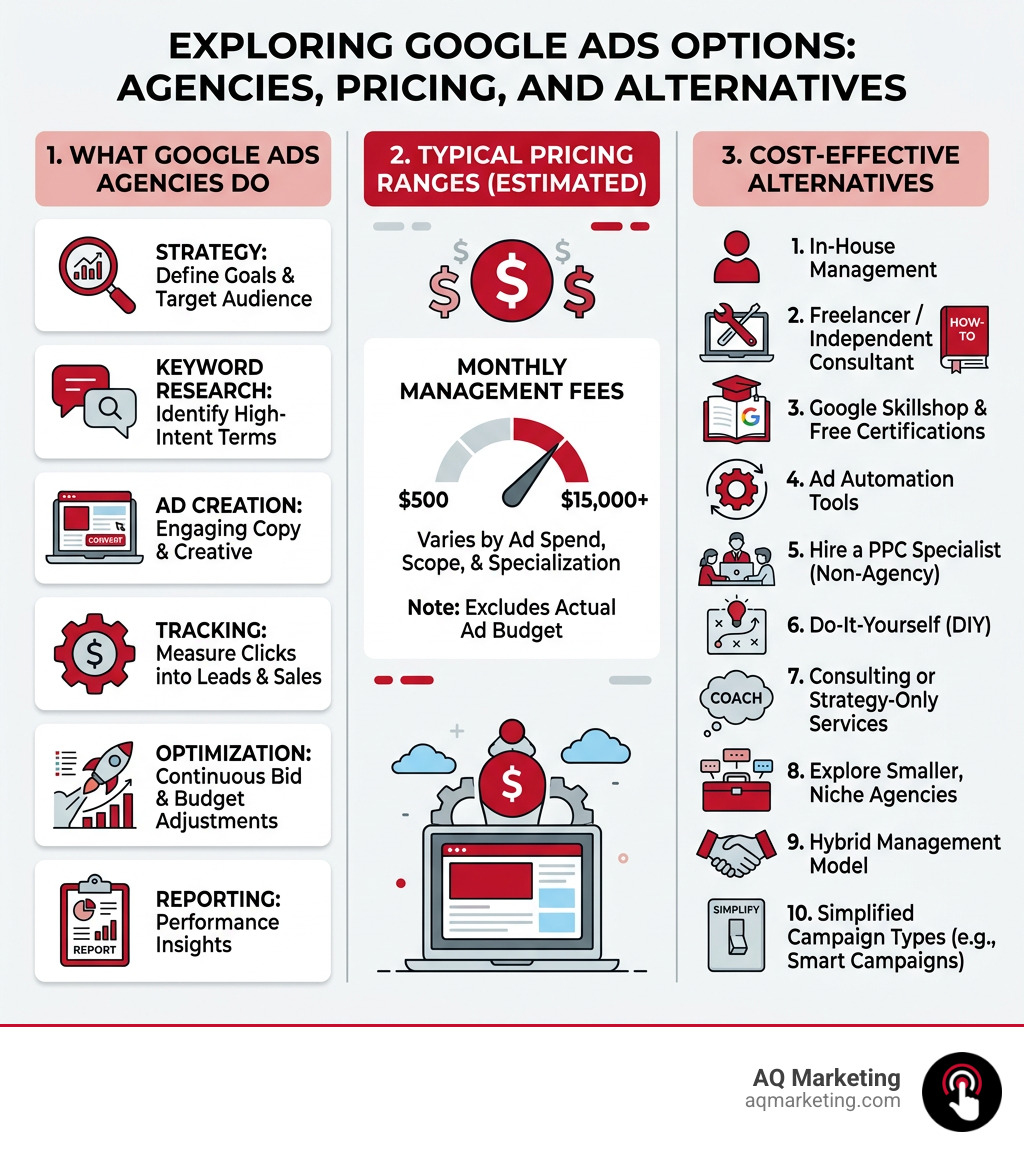
Google advertising agency word guide:
The Role of a Google Advertising Agency
When you partner with a google advertising agency, you are essentially hiring a team of specialists to navigate the increasingly complex world of paid search. It isn’t just about “buying ads”; it is about engineering a system that turns a searcher in Abington or Woburn into a paying customer.
The core of their role involves deep campaign strategy. This starts with identifying exactly who your audience is and where they live online. For a local plumber in Newton or an insurance agent in Worcester, this means Targeted PPC Advertising that focuses on high-intent local searches.
Key Services Provided
- Keyword Research: This is the foundation. Agencies look for terms with high commercial intent while avoiding “junk” traffic that eats your budget.
- Ad Creative: Writing compelling copy that stands out in a crowded Search Engine Results Page (SERP).
- Landing Page Optimization: A click is useless if the website is confusing. The best agencies ensure your landing page matches the ad’s promise.
- Remarketing: Using Facebook Retargeting Ads or Google Display to stay in front of people who visited your site but didn’t convert yet.
- Conversion Tracking: Setting up tools like GA4 to ensure every dollar spent is accounted for.

10 Cost-Effective Alternatives to High-End Agencies
If the five-figure monthly retainers of national firms don’t fit your Massachusetts small business budget, don’t worry. There are several ways to get professional results without the “big agency” price tag.
1. Freelance PPC Specialists
Individual freelancers often have the same certifications as agency staffers but lower overhead. You can often find experts who charge by the hour or a flat project fee for setup.
2. Niche-Specific Boutique Agencies
Instead of a generalist google advertising agency, look for a boutique Search Engine Marketing Agency that specializes in your specific industry, such as home services or legal. They often have pre-built keyword lists and proven strategies that save time and money.
3. Automated Bidding Software
Tools that use AI to manage bids can sometimes replace the need for a daily human manager. However, be careful—machine learning is only as good as the data you feed it.
4. Focused Retargeting Campaigns
Sometimes you don’t need a full-funnel strategy. Running Facebook Retargeting Ads to capture “lost” visitors can be a very low-cost way to increase sales compared to expensive top-of-funnel search terms.
5. YouTube Ad Specialists
Video can be significantly cheaper than search ads in terms of cost-per-view. Following a Youtube Ads Marketing Complete Guide can help you launch low-cost awareness campaigns.
6. Local SEO and Google Business Profile
Before spending thousands on ads, ensure your Google Business Profile Marketing is optimized. For many businesses in towns like Salem or Plymouth, appearing in the “Map Pack” provides free leads that rival paid ads.
7. Performance-Based Partnerships
Some smaller Digital Advertising Services offer models where they take a percentage of the revenue generated or a fee-per-lead, aligning their success directly with yours.
8. Hybrid In-House Management
You can hire an agency for the initial Targeted Pay-Per-Click Advertising setup and then have a trained staff member handle the weekly maintenance.
9. Specialized Landing Page Tools
Instead of paying an agency for web design, use high-conversion templates to improve your “Quality Score,” which naturally lowers your ad costs.
10. AI-Driven “Lite” Management
Many platforms now offer AI-managed versions of Google Ads. While less customizable, they are often much cheaper than a full-service google advertising agency.
Comparing Costs: Agency vs. Alternatives
| Service Level | Typical Monthly Fee (Avg) | High-End Range | Best For |
|---|---|---|---|
| National Agency | $2,500 | $15,000+ | Enterprise Brands |
| Boutique Local Agency | $1,000 | $4,000 | Small/Medium Businesses |
| Freelancer | $500 | $2,000 | Startups/Small Projects |
| DIY with Software | $150 | $600 | Micro-businesses |
Note: Pricing listed is based on average online data and does not represent AQ Marketing’s actual pricing.
Modern Challenges for a Google Advertising Agency
The world of Google Ads has changed drastically in the last few years. It isn’t just about picking the right keywords anymore; it’s about managing data and AI.
The Push for Automation
Google has been heavily pushing Performance Max (PMax) and broad-match keywords. While this makes it easier to start, it often leads to wasted spend if you don’t have “guardrails” in place. A smart google advertising agency knows when to trust Google’s AI and when to stick to 4 PPC Campaign Best Practices like manual keyword control.
Server-Side Tracking and Privacy
With the decline of third-party cookies, traditional “pixel” tracking is becoming less accurate. Top agencies are moving toward server-side tracking using Google Tag Manager (GTM) to ensure they aren’t missing conversion data. This is vital for maintaining a high ROI in 2024 and beyond.
Google Partners Program
When looking for help, you’ll often see the Google Partner badge. This program performs reviews on company information, checking for things like malware and trademark compliance. You can verify a company’s status on the official Company details for Google Partners page.
Frequently Asked Questions
Is a Google advertising agency worth the investment?
Yes, but it depends on your goals. If your business relies on a steady stream of new leads, the expertise of an agency can significantly improve your “Expert Score” and ROI. For example, research shows that professional management can often recover more in “wasted spend” (clicks that don’t convert) than the cost of the management fee itself. If you are spending more than $2,000 a month on ads, professional Digital Advertising Services usually pay for themselves.
What are common red flags when hiring a Google advertising agency?
Watch out for agencies that:
- Guarantee #1 Rankings: No one can guarantee the top spot in an auction every time.
- Hide Your Data: You should always own your Google Ads account. If they won’t give you admin access, walk away.
- Lack of Conversion Tracking: If they can’t show you exactly how many leads or sales came from your Targeted PPC Advertising, they aren’t doing their job.
- Long Contracts with No Exit: Avoid being locked into 12-month terms without a performance-based out-clause.
How long does it take to see results from a professional campaign?
While your ads can go live in 24 hours, we typically recommend a 90-day window for true optimization.
- Month 1: Data collection and testing.
- Month 2: Identifying winning keywords and pausing losers.
- Month 3: Scaling what works to maximize ROI. A professional Targeted Pay-Per-Click Advertising campaign needs time to improve its “Quality Score,” which lowers your costs over time.
Conclusion
Choosing the right path for your Google Ads doesn’t have to be a choice between “expensive” and “ineffective.” Whether you choose a full-service google advertising agency, a local boutique partner, or a hybrid approach, the key is focusing on long-term, impactful results.
At AQ Marketing, we’ve spent two decades helping businesses in Woburn, Boston, and throughout Massachusetts navigate the digital landscape. We focus on Digital Marketing Services that actually move the needle—from SEO and web design to high-performance Google Ads management.
Ready to stop wasting ad spend and start growing? Let’s talk about how we can transform your online presence.
Core Services of a Google Ads agency Boston
A Google Ads agency Boston businesses can trust will help you show up at the exact moment local customers are searching for what you offer — and turn those clicks into real leads or sales.
If you’re looking for a quick answer, here are the key things to know about working with a Boston Google Ads agency:
- What they do: Manage PPC campaigns on Google — including Search, Display, Shopping, and YouTube ads — to drive targeted traffic and conversions.
- Who they serve: Small and mid-sized businesses in industries like home services, healthcare, legal, e-commerce, and SaaS.
- What results look like: Agencies regularly report outcomes like 36% average conversion increases and 50% average drops in cost per conversion.
- What it costs: Monthly management fees typically range from $600 to $6,000 depending on scope and ad spend. (Pricing is based on average online data and does not represent AQ Marketing’s actual pricing.)
- What to look for: Google Partner certification, transparent reporting, local market knowledge, and a track record of measurable results.
Boston is one of the most competitive digital markets in New England. With a highly educated, tech-savvy population and industries ranging from biotech to home services all fighting for the same search real estate, running Google Ads without a clear strategy is a fast way to burn through budget with little to show for it.
That’s why the right local expertise matters.
I’m Robert P. Dickey, President and CEO of AQ Marketing, Inc., based in Woburn, MA — and with over 20 years helping small and medium-sized businesses navigate digital marketing, I’ve seen what separates a high-performing Google Ads agency Boston campaign from one that simply drains your budget. In the sections below, I’ll walk you through exactly what to look for, what to expect, and how to get the most out of Google Ads in the Greater Boston market.
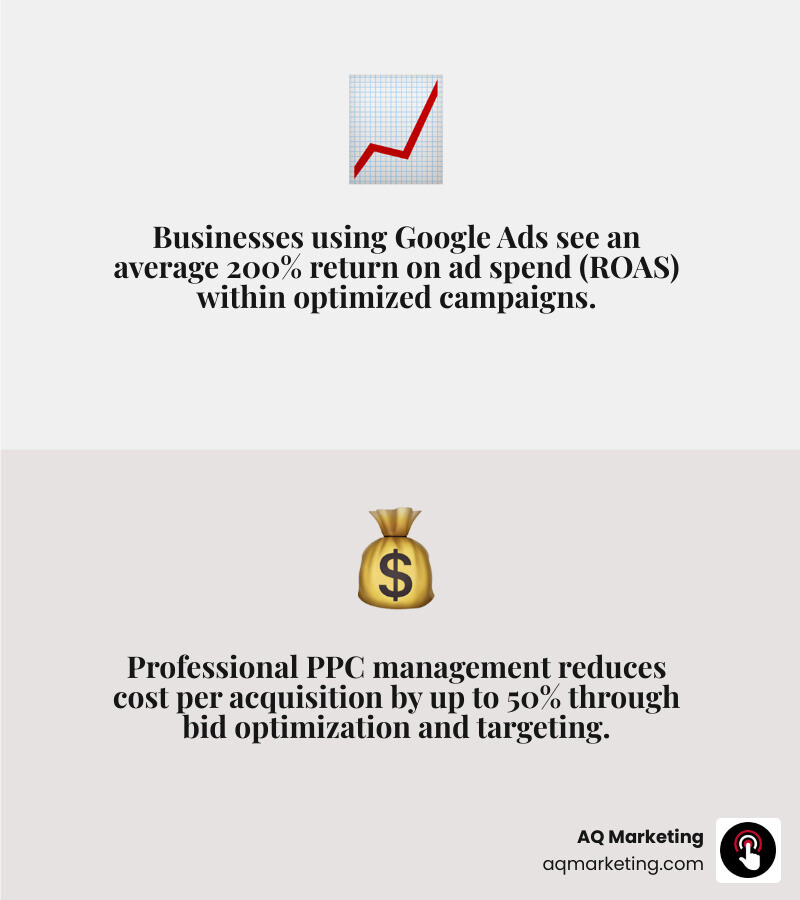
When you partner with a Google Ads agency Boston, you aren’t just paying someone to “turn on” ads. You are hiring a team to build a sophisticated engine that drives revenue. In a city like Boston, where every click can cost a premium, the quality of management makes the difference between profit and loss.

A comprehensive agency provides several layers of service:
- PPC Management: This is the day-to-day “heavy lifting.” It involves adjusting bids, testing different ad variations, and ensuring your budget is being spent during the hours when your customers are most likely to convert.
- Keyword Research: Understanding The Power of Keyword Research is the foundation of any campaign. We don’t just look for high-volume terms; we look for “transactional intent.” For a contractor in Newton or an insurance agent in Reading, we find the specific phrases local customers use when they are ready to buy.
- Audience Targeting: Google allows us to target users based on their interests, demographics, and even their physical location. A local expert knows how to geofence your ads so you aren’t paying for clicks in Worcester if your service area is strictly the North Shore.
- Ad Creation: Crafting compelling ad text requires skill. We focus on Targeted Pay-Per-Click Advertising that speaks directly to the pain points of Massachusetts residents.
- Bid Optimization & Tracking: We use data to determine exactly how much to pay for a click to stay competitive without overspending. By setting up rigorous conversion tracking, we can see exactly which ads led to a phone call or a form submission.
- Account Auditing: Many businesses come to us with existing accounts that are “leaking” money. A professional audit identifies wasted spend—often saving clients 10% to 15% immediately by cutting out bot traffic and irrelevant search terms.
- Landing Page Optimization: An ad is only as good as the page it sends people to. We ensure your landing pages are fast, mobile-responsive, and have clear calls to action (CTAs).
The Strategic Advantage of Local Boston Expertise
Why choose a local Google Ads agency Boston over a massive national firm? It comes down to “boots on the ground” knowledge. Boston isn’t just one big market; it’s a collection of unique neighborhoods and suburbs, each with its own consumer behavior.
A local expert understands that a homeowner in the Back Bay has different needs and search habits than a business owner in Burlington or a family in Andover. By working with a Digital Marketing Agency Andover MA, you gain an ally who understands the local landscape, the seasonal shifts in New England business, and the specific competitive pressures of the Massachusetts market.
Local agencies are relationship-focused. We aren’t hidden behind a 1-800 number. We are part of the same community, which means we are more accountable for your results. Proximity allows for better communication and a deeper understanding of your specific business goals.
Maximizing ROI with a Google Ads agency Boston
The ultimate goal of any advertising campaign is Return on Investment (ROI). In Google Ads, this is often measured as ROAS (Return on Ad Spend).
Hiring a PPC Management Firm: 5 Reasons Why You Should often leads to better ROI because professionals know how to prioritize “Lead Quality” over “Lead Quantity.” It’s better to have 10 clicks that result in 2 high-value sales than 100 clicks that result in nothing but a high bill.
We use data-driven decisions and competitive analysis to see what your rivals are doing and how to outmaneuver them. This includes fraud protection. Did you know that up to 15% of ad spend can be wasted on “spam clicks” from bots or even competitors? A top-tier agency uses tools to block these clicks, ensuring your budget goes toward real human beings in the Boston area.
Specialized Campaign Types for Massachusetts Businesses
Google Ads is much more than just the text ads you see at the top of a search result. Depending on your industry—whether you’re a plumber in Medford or a tech startup in Cambridge—different campaign types will yield better results.
- Search Campaigns: These are the classic text ads. They appear when someone searches for a specific term. We also utilize Search partners: Definition to extend your reach to other sites.
- Display Ads: These are visual banner ads that appear on websites across the internet. They are fantastic for building brand awareness.
- Remarketing: Ever visited a website and then saw their ads everywhere you went? That’s remarketing. How Does Google Remarketing Work? is a powerful way to re-engage people who visited your site but didn’t contact you the first time.
- Shopping Ads: Essential for e-commerce businesses, these show your product image and price directly in the search results.
- Performance Max: A newer, AI-driven campaign type that combines Search, Display, and YouTube to find customers wherever they are in their journey.
- YouTube Advertising: With video consumption at an all-time high, YouTube is a cost-effective way to get your brand in front of a local audience.
- Local Service Ads (LSAs): These are the “Google Guaranteed” ads at the very top of the page for home service providers like electricians and locksmiths. They operate on a pay-per-lead basis rather than pay-per-click.
Understanding Social Media Ads vs Search Ads: What’s the Difference? is also key. Search ads capture people who are actively looking for a solution right now, making them incredibly powerful for generating immediate leads.
Understanding Costs and Performance Metrics
One of the most common questions we hear is: “How much does this cost?” It is important to distinguish between your ad spend (what you pay Google) and your management fee (what you pay the agency).
| Pricing Model | Description | Typical Range |
|---|---|---|
| Flat Monthly Fee | A set price regardless of ad spend. | $600 – $3,000+ |
| Percentage of Spend | Agency fee is a % of your total Google budget. | 10% – 20% |
| Hybrid Model | A base flat fee plus a smaller % of spend. | Varies |
Note: Pricing listed is based on average online data and does not represent AQ Marketing’s actual pricing. Typical monthly management fees range from $600 to $6,000 depending on complexity.
As a Full Service Digital Marketing Agency, we focus on metrics that actually matter to your bottom line:
- CPA (Cost Per Acquisition): How much does it cost to get one new customer?
- ROAS: For every dollar spent, how many dollars did you make back?
- Quality Score: A Google metric (1-10) that measures how relevant your ads and landing pages are. A higher score means lower costs and better ad positions.
Choosing the Right Google Ads agency Boston for Your Business
Selecting the right partner is a big decision. You want an agency that treats your budget like their own. Here is what to look for:
- Google Partner Certification: This means the agency has met Google’s standards for performance, spend, and certification. It ensures they are up-to-date on the latest tools and features.
- Industry Experience: Do they understand the home services or insurance industries? Experience in your specific niche means they already know which keywords work and which don’t.
- Transparent Reporting: You should never have to wonder where your money is going. Look for agencies that provide clear, easy-to-read monthly reports.
- Communication: How often will you talk? A good agency provides regular strategy calls to review performance and plan for the next month.
- No Long-Term Contracts: Reputable agencies should earn your business every month. Be wary of anyone trying to lock you into a year-long contract without proven results first.
Conclusion
At AQ Marketing, we believe that Google Ads is one of the most powerful tools available for small business growth in Massachusetts. From our home base in Woburn, we’ve helped businesses across the state—from Boston to Burlington and beyond—achieve long-term, impactful results.
Success in digital marketing isn’t about “set it and forget it.” It requires constant optimization, local market knowledge, and a commitment to data. Whether you are looking to launch your first campaign or rescue an underperforming account, a dedicated Google Ads agency Boston expert can help you turn your marketing spend into a predictable engine for growth.
If you are ready to stop guessing and start growing, Pay-Per-Click Advertising managed by local experts is the fastest way to get there.
How long does it take to see results from Google Ads?
One of the biggest benefits of Google Ads is that it provides immediate traffic. Your ads can be live and appearing in front of customers within hours of a campaign launch. However, achieving sustainable profitability usually takes a bit longer.
The first 30 to 90 days are often considered the “learning phase.” During this time, we collect data on which keywords are converting and which are just wasting money. By the 90-day mark, most businesses see a clear path to ROI, allowing us to begin campaign scaling—increasing the budget for the ads that are performing best to drive even more revenue.
Is Google Ads better than SEO for my business?
It’s not necessarily a matter of one being “better” than the other; they serve different purposes. Google Ads provides instant visibility. If you need leads today, PPC is the answer. SEO (Search Engine Optimization) is a long-term strategy for organic growth. It takes longer to see results, but the traffic it generates is essentially “free” once you’ve earned your ranking.
When we look at Social Media Ads vs Search Ads: What’s the Difference? 2, we see that search-based marketing (both SEO and Google Ads) is unique because it targets search intent. The user is actively looking for you. An integrated marketing strategy that uses both Google Ads for immediate results and SEO for long-term stability is usually the most effective approach for Boston businesses.
What is a Google Partner and why does it matter?
A Google Partner is an agency that has been officially recognized by Google for its expertise and success in managing ad accounts. To earn this badge, an agency must:
- Maintain a high level of performance for their clients.
- Meet a minimum ad spend requirement across their managed accounts.
- Have staff members who have passed Google Ads certification exams in multiple areas (Search, Display, Video, etc.).
Working with a Partner ensures you are working with masters of the platform who have direct access to Google support and early access to new advertising features. It’s a mark of trust that your budget is in capable hands.