
Pay Per Click Advertising Firm: 10 Top-Rated Picks 2024
Why Finding the Right Pay Per Click Advertising Firm Can Make or Break Your Marketing Budget
A pay per click advertising firm specializes in creating, managing, and optimizing paid advertising campaigns where businesses pay only when someone clicks their ads. Here’s what top PPC firms deliver:
Core Services:
– Google Ads and Bing campaign management
– Keyword research and negative keyword filtering
– Ad copy creation and A/B testing
– Landing page optimization
– Bid management and budget allocation
– Performance tracking and ROI reporting
Typical Investment:
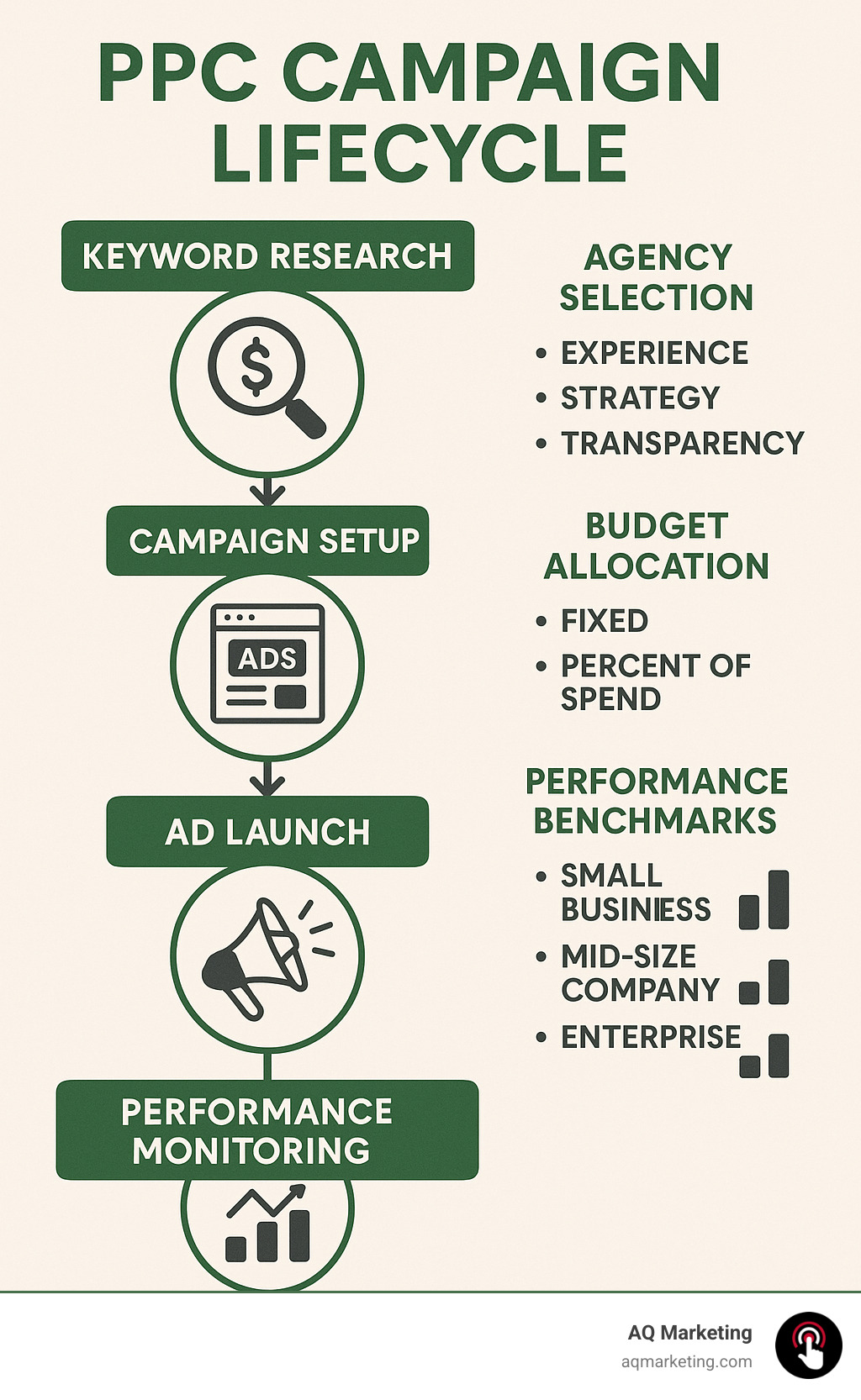
– Management fees: $350-$5,000/month or 12-30% of ad spend
– Hourly rates: $95-$150 for US-based providers
– Minimum budgets: $1,000-$50,000 depending on agency tier
The stakes are high. Research shows that less than 25% of PPC ads actually produce conversions, which means most businesses waste significant budget on poorly managed campaigns. The average cost per click sits at $2.59, but skilled firms can often reduce this while boosting results.
Whether you’re a home services contractor trying to fill your calendar, an insurance agent competing for local leads, or a fitness studio looking to drive memberships, the right PPC partner can deliver immediate visibility and measurable ROI that organic marketing simply can’t match.
I’m Robert P. Dickey, President and CEO of AQ Marketing, and I’ve spent over 20 years helping small and medium-sized businesses steer digital marketing challenges. Having worked with countless companies to optimize their pay per click advertising firm partnerships, I’ve seen how the right choice can transform a struggling campaign into a profit engine.
How Does PPC Actually Work?
Think of PPC as the world’s fastest auction – one that happens millions of times every day. When someone types “emergency plumber Boston” into Google, an invisible bidding war erupts in milliseconds among every business wanting to show up for that search.
But here’s where it gets interesting: the highest bidder doesn’t always win. Google uses something called Ad Rank, which combines how much you’re willing to pay with how good your ad actually is. This Quality Score measures whether your ad, keywords, and landing page truly match what the searcher wants.
A plumbing company with a perfectly crafted ad and helpful landing page might beat out a competitor who bids twice as much but has a generic, unhelpful ad. This is exactly why experienced pay per click advertising firm professionals obsess over Quality Score optimization – it’s like getting a bulk discount on prime advertising real estate.
The beauty of this auction model is that you typically pay just enough to edge out the next guy, often less than your maximum bid. And remember, you only pay when someone actually clicks – not when they just see your ad. According to scientific research on ad performance, understanding this dynamic is crucial since less than 25% of PPC ads actually convert into real business.
The whole process delivers instant traffic and measurable ROI in ways that feel almost magical compared to traditional advertising.
Key Benefits for Growth-Minded SMBs
For small and medium businesses, PPC feels like having a marketing superpower. The fast visibility alone changes everything – while waiting for SEO results feels like watching grass grow, PPC ads can start bringing customers to your door within hours of launching.
The budget control aspect brings real peace of mind. You set your daily spending limit, and your campaigns will never spend more. Unlike that radio ad you paid for upfront, PPC only charges when people actually engage with your business.
But the audience targeting capabilities are where things get really exciting. You can show ads only to homeowners within 10 miles of your shop, only during your business hours, only to people who’ve visited similar websites.
When PPC & SEO Team Up
The magic happens when your pay per click advertising firm works hand-in-hand with your SEO efforts instead of treating them as separate strategies.
When done right, you can dominate search results by appearing in both paid ads and organic listings for the same keywords. Users often see your brand in the ads, then feel more confident clicking your organic result below – creating an organic lift effect that boosts overall performance.
Even better, PPC campaigns become a crystal ball for your SEO strategy. The paid ads reveal exactly which keywords turn browsers into buyers, so you know where to focus your long-term organic efforts.
The end result? A lower blended CPA (cost per acquisition) as both channels reinforce each other. PPC delivers immediate results while SEO builds lasting value, creating a marketing engine that gets stronger and more cost-effective over time.
Types of PPC Campaigns Every Marketer Should Know
Think of PPC like a toolbox – you wouldn’t use just a hammer for every job, right? A skilled pay per click advertising firm knows exactly which campaign type works best for each situation.
The average remarketing cost per click is surprisingly low at just $0.66 to $1.23, making it one of the most cost-effective ways to convert hesitant prospects.
Search & Shopping
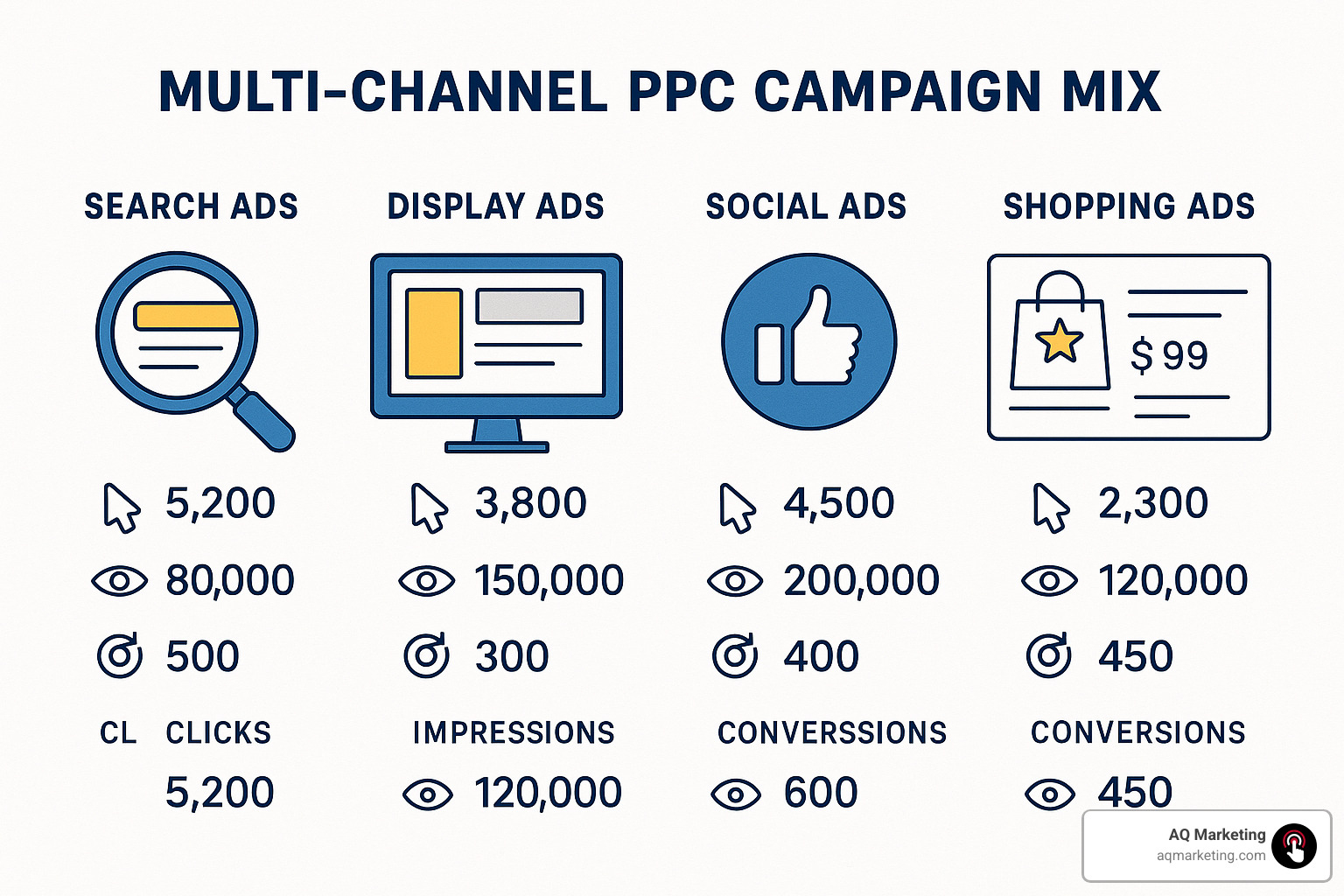
Search ads are your bread and butter – they catch people exactly when they’re looking for what you offer. When someone types “emergency plumber Boston” at 2 AM, they’re not browsing for fun. They need help now.
The magic happens through intent targeting. These searchers already know they have a problem and want it solved. Your job is simply to show up at the right moment with the right message.
Keyword match types give you control over how broadly you cast your net. Use exact match like [roof repair] when you want laser precision. Try phrase match “roof repair” to catch close variations. Broad match reaches the widest audience but needs careful management to avoid irrelevant clicks.
Shopping ads are game-changers for product-based businesses. Instead of just text, shoppers see your actual products with photos, prices, and reviews right in the search results.
Display & Video
Display ads work differently than search ads. Instead of waiting for people to search, you find them while they’re browsing their favorite websites. These visual ads appear across Google’s massive network of partner sites.
Think of display advertising as the digital version of a billboard – it’s all about awareness and staying top-of-mind.
Video ads let you tell your story in a way that text simply can’t match. YouTube ads can showcase your expertise, demonstrate your products, or share customer success stories.
Social & Remarketing
Social media ads on platforms like Facebook and Instagram offer targeting options that would make any marketer’s head spin. You can reach people based on their interests, behaviors, life events, and even their friends’ activities.
Custom audiences let you upload your customer list and target people just like your best clients. It’s incredibly powerful for local businesses who know exactly who they want to reach.
Remarketing is where the real magic happens – it’s like getting a second chance with everyone who almost became a customer. These ads follow people who visited your website but left without buying or calling.
Bounce recovery through remarketing works because you’re targeting warm prospects who already showed interest. They might have gotten distracted, needed to think it over, or wanted to compare options. Remarketing gently brings them back when they’re ready to decide.
The smartest approach combines multiple campaign types strategically. You might use search ads to catch immediate demand, display ads to build awareness, and remarketing to convert the fence-sitters.
What a Pay Per Click Advertising Firm Does (Step-by-Step)
Partnering with a pay per click advertising firm means handing the day-to-day math and mechanics of paid media to specialists so you can stay focused on running your company.
- Campaign planning & strategy – A good firm digs into your goals, margins and competitors before opening a keyword tool.
- Keyword & negative-keyword research – They uncover high-intent terms and block irrelevant searches that drain budget.
- Ad copy creation & A/B testing – Pros craft multiple ads, then let data decide which message wins.
- Bid management & optimization – Budgets and bids are tweaked daily (often hourly) with a mix of human insight and smart automation.
- Landing page optimization – Every click is sent to a page that matches the ad’s promise and makes conversion painless.
- Conversion tracking – Phone calls, forms, sales and even foot traffic are tied back to specific ads.
- Transparent reporting – Clear, plain-English summaries show what was spent, what was earned and what will be improved next.
| Bidding Approach | Best For | Pros | Cons |
|---|---|---|---|
| Manual Bidding | New campaigns, tight budgets | Full control, cost predictability | Time-intensive, slower optimization |
| Automated Bidding | Established campaigns, larger budgets | AI-powered optimization, time savings | Less control, requires conversion data |
Keyword Intelligence Your Pay Per Click Advertising Firm Must Deliver
Volume matters, but intent matters more. Ten clicks from “emergency drain cleaning” are worth far more than a hundred from “how to unclog a drain.” Smart agencies also run competitive gap analyses to spot keywords rivals ignore and lean heavily on long-tail phrases that cost less and convert better.
Ad Creation & CRO Secrets from a Pay Per Click Advertising Firm
You have about three seconds to earn a click. High-performing ads feature:
- Compelling headlines that solve a problem or spark curiosity
- A crystal-clear unique selling proposition (USP)
- Mobile-first design with tap-to-call buttons
Even small lifts matter – bumping a landing-page conversion rate from 2% to 3% cuts cost-per-acquisition by 33%. That’s why experienced firms never stop testing.
Budgeting, Pricing Models & Reporting
Let’s talk money – because understanding what you’ll actually pay for PPC management can save you from some nasty surprises down the road.
Hourly rates are the most straightforward option. Most US-based PPC specialists charge between $95-$150 per hour, though top-tier experts might command $200 or more. This works great for one-time audits or specific projects.
Percentage of ad spend is how most agencies structure their fees, typically charging 12-30% of your monthly ad budget. Here’s how it works: if you’re spending $5,000 monthly on ads, expect to pay $600-$1,500 in management fees. I like this model because it aligns your agency’s success with yours.
Flat monthly retainers offer predictability that many business owners prefer. These typically range from $1,000-$10,000 monthly depending on how complex your campaigns are and what level of service you need.
Project minimums exist for good reason. About 9.5% of top agencies accept projects with $1,000 minimum budgets, while 2.7% require $50,000 or more. This isn’t agencies being greedy – effective PPC management requires significant time investment regardless of your budget size.

Onboarding & Ongoing Communication
The way a pay per click advertising firm handles your first few weeks together tells you everything about how the relationship will go. Professional partnerships always start with a thorough kickoff call where they dig deep into your business goals, target audience, competitive landscape, and what success actually looks like for you.
Any agency worth their salt will also audit your existing campaigns to spot immediate opportunities. I’ve seen agencies find thousands of dollars in wasted spend just by cleaning up negative keywords in the first week.
Weekly performance updates should be brief but informative. Monthly strategy reviews are where the real value happens. These comprehensive analyses should include actionable recommendations, not just data dumps.
Quarterly business reviews step back from the day-to-day metrics to examine how your campaigns are supporting your bigger business objectives.
Here’s my non-negotiable rule: transparency is everything. You should have access to your ad accounts and understand exactly where every dollar goes. If an agency restricts account access or provides vague reporting, run.
Metrics That Matter
Not all PPC metrics deserve equal attention – and focusing on the wrong ones can actually hurt your business. Here’s what your pay per click advertising firm should prioritize.
Click-through rate (CTR) tells you if your ads are relevant and appealing to your target audience. Industry averages vary wildly, but 2-5% is typical for search ads.
Cost per click (CPC) is your actual cost when someone clicks your ad. This should generally decrease over time as campaigns optimize and Quality Scores improve.
Cost per acquisition (CPA) is often more important than CPC because it shows how much you’re actually spending to acquire each customer. This metric connects your advertising spend directly to business results.
Return on ad spend (ROAS) is calculated by dividing revenue generated by ad spend. A 4:1 ROAS means you earn $4 for every $1 spent on ads. Most businesses need at least 3:1 ROAS to be profitable.
Customer lifetime value (LTV) is the total revenue a customer generates over their entire relationship with your business. This helps determine acceptable acquisition costs.
The best agencies track all these metrics but help you focus on the ones that actually drive your business forward. Because at the end of the day, pretty dashboards don’t pay the bills – profitable customers do.
2024 Trends & Industry Adaptations
The digital advertising world moves fast, and what worked last year might be outdated today. Your pay per click advertising firm needs to stay on top of these shifts – not just to keep up, but to give you a real competitive edge.
AI-powered bidding has become the new normal. Google’s Smart Bidding system processes hundreds of signals in real-time to adjust your bids automatically. It considers everything from device type to time of day to location. The catch? You need at least 30 conversions per month for the AI to have enough data to work its magic.
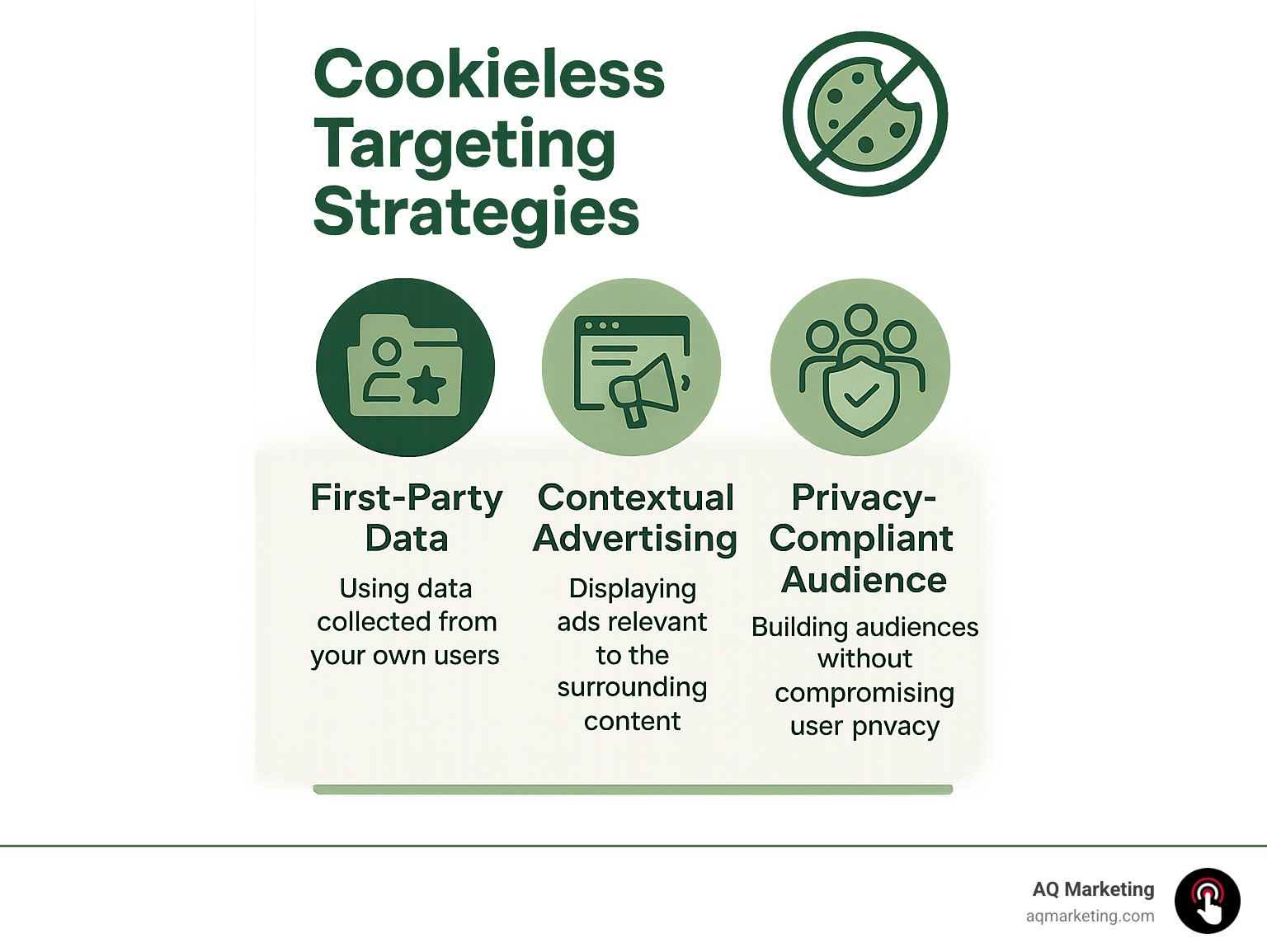
First-party data is becoming your secret weapon. With third-party cookies going away, the businesses that win will be those using their own customer information smartly. This means taking your email lists and CRM data and turning them into targeted campaigns.
Performance Max campaigns are Google’s latest attempt to simplify everything by showing your ads across all their platforms at once – Search, YouTube, Gmail, you name it. The results have been mixed so far, but Google keeps pushing these campaigns harder.
Voice search is changing how people look for businesses. Instead of typing “plumber Boston,” people ask their phones “Where can I find a good plumber near me right now?” These longer, conversational searches need different keyword strategies.
Privacy regulations keep getting stricter, which actually benefits businesses that focus on building real relationships with customers instead of just chasing anonymous clicks.
Case-Based Inspirations
Real success stories show what’s possible when everything clicks together. These aren’t pie-in-the-sky promises – they’re actual results from businesses that got their PPC strategy right.
One vacation rental company reduced their cost per click by 25% while getting 22% more people to click their ads. The secret was systematic testing of everything from headlines to landing pages.
An online retailer saw their return on ad spend jump 140% in just three months. Even better, their overall sales increased by 45% after four months of steady optimization.
A B2B company achieved something that sounds almost too good to be true: a 23% conversion rate and 4 times more leads in their first month. They did it by completely restructuring their campaigns around what their customers actually wanted.
The email marketing integration story is particularly impressive – one business saw their email open rates increase by 222% and click-through rates by 151%. When your PPC and email work together, the results multiply instead of just adding up.
Future-Proof Checklist
Your pay per click advertising firm should be preparing for what’s coming next, not just managing what’s happening now. Here’s what forward-thinking agencies focus on:
Smart automation adoption means using AI tools where they excel while keeping humans in charge of strategy and creativity. The best agencies know when to let the machines handle the number-crunching and when human insight is irreplaceable.
Consistent creative testing prevents your ads from getting stale. People stop noticing ads they’ve seen too many times, so fresh creative keeps your campaigns performing.
Clean data practices become more important as privacy rules tighten. Organized campaigns with accurate tracking don’t just perform better – they’re also easier to adapt when regulations change.
Cross-channel coordination makes your entire marketing strategy stronger. When your PPC campaigns work together with your SEO, social media, and email marketing, each channel performs better than it would alone.
The agencies that thrive in 2024 and beyond won’t just be the ones with the fanciest tools – they’ll be the ones that understand how all these pieces fit together to grow your business.
Frequently Asked Questions about Pay Per Click Advertising Firms
When you’re considering hiring a pay per click advertising firm, certain questions come up again and again. Having worked with hundreds of businesses over the years, I’ve heard these concerns countless times – and they’re all completely valid.
How much ad spend do I need before hiring a firm?
Here’s the straight truth: most professional pay per click advertising firm partnerships work best when you’re spending at least $2,000-$5,000 monthly on ads. Below that threshold, the math gets tricky.
Think about it this way – if you’re spending $1,000 on ads and paying 20% in management fees, that’s only $200 for professional management. Quality PPC management requires significant time for keyword research, ad creation, bid optimization, and reporting. At $200 monthly, agencies simply can’t provide the attention your campaigns deserve.
That said, some firms will work with smaller budgets if you’re committed to growth. The key is finding an agency that sees your potential, not just your current spend.
For businesses spending under $1,000 monthly, consider learning basic PPC management yourself initially. Use this time to grow your budget and understand what questions to ask when you’re ready for professional help.
How quickly will I see results and ROI?
This is probably the most common question I hear, and I understand why. You’re investing real money and need to know when you’ll see returns.
PPC campaigns can start driving traffic within hours of launch – that’s the beauty of paid advertising. But meaningful results take time to develop. Here’s what typically happens:
The first week or two gives you baseline data. You’ll see which keywords generate clicks, what your initial conversion rates look like, and where obvious problems exist.
By the end of month one, your agency should have enough data to make the first round of real optimizations. They’ll identify which ads perform best, adjust bids based on actual performance, and refine targeting.
Months two and three are where the magic happens. Campaigns mature, Quality Scores improve, and costs typically decrease while performance increases. This is when you start seeing the ROI that makes PPC worthwhile.
Month four and beyond should deliver consistent, optimized performance. Your agency knows what works for your business and can scale successful campaigns while testing new opportunities.
What certifications should my agency hold?
Certifications matter, but they’re not the whole story. Here’s what to look for and why:
Google Ads Certifications demonstrate that your agency’s team understands platform basics. These free certifications cover search, display, video, shopping, and measurement. Any serious PPC professional should hold current certifications.
Google Premier Partner Status is more meaningful than basic certifications. Google reserves this designation for agencies that meet strict spending thresholds, maintain strong client performance, and demonstrate ongoing platform expertise.
Microsoft Advertising Accreditation shows your agency can manage Bing Ads effectively. While Bing has smaller search volume than Google, it often delivers lower costs and less competition – especially valuable for B2B companies.
Facebook Blueprint Certification matters if social media advertising is part of your strategy. These certifications cover Facebook, Instagram, and other Meta platforms.
But here’s what I’ve learned after two decades in digital marketing: certifications don’t guarantee success. I’d rather work with an uncertified professional who has five years of hands-on experience and strong client testimonials than a newly certified expert with no real-world results.
When evaluating agencies, ask about certifications but focus more on case studies, client retention rates, and their ability to explain complex concepts in simple terms. The best pay per click advertising firm partners combine technical knowledge with business understanding – and that combination comes from experience, not just certifications.
Conclusion
Choosing the right pay per click advertising firm isn’t just about finding someone to manage your ads – it’s about finding a partner who can turn your marketing budget into a reliable growth engine. After two decades of watching businesses succeed and struggle with PPC, I’ve seen how the right choice can completely transform a company’s trajectory.
The difference really comes down to expertise and commitment. Amateur management might get you clicks, but professional management gets you customers. It’s the difference between throwing money at keywords and strategically investing in your business growth.
At AQ Marketing, we’ve been helping Massachusetts and Southern New Hampshire businesses make these critical decisions since 2003. We’ve watched the PPC landscape evolve from simple text ads to today’s AI-powered campaigns, and we understand what it takes to stay competitive. More importantly, we know that behind every campaign are real business owners with real goals – whether that’s filling your calendar with service calls or building a steady stream of insurance leads.
What sets successful PPC partnerships apart is finding an agency that truly gets your industry. A pay per click advertising firm that understands the seasonal nature of home services or the trust factors that matter in insurance isn’t just managing campaigns – they’re accelerating your business growth in ways that make sense for your specific situation.
The businesses thriving today aren’t necessarily the ones with the biggest budgets. They’re the ones making smart, strategic investments in professional management that delivers measurable results month after month.
Here’s the reality: every day you delay is another day your competitors might be capturing the customers you should be serving. The right PPC partnership doesn’t just level the playing field – it can give you a significant advantage.
If you’re ready to explore how professional PPC management could transform your lead generation, we’d love to discuss your specific situation. After all, the best approach is always one that’s custom to your unique business goals. Let’s talk about what success could look like for you.


