
Targeted PPC Advertising: Ultimate Guide 2025
Hitting the Bullseye with Your Ad Spend
Targeted PPC advertising is the practice of using specific criteria like demographics, location, interests, and search behavior to show your ads only to people most likely to become customers. Instead of casting a wide net, you’re using a precision approach to maximize every dollar you spend.
Think of it like fishing. You could drop your line anywhere and hope for the best, or you could research where your target fish swim and use the right bait. That’s what targeted PPC does for your business.
I’m Robert P. Dickey, President and CEO of AQ Marketing, and I’ve spent over 20 years helping businesses maximize their targeted PPC advertising results. My experience has taught me that precision targeting is the difference between profit and waste.
What is Targeted PPC Advertising and Why is it Crucial?
PPC, or Pay-Per-Click, is an online advertising model where advertisers pay a fee each time a user clicks on their ad. Targeted PPC advertising ensures those paid clicks come from the most relevant and valuable audience segments.
The cruciality of targeting stems from several key benefits:
- Increased Relevance: Your ads appear to users genuinely interested in your products or services, leading to higher engagement.
- Higher Conversion Rates: Relevant ads lead to more qualified clicks from individuals actively looking for what you offer, making them more likely to convert.
- Better Quality Score: Platforms like Google Ads reward relevance. Highly targeted ads with strong engagement earn a better Quality Score, which can lead to lower costs and better ad positions.
- Competitive Advantage: For small businesses, targeted PPC advertising allows you to compete with larger companies by focusing your budget on specific, high-intent audiences rather than trying to outspend them. It’s not about the size of your budget, but how smartly you spend it. Businesses often earn an average of $2 for every $1 spent on PPC, a powerful incentive for getting it right.
How PPC Targeting Boosts Campaign ROI
The ultimate goal of any marketing effort is a strong Return on Investment (ROI). Targeted PPC advertising excels at this by optimizing performance:
- Reduced Cost-Per-Acquisition (CPA): By focusing on relevant audiences, you reduce wasted ad spend on unqualified clicks, paying less to acquire each new customer.
- Increased Return on Ad Spend (ROAS): This metric measures the revenue generated for every dollar spent on advertising. When you target effectively, each ad dollar works harder, bringing in more revenue.
- Attracting Qualified Leads: Targeted campaigns bring in leads who are genuinely interested and often further along in their buying journey, making them easier to convert into sales.
- Aligning Ad Spend with Business Goals: Targeting allows you to precisely allocate budget to campaigns that directly contribute to your objectives, ensuring every dollar is invested for maximum impact.
For more information on how we align our strategies to your business goals, explore our digital advertising services. More info about AQ Marketing’s digital advertising services
Core Strategies for Effective Targeted PPC Advertising
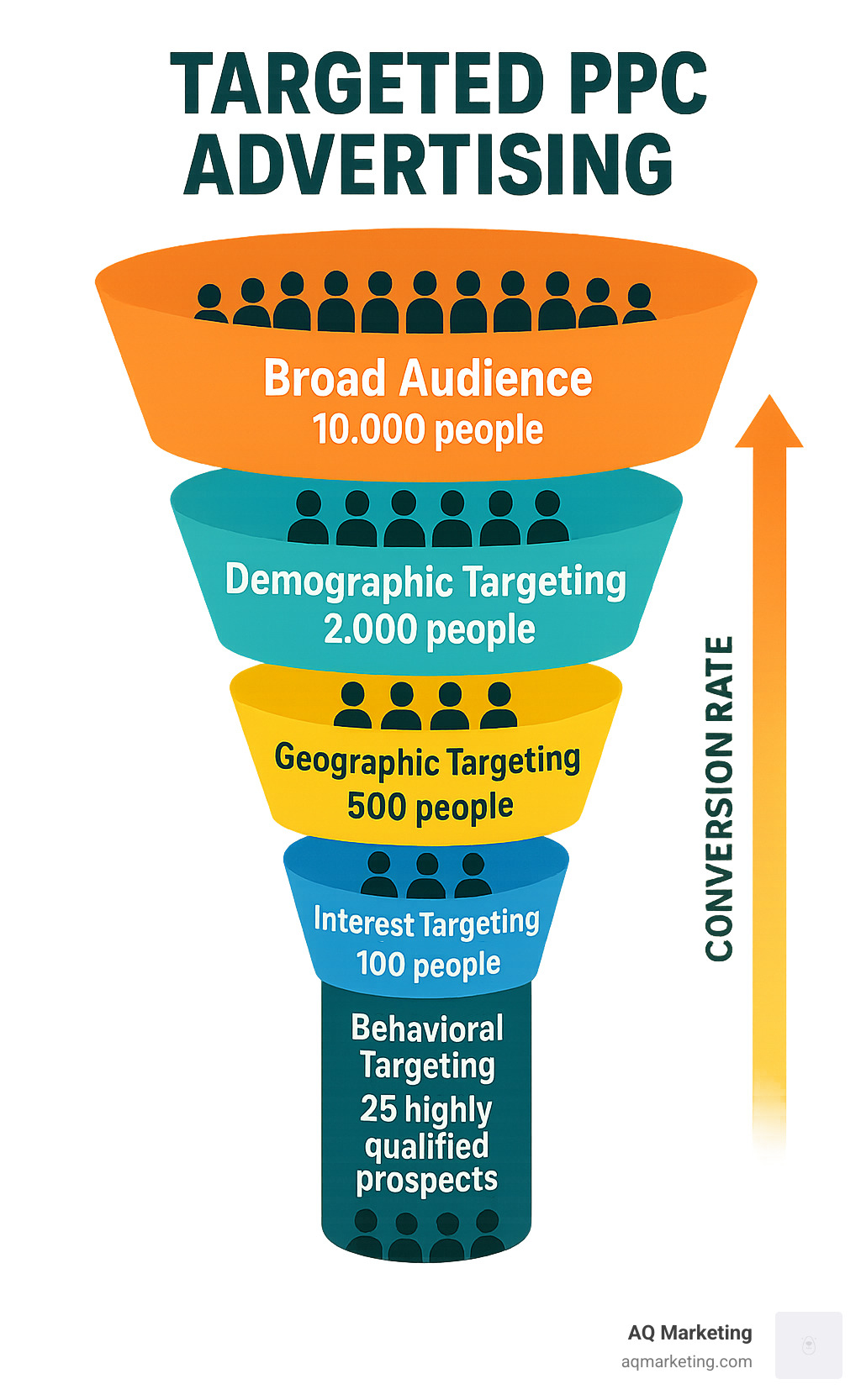
Effective targeted PPC advertising requires a robust foundation to ensure your ads reach the right people at the right time. Think of it as building a marketing funnel, where each layer of targeting refines your audience, drawing them closer to conversion.
Mastering Keyword and Search Intent Targeting
At the heart of any successful PPC campaign is understanding the language your potential customers use.
- Keyword Research: We identify the terms people type into search engines, using tools to find high-value keywords with reasonable search volume and competition.
- Long-Tail Keywords: These are longer phrases (e.g., “emergency furnace repair in Woburn MA”) that indicate higher purchase intent. They often have less competition, leading to lower costs and higher conversion rates.
- Search Intent: Understanding why someone is searching is crucial. Is a user looking for “HVAC repair tips” (informational) or “HVAC repair service near me” (commercial)? Your ad copy and landing pages must align with that intent.
- Negative Keywords: These prevent your ads from showing for irrelevant searches (e.g., “free insurance quotes” or “cheap [product]”). Regularly adding irrelevant queries to your negative keyword list is vital for preventing wasted ad spend.
Here’s a quick look at keyword match types:
| Match Type | Description | Example Keyword: “targeted ppc advertising” |
|---|---|---|
| Broad | Ads may show for searches that include misspellings, synonyms, related searches, and other relevant variations. Offers the widest reach but can be less precise. | PPC ad campaigns, digital marketing ads |
| Phrase | Ads may show for searches that include the meaning of your keyword. The search query can include words before or after your keyword. | “targeted ppc advertising agency”, “best targeted ppc advertising” |
| Exact | Ads may show for searches that have the same meaning or intent as your keyword. Offers the most control and precision. | [targeted ppc advertising], [PPC advertising targeting] |
Mastering these keyword strategies is fundamental. For more in-depth guidance on attracting organic search traffic, check out our SEO services. More info about AQ Marketing’s SEO services
Audience Segmentation: Speaking Directly to Your Customer
Beyond keywords, understanding who you are speaking to is paramount. Audience segmentation allows you to tailor your messaging for maximum impact.
- Buyer Personas: We develop semi-fictional representations of your ideal customers based on research and real data. Understanding their pain points, goals, and online behavior helps us craft resonant messaging.
- Demographic Targeting: Segment audiences based on age, gender, income, or parental status to refine your reach.
- Geographic Targeting: For local businesses in areas like Middlesex County, MA, or Southern New Hampshire, this is non-negotiable. We can target specific cities (e.g., Boston, MA), counties, or a radius around a business address.
- Device Targeting: People interact differently on various devices. We can adjust bids or create separate campaigns for mobile, desktop, and tablet users to optimize the user experience.
Leveraging Different Ad Platforms

The digital landscape offers a diverse array of platforms, each with unique strengths for targeted PPC advertising.
- Google Ads: As the dominant search engine, Google Ads is indispensable for capturing search intent. It’s excellent for driving immediate results and reaching a massive audience actively expressing a need.
- Microsoft Ads: Often overlooked, Microsoft Ads provides a valuable alternative. It can offer lower competition and a slightly different demographic, sometimes leaning towards an older, more established audience.
- Social Media Ads (Facebook, Instagram, LinkedIn): These platforms are powerful for interest-based and behavioral targeting. Facebook and Instagram excel at reaching users based on their hobbies, life events, and demographics. For B2B clients, LinkedIn is unparalleled, allowing for precision targeting based on professional attributes like job title, industry, and company size.
By understanding each platform’s strengths, we can create a powerful targeted PPC advertising presence. To learn more about how we can lift your social presence, explore our social media marketing services. More info about AQ Marketing’s social media marketing services
Advanced Techniques to Refine Your Targeting
Ready to take your targeted PPC advertising to the next level? Once you have the basics down, it’s time to explore the sophisticated tools that separate good campaigns from great ones. These advanced techniques give you laser-focused control and help you find high-intent customers who are ready to buy.
Advanced Strategies for Targeted PPC Advertising
The real magic happens when you dig into the advanced audience segments that most advertisers overlook. These are powerful insights into human behavior and buying patterns.
- In-Market Audiences: Google and Microsoft identify users who are actively researching specific products or services. Layering these audiences onto your campaigns means you’re reaching people who are in buying mode.
- Custom Intent Audiences: Create your own audience based on the websites, keywords, or apps your ideal customers engage with. It’s like creating a custom fishing spot where you know your target fish swim.
- Life Events: This targeting taps into pivotal moments when people need your services most, such as getting married, moving, or graduating.
- Affinity Audiences: Connect with people based on their long-term interests and passions. These are great for brand awareness and can be customized with specific keywords and websites.
- Similar Audiences: Also called Lookalike Audiences, this feature uses machine learning to find new customers who look just like your best existing ones. You provide a source list (like converted customers), and the platform finds new prospects with similar characteristics.
The Power of Retargeting and Remarketing
Most people don’t buy on their first visit. Retargeting is your second chance. It works by placing a small piece of code (a pixel) on your website that “tags” visitors. Later, as they browse other sites or social media, they’ll see your ads, reminding them of your services.
Retargeting is perfect for nurturing leads who aren’t quite ready to buy. You can show them ads highlighting testimonials or special offers. Dynamic remarketing takes this further by showing ads for the exact service or product a user viewed.
Remarketing Lists for Search Ads (RLSA) is particularly powerful, letting you customize search campaigns for past visitors. You might bid more aggressively on keywords when you know the searcher has already visited your site. The numbers speak for themselves: Emarketer finds 30% of users react positively to retargeting. The key is being helpful, not annoying, by segmenting lists and capping ad frequency.
Using Dynamic Search Ads (DSAs)
Sometimes the best targeted PPC advertising strategy is letting Google do some of the heavy lifting. That’s where Dynamic Search Ads come in.
Instead of you managing every possible keyword, DSAs scan your website content and automatically match user searches to relevant pages. Google then creates a headline and chooses a landing page on the fly. This is incredibly powerful for capturing unexpected queries you might not have thought to bid on.
DSAs save massive amounts of time on keyword management, especially for businesses with large websites or extensive service lists. The catch? Your website needs to be well-organized with quality content for DSAs to work effectively. Google’s introduction to Dynamic Search Ads provides more technical details.
The Crucial Role of Creative and Landing Pages

You can have the most precise targeting in the world, but if your ads are boring and your landing pages are confusing, you’re still going to lose money. The magic happens when your ad and landing page work together seamlessly. When someone clicks your ad, they should feel like they’re continuing the same conversation.
Crafting Compelling Ad Copy
Your ad copy is your first handshake with a potential customer. Make it count.
- Highlight Your USP: Showcase what makes you different. Are you the only HVAC company in Merrimack Valley with 24/7 emergency service? Say so.
- Use a Strong CTA: Your call-to-action should be clear. “Get Your Free Quote” works better than a generic “Learn More.”
- Leverage Ad Extensions: Use sitelink extensions to highlight important pages, call extensions to enable one-tap calling, and location extensions to show customers where to find you. Learn about sitelink extensions to see how they can make your ads stand out.
- A/B Test Everything: Test different headlines, descriptions, and CTAs to see what resonates most with your audience.
Optimizing Landing Pages for Conversion
Your landing page is where the conversion happens or dies. It must deliver on the promise your ad made.
- Maintain Relevance: If your ad promises “Emergency Plumbing in Southern New Hampshire,” the landing page must be about that specific service and location.
- Prioritize Speed: Pages should load in under three seconds. Any longer and you risk losing the visitor.
- Have a Clear Value Proposition: Visitors should understand within five seconds what you do and why you’re the best choice.
- Simplify Lead Forms: Only ask for essential information like name, phone, and email. You can gather more details later.
- Accept Mobile-First Design: Your site must be easy to use on a phone. Buttons should be thumb-friendly and text must be readable without squinting.
When your ads and landing pages work together, clicks turn into customers. Need help creating landing pages that convert? Check out our website design and development services. More info about AQ Marketing’s website design and development
Common Mistakes and How to Avoid Them
Even experienced marketers can stumble with targeted PPC advertising. Many campaigns burn through budgets due to avoidable errors. Think of PPC targeting like tuning a guitar; one wrong adjustment and the whole thing sounds off. But when dialed in correctly, it resonates perfectly with your audience.
Top 5 Targeting Blunders
- Ignoring Negative Keywords: This is like leaving your front door open. Without a solid negative keyword list, your ads will show for irrelevant searches (e.g., “home insurance jobs”), wasting money on clicks from non-customers.
- Incorrect or Broad Geo-Targeting: A contractor serving a 20-mile radius around Woburn shouldn’t target an entire state. Every click from outside your service area is wasted money.
- Forgetting Device-Specific Bids: A user searching for an emergency service on their phone has a different intent than someone researching on a desktop. Bids should be adjusted based on device performance.
- Not Segmenting Audiences: Lumping all customers together with generic messaging is a missed opportunity. A first-time homebuyer has different needs than someone looking to upgrade an HVAC system. Tailor your message to each group.
- Using Default Campaign Settings: Ad platforms are designed to spend your budget, not necessarily to spend it wisely. Always customize settings to align with your specific business goals, not the platform’s broad defaults.
Testing and Optimizing for Ongoing Success
Targeted PPC advertising is never truly “done.” The digital landscape shifts constantly, so ongoing optimization is essential.
- Monitor Key Metrics: Keep a close eye on Click-Through Rate (CTR), Cost-Per-Click (CPC), and Conversion Rate. These numbers tell a story about what’s working and what isn’t.
- Analyze the Search Terms Report: This report shows the exact phrases people typed before clicking your ad. It’s a goldmine for finding new negative keywords and finding high-performing search queries.
- Adjust Bids and Budgets: Funnel budget towards what’s working. If a keyword or audience is converting well, increase its budget. Reduce spend on underperformers.
- Iterate on Creative: Continuously A/B test your ad copy and landing pages. A small change, like a different headline or a simpler form, can significantly boost conversions.
- Improve Your Quality Score: Google rewards relevance with better ad positions and lower costs. When your ads, keywords, and landing pages are well-aligned, your Quality Score improves, saving you money. Improving your Quality Score
This cycle of testing, measuring, and refining is what makes targeted PPC advertising so powerful and profitable when done right.
Frequently Asked Questions about PPC Targeting
How can a small business use PPC targeting to compete with larger companies?
Targeted PPC advertising levels the playing field. You don’t need a massive budget; you just need to be smarter.
- Niche Down: While big companies target broad terms like “insurance,” you can target highly specific, long-tail keywords like “emergency furnace repair Woburn MA tonight.” These cost less and attract ready-to-buy customers.
- Use Hyper-Local Targeting: Focus your entire budget on your actual service area, like a 15-mile radius around Middlesex County, MA. Every click comes from a potential customer you can serve.
- Leverage Your Unique Story: As a small business, your unique selling points are your advantage. An ad that says “Family-owned, serving Merrimack Valley since 2003” builds more trust than a generic corporate ad.
The key is to be the big fish in a small pond.
How long does it take to see results from targeted PPC advertising?
PPC works much faster than organic methods like SEO. You can see your first clicks within hours of a campaign going live. This immediate visibility is perfect for generating leads quickly.
However, seeing clicks and achieving profitable results are different. The first 4-6 weeks are a crucial data-gathering and optimization period. During this time, we learn which keywords, ads, and audiences perform best. While some businesses see immediate success, most require a few weeks of fine-tuning to hit a consistently high ROI.
What’s a good budget for a targeted PPC campaign?
There’s no magic number; the right budget depends on your industry, location, and goals.
- Industry Competitiveness: A click for a lawyer or insurance agent in Boston can cost $50+, while a local bakery’s click might be $2. More competition means higher costs.
- Geographic Area: Advertising in a dense urban area costs more than in a smaller town.
For most small businesses, we recommend starting with a budget you’re comfortable with, perhaps $1,000-$2,000 per month. This is enough to gather meaningful data and prove that PPC can work for you. Once we demonstrate a positive return, increasing the budget becomes an easy decision. The goal isn’t to spend the least, but to spend the smartest.
Conclusion: Turn Clicks into Customers
Targeted PPC advertising isn’t about getting more clicks; it’s about getting the right clicks from people genuinely interested in what you offer. It’s the difference between throwing darts blindfolded and consistently hitting the bullseye.
We’ve covered the fundamentals of keyword and audience targeting, explored advanced techniques like retargeting, and stressed the importance of compelling ads and landing pages that work together seamlessly. Targeting is not a “set it and forget it” strategy. It requires ongoing attention, testing, and optimization to adapt to the ever-changing digital landscape.
At AQ Marketing, we’ve been helping businesses in home services and insurance steer this complex world since 2003. We know the challenges you face competing against larger companies. That’s why targeted PPC advertising is so powerful—it levels the playing field by focusing on precision over spending power.
Whether you’re serving customers in Woburn, MA, across Middlesex County, or throughout Southern New Hampshire, the principles are the same: find your ideal customers, speak their language, and meet them where they are in their buying journey.
Ready to transform your ad spend from an expense into a profitable investment? We’d love to help you create campaigns that don’t just generate clicks, but actually grow your business. Take your business to the next level with our Pay-Per-Click advertising services