Why Choosing the Right Startup Marketing Agency Can Make or Break Your Growth
Finding the right startup marketing agency is one of the most important decisions a founder will make — and also one of the most confusing.
There are hundreds of agencies competing for your budget. Some specialize in one channel. Others claim to do everything. A few will overpromise and underdeliver. And most startup founders don’t have the time or background to sort through the noise.
Here’s a quick answer to help you get oriented fast:
How to pick the right startup marketing agency — at a glance:
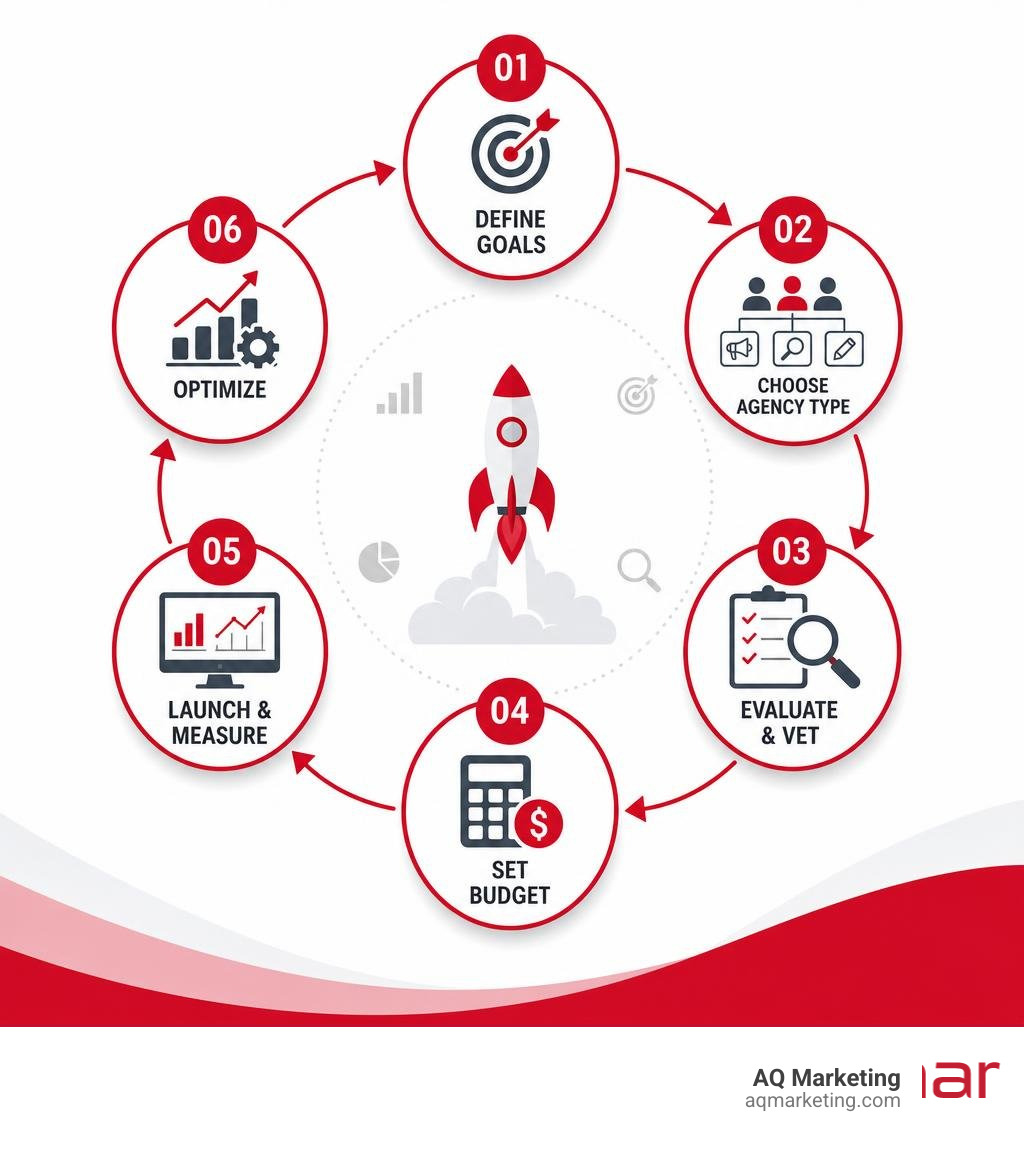
- Define your goal first — brand awareness, lead generation, SEO, paid ads, or all of the above?
- Match the agency type to your stage — seed-stage needs differ from Series A and beyond
- Check for real data — case studies, measurable results, not just testimonials
- Watch for red flags — vague pricing, “we do everything,” no constructive feedback
- Understand the cost range — industry pricing typically spans from roughly $1,000/month to $30,000+/month depending on scope and services
- Expect realistic timelines — SEO takes months; paid ads can show results faster
This guide walks you through every step of that process — from understanding agency types to spotting bad contracts before you sign one.
I’m Robert P. Dickey, President and CEO of AQ Marketing, Inc., with over 20 years of experience helping small and medium-sized businesses navigate the digital marketing landscape — including advising early-stage companies on how to choose and work with a startup marketing agency that actually moves the needle. I’ve seen what separates agencies that deliver results from those that just deliver reports.
Similar topics to startup marketing agency:
Understanding the Startup Marketing Agency Landscape

The agency landscape in June 2026 is highly diverse, offering everything from traditional public relations firms to cutting-edge AI-native growth operators. For a startup, navigating this territory requires a clear understanding of what each agency type actually brings to the table.
Startups don’t have the luxury of time or endless resources. We must achieve growth fast, often on a tight budget, with lean teams that may lack in-depth marketing expertise. When you hire the right partner, you gain immediate access to specialized knowledge, advanced analytics, and strategic leverage that would take years and hundreds of thousands of dollars to build in-house.
Specialized vs. Full-Service Startup Marketing Agency Options
Choosing between a specialized agency and a full-service partner is one of the first major decisions you will face.
- Specialized Agencies: These teams focus deeply on one or two core channels—such as organic search, paid advertising, or web development. For example, if your primary goal is to build long-term organic equity, partnering with a specialist for Startup SEO Services ensures you work with experts who understand technical optimization, topical authority, and link building inside out. Similarly, if your digital storefront needs a complete overhaul, a specialized Startup Website Design Company will focus entirely on user experience, conversion rate optimization, and mobile speed. You can learn more about this in our guide, From Idea to Icon: How a Startup Website Design Company Can Elevate Your Brand.
- Full-Service Agencies: These agencies handle everything from brand identity to media buying, social media management, and email automation. They act as an all-in-one marketing department. While they eliminate the coordination overhead of managing multiple vendors, the risk is that they may not possess deep, specialized expertise in every single channel. Some full-service operations may even outsource their more technical work, such as advanced SEO or custom development, behind the scenes.
For many growing businesses, a hybrid approach works best: hiring a comprehensive partner that specializes in core high-impact channels—like custom web design, organic search, and localized digital lead generation—to build a compounding growth engine. To explore how different structures compare, take a look at our breakdown of Digital Marketing Companies for Startups.
Aligning Agency Services with Your Growth Stage
Your marketing needs are dictated by your funding, runway, and product maturity. A seed-stage startup has vastly different priorities than a Series A scale-up.
- Seed Stage (The Foundation): At this point, your runway is ticking, and you must prove initial traction to secure funding or achieve self-sustainability. Your focus should be on establishing a strong digital identity, building a high-converting website, and launching targeted, high-intent search campaigns. You need a partner who can jump in quickly to establish product-market fit and capture early demand.
- Series A (The Launchpad): With fresh capital, your goal shifts to scaling customer acquisition. This stage requires a multi-channel demand generation strategy, blending short-term wins (like Google Ads and paid social) with long-term assets (like content marketing and search engine optimization).
- Scale-Up (The Engine): Once you have established repeatable acquisition channels, you need advanced data analytics, automated lead nurturing workflows, and sophisticated conversion rate optimization (CRO) to maximize the value of every visitor.
To align your growth goals with the right tactics, see our comprehensive guide on Marketing for Startups.
Key Criteria and Red Flags When Evaluating Partners
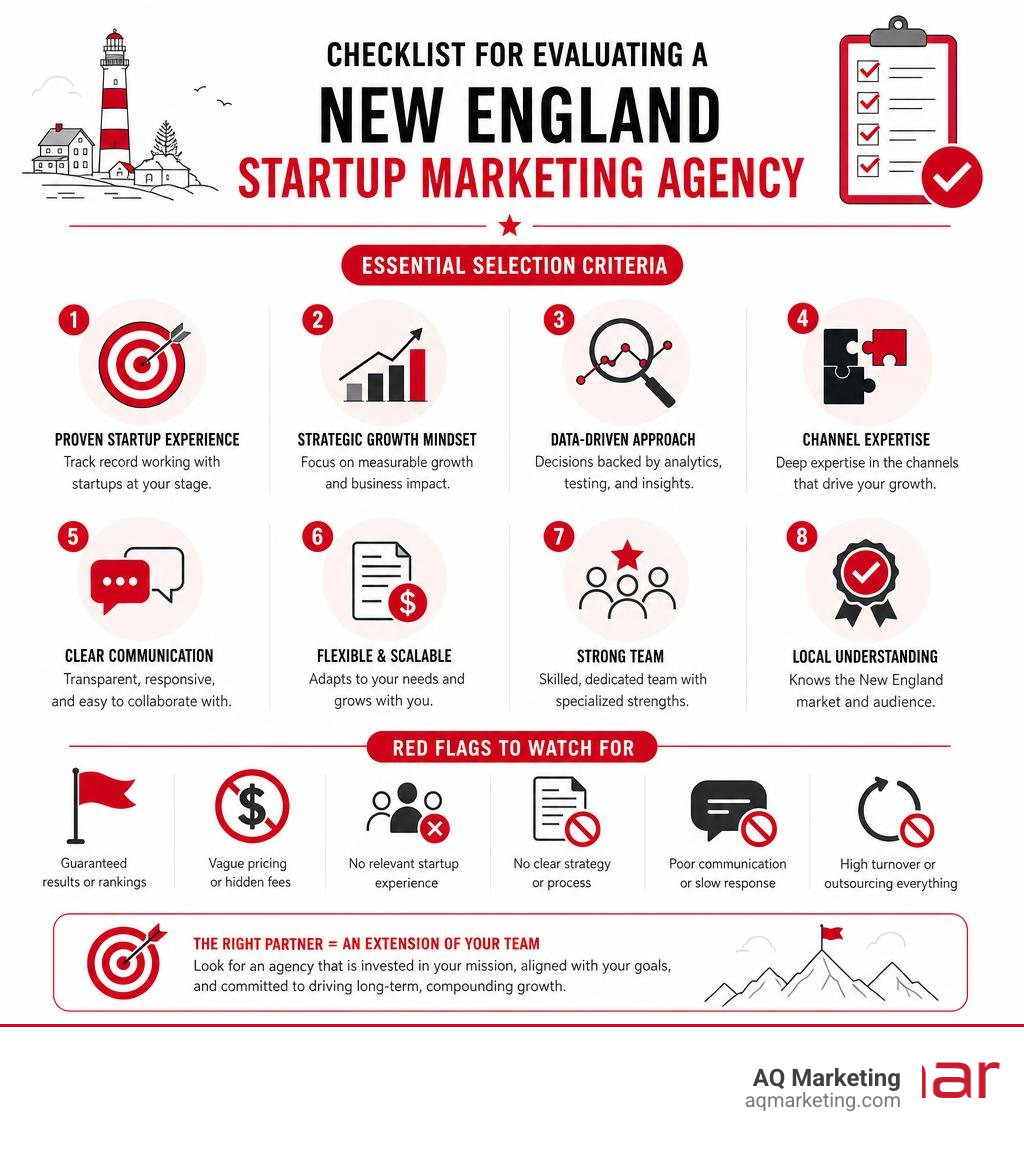
Selecting a partner is more than just reviewing a creative portfolio; it is about finding an extension of your team that is genuinely committed to your business objectives.
Essential Selection Criteria for a Startup Marketing Agency
When vetting potential agencies, look beyond polished sales pitches and focus on these critical criteria:
- Proven Case Studies and Hard Data: A reputable agency should easily provide case studies with measurable outcomes, such as increases in sales-qualified leads, organic traffic, and direct revenue. Ask for clear examples of how they helped similar ventures scale.
- Local and Regional Expertise: Partnering with an agency that understands your specific geographic market is incredibly valuable. For New England startups, working with a team familiar with the local business climate—from the tech hubs of Boston to the growing commercial sectors across Massachusetts—provides an immediate edge. You can explore regional rankings and directories like the Top Digital Marketing Agencies For Startups in Massachusetts | 2026 or the Top Digital Marketing Agencies in Massachusetts – Jun 2026 Rankings to find established local players.
- Communication and Transparency: Ensure the agency uses clear, jargon-free communication and provides direct access to the strategists working on your account, rather than passing you off to junior account managers the moment the contract is signed.
Warning Signs and Red Flags to Avoid
To protect your startup’s budget and runway, watch out for these common industry red flags during the evaluation process:
- “We Can Do It All”: Be skeptical of small agencies that claim world-class expertise in every imaginable marketing discipline. True mastery of SEO, high-end video production, PR, and complex custom software development rarely exists under one small roof.
- Zero Constructive Feedback: If an agency agrees with every single one of your ideas during the sales process and offers no constructive critiques of your current website, messaging, or strategy, they are likely more interested in securing your retainer than driving real growth.
- Vague Fee Structures: If an agency is evasive about their pricing models, setup fees, or ongoing retainer costs, walk away. Transparent pricing is the foundation of a healthy partnership.
- Lack of Performance Data: If they cannot show hard, historical data of past campaign performance—or if they focus entirely on vanity metrics like “impressions” and “social reach” rather than conversions and revenue—they may not be equipped to deliver a positive return on investment.
Pricing Models and Setting a Realistic Budget
Understanding how agencies structure their engagements is essential for planning your startup’s financial runway.
| Pricing Model | Typical Structure | Best For | Potential Drawback |
|---|---|---|---|
| Monthly Retainer | Fixed monthly fee for a defined scope of ongoing work (e.g., SEO, content, social media). | Predictable budgeting; long-term compounding strategies. | Requires a multi-month commitment before seeing full ROI. |
| Project-Based | One-time fixed fee for a specific deliverable (e.g., new website design, brand launch). | Clear scope and timeline; finite financial commitment. | Does not cover ongoing optimization or promotion. |
| Hourly Rate | Billed per hour of work performed by agency staff. | Small, ad-hoc tasks or consulting consultations. | Costs can quickly escalate if project scope creeps. |
| Subscription / Hourly Block | Monthly subscription for a set number of execution hours (e.g., 40, 80, or 160 hours). | Startups needing flexible execution across different channels. | Unused hours may not always roll over; requires active management. |
Typical Industry Cost Ranges and Engagement Models
Note: The pricing ranges and benchmarks listed below are based on average online industry data from June 2026 and do not represent AQ Marketing’s actual pricing.
Startup marketing agency engagements can vary wildly in cost depending on the size of your venture, the complexity of your tech stack, and the channels you target.
On the lower end of the spectrum, basic specialized services—such as simple link building packages or standard content production—often start around $2,700 to $4,000 per month. Mid-tier specialized campaigns, including comprehensive SEO or structured paid search management with initial setup commitments, typically range from $5,000 to $10,000 per month.
For highly intensive, full-service enterprise engagements or fractional CMO services that embed an entire marketing department into your business, costs can scale from $13,500 to upwards of $45,000 per month.
When building your initial marketing plan, it is critical to allocate your resources wisely across development, advertising spend, and agency fees. For a step-by-step framework on planning your finances, check out our guide on From Zero to Hero: Creating Your First Marketing Budget.
Maximizing ROI and Value from Your Investment
Startups that hire a professional marketing agency see an average 3x ROI on their marketing spend compared to struggling with inexperienced in-house teams. However, to achieve these results, you must actively manage the partnership:
- Streamline Onboarding: Over 80% of the time spent launching a new marketing campaign is actually operational work—such as setting up tracking pixels, integrating CRMs, organizing brand assets, and configuring ad accounts—rather than creative strategy. You can accelerate this phase by having your assets, brand guidelines, and technical access ready on day one.
- Establish Clear KPIs: Agree on performance metrics early. Ensure your agency’s goals are tied directly to business outcomes (like customer acquisition cost, pipeline velocity, and revenue) rather than vanity metrics.
- Build a Long-Term Growth Strategy: Marketing is not a series of disconnected, short-term hacks. It requires a cohesive, compounding plan. To learn what elements are vital for sustainable expansion, read about the 5 Things to Include in Your Small Business Growth Strategy.
Modern Trends: AI, Automation, and Search Evolution in 2026

The digital marketing landscape in June 2026 is rapidly evolving. Traditional search engines and standard content playbooks are no longer enough to maintain visibility. Leading agencies are now leveraging advanced AI-native operating systems and automated workflows to deliver faster, more precise results.
Generative Engine Optimization (GEO) and AI Search
The way users find information has fundamentally shifted. With the rise of AI-driven search experiences like ChatGPT Search, Gemini, and Google AI Overviews, traditional keyword stuffing is obsolete.
To stay visible, modern startups must optimize for Generative Engine Optimization (GEO). This involves:
- Passage-Level Targeting: Structuring your content to directly and concisely answer complex, conversational user queries.
- Topical Authority: Building deep, authoritative content hubs around your core business topics rather than writing superficial, disconnected blog posts.
- Conversational Optimization: Aligning your website copy with natural language patterns, as more users search using full questions and voice commands.
An experienced digital partner will help restructure your organic content to ensure that AI search engines cite your brand as a trusted source.
Leveraging AI and Automation for Scalable Growth
AI is not just a tool for drafting copy; it is a powerful engine for automating operational workflows. Forward-thinking agencies use AI to:
- Automate Lead Nurturing: Deploying intelligent webchat assistants and automated email sequences to engage and qualify website visitors 24/7.
- Streamline Campaigns: Using automated workflows to instantly sync lead data from social media ad campaigns directly into your CRM, triggering immediate follow-ups.
- Scale Content Engineering: Blending human editorial oversight with advanced AI research tools to produce high-quality, data-driven content at scale without sacrificing brand voice.
By automating repetitive operational tasks, startups can focus their energy on product innovation and customer success. Learn more about these modern approaches in our resource on Unlocking Growth: Marketing Strategies for the Modern Entrepreneur.
Frequently Asked Questions About Startup Marketing
How long does it take to see results from a startup marketing agency?
The timeline for measurable results depends heavily on the marketing channels you prioritize.
Paid advertising campaigns (like Google PPC and social media ads) can drive immediate traffic and lead conversions within the first two to four weeks of launching, making them excellent for short-term validation.
On the other hand, organic strategies like search engine optimization (SEO) and content marketing are long-term investments. You should expect to see compounding organic growth and ranking improvements within 60 to 90 days, with the full return on investment materializing over six to twelve months.
Should startups hire a local agency or a global one?
While global agencies offer broad reach, hiring a local agency provides significant advantages for startups, particularly in Massachusetts.
A local agency understands the regional business ecosystem, local economic trends, and the distinct consumer behavior of New England audiences. It also allows for seamless, in-person collaboration, local content creation shoots, and direct strategic alignment.
Local founders can also leverage excellent regional business resources, such as the Massachusetts SBDC | UMass Amherst , to support their growth alongside their agency partner.
How do we measure the success of an agency partnership?
Success should always be measured by metrics that impact your bottom line. Avoid getting distracted by vanity metrics like “impressions,” “clicks,” or “likes.” Instead, focus on:
- Customer Acquisition Cost (CAC): How much does it cost to acquire a single paying customer through agency-managed channels?
- Pipeline Velocity: How quickly are leads moving through your sales funnel from initial contact to closed-won revenue?
- Return on Ad Spend (ROAS): Are your paid ad campaigns generating direct, profitable revenue?
- Organic Traffic Value: Is your organic search visibility growing in areas that attract high-intent, qualified buyers?
Conclusion: Partner with a Team Built for Long-Term Success
Choosing a startup marketing agency is not about finding a vendor to check off a list of daily tasks. It is about finding a strategic partner who understands your vision, respects your runway, and builds a sustainable digital engine that compounds in value over time.
At AQ Marketing, based in Woburn, MA, we have spent over two decades helping small and medium-sized businesses across Massachusetts—from Boston to Worcester and beyond—enhance their online presence and drive real, long-term results. We specialize in custom website design, high-impact search engine optimization, and automated marketing workflows tailored to your unique growth goals.
Ready to build a marketing engine that gets results? Book a 15-Minute Phone Call with us today, and let’s discuss how we can help your startup scale.