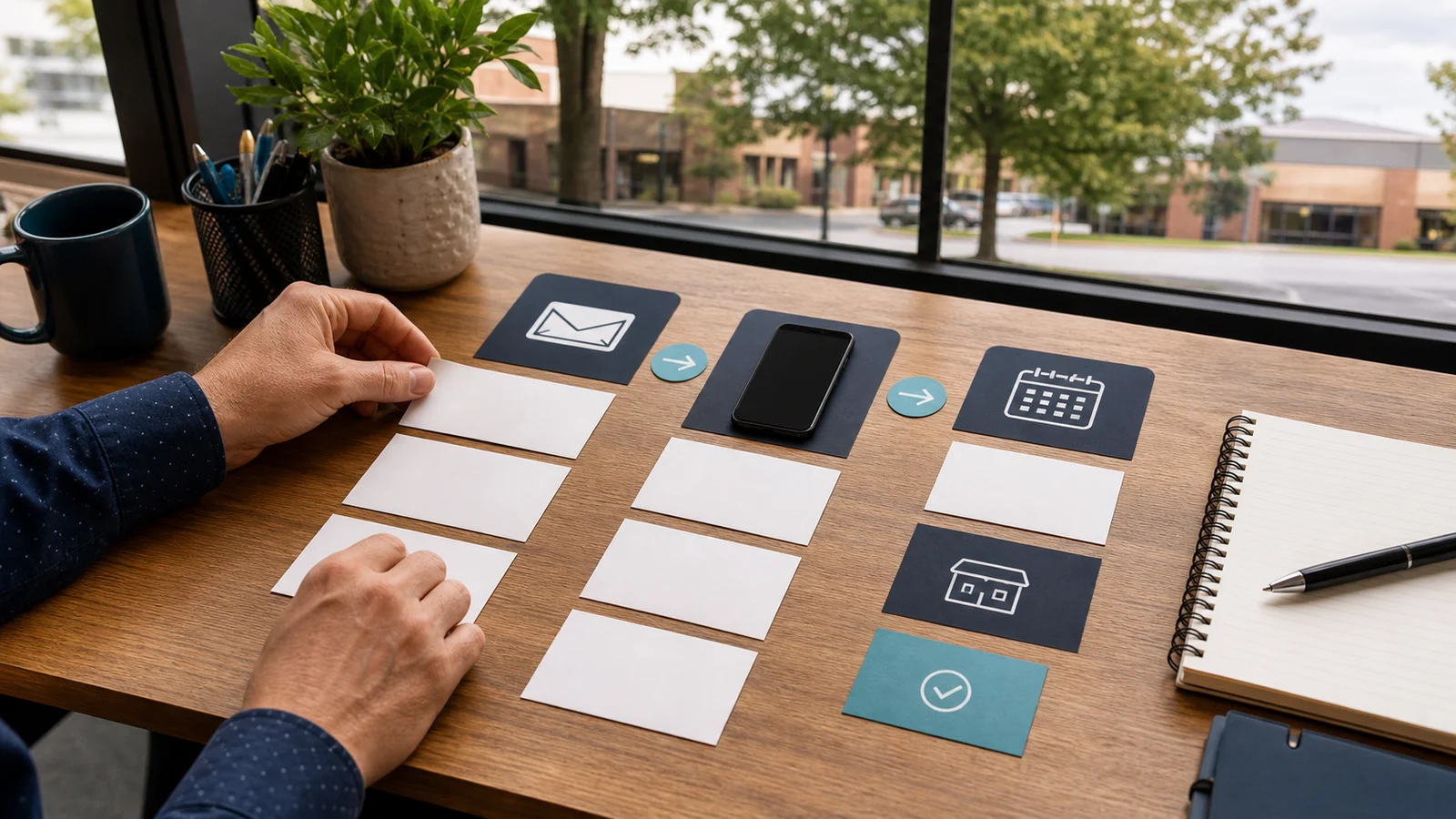
A customer reactivation campaign should give a past customer a relevant reason to return, use only channels the business is allowed to use, and stop when the person responds, books, or opts out. The work starts with list decisions and service timing—not with writing a promotional blast.
Define the campaign on one page before writing messages
A useful campaign brief names the eligible audience, the reason to contact them now, the service or next step being offered, the channels that may be used, the owner of replies, and the condition that ends the sequence. If those fields are vague, automation will scale confusion.
- Audience: a specific group of past customers, not the entire database.
- Reason: a legitimate service interval, seasonal need, product change, or useful update.
- Offer: the clear next step, such as booking, requesting an estimate, or replying with a question.
- Channels: email, SMS, or both, based on consent, message purpose, and urgency.
- Owner: the person or queue responsible for replies and bookings.
- Exit: booked, replied, declined, opted out, bounced, or otherwise ineligible.
Segment by the reason to return
“Past customer” is not a useful campaign segment on its own. A customer who completed a seasonal service last year has a different reason to hear from you than someone whose equipment is approaching a known maintenance interval. Build segments from facts in the customer record and suppress anyone whose status is uncertain.
| Segment | Useful reason to contact | Primary next step | Do not send when |
|---|---|---|---|
| Service may be due | The customer record shows a real maintenance or renewal interval. | Book or ask whether service is still needed. | The interval, service history, or customer identity is not reliable. |
| Seasonal customer | A relevant seasonal window is approaching in the customer's market. | Reserve a time or request an estimate before the schedule fills. | The service is not actually seasonal for that customer or location. |
| Dormant repeat customer | The customer previously used a repeatable service but has not returned. | Reply, book, or update preferences. | The person complained, opted out, moved, or has an unresolved service issue. |
| Past customer with a related need | A genuinely related service is now relevant to work already completed. | Learn more or ask for a scoped recommendation. | The relationship between services is speculative or the business does not offer the work. |
Choose email, SMS, or both based on the message
Email is useful when the customer needs context: what the service is, why it may be relevant now, and what choices are available. SMS is better reserved for a short, time-sensitive action when the business has the required consent and a clear reply or booking path. Using both can work, but the text should not merely repeat the email.
Compliance belongs in the campaign design. The FTC's CAN-SPAM guidance for businesses explains requirements for commercial email, including accurate sender information and a working opt-out process. For automated marketing texts, consent and revocation rules are more restrictive; the FCC's order on robocall and robotext consent explains that recipients may revoke consent through reasonable methods and that future covered texts must stop. Requirements can depend on the message and system, so have qualified counsel review an uncertain use case before sending.
Build a short sequence with a job for every message
The following sequence is a planning model, not a universal cadence. Adjust timing to the service cycle, customer expectations, and channel permissions.
Message 1: the useful reason
Reference the real relationship and explain why the message is timely. Use one primary action. A seasonal service business might say that the booking window for a relevant service has opened and invite the customer to choose a time or reply if the service is no longer needed.
Message 2: reduce the decision burden
Send only to people who remain eligible and have not acted. Answer the most likely decision question, such as what is included, how scheduling works, or whether an estimate comes first. Do not manufacture urgency or imply that availability is scarce unless the schedule supports that claim.
Message 3: close the loop
Give the customer a simple final choice: book, ask a question, update preferences, or stop these messages. A close-the-loop message protects the customer experience and gives the database a clearer status.
Connect replies to an operating process
A campaign is not complete when a message is delivered. Decide what happens when someone replies with a question, asks for a quote, selects a time, reports a problem, or says the service is no longer relevant. Every response needs an owner and a due time inside the team's actual workflow.
Use one customer record across the sequence. When someone books, replies, opts out, or becomes ineligible, that status should suppress later campaign messages. If email and SMS operate in disconnected tools, reconcile suppression and booking data before each send.
Do a preflight check before activating automation
- Confirm the segment is based on reliable customer and service data.
- Remove opt-outs, invalid addresses, bounced contacts, unresolved complaints, and records with uncertain identity.
- Confirm the business offers the service and can fulfill the requested next step.
- Verify consent and required disclosures for each channel.
- Test every link, reply path, booking path, and internal notification.
- Set suppression rules for bookings, replies, declines, and opt-outs.
- Assign a person to monitor early responses before expanding the send.
Measure customer outcomes and list health
Track delivered messages, replies, bookings, qualified requests, opt-outs, bounces, and revenue that can be tied to a known campaign source. Review results by segment and message purpose rather than relying on one blended campaign total. A high open rate with no useful replies may indicate curiosity, not a successful reactivation path.
Also record why people did not qualify or why they asked to stop. Those signals can reveal stale service data, a poor segment rule, or a message that arrived without enough context. The next campaign should improve the audience definition before it adds more messages.
Turn the playbook into a maintained system
AQ Marketing's email and SMS automation solution includes segmentation, reactivation campaigns, channel compliance controls, reply and booking paths, and ongoing campaign management. Use the one-page brief, segment table, sequence model, and preflight checklist above to define what your business needs before implementation.