
Why Insurance Marketing Automation Is Reshaping How Agencies Grow in 2026
Insurance marketing automation uses software to automatically handle repetitive marketing tasks — like sending renewal reminders, nurturing leads, and following up after a policy is bound — so your team can focus on higher-value work.
Here’s what it does at a glance:
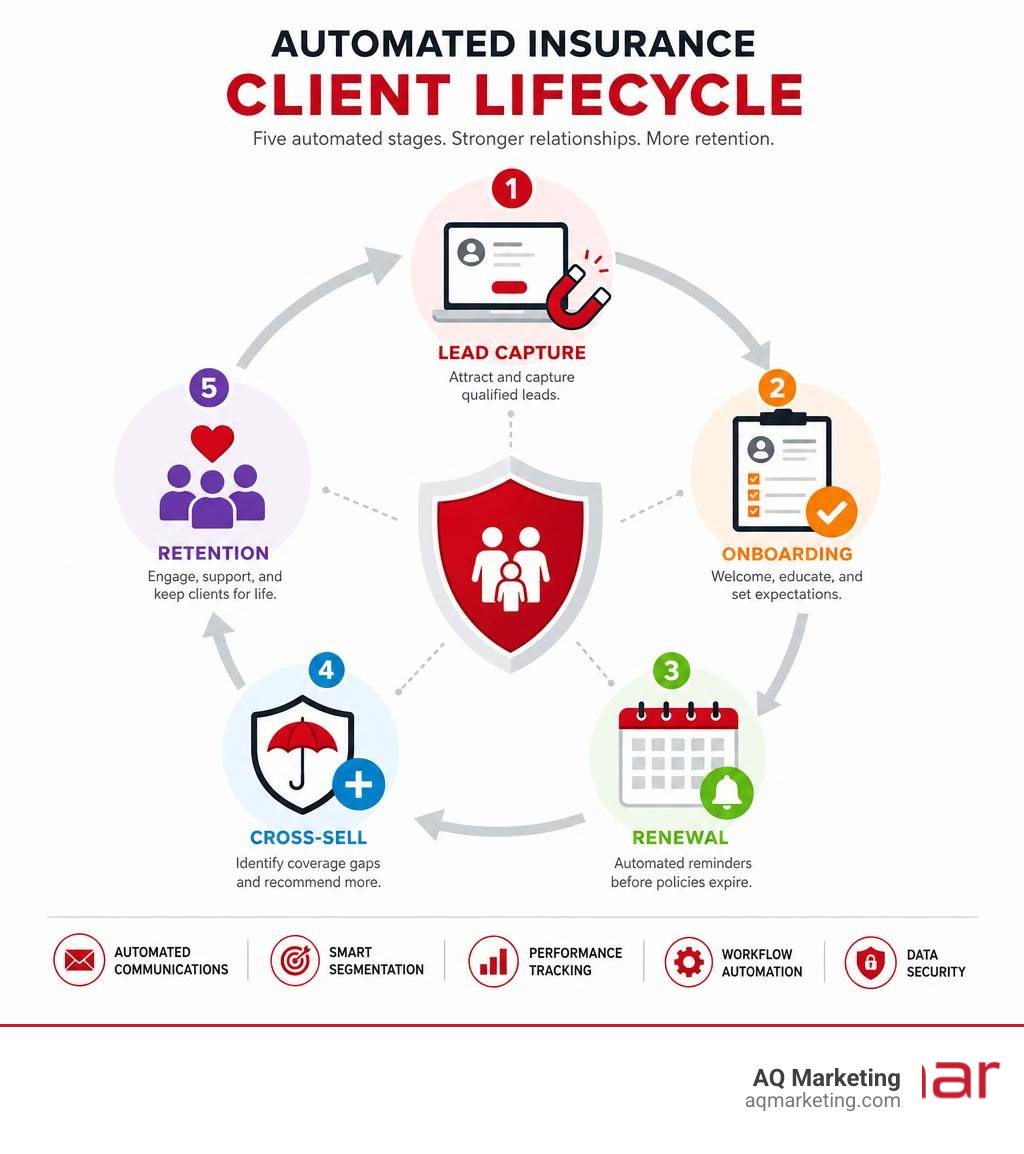
- Automates renewal outreach — timed email and SMS reminders sent without manual effort
- Nurtures leads automatically — drip sequences triggered by prospect behavior
- Supports cross-sell campaigns — targeted messages based on coverage gaps or policy type
- Streamlines onboarding — welcome kits and follow-ups delivered the moment a client signs
- Tracks performance — open rates, clicks, and pipeline movement in one dashboard
Picture a CSR at a busy independent agency. Every morning, she pulls a spreadsheet, manually identifies which clients are up for renewal in 90 days, drafts individual emails, logs each interaction, and then does it all again the next day. It works — but it doesn’t scale. And in a market where rising premiums are pushing policyholders to shop around, slow and manual is a risk your agency can’t afford.
Agencies using marketing automation report 28% higher client retention rates than those relying on manual outreach alone. Staff who once spent 6–8 hours a day on renewal reviews are now completing the same work in 2–3 hours. That’s not a small efficiency gain — that’s a fundamental shift in how an agency operates.
The insurance industry in 2026 is more competitive, more data-driven, and more client-expectation-heavy than ever before. Automation isn’t a “nice to have” anymore. It’s becoming the baseline for agencies that want to grow.
I’m Robert P. Dickey, President and CEO of AQ Marketing, Inc., and over my 20+ years in digital marketing I’ve helped small and mid-sized businesses — including insurance agencies — build smarter, more efficient marketing systems, including insurance marketing automation workflows that turn one-person efforts into scalable engines. In this guide, I’ll walk you through exactly how to put automation to work for your agency.
Related content about insurance marketing automation:
- email marketing insurance industry
- insurance customer retention strategies
- digital marketing for insurance agents
What is Insurance Marketing Automation?
At its core, insurance marketing automation is the strategic use of technology to streamline, schedule, and measure marketing communications across multiple channels. Instead of manually drafting every email, tracking down policy anniversaries on sticky notes, or guessing when a prospect might be ready to buy, automation software does the heavy lifting behind the scenes.
In the past, traditional marketing for insurance agencies relied heavily on “batch-and-blast” newsletters, cold calling, and local print advertising. These methods are not only time-consuming but also incredibly difficult to measure. Modern automation, however, shifts the focus from manual, generalized outreach to highly personalized, timely interactions triggered by real-time client data.
To make this work seamlessly, marketing automation tools must integrate directly with your existing technology stack. This includes your Agency Management System (AMS) and your Customer Relationship Management (CRM) platform. When these systems talk to each other, a change in a policy status automatically triggers the correct marketing sequence—no human intervention required. To understand how this fits into your broader digital strategy, check out our guide on Smart Marketing Solutions for Modern Insurance Pros.
Core Differences from Traditional Outreach
The difference between traditional manual outreach and automated marketing is the difference between rowing a boat and starting an outboard motor. With manual processes, every single message requires physical effort from your staff. This severely limits your agency’s ability to scale.
When you automate, you transition to data-driven decisions. The system monitors client behaviors, policy dates, and coverage changes, executing perfectly timed touchpoints.
| Feature / Capability | Traditional Manual Outreach | Automated Marketing Workflows |
|---|---|---|
| Scalability | Limited by staff hours; impossible to grow without hiring more CSRs. | Unlimited; can manage 10,000+ clients as easily as 100. |
| Personalization | Often generic or template-heavy due to time constraints. | Dynamic and highly personalized based on real-time policy data. |
| Timing | Reactive (often sent too late or only when a crisis occurs). | Proactive and triggered by specific behavioral or calendar milestones. |
| Data Tracking | Manual logging in AMS; high risk of human error or missed entries. | Automated tracking of opens, clicks, replies, and conversions. |
| Staff Workload | High; CSRs spend hours on repetitive administration. | Low; frees up staff for complex advisory and sales tasks. |
Key Features of Insurance Marketing Automation Platforms
If you are evaluating automation tools for your agency, look for platforms that offer these essential capabilities:
- Multichannel Email Campaigns: Beyond standard newsletters, you need the ability to build automated drip campaigns. These sequences guide prospects from initial quote request to bound policy, or welcome new policyholders with educational onboarding content.
- Integrated SMS Templates: Text messaging boasts incredibly high open rates. Automated SMS workflows are perfect for quick touchpoints like billing reminders, claims status updates, and urgent weather alerts.
- Sales Pipeline Management: A visual pipeline tracks where every prospect stands. When a lead moves from “Quoted” to “Follow-up,” the platform should automatically assign tasks to producers and trigger nurturing emails.
- Pre-Built, Industry-Specific Content: You shouldn’t have to write every email from scratch. The best systems come loaded with pre-built marketing assets designed specifically for various insurance lines—from personal auto and home to complex commercial coverages.
Driving Growth: Retention, Renewals, and Cross-Selling
Acquiring a new insurance client can cost up to nine times more than retaining an existing one. In a hardening market where premiums are rising across Massachusetts, proactive communication is your strongest shield against client churn.
By implementing structured workflows, agencies can protect their hard-earned book of business while driving organic growth from within. For a deeper look at navigating these market shifts, read our comprehensive guide on The Ultimate Guide to Growing an Insurance Business in a Tough Market.
Streamlining the Renewal Process
The renewal period is the most critical phase of the client lifecycle. It is also historically the most labor-intensive.
Consider a typical independent agency in Woburn, MA. Before automation, their technical service representatives (TSRs) spent between 6–8 hours per day completing manual renewal reviews—pulling policy files, comparing rates, drafting emails, and calling clients.
By automating the renewal outreach sequence, that daily administrative burden can be slashed to just 2–3 hours. The automation platform automatically triggers a personalized email 90 days prior to the renewal date, inviting the client to review their current coverage and schedule a quick call if their needs have changed.
This dramatic improvement in operational efficiency does two things: it guarantees that no client is forgotten, and it gives your staff their days back to focus on closing new business.
Maximizing Lifetime Value with Insurance Marketing Automation
Many agencies leave money on the table by failing to cross-sell. A client who buys home insurance from you but goes elsewhere for their auto policy is a prime target for automation.
Instead of generic bulk mailings that get ignored, smart automation uses behavioral triggers and policy data to identify coverage gaps. For example, if a client binds a commercial property policy, the system can automatically trigger a targeted sequence explaining the benefits of cyber liability or employment practices liability insurance (EPLI) 30 days later.
Agencies that automate renewal and cross-sell workflows see average annual revenue increases of 8–15% from improved retention and organic cross-selling. Furthermore, by utilizing email automation with behavioral triggers—such as sending a follow-up only when a client clicks a specific link—agencies achieve 3× higher engagement rates compared to standard broadcast emails.
When your marketing engine is driven by real-time client data, you can achieve highly successful automated campaign outcomes that directly impact your agency’s bottom line in retained commission.
Compliance, Security, and AI in Automated Marketing
Because insurance is a highly regulated, state-monitored, and “Your Money or Your Life” (YMYL) industry, you cannot approach digital marketing with a “move fast and break things” attitude. Every automated text, email, and form must adhere to strict regulatory standards.

Navigating Regulatory Guardrails
When automating your outreach, your system must be configured to comply with several key regulatory frameworks:
- TCPA (Telephone Consumer Protection Act): Crucial for SMS marketing. You must have documented, explicit consent before sending automated text messages to prospects or clients. One-to-one consent is now the industry standard.
- CAN-SPAM Act: Every marketing email must include a clear, functional unsubscribe link, your physical agency address, and honest subject lines.
- GDPR & State Data Laws: If you write business across state lines or handle international clients, strict data privacy rules apply. In Massachusetts, agencies must also comply with 201 CMR 17.00, which mandates the protection of personal information of commonwealth residents.
- E-E-A-T Standards: Search engines and regulators look for Experience, Expertise, Authoritativeness, and Trustworthiness. Your automated content should feature named producer authorship and clear licensing disclosures.
To protect your agency, ensure your automation platform maintains robust audit trails, tracking exactly when consent was granted, what messages were sent, and when opt-outs occurred.
How AI and Machine Learning Enhance Automation
Artificial intelligence is transforming basic “if-this-then-that” rules into highly intelligent, adaptive systems. Modern AI tools can analyze your entire book of business daily to predict which clients are at the highest risk of churning or which are most likely to need an umbrella policy.
AI-powered writing assistants and “Sidekicks” help producers draft personalized emails in seconds, ensuring that even automated messages sound warm, human, and locally relevant. Agencies utilizing AI-personalized outreach see open rates of 45–65%—which is significantly above the 20–25% industry average for standard automated email sequences.
Furthermore, advanced AI tools can eliminate complex, multi-step manual processes entirely. For example, implementing intelligent producer agents can lead to a massive 182% improvement in marketing automation productivity by automatically identifying target prospects, gathering household intelligence, and delivering tailored outreach.
Measuring Success: ROI and Implementation Costs
Any technology investment must justify its cost. Fortunately, marketing automation is one of the few software categories where the return on investment can be measured directly in dollars saved and policies bound. To see how these trends fit into the broader landscape, take a look at our analysis of The Shifting Sands: What’s Hot in Insurance Marketing.

Key Performance Indicators to Track
To measure the health and success of your automation efforts, focus on these four essential KPIs:
- Client Retention Rate: Track this metric pre- and post-implementation. A 2% to 5% lift in retention can easily translate to tens of thousands of dollars in recurring commission.
- Customer Lifetime Value (LTV): As your automated cross-sell sequences run in the background, the average policy-per-household ratio should increase, driving up your overall LTV.
- Pipeline Velocity: Measure how quickly a prospect moves from a submitted quote form to a bound policy. Agencies using pipeline automation close new business 23% faster than those relying on manual follow-ups.
- Email Open and Click-Through Rates: Monitor these to ensure your content remains relevant. If open rates drop, it is a sign that your audience segmentation needs adjustment.
Technology Investment and Cost Considerations
When planning your budget, it helps to understand what independent agencies typically spend on marketing technology.
Based on average online industry data, independent insurance agencies spend an average of $3,200 to $7,500 per year on marketing technology. Depending on the size of your agency and the complexity of your workflows, software licensing costs can range widely from $150 per month on the lower end for basic email tools, up to $1,500 per month or more for advanced, enterprise-grade AI orchestration platforms.
Please note: The pricing ranges listed above are based on average online industry data and do not represent AQ Marketing’s actual pricing or service fees. We customize our digital marketing and automation strategies to fit the specific goals and budgets of each individual agency.
Despite these software costs, the timeline for recovering your investment is remarkably short. Most agencies that implement structured renewal automation recover the software cost within the very first renewal cycle where the automation runs, simply by retaining a handful of clients who otherwise would have shopped their policies.
Frequently Asked Questions about Insurance Automation
How does marketing automation integrate with an Agency Management System (AMS)?
Modern marketing automation platforms integrate with your AMS (such as Applied Epic, Vertafore, or EZlynx) either through direct APIs or scheduled data synchronization (like secure daily CSV uploads). When a client’s policy details, contact information, or renewal dates change in your AMS, the data automatically syncs with your marketing system, triggering the appropriate communication paths without your staff having to enter data twice.
What is the typical ROI timeline for implementing automation?
Most agencies begin seeing time-savings and operational relief within the first 30 to 60 days of going live. The financial software cost is typically recovered within the first renewal cycle (usually 3 to 6 months), as automated reminders catch at-risk clients. Full organic growth from automated cross-selling and pipeline nurturing typically shows significant revenue impact within 6 to 9 months.
Should agencies choose insurance-specific or general marketing tools?
While general platforms (like HubSpot or ActiveCampaign) offer incredible depth and customization, they require significant time and technical expertise to build out from scratch. Insurance-specific platforms (like Zywave, InsuredMine, or Agency Revolution) come pre-loaded with industry-compliant email templates, pre-built workflows for 20+ insurance lines, and native integrations with major AMS providers. For most independent agencies, starting with an insurance-specific tool or partnering with an agency that understands the industry’s unique compliance guardrails is the fastest path to success.
Conclusion
Implementing insurance marketing automation is no longer about chasing a futuristic trend—it is about protecting your agency’s time, securing your book of business, and building a scalable foundation for long-term growth. When you free your team from hours of manual administrative tasks, you allow them to do what they do best: build relationships, offer expert advice, and close deals.
At AQ Marketing, based in Woburn, MA, we have spent over two decades helping small and medium-sized businesses across Massachusetts—from Boston and Cambridge to Arlington, Burlington, and beyond—enhance their online presence and streamline their operations. We specialize in building high-impact website designs, long-term SEO strategies, and automated lead generation workflows designed to deliver measurable, lasting results.
Ready to stop chasing renewals manually and start growing your agency automatically? Explore our full suite of digital marketing services or contact us today to discuss how we can help you build the ultimate marketing engine for your business.