
Why Insurance Industry Marketing Trends Matter More Than Ever in 2026
Insurance industry marketing trends are undergoing a seismic shift in 2026, driven by AI adoption, rising catastrophe losses, regulatory scrutiny, and a massive workforce transition. Here’s what every insurance marketer needs to know:
Top Insurance Marketing Trends for 2026:
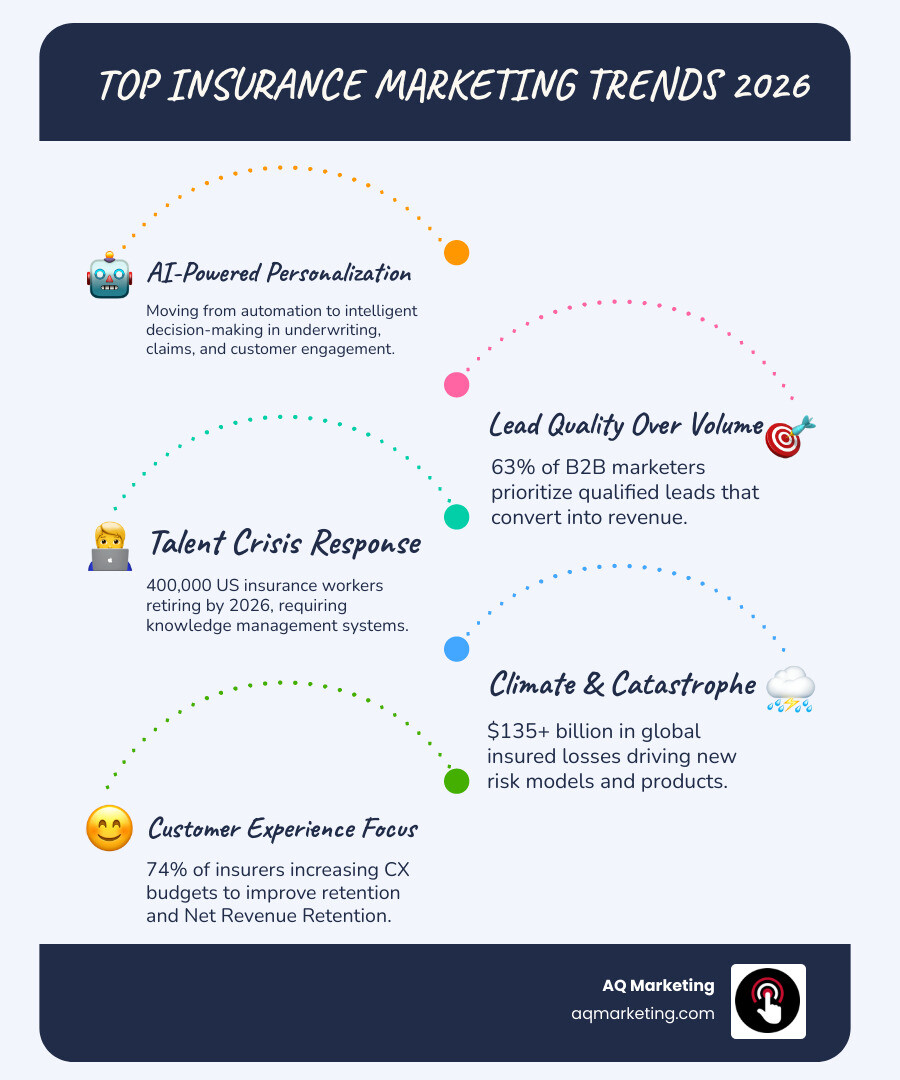
- AI-Powered Personalization – Moving from automation to intelligent decision-making in underwriting, claims, and customer engagement
- Lead Quality Over Volume – 63% of B2B marketers now prioritize qualified leads that convert into revenue
- Talent Crisis Response – 400,000 US insurance workers retiring by 2026, requiring knowledge management systems
- Climate & Catastrophe Adaptation – $135+ billion in global insured losses driving new risk models and products
- Broker-Carrier Connectivity – API-driven data integration becoming essential for competitive advantage
- Customer Experience Focus – 74% of insurers increasing CX budgets to improve retention and Net Revenue Retention
The insurance world is getting riskier and more fragmented. Extreme weather events, social inflation pushing liability claims up 57% over the past decade, and geopolitical uncertainty are reshaping how insurers assess risk and reach customers. At the same time, more than 60% of P&C insurers are piloting AI technologies, but fewer than 15% have scaled them across core operations—creating a widening performance gap between industry leaders and everyone else.
For insurance agencies and brokerages, this creates both challenge and opportunity. Traditional marketing approaches centered on lead volume are giving way to precision strategies focused on qualified prospects, personalized experiences, and measurable revenue impact. The shift from “inbox underwriting” to unified digital command centers is mirrored in marketing, where data-driven insights and AI-powered tools are replacing spray-and-pray campaigns.
As President and CEO of AQ Marketing, I’ve spent over 20 years helping insurance agencies and brokerages steer digital change, and I’ve seen how insurance industry marketing trends can make or break growth strategies in this rapidly evolving landscape. My experience spans from digital strategies in the early 2000s to today’s AI-driven personalization at scale, giving me a unique perspective on what actually moves the needle for insurance marketers.
Glossary for insurance industry marketing trends:
- digital marketing for insurance agents
- content marketing for insurance companies
- insurance agent website design
Navigating the 2026 Landscape: Key Insurance Industry Marketing Trends
As we look toward the 2026 horizon, the insurance landscape is being reshaped by forces that demand more than just traditional advertising. We’ve seen that the “old way” of doing things—relying solely on broad-reaching ads—is no longer enough to sustain growth in a market defined by volatility.
One of the primary challenges we face is the sheer scale of catastrophic events. In 2025 alone, California’s wildfires accounted for an estimated $40 billion in insured losses, while severe convective storms added another $50 billion. Even here in Massachusetts, from the coast of Barnstable to the hills of Adams, changing weather patterns are forcing us to rethink how we communicate risk to our clients.
Beyond the weather, “social inflation” is a major player. This isn’t just a buzzword; it refers to the rising costs of insurance claims due to more aggressive litigation and massive jury awards. In fact, liability claims have jumped 57% over the past ten years. For marketers, this means we must focus on transparency and education to build trust. Our digital marketing insurance industry strategies must now emphasize the value of adequate coverage in a world where “nuclear verdicts” are becoming more common.
Furthermore, geopolitical and economic uncertainty, including trade tensions and tariffs, are bleeding into the P&C outlook. With 82% of chief economists expecting global fragmentation to intensify, the Deloitte 2026 insurance outlook suggests that underwriters—and by extension, marketers—must remain incredibly agile. We are helping our clients across Massachusetts, from Boston to Worcester, adapt their messaging to address these rising healthcare costs and regulatory shifts.
The Rise of Intelligent Insurance and AI Integration
The most significant of the insurance industry marketing trends in 2026 is the transition to “Intelligent Insurance.” This isn’t just about using a chatbot on your website; it’s a new operating model that embeds AI and analytics directly into core workflows.
According to McKinsey research on AI in insurance, AI acts as a true force multiplier. It allows for “continuous underwriting,” where risk factors are monitored in real-time rather than just once a year at renewal. Imagine using AI to assess satellite or drone photos of a home in Newton or Quincy to model fire or flood risk with pinpoint accuracy.
From a marketing perspective, this data is gold. We can use these insights to improve SEO for insurance agencies by creating content that speaks to highly specific risks. However, with great power comes great responsibility. The NAIC AI governance framework is already ramping up focus on algorithmic bias. We must ensure that our AI tools are transparent and fair, especially when dealing with sensitive health or property data.
Leveraging AI for Better Insurance Industry Marketing Trends and Lead Quality
In 2026, we are finally seeing the end of the “MQL obsession.” For years, agencies focused on getting as many leads as possible. Today, the focus has shifted to lead value.
A recent Demand Gen Report on lead quality found that 63% of B2B marketers now rank improving lead quality as a higher priority than volume. We are implementing Account-Based Marketing (ABM) and Revenue Operations (RevOps) to ensure that the leads our clients receive in places like Billerica and Burlington are actually ready to bind.
AI-driven personalization is the secret sauce here. McKinsey notes that organizations using AI-driven personalization can increase revenue by 10–20%. By tailoring our outreach based on predictive analytics, we can reach a business owner in Waltham or a homeowner in Weymouth with exactly what they need, exactly when they need it.
Operational Shifts: MGAs, Reinsurance, and Connectivity
The way insurance is distributed and backed is also changing. Managing General Agents (MGAs) have emerged as the industry’s innovation engines, growing nearly twice as quickly as the broader market. They are filling the gaps in niche expertise, such as cyber risk and specialized commercial lines.
For many of our clients in the insurance brokerage industry, connectivity is the new baseline. The days of “inbox underwriting”—where work is managed through a mess of PDFs and emails—are over. In 2026, unified underwriting command centers are the standard.
This shift is supported by a Swiss Re on fragmented world order report, which highlights how insurers must use modern operating models to stay competitive. We are seeing increased industry consolidation as larger carriers seek scale, but this also creates space for tech-savvy local agencies in Lowell or Lawrence to thrive by being more responsive and data-integrated.
Adapting to Softening Rates and Underwriting Discipline
As we enter a softening market, where premium growth is expected to decelerate to around 3–4%, underwriting discipline becomes paramount.
According to Lloyd’s market cycle insights, underwriters must resist the urge to slash rates just to keep volume. Instead, the competitive advantage in 2026 lies in portfolio resilience. We help our clients communicate their “underwriting judgment”—which cannot be automated—as a value-add. This builds a “strategic defense” against margin compression by proving to clients in Framingham or Fitchburg that their carrier has the stability to weather any storm.
Solving the Talent Cliff and Knowledge Gap
Perhaps the most daunting of the insurance industry marketing trends is the “talent cliff.” By 2026, an estimated 400,000 insurance workers in the US will retire.
The US Chamber report on talent vacuum highlights that 50% of the current workforce will retire in little more than a decade. For an agency in Brockton or Braintree, this is an existential risk. How do you preserve decades of institutional knowledge when your top performers leave?
We believe marketing plays a role here. By using insurance marketing strategies that highlight an agency’s culture and technological forwardness, we help our clients attract Gen Z talent. AI can actually be part of the solution; it can document the wisdom of retiring professionals and build digital training libraries, making insurance a more compelling career choice for the next generation.
Human-Centric Insurance Industry Marketing Trends in a Tech-Driven World
With all this talk of AI and data, it’s easy to forget the human element. But in 2026, empathy is a competitive advantage.
Customers are tech-fatigued. They want digital onboarding that is lightning-fast, but they also want to know a human has their back when things go wrong. This is why insurance agency local SEO is so vital. When someone in Woburn or Winchester searches for an agent, they are looking for local trust.
We focus on reputation management and transparency. 74% of insurers are increasing their CX (Customer Experience) budgets because they know that a seamless, empathetic experience is the only way to maintain loyalty. Whether it’s through plain-language policy summaries or AI-enabled tools that help customers compare options, the goal is to make the complex simple.
Frequently Asked Questions about Insurance Marketing
How is AI changing insurance underwriting in 2026?
AI has moved from experimentation to execution. In 2026, it uses real-time data and risk scoring to enable “continuous underwriting.” This includes analyzing satellite imagery to check the condition of a roof in Arlington or using telematics to monitor driving habits in Medford. It helps underwriters make faster, more precise decisions while reducing manual “inbox” tasks by up to 75%.
What are the biggest challenges for insurance marketers this year?
The biggest problems include the massive talent drain (400,000 retirements), social inflation driving up claim costs, and the increasing frequency of climate-driven catastrophes. Marketers also have to steer a complex regulatory environment regarding AI bias and data privacy, while trying to break down internal data silos that prevent a unified view of the customer.
Why is lead quality more important than lead volume for agencies?
High lead volume often leads to wasted sales cycles and frustrated agents. In 2026, the focus is on “lead value”—finding prospects that have a higher customer lifetime value and a better chance of retention. By prioritizing quality, agencies in places like Peabody or Plymouth can improve their marketing efficiency and ensure their CRM is filled with qualified, revenue-ready opportunities.
Conclusion
The insurance industry marketing trends of 2026 represent a hyper-acceleration of digital change. From the rise of Intelligent Insurance and AI-driven personalization to the critical need for a new talent pipeline, the industry is reimagining itself.
At AQ Marketing, we’ve been the Woburn marketing experts since 2003, helping small to medium-sized businesses across Massachusetts—from Acton to Yarmouth—achieve strategic growth. We understand that in a world of “shifting sands,” you need a partner who delivers long-term, impactful results. Whether you need a complete digital marketing for insurance companies overhaul or a targeted SEO strategy, we are here to ensure you maintain your competitive edge.
The future of insurance is data-rich and AI-powered, but it remains rooted in trust and local expertise. Let us help you steer this new era and turn these challenges into your greatest opportunities for growth.
Note: Typical industry pricing for comprehensive digital marketing management can range from $2,500 to over $15,000 per month, depending on the scale of the campaign and the competitive nature of the local market. These figures are based on average online data and do not represent AQ Marketing’s actual pricing.