Targeted Pay Per Click Advertising: Maximize ROI 2025
Why Targeted Pay Per Click Advertising is Your Secret Weapon
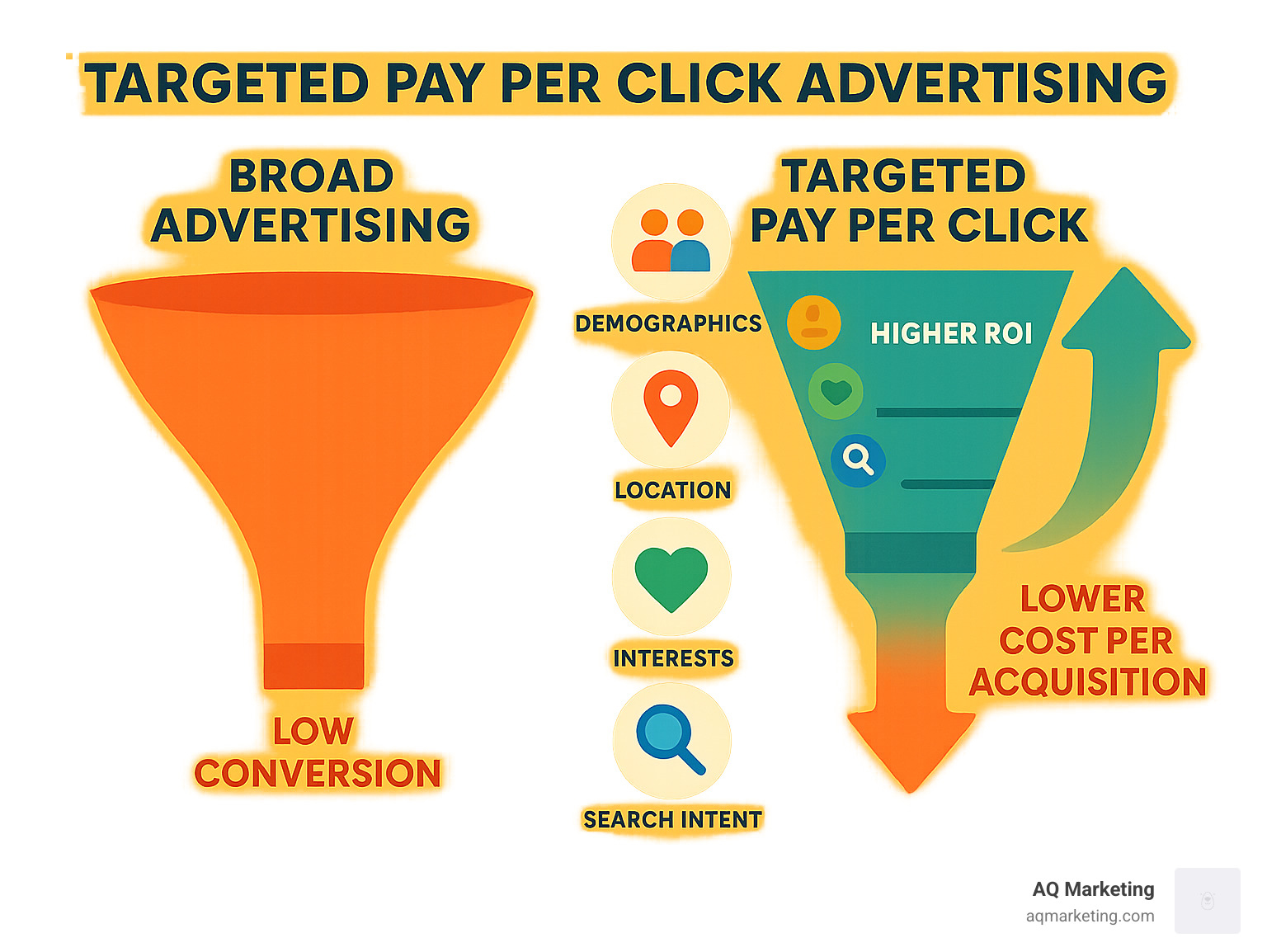
Targeted pay per click advertising is a strategy where businesses pay only when a potential customer clicks their ad, reaching specific audiences based on demographics, interests, location, and search behavior.
Key Benefits of Targeted PPC:
- Higher ROI – Paid search visitors are 50% more likely to purchase than organic visitors
- Immediate Results – Unlike SEO, PPC delivers instant visibility on search engines
- Cost Control – You only pay when someone clicks your ad
- Precise Targeting – Reach customers based on location, demographics, interests, and search intent
- Measurable Results – Track every click, conversion, and dollar spent
Statistics show that 76% of PPC ad spend fails to produce a single conversion, often because businesses cast too wide a net. When done right, however, businesses can see an average of $2 in revenue for every $1 spent on Google Ads.
It’s the difference between shouting your message on a busy street and speaking directly to someone already looking for what you offer. That’s the power of targeted pay per click advertising.
The problem? Many small businesses struggle with wasted ad spend on irrelevant clicks. The solution is targeting the right people with the right message at the right time.
I’m Robert P. Dickey, President and CEO of AQ Marketing. With over 20 years of experience, I’ve seen how proper targeting transforms struggling targeted pay per click advertising campaigns into profit-generating machines for our clients.
Targeted pay per click advertising word roundup:
The Core Components of a Winning PPC Strategy
At its heart, a successful targeted pay per click advertising strategy is a holistic plan for achieving specific marketing goals through intelligent execution, continuous optimization, and precise measurement. A campaign launched without a proper strategy is doomed to mediocrity.
Our approach begins with defining clear campaign goals, whether it’s increasing traffic, generating leads, or boosting sales. Next, we establish a realistic budget, often starting between $500 and $1,000 to gather data before scaling. Bidding is the auction process where we compete for ad space, balancing our bid against our Quality Score and the competition. Finally, data analysis and continuous optimization are non-negotiable. We constantly monitor key metrics to make data-driven decisions, as effective PPC is not a “set-it-and-forget-it” task.
Why PPC Targeting is Crucial for Business Growth
For any business, especially those we serve in Woburn, MA, and across Middlesex County, MA, maximizing return on investment (ROI) is paramount. This is where targeted pay per click advertising shines.
- Higher ROI and Conversions: It’s not just about getting clicks; it’s about getting clicks from people ready to buy. Many businesses earn an average of $2 in revenue for every $1 spent on Google Ads, with some seeing an impressive $8 for every $1 spent. Furthermore, retargeted ads are 70% more likely to convert.
- Brand Relevance: Precisely targeted ads appear at the right moment, improving brand relevance and building trust. This positions your business as the perfect solution to a customer’s immediate need.
- Competitive Advantage: By leveraging precise targeting, we ensure your ad spend is efficient, reaching high-intent prospects that competitors might be missing or overpaying to acquire.
The Synergy of PPC and SEO
PPC and Search Engine Optimization (SEO) are distinct disciplines that are incredibly powerful when combined, enhancing each other for maximum online visibility.
- Keyword Data Sharing: PPC campaigns provide immediate feedback on which keywords convert. This data informs our SEO strategy, helping us target high-performing keywords for organic rankings.
- Remarketing to Organic Visitors: We can use PPC to re-engage people who found you through an organic search, keeping your brand top-of-mind.
- SERP Domination: Appearing in both paid and organic search results significantly increases your visibility and click-through rate.
- Ad Copy Testing: We can A/B test ad copy in PPC to see what resonates with your audience, then use those winning messages to craft compelling meta descriptions for organic listings.
For more information on how we integrate these strategies, you can explore More info about SEO services.
Understanding Quality Score and Ad Rank
In Google Ads, Quality Score (QS) and Ad Rank are critical factors that influence your ad cost and position.
Quality Score (QS) is Google’s 1-10 rating of your ad, keyword, and landing page relevance. A higher QS leads to lower costs and better ad positions. It’s influenced by:
- Ad relevance: How closely your ad matches the user’s search query.
- Landing page experience: The quality and user-friendliness of your landing page.
- Expected CTR (Click-Through Rate): The likelihood your ad will be clicked when shown.
Ad Rank determines your ad’s position and is calculated by multiplying your maximum bid by your Quality Score. This means a superior Quality Score can earn you a better ad position for a lower cost, even against a competitor with a higher bid. Maintaining a high QS is crucial for avoiding inflated costs and wasted ad spend.
To dig deeper into improving your Quality Score, you can Learn how to improve your quality score.
Measuring Success and ROI
The beauty of targeted pay per click advertising is its measurability. We track every penny to optimize for maximum ROI.
Key metrics we monitor include:
- Click-Through Rate (CTR): The percentage of people who click your ad after seeing it. A high CTR indicates relevant ad copy and targeting.
- Conversion Rate (CVR): The percentage of clicks that result in a desired action (e.g., a sale or form submission). This is a key indicator of success.
- Cost Per Acquisition (CPA): How much it costs to acquire a single customer or lead.
- Return On Ad Spend (ROAS): The revenue generated for every dollar spent on advertising. This is a clear indicator of ROI.
Continuously analyzing these metrics allows us to make data-driven adjustments to improve performance and ensure our clients in Boston, MA, and Southern New Hampshire get the best possible results.

A Deep Dive into Targeted Pay Per Click Advertising Options
When it comes to targeted pay per click advertising, choosing the right platform and targeting method is crucial. Different platforms excel at reaching different audiences, and a one-size-fits-all approach rarely works.
Google Ads is king for capturing active searchers, while LinkedIn is ideal for reaching specific professionals. Microsoft Ads often provides a lower-cost alternative for valuable search traffic.
| Targeting Option | Google Ads | Microsoft Ads | LinkedIn Ads |
|---|---|---|---|
| Search Intent | Excellent (Keywords, DSAs, In-Market Audiences) | Good (Keywords, In-Market Audiences, LinkedIn data integration) | Limited (Mostly profile-based search) |
| Demographics | Good (Age, Gender, Household Income, Parental Status) | Good (Age, Gender, Household Income, LinkedIn data integration) | Excellent (Job Title, Company Size, Industry, Seniority, Education) |
| Interests/Behavior | Excellent (Affinity, In-Market, Custom Intent Audiences, Customer Match) | Good (In-Market, Custom Audiences, LinkedIn data integration) | Good (Skills, Groups, Professional Interests) |
| B2B Targeting | Good (Custom Intent, Customer Match, In-Market) | Good (LinkedIn data integration for professional targeting) | Excellent (Job Function, Seniority, Company Name, Industry) |
| B2C Targeting | Excellent (Search, Display, Shopping, YouTube) | Good (Search, Audience Network) | Limited (Primarily professional focus) |
| Remarketing | Excellent (Website visitors, Customer Match, GA integration) | Good (Website visitors, Customer Match) | Good (Website visitors, Contact Lists) |
| Geographic | Excellent (Country, State, City, Zip, Radius) | Excellent (Country, State, City, Zip, Radius) | Good (Country, State, City, DMA) |
B2B versus B2C targeting requires different strategies. Selling software to CFOs is a job for LinkedIn’s professional targeting. Promoting a local pizza place is best suited for Google’s location and search intent capture. Platform choice also affects budget, with Google often being the most competitive and LinkedIn being more expensive but delivering highly qualified B2B leads.
Keyword Targeting: The Foundation of Targeted Pay Per Click Advertising
Keywords connect your ads to what people are actively searching for. The key is understanding search intent. A search for “emergency plumber near me” shows a different intent than “how to fix a leaky faucet.” The first is ready to hire; the second is likely researching.
Match types give you control. Broad match casts a wide net, phrase match is more specific, and exact match is the most precise. A crucial tip is using negative keywords. If you sell premium home insurance, adding “cheap” and “free” as negatives prevents wasted clicks from bargain hunters.
Long-tail keywords are your secret weapon. Instead of the broad and expensive term “insurance,” targeting “homeowners insurance woburn ma” is more specific, indicates higher intent, and often converts better. The Google Keyword Planner helps uncover these opportunities. For example, Snickers successfully targeted misspelled search terms, generating over half a million impressions by thinking creatively about keywords.
Audience Targeting: Reaching People, Not Just Clicks
While keywords reveal what people want, audience targeting reveals who they are. This is where targeted pay per click advertising becomes surgically precise.

- Demographics: Target users by age, gender, income, or parental status to create a foundational audience.
- In-market audiences: Reach people Google identifies as actively researching specific products or services. These audiences convert at high rates.
- Affinity audiences: Target people based on broader interests and lifestyles, like “home improvement buffs,” to build brand awareness.
- Custom audiences: Target people based on their online behavior, such as websites they’ve visited or terms they’ve searched.
- Lookalike audiences: Find new people who are similar to your best existing customers. This is highly effective because it’s based on actual conversion data.
Layering these options—for example, targeting homeowners aged 35-55 who are in-market for insurance and live within 15 miles of your office—makes your ads more precise and relevant.
Contextual and Placement Targeting
Sometimes it’s not just about who sees your ad, but where they see it. Contextual and placement targeting puts your targeted pay per click advertising in the right environment.
Contextual targeting places your ads on relevant websites and apps across the Google Display Network, which reaches over 90% of internet users. You can target broad website topics (e.g., “Home & Garden”) or use placement targeting to handpick specific websites, YouTube channels, or apps. This approach makes your ads feel helpful and natural rather than intrusive.
Remarketing: Bringing Visitors Back
Most people don’t convert on their first visit. Remarketing is a targeted pay per click advertising superpower that brings them back. It works by tagging anonymous website visitors and showing them your ads as they browse other sites.
Key remarketing audiences include:
- Website visitors: People who have already shown interest in your services.
- Cart abandoners: For e-commerce, these users were one click away from buying and can be nudged to complete their purchase.
- Past converters: Previous customers can be targeted for new services or repeat business.
The data is clear: retargeted ads are 70% more likely to convert because you’re reaching an audience that is already familiar with your brand.
For more insights on how remarketing fits into a comprehensive digital advertising strategy, check out our More info about digital advertising services.
Location and Device Targeting
Knowing where your customers are and how they’re searching is vital, especially for local businesses in areas like Woburn, MA.
Geo-targeting ensures your budget reaches people who can actually use your services. You can target states, cities, or use radius targeting to draw a circle around your business. For instance, Kleenex geo-targeted ads based on real-time flu data, boosting sales by 40% with highly relevant messaging.
Device targeting recognizes that user behavior differs on mobile versus desktop. Mobile users often want quick answers and phone numbers, while desktop users may be doing more in-depth research. We adjust ad copy and bidding strategies to match these different behaviors and intents.

Common PPC Targeting Mistakes (And How to Avoid Them)
I’ve seen the same preventable mistakes derail countless targeted pay per click advertising campaigns. These errors lead to wasted budgets, low conversion rates, and irrelevant traffic. The good news? They are all fixable.
The most common targeting mistakes include broad keyword selection without proper refinement, neglecting negative keywords, incorrect geo-targeting, overlapping audience segments, ignoring device-specific optimization, targeting wrong time zones, relying on only one ad network, poor audience exclusions, ignoring sales funnel stages, insufficient remarketing, poor language targeting, not monitoring search terms reports, and using default settings without customization.
Overly Broad Targeting
Overly broad targeting is like fishing with a huge net in any body of water and hoping for salmon. It’s the most expensive mistake you can make in PPC.
This happens when businesses use vague keywords like “insurance” instead of “homeowners insurance quotes Woburn MA,” attracting irrelevant, costly clicks. It also occurs when advertisers accept default settings on ad platforms, which are intentionally broad. A major budget killer is the lack of negative keywords, which allows your ads to show for unrelated searches. Finally, poor segmentation treats all visitors the same, leading to generic messaging that doesn’t resonate.
Pro-tip: Make the search terms report your best friend. This report shows you exactly what people typed before clicking your ad. Check it weekly to find new negative keywords to add and new opportunities to explore.
Ignoring the Sales Funnel
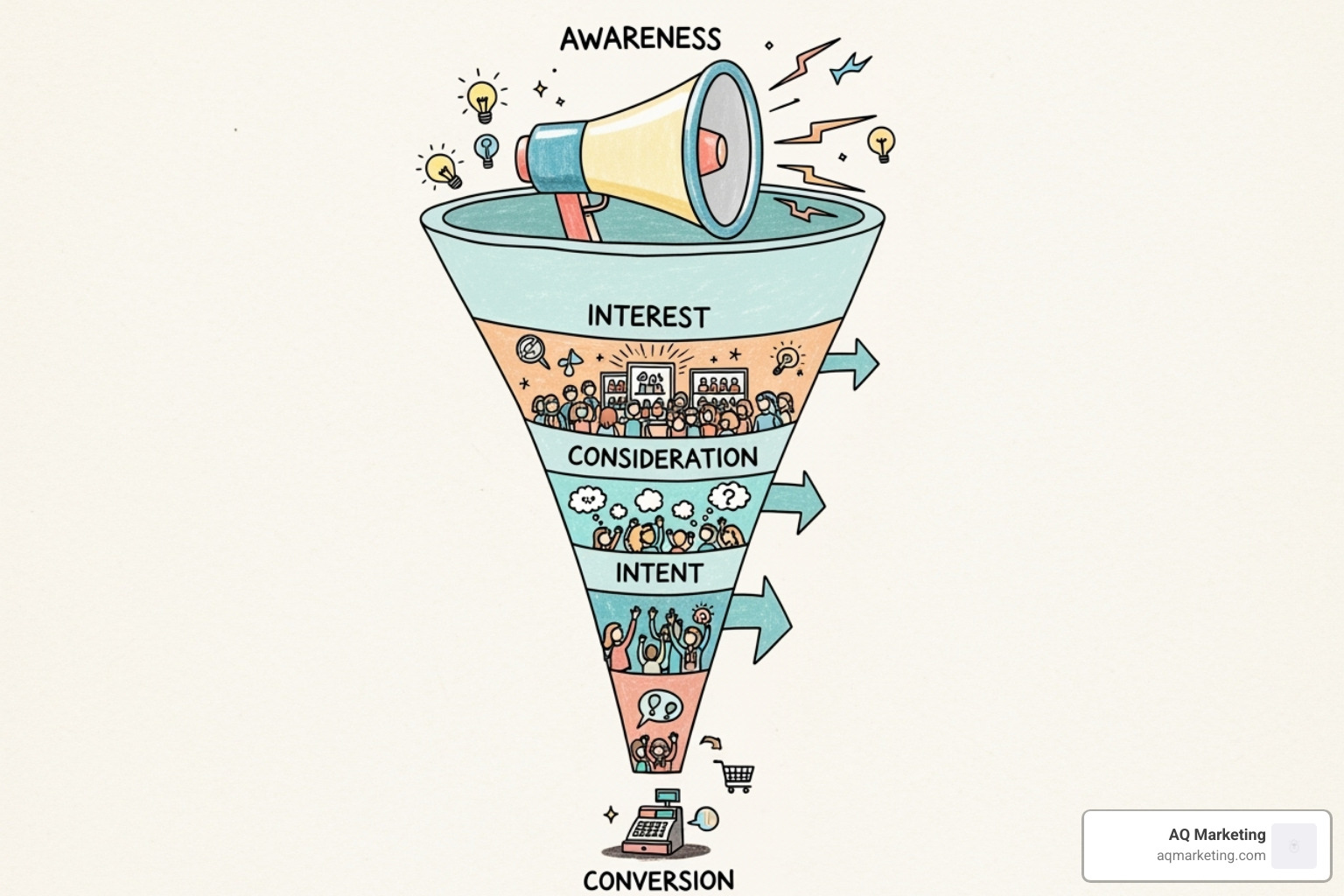
Showing the same ad to a new visitor and a ready-to-buy lead is like proposing on a first date—the timing is wrong. Your targeted pay per click advertising must meet customers where they are in their journey.
- Awareness Stage: Users have a problem and need educational content, not a hard sell.
- Consideration Stage: Users are comparing options. Your ads should highlight differentiators and offer helpful guides.
- Decision Stage: Users are ready to act. Now is the time for strong calls to action like “Get Your Free Quote Today.”
The key is tailoring ad copy and landing pages to match each stage. This consistency builds trust and dramatically improves conversion rates. When people get what they expect, they’re more likely to become customers.
For more insights on creating landing pages that convert, check out our website design services.
Neglecting Optimization and Testing
PPC is not “set it and forget it.” Continuous optimization is essential for success, as the digital landscape is always changing.
A/B testing ads is non-negotiable. We constantly experiment with different headlines and descriptions to find what works best. A small change can sometimes increase click-through rates by 20% or more.
Landing page optimization is equally important. We test everything from headlines to button colors to ensure the page delivers on the ad’s promise and converts visitors effectively.
Most importantly, we are constantly adjusting bids and budgets based on performance. Your budget should always flow to your best-performing campaigns and keywords. This process of testing, learning, and refining is what separates campaigns that consistently deliver great results from those that fail over time.
Frequently Asked Questions about PPC Targeting
Running targeted pay per click advertising campaigns brings up plenty of questions. Here are answers to the most common ones I’ve heard over my 20 years in digital marketing.
What is the average cost for PPC?
The average cost per click (CPC) is typically $1-$3, but this varies widely by industry. Highly competitive niches like legal services can see clicks costing $50 or more, while other industries might pay under $2 per click.
However, the cost per click is meaningless without context. A $20 click that regularly brings in a $2,000 customer is a great investment. Your budget should align with your campaign goals and expected ROI, not just the lowest possible CPC.
For most small businesses, we recommend a starting budget of $500-$1,000 per month to gather enough data to make smart decisions.
How long does it take to see results from PPC?
Targeted pay per click advertising delivers immediate visibility. Your ads can appear at the top of Google within hours of launching a campaign, and you’ll see traffic flowing almost immediately.
However, meaningful results like consistent leads and profitable conversions typically take a few weeks to a few months of continuous optimization. During this initial period, we gather data, test approaches, and refine every aspect of the campaign. Think of it like learning to drive: you can move the car on day one, but becoming skilled takes practice. PPC campaigns need time to mature and optimize for the best results.
Which platform is best for targeted pay per click advertising?
The best platform depends entirely on your audience and goals.
- Google Ads is ideal for capturing high-intent users who are actively searching for your products or services. For most businesses in sectors like home services or insurance, it’s the foundation of a PPC strategy.
- LinkedIn Ads dominates B2B targeting. Its ability to target by job title, company size, and industry is best for reaching professional audiences.
- Social media platforms like Facebook and Instagram are great for demographic and interest-based targeting. They excel at building awareness and generating demand among users who aren’t actively searching.
Most successful businesses use a mix of platforms, each playing a specific role in their overall marketing strategy.
Maximize Your ROI with Expert PPC Management
As we’ve seen, successful targeted pay per click advertising hinges on precision and relentless optimization. This transforms struggling campaigns into profit-generating powerhouses.
The reality is that effective PPC management is a complex, full-time job that can quickly overwhelm busy business owners. It requires constant research, testing, analysis, and adjustment to stay ahead.
That’s where we come in. Since 2003, AQ Marketing has delivered long-term, impactful results for small to medium-sized businesses in Woburn, MA, and our extended service areas, including Middlesex County, MA, Essex County, MA, Merrimack Valley, and Southern New Hampshire. Our two decades of experience are matched by our deep understanding of industries like home services and insurance.
We become an extension of your team, managing every aspect of your targeted pay per click advertising strategy. We don’t just drive traffic; we focus on converting that traffic into valuable customer relationships that fuel your growth. While competitors waste money on broad targeting, we craft precision-targeted campaigns that reach the right people at the right moment.
Ready to stop wondering if your advertising is working and start seeing measurable results? Let us show you how targeted pay per click advertising can become your most reliable source of new customers.
Get a free consultation for your PPC campaigns and let’s discuss how we can help your business thrive.