
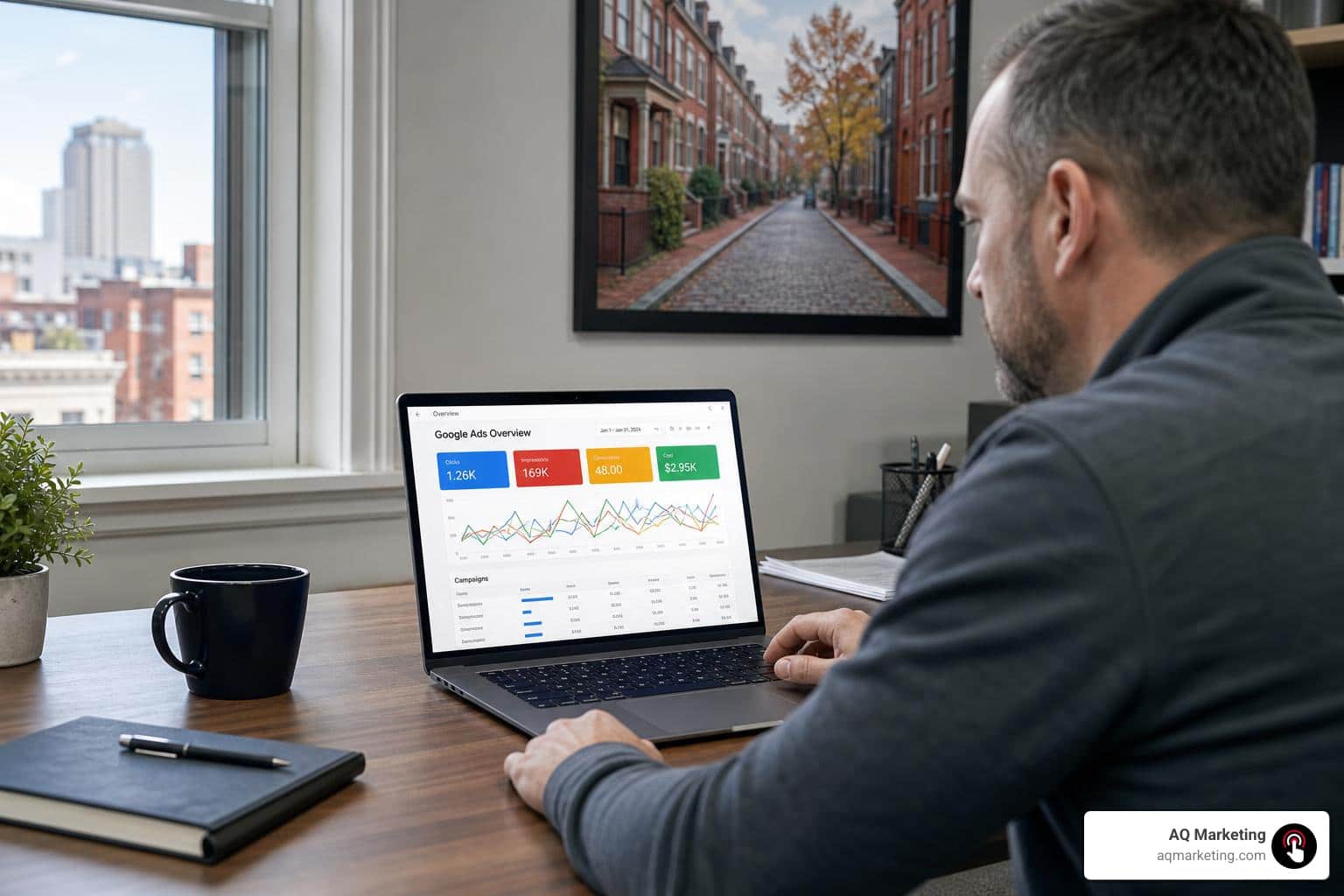
Why PPC for HVAC Companies Is One of the Fastest Ways to Fill Your Schedule
PPC for HVAC companies is a pay-per-click digital advertising model where your business pays only when a potential customer clicks your ad — placing you at the top of Google search results the moment someone needs heating or cooling help.
Here’s a quick breakdown of what it is and why it works:
| What It Is | What It Does for You |
|---|---|
| Pay-per-click advertising on Google, Bing, or social platforms | Puts your business in front of high-intent local searchers |
| Keyword-triggered ads that appear above organic results | Generates calls and form fills the same day a campaign launches |
| Budget-controlled bidding on service-specific terms | Lets you scale spend up in summer and winter peaks, pull back in slow months |
| Trackable, measurable lead channel | Shows you exactly which ads drive calls, bookings, and revenue |
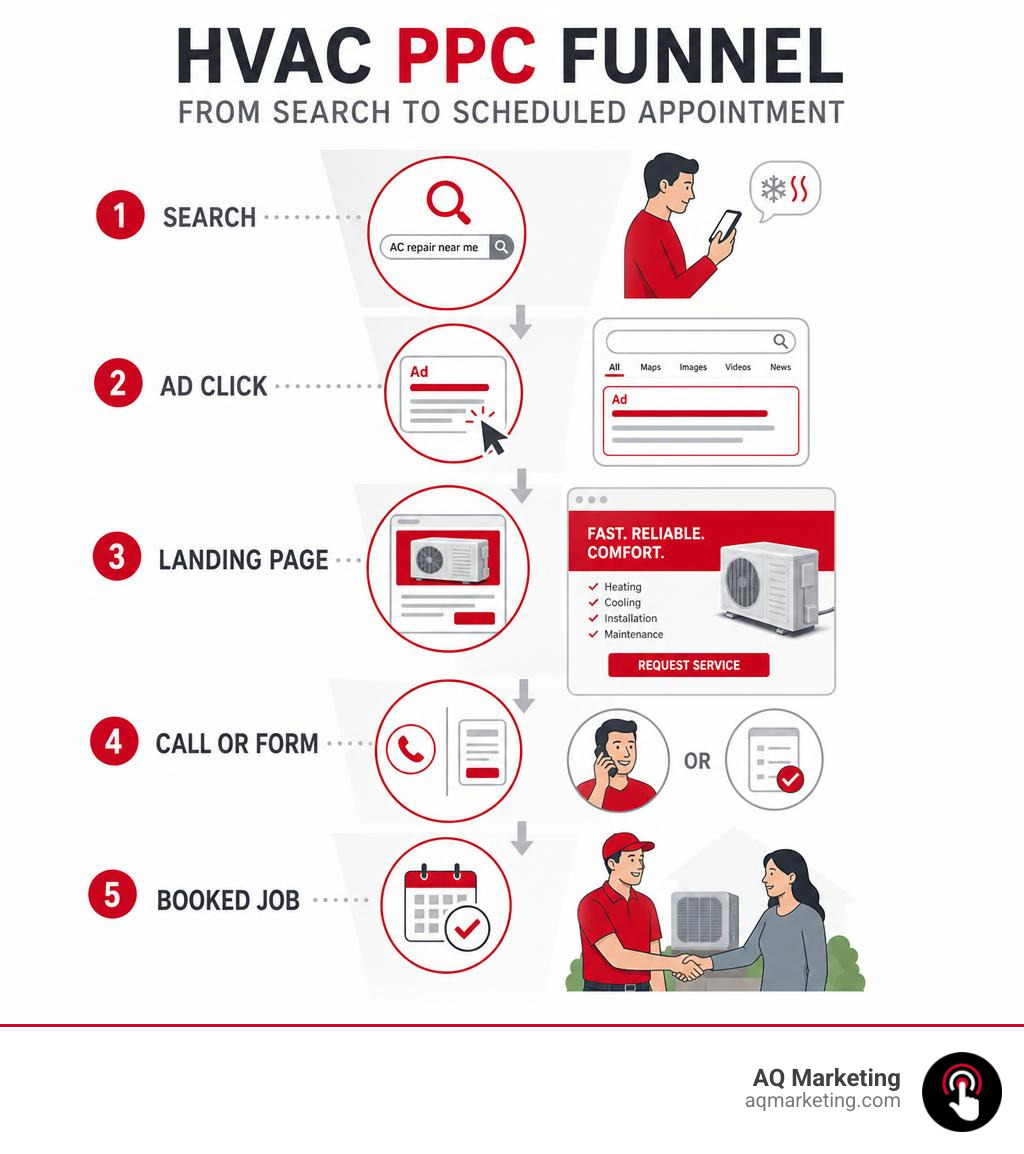
The core benefit in one sentence: When a homeowner’s AC fails at 7pm in July and they search “AC repair near me,” a well-run PPC campaign puts your phone number at the top of their screen — before they ever scroll to a competitor.
The numbers back this up. Google estimates businesses earn roughly $2 in revenue for every $1 spent on paid ads. PPC traffic also converts at a significantly higher rate than organic traffic — up to 50% more, according to industry data. And the top three paid ads on Google capture nearly 41% of all clicks on a results page.
For HVAC contractors specifically, this matters because demand is urgent and seasonal. A homeowner with a broken furnace in January is not browsing — they’re ready to book. PPC captures that moment. SEO often can’t move fast enough to compete.
That said, PPC isn’t magic. It rewards smart setup, the right keywords, and landing pages built to convert — not just any ad pointed at a homepage.
I’m Robert P. Dickey, President and CEO of AQ Marketing, with over 20 years of experience helping small and mid-sized businesses grow through digital marketing — including managing PPC for HVAC companies and other home service contractors across the New England market. In the sections below, I’ll walk you through everything you need to run smarter, more profitable paid ad campaigns.
Must-know ppc for hvac companies terms:
What PPC for HVAC Companies Is, How It Works, and Where It Fits
HVAC PPC is paid digital advertising designed to generate calls, form fills, chats, and booked appointments for heating and cooling contractors. The most common version is Google Search Ads, where your ad appears when someone searches for a phrase like:
- “AC repair near me”
- “furnace repair Woburn MA”
- “heat pump installation”
- “emergency HVAC service”
- “HVAC maintenance plan”
The big advantage is timing. PPC reaches people while they are actively looking for help, not six months before or after the problem. For HVAC, that matters because many searches are driven by discomfort: no heat, no cooling, strange noises, leaking equipment, poor airflow, or a system that picked the worst possible weekend to quit.
How HVAC PPC Advertising Works for Contractors
PPC works through an ad auction. You choose keywords, write ads, set a budget, and decide where your ads should appear. When someone searches one of your target terms, Google or another ad platform evaluates your bid, ad quality, landing page, and relevance.
The winning ads usually earn the most visible spots.
Key pieces include:
- Keyword bidding: You bid on searches related to your HVAC services.
- Cost per click: You pay when someone clicks your ad, not when they merely see it.
- Ad rank: Your position depends on bid, Quality Score, expected click-through rate, and landing page experience.
- Call extensions: Searchers can tap to call directly from mobile results.
- Conversion tracking: You measure calls, forms, chats, and booked jobs.
- Budget control: You can set daily and monthly limits.
A well-built campaign does not just buy traffic. It buys targeted opportunities from people in your service area.
PPC vs SEO for HVAC Companies
PPC and SEO solve different problems.
PPC gives you fast visibility. SEO builds long-term organic presence. PPC is ideal when you need leads now; SEO is essential when you want durable visibility that compounds over time.
| Channel | Best For | Timeline | Main Benefit |
|---|---|---|---|
| PPC | Immediate calls, seasonal demand, promotions | Same day to first week | Fast visibility and measurable leads |
| SEO | Long-term rankings, organic trust, lower dependency on ads | Months | Compounding traffic and credibility |
| Both Together | Full search coverage | Ongoing | More SERP real estate and better lead consistency |
For example, an HVAC company in Woburn, Boston, Worcester, Springfield, or Lowell may use PPC to capture urgent repair leads during a heat wave while SEO supports long-term rankings for service pages and blog content.
For more on paid search strategy, see our guide to paid search marketing campaigns. For long-term visibility, explore our SEO support for local visibility.
When HVAC Contractors Should Use PPC
PPC is especially useful when you want to:
- Generate emergency repair calls quickly
- Enter a new service area
- Promote high-margin installations or replacements
- Keep crews busy during slower shoulder seasons
- Test new offers or services
- Expand into nearby Massachusetts towns
- Increase visibility before peak summer or winter demand
- Fill schedule gaps without waiting for SEO rankings
For many HVAC companies, PPC works best as a flexible throttle. Turn it up when demand and capacity are high. Pull it back when schedules are full.
What HVAC PPC Is Not
PPC is powerful, but it is not a vending machine where you insert ad spend and receive guaranteed profits.
HVAC PPC is not:
- A replacement for SEO
- A substitute for reputation management
- A “set it and forget it” channel
- A reason to send every visitor to your homepage
- A guessing game with broad keywords
- A fix for poor phone answering or weak follow-up
- Automatic profit without tracking and optimization
If your ads generate calls but no one answers the phone, the campaign is not the only problem. Sometimes the leak is in the follow-up, not the faucet. Or in this case, the condensate line.
HVAC PPC Ad Types: Which Channels Generate the Best Leads?

Different PPC channels serve different roles. Search ads and Local Services Ads usually produce the strongest immediate lead intent. Display, remarketing, video, and social ads are better for follow-up, awareness, and nurturing homeowners who are not ready to book yet.
| Ad Type | Best Use Case | Cost Model | Lead Intent |
|---|---|---|---|
| Search Ads | Emergency repair, installs, service calls | Pay per click | Very high |
| Local Services Ads | Trust-based local calls | Pay per lead | Very high |
| Display Ads | Awareness and retargeting | Pay per click or impression | Low to medium |
| Remarketing Ads | Re-engaging site visitors | Pay per click or impression | Medium |
| Video Ads | Education and seasonal awareness | Pay per view or impression | Low to medium |
| Social Ads | Offers, reviews, retargeting | Pay per click or impression | Medium |
Search Ads for High-Intent HVAC Leads
Search ads are often the workhorse of ppc for hvac companies because they target people actively searching for help.
Examples include:
- “AC repair near me”
- “furnace repair near me”
- “same day HVAC service”
- “heat pump installation”
- “boiler repair”
- “emergency heating repair”
These clicks can be expensive, but they often carry strong intent. A homeowner searching “furnace not working” during a New England cold snap is not casually researching. They want warmth, fast.
To learn more about audience and keyword precision, see our resource on targeted PPC advertising.
Local Services Ads for Trust-Based Local Calls
Local Services Ads, often called LSAs, appear above traditional search ads for many home service searches. Instead of paying for every click, contractors generally pay for qualified leads such as calls or messages.
LSAs can include trust signals like:
- Google Guaranteed badge, when eligible
- License and insurance verification
- Review ratings
- Service area
- Business hours
- Direct call options
For HVAC companies, LSAs are especially useful because homeowners often want fast confirmation that a contractor is legitimate, nearby, and available.
Important LSA success factors include:
- Accurate service categories
- Strong reviews
- Fast response times
- Correct business hours
- Clean lead tracking
- Disputing invalid leads when appropriate
Display, Remarketing, and Video Ads for Follow-Up Demand
Not every HVAC buyer converts on the first visit. Someone comparing heat pump installation options may visit several websites before calling. Remarketing helps bring those visitors back.
Display and remarketing ads can promote:
- Seasonal tune-up offers
- Financing options
- Maintenance plans
- Replacement consultations
- Reviews and trust messages
Google’s Display Network reaches a huge share of internet users across websites, apps, and YouTube. That reach is useful, but HVAC companies should avoid blasting everyone. Frequency caps, audience segmentation, and clear offers help prevent “why is this ad following me into my recipe blog?” syndrome.
For deeper setup guidance, review our remarketing campaign setup guide.
Social PPC for Residential Awareness and Retargeting
Social ads on Facebook and Instagram are usually not as intent-heavy as Google Search Ads. People scrolling social media are not always looking for furnace repair at that exact second.
But social PPC can work well for:
- Homeowner awareness
- Seasonal tune-up reminders
- Review-based creative
- Before-and-after visuals
- Retargeting website visitors
- Promoting maintenance memberships
- Reaching lookalike homeowner audiences
For residential HVAC, social ads often support the middle of the funnel. They keep your brand visible before the urgent need appears. Learn more about our social media advertising services.
Building PPC for HVAC Companies With Keywords, Geo-Targeting, and Campaign Structure
A profitable HVAC PPC campaign starts with structure. If repair, installation, maintenance, residential, and commercial terms all live in one messy campaign, performance gets cloudy fast.
For more local HVAC strategy, see our guide to 6 local SEM strategies for HVAC companies.
Keyword Strategy for PPC for HVAC Companies
Strong campaigns group keywords by service and intent.
High-intent HVAC keyword groups include:
- Emergency repair: emergency HVAC repair, 24 hour furnace repair, AC stopped working
- Standard repair: AC repair, furnace repair, boiler repair, heat pump repair
- Installation: AC installation, furnace installation, heat pump installation
- Replacement: replace central air, furnace replacement, new HVAC system
- Maintenance: HVAC tune-up, AC maintenance, furnace inspection
- Commercial HVAC: commercial HVAC contractor, rooftop unit repair, HVAC maintenance for buildings
- Residential HVAC: home AC repair, residential furnace service
- Near me terms: HVAC near me, AC repair near me
- City modifiers: HVAC repair Woburn MA, furnace repair Boston MA
- Manufacturer terms: brand-specific repair or installation searches, where appropriate
Long-tail keywords often convert better than broad terms. “Emergency furnace repair in Woburn MA” is more specific than “HVAC,” and specificity usually helps both relevance and lead quality.
Match Types and Negative Keywords
Match types control how closely a search must match your keyword.
- Exact match: Best for your most valuable terms.
- Phrase match: Useful for controlled expansion.
- Broad match: Can work with strong data and negative keywords, but should be used carefully.
Negative keywords are just as important as target keywords. They prevent your ads from showing for searches that are unlikely to become customers.
Common HVAC negative keyword themes include:
- Jobs
- Careers
- Salary
- Training
- Certification
- School
- DIY
- How to
- Parts
- Wholesale
- Manual
- Used equipment
- Free classes
Search term reports should be reviewed regularly, especially in the first 30 to 90 days. That is where you find the odd searches eating budget. Google is smart, but it occasionally needs adult supervision.
Local Geo-Targeting for PPC for HVAC Companies
HVAC is local. Paying for clicks outside your service area is one of the fastest ways to waste money.
Geo-targeting can include:
- Radius around your shop
- Cities and towns
- ZIP codes
- Counties
- Excluded areas
- Location-based keywords
- Mobile bid adjustments
- Weather and seasonal demand patterns
For AQ Marketing clients across Massachusetts communities such as Woburn, Burlington, Lexington, Winchester, Medford, Stoneham, Boston, Worcester, Springfield, and surrounding service areas, local targeting should match real dispatch capacity.
If you do not serve a town, exclude it. If you want more installs in a specific suburb, build campaigns and landing pages around that area.
For more practical local campaign ideas, read our guide to local Google Ads tactics.
Campaign Structure by Service Line and Season
HVAC demand changes with the calendar. In Massachusetts, cooling searches climb in warm months, while heating searches spike in cold weather.
A clean structure might include:
- AC repair campaign
- Furnace repair campaign
- Heat pump campaign
- Installation and replacement campaign
- Maintenance and tune-up campaign
- Emergency HVAC campaign
- Commercial HVAC campaign
- Brand campaign
- Remarketing campaign
Seasonal adjustments matter. Summer budgets may prioritize AC repair and replacement. Winter budgets may shift toward furnaces, boilers, and emergency heating. Shoulder seasons are ideal for tune-ups, maintenance plans, and replacement consultations.
Emergency campaigns may run after hours. Maintenance campaigns may perform better during business hours.
Residential vs Commercial HVAC PPC Strategies
Residential and commercial HVAC PPC require different messaging.
Residential PPC usually targets:
- Homeowners
- Urgent repairs
- Same-day service
- Financing
- Seasonal comfort
- Reviews and trust signals
- Easy online booking or click-to-call
Commercial PPC often targets:
- Facility managers
- Property managers
- Business owners
- Preventive maintenance contracts
- Rooftop units
- Multi-location service
- Longer buying cycles
- Technical service needs
Commercial HVAC keywords may have lower search volume but higher job value. Landing pages should speak to reliability, documentation, maintenance contracts, response times, and experience with commercial systems.
Landing Pages, Quality Score, and Conversion Assets That Turn Clicks Into Calls
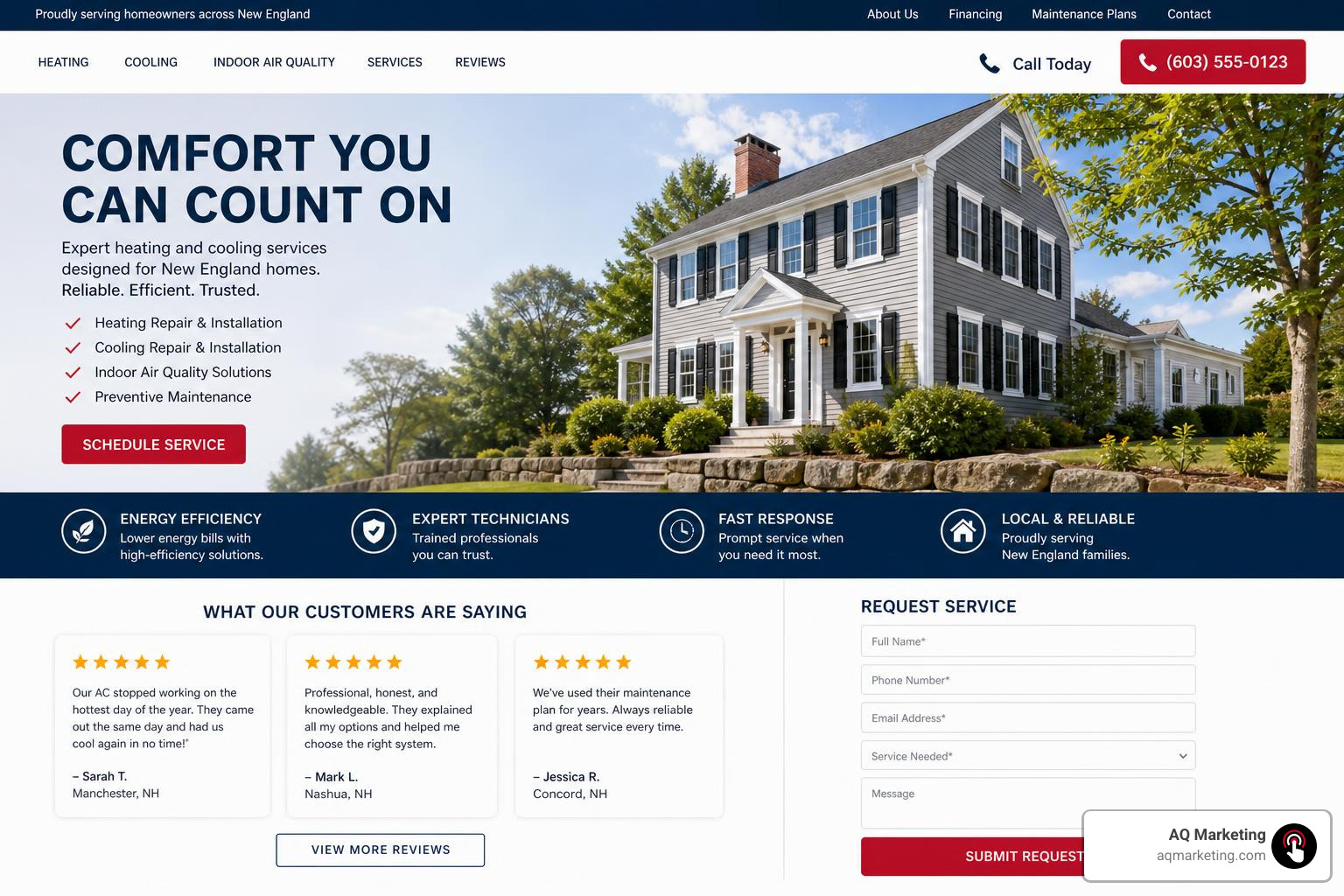
Clicks are not the finish line. Booked jobs are.
A strong PPC campaign needs conversion assets: landing pages, call tracking, fast mobile load times, clear forms, chat options, and follow-up workflows.
Dedicated Landing Pages Beat Generic Homepages
Sending paid traffic to a homepage often weakens conversion rates because the visitor has to hunt for what they need.
A better approach is to use dedicated landing pages by service and location.
A strong HVAC PPC landing page should include:
- Service-specific headline
- City or service-area relevance
- Click-to-call button above the fold
- Short form
- Reviews or testimonials
- License and insurance information, where applicable
- Financing or promotion details
- Clear service benefits
- Fast mobile loading
- One primary call to action
If the ad says “Emergency Furnace Repair,” the landing page should not open with a generic “Welcome to Our Company” message. Match the emergency.
Need better conversion-focused pages? Explore our website design and development services.
Quality Score and Ad Rank for HVAC PPC
Quality Score is Google’s measure of how useful and relevant your ad experience is. It is influenced by:
- Expected click-through rate
- Ad relevance
- Landing page experience
- Keyword alignment
- Page speed
- Search intent match
Higher Quality Scores can help improve ad position and reduce cost per click. In plain English: better relevance can make your budget work harder.
If your keyword is “AC repair Woburn MA,” your ad and landing page should clearly talk about AC repair in that area. Relevance is not fancy. It is just giving people what they searched for.
Ad Copy and Extensions That Increase Calls
Good HVAC ad copy is specific, local, and action-oriented.
Useful elements include:
- Emergency wording for urgent searches
- Same-day or fast-response messaging when accurate
- Local town or region cues
- Financing mentions for replacements
- Review or rating references when eligible
- Clear calls to action
- Service-specific benefits
Ad extensions can improve visibility and calls:
- Call extensions
- Location extensions
- Sitelinks
- Callouts
- Structured snippets
- Review assets, where available
Test multiple CTAs such as “Call Now,” “Schedule Service,” “Book Repair,” and “Request Estimate.” Small copy changes can make a real difference.
Tracking Calls, Forms, Chats, and Booked Jobs
The best PPC reporting goes beyond clicks.
Track:
- Phone calls
- Form submissions
- Chat leads
- Booked appointments
- Canceled or unqualified leads
- Revenue by campaign
- Cost per booked job
- Lead-to-job close rate
Dynamic number insertion can show which keyword or ad drove a phone call. CRM source tags help connect leads to booked revenue. Offline conversion imports can help Google optimize toward real customers, not just button clicks.
If you are preparing a new account, start with proper tracking. Our Google Ads account setup guide explains the basics.
Budgets, ROI, Optimization, and Management Decisions
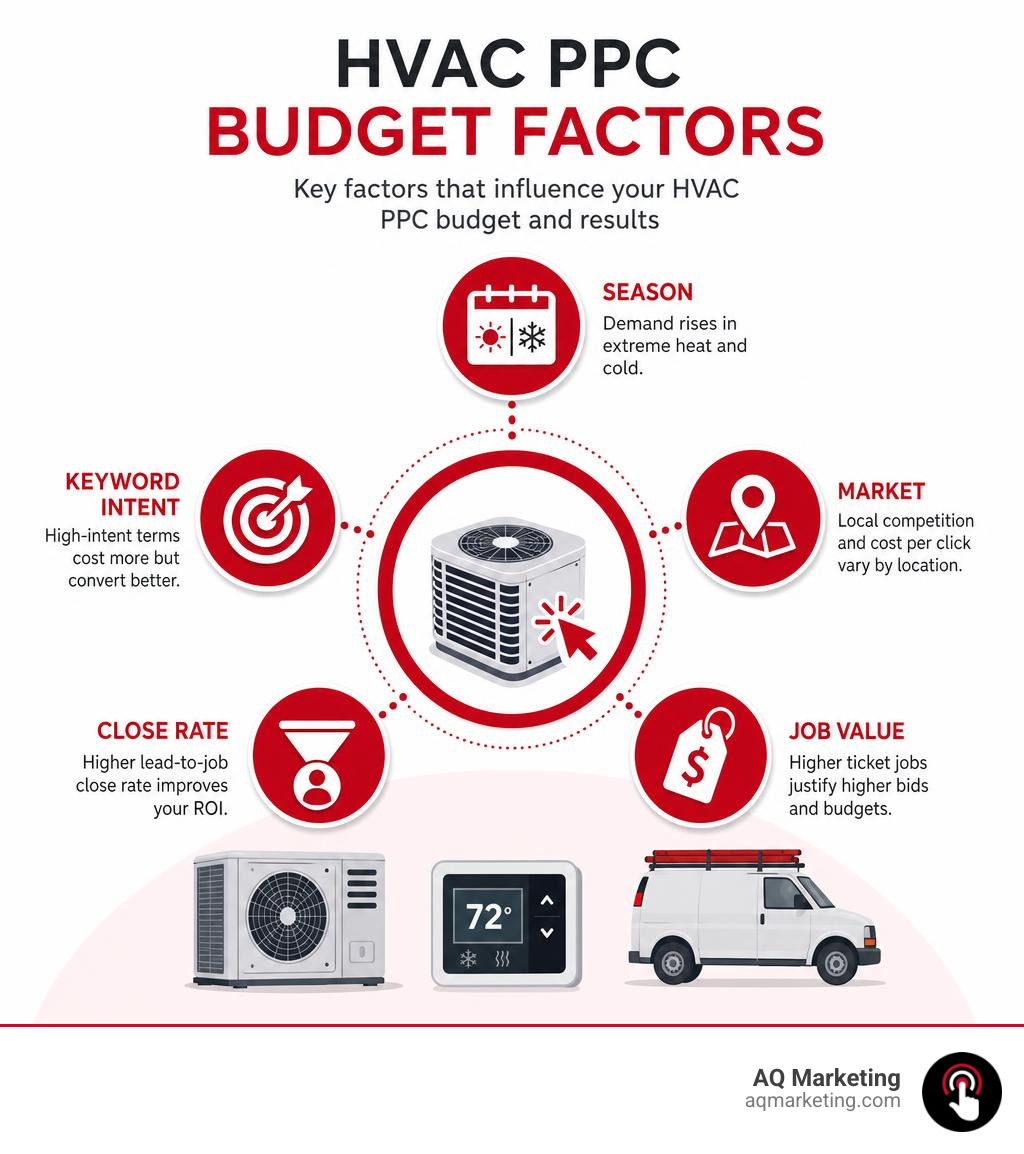
HVAC PPC performance depends on market competition, season, service mix, landing pages, phone handling, and follow-up. Budget alone does not guarantee results.
For a broader foundation, see our PPC campaign best practices.
Typical HVAC PPC Costs and ROI Expectations
Important pricing note: The ranges below are based on average online industry data and general market observations. They do not represent AQ Marketing’s actual pricing.
Typical HVAC PPC ranges found across industry data include:
| Metric | Common Online Range |
|---|---|
| Cost per click | $5 to $75+ |
| Cost per lead | $50 to $300+ |
| Monthly ad budget | $500 to $10,000+ |
| PPC management fees | Widely variable depending on scope |
| Customer acquisition cost | Often estimated around $200 to $300 in industry references |
Competitive metro areas and peak seasons can push costs higher. Emergency repair clicks may cost more than maintenance clicks, but they may also close faster. Installation leads can be more expensive, yet the job value may be much higher.
Google’s common benchmark says businesses average about $2 in revenue for every $1 spent on ads. That is a helpful reference, not a guarantee. Your true ROI depends on close rate, average ticket, margins, and lead quality.
KPIs That Matter Most
Clicks are useful, but they are not the whole story.
Track these KPIs:
- Cost per lead
- Cost per booked job
- Conversion rate
- Click-through rate
- Cost per click
- Impression share
- Quality Score
- Return on ad spend
- Lead-to-job close rate
- Revenue per lead
- Phone answer rate
- Missed call rate
For HVAC companies, phone answer rate is huge. If 70% of urgent leads call and half go unanswered, PPC performance will look worse than it really is.
Negative Keywords, Retargeting, and Automation Tools
Optimization is ongoing.
Use negative keywords to block waste. Use retargeting to bring back non-converting visitors. Use automation carefully once the account has enough conversion data.
Helpful tools and tactics include:
- Weekly search term reviews
- Negative keyword expansion
- Remarketing audiences by page type
- Smart bidding
- Target CPA
- Maximize Conversions
- Automated rules
- Call-only campaigns
- Budget pacing
- Seasonal bid adjustments
Automation works best when tracking is clean. If the system is optimizing toward low-quality form fills, it will happily find more low-quality form fills. Robots are efficient, not psychic.
Before launching, review our checklist of 7 things before launching PPC.
In-House vs Agency PPC Management
You can manage HVAC PPC in-house, but it requires time, platform knowledge, tracking setup, and frequent optimization.
Consider these decision factors:
- Internal marketing time available
- Google Ads experience
- Tracking and analytics knowledge
- Landing page support
- Copywriting ability
- Budget size
- Seasonal strategy needs
- Reporting expectations
- CRM integration needs
- Local market knowledge
- Accountability and communication
- Growth goals
In-house can work for companies with a trained marketer and enough time. An agency can help when you need strategy, technical setup, landing pages, reporting, and ongoing optimization without pulling your team away from operations.
Frequently Asked Questions About HVAC PPC
How quickly can HVAC PPC start producing leads?
HVAC PPC can create visibility as soon as campaigns are approved and launched. Many contractors can begin receiving impressions and clicks within the first week.
However, better performance usually develops over 30 to 90 days as data builds. During that period, we look at search terms, add negative keywords, refine bids, improve ads, and adjust landing pages.
Think of month one as learning, month two as cleanup, and month three as smarter scaling.
Are Google Ads or Facebook Ads better for HVAC leads?
For immediate HVAC leads, Google Search Ads and Local Services Ads usually perform better because they capture active intent. Someone searching “emergency furnace repair near me” is much closer to booking than someone scrolling through vacation photos.
Facebook and Instagram can still be valuable for:
- Retargeting website visitors
- Promoting tune-ups
- Building brand awareness
- Sharing reviews
- Reaching homeowner audiences
- Supporting seasonal offers
The strongest strategy often combines both: Google for urgent demand, social for awareness and follow-up.
Do HVAC companies still need SEO if they run PPC?
Yes. PPC and SEO work best together.
PPC delivers speed. SEO builds long-term visibility and trust. Organic rankings, helpful content, local pages, Google Business Profile optimization, and reviews all support your ability to earn leads without paying for every click.
Over time, strong SEO can reduce dependency on paid ads. PPC can fill the gap while SEO grows, support peak seasons, and test which keywords convert before investing in long-term content.
For local visibility support, see our business profile management services.
Conclusion: Turn Paid Clicks Into Booked HVAC Jobs
PPC for HVAC companies works because it meets homeowners and property decision-makers at the exact moment they need help. The best campaigns are not just ads. They are systems built around keywords, local targeting, landing pages, call tracking, CRM workflows, reviews, and ongoing optimization.
At AQ Marketing, we help small and mid-sized businesses build digital marketing programs designed for long-term, measurable growth. Since 2003, our team has supported businesses with Google Advertising, Social Media Advertising, SEO, website design, content, reputation building, Google Business Profile marketing, CRM workflows, AI webchat, and lead generation systems.
If you want more HVAC leads, better tracking, and a strategy built around booked jobs instead of vanity clicks, we can help.
Start here: Explore PPC advertising services


