
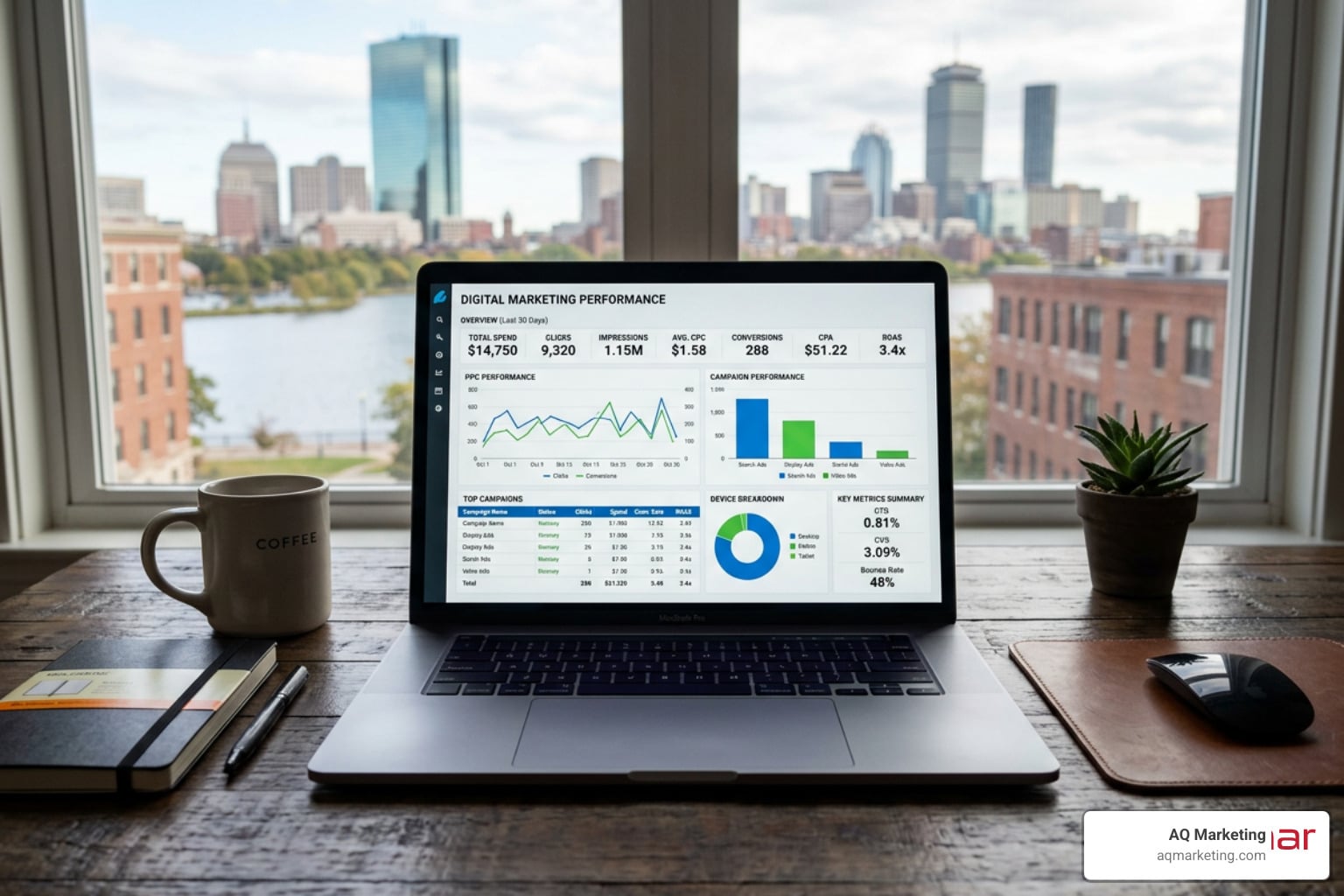
What Is Pay Per Click? Your Quick Answer First
What is pay per click (PPC) is something millions of business owners search for every day — and the answer is simpler than you might think.
Pay-per-click (PPC) advertising is a digital advertising model where you pay a fee each time someone clicks on your ad. You only pay for actual clicks — not for how many times your ad is shown.
Here’s the core idea at a glance:
| Term | What It Means |
|---|---|
| PPC | Pay-per-click — you pay only when someone clicks your ad |
| CPC | Cost-per-click — the dollar amount you pay per click |
| Ad Auction | The real-time process that decides which ads show up and where |
| Quality Score | A rating (1–10) that measures how relevant your ad is |
| SERP | Search Engine Results Page — where your ads appear |
In plain terms: you set a budget, target the right people, and only pay when someone is interested enough to click. That’s the whole model.
PPC is one of the fastest ways for a small business to get in front of potential customers — right now, not months from now. Whether you run a home services company, an insurance agency, or a fitness studio, PPC puts your business at the top of search results while you’re still building long-term organic visibility.
According to industry data, PPC advertising brings in an average of $2 for every $1 spent — with an average cost per click of just $1.16. Google alone processes over 99,000 search queries every second, which means the opportunity to reach your audience is enormous.
I’m Robert P. Dickey, President and CEO of AQ Marketing, and I’ve spent over 20 years helping small and medium-sized businesses navigate the digital marketing landscape — including what is pay per click and how to make it work without wasting budget. In this guide, I’ll walk you through everything you need to know to understand PPC and use it strategically for your business.
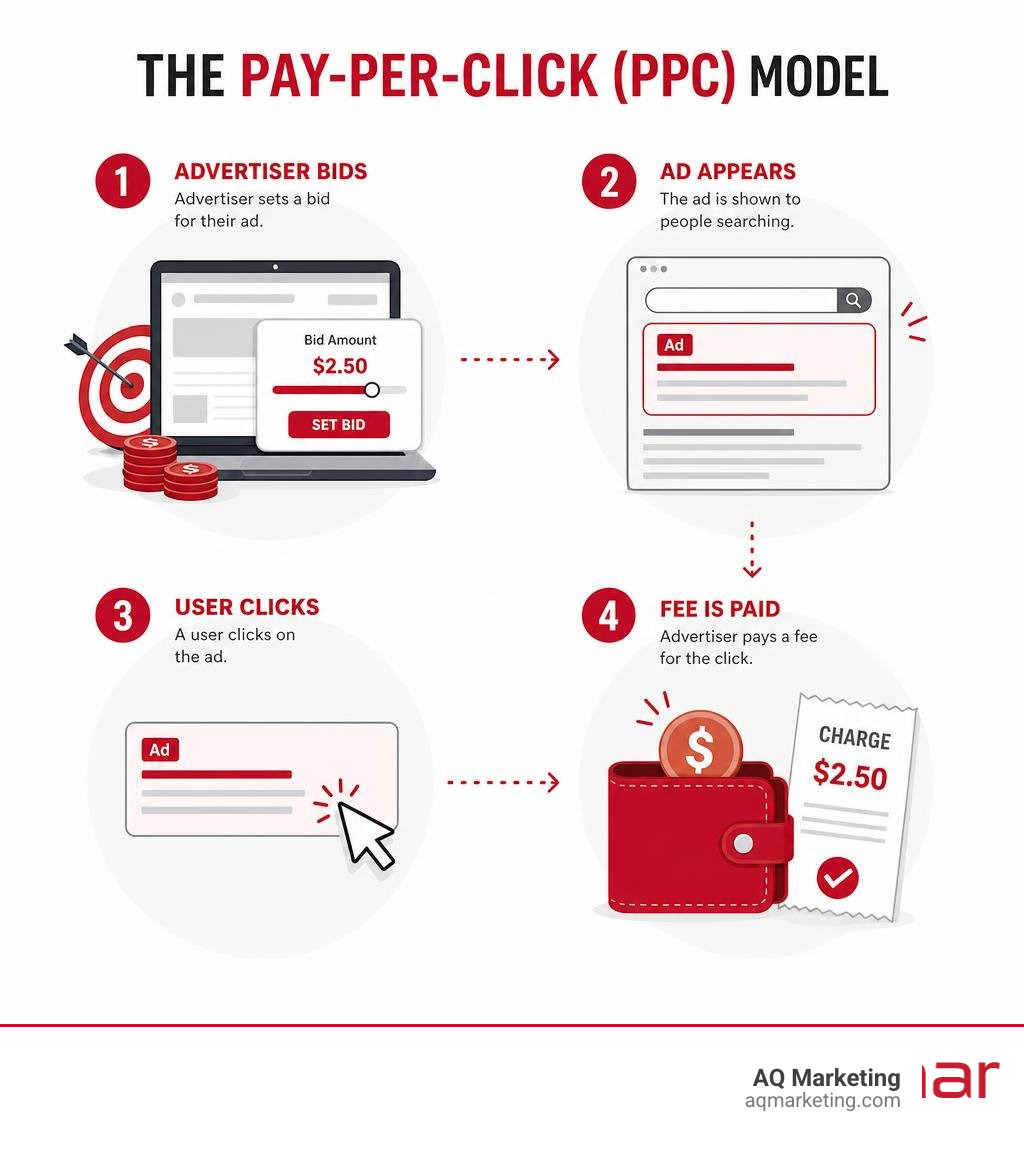
Basic what is pay per click vocab:
- Pay Per Click Advertising
- PPC Targeting Ultimate Guide
- PPC for Start-ups
Demystifying the Basics: What Is Pay Per Click?
To understand how digital advertising drives immediate growth, we must first break down the core mechanics of Pay-per-click (PPC).
At its heart, pay-per-click is a partnership between advertisers and publishers. The advertiser (your business) wants to reach a specific audience. The publisher (a search engine like Google, or a social media network like Facebook) has the audience’s attention. Instead of paying a flat fee to display a banner indefinitely — similar to buying a physical billboard on Route 128 in Massachusetts — you only pay the publisher a fee when a user takes a specific action: clicking on your ad.
This fee is called the cost-per-click (CPC). If 10,000 people see your ad while searching for “plumber in Woburn, MA” but only 10 people click on it, you are only billed for those 10 clicks. This makes PPC an incredibly cost-effective and highly measurable digital advertising model compared to traditional print, radio, or television ads, where you pay for estimated exposure rather than guaranteed engagement.
Understanding What Is Pay Per Click in Modern Marketing
In modern digital marketing, think of PPC as renting highly targeted digital real estate. When you want to find the best local services, you turn to search engines. If a business bids on the search terms you use, their ad appears right at the top of your search results.
By utilizing What Is PPC? Learn the Basics of Pay-Per-Click Marketing, businesses can bypass the waiting game associated with organic growth. Instead of hoping a search engine notices your website, you buy your way to the top of the search engine results page (SERP). This provides a predictable stream of targeted traffic composed of users who are actively searching for exactly what you sell.
For small to medium-sized businesses throughout Massachusetts — from Cape Cod up to Amesbury — this model levels the playing field. A local service provider can stand side-by-side with national brands simply by out-strategizing them on keyword relevance and local intent.
PPC vs. SEO vs. SEM: Knowing the Difference
It is common to hear the terms PPC, SEO, and SEM used interchangeably, but they represent very different pillars of search engine marketing. Understanding how they interact is crucial for building a balanced digital strategy.
- PPC (Pay-Per-Click): A paid model where you purchase immediate traffic. Your ads appear in designated “Sponsored” areas of search results or social media feeds. The moment you pause your budget, the traffic stops.
- SEO (Search Engine Optimization): The practice of optimizing your website’s content, technical setup, and authority to earn high rankings in the organic (unpaid) search results. While SEO takes time and consistent effort, it provides long-term, compounding traffic without a direct cost-per-click. To explore this comparison in detail, read our breakdown of SEO vs PPC What’s the Difference.
- SEM (Search Engine Marketing): An umbrella term that historically encompassed both paid search (PPC) and organic search (SEO). Today, many marketers use SEM specifically to refer to paid search efforts. You can learn more about how we structure these campaigns by visiting our Search Engine Marketing Services page.
By combining immediate paid visibility with steady organic growth, Massachusetts businesses can dominate both the sponsored and organic sections of search results.
How Pay-Per-Click Advertising Works
Many business owners assume that the advertiser who is willing to pay the most money always gets the top spot on search results. Fortunately, that is not how modern search engines operate. Instead, platforms like Google use a highly sophisticated, instantaneous ad auction to determine which ads display and in what order.

Every time a user types a search query into Google, an automated auction takes place in milliseconds. The search engine evaluates all eligible advertisers bidding on those terms and calculates which ads are most likely to provide a high-quality experience for the user. To learn more about how this ecosystem operates, you can read What Is Pay-Per-Click (PPC) Marketing?.
The Mechanics of the Real-Time Ad Auction
The ad auction begins when a user submits a search query. The search engine’s algorithm instantly pulls all ads targeting keywords matching that query. To decide which ads to display and how to rank them, the platform calculates an Ad Rank for each participant.
Ad Rank is determined by combining several key factors:
- Your Maximum Bid: The highest amount you have specified you are willing to pay for a single click.
- Your Quality Score: A metric measuring the overall quality and relevance of your ad campaign.
- Ad Extensions and Formatting: The expected impact of additional information included in your ad, such as phone numbers, location links, or extra site pages.
Because of this auction formula, a highly relevant ad with a lower bid can easily outrank a poorly written ad with a massive budget.
How Search Engines Determine What Is Pay Per Click Cost
Your actual cost-per-click is calculated dynamically during every single auction. Google uses a generalized second-price auction model, meaning you do not necessarily pay your maximum bid. Instead, you only pay the minimum amount required to beat the Ad Rank of the advertiser directly below you.
The formula generally looks like this:
Your Price = (Ad Rank of the competitor below you / Your Quality Score) + $0.01
As a result, your Quality Score acts as a direct lever for cost control. The higher your Quality Score, the less you have to pay to maintain a top position. This score is evaluated on a scale of 1 to 10 and is heavily influenced by three pillars:
- Expected Click-Through Rate (CTR): How likely Google thinks users are to click your ad.
- Ad Relevance: How closely your ad copy matches the user’s search query.
- Landing Page Experience: How helpful, fast, and easy-to-navigate your website is once a user clicks through.
Flat-Rate vs. Bid-Based PPC Models
While most major search platforms use the bid-based model described above, there are two primary structures for pay-per-click campaigns:
- Bid-Based PPC: Advertisers compete in real-time auctions. Your CPC fluctuates based on competitor activity, search volume, and Quality Score. This is the model used by Google Ads, Microsoft Advertising, and most social media networks.
- Flat-Rate PPC: The advertiser and the publisher agree on a fixed rate for every click. This is common on local directory sites, niche industry comparison portals, and specialized publisher networks. Regardless of search trends or competition, you pay a set fee (e.g., $2.00 per click) for every visitor sent to your site.
The Core Types of PPC Ads and Platforms
PPC is not a one-size-fits-all channel. Depending on where your potential clients spend their time online, you can choose from various ad formats and platforms to maximize your reach.
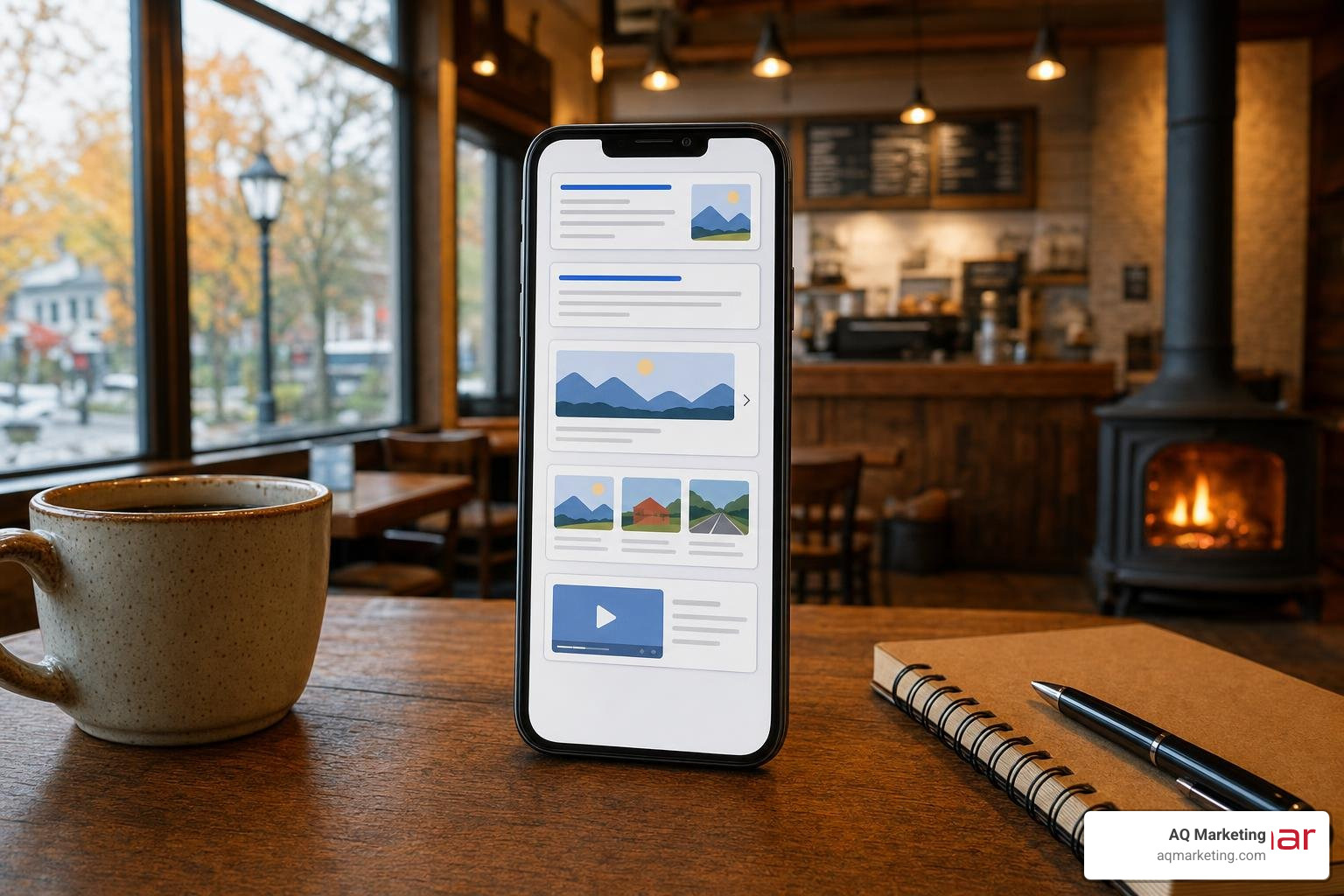
To get a comprehensive overview of how to structure these campaigns across different channels, check out What is PPC? A starter guide to pay-per-click advertising.
Search, Display, and Shopping Ads
These are the three foundational pillars of search-engine-based paid advertising:
- Search Ads: These are traditional text-based ads that appear at the very top and bottom of search engine results pages. They are highly effective because they target users with immediate purchase intent. For instance, someone searching for “emergency roof repair in Andover, MA” is actively looking to hire a professional immediately.
- Display Ads: These visual banner ads appear across millions of partner websites within the Google Display Network. Unlike search ads, display ads are excellent for building brand awareness and introducing your business to prospects who may not be actively searching for you yet.
- Shopping Ads: Crucial for e-commerce brands, shopping ads display a product image, price, and business name directly in search results, allowing users to compare products visually before clicking.
Social Media Ads vs. Search Ads
While search ads capture active intent, social media ads on platforms like Facebook, Instagram, LinkedIn, and TikTok focus on demographic and behavioral targeting.
On social networks, users are not actively searching for a service; instead, they are browsing content. Social media ads slide seamlessly into their feeds based on their interests, job titles, location, and online behavior. For example, an insurance agency in Woburn might target parents within a 15-mile radius with ads about life insurance policies. To understand which approach fits your goals, explore our comparison of Social Media Ads vs Search Ads What’s the Difference.
Strategic Benefits of PPC for Growing Businesses
For small to medium-sized businesses aiming to scale, PPC provides an unparalleled level of control and speed. It acts as a digital catalyst, driving immediate visibility while your long-term organic strategies take root.
Instant Visibility and Targeted Reach
Unlike organic search optimization, which requires months of consistent content creation and technical refinement to rank, a PPC campaign can go live and start sending targeted visitors to your website within hours.
Furthermore, the targeting capabilities of modern PPC platforms are incredibly precise. You can filter your audience by:
- Geography: Target specific cities and towns in Massachusetts, such as Woburn, Boston, Burlington, or Newton.
- Demographics: Filter by age, gender, household income, or parental status.
- Devices: Show your ads only to mobile users, which is highly effective for emergency services like towing or plumbing.
- Timing: Run your ads only during business hours when your staff is available to answer phone calls.
Measurable ROI and Cost Control
One of the greatest advantages of pay-per-click advertising is absolute measurability. With tracking tools like Google Analytics, you can see exactly which keyword led to a click, which ad copy prompted the user to call, and how much it cost to secure that customer.
This transparency allows for strict cost control. You can set a firm daily budget (e.g., $20 per day) and rest assured that you will never spend a penny over that limit. If a campaign is performing exceptionally well and generating a high return on ad spend (ROAS), you can scale your budget upward. If a specific keyword is costing money without generating leads, you can pause it instantly.
Setting Up and Managing a High-Performing Campaign
Building a successful campaign requires a strategic approach that aligns your keywords, your ad copy, and your landing pages. Here is how we structure campaigns to ensure maximum return on investment.
Defining Goals and Audience Targeting
Before writing a single line of ad copy, you must define what success looks like. Are you looking to generate phone calls for a local service business, secure registrations for a local event, or build brand awareness for a new product launch?
Once your goals are set, you can map out your audience targeting. For local service providers in Massachusetts, geo-targeting is critical. If your service area is limited to the North Shore, you do not want to waste budget displaying ads to users in Western Massachusetts. By narrowing your geographic targeting to specific towns like Peabody, Danvers, and Beverly, you protect your budget and ensure every click comes from a viable lead.
Keyword Research and Negative Keywords
Keyword research is the foundation of any search campaign. We focus on identifying high-intent, long-tail keywords—longer, more specific search phrases that indicate a user is close to making a buying decision. For example, instead of bidding on the broad and expensive term “lawyer,” a practice might target “family law attorney in Amherst, MA.”
Equally important is the creation of a robust negative keyword list. Negative keywords prevent your ads from showing up for search terms that are irrelevant to your business. If you are a premium website design agency, you might add negative keywords like “free,” “cheap,” or “DIY.” This prevents you from paying for clicks from users who have no intention of hiring a professional.
For example, local campaigns like those for a Digital Marketing Agency Serving Amesbury Businesses or specialized legal services such as Law Firm PPC Advertising Amherst Center rely heavily on precise keyword filtering to maximize ROI.
Landing Page Optimization and Quality Score
The click is only the first half of the journey. What happens after the click is what determines your conversion rate and your ultimate cost-per-click.
When a user clicks your ad, they should land on a dedicated, highly relevant page designed specifically to answer their search query. Sending paid traffic to your homepage is a common mistake; homepages are often too broad and distract visitors. Instead, send them to a page that matches the exact promise of the ad, featuring:
- A clear, compelling headline.
- A prominent call-to-action (like a phone number or a simple contact form).
- Fast loading times and absolute mobile responsiveness.
- Trust signals, such as local reviews or industry credentials.
By optimizing this post-click experience, you boost your Quality Score, lower your cost-per-click, and convert more casual visitors into paying clients.
Frequently Asked Questions About PPC
To help you gain complete clarity on how to leverage paid search for your business, we have compiled answers to some of the most common questions we receive from business owners in Massachusetts.
What is a good cost per click (CPC) in 2026?
A “good” cost-per-click varies wildly depending on your industry, geographic location, and level of competition. High-value industries (like legal services or commercial HVAC) naturally command higher CPCs because a single converted lead can translate into thousands of dollars in revenue.
The table below outlines average online industry data for CPC ranges across various sectors in 2026.
Please note: This data is based on general online marketing averages and does not represent AQ Marketing’s actual pricing.
| Industry Sector | Average CPC (Online Data) | Typical High-End CPC Range |
|---|---|---|
| Home Services (Plumbing, Electrical) | $4.50 | $15.00 – $25.00+ |
| Professional Services (Legal, Finance) | $6.50 | $20.00 – $45.00+ |
| Local Retail & E-commerce | $1.20 | $4.00 – $8.00+ |
| Real Estate & Property Management | $2.10 | $7.00 – $12.00+ |
As a general rule, a good CPC is one that allows you to maintain a healthy profit margin based on your average customer lifetime value and conversion rates.
How does Quality Score affect my ad spend?
Quality Score is Google’s way of ensuring that searchers see relevant ads. It acts as a discount mechanism for high-quality advertisers.
If your Quality Score is high (e.g., 8 to 10), Google rewards you by lowering your actual cost-per-click and giving your ad better placement on the page. If your Quality Score is low (e.g., 1 to 3), you will be penalized with significantly higher costs-per-click, and your ads may not show up at all. Keeping your keywords, ad copy, and landing pages tightly aligned is the best way to keep this score high and your costs low.
Can small businesses succeed with a small PPC budget?
Absolutely. One of the greatest myths in digital marketing is that you need a multi-million dollar budget to compete in PPC.
Small businesses can succeed on modest budgets by being highly strategic:
- Hyper-Local Targeting: Instead of targeting the entire state of Massachusetts, focus only on the specific zip codes or towns you can easily service.
- Niche Keywords: Avoid broad, highly competitive keywords. Target specific, long-tail search terms that larger competitors might overlook.
- Ad Scheduling: Run your ads only during peak hours of the day when you are ready to answer the phone and close the lead immediately.
Conclusion
Understanding what is pay per click is the first step toward transforming your business’s online presence. When executed with precision, PPC is not an expense—it is a highly controllable, measurable asset that drives immediate visibility, high-quality leads, and long-term business growth.
At AQ Marketing, based in Woburn, MA, we have spent over two decades helping small to medium-sized businesses across Massachusetts navigate the complexities of digital marketing. From professional website design and strategic search engine optimization to high-performing paid advertising campaigns, our mission is to deliver long-term, impactful results that help your business thrive.
Ready to stop guessing and start growing? Book a 15-Minute Phone Call with us today, and let’s build a tailored PPC strategy that works for your business.


