

Why PPC Google Ads Still Matter for Small Business Growth
PPC Google Ads remain one of the most powerful ways for small and medium-sized businesses to get in front of customers who are actively searching for what they sell — right now, not months from now.
Quick answer: What is PPC Google Ads?
| Term | What it means |
|---|---|
| PPC | Pay-Per-Click — the payment model where you only pay when someone clicks your ad |
| Google Ads | Google’s advertising platform that uses the PPC model across Search, Display, YouTube, Shopping, and more |
| How it works | You bid on keywords → Google runs an auction → your ad shows to relevant searchers → you pay per click |
| Why it works | 63% of people click on Google Ads when they’re ready to buy, and businesses earn an average of $2 for every $1 spent |
Think of PPC as the model and Google Ads as the machine that runs it.
Google processes 8.5 billion searches every day. A well-run Google Ads campaign puts your business directly in front of the people making those searches — specifically the ones looking for exactly what you offer.
But here’s the catch: running ads and running them well are two very different things. Many business owners burn through their budget quickly and walk away thinking Google Ads doesn’t work. Usually, the problem isn’t the platform — it’s the strategy.
I’m Robert P. Dickey, President and CEO of AQ Marketing, Inc., and over my 20+ years in digital marketing I’ve helped countless small and mid-sized businesses turn underperforming PPC Google Ads accounts into consistent lead-generation engines. In this guide, I’ll break down exactly how the platform works and what it takes to stop wasting money and start getting real results.
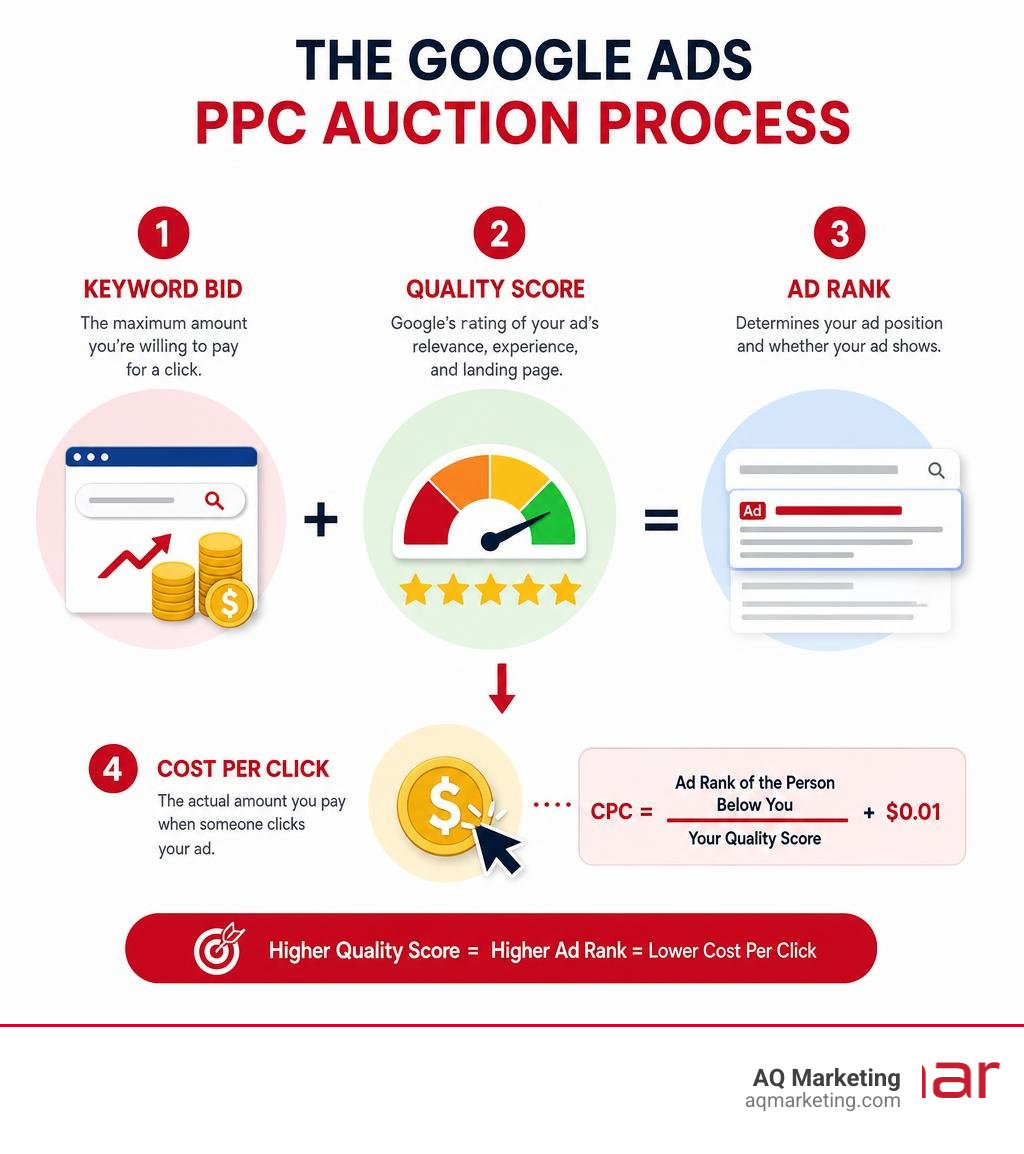
Ppc google ads vocab to learn:
Demystifying PPC Google Ads: Platform vs. Model
To get the most out of your digital marketing budget, it is critical to understand the distinction between the payment model and the software platform.
Many business owners use “PPC” and “Google Ads” interchangeably, but they are not the same thing. PPC (Pay-Per-Click) is a broad digital advertising model. It is a billing mechanism where you only pay the hosting platform when a user actively clicks on your advertisement. This model is used by various search engines and social media networks.
Google Ads, on the other hand, is Google’s proprietary advertising platform. It is the most widely used PPC engine in the world, serving ads across Google Search, the Google Display Network, YouTube, Google Shopping, and Google Maps.
| Feature | PPC (The Model) | Google Ads (The Platform) |
|---|---|---|
| Definition | An advertising payment mechanism. | A specific advertising tool owned by Google. |
| Scope | Includes Google, Microsoft Advertising, Facebook, LinkedIn, etc. | Limited to Google’s search and partner networks. |
| Control | Dictates how you pay for traffic (cost-per-click). | Dictates where and how your ads appear using targeting algorithms. |
When we talk about targeted PPC advertising, we are talking about using these platforms to match user intent with your business offerings. If you run a local home services business in Woburn, MA, or an insurance agency in Boston, MA, your marketing budget is best spent targeting users who are expressing immediate local search intent rather than casting a wide, expensive net.
How Google Ads Works: Campaigns and Smart Bidding
At its core, Google Ads functions as a lightning-fast, continuous auction. Every single time a user types a query into Google, an auction occurs in milliseconds to determine which ads appear, what order they appear in, and how much each advertiser will pay for a click.

To enter this auction, you must establish a campaign structure, define your target geographic parameters, and choose a bidding strategy. Google has shifted heavily toward automated bidding systems. In fact, in 2026, more than 80% of Google advertisers rely on automated bidding to manage their campaigns.
According to Google’s official documentation on About automated bidding, these machine-learning systems adjust your bids in real time for every single auction based on the likelihood of that specific search resulting in a click or a conversion. This is a game-changer for businesses looking to get local paid search ROAS (Return on Ad Spend) right without spending hours manually tweaking bids.
Understanding the Core Campaign Types in PPC Google Ads
Google Ads offers several campaign types tailored to different business objectives:
- Search Ads: These are the classic text ads that appear at the top of the Search Engine Results Pages (SERPs) marked with an “Ad” or “Sponsored” label. They target high-intent search queries and are highly effective for lead-generation businesses.
- Display Ads: Visual banner ads that appear across more than two million websites and apps within the Google Display Network. These are excellent for building local brand awareness in communities from Worcester, MA, to Cape Cod.
- Shopping Ads: E-commerce-focused ads that display product photos, prices, ratings, and store names directly on the search results page.
- Video Ads: Ads that run before, during, or after YouTube videos, allowing businesses to tell a more dynamic story.
- App Campaigns: Highly automated campaigns designed to drive app downloads across Google properties. If you are launching an app, you can follow Google’s guide on how to Set up an App campaign for installs to streamline your user acquisition.
How AI-Powered Smart Bidding Drives Conversion Value
Smart Bidding is a subset of automated bidding that uses machine learning to optimize specifically for conversions or conversion value. It utilizes a vast array of “auction-time signals”—including the searcher’s physical location, device type, browser, language, operating system, and the exact time of day—to set the optimal bid.
Two of the most common Smart Bidding strategies are:
- Target CPA (Cost Per Acquisition): You set the average amount you are willing to pay for a single conversion (like a phone call or a form submission), and Google’s AI adjusts bids to get as many conversions as possible at that price.
- Target ROAS (Return on Ad Spend): Ideal for e-commerce or businesses tracking precise transaction values. You tell Google you want a specific return (e.g., $4 of revenue for every $1 spent), and the system optimizes bids to find high-value buyers.
According to Google’s data on AI-powered Smart Bidding, advertisers who transition from a Target CPA strategy to a Target ROAS strategy can see an average increase of 14% in conversion value while maintaining a similar return on ad spend.
The Pillars of Campaign Success: Quality Score and Structure
Getting clicks is easy; getting profitable clicks is where the real work begins. To prevent Google from draining your budget, you must understand the Quality Score metric and how to structure your account.
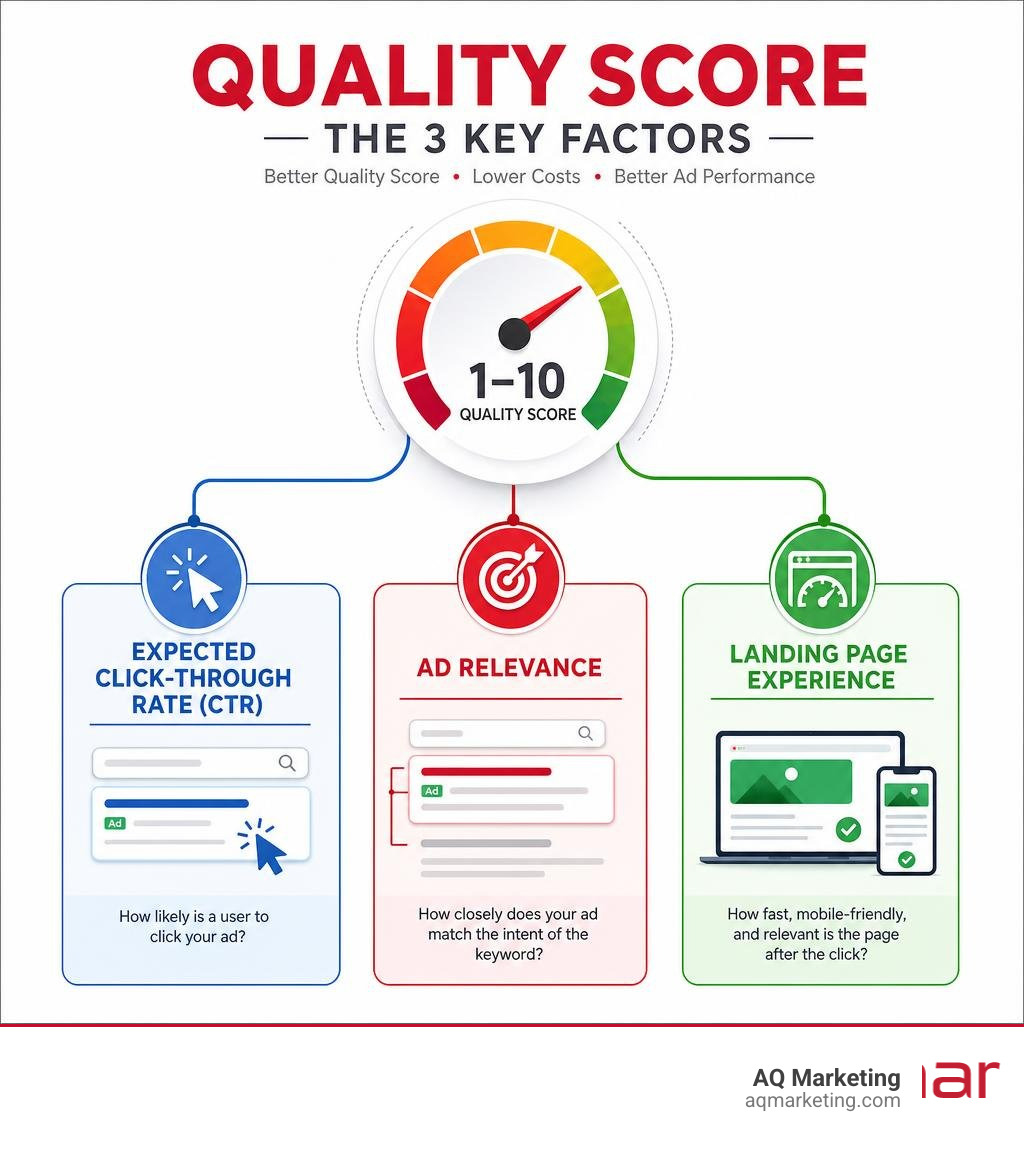
Quality Score is a diagnostic tool graded on a scale from 1 to 10. It is calculated based on three primary factors:
- Expected Click-Through Rate (CTR): How likely is a user to click your ad when it is shown?
- Ad Relevance: How closely does your ad copy match the intent of the keyword the user searched?
- Landing Page Experience: How fast, mobile-friendly, and relevant is the page the user lands on after clicking your ad?
A high Quality Score acts as a discount code. If you have a Quality Score of 10, your actual cost-per-click can be roughly 50% lower than an advertiser with a Quality Score of 5 bidding on the same keyword. To see how to align your targeting with high-quality traffic, review our PPC Targeting Ultimate Guide.
Structuring Your PPC Google Ads Account for Maximum ROI
A disorganized account structure is the primary reason small businesses waste money on Google Ads. If you group all your keywords into a single campaign with one generic ad, Google’s algorithm will struggle to show relevant ads, and your Quality Score will plummet.
Instead, organize your account logically:
- Campaign Level: Grouped by broad business goals, product lines, or major service categories (e.g., “Plumbing Services” vs. “HVAC Services”).
- Ad Group Level: Sub-categories containing a small, tightly themed set of keywords (usually 5 to 20 keywords) and highly specific ads that match those exact terms. For example, if you are a home services contractor in Braintree, MA, you should have separate ad groups for “heating repair” and “AC installation” rather than grouping them together, a strategy we detail in our Cheat Sheet to HVAC PPC Services.
- Keyword Match Types: Use Exact Match and Phrase Match to maintain control over your traffic. Avoid Broad Match unless you have a robust negative keyword list and are utilizing Smart Bidding, otherwise, you run the risk of paying for irrelevant queries.
- Negative Keywords: These are terms you explicitly exclude from your campaigns. If you sell premium, high-end services in Newton, MA, you should add negative keywords like “free,” “cheap,” or “DIY” to prevent your ads from showing to bargain hunters.
For a deeper dive into structuring your accounts properly, academic resources like the Google Ads Essential Training (2020) – SBS Pathways course provide excellent foundational frameworks. Alternatively, you can read our guide on Why Your Business Needs a Google PPC Advertising Agency to understand how professional management prevents structural mistakes, or explore The Ultimate Guide to Google Ad Management Services for a comprehensive look at account optimization.
Performance Max vs. Traditional Search Campaigns
Performance Max (PMax) is Google’s fully automated, AI-driven campaign type. Unlike traditional Search campaigns where you bid on specific keywords and write static text ads, Performance Max allows you to upload a collection of creative assets (headlines, descriptions, logos, images, and videos). Google’s AI then mixes and matches these assets to serve ads across all of Google’s channels, including Search, YouTube, Display, Gmail, Maps, and Discover.
| Feature | Traditional Search Campaigns | Performance Max Campaigns |
|---|---|---|
| Primary Targeting | Keyword-based | Audience signals, customer data, and themes |
| Placements | Google Search SERPs and partner sites | YouTube, Display, Search, Maps, Gmail, Discover |
| Control | High control over exact search queries and ad copy | High automation; Google determines asset combinations |
| Best Used For | Capturing high-intent search traffic | Scaling conversions across multiple networks simultaneously |
While Performance Max can be highly effective for e-commerce brands, local service businesses in Massachusetts should proceed with caution. PMax requires a significant budget to feed the algorithm enough data to learn, and it offers limited search term reporting compared to traditional campaigns.
To ensure your creative assets are optimized for whatever campaign type you choose, review Google’s official Google Ads specs: ad formats, sizes and best practices guide.
Measuring Performance and Avoiding Costly Mistakes
You cannot optimize what you do not track. Without proper conversion tracking, running a ppc google ads campaign is like throwing money into a dark room and hoping some of it finds its way back to you.

To measure your true return on investment, you must track primary conversion actions, such as:
- Form completions on your website
- Inbound phone calls generated directly from your ads
- Online purchases or booked appointments
Once tracking is established, you can monitor the Digital Marketing Metrics That Matter, including Click-Through Rate (CTR), Cost Per Click (CPC), Conversion Rate (CVR), and Return on Ad Spend (ROAS).
Another critical metric to watch is ad fatigue. Over time, searchers in your target local market (whether in Woburn, MA, or surrounding towns like Burlington and Lexington) will grow accustomed to seeing the same ad creative, causing your CTR to drop. Regularly refreshing your headlines, descriptions, and visual assets is essential to keep your campaigns performing at their peak. If you are running app promotion campaigns alongside search, make sure to consult Google’s Tips for maximizing your App campaign to maintain healthy conversion rates across mobile platforms.
Frequently Asked Questions About Google PPC
How much does it cost to run Google Ads in 2026?
The cost of running Google Ads varies widely depending on your industry, geographic targeting, and level of competition. Highly competitive industries, such as legal services or emergency home repairs in major metropolitan areas like Boston, MA, will naturally see much higher costs per click than niche markets.
Based on average online data across the digital marketing industry:
- Small to mid-sized businesses typically spend anywhere from $1,000 to $15,000 per month on Google Ads.
- Average cost-per-click (CPC) ranges from $2.50 on the low end to $45.00+ on the high end for highly competitive, high-value keywords.
Please note: These pricing ranges are based on average online industry data and do not represent AQ Marketing’s actual service pricing or required ad spend budgets.
How long does it take to see results from a PPC campaign?
While your ads can technically go live and start generating clicks within hours of launching a campaign, achieving a stable, optimized ROI typically takes 30 to 90 days.
During the initial 2 to 4 weeks, your campaign enters a “learning phase” where Google’s machine learning algorithms gather performance data to understand which audiences and search queries are most likely to convert. Consistent optimization—including negative keyword updates, ad copy tweaks, and landing page adjustments—is required during this period to refine performance.
Why is my Quality Score low and how do I fix it?
A low Quality Score (typically 4 or below) is usually caused by one of three issues:
- Poor Landing Page Speed and Mobile Experience: Over 60% of Google search traffic comes from mobile devices. If your landing page loads slowly or is difficult to navigate on a smartphone, your Quality Score will suffer. Studies show that pages loading in 1 second convert 2.5x better than pages loading in 5 seconds.
- Irrelevant Ad Copy: If your keyword is “residential roofing repair Woburn MA” but your ad headline simply says “We Do Home Remodeling,” Google will view the ad as irrelevant to the searcher’s intent.
- Low Expected CTR: If your ad copy is boring or lacks a clear call to action, searchers will skip over it, signaling to Google that your ad is not engaging.
Conclusion
Running a successful ppc google ads campaign in 2026 requires a strategic balance of human oversight and AI-powered automation. By structuring your account logically, focusing on high Quality Scores, utilizing Smart Bidding correctly, and constantly monitoring your conversion metrics, you can stop wasting your marketing budget and start generating high-quality leads.
At AQ Marketing, we have spent over two decades helping small and medium-sized businesses in Woburn, MA, and throughout the Commonwealth achieve long-term, impactful results. We handle the technical complexities of campaign structure, keyword research, and conversion tracking so you can focus on running your business.
Ready to stop wasting money and start getting clicks that convert? Book a 15-minute phone call with our team today, or learn more about our professional pay-per-click advertising services to begin your digital marketing transformation.


