

Why PPC Ad Campaign Management Can Make or Break Your Ad Spend
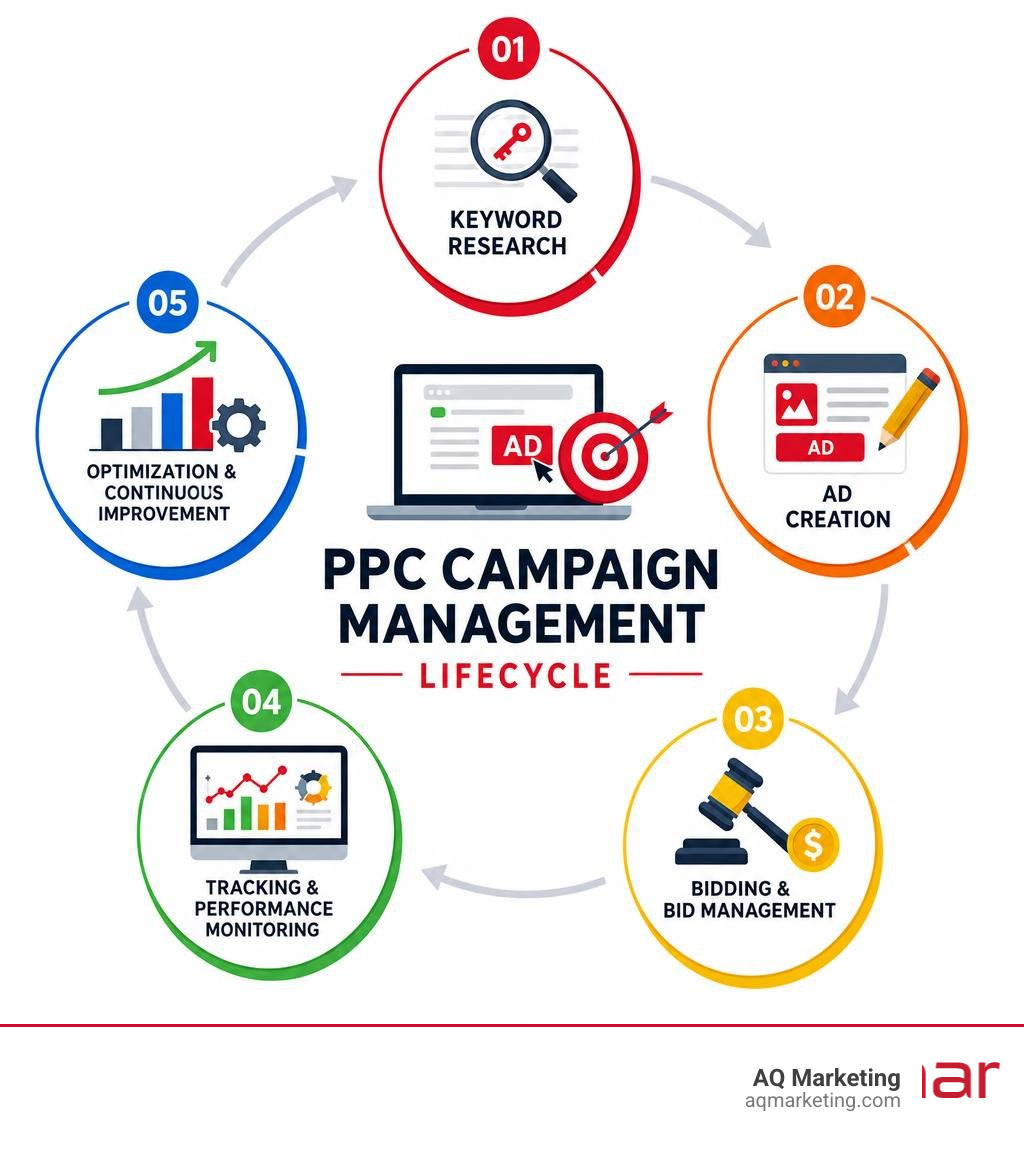
PPC ad campaign management is the ongoing process of overseeing, optimizing, and improving your paid search and paid social advertising campaigns to get the best possible results for every dollar you spend.
Here’s a quick snapshot of what it involves:
| Element | What It Means |
|---|---|
| Keyword Research | Finding the right search terms your customers actually use |
| Ad Creation | Writing compelling ads that earn clicks |
| Bid Management | Controlling how much you pay per click |
| Negative Keywords | Blocking irrelevant searches that waste budget |
| Landing Page Optimization | Making sure clicks turn into leads or sales |
| Performance Tracking | Measuring CTR, CPA, ROAS, and conversion rate |
| Continuous Testing | A/B testing ads and refining what works |
Here’s a sobering fact: less than 25% of PPC ads actually produce conversions. That means most businesses running paid ads are burning through budget without seeing real returns. The difference between those that succeed and those that don’t usually comes down to one thing — how well their campaigns are actively managed.
Simply launching an ad is not the same as managing a campaign. Active PPC management means constant monitoring, tweaking, and improving. Without it, even a generous ad budget can quietly drain away with little to show for it.
This guide is designed for small and medium-sized business owners who want to understand how professional PPC management works — and how to make smarter decisions about their paid advertising.
I’m Robert P. Dickey, President and CEO of AQ Marketing, Inc., and with over 20 years of experience in digital marketing — including hands-on PPC ad campaign management for businesses across New England — I’ve seen what separates campaigns that grow a business from those that just spend money. Let’s walk through everything you need to know.
Ppc ad campaign management basics:
- what is pay per click
- targeted ppc advertising
- ppc for hvac companies
What is PPC Ad Campaign Management and Why Does It Matter?
At its core, ppc ad campaign management is the strategic, day-to-day oversight of a company’s pay-per-click advertising budget. It is not a passive task. Instead, it is an evolving art where perfect optimization is the continuous goal. The primary purpose of active management is to determine the most effective budget for your ads, improve your overall return on ad spend (ROAS), and secure top placement in search results without overspending.
When we look at the digital landscape in June 2026, the online marketplace is more crowded than ever. Whether you run a local home services company in Woburn, MA, or an insurance agency in Boston, MA, simply having your ads “show up” is no longer enough. Because less than 25% of PPC ads produce conversions, many businesses find themselves throwing money into a black hole.
Active management addresses this gap. It ensures that every ad dollar is directed toward users who demonstrate genuine purchase intent. By executing strategic keyword research, channel selection, and ongoing performance monitoring, professional management transforms paid search from an expensive gamble into a predictable source of new leads. For a deeper look at how this works on a local level, explore our insights on Targeted Pay Per Click Advertising.
The Difference Between Running Ads and Active PPC Ad Campaign Management
Many business owners believe that launching a Google Ads campaign is a “set-and-forget” project. They log into the platform, select a few keywords, write a basic ad, enter a credit card, and hope for the best. This is simply running ads, and it often leads to silent money burning.
Active ppc ad campaign management is the exact opposite. It is a continuous cycle of measurement, hypothesis, testing, and refinement.

The table below highlights the key differences between these two approaches:
| Passive Ad Running | Active PPC Campaign Management |
|---|---|
| Set-and-forget campaign launching | Continuous daily and weekly optimization |
| Bidding on broad, unmonitored search queries | Regular analysis of search term reports to refine intent |
| Accepting default platform bidding recommendations | Manual or carefully guided automated bid adjustments |
| Letting irrelevant clicks drain your budget | Aggressive use of negative keywords to filter bad traffic |
| Pointing all ads to a generic homepage | Designing targeted landing pages for specific ad groups |
One of the most powerful tools in active campaign management is the search term report. While you might bid on a keyword like “home insurance,” users might actually type in “free home insurance options” or “insurance jobs in Boston.” Without active management to identify and exclude these non-commercial queries using negative match types, you will pay for clicks that have zero chance of converting. Active management isolates competitive gaps — targeting the high-value queries your competitors are overlooking — rather than blindly fighting over the most expensive terms.
Core Components of Effective PPC Ad Campaign Management
An effective PPC strategy relies on several moving parts working in perfect harmony. If any one of these components is neglected, the entire campaign can falter.
To build a high-performing campaign, we must structure it correctly from the ground up. This involves utilizing specialized developer tools like the Campaign | Google Ads API | Google for Developers to structure accounts programmatically, or using modern platforms to keep track of conversion actions.
The core components of any successful campaign include:
- Keyword Strategy: Identifying high-intent search terms.
- Compelling Ad Copy: Writing headlines and descriptions that stand out.
- Landing Page Optimization: Creating a seamless transition from click to conversion.
- Bid and Budget Management: Pacing your spend to maximize ROI.
- Conversion Tracking: Measuring the exact actions users take after clicking.
Strategic Keyword Selection and Match Types
Keywords are the foundation of paid search. However, how you target those keywords matters just as much as the words themselves. Google Ads and Microsoft Ads use match types to determine how closely a user’s search query must match your chosen keyword:
- Broad Match: This offers the widest reach but the lowest control. Your ad can show for searches that are loosely related to your keyword. Without careful monitoring, broad match can quickly drain your budget on irrelevant terms.
- Phrase Match: This strikes a balance between reach and control. Your ad shows for searches that include the meaning of your keyword, offering a safer way to scale.
- Exact Match: This is the most restrictive and highly relevant option. Your ad only shows for searches that match the exact meaning or intent of your keyword, delivering the highest quality traffic.
- Negative Keywords: This is your shield against wasted spend. By adding negative keywords (such as “free,” “DIY,” or “jobs”), you prevent your ads from appearing to users who are unlikely to convert. For example, a premium home remodeling business in Acton, MA, might use income-based and geographic negative matching to focus ad spend strictly on local homeowners looking for professional services.
Landing Page Alignment and Message Match
Getting the click is only half the battle. Once a user clicks your ad, they must land on a page that immediately reassures them they are in the right place. This is known as message match.
If your ad promises “Emergency Plumbing Repair in Woburn” but links to a generic homepage that lists every service from kitchen remodeling to HVAC maintenance, the user is likely to bounce. High bounce rates signal to search engines that your page isn’t relevant, which lowers your Quality Score and increases your cost per click (CPC).
To optimize your conversion rates, your landing pages should feature:
- Consistent headlines that match the ad copy.
- A clear, prominent call-to-action (CTA) such as “Get a Free Quote” or “Call Now.”
- Trust signals like customer reviews, local credentials, and clear contact information.
- Fast load times and a mobile-friendly design.
For more details on streamlining your ad-to-page experience, read our guide on 4 PPC Campaign Best Practices.
Performance Tracking and Key Metrics
To manage a campaign successfully, you must rely on data, not guesswork. Modern tools like Claude Code for Google Ads | AI-Powered PPC Management can assist by analyzing historical account data to identify optimization opportunities.

When reviewing your campaign performance, keep a close eye on these essential key performance indicators (KPIs):
- Impressions: How many times your ad was displayed.
- Click-Through Rate (CTR): The percentage of impressions that resulted in a click (Clicks ÷ Impressions). A high CTR indicates highly relevant ad copy.
- Cost Per Click (CPC): The actual price you pay for each click.
- Conversion Rate: The percentage of clicks that result in a completed lead form, phone call, or purchase.
- Cost Per Acquisition (CPA): How much it costs to acquire a single customer or lead.
- Return on Ad Spend (ROAS): The total revenue generated divided by the total ad spend.
The Business Benefits of Professional PPC Management
For many small to medium-sized businesses in Massachusetts, managing paid media campaigns in-house can be overwhelming. Between running daily operations and serving clients, there is rarely enough time to monitor bidding strategies, perform A/B split testing, and prune search terms.
This is where partnering with a professional management firm yields significant returns. Working with a dedicated specialist typically results in an immediate performance boost of 30% to 50% on existing, underperforming campaigns. Professional managers bring years of platform expertise, specialized software, and strategic insights that prevent costly trial-and-error. If you are wondering whether to make the transition, consider reading Hiring a PPC Management Firm: 5 Reasons Why You Should.
For businesses looking for regional support, partnering with localized specialists—such as those at a Pay-Per Click (PPC) Management Services Agency Boston MA or agencies serving Abington via PPC Services For Lawyers Abington | PPC Advertising For Lawyers —ensures your campaigns are tailored to the unique demographics of the Massachusetts market.
Real-World Success and Case Studies
To understand the true impact of professional ppc ad campaign management, we can look at documented performance benchmarks across various industries. While these results represent broader industry case studies rather than AQ Marketing’s specific client portfolio, they demonstrate what is possible with expert oversight:
- E-commerce Retailer: An online furniture store achieved a 5x ROAS and generated nearly $800,000 in revenue by structuring granular product campaigns and optimizing Google Shopping feeds.
- Corporate Security Firm: By implementing strict negative keyword matching and refining demographic targeting, a security company achieved a 50% increase in conversions alongside a 75% reduction in cost per acquisition (CPA).
- Local Equipment Dealership: A regional tractor and Kubota dealership saw a 300%+ increase in actionable leads and a 20%+ reduction in CPA by shifting to localized geo-targeted campaigns.
- Industrial Maintenance Client: By restructuring underperforming campaigns, an industrial services business improved its cost per conversion by more than 3x (dropping from $94 to $25) while boosting its conversion rate from 0.82% to 10.75% (a 10x improvement).
- Travel Booking Agency: A travel provider improved its clicks-to-call by over 40% on a $50,000 monthly Google Ads budget by optimizing mobile ad extensions and call-only bidding strategies.
Integrating PPC Ad Campaign Management with SEO
PPC does not exist in a vacuum. To build a highly visible online presence, paid search should work hand-in-hand with search engine optimization (SEO).
When you coordinate your paid and organic marketing efforts, you unlock powerful synergies:
- Keyword Intelligence: The high-converting keywords you discover through PPC campaigns can immediately inform your long-term organic SEO content strategy.
- Dominating the SERPs: Appearing in both the paid ad spots and the organic search results increases your brand authority and captures a larger share of search traffic.
- Lowering Blended CAC: While paid search delivers immediate leads, organic SEO builds long-term equity. Together, they lower your blended customer acquisition cost (CAC).
Whether you are working with an agency in Acton via a Digital Marketing Agency in Acton, Massachusetts | SEO, Website … or a specialist in Agawam like the Agawam PPC Agency | EZMarketing , aligning your search strategies is critical. Learn more about balancing these channels by reading Getting Local Paid Search Right: How to Achieve ROAS.
Choosing the Right Partner and Understanding the Costs
Selecting a PPC management partner is a major decision for any business. The right specialist will treat your budget as their own, maintaining complete transparency and focusing on metrics that drive real revenue. To guide your search, you can review our PPC Advertising Services Complete Guide.
How to Evaluate a PPC Specialist or Agency
When interviewing potential agencies or consultants—including national providers like Get Professional PPC Management Services – Netlynx Inc —it is essential to ask the right questions to ensure they align with your business goals.
Keep this evaluation checklist in mind during your discovery calls:
- Account Ownership: Do you retain 100% ownership and access to your Google Ads and Meta accounts? (An ethical agency will never hold your account hostage).
- Fee Transparency: Are management fees billed separately from your direct ad spend?
- Reporting Frequency: Will you receive regular, easy-to-understand reports that connect ad spend to actual leads and revenue, rather than just vanity metrics like impressions?
- Strategic Approach: Do they offer custom strategies tailored to your industry, or do they rely on generic templates?
Typical Costs and Pricing Models
PPC management services are structured under several different pricing models. Because every business has unique needs, understanding these models will help you choose the best fit for your budget.
Please note: The pricing ranges listed below are based on average online industry data in 2026 and do not represent AQ Marketing’s actual pricing. We present these ranges to help you understand typical market rates.
| Pricing Model | Typical Monthly Range (Wide Industry Spread) | Best For |
|---|---|---|
| Flat Monthly Fee | $500 – $5,000+ per month | Businesses with stable, predictable monthly ad budgets. |
| Percentage of Ad Spend | 10% – 30% of monthly ad spend | Scaling campaigns where management complexity grows with budget. |
| Hourly Consulting Rate | $75 – $250+ per hour | One-time audits, campaign setups, or short-term strategy consulting. |
Note: In professional engagements, monthly management fees are billed separately from your actual ad spend, which is paid directly to the advertising platforms (like Google or Meta).
Frequently Asked Questions About PPC Management
What are the most common mistakes businesses make when managing their own PPC?
The most frequent mistake is the “set-and-forget” approach, which leads to significant wasted ad spend. Many self-managed accounts fail to add negative keywords, resulting in paying for irrelevant search queries. Other common errors include directing all ad traffic to a generic homepage instead of a dedicated landing page, and failing to set up proper conversion tracking, which makes it impossible to measure actual ROI.
How long does it take to see results from a managed PPC campaign?
One of the greatest benefits of PPC is its speed. Unlike organic SEO, which can take several months to build momentum, paid ads can start driving traffic immediately. When restructuring an existing, underperforming campaign, initial improvements and “quick wins” are typically visible within 14 to 30 days. Bidding strategies and conversion modeling usually require 60 to 90 days of consistent data to compound and fully stabilize.
Is there a minimum budget required for professional PPC management?
While search engines do not enforce a minimum budget, most professional agencies recommend a starting ad spend of at least $1,000 per month for local campaigns. This budget ensures your ads receive enough impressions and clicks to gather actionable performance data. If your budget is set too low, it will take much longer to determine which keywords and ad creatives are driving real business growth.
Conclusion
Navigating ppc ad campaign management can feel overwhelming, but you don’t have to do it alone. Since 2003, AQ Marketing has been helping small to medium-sized businesses in Woburn, MA, and throughout New England enhance their online presence. We specialize in delivering long-term, impactful results through tailored digital marketing strategies, including professional Google and social media advertising management.
If you are ready to stop wasting ad spend and start driving high-quality leads to your business, we are here to help. Reach out to our team today to discuss how we can support your business growth.
- Ready to scale your paid search? Explore our specialized Pay-Per-Click Advertising services.
- Want to learn more about our history and values? Read About AQ Marketing.
- Let’s discuss your goals: Book a 15-Minute Phone Call with us today!
