
Why Middlesex Web Design Is Your Path to a High-Demand Digital Career
Middlesex web design programs give you a clear, structured path into one of the fastest-growing fields in the U.S. economy. Here is what you need to know at a glance:
- Where to learn: Middlesex College offers a Web Design Professional certificate, a Visual Design associate degree, and a micro credential in Web Design and Coding.
- What you'll learn: HTML5, CSS3, JavaScript, Vue.js, Adobe Photoshop, Bootstrap, and responsive design principles.
- How long it takes: From a few months (certificate) to two years (associate degree), depending on the path you choose.
- What you can earn: The median U.S. web designer salary is around $50,644 per year, with web developers earning close to $68,000.
- Job growth: Employment for web designers is projected to grow 15% through 2026 — much faster than most occupations.
- No four-year degree required: 38% of working web designers hold less than a bachelor's degree.
Whether you are a business owner trying to understand what good web design looks like, or someone exploring a career change, Middlesex has practical options worth knowing about.
I'm Robert P. Dickey, President and CEO of AQ Marketing, Inc., a digital marketing agency based in Woburn, MA, with over 20 years of experience helping small and medium-sized businesses build strong digital presences — including Middlesex web design strategy and execution. In the sections below, I'll walk you through the programs, career paths, and real-world applications that matter most.
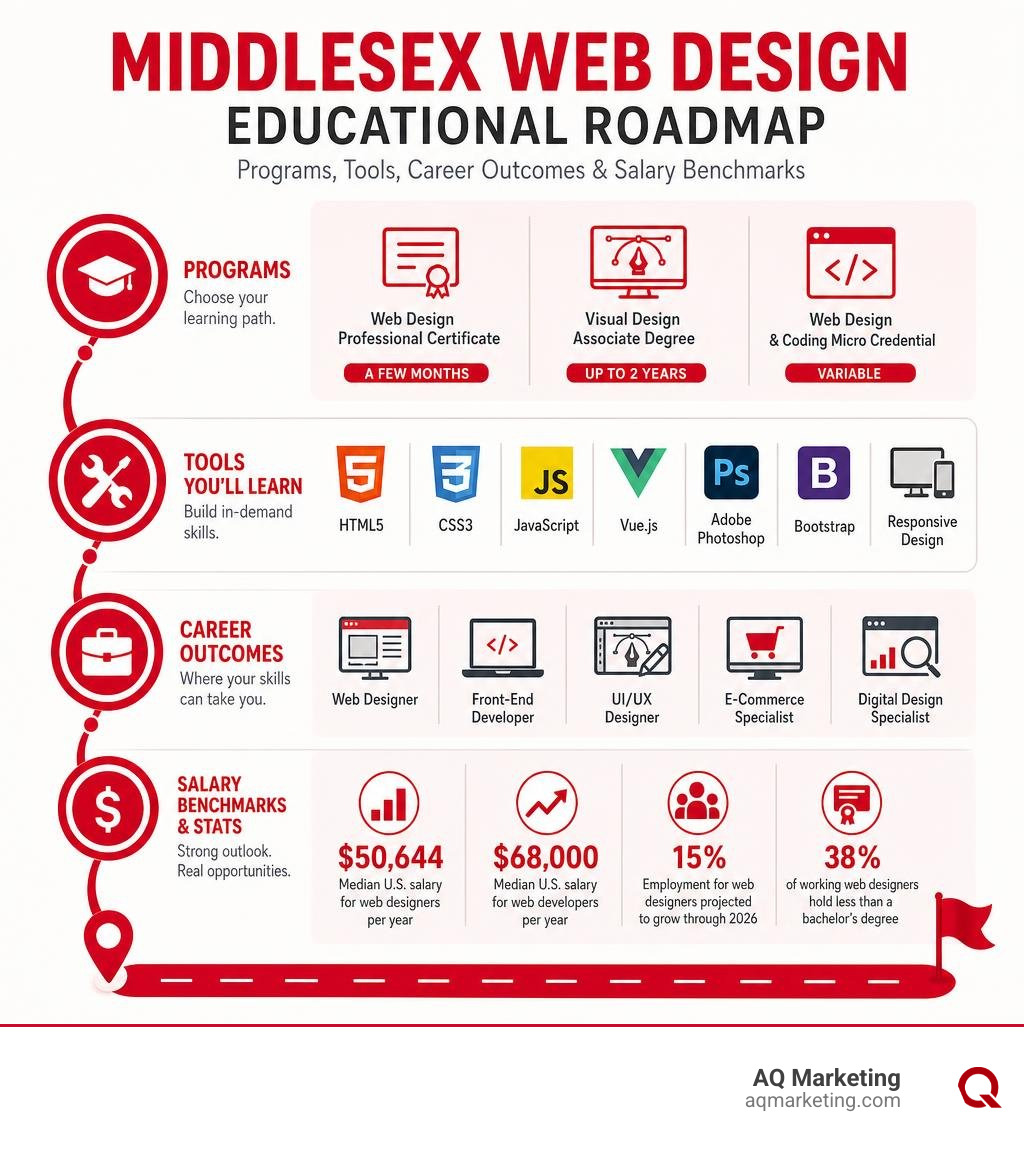
Middlesex web design terms at a glance:
Educational Pathways for Middlesex Web Design Students
Entering the digital creative field requires a blend of artistic vision, technical precision, and foundational business acumen. In Middlesex County and the surrounding New England region, aspiring web creators can access diverse academic pathways to build these competencies. Whether you are aiming for a full college degree, a targeted industry certification, or self-paced adult education, local institutions provide options suited to different schedules, learning styles, and career ambitions.
At Middlesex College and Middlesex Community College, web design curricula emphasize both conceptual design principles and technical execution. Students explore historical art movements, visual hierarchy, color theory, and typography while mastering modern digital studio software. Prerequisites for major coursework generally require basic competency in mathematics, such as Algebra I, to ensure students are prepared for logical programming and design layout calculations.
To understand why localized academic training creates such strong results for region-based businesses, explore our insights on Why Web Design Middlesex County Is The Secret To Local Success/.
Certification vs Degree in Middlesex Web Design
When selecting an educational track, students often weigh the time commitment and depth of a traditional college degree against the speed and direct skill-building of certificate programs.
An Associate Degree in Liberal Arts and Sciences with a Visual Design focus provides a well-rounded academic foundation. This two-year path blends graphic layout, commercial photography, visual storytelling, and general education requirements. It is ideal for students who plan to transfer to a four-year institution or desire a comprehensive understanding of visual communication across print, web, and interactive media.
Conversely, focused certificate tracks like the Web Design Professional program offered through continuing education focus directly on front-end coding and digital asset creation. These programs deliver around 390 course hours of instruction over 12 months. They are designed for quick career entry, skill upgrades, or adult career retraining. Similarly, specialized offerings like the Web Design & Coding Micro Credential give students bite-sized credentials in front-end markup and scripting.
Here is how these primary educational tracks compare for prospective students:
| Program Option | Typical Duration | Major Focus | Ideal Candidates |
|---|---|---|---|
| Visual Design Associate Degree | 2 Years (Full-Time) | Visual design theory, art history, typography, photography, general education | Students planning 4-year transfer or broad creative agency careers |
| Web Design Professional Certificate | 390 Hours / 12 Months | HTML5, CSS3, JavaScript, Vue.js, Photoshop, responsive site builds | Career switchers and professionals seeking practical coding skills |
| Web Design & Coding Micro Credential | Few Weeks to 1 Semester | Core HTML, CSS, foundational coding | Beginners wanting basic site management or fast credentialing |
| Professional Bootcamps | 12 to 24 Weeks (Intensive) | Full-stack coding, real-world portfolio builds | Career changers seeking immersive project work |
Essential Tools and Programming Languages
A complete Middlesex web design education bridges creative aesthetic styling with technical front-end code. Graduates emerge with functional fluency across industry-standard software tools, web languages, and development frameworks.
Core technical subjects taught in these academic tracks include:
- HTML5 Markup: Building semantic, accessible document structures that search engines and screen readers can read easily.
- CSS3 Styling & Modern Frameworks: Mastering layout systems, flexbox, CSS grid, and responsive frameworks like Bootstrap to ensure sites adapt to any mobile screen size.
- JavaScript & Modern Libraries: Implementing client-side interactivity, form validation, JSON data manipulation, and modern front-end frameworks such as Vue 3.
- Adobe Creative Cloud Suite: Using Adobe Photoshop for graphics rasterization and photo editing, alongside vector tools and Adobe Animate for web graphics.
- Usability & Web Accessibility: Applying user experience (UX) testing, wireframing, and web accessibility standards to build usable digital interfaces.
Career Opportunities and Salaries in the Local Market

The job market for skilled digital designers and web developers remains exceptionally buoyant across eastern Massachusetts and the broader region. As local enterprises across Woburn, Boston, Cambridge, and Chelmsford shift operations online, qualified technical creators are in high demand.
Data from the Bureau of Labor Statistics indicates that employment for web designers and developers is projected to grow by 15% through 2026, a rate significantly faster than the average across all U.S. occupations. Industry salary metrics show that the national median annual earnings for web designers stand near $50,644, while general web developers earn median annual salaries closer to $68,000. Experienced designers operating in major metropolitan commercial markets often command even higher compensation as they gain specialized technical expertise.
A notable characteristic of this sector is its flexible entry bar. Approximately 38% of working web design and development professionals hold less than a four-year college degree, proving that strong practical skills, industry certificates, and a standout portfolio carry significant weight with prospective employers. Furthermore, nearly 1 in 6 digital web professionals operate as self-employed freelancers or independent contractor consultants, managing their own business operations.
For a perspective on how independent regional professionals deliver custom development, review this external resource on Web Designer & Developer in Middlesex.
Portfolio Development for Middlesex Web Design Careers
Regardless of whether you graduate with an associate degree or complete a self-paced professional certificate, your portfolio is your most vital career asset. Prospective employers and digital agencies evaluate practical coding proficiency, design aesthetic, user interface flow, and site performance over academic credentials alone.
Academic programs structured around the Middlesex web design framework place heavy emphasis on practical capstone projects. During these projects, students conceive, design, code, and deploy fully functional, responsive websites from scratch.
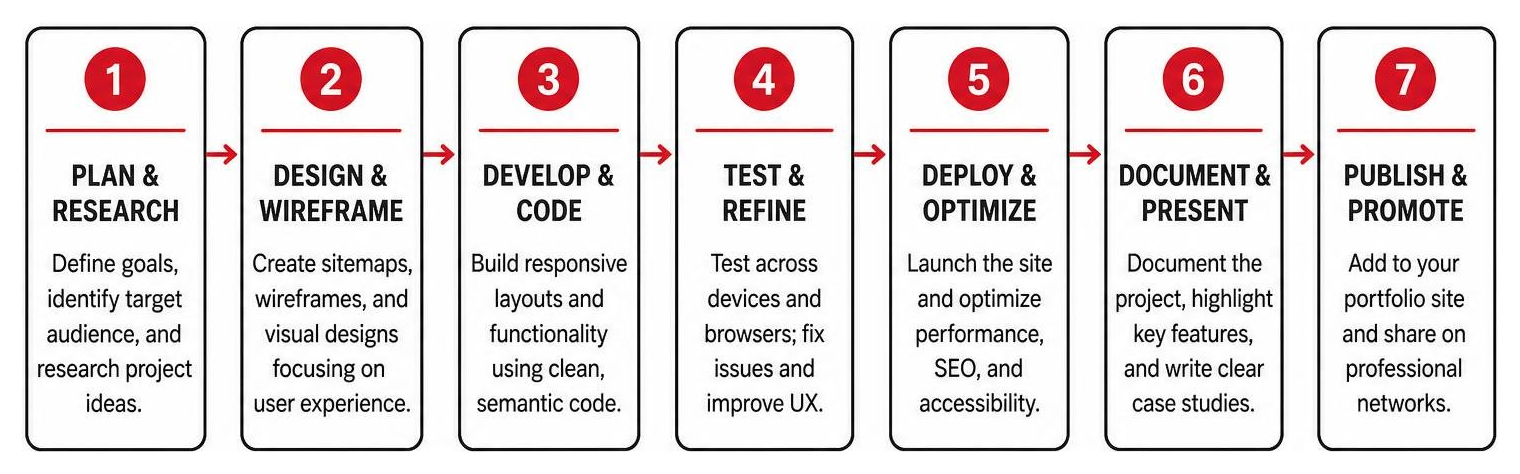
A well-constructed design portfolio demonstrates:
- Responsive Execution: Websites that reflow across mobile phones, tablets, and high-resolution desktop monitors.
- Clean, Validated Code: Semantic HTML5 and modular CSS3 written according to modern industry standards.
- Interactive Elements: Functional contact forms, mobile navigation drawers, and custom scripts built using JavaScript or Vue.js.
- User Experience Focus: Clear visual hierarchy, accessible color contrast ratios, fast page loading times, and logical site search.
Freelance Opportunities and Industry Demand
The density of commercial businesses across New England creates ongoing opportunities for independent freelance designers and boutique digital marketing agencies. Small business owners, local service providers, contractors, and non-profit organizations regularly require fresh website design, performance upgrades, and continuous content management.
Self-employed web designers operating locally build client bases by offering tailored services such as:
- Custom WordPress and CMS theme customization.
- E-commerce product catalog configuration.
- Localized landing page creation and search engine optimization.
- Website security maintenance, speed tuning, and mobile responsiveness audits.
By serving regional clients directly, freelance creators build long-term advisory relationships while generating recurring retainer income.
How Web Design Solves Real-World Business Challenges

For a local enterprise, a website is far more than a digital business card — it serves as the central engine for brand credibility, customer acquisition, and lead generation. At AQ Marketing, we have seen how an outdated, non-responsive, or slow website directly suppresses business growth. Professionally executed web design systematically addresses these operational roadblocks.
Modern web design directly improves real-world business outcomes through:
- Mobile Responsiveness: Over 60% of web traffic originates on mobile devices. Modern layout frameworks ensure that tap targets, text sizes, and contact forms adjust seamlessly for smartphone users. Explore our specialized Responsive Web Design Services/ to see how mobile-first architecture drives conversions.
- Search Engine Visibility: Clean code architecture, fast page load speeds, and semantic heading tags provide the foundational structure search engines need to index site content effectively.
- Conversion-Driven Layouts: Clear call-to-action buttons, intuitive navigation menus, and strategically placed contact forms convert casual visitors into active telephone inquiries and web leads.
- Accessibility Compliance: Designing according to web accessibility standards ensures people of all physical abilities can navigate your business site, protecting your brand while broadening your customer audience.
Serving B2B and Industrial Enterprises
In regions with rich manufacturing and B2B commercial ecosystems, web design requirements extend well beyond standard corporate service pages. Industrial equipment distributors, original equipment manufacturers (OEMs), and B2B suppliers require specialized digital architecture to display complex product lines.
Industrial e-commerce sites require custom catalog navigation, robust product filtering, and fast keyword search tools so business clients can identify specific replacement parts or equipment models quickly. Building these platforms on open-source or custom e-commerce engines allows industrial distributors to manage thousands of SKUs efficiently while offering buyers streamlined ordering workflows.
When paired with targeted local search strategy, a custom B2B web interface becomes a highly automated sales engine for regional manufacturing and supply businesses.
Web Design Pricing and Investment Benchmarks
When evaluating custom web development investment, business decision-makers often encounter widely varied market pricing. Understanding typical industry pricing structures helps organizations plan realistic budgets.
Based on average online industry data, custom business web design costs vary depending on site complexity, custom graphic requirements, functionality, and e-commerce capabilities.
To help illustrate standard industry benchmarks across the broader market, review the comparison table below:
| Project Scope | Average Online Market Price | Market Range Spread (Low to High) | Typical Deliverables Included |
|---|---|---|---|
| Starter Business Website | ~$2,500 | $1,200 – $7,500+ | 5–10 pages, responsive layout, standard contact form, basic SEO setup |
| Growth Business Website | ~$5,000 | $2,200 – $15,000+ | 10–25 pages, custom design assets, CMS integration, lead capture workflows |
| Custom Pro / E-Commerce | ~$10,000 | $4,000 – $30,000+ | Large product catalog, custom B2B portals, advanced API integrations, bespoke UX |
Note: The pricing figures listed above represent average online industry market estimates gathered from general web design benchmarks. They do not represent actual pricing schedules for AQ Marketing, Inc.
For detailed guidance on structuring web development investments for your business, examine our comprehensive guide on Custom Website Design Pricing/.
Frequently Asked Questions About Middlesex Web Design
What is the average cost range for professional web design services?
Across standard industry estimates online, basic starter business websites typically average around $2,500, whereas larger corporate sites or custom e-commerce platforms average between $5,000 and $10,000, with complex high-end custom enterprise builds ranging up to $30,000 or more depending on functionality and scope.
Do I need a four-year college degree to become a web designer?
No. Industry statistics indicate that 38% of working web designers and developers hold less than a four-year degree. Graduating from a structured academic certificate program, such as the Web Design Professional track at Middlesex College, or earning an associate degree while building a practical design portfolio provides a highly effective pathway into the industry.
How does local web design improve search engine rankings?
Local web design integrates geo-targeted keyword structures, fast mobile load speeds, clear site navigation, structured business markup, and local service landing pages directly into your site's code. This allows search engines like Google to accurately index your business for local customer searches across Middlesex County and surrounding New England communities. Discover more in our guide to Small Business Web Design/.
Conclusion
Mastering web design — whether by earning a formal credential through local academic institutions like Middlesex College or by partnering with experienced regional web professionals — is one of the most effective strategic moves a professional or business owner can make in today's digital economy.
At AQ Marketing, Inc., we have spent over two decades helping businesses across Woburn, Boston, Chelmsford, and eastern Massachusetts convert their online presence into an engine for long-term growth. From mobile-responsive web development and search engine optimization to automated lead generation workflows and brand identity, we deliver clear, sustainable results tailored specifically to your industry.
Ready to elevate your business's digital performance? Explore Professional Web Design Services with our expert team today, or schedule a strategy consultation to discuss your web design goals.
Why Every Startup Needs Market Research Before Spending a Dollar
Startup market research is the process of gathering and analyzing information about your target customers, competitors, and industry — so you know whether real demand exists before you invest serious time or money.
Here's what it covers at a glance:
| What It Answers | Why It Matters |
|---|---|
| Is there demand for my product? | Avoid building something nobody wants |
| Who is my target customer? | Focus your marketing and messaging |
| How big is the market? | Attract investors with credible numbers |
| What do competitors charge? | Set a competitive, profitable price |
| Where are the gaps? | Find your unique angle |
The stakes are real. According to CB Insights, 42% of startups fail simply because there is no market need for what they built. That's not a product problem or a marketing problem — it's a research problem.
Market research lets you reduce those risks before your business is anything more than an idea.
It doesn't have to be expensive or complicated. Whether you're validating a concept over the weekend or preparing a pitch deck for investors, the same core principles apply.
I'm Robert P. Dickey, President and CEO of AQ Marketing, and over my 20+ years in digital marketing I've worked with dozens of small and mid-sized businesses navigating exactly this challenge — using startup market research to sharpen their positioning and attract the right customers from day one. In the sections below, I'll walk you through a practical, strategic approach that works even on a limited budget.
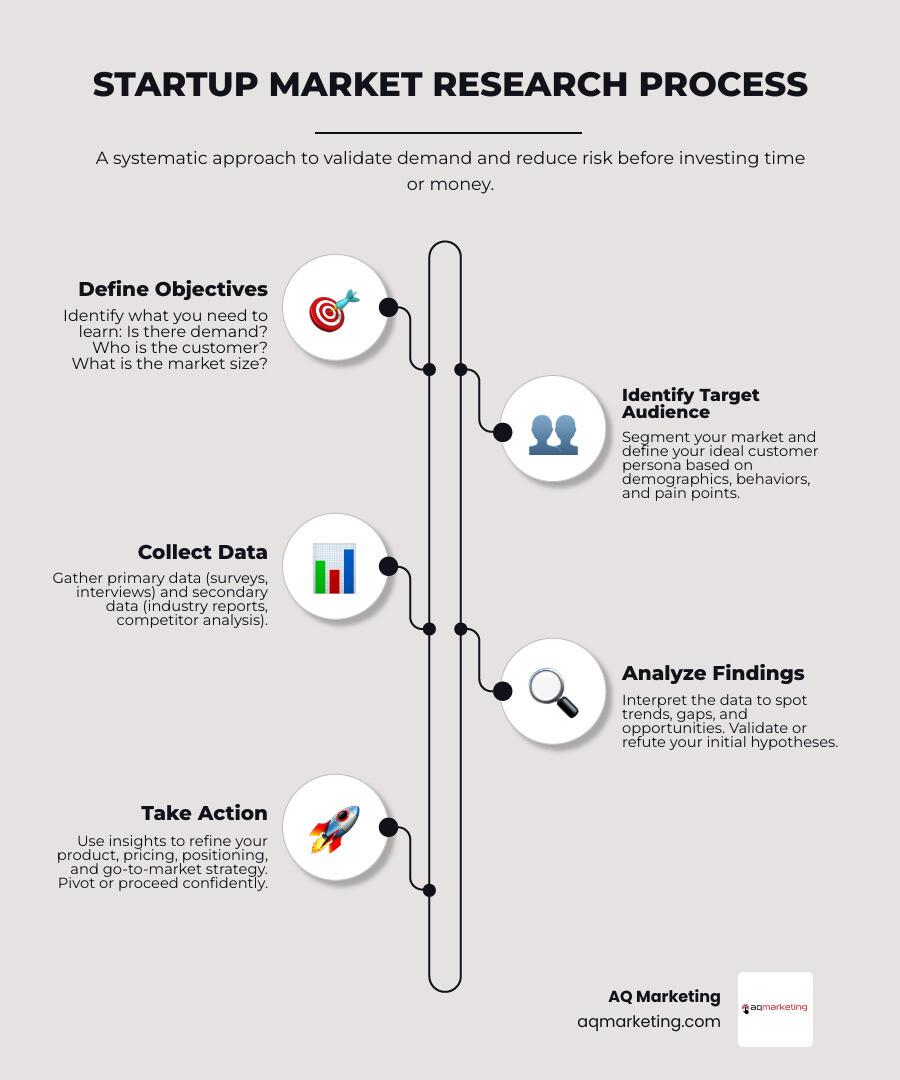
Easy startup market research glossary:
- startup competitive analysis
- startup customer acquisition
- early stage marketing
Why Market Validation is the Foundation of Business Success
When we talk to early-stage founders from Boston to Worcester, we often see incredible passion. Passion is the engine of entrepreneurship, but it can also create a dangerous blind spot. Operating a business based on a "gut feeling" or sheer excitement is not a strategy. True market validation is about moving from assumptions to evidence.
The primary reason to conduct rigorous validation is simple: it directly combats the leading causes of startup mortality. While 42% of startups fail due to a lack of market need, another 20% fail because they are beaten by the competition. In total, some industry studies suggest up to 83% of startups fail because of an fundamental disconnect with market demand.
By taking the time to validate your business idea, you achieve three critical strategic objectives:
- Risk Reduction: Instead of investing thousands of dollars developing a minimum viable product (MVP) in a vacuum, you identify potential deal-breakers early. This allows you to pivot before you write code, sign a commercial lease, or purchase inventory.
- Investor Attraction: Modern investors and venture capitalists do not back "good ideas" alone. They back validated opportunities. Presenting proprietary consumer data, clear market sizing, and verified demand signals shows professional-grade preparation.
- Strategic Alignment: Market validation forms the blueprint for your entire launch strategy. It dictates your messaging, guides your product roadmap, and shapes your initial promotional campaigns.
To build a sustainable venture, you must establish a solid foundation. For more insights on building your brand after validation, explore our comprehensive guide on marketing for startups.
Primary vs. Secondary Research: When to Use Each Method
A balanced startup market research strategy relies on two distinct types of information: primary research and secondary research. Understanding the difference—and knowing when to deploy each—saves both time and capital.
Secondary Research: The High-Level View
Secondary research involves analyzing existing data that has already been collected, compiled, and published by others. This is always your starting point because it is incredibly cost-effective and provides the necessary context for your business model.
- When to use it: Use secondary research to calculate overall market size, identify major industry trends, evaluate demographic shifts, and map out your competitor landscape.
- Key resources: Free federal databases (such as the U.S. Census Bureau and the Bureau of Labor Statistics) are goldmines for local demographics and economic indicators. For automated analysis of broader market sectors, platform directories like Markethunt offer pre-compiled data on market growth projections, capital intensity, and technological drivers.
- The limitation: Secondary data is general. It won't tell you how a customer feels about your specific logo, user interface, or pricing structure. Beware of citation bias, where the original studies you rely on may have had slightly different research objectives or unmeasured biases.
Primary Research: The Deep Dive
Primary research is original data you collect directly from your target audience. It is tailored specifically to your unique business hypotheses.
- When to use it: Use primary research when you need to understand specific user pain points, test reactions to a prototype, evaluate brand perception, or determine exact willingness to pay.
- Qualitative vs. Quantitative:
- Qualitative data (gathered through focus groups, open-ended interviews, and observation) explores the "why" behind consumer behavior. It provides nuanced feedback but is harder to scale.
- Quantitative data (gathered through structured surveys and digital experiments) gives you the "how many." It allows you to count recurring patterns and assign mathematical confidence to your findings.
- The limitation: Primary research is traditionally time-consuming and can be highly susceptible to bias if questions are not designed carefully.
To bridge this gap, modern founders often use structured validation tools. For example, you can generate a comprehensive, data-backed Market Validation Report - SageScan to rapidly combine both real-time web verification and structured customer persona mapping.
Key Steps to Execute a Strategic Market Research Plan
Conducting market research doesn't require a massive corporate budget. By following a structured, step-by-step framework, small business owners and startup founders can gather highly actionable insights.
Step 1: Define Clear Research Objectives
Before collecting any data, write down exactly what you need to learn. Are you trying to determine if homeowners in Newton, MA, want a smart snow-removal service? Or are you trying to find out what price point local commercial offices will pay for eco-friendly janitorial services? Setting narrow, specific objectives prevents you from drowning in irrelevant data.
Step 2: Calculate Your Market Size (TAM, SAM, SOM)
Investors want to see that you understand the realistic scale of your opportunity. You must break your market down into three distinct tiers:
- TAM (Total Addressable Market): The absolute total market demand for your product or service globally or nationally (e.g., the entire U.S. residential landscaping market).
- SAM (Serviceable Available Market): The portion of the TAM that fits your geographic reach and business model (e.g., residential landscaping in Eastern Massachusetts).
- SOM (Serviceable Obtainable Market): The realistic percentage of the SAM you can capture within your first few years of operation, taking into account marketing budgets and local competition.
Step 3: Profile Your Target Demographics
Build detailed buyer personas. Go beyond basic demographics like age and income. Dig into behavioral and attitudinal data. Where do your customers hang out online? What are their daily frustrations? What challenges are they trying to solve when they look for a solution?
Step 4: Establish Your Pricing Strategy
Your research must answer what potential customers are currently paying for alternatives, and what they would be willing to pay for your superior offering. Use rank-order questions in surveys to understand which features drive the most value, helping you structure profitable tiers.
For first-time entrepreneurs looking to navigate this process smoothly, resources like Startup Validation for First-Time Founders provide structured guidance to identify blindspots before building an MVP.
Defining Your Hypotheses for Startup Market Research
A common trap in startup market research is gathering vast amounts of data without a clear focus. To avoid this, treat your research like a scientific experiment: formulate and test specific hypotheses.
A strong hypothesis is clear, testable, and falsifiable. For example:
- Weak Hypothesis: "People will like our local delivery app."
- Strong Hypothesis: "Busy dual-income households in Woburn, MA, are willing to pay a $15 premium per delivery to have organic groceries delivered within a two-hour window."
By framing your assumptions as testable hypotheses, you can design highly targeted survey questions and interview scripts. Focus on uncovering genuine customer pain points and evaluating their actual willingness to pay.
Always prioritize observed behavior over verbal feedback. If you show a prospect a prototype, don't just ask if they like it. Watch them interact with it. If they claim it is "easy to use" but hesitate and struggle at every step, their physical actions are telling you the real story.
Leveraging AI and Modern Tools in Startup Market Research
The technological landscape of 2026 has completely transformed how startups gather and analyze market intelligence. Artificial intelligence now allows bootstrapped founders to run sophisticated data-gathering processes in hours rather than months.
However, there is a major difference between generic AI chatbots and specialized research tools. Generic LLMs suffer from training data cutoffs, lack real-time web scraping capabilities, and are trained to be highly agreeable—meaning they will often validate almost any idea you feed them, giving you "permission" rather than actual, honest validation.
To get real value, founders are turning to specialized, multi-layered AI architectures:
- Autonomous Research Agents: Tools like proofnest — AI Market Research That Fights Back use multiple AI layers to scan live sources, cross-check findings, and challenge assumptions, providing a weighted viability verdict based on real-time demand and competitive density.
- Developer-Focused Research Integrations: For technical founders, tools like StartupKit - Research tools for AI agents package structured research workflows—such as SEO metrics, domain availability, and search trend analysis—directly into AI coding environments using the Model Context Protocol (MCP).
- Automated Validation Reports: Platforms such as StartupValidation — AI-Driven Validation Reports for Founders can generate comprehensive, multi-page reports analyzing customer personas, search demand analytics, and competitor pricing in minutes.
To learn more about integrating these technologies ethically and effectively into your broader marketing workflow, read our guide on how to use AI in market research.
Integrating Competitive Analysis into Your Startup Market Research
Market research and competitive analysis are two sides of the same coin. While market research helps you understand your customers, competitive analysis helps you find a sustainable market advantage.
To position your business for long-term success, you must analyze both direct competitors (those offering the exact same solution) and indirect competitors (those solving the same problem with a different approach). For example, if you are opening a boutique fitness studio in Concord, MA, your direct competitors are other local gyms. Your indirect competitors include home workout apps, local running clubs, and corporate wellness programs.
Use this comparison table to understand how these two research components work together:
| Feature | Market Research | Competitive Analysis |
|---|---|---|
| Primary Focus | Customer needs, demographics, and industry trends | Competitor strengths, weaknesses, and market share |
| Core Goal | Validate demand and define the target audience | Identify market gaps and define your unique value proposition |
| Key Questions | "Who is buying, and what are they willing to pay?" | "What are rivals missing, and how can we beat them?" |
| Data Sources | Surveys, census data, focus groups, search trends | Competitor websites, reviews, pricing pages, SEO metrics |
When analyzing competitors, look closely at their customer reviews. What are their clients complaining about? Is it slow customer service? Outdated website design? Lack of mobile responsiveness? These complaints represent immediate opportunities for your startup to differentiate itself.
For a deeper dive into running a stealthy, effective analysis of your rivals, check out our guide, The Spy Game: Mastering Competitive Analysis for Startup Success.
Frequently Asked Questions
How much does market research typically cost for a new business?
The cost of market research varies wildly depending on your methodology, scope, and whether you choose a DIY approach or hire professional services.
Based on average online data, traditional, high-end market research can be a significant investment:
- Focus Groups: Typically cost between $4,000 and $6,000 per focus group, which includes moderator fees, participant incentives, and facility rentals.
- Consumer Research Studies: Can range from $15,000 to upwards of $35,000 for comprehensive, custom-designed consumer surveys.
- Business-to-Business (B2B) Research: Often requires specialized industry recruiting and can reach up to $50,000 or more.
Please note: The pricing ranges listed above are based on average industry data and do not represent AQ Marketing’s actual pricing or service structures.
For bootstrapped startups, you do not need to spend tens of thousands of dollars to get started. By leveraging free federal databases, utilizing modern AI-driven validation platforms, and conducting localized primary research (like simple digital surveys or direct customer interviews), you can gather highly reliable validation data for a fraction of the cost.
How often should a startup conduct market research?
Market research is not a one-time, pre-launch task. It must be treated as an ongoing, iterative endeavor throughout the entire life cycle of your business.
Consumer preferences, technological capabilities, and competitor strategies shift rapidly. For example, relying on survey data gathered in January to plan your next winter holiday marketing strategy can lead to major mistakes, as consumer sentiment can change completely in a matter of months.
We recommend integrating market research into several business stages:
- Product Development: To gather continuous feedback on new features or service offerings.
- Marketing and Sales Alignment: To optimize your digital ad copy, website design, and search engine optimization.
- Customer Satisfaction Monitoring: To measure net promoter scores and identify areas for operational improvement.
To keep a constant pulse on your industry, explore our strategic framework for ongoing market landscape analysis.
What is the biggest mistake founders make during market validation?
The single most common—and dangerous—mistake founders make is falling victim to confirmation bias.
Confirmation bias occurs when you look only for data that supports your pre-existing beliefs while ignoring or explaining away negative feedback. If you design a survey with leading questions (e.g., "Don't you think this app would make your life much easier?"), you are not validating your idea; you are merely seeking permission.
To protect your startup from this cognitive trap, establish hard, dated kill criteria before you begin your research. Kill criteria are objective, quantitative thresholds that determine whether you proceed, pivot, or abandon an idea.
For example, you might decide: "If fewer than 15% of surveyed local homeowners express a high willingness to pay our target price point by Day 45, we will pivot our service model." Establishing these decision gates early removes emotion from the validation process, saving you months of wasted effort and thousands of dollars in capital.
Conclusion
Conducting thorough startup market research is the single best way to ensure your business is built on a foundation of real-world demand, rather than assumptions. By combining secondary demographic data with targeted primary research, mapping your competitive landscape, and utilizing modern AI tools, you can dramatically reduce your risk of failure and position your brand for sustainable growth.
At AQ Marketing, we have spent over two decades helping small and medium-sized businesses across Massachusetts—from our home base in Woburn to communities throughout the North Shore and Greater Boston—enhance their online presence. Once you have validated your business idea, we are here to help you turn those insights into a powerful, high-converting digital presence through expert website design, local SEO, organic social media posting, and automated lead generation.
Are you ready to grow your business and execute a digital marketing strategy that delivers long-term, impactful results? Grow your business with AQ Marketing services and let's build your market advantage together.
When "Affordable" PPC Advertising Packages Cost You More Than You Think
PPC advertising packages vary widely — and the cheapest option rarely delivers the best return. Here's a quick breakdown of what to expect:
| Package Type | Typical Monthly Cost* | Best For |
|---|---|---|
| Entry-Level Flat Fee | $150 - $500 | Startups, local businesses |
| Mid-Tier Managed | $500 - $1,500 | Growing SMBs |
| Full-Service Custom | $1,500 - $5,000+ | Competitive industries |
*Pricing based on average online data only. It does not represent AQ Marketing's actual pricing.
Every package type comes with different levels of service, transparency, and results. Before you commit to any plan, it pays to understand what you're actually buying.
The difference between a package that burns your budget and one that grows your business often comes down to a few key factors — management quality, reporting transparency, and whether your goals are actually built into the strategy.
I'm Robert P. Dickey, President and CEO of AQ Marketing, and over my 20+ years in digital marketing I've helped hundreds of small and medium-sized businesses navigate the crowded world of PPC advertising packages — separating real value from flashy pricing. In the sections ahead, we'll break down exactly what to look for, what to avoid, and how to choose a package that works as hard as you do.
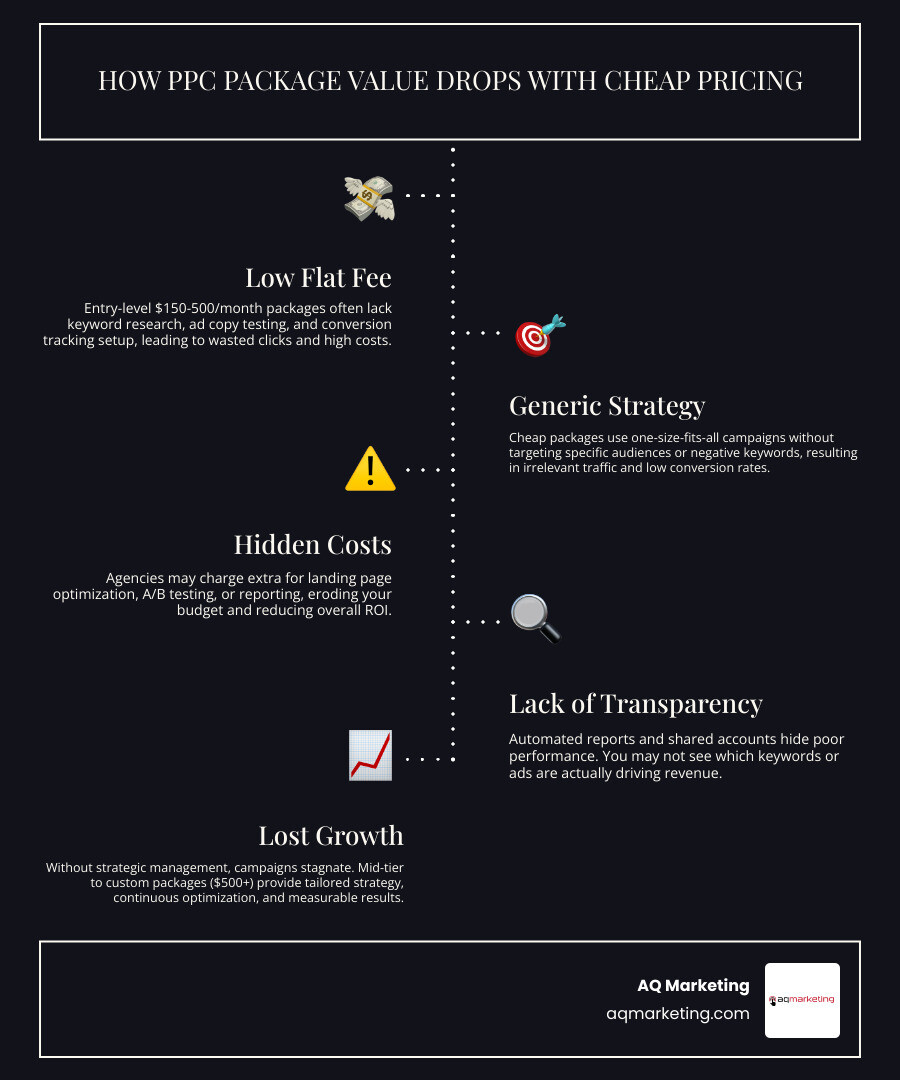
Ppc advertising packages word guide:
Understanding the Reality of PPC Advertising Packages
When you start searching for ways to grow your business online, you will inevitably run into a massive range of pricing options. Some international agencies offer extremely low-cost entry points, such as PPC & Google Ads Packages India 2026 – Flat Fee from ₹3,999/mo · SEO247 (which translates to roughly $50 USD per month). While a flat fee that low sounds incredibly appealing to a small business owner in Woburn, Boston, or Newton, it is critical to look beneath the surface.
In highly competitive local markets across Massachusetts—whether you are looking for customers in Andover, Worcester, or Quincy—the reality of paid search is that you get what you pay for. Managing a high-performing campaign requires hands-on optimization, continuous keyword analysis, and localized strategy that simply cannot be sustained on a bottom-dollar budget.
To help you understand how different agencies structure their pricing, we have compiled a comparison of the most common pricing models you will encounter when shopping for ppc advertising packages.
| Pricing Model | Average Monthly Cost Range* | Pros | Cons |
|---|---|---|---|
| Flat-Fee Management | $150 - $1,500/mo | Highly predictable monthly marketing costs; easy to budget. | Often limits the active hours spent optimizing your account. |
| Percentage of Ad Spend | 15% - 30% of monthly spend (Min. fees often apply) | Agency goals align with scaling your campaign budget successfully. | Can incentivize the agency to push for higher spend regardless of ROI. |
| Custom / Performance Pricing | $1,500 - $5,000+/mo | Tailored specifically to your business goals and competitive landscape. | Higher initial investment; requires deep collaboration. |
*Note: Pricing listed above is based on average online industry data and does not represent AQ Marketing’s actual pricing. Actual costs vary significantly based on your industry, location, and target audience.
Before committing to any pricing structure, it is highly recommended to read our guide on Demystifying Your Google PPC Campaign Costs to understand how ad spend and management fees interact to form your total monthly investment.
What is Typically Included in Professional Ad Management?
A truly professional pay-per-click campaign is never a "set-it-and-forget-it" project. When we look at what goes into high-quality campaign management, it involves a complex mix of technical skill, marketing psychology, and continuous data analysis.
If you partner with an experienced Pay Per Click Advertising Firm, a professional management package should include:
- In-Depth Keyword Research: Identifying high-intent search terms that your prospective customers in Massachusetts actually use.
- Strategic Ad Copy Creation: Writing compelling, click-worthy headlines and descriptions that stand out from the competition.
- Landing Page Optimization Strategy: Ensuring that once a user clicks your ad, they land on a highly relevant page designed to convert them into a lead.
- Continuous Bid Management: Adjusting your bids to secure the best ad placements without overpaying.
- Detailed Performance Reporting: Providing clear, transparent data on how many leads, calls, or sales your budget generated.
To learn more about the day-to-day work required to keep your campaigns profitable, check out our comprehensive guide on PPC Ad Campaign Management 101: From Noob to Pro as well as The Ultimate Guide to Google Ad Management Services.
Evaluating Google Ads vs. Social Media PPC Advertising Packages
When evaluating different packages, you will notice that some focus strictly on Google Ads, while others bundle social media advertising (such as Facebook or Instagram ads). The right choice depends heavily on your business model and target audience.
Google Ads is driven by search intent. When someone in Waltham or Braintree searches for "emergency plumber near me," they have an immediate need. Showing up at the top of Google search results at that exact moment is incredibly valuable. This is why search campaign packages are highly focused on precise keyword match types and local geo-targeting. For more on this, read our resource on Targeted PPC Advertising.
Social media ads, on the other hand, rely on demographic and interest-based targeting. Instead of capturing active searchers, you are disrupting a user's feed with visually engaging content. This is fantastic for building brand awareness, promoting visual products, or targeting specific life events. A comprehensive digital strategy often uses both, but your immediate budget might dictate starting with the platform that offers the fastest path to direct leads.
Key Deliverables to Look For in a Campaign Setup
A successful campaign starts long before the first ad goes live. If you are reviewing a proposal for a new PPC campaign, look closely at the setup phase deliverables. A professional setup must include:
- Conversion Tracking Installation: Setting up Google Analytics, Google Tag Manager, or platform-specific pixels to track phone calls, form submissions, and sales. Without this, you are flying blind.
- Negative Keyword Lists: Building a robust list of terms you do not want to display for (e.g., "free," "jobs," or irrelevant services) to prevent wasted spend.
- A/B Test Variations: Creating multiple ad variations to test which copy and offers perform best.
Skipping these foundational steps is a recipe for wasted ad spend. Be sure to read our checklist on 7 Things to Do Before You Launch a PPC Campaign to make sure your campaign is set up for success from day one.
The Pitfalls of Ultra-Cheap Flat-Fee Models
It is a common story: a small business owner signs up for an ultra-cheap PPC package, only to find that their ad spend is completely wasted, or worse, they cannot even access their own advertising account.
Low-cost, flat-fee agencies often survive on high volume. To make a profit on a $150/month management fee, they have to automate almost everything. This leads to several major risks:
- Lack of Active Optimization: Your account is set up using automated templates and rarely, if ever, reviewed by a human expert.
- Hidden Fees: Some cheap packages hide their management fees by bundling them directly with your ad spend. For example, you pay $500/month, but the agency only spends $200 on actual ads and pockets the remaining $300 without telling you.
- No Account Ownership: Many low-cost agencies set up your campaigns inside their master account. If you ever decide to leave, they keep all your historical data, campaign structures, and landing pages, forcing you to start from scratch.
- Irrelevant Traffic: Without active negative keyword management, your ads will display for completely irrelevant searches, draining your daily budget on clicks that will never convert.
If you are tempted by low-cost options, we encourage you to read about the potential trade-offs in our article on 10 Cheaper Alternatives to Google Advertising Agencies.
Who Actually Benefits from Entry-Level PPC Advertising Packages?
While we caution against ultra-cheap, automated services, there is a place for entry-level, highly focused campaigns. Startups and very small local businesses with limited budgets can still leverage paid search successfully if they keep their scope narrow.
For instance, a local home services provider in Woburn or a new startup in Cambridge can benefit from a highly targeted campaign focused on a single service in a small geographic radius. By keeping the target area and keyword list tight, you can maximize a modest budget. For specific examples, see our guides on PPC for Start Ups and our specialized Cheat Sheet to HVAC PPC Services.
Red Flags of Low-Cost Ad Management
When shopping around for ppc advertising packages, keep an eye out for these warning signs:
- Guaranteed Rankings or Clicks: No one can guarantee a specific position or click volume on Google because the auction changes in real-time.
- Refusal to Grant Admin Access: You should always have full ownership and administrative access to your Google Ads and Google Analytics accounts.
- Vague, Automated Reporting: If your monthly report only shows "impressions" and "clicks" without detailing actual conversions (calls and form leads), the agency may be hiding poor performance.
To protect your business, read our advice on The No-Nonsense Guide to Choosing a Google Ads Company.
How to Measure ROI and Evaluate Your Campaign's Success
At the end of the day, the only metric that truly matters is your Return on Investment (ROI). You should not measure the success of your PPC campaign by how "cheap" the management package is, but by how much revenue it generates for your business.
To evaluate if your PPC package is working, focus on these key performance indicators (KPIs):
- Click-Through Rate (CTR): The percentage of people who see your ad and click on it. A high CTR indicates your ads are highly relevant to the searchers.
- Cost Per Acquisition (CPA): How much you pay in ad spend to secure a single lead, phone call, or customer.
- Quality Score: Google’s rating of the relevance and quality of both your keywords and your PPC ads. A higher Quality Score lowers your cost per click.
- Conversion Rate: The percentage of website visitors who take a desired action (like calling your office or filling out a contact form).
To dive deeper into optimizing these metrics, check out PPC Campaigns 101: Stop Wasting Money and Start Getting Clicks and implement these 4 PPC Campaign Best Practices.
Frequently Asked Questions About Paid Search Pricing
Navigating paid search pricing can be confusing. Here are answers to some of the most common questions we hear from business owners in Massachusetts.
What is the average cost of a professional PPC management package in 2026?
In 2026, professional, hands-on PPC management for a small to medium-sized business typically ranges from $500 to $1,500+ per month, plus your actual ad spend paid directly to Google or social media platforms. Highly competitive industries (like legal, insurance, or emergency home services) in major metro areas like Boston may require custom packages ranging from $1,500 to $5,000+ per month to account for the intense competition and constant optimization required.
(Please note: This pricing is based on average online industry data for 2026 and does not represent AQ Marketing's actual pricing structures.)
Why do some agencies charge a percentage of ad spend instead of a flat fee?
Charging a percentage of ad spend (typically 15% to 20%) is a standard industry practice for larger campaigns. As your ad spend increases, the complexity of managing the account, testing ad variations, and optimizing bids grows significantly. A percentage-based model ensures the agency has the resources required to dedicate more hours to managing your expanding campaign.
Can a small business run successful PPC campaigns on a tight budget?
Yes! A small business can absolutely run a successful campaign on a modest budget, provided the campaign is highly focused. Instead of trying to target all of Massachusetts, you can limit your targeting to specific towns like Woburn, Burlington, or Lexington. By focusing on your most profitable services and using exact-match keywords, you can achieve a fantastic return without a massive budget. For a basic introduction to how this works, see The No-Nonsense Guide to What Pay Per Click Is.
Conclusion: Choosing the Right Partner for Long-Term Growth
Choosing the right partner for your paid search campaigns is about finding an agency that values transparency, communication, and real business growth. Cheap, automated packages might save you a few dollars upfront, but they often lead to wasted ad budgets and missed opportunities.
At AQ Marketing, we have spent over two decades helping small to medium-sized businesses in Woburn, MA, and surrounding communities build sustainable, long-term online visibility. We believe in clear reporting, direct account ownership, and strategies tailored to your unique business goals.
If you are ready to stop guessing and start growing, discover Why Your Business Needs a Google PPC Advertising Agency and read about the top Hiring a PPC Management Firm: 5 Reasons Why You Should.
Ready to take your digital marketing to the next level? Partner with AQ Marketing for Professional PPC Management and let's build a campaign that drives real results for your business.
Understanding PPC Marketing vs. SEO and SEM
Navigating digital marketing can feel like learning a whole new language. To get the most out of your ad dollars, it helps to understand how pay-per-click (PPC) fits alongside Search Engine Optimization (SEO) and Search Engine Marketing (SEM).
At its core, PPC is an advertising model where you pay a platform every time a searcher clicks your ad. What is Pay Per Click explains how this direct fee model grants immediate entry to top-of-page search results.
SEO, on the other hand, focuses on earning free organic search rankings through high-quality content, solid web architecture, and backlinks. While SEO builds long-term authority, it takes time to show results.
SEM is the umbrella term that covers both paid search (PPC) and organic search (SEO). To see how these channels complement one another, read our full breakdown on SEO vs PPC: What's the Difference?.
Pros and Cons of PPC Advertising for SMBs
For small and medium-sized businesses across Massachusetts, PPC search advertising offers powerful growth opportunities alongside real budget responsibilities.
Pros:
- Immediate Search Visibility: Unlike organic ranking efforts that build over months, launching a pay per click keyword campaign places your business at the top of search results right away.
- Granular Budget Control: You can set strict daily spend caps. Platforms allow businesses to start testing campaigns with as little as $5 per day with no minimum spend requirements.
- Measurable ROI: Every click, phone call, and contact form submission can be tied back to specific search terms, giving you full visibility into what’s working.
Cons:
- Ongoing Spend: Once you pause your campaign or exhaust your daily budget, your ad visibility stops immediately.
- Competitive Bidding: High-demand service categories can drive up cost-per-click rates, requiring active management to prevent wasted ad spend.
How to Master Pay Per Click Keyword Selection and Match Types
Choosing effective keywords isn't about collecting hundreds of random terms; it's about matching searcher intent. Grouping search queries by intent allows you to separate casual researchers from active buyers ready to hire a contractor or buy a service. Focus heavily on high-intent, long-tail phrases (typically 3 to 4 words) which carry higher conversion rates and often lower competition than generic single-word searches. Check out our PPC Targeting Ultimate Guide for deeper audience strategies.
Match types tell ad platforms how closely a user's search query must match your selected pay per click keyword before your ad enters the auction.
| Match Type | Google Ads Syntax | Reach | Specificity | Wasted Spend Risk |
|---|---|---|---|---|
| Broad Match | keyword |
Maximum | Low | High |
| Phrase Match | "keyword" |
Moderate | High | Moderate |
| Exact Match | [keyword] |
Targeted | Maximum | Low |
Strategic Matching Rules for Your Pay Per Click Keyword List
Using match types strategically keeps your budget focused on qualified prospects:
- Broad Match: Matches your query to broad concepts and related searches. While it yields maximum exposure, it carries a higher risk of triggering ads on irrelevant terms if left unmonitored.
- Phrase Match: Includes the meaning of your search phrase. Ads show on searches that include the core intent of your term, offering a balanced mix of volume and lead control.
- Exact Match: Matches the specific intent of your phrase directly. Exact match gives you tight control over who sees your ads, ensuring high ad relevance.
- Close Variants: Ad networks automatically show your ads on close variants—including misspellings, singular or plural forms, and abbreviations—regardless of the match type selected.
Negative Keywords and Bid Refinement Strategies
Negative keywords block your ads from triggering on queries that won't produce business. For example, if you offer premium roofing services, adding terms like "free," "DIY," "jobs," or "cheap" as negative keywords keeps casual searchers from draining your budget. Adding at least three targeted negative keywords per ad group is a smart baseline practice.
To keep costs under control, read Google's guidance on Refining your keywords and bids. You can also adopt automated bidding strategies like Target CPA (Cost Per Acquisition) to auto-adjust bids in real time once your account hits steady conversion volumes (typically 50 conversions per month).
Conducting Keyword Research and Forecasts with Google Keyword Planner

Google Keyword Planner is a free resource inside Google Ads built to help businesses discover search terms, inspect volume trends, and build baseline ad budgets. You can begin by entering seed words related to your core services or scanning your business domain URL. You can also review Google's official documentation on how to Research Keywords for Campaigns with Keyword Planner.
Evaluating Forecasts to Estimate Clicks, Impressions, and Costs
Keyword Planner provides predictive performance forecasts based on recent 7- to 10-day search trends and seasonal adjustments. To learn how these traffic projections are calculated, review Google's guide About Keyword Planner forecasts.
These tools let you adjust bid sliders and daily budget caps to model projected clicks, impressions, and estimated costs before spending real ad dollars. That search volume historical data is always displayed using exact match metrics, regardless of which match type you select for your plan.
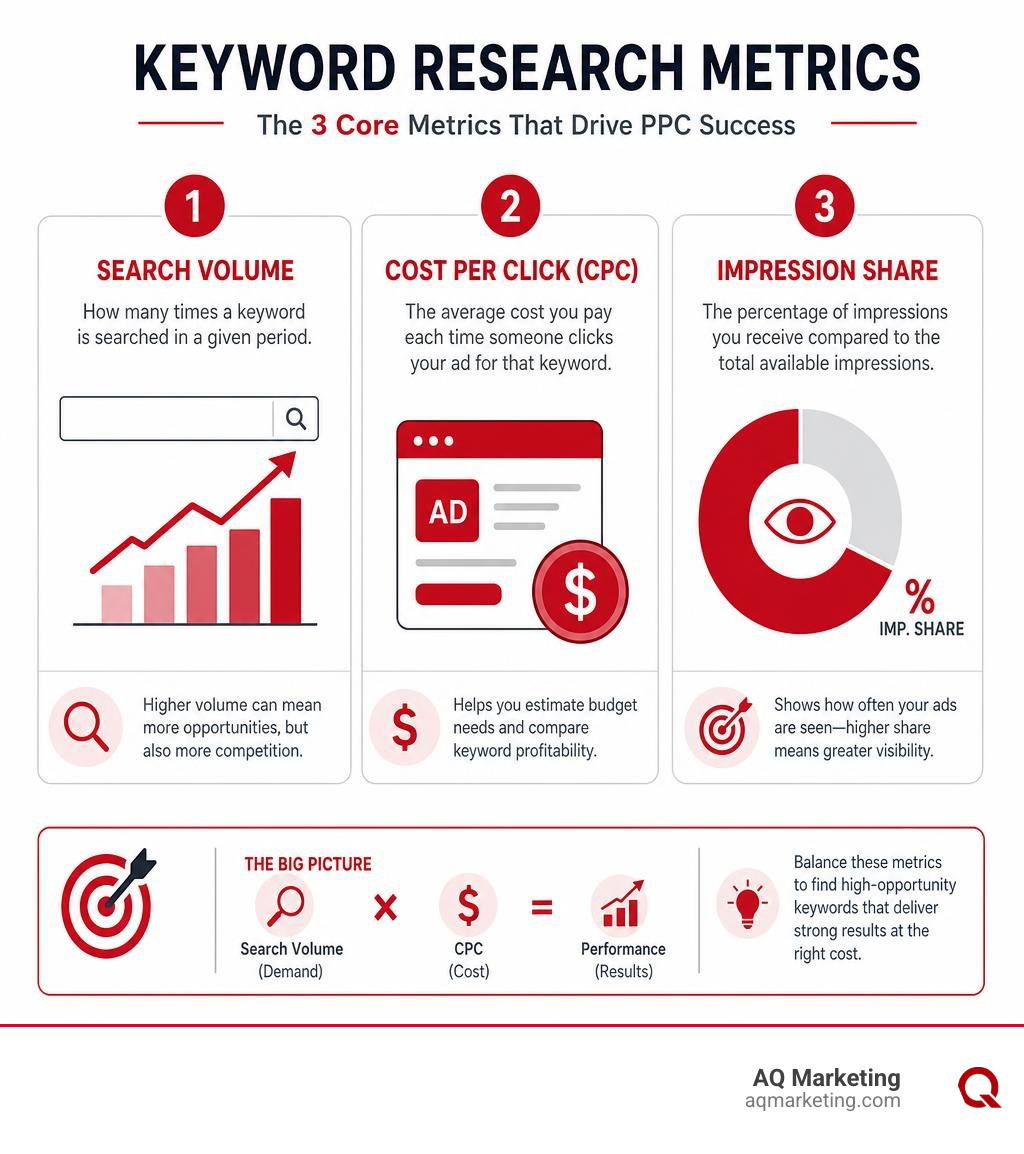
Calculating Cost-Per-Click: Average CPC vs. Maximum CPC
Understanding the mechanics of ad pricing helps you build predictable ad budgets:
For example, if your campaign receives two clicks—one costing $0.20 and another costing $0.40—your total cost is $0.60, making your Average CPC $0.30.
- Maximum CPC (Max CPC): The maximum cap you set manually for a single ad click.
- Actual CPC: The actual fee billed. Thanks to auction dynamics, you only pay one cent ($0.01) above the minimum amount required to hold your ad position, which is often lower than your Max CPC cap.
- Bidding Modes: You can manage bids using Manual CPC for total budget control, or switch to Enhanced CPC (ECPC), which automatically scales manual bids up or down based on conversion likelihood.
Setting Up, Managing, and Tracking Your Campaign for Peak Traffic
A successful campaign relies on careful setup. Before turning on live ad spend, read our quick checklist on 7 Things to Do Before You Launch a PPC Campaign. Structuring tight ad groups focused around single search themes keeps your ad text aligned with search intent. For a step-by-step walkthrough, check out our guide on PPC Campaigns 101: Stop Wasting Money and Start Getting Clicks.
Essential Metrics: Quality Score, CTR, and Conversion Rates
To maximize website traffic within a fixed budget, monitor these core performance metrics continuously:
- Click-Through Rate (CTR): The percentage of users who click your ad after seeing it. High CTR signals relevant ad copy and strong search alignment.
- Quality Score: A score from 1 to 10 assigned by Google based on expected CTR, ad relevance, and landing page user experience. A high Quality Score lowers your actual CPC and improves ad position.
- Conversion Rate: The percentage of ad clicks that result in desired user actions, like filled contact forms or phone calls.
Elevating Ad Relevance with Dynamic Pay Per Click Keyword Insertion
Dynamic Keyword Insertion (DKI) automatically updates your text ad to include the exact term that triggered the ad, increasing ad relevance instantly.
To set up dynamic keyword insertion safely, follow these rules:
- Use Proper Syntax: Insert
{KeyWord:Default Text}into your ad headline or description line. - Include Default Text: Always set clear default text (e.g., "Local Plumbing Services") to display if a search term exceeds character limits.
- Mind Character Limits: Headlines allow up to 30 characters; descriptions permit up to 90 characters.
- Capitalization Rules: Use
KeyWordfor Title Case,Keywordfor Sentence Case, orkeywordfor lowercase text.
For official step-by-step setup instructions, consult Google's documentation to Set up keyword insertion for your ad text.
Frequently Asked Questions About Pay-Per-Click Keywords
What is the average cost-per-click for small business ad campaigns?
Based on average online data, most small business search campaigns see cost-per-click rates ranging between $1.50 and $7.00 per click. However, overall industry pricing spans a wide range. Competitive industries like legal, specialized insurance, or emergency home repairs can see top-of-page bids reaching $25.00 to $50.00+ per click—more than 3× the average rate. This pricing reflects industry data and does not represent AQ Marketing's actual pricing.
How often should negative keywords be updated in a PPC campaign?
You should review your campaign's Search Term Report weekly during the first month of a new campaign. Identifying and adding non-relevant search queries to your negative keyword list on a regular schedule prevents budget waste early on. Once campaigns stabilize, bi-weekly or monthly negative keyword audits help maintain high lead quality.
What is the difference between broad match and exact match keywords?
Broad match offers the widest reach by displaying your ad on searches related to your keyword, including implicit concepts, variations, and related topics. Exact match offers strict control, showing your ad only when a user's search query shares the exact meaning and intent of your selected keyword phrase.
Conclusion
Mastering every pay per click keyword in your account is one of the fastest ways to eliminate wasted ad spend and generate reliable business growth. By selecting high-intent search terms, setting smart match types, maintaining negative keyword lists, and monitoring your Quality Score, you can turn search ad budgets into predictable revenues.
At AQ Marketing, we’ve spent over two decades helping businesses across Woburn and the greater Boston area build and manage high-converting digital ad campaigns. Explore our comprehensive pay-per-click advertising services or reach out to our team today to optimize your search marketing strategy!
What a Boutique Branding Agency Can Do for Your Business
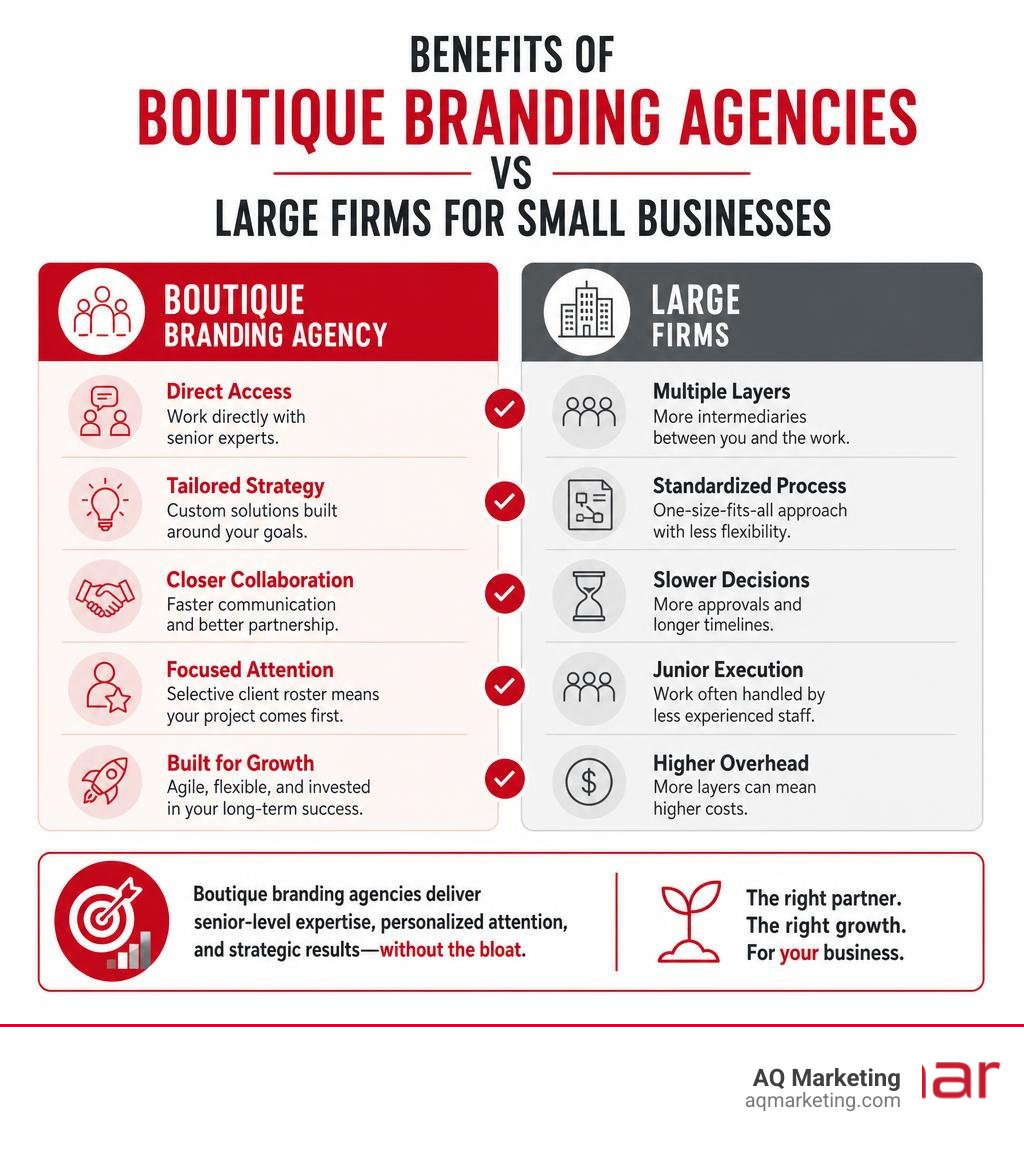
A boutique branding agency gives small and mid-sized businesses something most large firms simply can't offer: senior-level creative attention, tighter collaboration, and a brand built around your goals — not a templated process.
Quick answer: What is a boutique branding agency?
| Feature | What It Means for You |
|---|---|
| Small, focused team (2–49 people) | You work directly with senior strategists and designers |
| Specialized services | Brand strategy, logo design, visual identity, naming, and guidelines |
| Selective client roster | Your project gets real attention, not junior staff |
| Typical project cost | $10,000–$150,000+ (based on avg. online data; not AQ Marketing pricing) |
| Typical timeline | 4–14 weeks depending on scope |
| Best for | Startups, founder-led brands, SMBs ready to grow |
Whether you're launching a new business or your current brand no longer reflects who you are, the right agency partner can make a measurable difference — in how customers perceive you, trust you, and choose you over a competitor.
Most business owners assume a bigger agency means better results. It usually just means more layers, slower decisions, and less access to the people actually doing the work.
I'm Robert P. Dickey, President and CEO of AQ Marketing, and with over 20 years helping small and mid-sized businesses grow their digital presence, I've seen how partnering with the right boutique branding agency can transform a business's identity and market position. Let's walk through everything you need to know to find the right fit.
Must-know boutique branding agency terms:
Why Choose a Boutique Branding Agency Over a Large Firm?
When searching for the perfect partner to build or refresh your brand, you will likely find yourself at a crossroads: do you hire a massive, multi-national holding company agency, or do you partner with a specialized, smaller team?
For most small and mid-sized businesses, the large agency model introduces unnecessary friction. Massive firms are structured for multi-market coordination and enterprise-level scale, which means they come with multiple layers of account management and approval processes. Your project can easily get lost in the shuffle, often handed off to junior designers once the contract is signed.
A boutique agency operates on a completely different philosophy. The team is intentionally small, highly collaborative, and deeply invested in your success. You get direct access to senior talent, faster decision-making, and a highly customized creative process.
To help you visualize the differences, here is a direct comparison of the two models:
| Feature | Boutique Branding Agency | Large Holding Company Agency |
|---|---|---|
| Primary Contact | Senior Creative Director / Partner | Junior Account Executive |
| Team Structure | Flat, agile, and collaborative | Hierarchical with multiple middle managers |
| Project Turnaround | Fast and responsive (typically 4–14 weeks) | Slower, bureaucratic approval cycles |
| Creative Output | Bespoke, highly original, and tailored | Often standardized or category-templated |
| Client Selectivity | Highly selective (fewer clients, deeper focus) | Volume-driven to meet corporate overhead |
By choosing a smaller, specialized partner, you avoid the administrative bloat and ensure that your brand strategy is built with substance and soul. If you want to dive deeper into how a strong visual identity impacts your overall business growth, check out our guide on Building a Business Logo and Brand Identity.
What Defines a Boutique Branding Agency?
A boutique branding agency is typically defined by its size, focus, and methodology. Most boutique firms maintain a team size of 2 to 49 employees. Rather than attempting to be a "one-stop-shop" that handles everything from nationwide TV commercials to massive public relations campaigns, they focus strictly on what they do best: brand strategy, visual positioning, naming, and identity systems.
This specialized focus allows them to be highly selective with their client roster. Instead of juggling dozens of accounts simultaneously, a boutique team might only take on a handful of projects per quarter. This selectivity ensures that your business receives the dedicated focus it deserves. If you feel like your current branding has lost its edge, it might be time to read our insights on Is Your Brand Identity Frozen in the Past? Learn How to Modernize It.
For premium or niche businesses, this dedicated approach is invaluable. For example, specialized agencies like Boutique Branding Agency - SUM focus on helping founders and luxury brands craft distinctive identities with lasting value through a direct, senior-led approach.
The Advantages of Direct Access to Senior Creatives
One of the most significant advantages of working with a boutique agency is the elimination of the "agency game." In large firms, senior partners pitch the business, but junior staff execute the work. In a boutique setting, the people selling the idea are the ones actually building it.
This flat structure offers several business benefits:
- No Bureaucracy: You do not have to filter your feedback through three layers of account managers. You speak directly to the designer or strategist.
- Faster Decisions: Changes and iterations happen in hours or days, not weeks.
- Creative Conviction: Smaller teams survive on the strength of their ideas. They are forced to have a strong, distinctive point of view, protecting your brand from being diluted into generic "category wallpaper."
This direct collaboration leads to what is known as "embodied branding"—a process where the brand identity is so perfectly aligned with the founder's vision and business values that it shifts how the entire company shows up in the marketplace. To learn more about selecting the right creative partner, take a look at The Ultimate Guide to Hiring a Graphic and Web Design Company.
Core Services Offered by Specialized Branding Studios

Boutique branding agencies do not offer watered-down, one-size-fits-all services. Instead, they provide deeply focused creative solutions designed to shape how your target audience feels, thinks, and acts when they interact with your business.
Whether you run a local home services business in Woburn, MA, or a growing insurance agency in Acton, MA, a specialized branding studio will tailor their deliverables to your specific industry economics.
Brand Strategy and Positioning
Before a single line is drawn or a color palette is selected, a boutique agency will focus heavily on research and strategy. This phase is designed to eliminate personal bias and establish clear, data-driven benchmarks for your brand.
Key strategic services typically include:
- Market Research & Competitor Analysis: Identifying gaps in your local or digital market so your business stands out.
- Target Audience Definition: Mapping out your ideal customer's demographics, challenges, and lifestyle preferences to humanize your marketing.
- Brand Voice & Messaging: Crafting a clear, consistent tone of voice that communicates your unique value proposition in seconds.
For specialized industries like hospitality, agencies like Hospitality Branding Agency | Hotel & Resort Branding Experts demonstrate how early-stage brand positioning directly shapes physical spaces, guest experiences, and long-term asset value. To see how we approach these foundational elements, you can explore our own specialized Services: Branding.
Visual Identity and Logo Design
Once the strategic foundation is built, the agency transitions into visual execution. A logo is not a brand on its own; it is simply the visual anchor of a much larger, cohesive brand system.
A comprehensive visual identity package from a boutique agency typically includes:
- Custom Typography Systems: Selecting and licensing fonts that reflect your corporate character.
- Color Psychology & Accessibility: Developing a color palette tested for WCAG contrast compliance across digital devices.
- Comprehensive Brand Guidelines: A detailed PDF manual covering logo usage, spacing, color values (HEX, RGB, CMYK), and photography direction to ensure consistency across all marketing channels.
For consumer-facing brands, this visual system extends directly to packaging and product presentation. Agencies like Custom CPG Branding Solutions | Vanp Brand Studio – Elevate Your Brand Strategy specialize in helping consumer product goods (CPG) founders turn raw ideas into iconic, shelf-ready brands.
If you want to see how these visual systems come together in real-world applications, browse our Portfolio: Branding.
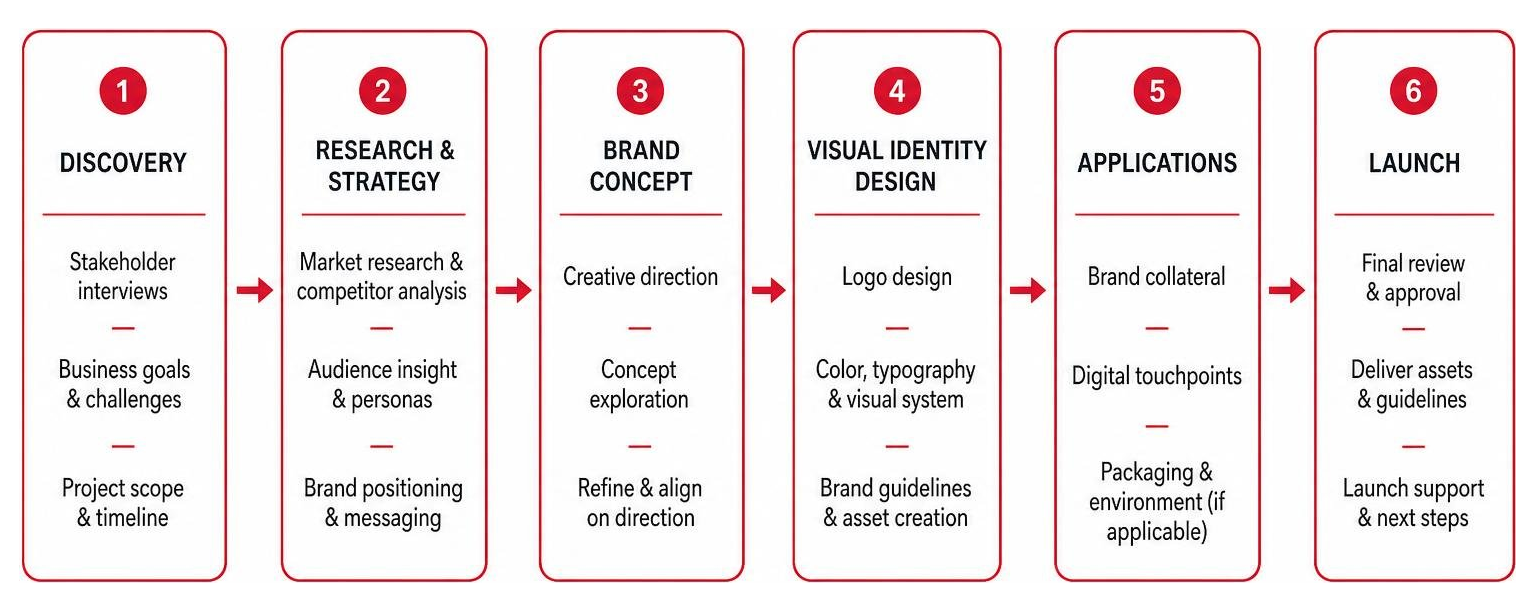
To make these creative processes highly successful, boutique agencies often combine multiple disciplines into a unified workflow:
Other specialized boutique firms, such as Branding Chicks, focus on empowering women-owned businesses and femme-focused brands, proving that a highly targeted niche strategy can build incredible brand love. Similarly, agencies like WHAT DO WE DO - BRAND BOUTIQUE – consultancy for marketing, strategy & design and NOBRAND - Restaurant Branding, Fashion Branding, Jewellery Branding – Nobrand Agency demonstrate how specialized design can translate complex ethical values or luxury concepts into commercial success on retail shelves and digital platforms.
The Cost of Hiring a Boutique Branding Agency

Understanding the financial investment required to partner with a boutique agency is crucial for planning your annual marketing budget. Because boutique agencies prioritize quality over volume, their pricing reflects the depth of research, strategy, and custom design involved in each project.
Disclaimer: The pricing ranges listed below are based on average online industry data collected in July 2026. They do not represent AQ Marketing’s actual pricing or service rates. We provide these figures to give you a realistic overview of the broader agency market.
When evaluating costs, keep in mind that a strong brand is an investment that compounds over time, acting as a "commerce multiplier" that supports premium pricing and reduces customer acquisition costs. If you are a startup trying to balance your budget with your creative needs, read our guide on Package Deal: Finding the Perfect Branding Solution for Your Startup.
Typical Project Budgets and Hourly Rates
Boutique agencies typically charge either an hourly rate or a flat, project-based fee.
- Hourly Rates: Most established boutique branding agencies command hourly rates ranging from $150 to $450+ per hour.
- Project Budgets: A standard, mid-market brand identity project (encompassing strategy, logo design, typography, color systems, and guidelines) commonly ranges from $10,000 to $50,000.
- Enterprise-Level Brand Systems: For larger organizations requiring complex brand architecture, multi-market research, or extensive digital-first motion systems, project costs can easily scale from $50,000 to $150,000+ (with high-end, specialized projects occasionally exceeding $200,000).
This wide spread in pricing depends heavily on the agency's prestige, geographic location, and the complexity of the deliverables.
Tiered Branding Packages for Startups
To accommodate early-stage, venture-backed, or bootstrapped startups, many boutique agencies offer structured, fixed-price tiered packages. These packages are aligned with the business's growth stage:
- Pre-Seed / Bootstrapped Package (Approx. $10,000 – $15,000): Focuses on the essentials—a core logo, basic color palette, primary typography, and a simple style sheet to help the business launch quickly.
- Seed Round Package (Approx. $20,000 – $35,000): Includes a deeper competitive discovery phase, primary and secondary logo marks, full brand guidelines, custom stationery, and basic social media templates.
- Series A / Scale-Up Package (Approx. $50,000 – $150,000+): An exhaustive brand transformation including complete brand architecture, comprehensive messaging frameworks, custom packaging or digital product styling, and full website design integration.
If you are preparing to launch a new business, you can explore how to lay a rock-solid foundation by reading The Secret Sauce: Building a Winning Brand Strategy for New Ventures.
How to Choose the Right Boutique Partner
Selecting the right boutique branding agency is a highly personal decision. Because you will be working closely with their team, finding a partner that aligns with your industry, geographic region, and communication style is essential for a successful outcome.
If you are a business based in Massachusetts, working with a regional agency can offer massive cultural advantages. For example, if you are looking for local marketing support, checking out specialized local providers like SHD Marketing | Your Full-Service Agency in Norwell, MA, Advertising and Marketing Agency in Acton, MA, Branding & Design Agency - BRIGADE - Northampton, MA, Gemini Creative, Branding, Website Design & Digital Marketing Agency, or Birdhouse Marketing & Design, LLC can help you find a team that understands the local New England demographic.
How to Evaluate a Boutique Branding Agency Portfolio
When reviewing an agency's portfolio, do not just look for "pretty designs." You want to look for strategic depth and consistency.
Ask yourself these questions while browsing their past work:
- Is there a variety of styles? If every client in their portfolio looks identical, the agency may be forcing brands into their own preferred aesthetic rather than building an identity tailored to the client's audience.
- Are there real-world case studies? Look for detailed explanations of why certain design decisions were made and what business results those decisions achieved.
- Are the reviews verified? Check independent, third-party directories to confirm the legitimacy of their client feedback.
A disciplined, professional agency will always start with research to eliminate guesswork. For a step-by-step roadmap on building your brand from scratch, take a look at our 8 Steps to Create a Powerful Brand for Your Small Business.
Assessing Communication and Project Management Styles
Because boutique agencies are small, they rely heavily on organization and clear communication to keep projects on track. During your initial consultation, ask about their workflow:
- What tools do they use? Look for agencies that utilize modern project management platforms (like Asana, Basecamp, or ClickUp) and collaborative design spaces (like Figma).
- Who is your point of contact? Ensure you will have direct access to the creative team, not an administrative assistant.
- What is their reporting frequency? A professional agency will provide regular, structured updates rather than leaving you in the dark for weeks.
Understanding these operational details upfront will ensure a smooth, stress-free creative partnership. To learn more about how a strategic approach can ignite your marketing efforts, check out our insights on Startup Marketing Magic: 5 Strategies to Ignite Your Brand.
Frequently Asked Questions About Boutique Branding
How long does a typical boutique branding project take?
A typical comprehensive branding project with a boutique agency takes between 8 to 14 weeks from kickoff to final asset delivery.
Here is a general breakdown of the timeline:
- Weeks 1–3 (Discovery & Research): Competitor audits, audience research, and brand strategy definition.
- Weeks 4–7 (Concept Development): Logo design, visual identity exploration, and typography selection.
- Weeks 8–10 (Refinement): Client feedback cycles, color testing, and packaging or layout mockups.
- Weeks 11–14 (Guidelines & Asset Delivery): Finalizing the brand style guide and exporting all logo formats (vector, raster, monochrome, favicons) and digital templates.
Can a boutique agency handle digital and web design?
Yes, many modern boutique branding agencies build "digital-first" brand systems. They recognize that your website is often the primary touchpoint where customers interact with your brand.
A professional branding agency will ensure that your new visual vocabulary—including color systems, typography, and photography styles—translates seamlessly into a responsive, user-friendly website. To understand how professional web design elevates your corporate identity, read our article on From Idea to Icon: How a Startup Website Design Company Can Elevate Your Brand.
How do I know when it is time to rebrand my business?
Every brand eventually outgrows its original design. You know it is time to consider a rebrand or a brand refresh when:
- Your business has evolved: You have added new services, entered new markets, or shifted your target audience, and your current visuals no longer reflect who you are.
- Your branding looks outdated: Your logo, website, and marketing materials look tired compared to modern competitors.
- You are struggling to attract premium clients: If your branding looks amateurish, you will struggle to command premium pricing.
If you are not ready for a complete overhaul, a simple visual update might be all you need. Discover some inspiration in our guide on 5 Brand Refresh Ideas for Small Business.
Conclusion
Partnering with a boutique branding agency is one of the most effective ways for small and mid-sized businesses to achieve world-class creative results without the unnecessary administrative bloat of a massive firm. By working with a dedicated, senior-led team, you ensure that your brand strategy is built with purpose, precision, and a deep understanding of your business goals.
At AQ Marketing, based in Woburn, MA, we have spent over two decades helping local and regional businesses across Massachusetts strengthen their digital footprint and build professional online presences. Whether you are in the home services industry, running an insurance agency, or scaling a growing local service business, we specialize in delivering long-term, impactful results through custom website design, search engine optimization (SEO), and strategic content writing.
Ready to take your online presence to the next level? Book a 15-minute phone call with AQ Marketing today, and let's discuss how we can help your business grow.
Why Finding the Right B2B Content Agency Can Make or Break Your Pipeline
A B2B content agency is a specialized marketing partner that creates and distributes content designed for business-to-business buyers — not general consumers. Unlike broad content shops, B2B-focused agencies understand long sales cycles, multiple decision-makers, and the kind of technical credibility that actually moves deals forward.
Here's what a B2B content agency typically does:
- Builds content strategies tied to revenue goals, not just traffic
- Creates thought leadership, case studies, white papers, and SEO content
- Optimizes content for traditional search and AI-powered engines (ChatGPT, Perplexity, Google AI Overviews)
- Supports sales teams with enablement content like battlecards and pitch decks
- Measures results in pipeline and conversions, not just page views
The numbers back up why this matters. According to recent industry data, 75% of B2B buyers now prefer a sales rep-free experience — meaning your content has to do the selling. And 46% of B2B marketers plan to increase content budgets in 2026, signaling that competition for buyer attention is only getting fiercer.
Getting this wrong is expensive. Fifty-seven percent of B2B marketers say they struggle to create content that actually resonates with their audience. A generic agency that doesn't understand your buyers' world won't close that gap.
I'm Robert P. Dickey, President and CEO of AQ Marketing, Inc., with over 20 years of experience helping small and mid-sized businesses cut through the noise with smarter digital marketing — including B2B content agency strategy and execution. In this guide, I'll walk you through exactly what to look for so you can find a partner that delivers real results, not just deliverables.
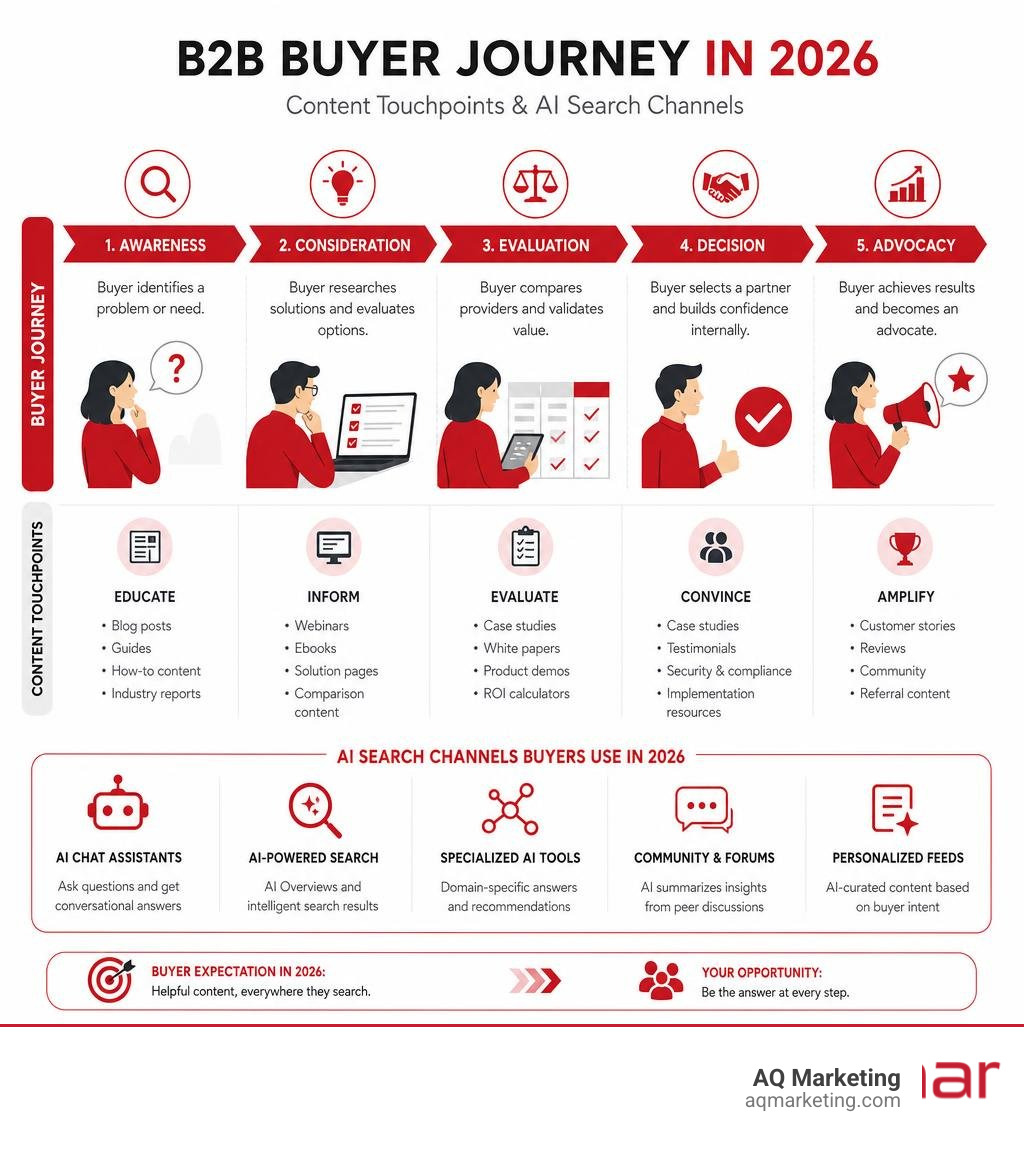
Essential b2b content agency terms:
What is a B2B Content Agency and Why Does Tech Need One?
To understand why a dedicated B2B content agency is essential, we have to look at how businesses buy. In the consumer (B2C) world, buying decisions are often emotional, fast, and driven by a single person. If you want to buy a pair of running shoes, you click an ad, read a quick review, and make a purchase in five minutes.
In the B2B technology and SaaS sectors, the buying process couldn't be more different:
- Longer, Complex Sales Cycles: A typical enterprise software purchase can take anywhere from three to twelve months.
- Multiple Stakeholders: The average B2B purchase involves 6 to 10 stakeholders in a buying committee. You must satisfy the technical requirements of the IT director, the financial scrutiny of the CFO, the security compliance of the CISO, and the usability demands of the end-users.
- High-Risk Decisions: Choosing the wrong software or service provider can cost a company millions of dollars, disrupt daily operations, or lead to security vulnerabilities.
Because of these dynamics, B2B buyers do extensive research before ever speaking to a sales representative. This is where The Importance of Blog Content in Attracting and Converting Buyers becomes clear. High-quality, educational blog content acts as a silent salesperson, answering critical questions, building trust, and guiding prospects through every stage of their decision-making process.
To find the right support, many local companies look to specialized regional resources, such as a Boston MA Web Design + Digital Marketing Agency Massachusetts or explore The B2B Marketing Agency Boston Directions - Stifel Marcin to connect with local experts. Additionally, reviewing options via Top B2B Digital Marketing Agencies in Massachusetts - DesignRush can help identify teams that understand regional market dynamics.
Why Generalist Agencies Fall Short in Tech
Many business owners make the mistake of hiring a generalist content agency. While these agencies might write beautiful prose, they often struggle when tasked with explaining complex technical concepts.
Here is why generalist agencies often fall short in the tech space:
- Over-reliance on Jargon: Generalist writers who do not understand tech tend to mask their lack of depth with buzzwords and fluffy marketing speak. Tech buyers, who are naturally skeptical, see right through this.
- Inability to Interview Subject Matter Experts (SMEs): To write truly authoritative tech content, a writer must interview your developers, product managers, or engineers. A generalist writer won't know the right questions to ask to extract those deep, valuable insights.
- Lack of Audience Trust: If your content contains technical inaccuracies, you instantly lose credibility. In tech, building authority in niche markets requires absolute precision.
- A "Set and Forget" Mentality: Generalist agencies often produce content based on high-volume keywords without understanding if those keywords actually attract qualified buyers.
For businesses seeking specialized support, partnering with a dedicated B2B Marketing Agency | Elevation or consulting with an experienced Kyle Adams - B2B Marketing Communications Advisor - LinkedIn can provide the deep industry expertise required to write for highly technical audiences.
The Dual Role of a B2B Content Agency: Brand and Pipeline
A great B2B content agency doesn't just write articles; they act as a strategic business partner. They balance two equally important goals: building brand equity and generating a measurable sales pipeline.
- Demand Generation & Brand Equity: Content builds long-term awareness by positioning your brand as the go-to authority in your space. When a prospect is finally ready to buy, your brand is already top-of-mind.
- Lead Generation & Revenue: By mapping content to the entire buyer journey, an agency helps you capture high-intent search traffic. This means creating comparison guides, product deep-dives, and landing pages that convert casual readers into booked demos.
To see how these concepts work in action, you can read about The Pillars of Lead Generation Content to learn how to structure your assets for maximum conversion.
Key Services That Drive Pipeline and Revenue
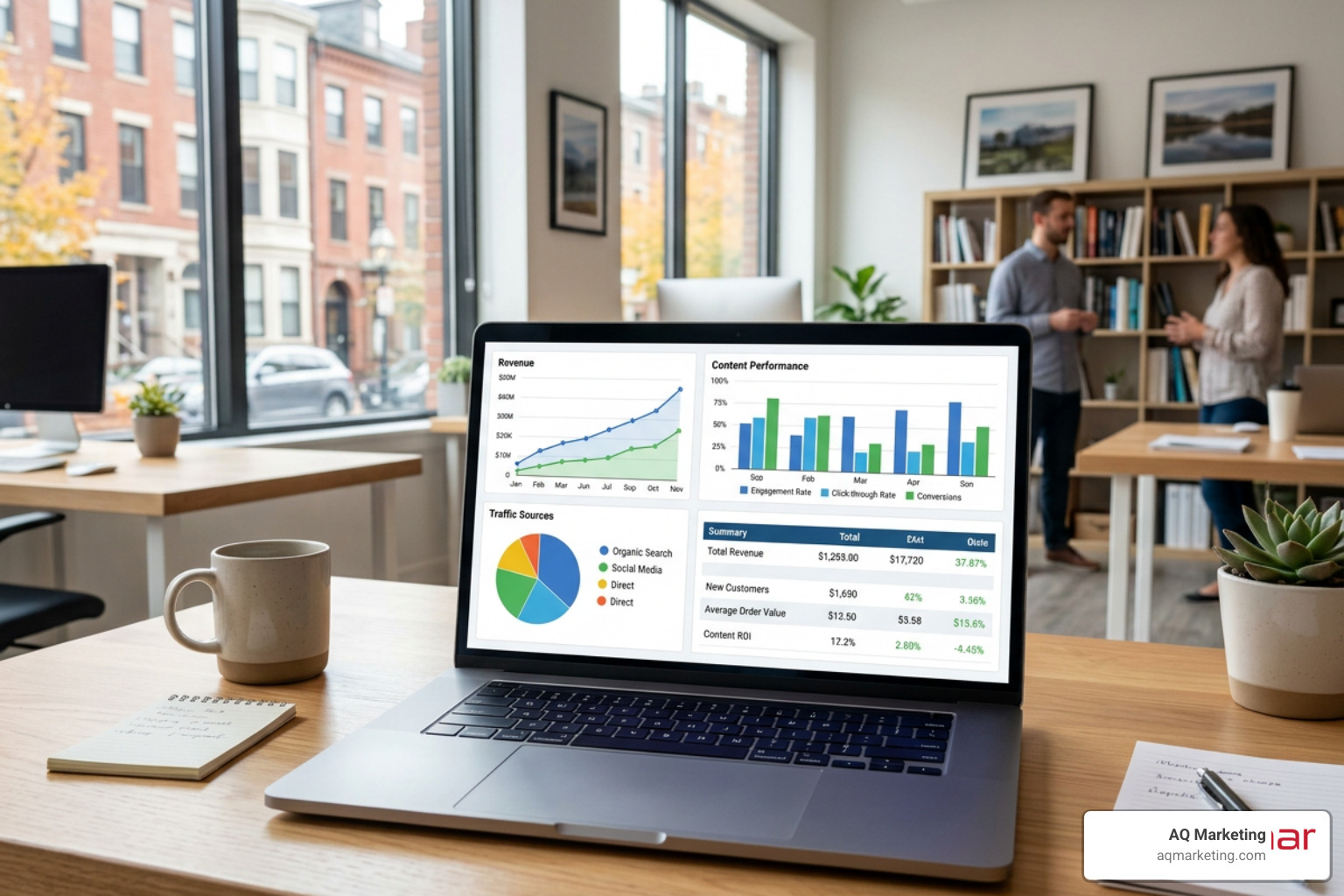
When evaluating a B2B content agency, look beyond simple writing packages. A full-service partner should offer an integrated suite of services designed to turn your website into a scalable growth engine.
Core Services Offered by a B2B Content Agency
- Comprehensive Content Strategy: A successful program starts with a documented strategy. This includes target audience research, competitor gap analysis, and building a 90-day content roadmap. In fact, 74% of B2B marketers who improved their content strategy's effectiveness cited strategy refinement as the single biggest driver of success.
- Search Engine Optimization (SEO): To rank in 2026, your content must satisfy both human searchers and search engine algorithms. This requires in-depth keyword research, semantic clustering, and technical on-page optimization. For a deeper look at why this matters, check out Why Blog SEO Matters in Increasing Website Traffic.
- Sales Enablement Assets: Content shouldn't stop working once a lead is generated. Top agencies produce case studies, white papers, pitch decks, and product sheets that your sales reps can use to close deals.
- Content Refreshing: Creating new content is only half the battle. Top-ranking search pages are updated every two years on average to maintain their positions. A smart agency will identify high-performing older posts and refresh them with updated data and insights, often yielding faster traffic gains than starting from scratch.
For startups looking to establish their market presence, we highly recommend reading Storytelling for Success: Building a Powerful Startup Content Strategy to learn how to craft a compelling brand narrative from day one.
Video and Multimedia Content Production
In 2026, text-based content is no longer enough on its own. Video has become the number one format where marketers are increasing their investments.
A modern B2B content agency must be able to repurpose your written assets into highly engaging multimedia formats, including:
- Explainer Videos & Product Demos: To break down complex software features into easily digestible visual guides.
- Webinars & Podcasting: To showcase your internal experts and build deep relationships with your audience.
- Social Media Clips: Short-form vertical videos optimized for platforms like LinkedIn to drive organic reach.
By distributing your message across multiple channels, you ensure that you reach buyers wherever they prefer to consume information.
The Role of Thought Leadership and GEO in 2026
The B2B marketing landscape has shifted dramatically over the last couple of years. With the rapid rise of artificial intelligence, search engines have evolved from simple list-of-links pages into interactive answer engines. To stay visible, B2B brands must adapt their content strategies to these new technologies.
Why Thought Leadership Drives B2B Purchases
Thought leadership is no longer a luxury; it is the single most powerful tool for accelerating sales and de-positioning competitors. When done right, it directly influences executive decision-making:
- 60% of senior executives say a high-quality piece of thought leadership made them realize they were missing out on a significant business opportunity.
- 75% of senior executives have made a purchase as a direct consequence of engaging with thought leadership content.
- 60% of senior executives state that good thought leadership makes them willing to pay a premium for a brand's services.
True thought leadership goes beyond generic tips. It requires sharing original research, proprietary data, and strong, unique points of view on industry trends. While AI can draft standard educational content, it cannot replicate the real-world experiences of your company's leaders.
To understand how to balance human expertise with modern tools, explore the Benefits of Using AI in Digital Marketing to see how technology can enhance, rather than replace, your creative efforts.
Adapting to AI Search and Answer Engine Optimization (AEO)
In 2026, search engine optimization has expanded to include Generative Engine Optimization (GEO) and Answer Engine Optimization (AEO). Buyers are increasingly using platforms like ChatGPT, Perplexity, and Google AI Overviews to find business solutions.
To ensure your brand is cited as a trusted source by these AI engines, your content agency must implement advanced optimization techniques:
- Passage-Level Content Engineering: AI models index information in small, high-density chunks. Your content must use an answer-first, inverted-pyramid structure, ensuring that key answers are easily retrievable in the first 30% of your articles.
- Schema Graph Architecture: Implementing detailed schema markup (such as Article, Organization, and FAQ schema) helps AI crawlers understand the relationships between your brand, your experts, and your services.
- Configuring llms.txt: This emerging standard acts like a robots.txt file specifically for AI bots, directing LLM crawlers directly to your highest-value, most authoritative content assets.
- Original Research as a Citation Magnet: AI engines prioritize citing primary sources that contain original data and statistics. Publishing proprietary research reports is the fastest way to win citation share across the AI search stack.
For a comprehensive breakdown of these trends, read our guide on AI in Content Marketing to stay ahead of the curve.
How to Choose the Right Partner for Your Tech Brand

Choosing a B2B content agency is a major decision that impacts your brand's voice, search visibility, and revenue pipeline. If you want to explore local options, you can consult with a Trusted Digital Marketing & SEO Agency or look into a full-service provider like B2B - Carbon Full Service Digital Agency to see how different teams approach the market.
For specialized advice tailored to specific fields, you can also review our Content Marketing Insurance Companies Guide to see how we adapt content strategies for highly regulated industries.
Evaluating Methodology and Proven Results
When vetting potential agencies, ask them to walk you through their exact methodology. A reputable agency should be able to answer:
- How do you align content with our business goals? The strategy should be anchored to a North Star Metric tied to revenue (like qualified leads or demo bookings) rather than just traffic.
- How do you measure and prove ROI? Look for agencies that use advanced attribution models to connect content consumption directly to pipeline growth and assisted conversions in your CRM.
- Can you show us relevant case studies? Ask for examples of how they helped similar tech or SaaS companies solve complex search or lead generation challenges.
Evaluating Pricing Models and Contracts
To help you plan your marketing budget, we have compiled a table showing typical industry pricing models and contract structures.
Please note: The pricing ranges listed below are based on average online industry data and do not represent AQ Marketing's actual pricing.
| Pricing Model | Average Monthly Cost / Project Cost | Typical High-End Cost (3x+ average) | Best Suited For |
|---|---|---|---|
| Monthly Content Retainer | $4,500 - $8,000 / month | $24,000+ / month | Continuous growth, ongoing SEO, and regular publishing cadences. |
| Project-Based Strategy | $3,500 - $6,000 / project | $18,000+ / project | Building initial content playbooks, audits, and style guides. |
| One-Off Premium Assets | $2,000 - $4,000 / asset | $12,000+ / asset | In-depth original research reports, white papers, or interactive tools. |
Most premium agencies require an initial 6 to 12-month contract commitment. This is because meaningful content marketing traction and organic SEO growth typically take time to build, compound, and show sustainable revenue results.
Frequently Asked Questions about B2B Content Marketing
How long does it take to see results from B2B content?
While paid advertising can drive immediate traffic, content marketing is an investment that compounds over time. Typically, you will start seeing early indicators of success—such as keyword ranking improvements and increased engagement—within 3 to 6 months. Significant pipeline growth, organic lead generation, and compounding ROI usually become highly visible between 6 and 12 months of consistent publishing and optimization.
Should we hire an agency or use freelancers?
Hiring individual freelancers can be cost-effective if you have an experienced, in-house content manager who has the time to coordinate briefs, edit drafts, manage SEO, and handle publishing. However, partnering with an agency provides you with an entire, built-in marketing department instantly. You get access to content strategists, SEO specialists, expert writers, editors, and project managers who work in harmony to scale your program without the overhead of hiring a massive in-house team.
What access does a content agency need from our team?
To produce high-quality, authentic content that sounds like your internal experts, a B2B content agency will typically need:
- Your brand guidelines, target buyer personas (ICPs), and existing sales decks.
- Regular, brief access to your subject matter experts (SMEs) for interviews.
- Access to your analytics platforms (Google Analytics, Search Console) and CRM to track conversions and optimize performance.
Conclusion
In 2026, content is the bridge that connects your technology brand with independent, self-directed B2B buyers. To win in this environment, you need a strategic partner who understands how to blend human creativity, technical expertise, and advanced AI optimization to drive real business growth.
At AQ Marketing, based in Woburn, MA, we have spent more than two decades helping small and medium-sized businesses in Massachusetts build powerful, long-term online presences. Whether you need a high-performing website, expert search engine optimization, or a content strategy that turns readers into loyal customers, we are here to help you achieve your goals.
Are you ready to elevate your digital marketing and build a sustainable lead generation engine? Partner with AQ Marketing for Long-Term Growth and let’s grow your business together. We also specialize in helping local service providers expand their reach; check out our guide on Digital Marketing for Local Businesses to see how we drive results in your local community.
What Is Performance Max Campaign Setup — and Why It Matters in 2026
Performance Max campaign setup is the process of configuring Google's AI-driven, cross-channel campaign type to serve ads across Search, YouTube, Display, Discover, Gmail, and Maps — all from a single campaign.
Here's a quick overview of what's involved:
- Verify conversion tracking — confirm high-value actions are being recorded accurately
- Link Google Merchant Center (for eCommerce) — connect your product feed before launch
- Set your campaign objective — choose Sales, Leads, or Website Traffic
- Choose a bidding strategy — start with Maximize Conversions, then layer in Target ROAS once you have data
- Build asset groups — upload headlines, descriptions, images, and video creative
- Add audience signals — provide customer lists, custom segments, and remarketing data to guide the AI
- Set your daily budget — aim for at least 3–5x your target cost per acquisition
- Launch and observe — allow 2–4 weeks for the learning phase before making changes
Running Google Ads in 2026 is not the same game it was five years ago. Google's automation has become the engine — but you are still the driver. Performance Max puts that automation to work across every channel Google owns, which means more reach, more touchpoints, and more chances to convert customers you might never have found through traditional keyword targeting alone.
The results can be significant. Businesses that have made the switch have reported outcomes like a 6x return on ad spend within three months, and others have seen subscriber growth climb 17% while cutting cost per acquisition by 21%. But those results don't happen by accident. They happen because the campaign was set up the right way — with clean data, strong creative, and a clear goal.
That's exactly what this guide covers.
I'm Robert P. Dickey, President and CEO of AQ Marketing, and over my 20+ years in digital marketing I've helped small and medium-sized businesses across New England navigate platforms like Google Ads — including understanding exactly what a smart Performance Max campaign setup requires to drive real, measurable growth. In the sections ahead, I'll walk you through everything you need to know to build a campaign that performs.
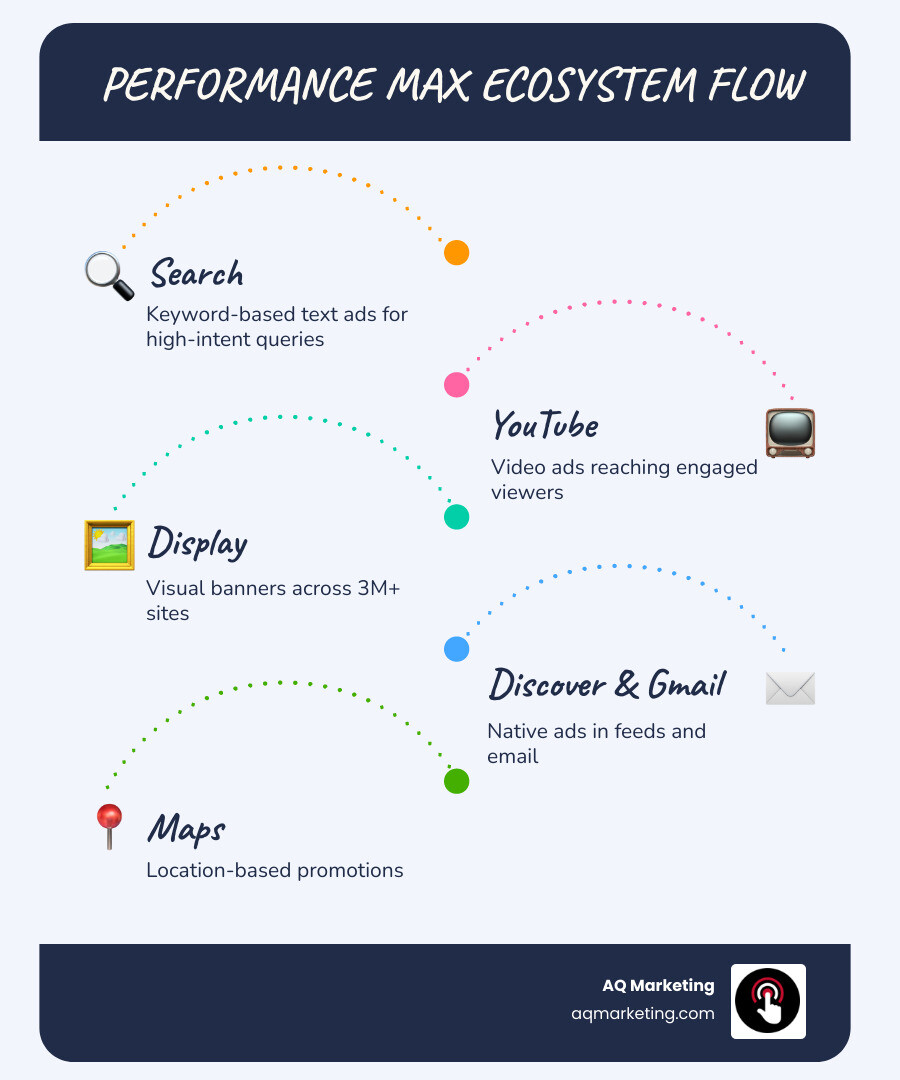
Performance Max campaign setup definitions:
The Evolution of Cross-Channel Automation in 2026
By May 2026, the landscape of digital advertising has shifted entirely toward a "Human + AI" partnership. We no longer view AI as a replacement for marketing strategy; rather, it acts as a business multiplier. In our work with clients from Woburn to Boston and across the North Shore, we’ve seen that the most successful campaigns are those where the advertiser provides high-quality "fuel"—data and creative—while Google's Gemini models provide the "engine" to reach customers at unpredictable touchpoints.
Performance Max (PMax) has evolved to use sophisticated predictive bidding. It doesn't just look for someone searching for a keyword; it finds a potential customer watching a New England travel vlog on YouTube or checking a local weather update on the Discover feed. This cross-channel reach is essential because modern consumer intent is fragmented. A customer might see your ad on Maps while driving through Lexington, then finally convert on a Search ad three days later while sitting in a coffee shop in Cambridge.
For a deeper dive into how these automated systems fit into a broader strategy, see our PPC Advertising Services Complete Guide. Understanding this evolution is the first step in avoiding the "black box" frustration that many advertisers feel. As noted in this Performance Max Campaigns: How to Set Up, Optimize, and Avoid Common Mistakes, the key is to stop trying to control every individual placement and start focusing on the quality of the signals you provide.
Strategic Prerequisites for High-Performance Campaigns
Before you even click the "New Campaign" button, your Performance Max campaign setup requires a solid foundation. Launching PMax without historical data is often compared to asking a blind person to navigate a busy Boston intersection—it’s possible, but it’s going to be messy.
The 30-50 Conversion Rule
Google’s AI thrives on data. We recommend that your account has at least 30 to 50 conversions in the past 30 days before launching a PMax campaign. This provides the algorithm with a baseline of what a "successful" user looks like. If you are a new business in a town like Billerica or Peabody and don't have this data yet, it is often better to start with a traditional Search campaign to build that initial conversion history.
Data Hygiene and Tracking
Your conversion tracking must be bulletproof. In 2026, we focus on high-value actions. If you’re a service-based business, don’t just track "page views." Track form submissions, or phone calls that last longer than 60 seconds. For eCommerce businesses, ensuring your Google Merchant Center feed is optimized with accurate MPNs, GTINs, and custom labels is non-negotiable.
First-Party Data
One of the strongest signals you can give the AI is your own customer list (Customer Match). By uploading a list of your existing high-value customers, you’re telling Google, "Find me more people like these." This is a cornerstone of The No-Nonsense Guide to Google Ads Account Setup.
For technical assistance with the initial steps, you can always refer to the official documentation on how to Create a Performance Max campaign - Google Ads Help.
A Strategic Framework for Performance Max Campaign Setup
When we begin the actual Performance Max campaign setup, we follow a structured hierarchy. It starts with selecting the right objective. For most of our clients in the home services or insurance industries, this is either "Sales" or "Leads."
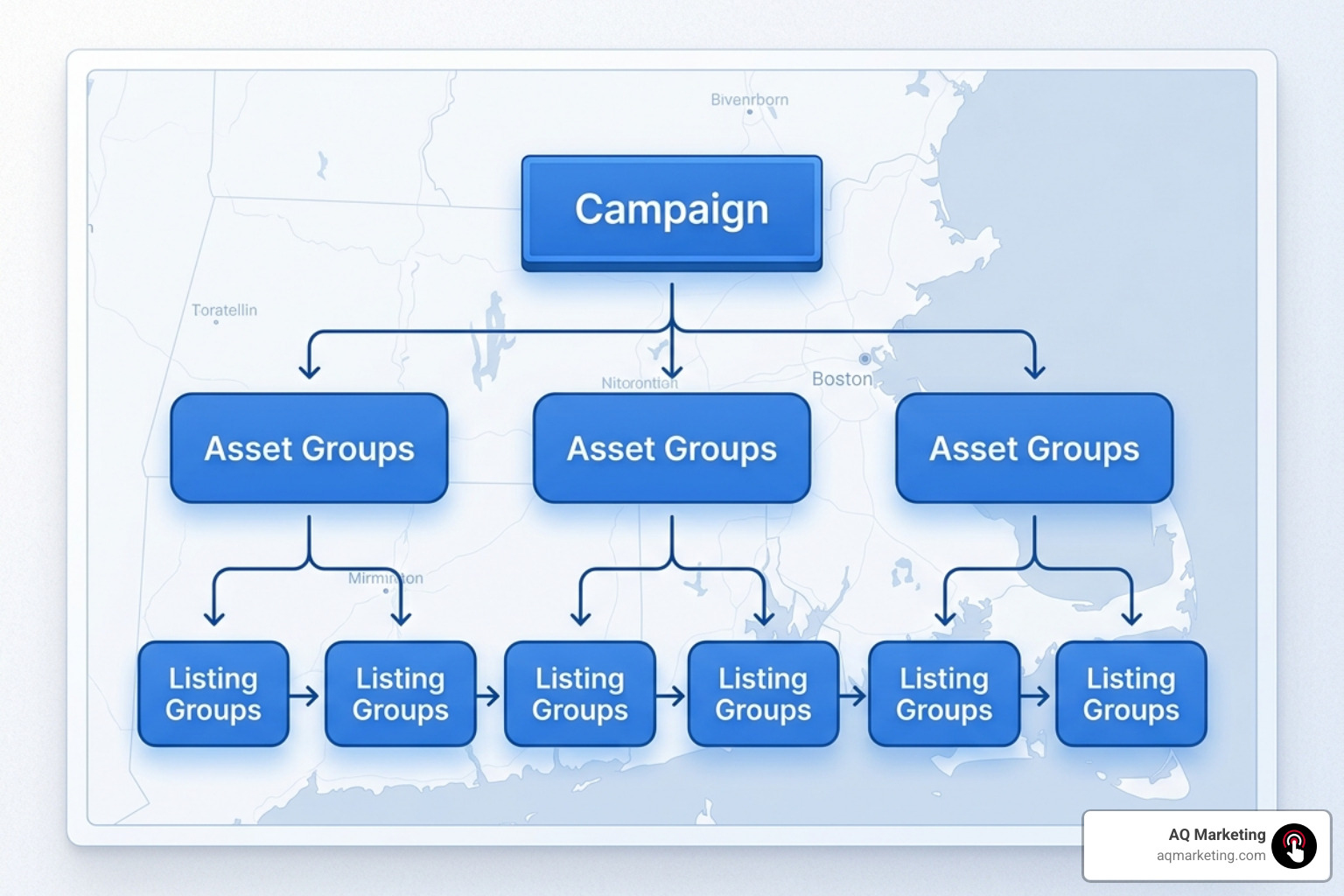
Bidding Strategies: Maximize Conversions vs. Value
Choosing your bidding strategy is a pivotal decision.
| Strategy | When to Use It | Goal |
|---|---|---|
| Maximize Conversions | New campaigns or lead gen | Get the highest volume of leads within your budget. |
| Maximize Conversion Value | eCommerce or tiered lead value | Focus on the revenue or "weight" of the conversion. |
We typically suggest starting with "Maximize Conversions" without a Target CPA (Cost Per Acquisition) for the first 2–4 weeks. This allows the AI to explore the market without constraints. Once the campaign stabilizes, you can layer in a Target ROAS (Return on Ad Spend) or Target CPA to maintain profitability. This approach aligns with 4 PPC Campaign Best Practices.
Final URL Expansion
Should you leave this on? In 2026, the answer is usually "Yes," provided your website is well-structured. Final URL Expansion allows Google to find new, relevant landing pages on your site that match a user's specific intent. However, if you have specific pages (like a "Thank You" page or a "Privacy Policy") that shouldn't receive traffic, be sure to add them to your exclusion list.
Creative Asset Requirements for Performance Max Campaign Setup
Creative is the most significant lever you have in an automated world. If the AI is the engine, your images and text are the "creative fodder" it uses to find your audience.
- Headlines: You can provide up to 15 headlines (30 characters each). Make sure they are distinct; Google will mix and match these, so they must make sense in any combination.
- Long Headlines & Descriptions: Provide 5 of each (90 characters). These are often used on YouTube and Display placements where more context is needed.
- Images: You need a mix of landscape (1.91:1), square (1:1), and portrait (4:5). We recommend at least 15–20 high-quality images. Avoid generic stock photos; use lifestyle imagery that reflects the New England communities you serve.
- Video: This is technically optional, but practically mandatory. If you don't provide a video, Google will create a slideshow from your images, which often looks low-quality. Even a simple 15-second smartphone video showing your team at work in a town like Framingham or Waltham is better than an auto-generated one.
Refining Audience Signals During Performance Max Campaign Setup
In PMax, audience signals are not "targets"—they are "hints." You are telling Google where to start looking.
- Custom Intent: Use top-performing keywords from your Search campaigns.
- Remarketing: Include people who have visited your site but haven't converted.
- Search Themes: A newer feature in 2026 that allows you to provide explicit strings of text to help Google understand your business category.
For more on how to narrow down your focus, check out our PPC Targeting Ultimate Guide.
Navigating the Learning Phase and Post-Launch Optimization
Once you hit "Publish," the hardest part begins: waiting. The learning phase for a Performance Max campaign setup typically lasts 2 to 4 weeks. During this time, performance will fluctuate. You might see a high CPA on Tuesday and no conversions on Wednesday. This is normal. The AI is testing different channels—YouTube, then Gmail, then Search—to see where your audience lives.
Monitoring the Insights Tab
The Insights tab is your window into the "black box." In 2026, it provides detailed information on which search categories are driving traffic and which asset groups are performing best. If you see that a specific image is consistently rated as "Low" performance, replace it with a new variation.
Account-Level Negatives
One common critique of PMax is the lack of keyword control. To prevent your ads from showing up for irrelevant terms (like "jobs" or "repair" if you only do installations), you must use account-level negative keyword lists. This ensures your budget isn't wasted on tire-kickers. This is a critical part of Getting Local Paid Search Right: How to Achieve ROAS.
Placement Exclusions
While Google automates placements, you can still exclude your ads from appearing on low-quality mobile apps or specific websites that don't align with your brand. As suggested in this guide on Performance Max Campaign Setup: What You Need to Know in 2025, reviewing your placement reports every few weeks is essential for brand safety.
Budgeting Strategies and Industry Cost Standards
Setting a budget for PMax requires a different mindset than traditional Search. Because the campaign covers so much territory, it needs enough "room" to learn.
The 3-5x Rule: Your daily budget should be at least 3 to 5 times your target CPA. If you want to acquire a lead for $50, your daily budget should be at least $150 to $250. This gives the algorithm enough daily data points to optimize effectively.
Regarding industry costs, it’s important to understand the general landscape. Based on average online data:
- Small Business Entry Point: A typical monthly ad spend might average around $2,500.
- High-End Scaling: For businesses looking to dominate a larger region or multiple service categories, scaling can reach $8,500+ per month.
Please note: These figures are based on average online data and do not represent AQ Marketing’s actual pricing or specific client results. Every business has unique needs and competition levels.
When scaling, never increase your budget by more than 20% in a single week. Large jumps can "shock" the algorithm and send the campaign back into a reset learning phase.
Frequently Asked Questions about Performance Max
How long is the learning phase for Performance Max?
While Google officially cites 2 weeks, we find that for most local businesses in Massachusetts, it takes 4 to 6 weeks for the campaign to fully stabilize and reach peak efficiency. Avoid making any major changes during the first 14 days.
Should I run Performance Max alongside Search campaigns?
Yes. PMax and Search are complements, not competitors. Search allows for precise control over high-intent keywords, while PMax finds incremental conversions across other channels. To avoid overlap, ensure you have brand exclusions in place so PMax doesn't cannibalize your branded search traffic.
What is the minimum recommended budget for PMax?
While there is no hard floor, we generally recommend a minimum of $50 to $100 per day. Anything less often results in the campaign taking months to exit the learning phase because the data is trickling in too slowly.
Conclusion
At AQ Marketing, we believe that Performance Max campaign setup is one of the most powerful tools available to small and medium-sized businesses today—but only when it's guided by a human hand. From our headquarters in Woburn, we’ve helped businesses across the Commonwealth transform their digital presence by embracing these AI-driven shifts rather than fearing them.
The key to long-term success in 2026 isn't just about "setting and forgetting." It’s about constant refinement, high-quality creative, and a deep understanding of your local market. Whether you’re a contractor in Gloucester or an insurance agency in Worcester, a well-structured PMax campaign can put your brand in front of the right person at the exact moment they’re ready to buy.
If you’re ready to see how automated, cross-channel advertising can grow your business, we invite you to learn more about our approach to full-service digital marketing. Let’s build something that lasts.
Why Every Homeowner Starts Their Basement Project Online
Finding the right basement finishing website is the fastest way to go from an empty concrete box to a livable, valuable space in your home. Whether you're hunting for design inspiration, comparing contractors, or trying to understand costs and materials, the best websites give you all of that in one place.
Here are the top things to look for when evaluating a basement finishing website:
- Design galleries - Before-and-after photos of real projects (family rooms, home gyms, theaters, bars)
- Material information - Details on waterproof, mold-resistant systems vs. standard drywall
- Process transparency - Clear steps from consultation through construction and warranty
- Financing options - Payment plans, promotions, and transferable warranties explained upfront
- Customer reviews - Verified testimonials and star ratings from real homeowners
- Free consultation or quote tools - Easy ways to start the conversation without commitment
A finished basement can return roughly 70% of your project cost when you sell your home. That's a significant number — and it's why millions of homeowners search for basement finishing resources every year before picking up the phone.
The challenge? Not all basement finishing websites are created equal. Some give you real, useful information. Others bury the details you actually need.
This guide breaks down what separates a truly helpful basement finishing website from one that wastes your time.
I'm Robert P. Dickey, President and CEO of AQ Marketing, Inc., a digital marketing agency based in Woburn, MA — I've spent over 20 years helping home services businesses build websites that actually convert visitors into leads, including businesses in the basement finishing website space. Understanding what makes these sites work (or fail) is something I've studied closely, and I'll share exactly what homeowners and contractors alike should be looking for.
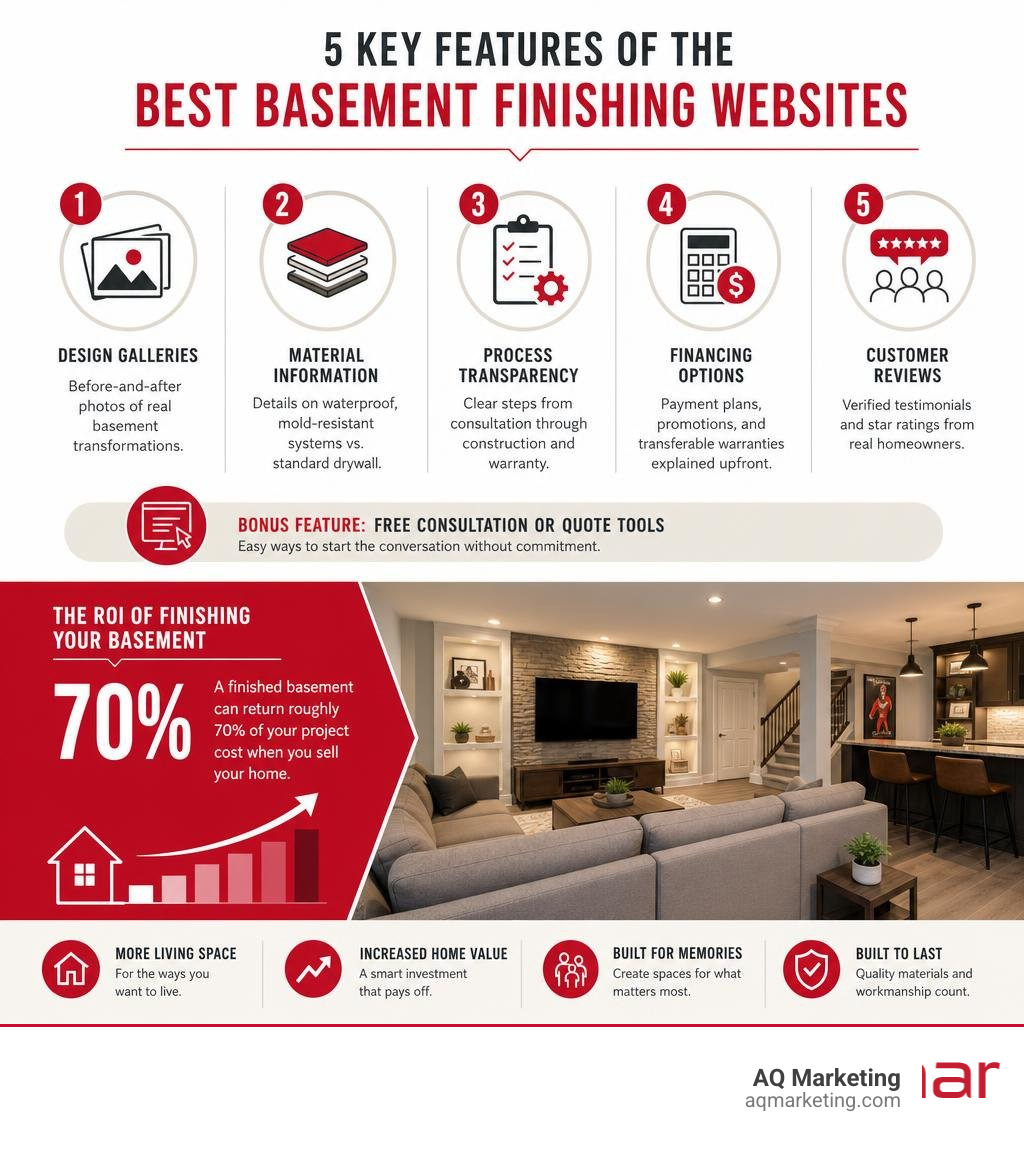
Basement finishing website terms to remember:
The Value of Finishing Your Basement in 2026
When New England winters set in, having extra indoor living space becomes a priority. Whether you live in a historic home in Concord, MA, or a modern build in Woburn, MA, finishing your basement is one of the smartest investments you can make.
From a financial perspective, homeowners who finish their basements report an average ROI of 70% upon resale. Beyond the financial return, you gain immediate, highly flexible square footage without the massive expense or zoning headaches of building an above-ground home addition.
According to online industry data, a typical basement finishing project can cost anywhere from $30 to over $150 per square foot, depending heavily on the materials, layout, plumbing, and finishes selected. (Please note: This pricing is based on general online market averages and does not represent AQ Marketing's pricing or services.)
To understand why this cost variation exists, we must look at the environment itself. Basements are inherently prone to moisture, cold floor temperatures, and high humidity. Using standard above-grade materials like traditional wood studs, paper-faced drywall, and standard fiberglass insulation in a below-grade space is a recipe for mold, mildew, and structural rot.
To prevent these issues, premier contractors utilize specialized materials featured on the Basement Finishing and Remodeling from the experts at Basement Systems, Inc. platform. These specialized systems are engineered specifically to withstand basement conditions, improve energy efficiency, and protect your home’s indoor air quality.
| Feature / Material | Standard Above-Grade Materials | Specialized Basement Finishing Systems |
|---|---|---|
| Wall Construction | Standard wood framing & paper-faced drywall | Inorganic, mold-resistant wall panels (e.g., EverLast) |
| Insulation | Standard fiberglass batts (absorbs moisture) | Rigid, moisture-proof foam insulation (e.g., SilverGlo R-13) |
| Flooring | Standard carpet padding or wood over concrete | ThermalDry flooring tiles or waterproof vinyl plank |
| Ceilings | Standard drywall or sag-prone ceiling tiles | No-sag, mold-resistant acoustic ceiling tiles |
| Warranty | Typical 1-year builder warranty | Up to 50-year transferable mold/water damage warranty |
By investing in specialized materials, you create a thermal break that keeps your basement warmer in the winter and drier in the summer, reducing your overall heating and cooling costs.
What to Look for in a Premier Basement Finishing Website

When you are searching for a contractor, their website is often your first point of contact. A professional, highly functional website is a direct reflection of the contractor's professionalism and attention to detail. If a contractor's website is outdated, difficult to navigate, or broken on mobile devices, it raises red flags about how they manage their physical job sites.
At AQ Marketing, we specialize in Website Design for Small Business and know exactly what features make a home services website reliable and user-friendly. When evaluating a basement finishing website, look for these key elements:
- Responsive Web Design: Over 60% of homeowners browse local services on their phones. A premier contractor will utilize Responsive Web Design Services to ensure their site looks perfect on smartphones, tablets, and desktops alike.
- Intuitive Navigation: You should be able to find service areas, material specifications, galleries, and contact forms within one or two clicks.
- Local Trust Signals: Look for clear indicators of local licensing, insurance, Better Business Bureau (BBB) accreditation, and links to third-party review sites.
- Clear Geographic Service Areas: A reputable contractor will explicitly list the towns they serve, ensuring they are licensed and familiar with local building codes in towns like Amesbury, MA, or Acton, MA.
How a Basement Finishing Website Showcases Design Inspiration
The best websites do more than just list services; they inspire you. When visiting a top-tier Basement Finishing Company & Remodeling Contractor, you should find a highly detailed, searchable portfolio of completed projects.
A great gallery will categorize projects by room type, allowing you to browse specific ideas:
- Family Rooms & Lounges: Cozy spaces featuring integrated entertainment centers and warm lighting.
- Home Theaters: Sound-insulated rooms designed for the ultimate movie-watching experience.
- Basement Bars & Kitchenettes: Wet bars with custom cabinetry, stone countertops, and under-counter refrigeration.
- Home Gyms: Bright, well-ventilated spaces with durable, impact-resistant flooring.
- Playrooms: Safe, easy-to-clean spaces designed to keep toys off your main living floors.
By exploring a comprehensive Basement Finishing System | Total Basement Finishing gallery, you can see how proprietary wall panels, waterproof flooring, and no-sag ceiling tiles look in real-world applications.
Interactive Tools to Look for on a Basement Finishing Website
Modern contractors use interactive digital tools to streamline the planning phase for homeowners. When browsing a highly functional website, look for these advanced features:
- 3D Space Visualizers: Some sites allow you to drag and drop walls, furniture, and flooring options to visualize your layout before any construction begins.
- Instant Quote Calculators: While an in-person inspection is always required for an exact price, rough-estimate calculators help you align your project goals with your budget.
- Seamless Consultation Schedulers: Integrated booking calendars allow you to select a convenient date and time for an in-home assessment without waiting for a callback.
These user-focused features are the hallmark of high-quality Home Services Web Design. A transparent, step-by-step breakdown of the Website Design and Development Process ensures that both the digital experience and the physical remodeling project run smoothly.
Essential Technical Standards: Waterproofing and Moisture Control
You cannot successfully finish a basement without first addressing moisture. Because concrete is porous, water vapor continuously migrates through foundation walls and floors. If this moisture gets trapped behind standard drywall, it creates a breeding ground for mold and mildew.

Before any framing or paneling is installed, a professional contractor will assess your basement's waterproofing needs. If your home has a history of hydrostatic pressure or minor leaks, the contractor should offer or partner with experts who provide We Provide Basement Waterproofing in Abington, MA.
A complete basement protection plan typically integrates:
- Interior Drainage Systems: Sub-floor perimeter drains that catch water before it reaches your finished space and direct it to a high-performance sump pump.
- High-Capacity Dehumidification: Industrial-strength, energy-efficient dehumidifiers (such as SaniDry systems) that maintain relative humidity below 50% to prevent mold growth.
- Inorganic Wall Panels: Products like EverLast wall panels, which are 197% stronger than drywall and contain zero organic material, meaning they cannot support mold growth even if exposed to water.
- Thermal Flooring Barriers: Systems like ThermalDry floor decking, which create a thermal break between the cold concrete slab and your finished flooring, keeping your feet warm and preventing vapor transmission.
Understanding the Basement Remodeling Process and Timelines
A structured, predictable process is what separates elite contractors from unreliable operations. When researching companies, look for websites that clearly outline their project phases. For example, a thorough 7-stage process, like the one highlighted by Basement Finishing Services in Michigan | Finished Basements Plus, ensures no detail is overlooked:
- Initial Consultation: A 90-minute in-home assessment to measure the space, check for moisture issues, and discuss your design goals.
- Plan & Proposal: The development of 2D and 3D CAD design renderings so you can visualize the layout.
- Material Selection: Choosing your waterproof wall finishes, flooring styles, ceiling tiles, lighting fixtures, and custom cabinetry.
- Measure & Confirm: A final pre-construction walkthrough to verify all measurements and confirm structural details.
- Permitting & Prep: Navigating local municipal requirements, such as the guidelines for a Finish Basement / Interior Remodeling - Westford, MA permit, to ensure all plumbing, electrical, and structural changes are fully code-compliant.
- Production & Construction: The physical installation, which typically takes between 4 to 8 weeks, depending on the complexity of the design.
- Service & Warranty: A post-job walkthrough to ensure complete satisfaction, backed by long-term, transferable warranties (often up to 50 years on wall panels).
To make these major home improvements more accessible, leading contractors frequently offer flexible financing promotions directly on their websites. These can range from low-interest payment plans to special limited-time incentives, such as "no payments until 2028."
Frequently Asked Questions About Basement Remodeling
How much value does a finished basement add to a home?
On average, a professionally finished basement yields approximately a 70% return on investment (ROI). Additionally, it significantly increases your home's livable square footage, making your property far more attractive to prospective buyers if you decide to sell.
Why are specialized basement materials better than standard drywall?
Standard drywall is made of gypsum pressed between sheets of paper. Paper is organic, meaning that when it absorbs moisture from a basement environment, it inevitably molds and degrades. Specialized basement wall panels, flooring, and ceiling tiles are made from completely inorganic, waterproof materials that resist mold, mildew, and water damage, ensuring your investment lasts for decades.
How long does a typical basement finishing project take?
While every home is unique, a standard basement finishing project typically takes between 4 to 8 weeks of active construction. This timeline can vary depending on whether you are adding complex elements like a full bathroom, custom wet bar, or specialized sub-floor drainage systems.
Conclusion
For home services contractors in Massachusetts, having a high-performing online presence is no longer optional. To stand out in competitive local markets—from Woburn to Abington—remodeling companies must provide an educational, highly visual, and easy-to-use digital experience.
At AQ Marketing, we design and build custom, conversion-focused Home Renovation Websites that showcase your craftsmanship, build trust, and generate high-quality leads. By combining beautiful web design with a targeted local Search Engine Optimization strategy, we help local contractors get found by homeowners actively looking to transform their basements.
If you are a home services business owner looking to grow your brand, get more qualified leads, and dominate your local market, we are here to help. Book a 15-Minute Phone Call with us today, and let's discuss how we can take your online presence to the next level.
Why Content Marketing in Boston Demands a Smarter Approach
Content marketing Boston businesses rely on has never been more competitive — or more full of opportunity.
Here's a quick snapshot of what you need to know:
- 860+ content marketing jobs are currently listed in Boston on LinkedIn, signaling strong and growing demand
- Boston's industries — biotech, healthcare, SaaS, higher education, and professional services — require trust-based, thought leadership content, not generic blog posts
- Most Boston businesses begin seeing measurable results from content marketing within 3 to 6 months
- Combining content with paid search (PPC) accelerates results and lowers your overall cost to acquire customers
- Local SEO, Google Business Profile, and geo-targeted content are critical for small and mid-sized businesses competing in the Boston area
- AI is reshaping how content is created and distributed — but human strategy and editing still drive the best results
Boston is not an average market. It is home to world-class universities, a booming innovation corridor, and some of the most sophisticated B2B buyers in the country. Small and mid-sized businesses here face real pressure to stand out — and a smart content strategy, backed by data and aligned with paid advertising, is one of the most reliable ways to do it.
I'm Robert P. Dickey, President and CEO of AQ Marketing, and over my 20+ years helping businesses throughout Greater Boston grow their digital presence, I've seen what separates content marketing Boston strategies that generate leads from those that just fill a page. In the sections ahead, I'll walk you through exactly how to build a content and PPC approach that wins in this market.
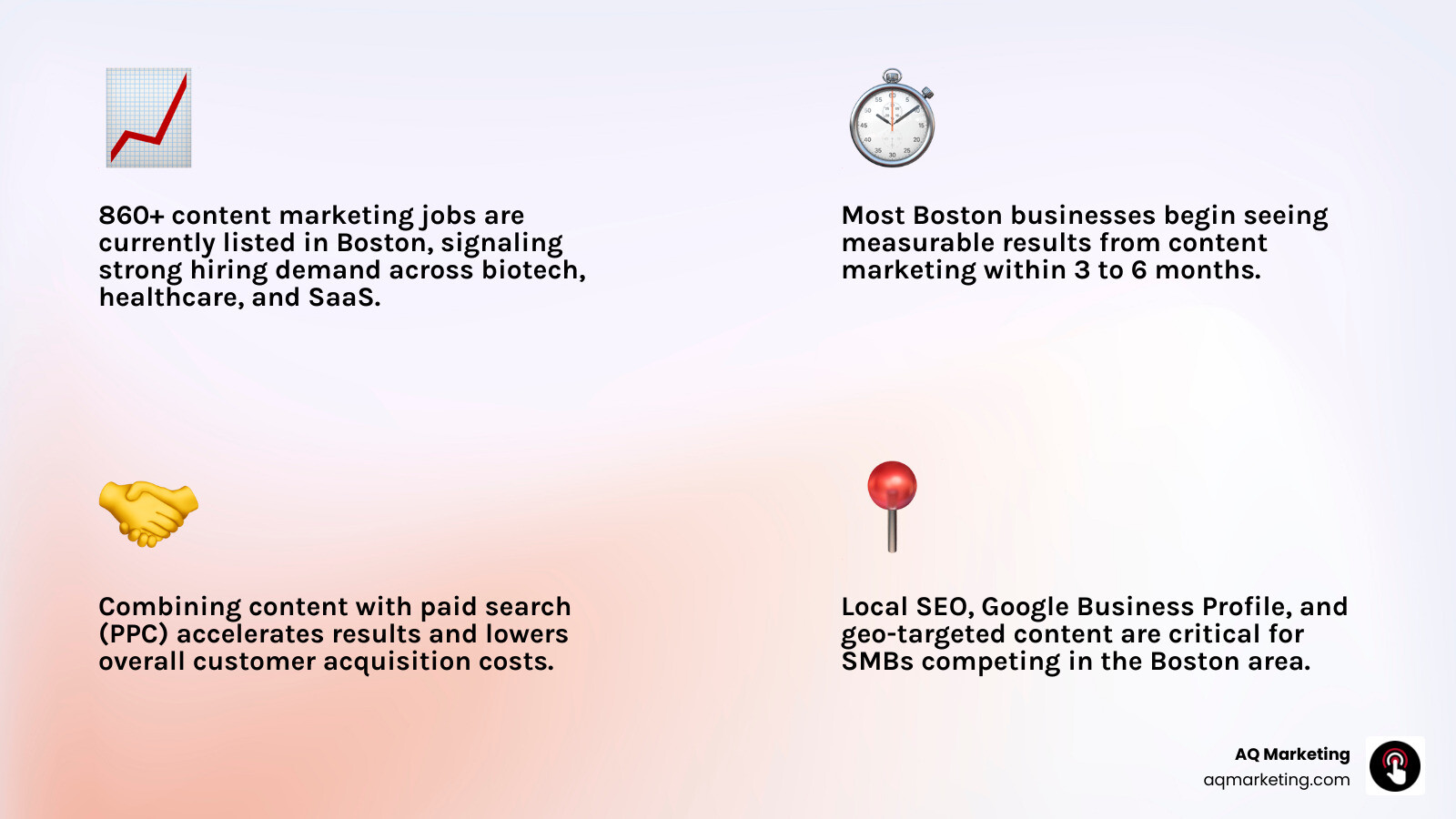
Terms related to Content marketing Boston:
- AI Marketing Solutions for Small Business
- Effective digital marketing
- Boost online visibility
Content Marketing Boston in 2026: Market Reality, Demand, and Opportunity
Boston's content market is active, competitive, and still growing. Research shows about 860 current LinkedIn listings for content marketing jobs in Boston, with hundreds posted in the last month and many added weekly. You can see the live market snapshot on LinkedIn's Boston content marketing jobs page and Indeed's Boston content marketing listings.
That hiring volume tells us something important: businesses across Greater Boston are investing in content because it works. They need content to support SEO, paid media, email, social, sales enablement, and customer education. In other words, content is no longer the side dish. It is the entree.

Why Boston is a unique market for content and PPC
Boston buyers tend to be skeptical in the best possible way. They want proof, clarity, and expertise before they convert. That is especially true in industries common across Boston, Cambridge, Waltham, Burlington, Somerville, and surrounding communities: healthcare, tech, SaaS, higher education, professional services, and specialized local services.
This creates a few realities:
- Sales cycles are often longer
- Buyers compare more vendors
- Trust signals matter more
- Thin content underperforms
- PPC clicks are too expensive to waste on weak landing pages
That is why content and PPC work best together here. Content builds credibility and organic visibility over time. PPC helps us test offers, accelerate traffic, and reach high-intent searches now. Together, they create both momentum and staying power.
What the current Content marketing Boston job market reveals
The Boston job market shows a clear shift toward hybrid marketing roles. Employers are not just looking for blog writers. They want people who can handle several of these at once:
- SEO content planning
- Social media publishing
- Email campaign support
- Press releases and case studies
- Analytics and ROI reporting
- CMS management
- Video and short-form content coordination
Many Boston-area postings also emphasize cross-functional collaboration. Content marketers are expected to work with sales teams, product teams, leadership, and sometimes compliance teams. That is especially common in regulated or technical industries.
The takeaway is simple: in Boston, content is expected to perform, not just exist.
The biggest opportunities for Boston small and mid-sized businesses
For small and mid-sized businesses, this is actually good news. You do not need a giant brand budget to compete if you build the right foundation.
The biggest opportunities include:
- Building owned media assets that keep working after publication
- Improving local search visibility with service-area and geo-targeted content
- Supporting PPC campaigns with better landing pages and stronger message match
- Increasing branded search through consistent thought leadership
- Lowering customer acquisition cost over time through organic traffic
- Nurturing leads with email and remarketing after the first visit
A good blog post may not wear a cape, but over time it can do superhero work.
The Roles, Skills, and Specializations Boston Employers Want Most
Boston's hiring trends give us a useful picture of what the market values right now. If employers are paying for these skills, businesses should pay attention too.
Content marketing Boston roles in highest demand right now
The most in-demand roles in the Boston area include:
- Content Manager
- Content Strategist
- SEO Content Writer
- Copywriter
- Social Media Manager
- Video Content Producer
- Demand Generation Specialist
- Email Marketing Manager
- Marketing Operations Analyst
- Marketing Communications Analyst
These roles appear across in-house teams, agencies, and hybrid organizations. Some companies want specialists. Others want one person who can write, optimize, publish, analyze, and somehow still smile during a Monday meeting.
Skills and qualifications that stand out in Boston hiring
Based on Boston-area job listings, employers commonly want:
- 3+ years of B2B or industry-specific marketing experience
- A bachelor's degree in marketing, communications, journalism, or a related field
- Strong writing and editing ability
- Keyword research and on-page SEO skills
- Content calendar planning
- Experience with CMS platforms
- Reporting and analytics knowledge
- Stakeholder management and collaboration skills
- Ability to create content in multiple formats
For businesses hiring outside help, this matters because it defines the standard. If your content partner cannot connect strategy, SEO, publishing, and reporting, you are likely getting only part of the job done.
How AI is changing hiring expectations
In 2026, AI is part of the workflow, but not the whole workflow. Boston employers increasingly expect marketers to know how to use AI for:
- Research acceleration
- Brief creation
- Outline development
- Draft support
- Content refreshes
- Workflow efficiency
But they also expect human judgment. That includes fact-checking, brand voice control, compliance review, and strategic editing.
AI fluency now means knowing where AI helps and where it absolutely should not be left unsupervised. Think of it like a very fast intern with no instinct for risk.
Building a Boston Strategy That Connects Content, SEO, and PPC
A strong Content marketing Boston plan does not begin with "let's post more." It starts with audience needs, business goals, and a clear path to conversion.
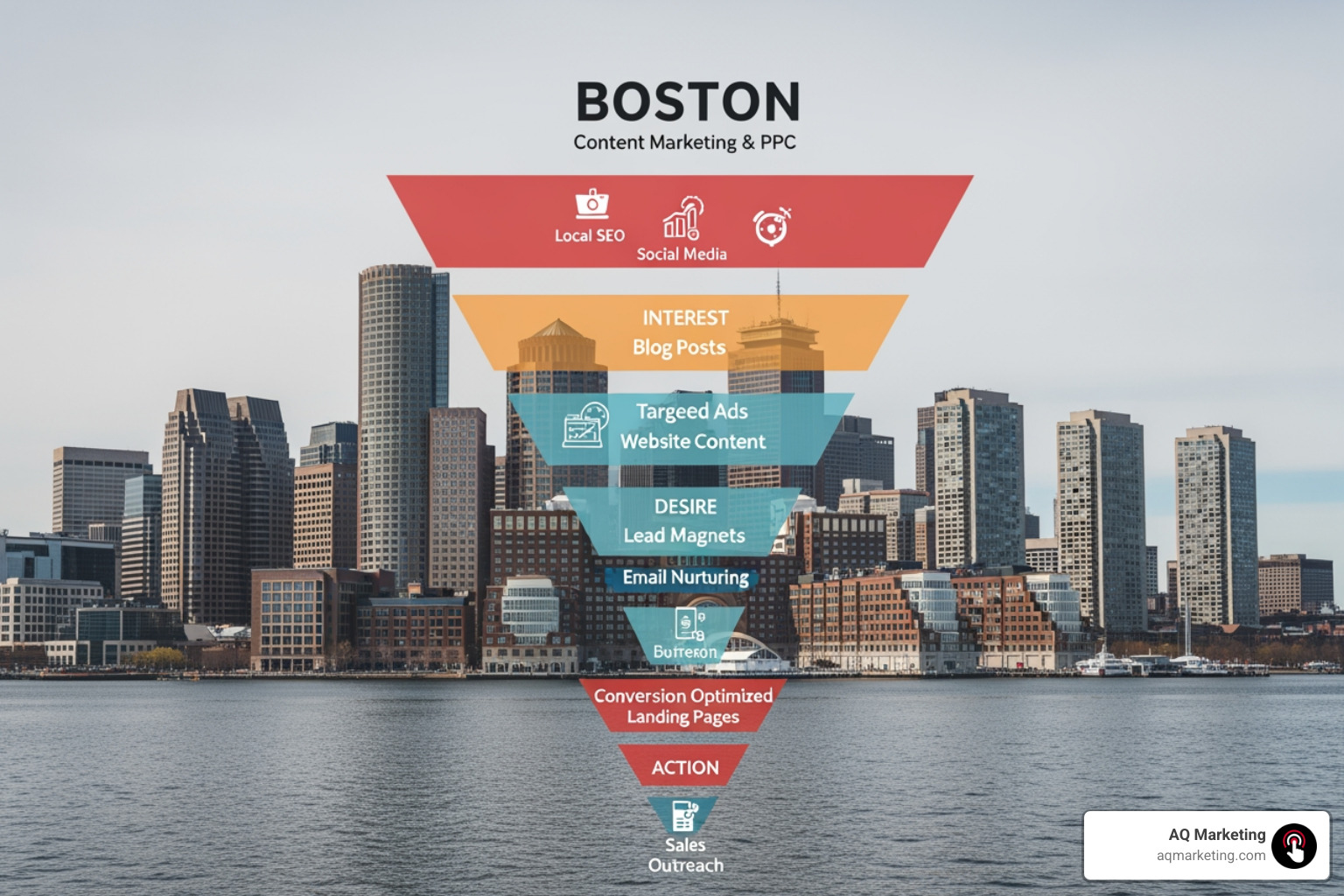
Strategy first: what winning Boston agencies do before publishing
Before publishing anything, strong teams usually work through:
- A content audit of existing pages and assets
- Competitor and gap analysis
- Keyword research tied to real intent
- Audience and persona research
- Topic cluster planning
- Funnel mapping
- Conversion path review
- Landing page alignment with offers
That sequence matters. Publishing before strategy is how businesses end up with random blogs, disconnected ads, and dashboards full of "interesting" numbers that do not generate leads.
Content formats that perform best for Boston audiences
Boston audiences respond well to useful, evidence-based formats. The best-performing content often includes:
- Blog articles targeting search intent
- Service pages for local and regional searches
- Case studies and success stories
- White papers and guides for complex B2B sales
- Email nurture sequences
- Press releases for major announcements
- Short-form video clips
- PPC landing pages with a single clear offer
For small and mid-sized businesses, we usually recommend a practical mix rather than trying to be everywhere at once. Better to publish consistently in the right formats than chase every shiny platform.
How to align content with Google Ads and paid social
This is where many businesses miss easy wins.
When content and PPC are aligned, we can:
- Use PPC search term data to guide future content topics
- Build landing pages around high-intent keywords
- Test headlines in ads before expanding them into longer content
- Create remarketing campaigns for blog and service-page visitors
- Match ad messaging to page messaging for better conversion rates
- Use educational content as middle-funnel support after the click
Here is a simple comparison:
| Channel | Best use | Speed | Long-term value |
|---|---|---|---|
| Content marketing | Authority, SEO, education, trust | Slower | High |
| PPC | Immediate traffic, testing, lead capture | Fast | Stops when spend stops |
| Combined strategy | Faster learning plus compounding growth | Balanced | Highest |
That is one reason we connect content with paid search and paid social instead of treating them like separate planets.
Boston-specific execution for local and regional search demand
For local visibility in Boston and surrounding Massachusetts communities, execution should include:
- City and service-area pages
- Neighborhood-aware copy where relevant
- Google Business Profile optimization
- Citation building and listings consistency
- Review generation and reputation support
- Geo-targeted blog and landing page content
- Location-based PPC campaigns
- Conversion-focused website design
If you want the underlying SEO framework behind this, here is more info about search engine optimization services and more info about digital marketing services.
Measurement, ROI, and AI Integration in Modern Boston Campaigns
The old way of measuring content was traffic-only. The modern way is much better. We want to know whether content and PPC are producing qualified leads, stronger conversion paths, and revenue influence.
How Boston companies measure content marketing success
The most useful metrics usually include:
- Organic traffic growth
- Keyword rankings
- Engagement quality
- Form fills and calls
- Demo requests or quote requests
- Landing page conversion rate
- Assisted conversions
- Pipeline or revenue influence
- Branded search growth
Case studies in the market also show why measurement matters. Boston agencies commonly highlight results such as large gains in organic traffic, impressions, inquiries, and revenue after structured content programs. The broader lesson is not about any one company. It is that content works best when goals, KPIs, and optimization cycles are defined from the start.
How PPC strengthens content performance and vice versa
PPC makes content smarter. Content makes PPC cheaper and more effective.
PPC helps us:
- Validate keyword intent quickly
- Identify top-converting headlines and offers
- Retarget visitors who are not ready to convert
- Accelerate early traffic to new landing pages
Content helps PPC by:
- Raising Quality Score with better relevance
- Supporting landing page experience
- Improving post-click trust
- Increasing branded demand
- Giving us remarketing audiences from organic visitors
That feedback loop is one of the strongest growth levers available to Boston businesses.
AI workflows, guardrails, and what to measure now
Many agencies now use AI-assisted workflows, and the smarter ones add guardrails around them. That usually means:
- AI for research and first-pass drafting
- Human editing for accuracy, depth, and tone
- Compliance review where needed
- Ongoing updates for freshness
- Optimization for both traditional search and AI-generated answers
In practical terms, we now measure not just rankings and traffic, but also:
- Visibility in AI Overviews and answer engines
- Content freshness and update cadence
- Conversion performance by content type
- Engagement signals from different traffic sources
Typical budgets and timelines businesses should expect
Based on average online data, not AQ Marketing's actual pricing, Boston-area content marketing programs often range widely depending on scope.
Typical monthly industry ranges based on public online data can look like this:
- Light local content support: $1,500 to $4,500 per month
- Mid-level strategy and production: $3,000 to $15,000+ per month
- Large or highly specialized programs: $10,000 to $30,000+ per month
For PPC management, average online pricing also varies widely based on ad spend, market competitiveness, landing page needs, and reporting depth.
Timeline-wise, most businesses begin seeing measurable movement within 3 to 6 months. Faster channels like PPC can produce data sooner, while organic content compounds over time. Stronger lead growth often shows up after the early ramp period, especially in longer sales cycles.
Boston Content Communities, Learning Resources, and Career Growth Paths
Boston also benefits from a strong professional community around content and marketing.
Where Boston content professionals build relationships and stay sharp
One local Boston content community reports more than 2,300 members, with activity that includes:
- Meetups
- Workshops
- Coffee chats
- Book clubs
- Job sharing
- Peer support
That matters because Boston marketing is relationship-driven. Communities like these help professionals exchange ideas, learn tools, find work, and stay current with changing platforms and buyer behavior.
Courses, training, and ongoing education options in Massachusetts
Massachusetts also offers useful educational resources for marketers. For example, UMass SBS Pathways offers a course on Content Marketing: Online Reviews in Social Media, which reflects how closely content, social proof, and reputation now intersect.
Beyond formal courses, marketers in this region often keep sharp through:
- SEO and analytics certifications
- Writing practice and editorial feedback
- Platform training for Google Ads and paid social
- AI workflow training
- Industry webinars and workshops
Career paths from specialist to strategist to growth leader
A common Boston career path looks like this:
- Start as a writer, coordinator, or channel specialist
- Add SEO, analytics, and campaign planning skills
- Take ownership of integrated campaigns
- Move into strategy and cross-channel leadership
- Grow into demand generation or revenue-focused leadership roles
For business owners, this progression is useful because it shows what mature marketing leadership actually looks like: not just content creation, but orchestration.
Frequently Asked Questions About Content Marketing Boston
How long does it take to see results from content marketing in Boston?
For most businesses, early traction appears in about 3 to 4 months, with stronger momentum building between 6 and 9 months. The exact timing depends on your website health, competition, publishing cadence, and sales cycle. Local service businesses may see faster lead movement than complex B2B companies with long decision processes.
What should Boston businesses prioritize first: content, SEO, or PPC?
It depends on the goal.
- If you need leads quickly, PPC usually comes first
- If your site lacks visibility, SEO and content should be built in immediately
- If your website is weak, fix the site before scaling traffic
- If local discovery matters, prioritize Google Business Profile, citations, reviews, and geo-targeted pages
In most cases, the real answer is not one or the other. It is sequencing them correctly.
How do you know if your Boston content strategy is actually working?
We look beyond pageviews. A strategy is working when you see:
- More qualified leads, not just more traffic
- Better rankings for high-intent terms
- Stronger conversion rates on landing pages
- Increased branded search
- More assisted conversions from organic visitors
- Better performance from remarketing and paid campaigns
If traffic is rising but lead quality is flat, something is off. If PPC spend is rising but landing pages are weak, same story. The best systems work together.
Conclusion
Winning with Content marketing Boston style means understanding the market, respecting buyer sophistication, and connecting content to real business outcomes.
That means building authority through useful content, supporting it with smart SEO, amplifying it with PPC, and measuring what matters. For small and mid-sized businesses across Boston, Woburn, Cambridge, Somerville, Burlington, Waltham, and the wider Massachusetts communities we serve, this approach creates both short-term traction and long-term visibility.
If you want a partner focused on durable growth rather than quick-hit vanity metrics, AQ Marketing is here to help. Explore more info about digital marketing services for small businesses or more info about Google Advertising and PPC support.