Why Every Startup Needs Market Research Before Spending a Dollar
Startup market research is the process of gathering and analyzing information about your target customers, competitors, and industry — so you know whether real demand exists before you invest serious time or money.
Here's what it covers at a glance:
| What It Answers | Why It Matters |
|---|---|
| Is there demand for my product? | Avoid building something nobody wants |
| Who is my target customer? | Focus your marketing and messaging |
| How big is the market? | Attract investors with credible numbers |
| What do competitors charge? | Set a competitive, profitable price |
| Where are the gaps? | Find your unique angle |
The stakes are real. According to CB Insights, 42% of startups fail simply because there is no market need for what they built. That's not a product problem or a marketing problem — it's a research problem.
Market research lets you reduce those risks before your business is anything more than an idea.
It doesn't have to be expensive or complicated. Whether you're validating a concept over the weekend or preparing a pitch deck for investors, the same core principles apply.
I'm Robert P. Dickey, President and CEO of AQ Marketing, and over my 20+ years in digital marketing I've worked with dozens of small and mid-sized businesses navigating exactly this challenge — using startup market research to sharpen their positioning and attract the right customers from day one. In the sections below, I'll walk you through a practical, strategic approach that works even on a limited budget.
Easy startup market research glossary:
- startup competitive analysis
- startup customer acquisition
- early stage marketing
Why Market Validation is the Foundation of Business Success
When we talk to early-stage founders from Boston to Worcester, we often see incredible passion. Passion is the engine of entrepreneurship, but it can also create a dangerous blind spot. Operating a business based on a "gut feeling" or sheer excitement is not a strategy. True market validation is about moving from assumptions to evidence.
The primary reason to conduct rigorous validation is simple: it directly combats the leading causes of startup mortality. While 42% of startups fail due to a lack of market need, another 20% fail because they are beaten by the competition. In total, some industry studies suggest up to 83% of startups fail because of an fundamental disconnect with market demand.
By taking the time to validate your business idea, you achieve three critical strategic objectives:
- Risk Reduction: Instead of investing thousands of dollars developing a minimum viable product (MVP) in a vacuum, you identify potential deal-breakers early. This allows you to pivot before you write code, sign a commercial lease, or purchase inventory.
- Investor Attraction: Modern investors and venture capitalists do not back "good ideas" alone. They back validated opportunities. Presenting proprietary consumer data, clear market sizing, and verified demand signals shows professional-grade preparation.
- Strategic Alignment: Market validation forms the blueprint for your entire launch strategy. It dictates your messaging, guides your product roadmap, and shapes your initial promotional campaigns.
To build a sustainable venture, you must establish a solid foundation. For more insights on building your brand after validation, explore our comprehensive guide on marketing for startups.
Primary vs. Secondary Research: When to Use Each Method
A balanced startup market research strategy relies on two distinct types of information: primary research and secondary research. Understanding the difference—and knowing when to deploy each—saves both time and capital.
Secondary Research: The High-Level View
Secondary research involves analyzing existing data that has already been collected, compiled, and published by others. This is always your starting point because it is incredibly cost-effective and provides the necessary context for your business model.
- When to use it: Use secondary research to calculate overall market size, identify major industry trends, evaluate demographic shifts, and map out your competitor landscape.
- Key resources: Free federal databases (such as the U.S. Census Bureau and the Bureau of Labor Statistics) are goldmines for local demographics and economic indicators. For automated analysis of broader market sectors, platform directories like Markethunt offer pre-compiled data on market growth projections, capital intensity, and technological drivers.
- The limitation: Secondary data is general. It won't tell you how a customer feels about your specific logo, user interface, or pricing structure. Beware of citation bias, where the original studies you rely on may have had slightly different research objectives or unmeasured biases.
Primary Research: The Deep Dive
Primary research is original data you collect directly from your target audience. It is tailored specifically to your unique business hypotheses.
- When to use it: Use primary research when you need to understand specific user pain points, test reactions to a prototype, evaluate brand perception, or determine exact willingness to pay.
- Qualitative vs. Quantitative:
- Qualitative data (gathered through focus groups, open-ended interviews, and observation) explores the "why" behind consumer behavior. It provides nuanced feedback but is harder to scale.
- Quantitative data (gathered through structured surveys and digital experiments) gives you the "how many." It allows you to count recurring patterns and assign mathematical confidence to your findings.
- The limitation: Primary research is traditionally time-consuming and can be highly susceptible to bias if questions are not designed carefully.
To bridge this gap, modern founders often use structured validation tools. For example, you can generate a comprehensive, data-backed Market Validation Report - SageScan to rapidly combine both real-time web verification and structured customer persona mapping.
Key Steps to Execute a Strategic Market Research Plan
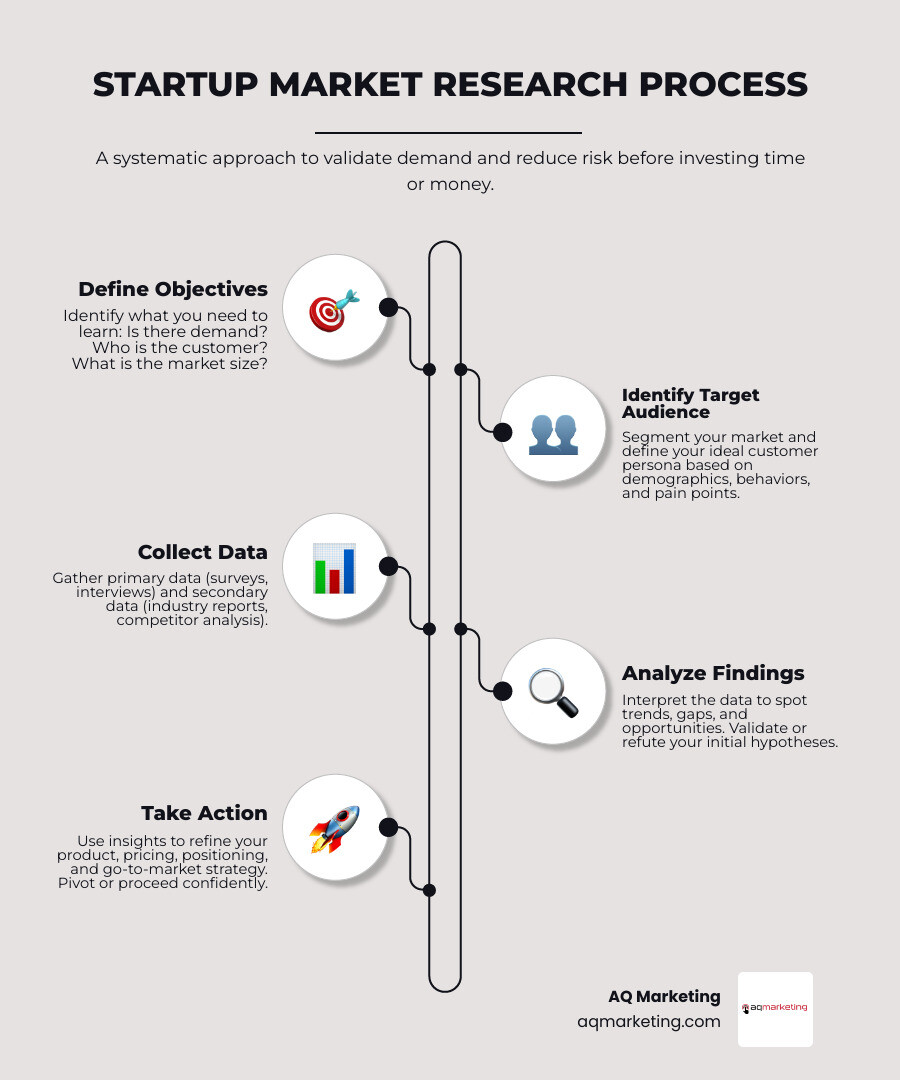
Conducting market research doesn't require a massive corporate budget. By following a structured, step-by-step framework, small business owners and startup founders can gather highly actionable insights.

Step 1: Define Clear Research Objectives
Before collecting any data, write down exactly what you need to learn. Are you trying to determine if homeowners in Newton, MA, want a smart snow-removal service? Or are you trying to find out what price point local commercial offices will pay for eco-friendly janitorial services? Setting narrow, specific objectives prevents you from drowning in irrelevant data.
Step 2: Calculate Your Market Size (TAM, SAM, SOM)
Investors want to see that you understand the realistic scale of your opportunity. You must break your market down into three distinct tiers:
- TAM (Total Addressable Market): The absolute total market demand for your product or service globally or nationally (e.g., the entire U.S. residential landscaping market).
- SAM (Serviceable Available Market): The portion of the TAM that fits your geographic reach and business model (e.g., residential landscaping in Eastern Massachusetts).
- SOM (Serviceable Obtainable Market): The realistic percentage of the SAM you can capture within your first few years of operation, taking into account marketing budgets and local competition.
Step 3: Profile Your Target Demographics
Build detailed buyer personas. Go beyond basic demographics like age and income. Dig into behavioral and attitudinal data. Where do your customers hang out online? What are their daily frustrations? What challenges are they trying to solve when they look for a solution?
Step 4: Establish Your Pricing Strategy
Your research must answer what potential customers are currently paying for alternatives, and what they would be willing to pay for your superior offering. Use rank-order questions in surveys to understand which features drive the most value, helping you structure profitable tiers.
For first-time entrepreneurs looking to navigate this process smoothly, resources like Startup Validation for First-Time Founders provide structured guidance to identify blindspots before building an MVP.
Defining Your Hypotheses for Startup Market Research
A common trap in startup market research is gathering vast amounts of data without a clear focus. To avoid this, treat your research like a scientific experiment: formulate and test specific hypotheses.
A strong hypothesis is clear, testable, and falsifiable. For example:
- Weak Hypothesis: "People will like our local delivery app."
- Strong Hypothesis: "Busy dual-income households in Woburn, MA, are willing to pay a $15 premium per delivery to have organic groceries delivered within a two-hour window."
By framing your assumptions as testable hypotheses, you can design highly targeted survey questions and interview scripts. Focus on uncovering genuine customer pain points and evaluating their actual willingness to pay.
Always prioritize observed behavior over verbal feedback. If you show a prospect a prototype, don't just ask if they like it. Watch them interact with it. If they claim it is "easy to use" but hesitate and struggle at every step, their physical actions are telling you the real story.
Leveraging AI and Modern Tools in Startup Market Research
The technological landscape of 2026 has completely transformed how startups gather and analyze market intelligence. Artificial intelligence now allows bootstrapped founders to run sophisticated data-gathering processes in hours rather than months.
However, there is a major difference between generic AI chatbots and specialized research tools. Generic LLMs suffer from training data cutoffs, lack real-time web scraping capabilities, and are trained to be highly agreeable—meaning they will often validate almost any idea you feed them, giving you "permission" rather than actual, honest validation.
To get real value, founders are turning to specialized, multi-layered AI architectures:
- Autonomous Research Agents: Tools like proofnest — AI Market Research That Fights Back use multiple AI layers to scan live sources, cross-check findings, and challenge assumptions, providing a weighted viability verdict based on real-time demand and competitive density.
- Developer-Focused Research Integrations: For technical founders, tools like StartupKit - Research tools for AI agents package structured research workflows—such as SEO metrics, domain availability, and search trend analysis—directly into AI coding environments using the Model Context Protocol (MCP).
- Automated Validation Reports: Platforms such as StartupValidation — AI-Driven Validation Reports for Founders can generate comprehensive, multi-page reports analyzing customer personas, search demand analytics, and competitor pricing in minutes.
To learn more about integrating these technologies ethically and effectively into your broader marketing workflow, read our guide on how to use AI in market research.
Integrating Competitive Analysis into Your Startup Market Research
Market research and competitive analysis are two sides of the same coin. While market research helps you understand your customers, competitive analysis helps you find a sustainable market advantage.
To position your business for long-term success, you must analyze both direct competitors (those offering the exact same solution) and indirect competitors (those solving the same problem with a different approach). For example, if you are opening a boutique fitness studio in Concord, MA, your direct competitors are other local gyms. Your indirect competitors include home workout apps, local running clubs, and corporate wellness programs.
Use this comparison table to understand how these two research components work together:
| Feature | Market Research | Competitive Analysis |
|---|---|---|
| Primary Focus | Customer needs, demographics, and industry trends | Competitor strengths, weaknesses, and market share |
| Core Goal | Validate demand and define the target audience | Identify market gaps and define your unique value proposition |
| Key Questions | "Who is buying, and what are they willing to pay?" | "What are rivals missing, and how can we beat them?" |
| Data Sources | Surveys, census data, focus groups, search trends | Competitor websites, reviews, pricing pages, SEO metrics |
When analyzing competitors, look closely at their customer reviews. What are their clients complaining about? Is it slow customer service? Outdated website design? Lack of mobile responsiveness? These complaints represent immediate opportunities for your startup to differentiate itself.
For a deeper dive into running a stealthy, effective analysis of your rivals, check out our guide, The Spy Game: Mastering Competitive Analysis for Startup Success.
Frequently Asked Questions
How much does market research typically cost for a new business?
The cost of market research varies wildly depending on your methodology, scope, and whether you choose a DIY approach or hire professional services.
Based on average online data, traditional, high-end market research can be a significant investment:
- Focus Groups: Typically cost between $4,000 and $6,000 per focus group, which includes moderator fees, participant incentives, and facility rentals.
- Consumer Research Studies: Can range from $15,000 to upwards of $35,000 for comprehensive, custom-designed consumer surveys.
- Business-to-Business (B2B) Research: Often requires specialized industry recruiting and can reach up to $50,000 or more.
Please note: The pricing ranges listed above are based on average industry data and do not represent AQ Marketing’s actual pricing or service structures.
For bootstrapped startups, you do not need to spend tens of thousands of dollars to get started. By leveraging free federal databases, utilizing modern AI-driven validation platforms, and conducting localized primary research (like simple digital surveys or direct customer interviews), you can gather highly reliable validation data for a fraction of the cost.
How often should a startup conduct market research?
Market research is not a one-time, pre-launch task. It must be treated as an ongoing, iterative endeavor throughout the entire life cycle of your business.
Consumer preferences, technological capabilities, and competitor strategies shift rapidly. For example, relying on survey data gathered in January to plan your next winter holiday marketing strategy can lead to major mistakes, as consumer sentiment can change completely in a matter of months.
We recommend integrating market research into several business stages:
- Product Development: To gather continuous feedback on new features or service offerings.
- Marketing and Sales Alignment: To optimize your digital ad copy, website design, and search engine optimization.
- Customer Satisfaction Monitoring: To measure net promoter scores and identify areas for operational improvement.
To keep a constant pulse on your industry, explore our strategic framework for ongoing market landscape analysis.
What is the biggest mistake founders make during market validation?
The single most common—and dangerous—mistake founders make is falling victim to confirmation bias.
Confirmation bias occurs when you look only for data that supports your pre-existing beliefs while ignoring or explaining away negative feedback. If you design a survey with leading questions (e.g., "Don't you think this app would make your life much easier?"), you are not validating your idea; you are merely seeking permission.
To protect your startup from this cognitive trap, establish hard, dated kill criteria before you begin your research. Kill criteria are objective, quantitative thresholds that determine whether you proceed, pivot, or abandon an idea.
For example, you might decide: "If fewer than 15% of surveyed local homeowners express a high willingness to pay our target price point by Day 45, we will pivot our service model." Establishing these decision gates early removes emotion from the validation process, saving you months of wasted effort and thousands of dollars in capital.
Conclusion
Conducting thorough startup market research is the single best way to ensure your business is built on a foundation of real-world demand, rather than assumptions. By combining secondary demographic data with targeted primary research, mapping your competitive landscape, and utilizing modern AI tools, you can dramatically reduce your risk of failure and position your brand for sustainable growth.
At AQ Marketing, we have spent over two decades helping small and medium-sized businesses across Massachusetts—from our home base in Woburn to communities throughout the North Shore and Greater Boston—enhance their online presence. Once you have validated your business idea, we are here to help you turn those insights into a powerful, high-converting digital presence through expert website design, local SEO, organic social media posting, and automated lead generation.
Are you ready to grow your business and execute a digital marketing strategy that delivers long-term, impactful results? Grow your business with AQ Marketing services and let's build your market advantage together.