Why Every Startup Needs a Competitive Analysis Strategy
Startup competitive analysis is the process of researching your rivals to understand their strengths, weaknesses, pricing, marketing, and market position — so you can find gaps, differentiate, and win.
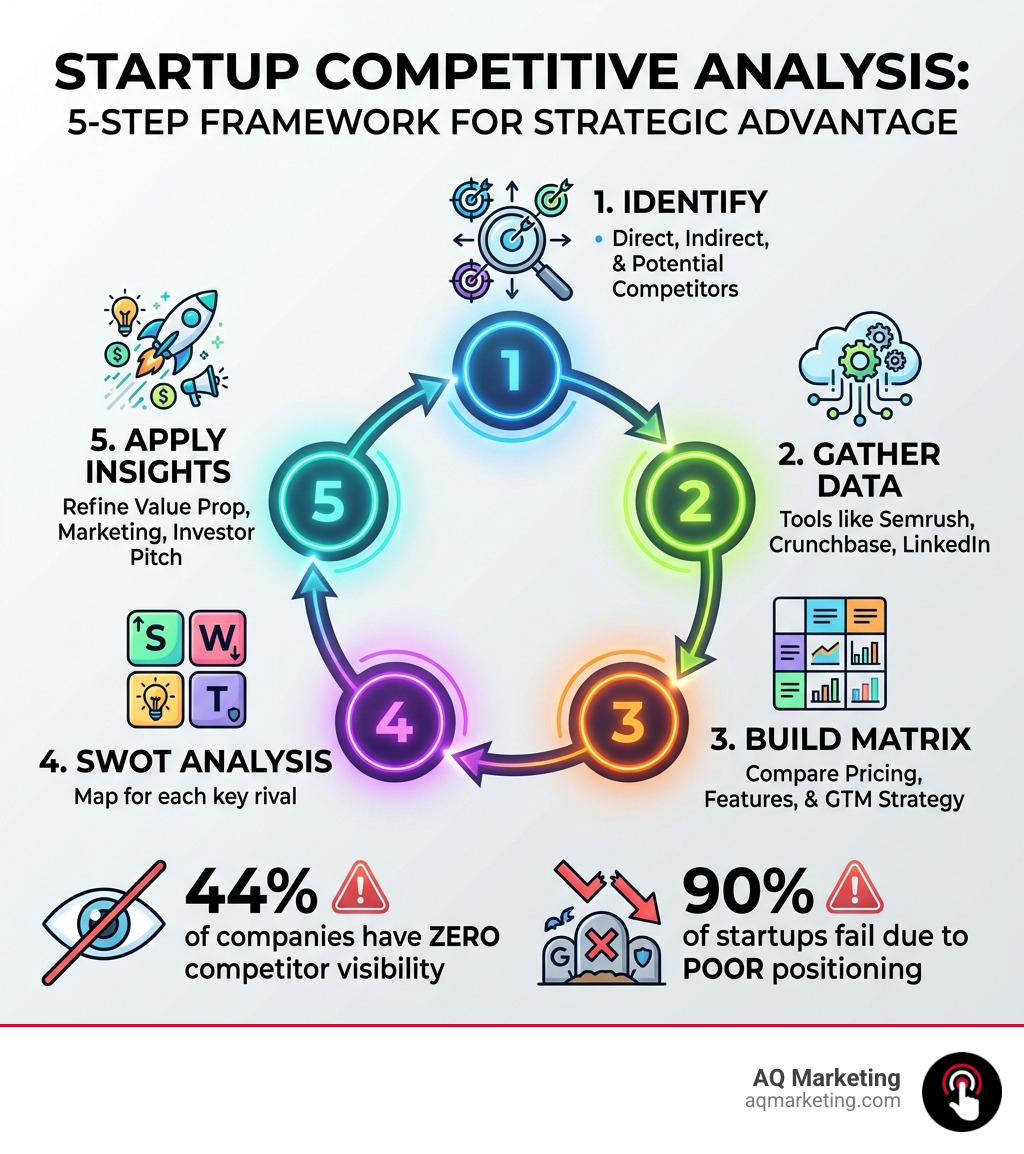
Here’s a quick breakdown of how it works:
- Identify your competitors — direct (same product, same audience), indirect (different product, same problem), and potential (could enter your space)
- Gather data — from tools like Semrush, Crunchbase, LinkedIn, and customer reviews
- Build a competitor matrix — compare pricing, features, and go-to-market strategies side by side
- Run a SWOT analysis — map each rival’s strengths, weaknesses, opportunities, and threats
- Apply the insights — sharpen your value proposition, pricing, marketing, and pitch deck
Here’s a number that should stop you cold: 44% of companies currently have zero visibility into what their competitors are doing. That’s nearly half the market operating blind.
For startups, the stakes are even higher. Nearly 90% of startups fail — and poor strategic positioning is one of the leading reasons why. When you don’t know what your rivals are doing, you can’t carve out a defensible space in the market.
That’s what startup competitive analysis is really about. It’s not corporate espionage. It’s survival intelligence.
I’m Robert P. Dickey, President and CEO of AQ Marketing, and over my 20+ years helping small and medium-sized businesses grow their digital presence, I’ve seen how startup competitive analysis separates the businesses that thrive from those that stall. This guide will give you a clear, practical framework to do it right.
Key startup competitive analysis vocabulary:
Why Startup Competitive Analysis is the Foundation of Survival
In the bustling business corridors from Boston to Worcester, we often see founders so enamored with their own product that they forget they aren’t operating in a vacuum. 44% of companies admit to having a massive blind spot regarding their rivals. This lack of visibility is a silent business killer.
The data is sobering: nearly 90% of startups fail, often because they build something the market doesn’t need or they get outmaneuvered by a more agile competitor. In fact, roughly 19% of failures are directly attributed to being outcompeted. When we work with clients on startup SEO services, the first thing we do is look at the landscape. Without strategic positioning, you are just making noise in a crowded room.
Competitive intelligence (CI) is no longer a luxury for big corporations. The CI market is forecasted to reach $122.8 billion by 2033 because information is the ultimate risk mitigation tool. By understanding where others are failing, you can avoid their mistakes and double down on their weaknesses.
Identifying Your Rivals: Direct, Indirect, and Potential Competitors
To master the “spy game,” we first need to know who we are watching. With over 150 million startups competing globally, the “enemy” isn’t always who you think it is. At AQ Marketing, we help businesses in places like Billerica and Newton realize that competition comes in three distinct flavors:
- Direct Competitors: These are the folks offering the same solution to the same target audience. If you’re a local HVAC company in Woburn, other HVAC companies in Woburn are your direct rivals.
- Indirect Competitors: These are the tricky ones. They solve the same problem but with a different solution. For a project management software, an indirect competitor might be a simple physical whiteboard or a shared Excel sheet.
- Potential/Substitute Competitors: These are businesses that could easily pivot into your space or offer a substitute that makes your product unnecessary.
Understanding market saturation is key. If you are launching a new venture, your startup website design company needs to know exactly how to position your brand so it doesn’t just look like a “me too” version of what’s already out there.
Using Digital Tools for Startup Competitive Analysis
Gone are the days of literal “spying.” Today, we use sophisticated digital dashboards to gather intelligence. We recommend a “big three” approach for any startup:
- Semrush: This is our go-to for keyword research. It allows us to see exactly which terms your competitors are ranking for and where their traffic is coming from.
- Crunchbase: Essential for tracking financial health. You can see funding rounds, revenue estimates, and even who is investing in your rivals.
- LinkedIn: A goldmine for tracking employee growth and organizational structure. If a rival is suddenly hiring ten new developers, you can bet a major product update is coming.
Uncovering Market Gaps Through Customer Sentiment
Data tells you what is happening; customer sentiment tells you why. We encourage startups to look at “unfiltered” sources to find the cracks in a competitor’s armor.
- Glassdoor: Low employee morale often leads to poor customer service. If a competitor has a 2-star rating from their own staff, that’s an opportunity for you to win on service quality.
- Trustpilot & Google Reviews: Read the 1-star and 2-star reviews of your rivals. Are customers complaining about a specific missing feature? Is their pricing too confusing? These complaints are your roadmap for innovation.
The Framework: Building a Comprehensive Competitor Matrix
Once you’ve gathered your “intel,” you need to organize it. We use a competitor matrix to turn raw data into a visual strategy. This isn’t just a spreadsheet; it’s a battle plan.
| Feature | Your Startup | Competitor A | Competitor B |
|---|---|---|---|
| Core Product | AI-Driven SEO | Manual SEO | Content Only |
| Pricing Model | Subscription ($150/mo) | Flat Fee ($500) | Freemium |
| Target Audience | Small Biz (MA) | Enterprise | Tech Startups |
| GTM Strategy | Content Marketing | Cold Calling | Paid Ads |
| Key Strength | Local Expertise | Brand Name | Low Cost |
| Key Weakness | New to Market | High Churn | Limited Support |
Note: Pricing listed is based on average online data and does not represent AQ Marketing’s actual pricing. Typical industry ranges for comprehensive analysis can span from $1,000 to over $10,000 depending on depth.
Beyond the matrix, we utilize frameworks like Porter’s Five Forces to assess competitive intensity and Perceptual Mapping to visualize where you sit in the minds of customers compared to others. This is a core part of what digital marketing companies for startups should provide to ensure long-term success.
Executing a Data-Driven Startup Competitive Analysis
Execution is where most startups stumble. Research shows that 70% of B2B startup failures result from go-to-market (GTM) execution errors, not product flaws. Your analysis must inform your launch marketing strategy.
When estimating a private competitor’s revenue, a good rule of thumb is to look at their employee count on LinkedIn. Well-funded tech companies often generate roughly $150,000 to $200,000 in revenue per employee. If they have 50 employees, they are likely in the $7M–$10M revenue range. This helps you understand the “weight class” of the rival you are stepping into the ring with.
Leveraging Insights for Investor Pitches and Market Dominance
If you are looking for funding, your startup competitive analysis is the star of your pitch deck. Investors don’t want to hear that you have “no competition” — that usually means there’s no market. They want to see that you understand the landscape and have built a “defensible moat.”
In 2024, $89 billion in startup funding was tracked, and a significant portion went to founders who could clearly articulate their Unique Value Proposition (UVP). Your UVP should be a direct response to the weaknesses you identified in your rivals. If Competitor A is expensive and hard to use, your pitch should highlight your affordability and intuitive design.
Frequently Asked Questions about Startup Competitive Analysis
How often should a startup update its competitive research?
Competitive analysis is a living document, not a one-time task. We recommend a full, deep-dive audit every quarter. However, you should be doing “light” monitoring weekly. Set up Google Alerts for your competitors’ names and follow their social media accounts to stay agile. Markets shift fast — especially in tech-heavy areas like Cambridge or Burlington — and what worked in January might be obsolete by June.
What are the most common mistakes in competitor tracking?
The biggest mistake is “tunnel vision” — focusing only on your direct rivals while ignoring the indirect ones. Another common pitfall is confirmation bias, where you only look for data that proves your startup is better, ignoring the areas where your rivals are actually winning. Finally, many founders treat this as an academic exercise. If your analysis doesn’t lead to a change in your product, pricing, or marketing, it was a waste of time.
Can AI tools like ChatGPT replace traditional market research?
AI is a powerful assistant, but not a replacement. Currently, 37% of product discovery queries start in AI interfaces like ChatGPT or Perplexity. These tools are excellent for synthesizing large amounts of data and spotting broad trends. However, they can “hallucinate” facts and lack the nuance of human verification. Use AI to build your initial lists and summarize reviews, but verify the “hard” data through primary sources.
Conclusion
At AQ Marketing, we believe that the “spy game” is really about empathy — understanding the market so well that you can serve customers better than anyone else. Whether you are a small home services business in Amesbury or a growing tech firm in Woburn, startup competitive analysis is your most reliable tool for navigating the path to success.
Strategic agility is the difference between a startup that survives its first year and one that becomes a market leader. Don’t operate in the dark. Use the tools, build the matrix, and constantly reinvent yourself to stay ahead of the curve.
Ready to sharpen your strategy? Elevate your digital presence with professional marketing services and let us help you turn competitor insights into market dominance.