What Is Performance Max Campaign Setup — and Why It Matters in 2026
Performance Max campaign setup is the process of configuring Google's AI-driven, cross-channel campaign type to serve ads across Search, YouTube, Display, Discover, Gmail, and Maps — all from a single campaign.
Here's a quick overview of what's involved:
- Verify conversion tracking — confirm high-value actions are being recorded accurately
- Link Google Merchant Center (for eCommerce) — connect your product feed before launch
- Set your campaign objective — choose Sales, Leads, or Website Traffic
- Choose a bidding strategy — start with Maximize Conversions, then layer in Target ROAS once you have data
- Build asset groups — upload headlines, descriptions, images, and video creative
- Add audience signals — provide customer lists, custom segments, and remarketing data to guide the AI
- Set your daily budget — aim for at least 3–5x your target cost per acquisition
- Launch and observe — allow 2–4 weeks for the learning phase before making changes
Running Google Ads in 2026 is not the same game it was five years ago. Google's automation has become the engine — but you are still the driver. Performance Max puts that automation to work across every channel Google owns, which means more reach, more touchpoints, and more chances to convert customers you might never have found through traditional keyword targeting alone.
The results can be significant. Businesses that have made the switch have reported outcomes like a 6x return on ad spend within three months, and others have seen subscriber growth climb 17% while cutting cost per acquisition by 21%. But those results don't happen by accident. They happen because the campaign was set up the right way — with clean data, strong creative, and a clear goal.
That's exactly what this guide covers.
I'm Robert P. Dickey, President and CEO of AQ Marketing, and over my 20+ years in digital marketing I've helped small and medium-sized businesses across New England navigate platforms like Google Ads — including understanding exactly what a smart Performance Max campaign setup requires to drive real, measurable growth. In the sections ahead, I'll walk you through everything you need to know to build a campaign that performs.
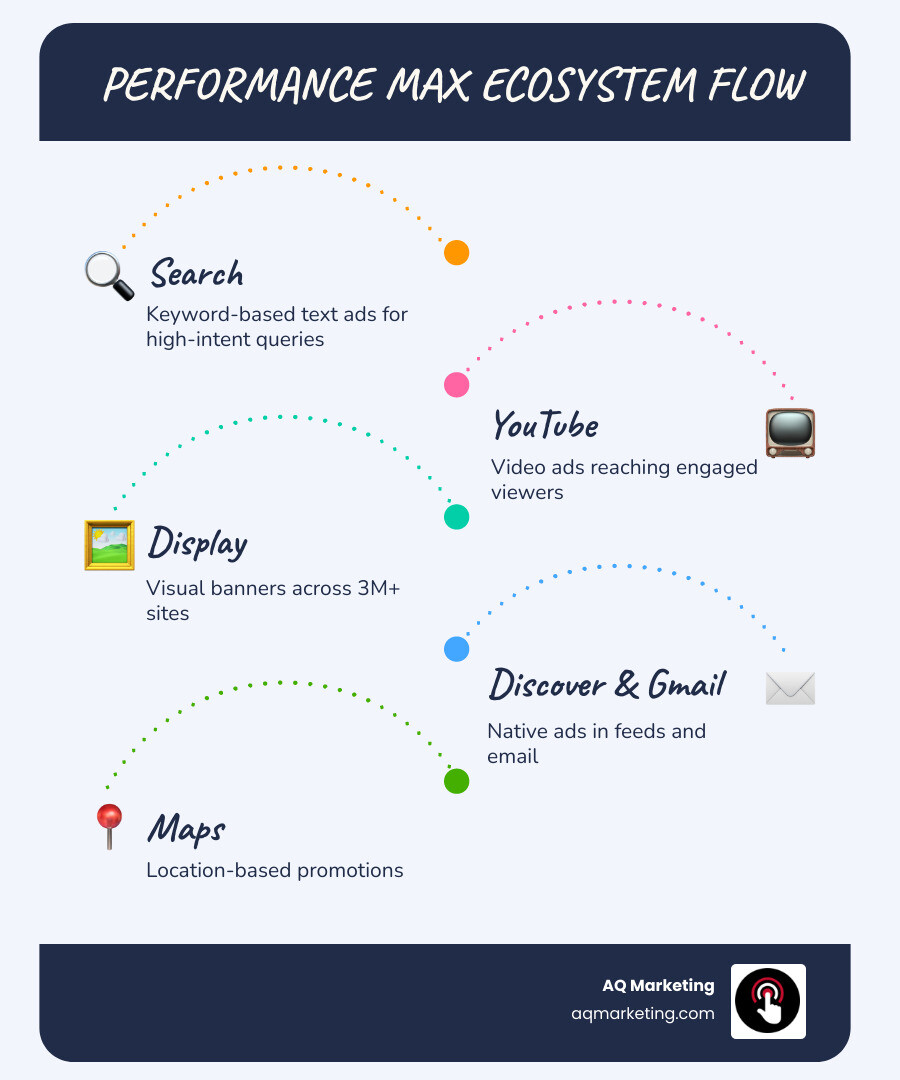
Performance Max campaign setup definitions:
The Evolution of Cross-Channel Automation in 2026
By May 2026, the landscape of digital advertising has shifted entirely toward a "Human + AI" partnership. We no longer view AI as a replacement for marketing strategy; rather, it acts as a business multiplier. In our work with clients from Woburn to Boston and across the North Shore, we’ve seen that the most successful campaigns are those where the advertiser provides high-quality "fuel"—data and creative—while Google's Gemini models provide the "engine" to reach customers at unpredictable touchpoints.
Performance Max (PMax) has evolved to use sophisticated predictive bidding. It doesn't just look for someone searching for a keyword; it finds a potential customer watching a New England travel vlog on YouTube or checking a local weather update on the Discover feed. This cross-channel reach is essential because modern consumer intent is fragmented. A customer might see your ad on Maps while driving through Lexington, then finally convert on a Search ad three days later while sitting in a coffee shop in Cambridge.
For a deeper dive into how these automated systems fit into a broader strategy, see our PPC Advertising Services Complete Guide. Understanding this evolution is the first step in avoiding the "black box" frustration that many advertisers feel. As noted in this Performance Max Campaigns: How to Set Up, Optimize, and Avoid Common Mistakes, the key is to stop trying to control every individual placement and start focusing on the quality of the signals you provide.
Strategic Prerequisites for High-Performance Campaigns
Before you even click the "New Campaign" button, your Performance Max campaign setup requires a solid foundation. Launching PMax without historical data is often compared to asking a blind person to navigate a busy Boston intersection—it’s possible, but it’s going to be messy.
The 30-50 Conversion Rule
Google’s AI thrives on data. We recommend that your account has at least 30 to 50 conversions in the past 30 days before launching a PMax campaign. This provides the algorithm with a baseline of what a "successful" user looks like. If you are a new business in a town like Billerica or Peabody and don't have this data yet, it is often better to start with a traditional Search campaign to build that initial conversion history.
Data Hygiene and Tracking
Your conversion tracking must be bulletproof. In 2026, we focus on high-value actions. If you’re a service-based business, don’t just track "page views." Track form submissions, or phone calls that last longer than 60 seconds. For eCommerce businesses, ensuring your Google Merchant Center feed is optimized with accurate MPNs, GTINs, and custom labels is non-negotiable.
First-Party Data
One of the strongest signals you can give the AI is your own customer list (Customer Match). By uploading a list of your existing high-value customers, you’re telling Google, "Find me more people like these." This is a cornerstone of The No-Nonsense Guide to Google Ads Account Setup.
For technical assistance with the initial steps, you can always refer to the official documentation on how to Create a Performance Max campaign - Google Ads Help.
A Strategic Framework for Performance Max Campaign Setup
When we begin the actual Performance Max campaign setup, we follow a structured hierarchy. It starts with selecting the right objective. For most of our clients in the home services or insurance industries, this is either "Sales" or "Leads."
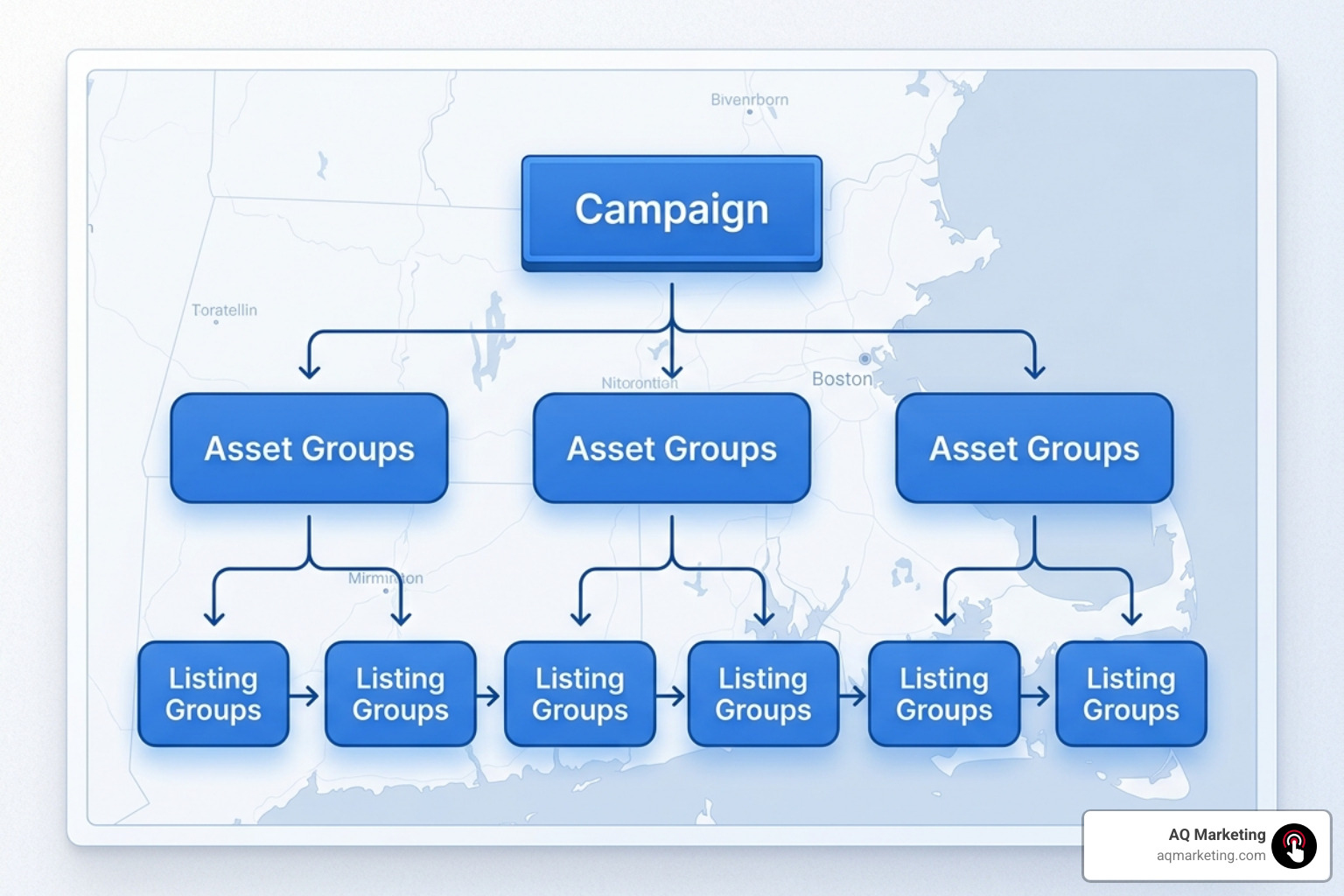
Bidding Strategies: Maximize Conversions vs. Value
Choosing your bidding strategy is a pivotal decision.
| Strategy | When to Use It | Goal |
|---|---|---|
| Maximize Conversions | New campaigns or lead gen | Get the highest volume of leads within your budget. |
| Maximize Conversion Value | eCommerce or tiered lead value | Focus on the revenue or "weight" of the conversion. |
We typically suggest starting with "Maximize Conversions" without a Target CPA (Cost Per Acquisition) for the first 2–4 weeks. This allows the AI to explore the market without constraints. Once the campaign stabilizes, you can layer in a Target ROAS (Return on Ad Spend) or Target CPA to maintain profitability. This approach aligns with 4 PPC Campaign Best Practices.
Final URL Expansion
Should you leave this on? In 2026, the answer is usually "Yes," provided your website is well-structured. Final URL Expansion allows Google to find new, relevant landing pages on your site that match a user's specific intent. However, if you have specific pages (like a "Thank You" page or a "Privacy Policy") that shouldn't receive traffic, be sure to add them to your exclusion list.
Creative Asset Requirements for Performance Max Campaign Setup
Creative is the most significant lever you have in an automated world. If the AI is the engine, your images and text are the "creative fodder" it uses to find your audience.
- Headlines: You can provide up to 15 headlines (30 characters each). Make sure they are distinct; Google will mix and match these, so they must make sense in any combination.
- Long Headlines & Descriptions: Provide 5 of each (90 characters). These are often used on YouTube and Display placements where more context is needed.
- Images: You need a mix of landscape (1.91:1), square (1:1), and portrait (4:5). We recommend at least 15–20 high-quality images. Avoid generic stock photos; use lifestyle imagery that reflects the New England communities you serve.
- Video: This is technically optional, but practically mandatory. If you don't provide a video, Google will create a slideshow from your images, which often looks low-quality. Even a simple 15-second smartphone video showing your team at work in a town like Framingham or Waltham is better than an auto-generated one.
Refining Audience Signals During Performance Max Campaign Setup
In PMax, audience signals are not "targets"—they are "hints." You are telling Google where to start looking.
- Custom Intent: Use top-performing keywords from your Search campaigns.
- Remarketing: Include people who have visited your site but haven't converted.
- Search Themes: A newer feature in 2026 that allows you to provide explicit strings of text to help Google understand your business category.
For more on how to narrow down your focus, check out our PPC Targeting Ultimate Guide.
Navigating the Learning Phase and Post-Launch Optimization
Once you hit "Publish," the hardest part begins: waiting. The learning phase for a Performance Max campaign setup typically lasts 2 to 4 weeks. During this time, performance will fluctuate. You might see a high CPA on Tuesday and no conversions on Wednesday. This is normal. The AI is testing different channels—YouTube, then Gmail, then Search—to see where your audience lives.
Monitoring the Insights Tab
The Insights tab is your window into the "black box." In 2026, it provides detailed information on which search categories are driving traffic and which asset groups are performing best. If you see that a specific image is consistently rated as "Low" performance, replace it with a new variation.
Account-Level Negatives
One common critique of PMax is the lack of keyword control. To prevent your ads from showing up for irrelevant terms (like "jobs" or "repair" if you only do installations), you must use account-level negative keyword lists. This ensures your budget isn't wasted on tire-kickers. This is a critical part of Getting Local Paid Search Right: How to Achieve ROAS.
Placement Exclusions
While Google automates placements, you can still exclude your ads from appearing on low-quality mobile apps or specific websites that don't align with your brand. As suggested in this guide on Performance Max Campaign Setup: What You Need to Know in 2025, reviewing your placement reports every few weeks is essential for brand safety.
Budgeting Strategies and Industry Cost Standards
Setting a budget for PMax requires a different mindset than traditional Search. Because the campaign covers so much territory, it needs enough "room" to learn.
The 3-5x Rule: Your daily budget should be at least 3 to 5 times your target CPA. If you want to acquire a lead for $50, your daily budget should be at least $150 to $250. This gives the algorithm enough daily data points to optimize effectively.
Regarding industry costs, it’s important to understand the general landscape. Based on average online data:
- Small Business Entry Point: A typical monthly ad spend might average around $2,500.
- High-End Scaling: For businesses looking to dominate a larger region or multiple service categories, scaling can reach $8,500+ per month.
Please note: These figures are based on average online data and do not represent AQ Marketing’s actual pricing or specific client results. Every business has unique needs and competition levels.
When scaling, never increase your budget by more than 20% in a single week. Large jumps can "shock" the algorithm and send the campaign back into a reset learning phase.
Frequently Asked Questions about Performance Max
How long is the learning phase for Performance Max?
While Google officially cites 2 weeks, we find that for most local businesses in Massachusetts, it takes 4 to 6 weeks for the campaign to fully stabilize and reach peak efficiency. Avoid making any major changes during the first 14 days.
Should I run Performance Max alongside Search campaigns?
Yes. PMax and Search are complements, not competitors. Search allows for precise control over high-intent keywords, while PMax finds incremental conversions across other channels. To avoid overlap, ensure you have brand exclusions in place so PMax doesn't cannibalize your branded search traffic.
What is the minimum recommended budget for PMax?
While there is no hard floor, we generally recommend a minimum of $50 to $100 per day. Anything less often results in the campaign taking months to exit the learning phase because the data is trickling in too slowly.
Conclusion
At AQ Marketing, we believe that Performance Max campaign setup is one of the most powerful tools available to small and medium-sized businesses today—but only when it's guided by a human hand. From our headquarters in Woburn, we’ve helped businesses across the Commonwealth transform their digital presence by embracing these AI-driven shifts rather than fearing them.
The key to long-term success in 2026 isn't just about "setting and forgetting." It’s about constant refinement, high-quality creative, and a deep understanding of your local market. Whether you’re a contractor in Gloucester or an insurance agency in Worcester, a well-structured PMax campaign can put your brand in front of the right person at the exact moment they’re ready to buy.
If you’re ready to see how automated, cross-channel advertising can grow your business, we invite you to learn more about our approach to full-service digital marketing. Let’s build something that lasts.