Why Content Marketing in Boston Demands a Smarter Approach
Content marketing Boston businesses rely on has never been more competitive — or more full of opportunity.
Here's a quick snapshot of what you need to know:
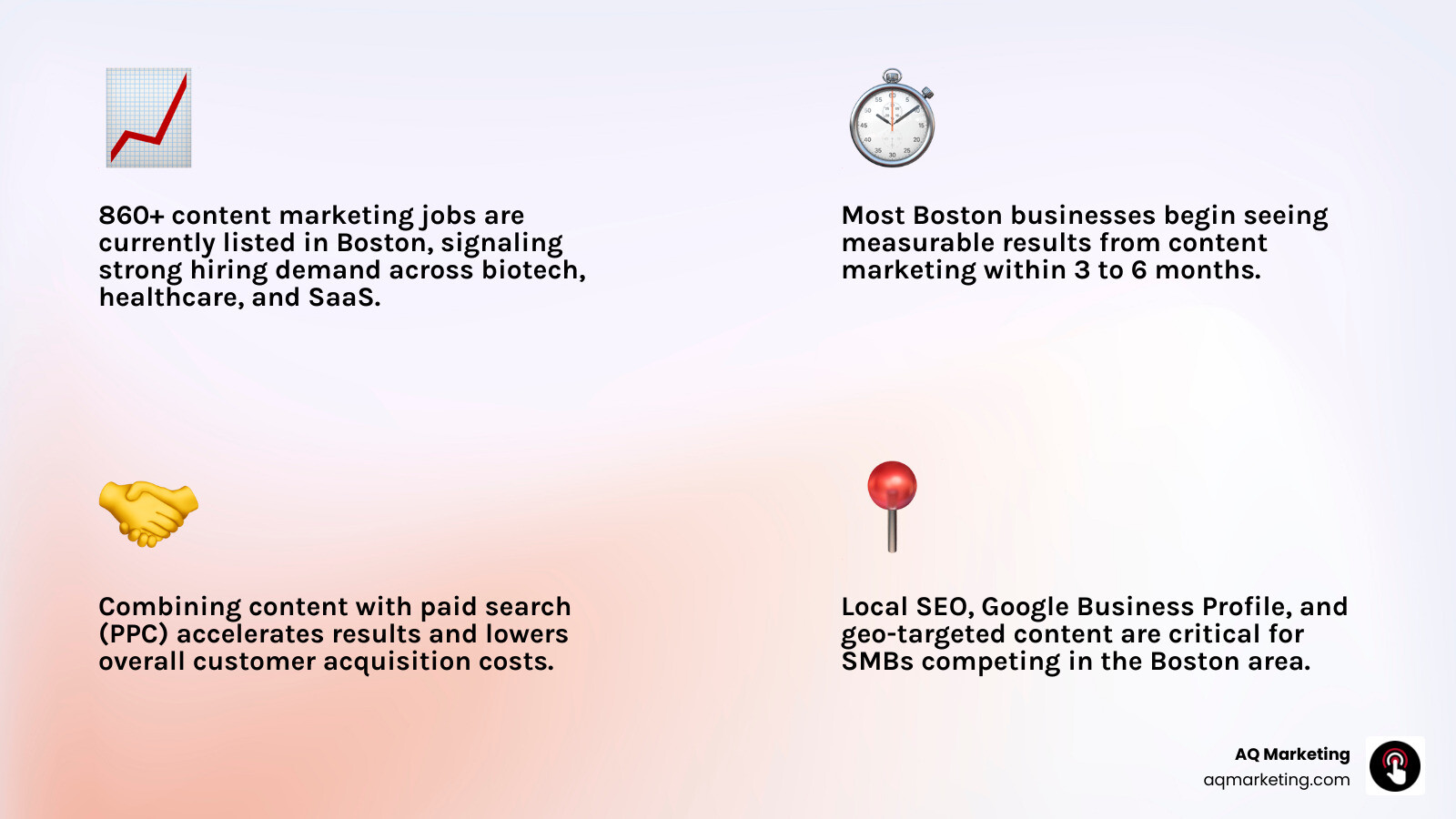
- 860+ content marketing jobs are currently listed in Boston on LinkedIn, signaling strong and growing demand
- Boston's industries — biotech, healthcare, SaaS, higher education, and professional services — require trust-based, thought leadership content, not generic blog posts
- Most Boston businesses begin seeing measurable results from content marketing within 3 to 6 months
- Combining content with paid search (PPC) accelerates results and lowers your overall cost to acquire customers
- Local SEO, Google Business Profile, and geo-targeted content are critical for small and mid-sized businesses competing in the Boston area
- AI is reshaping how content is created and distributed — but human strategy and editing still drive the best results
Boston is not an average market. It is home to world-class universities, a booming innovation corridor, and some of the most sophisticated B2B buyers in the country. Small and mid-sized businesses here face real pressure to stand out — and a smart content strategy, backed by data and aligned with paid advertising, is one of the most reliable ways to do it.
I'm Robert P. Dickey, President and CEO of AQ Marketing, and over my 20+ years helping businesses throughout Greater Boston grow their digital presence, I've seen what separates content marketing Boston strategies that generate leads from those that just fill a page. In the sections ahead, I'll walk you through exactly how to build a content and PPC approach that wins in this market.
Terms related to Content marketing Boston:
- AI Marketing Solutions for Small Business
- Effective digital marketing
- Boost online visibility
Content Marketing Boston in 2026: Market Reality, Demand, and Opportunity
Boston's content market is active, competitive, and still growing. Research shows about 860 current LinkedIn listings for content marketing jobs in Boston, with hundreds posted in the last month and many added weekly. You can see the live market snapshot on LinkedIn's Boston content marketing jobs page and Indeed's Boston content marketing listings.
That hiring volume tells us something important: businesses across Greater Boston are investing in content because it works. They need content to support SEO, paid media, email, social, sales enablement, and customer education. In other words, content is no longer the side dish. It is the entree.

Why Boston is a unique market for content and PPC
Boston buyers tend to be skeptical in the best possible way. They want proof, clarity, and expertise before they convert. That is especially true in industries common across Boston, Cambridge, Waltham, Burlington, Somerville, and surrounding communities: healthcare, tech, SaaS, higher education, professional services, and specialized local services.
This creates a few realities:
- Sales cycles are often longer
- Buyers compare more vendors
- Trust signals matter more
- Thin content underperforms
- PPC clicks are too expensive to waste on weak landing pages
That is why content and PPC work best together here. Content builds credibility and organic visibility over time. PPC helps us test offers, accelerate traffic, and reach high-intent searches now. Together, they create both momentum and staying power.
What the current Content marketing Boston job market reveals
The Boston job market shows a clear shift toward hybrid marketing roles. Employers are not just looking for blog writers. They want people who can handle several of these at once:
- SEO content planning
- Social media publishing
- Email campaign support
- Press releases and case studies
- Analytics and ROI reporting
- CMS management
- Video and short-form content coordination
Many Boston-area postings also emphasize cross-functional collaboration. Content marketers are expected to work with sales teams, product teams, leadership, and sometimes compliance teams. That is especially common in regulated or technical industries.
The takeaway is simple: in Boston, content is expected to perform, not just exist.
The biggest opportunities for Boston small and mid-sized businesses
For small and mid-sized businesses, this is actually good news. You do not need a giant brand budget to compete if you build the right foundation.
The biggest opportunities include:
- Building owned media assets that keep working after publication
- Improving local search visibility with service-area and geo-targeted content
- Supporting PPC campaigns with better landing pages and stronger message match
- Increasing branded search through consistent thought leadership
- Lowering customer acquisition cost over time through organic traffic
- Nurturing leads with email and remarketing after the first visit
A good blog post may not wear a cape, but over time it can do superhero work.
The Roles, Skills, and Specializations Boston Employers Want Most
Boston's hiring trends give us a useful picture of what the market values right now. If employers are paying for these skills, businesses should pay attention too.
Content marketing Boston roles in highest demand right now
The most in-demand roles in the Boston area include:
- Content Manager
- Content Strategist
- SEO Content Writer
- Copywriter
- Social Media Manager
- Video Content Producer
- Demand Generation Specialist
- Email Marketing Manager
- Marketing Operations Analyst
- Marketing Communications Analyst
These roles appear across in-house teams, agencies, and hybrid organizations. Some companies want specialists. Others want one person who can write, optimize, publish, analyze, and somehow still smile during a Monday meeting.
Skills and qualifications that stand out in Boston hiring
Based on Boston-area job listings, employers commonly want:
- 3+ years of B2B or industry-specific marketing experience
- A bachelor's degree in marketing, communications, journalism, or a related field
- Strong writing and editing ability
- Keyword research and on-page SEO skills
- Content calendar planning
- Experience with CMS platforms
- Reporting and analytics knowledge
- Stakeholder management and collaboration skills
- Ability to create content in multiple formats
For businesses hiring outside help, this matters because it defines the standard. If your content partner cannot connect strategy, SEO, publishing, and reporting, you are likely getting only part of the job done.
How AI is changing hiring expectations
In 2026, AI is part of the workflow, but not the whole workflow. Boston employers increasingly expect marketers to know how to use AI for:
- Research acceleration
- Brief creation
- Outline development
- Draft support
- Content refreshes
- Workflow efficiency
But they also expect human judgment. That includes fact-checking, brand voice control, compliance review, and strategic editing.
AI fluency now means knowing where AI helps and where it absolutely should not be left unsupervised. Think of it like a very fast intern with no instinct for risk.
Building a Boston Strategy That Connects Content, SEO, and PPC
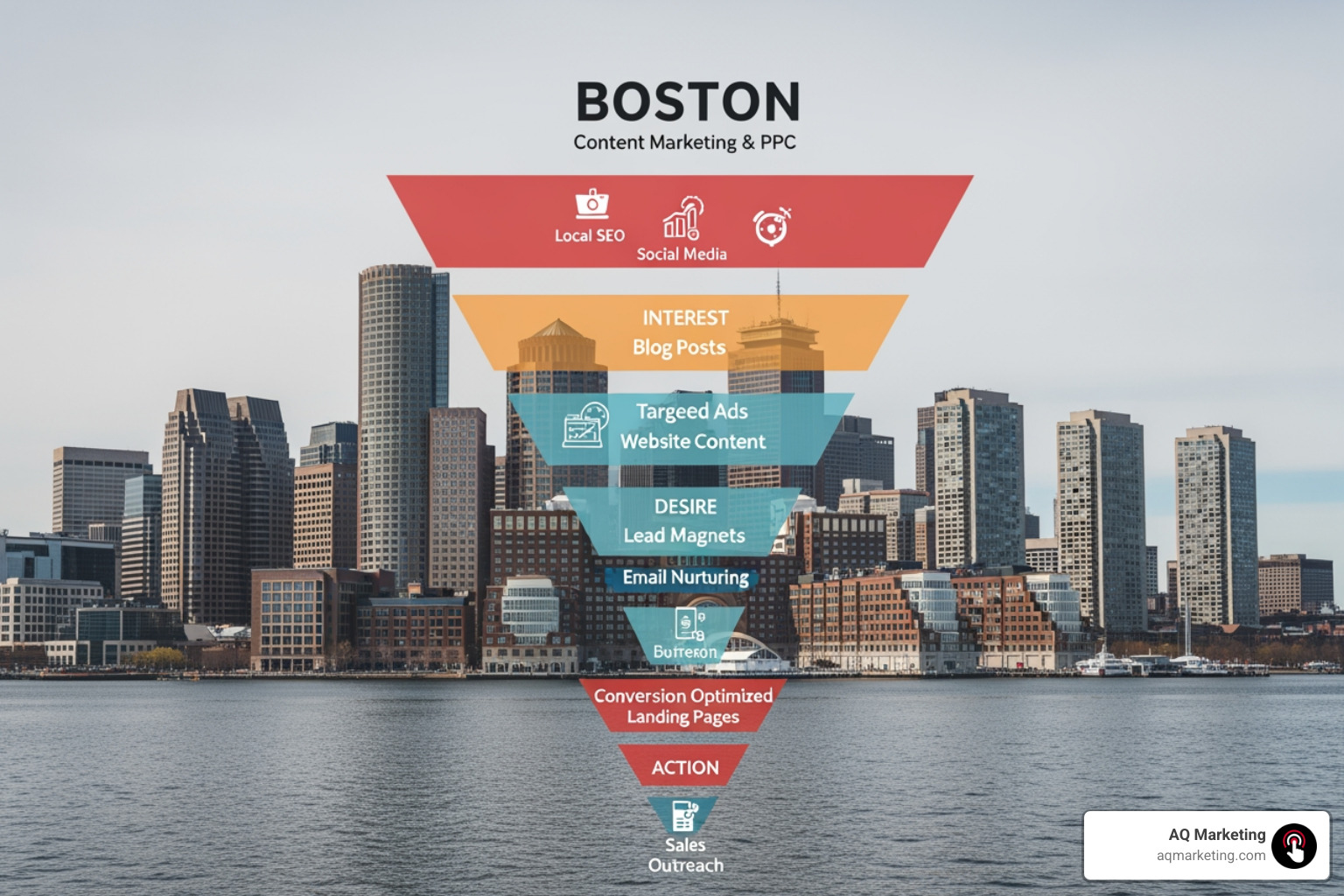
A strong Content marketing Boston plan does not begin with "let's post more." It starts with audience needs, business goals, and a clear path to conversion.
Strategy first: what winning Boston agencies do before publishing
Before publishing anything, strong teams usually work through:
- A content audit of existing pages and assets
- Competitor and gap analysis
- Keyword research tied to real intent
- Audience and persona research
- Topic cluster planning
- Funnel mapping
- Conversion path review
- Landing page alignment with offers
That sequence matters. Publishing before strategy is how businesses end up with random blogs, disconnected ads, and dashboards full of "interesting" numbers that do not generate leads.
Content formats that perform best for Boston audiences
Boston audiences respond well to useful, evidence-based formats. The best-performing content often includes:
- Blog articles targeting search intent
- Service pages for local and regional searches
- Case studies and success stories
- White papers and guides for complex B2B sales
- Email nurture sequences
- Press releases for major announcements
- Short-form video clips
- PPC landing pages with a single clear offer
For small and mid-sized businesses, we usually recommend a practical mix rather than trying to be everywhere at once. Better to publish consistently in the right formats than chase every shiny platform.
How to align content with Google Ads and paid social
This is where many businesses miss easy wins.
When content and PPC are aligned, we can:
- Use PPC search term data to guide future content topics
- Build landing pages around high-intent keywords
- Test headlines in ads before expanding them into longer content
- Create remarketing campaigns for blog and service-page visitors
- Match ad messaging to page messaging for better conversion rates
- Use educational content as middle-funnel support after the click
Here is a simple comparison:
| Channel | Best use | Speed | Long-term value |
|---|---|---|---|
| Content marketing | Authority, SEO, education, trust | Slower | High |
| PPC | Immediate traffic, testing, lead capture | Fast | Stops when spend stops |
| Combined strategy | Faster learning plus compounding growth | Balanced | Highest |
That is one reason we connect content with paid search and paid social instead of treating them like separate planets.
Boston-specific execution for local and regional search demand
For local visibility in Boston and surrounding Massachusetts communities, execution should include:
- City and service-area pages
- Neighborhood-aware copy where relevant
- Google Business Profile optimization
- Citation building and listings consistency
- Review generation and reputation support
- Geo-targeted blog and landing page content
- Location-based PPC campaigns
- Conversion-focused website design
If you want the underlying SEO framework behind this, here is more info about search engine optimization services and more info about digital marketing services.
Measurement, ROI, and AI Integration in Modern Boston Campaigns
The old way of measuring content was traffic-only. The modern way is much better. We want to know whether content and PPC are producing qualified leads, stronger conversion paths, and revenue influence.
How Boston companies measure content marketing success
The most useful metrics usually include:
- Organic traffic growth
- Keyword rankings
- Engagement quality
- Form fills and calls
- Demo requests or quote requests
- Landing page conversion rate
- Assisted conversions
- Pipeline or revenue influence
- Branded search growth
Case studies in the market also show why measurement matters. Boston agencies commonly highlight results such as large gains in organic traffic, impressions, inquiries, and revenue after structured content programs. The broader lesson is not about any one company. It is that content works best when goals, KPIs, and optimization cycles are defined from the start.
How PPC strengthens content performance and vice versa
PPC makes content smarter. Content makes PPC cheaper and more effective.
PPC helps us:
- Validate keyword intent quickly
- Identify top-converting headlines and offers
- Retarget visitors who are not ready to convert
- Accelerate early traffic to new landing pages
Content helps PPC by:
- Raising Quality Score with better relevance
- Supporting landing page experience
- Improving post-click trust
- Increasing branded demand
- Giving us remarketing audiences from organic visitors
That feedback loop is one of the strongest growth levers available to Boston businesses.
AI workflows, guardrails, and what to measure now
Many agencies now use AI-assisted workflows, and the smarter ones add guardrails around them. That usually means:
- AI for research and first-pass drafting
- Human editing for accuracy, depth, and tone
- Compliance review where needed
- Ongoing updates for freshness
- Optimization for both traditional search and AI-generated answers
In practical terms, we now measure not just rankings and traffic, but also:
- Visibility in AI Overviews and answer engines
- Content freshness and update cadence
- Conversion performance by content type
- Engagement signals from different traffic sources
Typical budgets and timelines businesses should expect
Based on average online data, not AQ Marketing's actual pricing, Boston-area content marketing programs often range widely depending on scope.
Typical monthly industry ranges based on public online data can look like this:
- Light local content support: $1,500 to $4,500 per month
- Mid-level strategy and production: $3,000 to $15,000+ per month
- Large or highly specialized programs: $10,000 to $30,000+ per month
For PPC management, average online pricing also varies widely based on ad spend, market competitiveness, landing page needs, and reporting depth.
Timeline-wise, most businesses begin seeing measurable movement within 3 to 6 months. Faster channels like PPC can produce data sooner, while organic content compounds over time. Stronger lead growth often shows up after the early ramp period, especially in longer sales cycles.
Boston Content Communities, Learning Resources, and Career Growth Paths
Boston also benefits from a strong professional community around content and marketing.
Where Boston content professionals build relationships and stay sharp
One local Boston content community reports more than 2,300 members, with activity that includes:
- Meetups
- Workshops
- Coffee chats
- Book clubs
- Job sharing
- Peer support
That matters because Boston marketing is relationship-driven. Communities like these help professionals exchange ideas, learn tools, find work, and stay current with changing platforms and buyer behavior.
Courses, training, and ongoing education options in Massachusetts
Massachusetts also offers useful educational resources for marketers. For example, UMass SBS Pathways offers a course on Content Marketing: Online Reviews in Social Media, which reflects how closely content, social proof, and reputation now intersect.
Beyond formal courses, marketers in this region often keep sharp through:
- SEO and analytics certifications
- Writing practice and editorial feedback
- Platform training for Google Ads and paid social
- AI workflow training
- Industry webinars and workshops
Career paths from specialist to strategist to growth leader
A common Boston career path looks like this:
- Start as a writer, coordinator, or channel specialist
- Add SEO, analytics, and campaign planning skills
- Take ownership of integrated campaigns
- Move into strategy and cross-channel leadership
- Grow into demand generation or revenue-focused leadership roles
For business owners, this progression is useful because it shows what mature marketing leadership actually looks like: not just content creation, but orchestration.
Frequently Asked Questions About Content Marketing Boston
How long does it take to see results from content marketing in Boston?
For most businesses, early traction appears in about 3 to 4 months, with stronger momentum building between 6 and 9 months. The exact timing depends on your website health, competition, publishing cadence, and sales cycle. Local service businesses may see faster lead movement than complex B2B companies with long decision processes.
What should Boston businesses prioritize first: content, SEO, or PPC?
It depends on the goal.
- If you need leads quickly, PPC usually comes first
- If your site lacks visibility, SEO and content should be built in immediately
- If your website is weak, fix the site before scaling traffic
- If local discovery matters, prioritize Google Business Profile, citations, reviews, and geo-targeted pages
In most cases, the real answer is not one or the other. It is sequencing them correctly.
How do you know if your Boston content strategy is actually working?
We look beyond pageviews. A strategy is working when you see:
- More qualified leads, not just more traffic
- Better rankings for high-intent terms
- Stronger conversion rates on landing pages
- Increased branded search
- More assisted conversions from organic visitors
- Better performance from remarketing and paid campaigns
If traffic is rising but lead quality is flat, something is off. If PPC spend is rising but landing pages are weak, same story. The best systems work together.
Conclusion
Winning with Content marketing Boston style means understanding the market, respecting buyer sophistication, and connecting content to real business outcomes.
That means building authority through useful content, supporting it with smart SEO, amplifying it with PPC, and measuring what matters. For small and mid-sized businesses across Boston, Woburn, Cambridge, Somerville, Burlington, Waltham, and the wider Massachusetts communities we serve, this approach creates both short-term traction and long-term visibility.
If you want a partner focused on durable growth rather than quick-hit vanity metrics, AQ Marketing is here to help. Explore more info about digital marketing services for small businesses or more info about Google Advertising and PPC support.