When we talk to founders across Massachusetts, from the tech hubs in Cambridge to the growing small businesses in Woburn, we often find a common misconception: that “branding” is just a fancy word for a logo. In reality, a brand is a lot more than its visual elements.
Think of it this way: if your startup were a person, the visual identity would be the clothes they wear, while the brand would be their character, their reputation, and the way they make people feel. A brand is an emotional experience. It is the set of expectations, memories, and stories that account for a consumers decision to choose your product over a competitors.
Internal values play a massive role here. Your brand strategy is the “secret sauce” that aligns your team. When everyone from engineering to sales understands the core mission, the customer perception becomes consistent. This consistency is vital when Marketing for Local Business Start-ups: Building Your Website, as your digital presence must reflect these deeper values to build trust.
The Role of Visual Identity
While strategy is the foundation, your visual identity is the “face” of your business. It includes:
Logo Design: The unique mark that makes you instantly recognizable.
Color Palettes: Colors that evoke specific emotions (e.g., blue for trust, green for growth).
Typography: Fonts that communicate your brands “voice”-whether its traditional and modern like some educational startups, or bold and disruptive.
Creating a visual brand identity that is distinguishable and memorable is what makes you stand out in a saturated market. It provides brand recognition, ensuring that when a potential customer sees your social media post or a local advertisement in Peabody or Salem, they immediately associate it with your previous high-quality interactions.
Why Strategy Precedes Design
We always advise our clients that strategic alignment must happen before a single pixel is moved in a design program. Why? Because your design should be a servant to your strategy.
Your startup brand strategy acts as a decision-making framework. If your mission is to “make commerce easy,” every design choice-from the simplicity of the website interface to the clarity of the checkout button-should reflect that mission. Strategy defines your value proposition: the specific reason why a customer should care about you. Without this “North Star,” you risk spending thousands on a “pretty” identity that fails to connect with your target audiences actual needs.
The 3 Ps of a Successful Startup Brand Strategy
To simplify the complex world of branding, we look to a framework popularized by experts like Arielle Jackson: Purpose, Position, and Personality. For startups navigating the competitive Boston tech scene, this framework is essential for differentiation.
Defining Your 10-Year Purpose
Your purpose is your 10-year horizon. It’s the “why” behind your existence that goes beyond making a profit. To find this, you can use frameworks like the “Big ideaL,” which looks at the intersection of a cultural tension and your brand’s best self.
For example, if the cultural tension is that “modern technology makes us feel more alone,” and your brand’s best self is “creating authentic human connection,” your purpose might be to “bring people together through shared experiences.” This purpose becomes your social impact statement and your North Star for long-term vision. As a Startup Website Design Company, we help businesses articulate this purpose so it resonates through every page of their site.
Crafting an 18-Month Position
While purpose is long-term, positioning is your 18-month tactical plan. It defines:
Target Audience: Who are you serving right now? (e.g., small insurance agencies in New England).
Category Choice: Are you entering an existing category, modifying one (like Nest did with “learning” thermostats), or attempting to create a new one?
Key Benefits: What is the one functional thing you do better than anyone else?
Competitive Differentiation: Why are you different from the “status quo” or the “old way” of doing things?
Developing a Unique Personality
If your brand were a person at a party, how would they act? This is your brand personality. Research shows that strong brands usually “spike” in two of the five dimensions: Sincerity, Excitement, Competence, Sophistication, or Ruggedness.
Developing a voice guide is essential here. It ensures that whether you are writing an email, a tweet, or a blog post, the branding remains consistent. Use human attributes-are you the “wise mentor” or the “playful disruptor”? This personality is what creates an emotional bond with your audience.
Strategic Timing: When to Invest in Your Identity
Timing is everything in the startup world. Spend too much on a fancy brand agency before you have a product, and you’ll run out of cash. Wait too long, and you’ll lose the chance to control your own narrative. In the New England venture capital landscape, timing your brand evolution is key to securing the right partners.
Attracting Investors and Securing Funding
For early-stage startups in Boston or Worcester looking for seed funding, a cohesive startup brand strategy provides immediate credibility. Investors aren’t just looking for a product; they are looking for a team that understands their market and can tell a compelling story.
Professionalism in your pitch deck and a clear articulation of your “why” builds investor confidence. It signals that you aren’t just building a feature-you are building a company. While many seed-stage websites are “pretty ugly” when they raise funds, having a clear “Messaging House” ensures you can explain what you do, for whom, and why it matters without causing confusion.
Balancing Resources and Impact
We advocate for a “Minimum Viable Brand” (MVB) approach for early-stage ventures. This means:
Seed Stage: Focus on the 3 Ps (Purpose, Position, Personality). Use affordable tools or a specialized agency like AQ Marketing for Early Stage Marketing to get a professional wordmark and a consistent color palette.
Series A and Beyond: Once you have product-market fit and traction, invest in a full visual system, comprehensive brand guidelines, and professional photography.
This iterative development allows you to scale your brand as you grow, ensuring your resource allocation matches your current stage of development.
Avoiding Common Pitfalls in Early-Stage Branding
Building a brand is a minefield of potential mistakes. One of the most common is focusing on emotional benefits before you’ve proven functional ones.
Messaging Type
Focus
When to Use
Example
Functional
What it does / Problem it solves
Early Stage / Launch
“Record instantly shareable videos of your screen.”
Emotional
How it makes you feel / Aspirations
Late Stage / Established
“Inspiration and innovation for every athlete.”
The “Ugly Baby” Syndrome
As a founder, you are biased. You love your product. This can lead to “Ugly Baby Syndrome,” where you assume the value of your innovation is obvious. To avoid this, seek an objective assessment.
Get customer feedback early and often. If ten people look at your homepage and five are confused about what you actually do, your branding has failed. Avoid jargon and “explain it like I’m a bored teenager” to ensure your message hits home.
Choosing the Right Foil
Many startups list other startups as their main competitors. In reality, your “foil” is usually the status quo—the “old way” of doing things. For a fintech startup, the foil isn’t another app; it’s paper checks and manual reconciliation. By positioning yourself against the friction of the current market, you make your solution’s value proposition much clearer. Unforgettable branding is often built on being the hero that slays the “status quo” dragon.
Scaling and Evolving Your Brand Presence
As your startup gains traction and reaches product-market fit, your startup brand strategy must evolve. A brand is not a static document; it’s a living business personality.
Differentiating Through a Startup Brand Strategy
In a competitive market, differentiation is your greatest weapon. You can achieve this through:
Category Modification: Don’t just be another CRM; be the CRM built specifically for New England contractors.
Thought Leadership: Use Startup SEO Services and content marketing to highlight inefficiencies in your industry and present your unique solution.
Brand Equity: As you deliver on your promises, your name begins to hold value. This equity allows you to command premium pricing and reduces the “mistrust” gap that new companies often face.
Measuring the Impact of Your Startup Brand Strategy
How do you know if your branding is working? Look at these metrics:
CAC Reduction: Clearer messaging leads to better ad conversion and lower customer acquisition costs.
Conversion Rates: A consistent, trustworthy visual identity improves website conversion.
Customer Loyalty: Brands that align with customer values see higher retention.
Brand Awareness: Use social listening and search data to see if people are searching for your brand name directly.
Frequently Asked Questions about Startup Branding
At what stage should a startup prioritize brand strategy?
Immediately. You should define your Purpose, Position, and Personality before you even hire your first employee or write your first line of code. It ensures everyone is rowing in the same direction.
Who should be responsible for developing the brand identity?
In the earliest days, the founders must drive the brand strategy. However, for the visual identity, we recommend a mix: use professional tools or a specialized agency to ensure a baseline of quality. As you scale, a dedicated “brand steward” (like a Chief Brand Officer or a marketing lead) should take over.
How does branding differ for B2B vs. B2C startups?
B2C branding often leans more into personality and emotional connection early on. B2B branding must prioritize competence and reliability. However, both require a strong “foil” and a clear functional benefit to cut through the noise.
Conclusion
Building a winning startup brand strategy is a marathon, not a sprint. It requires deep introspection, a clear understanding of your audience, and the courage to stand for something meaningful. At AQ Marketing, we’ve helped businesses across the North Shore and the Greater Boston area transform from “just another startup” into recognizable, trusted brands.
Whether you are in Woburn, Burlington, or Lexington, the digital landscape is crowded. A strategic approach to your brand ensures that your marketing dollars aren’t just “noise,” but an investment in long-term results. By focusing on your purpose, sharpening your position, and humanizing your personality, you give your venture the best possible chance to scale and thrive.
Why Insurance Industry Marketing Trends Matter More Than Ever in 2026
Insurance industry marketing trends are undergoing a seismic shift in 2026, driven by AI adoption, rising catastrophe losses, regulatory scrutiny, and a massive workforce transition. Here’s what every insurance marketer needs to know:
Top Insurance Marketing Trends for 2026:
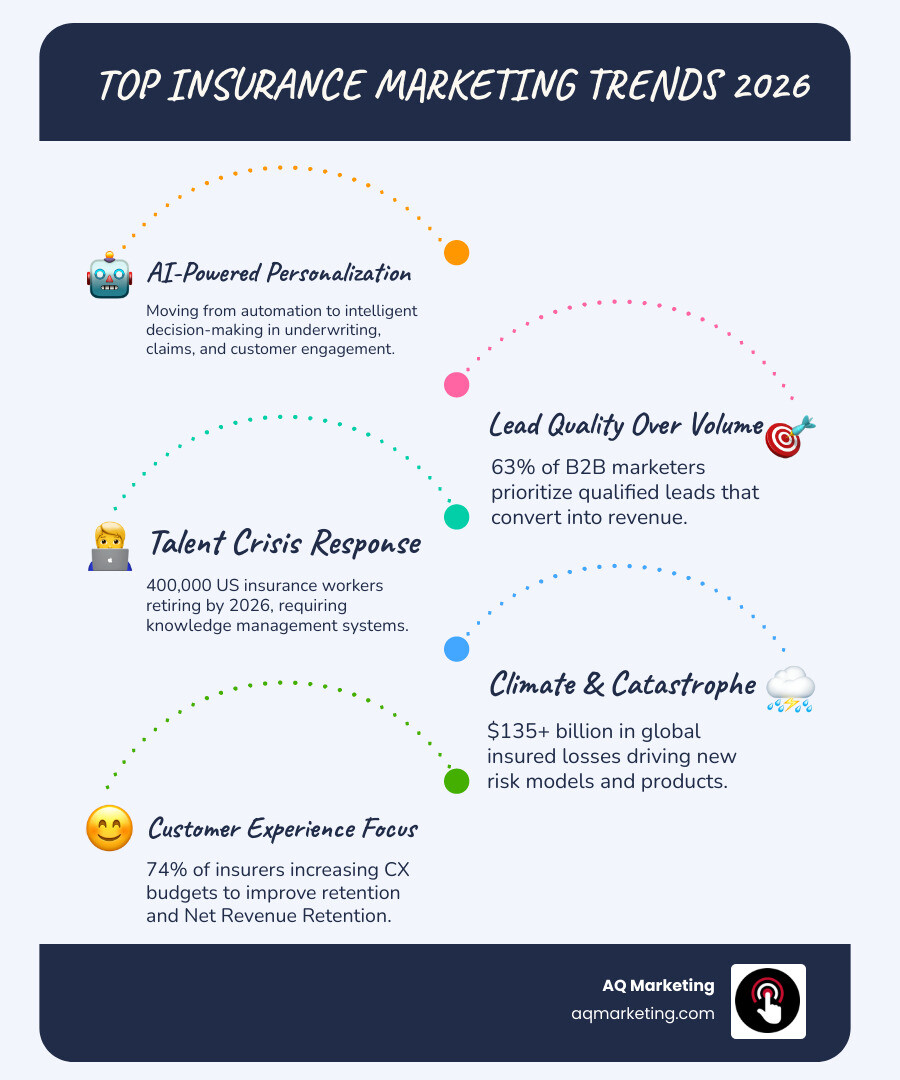
AI-Powered Personalization – Moving from automation to intelligent decision-making in underwriting, claims, and customer engagement
Lead Quality Over Volume – 63% of B2B marketers now prioritize qualified leads that convert into revenue
Talent Crisis Response – 400,000 US insurance workers retiring by 2026, requiring knowledge management systems
Climate & Catastrophe Adaptation – $135+ billion in global insured losses driving new risk models and products
Broker-Carrier Connectivity – API-driven data integration becoming essential for competitive advantage
Customer Experience Focus – 74% of insurers increasing CX budgets to improve retention and Net Revenue Retention
The insurance world is getting riskier and more fragmented. Extreme weather events, social inflation pushing liability claims up 57% over the past decade, and geopolitical uncertainty are reshaping how insurers assess risk and reach customers. At the same time, more than 60% of P&C insurers are piloting AI technologies, but fewer than 15% have scaled them across core operations—creating a widening performance gap between industry leaders and everyone else.
For insurance agencies and brokerages, this creates both challenge and opportunity. Traditional marketing approaches centered on lead volume are giving way to precision strategies focused on qualified prospects, personalized experiences, and measurable revenue impact. The shift from “inbox underwriting” to unified digital command centers is mirrored in marketing, where data-driven insights and AI-powered tools are replacing spray-and-pray campaigns.
As President and CEO of AQ Marketing, I’ve spent over 20 years helping insurance agencies and brokerages steer digital change, and I’ve seen how insurance industry marketing trends can make or break growth strategies in this rapidly evolving landscape. My experience spans from digital strategies in the early 2000s to today’s AI-driven personalization at scale, giving me a unique perspective on what actually moves the needle for insurance marketers.
Navigating the 2026 Landscape: Key Insurance Industry Marketing Trends
As we look toward the 2026 horizon, the insurance landscape is being reshaped by forces that demand more than just traditional advertising. We’ve seen that the “old way” of doing things—relying solely on broad-reaching ads—is no longer enough to sustain growth in a market defined by volatility.
One of the primary challenges we face is the sheer scale of catastrophic events. In 2025 alone, California’s wildfires accounted for an estimated $40 billion in insured losses, while severe convective storms added another $50 billion. Even here in Massachusetts, from the coast of Barnstable to the hills of Adams, changing weather patterns are forcing us to rethink how we communicate risk to our clients.
Beyond the weather, “social inflation” is a major player. This isn’t just a buzzword; it refers to the rising costs of insurance claims due to more aggressive litigation and massive jury awards. In fact, liability claims have jumped 57% over the past ten years. For marketers, this means we must focus on transparency and education to build trust. Our digital marketing insurance industry strategies must now emphasize the value of adequate coverage in a world where “nuclear verdicts” are becoming more common.
Furthermore, geopolitical and economic uncertainty, including trade tensions and tariffs, are bleeding into the P&C outlook. With 82% of chief economists expecting global fragmentation to intensify, the Deloitte 2026 insurance outlook suggests that underwriters—and by extension, marketers—must remain incredibly agile. We are helping our clients across Massachusetts, from Boston to Worcester, adapt their messaging to address these rising healthcare costs and regulatory shifts.
The Rise of Intelligent Insurance and AI Integration
The most significant of the insurance industry marketing trends in 2026 is the transition to “Intelligent Insurance.” This isn’t just about using a chatbot on your website; it’s a new operating model that embeds AI and analytics directly into core workflows.
According to McKinsey research on AI in insurance, AI acts as a true force multiplier. It allows for “continuous underwriting,” where risk factors are monitored in real-time rather than just once a year at renewal. Imagine using AI to assess satellite or drone photos of a home in Newton or Quincy to model fire or flood risk with pinpoint accuracy.
From a marketing perspective, this data is gold. We can use these insights to improve SEO for insurance agencies by creating content that speaks to highly specific risks. However, with great power comes great responsibility. The NAIC AI governance framework is already ramping up focus on algorithmic bias. We must ensure that our AI tools are transparent and fair, especially when dealing with sensitive health or property data.
Leveraging AI for Better Insurance Industry Marketing Trends and Lead Quality
In 2026, we are finally seeing the end of the “MQL obsession.” For years, agencies focused on getting as many leads as possible. Today, the focus has shifted to lead value.
A recent Demand Gen Report on lead quality found that 63% of B2B marketers now rank improving lead quality as a higher priority than volume. We are implementing Account-Based Marketing (ABM) and Revenue Operations (RevOps) to ensure that the leads our clients receive in places like Billerica and Burlington are actually ready to bind.
AI-driven personalization is the secret sauce here. McKinsey notes that organizations using AI-driven personalization can increase revenue by 10–20%. By tailoring our outreach based on predictive analytics, we can reach a business owner in Waltham or a homeowner in Weymouth with exactly what they need, exactly when they need it.
Operational Shifts: MGAs, Reinsurance, and Connectivity
The way insurance is distributed and backed is also changing. Managing General Agents (MGAs) have emerged as the industry’s innovation engines, growing nearly twice as quickly as the broader market. They are filling the gaps in niche expertise, such as cyber risk and specialized commercial lines.
For many of our clients in the insurance brokerage industry, connectivity is the new baseline. The days of “inbox underwriting”—where work is managed through a mess of PDFs and emails—are over. In 2026, unified underwriting command centers are the standard.
This shift is supported by a Swiss Re on fragmented world order report, which highlights how insurers must use modern operating models to stay competitive. We are seeing increased industry consolidation as larger carriers seek scale, but this also creates space for tech-savvy local agencies in Lowell or Lawrence to thrive by being more responsive and data-integrated.
Adapting to Softening Rates and Underwriting Discipline
As we enter a softening market, where premium growth is expected to decelerate to around 3–4%, underwriting discipline becomes paramount.
According to Lloyd’s market cycle insights, underwriters must resist the urge to slash rates just to keep volume. Instead, the competitive advantage in 2026 lies in portfolio resilience. We help our clients communicate their “underwriting judgment”—which cannot be automated—as a value-add. This builds a “strategic defense” against margin compression by proving to clients in Framingham or Fitchburg that their carrier has the stability to weather any storm.
Solving the Talent Cliff and Knowledge Gap
Perhaps the most daunting of the insurance industry marketing trends is the “talent cliff.” By 2026, an estimated 400,000 insurance workers in the US will retire.
The US Chamber report on talent vacuum highlights that 50% of the current workforce will retire in little more than a decade. For an agency in Brockton or Braintree, this is an existential risk. How do you preserve decades of institutional knowledge when your top performers leave?
We believe marketing plays a role here. By using insurance marketing strategies that highlight an agency’s culture and technological forwardness, we help our clients attract Gen Z talent. AI can actually be part of the solution; it can document the wisdom of retiring professionals and build digital training libraries, making insurance a more compelling career choice for the next generation.
Human-Centric Insurance Industry Marketing Trends in a Tech-Driven World
With all this talk of AI and data, it’s easy to forget the human element. But in 2026, empathy is a competitive advantage.
Customers are tech-fatigued. They want digital onboarding that is lightning-fast, but they also want to know a human has their back when things go wrong. This is why insurance agency local SEO is so vital. When someone in Woburn or Winchester searches for an agent, they are looking for local trust.
We focus on reputation management and transparency. 74% of insurers are increasing their CX (Customer Experience) budgets because they know that a seamless, empathetic experience is the only way to maintain loyalty. Whether it’s through plain-language policy summaries or AI-enabled tools that help customers compare options, the goal is to make the complex simple.
Frequently Asked Questions about Insurance Marketing
How is AI changing insurance underwriting in 2026?
AI has moved from experimentation to execution. In 2026, it uses real-time data and risk scoring to enable “continuous underwriting.” This includes analyzing satellite imagery to check the condition of a roof in Arlington or using telematics to monitor driving habits in Medford. It helps underwriters make faster, more precise decisions while reducing manual “inbox” tasks by up to 75%.
What are the biggest challenges for insurance marketers this year?
The biggest problems include the massive talent drain (400,000 retirements), social inflation driving up claim costs, and the increasing frequency of climate-driven catastrophes. Marketers also have to steer a complex regulatory environment regarding AI bias and data privacy, while trying to break down internal data silos that prevent a unified view of the customer.
Why is lead quality more important than lead volume for agencies?
High lead volume often leads to wasted sales cycles and frustrated agents. In 2026, the focus is on “lead value”—finding prospects that have a higher customer lifetime value and a better chance of retention. By prioritizing quality, agencies in places like Peabody or Plymouth can improve their marketing efficiency and ensure their CRM is filled with qualified, revenue-ready opportunities.
Conclusion
The insurance industry marketing trends of 2026 represent a hyper-acceleration of digital change. From the rise of Intelligent Insurance and AI-driven personalization to the critical need for a new talent pipeline, the industry is reimagining itself.
At AQ Marketing, we’ve been the Woburn marketing experts since 2003, helping small to medium-sized businesses across Massachusetts—from Acton to Yarmouth—achieve strategic growth. We understand that in a world of “shifting sands,” you need a partner who delivers long-term, impactful results. Whether you need a complete digital marketing for insurance companies overhaul or a targeted SEO strategy, we are here to ensure you maintain your competitive edge.
The future of insurance is data-rich and AI-powered, but it remains rooted in trust and local expertise. Let us help you steer this new era and turn these challenges into your greatest opportunities for growth.
Note: Typical industry pricing for comprehensive digital marketing management can range from $2,500 to over $15,000 per month, depending on the scale of the campaign and the competitive nature of the local market. These figures are based on average online data and do not represent AQ Marketing’s actual pricing.
The Best Contractor Marketing Boston Strategies for Growth
Why Contractor SEO Boston is Essential for Local Growth
Contractor SEO Boston is the practice of optimizing a contractor’s online presence so local homeowners and property managers find your business first on Google — before they ever call a competitor.
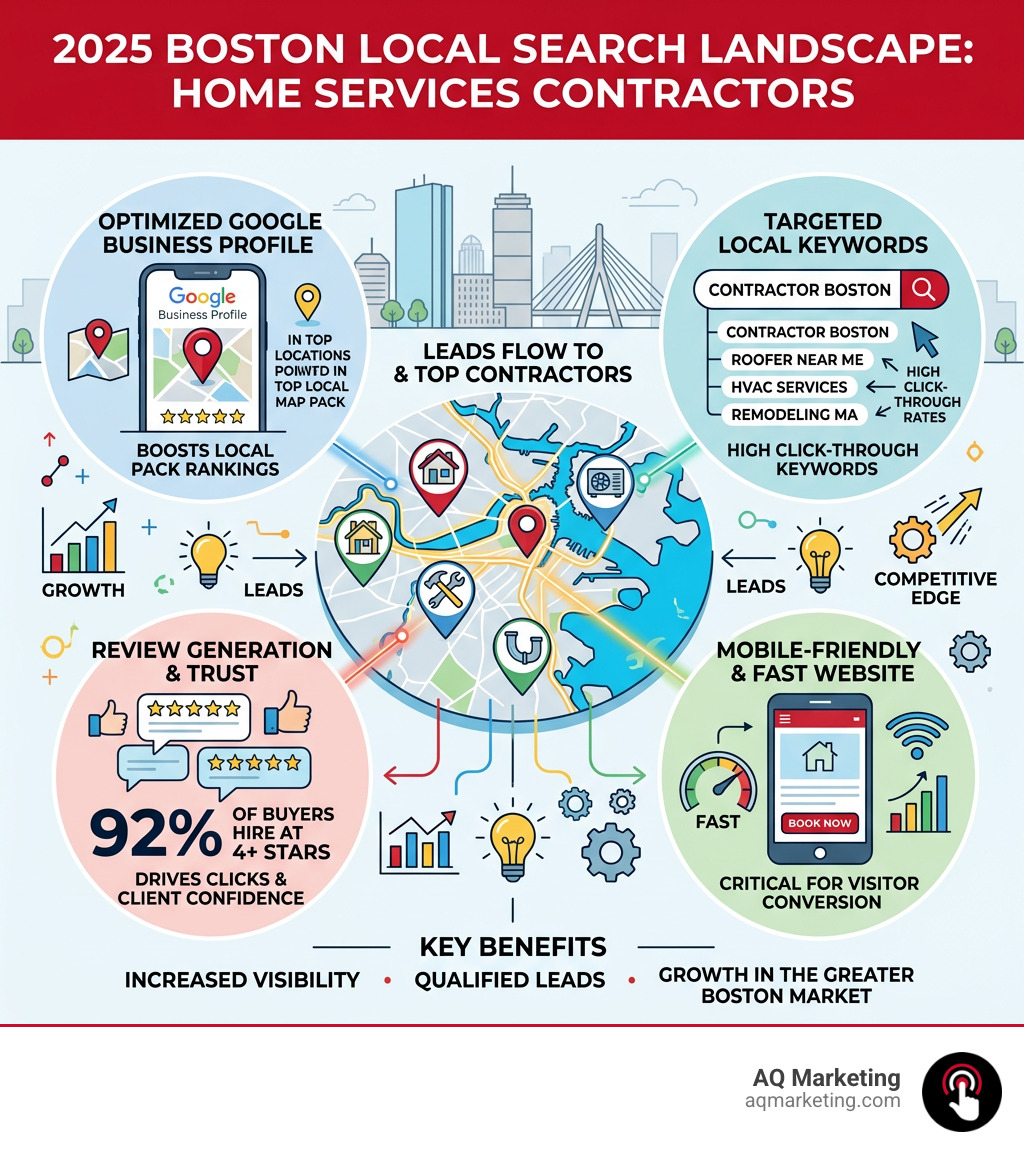
Here’s what effective Contractor SEO Boston looks like in 2025:
Strategy
What It Does
Google Business Profile optimization
Gets you into the top local map pack
Local keyword targeting
Connects you with buyers searching your exact services
On-page SEO for service pages
Converts visitors into booked jobs
Citation building & NAP consistency
Builds trust with Google’s local algorithm
Review generation
Drives clicks — 92% of buyers hire at 4+ stars
Technical SEO (speed, mobile, schema)
Keeps your site ranking and converting
The numbers tell the story clearly. Over 93% of online experiences start with a search engine, and 94% of homeowners search online before calling a contractor. Yet most contractors still rely primarily on referrals and word-of-mouth — leaving a massive gap that smarter competitors are already filling.
Boston’s contractor market is dense and competitive. Whether you do roofing, HVAC, remodeling, or general contracting, the businesses that show up on page one of Google capture the lion’s share of leads. The top three results alone receive over 68% of all clicks — and 90% of searchers never scroll past page one.
The good news? A focused, well-executed SEO strategy changes everything. Contractors who commit to local SEO consistently see more qualified leads, lower cost per acquisition, and sustainable growth that paid ads alone can’t deliver.
I’m Robert P. Dickey, President and CEO of AQ Marketing — a digital marketing agency based in Woburn, MA — and I’ve spent over 20 years helping small and mid-sized businesses across the Boston area grow their online presence, including developing Contractor SEO Boston strategies that drive real, measurable results. In this guide, I’ll walk you through exactly what it takes to build a dominant local search presence as a contractor in the Greater Boston market.
In a city as historic and fast-moving as Boston, the way homeowners find help has fundamentally shifted. Gone are the days when a listing in the Yellow Pages or a magnet on a van was enough to keep the phone ringing. Today, the “digital storefront” is the first place your potential clients visit.
The competition in the Massachusetts contractor market is fierce. From the triple-deckers of Dorchester to the historic estates in Concord, thousands of general contractors are vying for the same projects. This is where SEO for Service Providers becomes your most valuable employee. It works 24/7 to ensure that when a homeowner types “kitchen remodeler near me” into their phone, your business is the one they see.
Research shows that 94% of homeowners search online before calling a contractor. If you aren’t visible in those search results, you effectively don’t exist to the vast majority of your market. By investing in SEO for In-Home Service Providers, you aren’t just “getting clicks”; you are building brand authority. When Google places you at the top of the results, it gives you a “seal of approval” that builds immediate trust with the consumer.
Furthermore, the long-term ROI of Home Service SEO far outpaces traditional advertising. While paid ads stop the moment you stop paying, a solid organic ranking continues to deliver leads month after month. In a market where the average home improvement spend is significant, capturing even a small increase in market share through organic search can lead to hundreds of thousands of dollars in additional annual revenue.
Core Components of a High-Performing Contractor SEO Boston Strategy
Winning at SEO isn’t about “tricking” Google; it’s about providing the best possible answer to a user’s problem. For Boston contractors, this requires a balanced approach that covers technical health, content relevance, and local authority.
On-Page SEO: This involves optimizing the actual content and code on your website. Our On-Page SEO Services focus on making sure your headlines, images, and text clearly communicate your expertise to both users and search engines.
Off-Page SEO: This is about building your reputation across the web. Through Off-Page SEO for Home Services, we help you earn backlinks from reputable industry sites and local Boston directories, which signals to Google that you are a trusted local authority.
Technical SEO: This is the “under the hood” work—ensuring your site is fast, secure, and easy for Google to read.
Technical Foundations for Contractor SEO Boston Success
Your website needs to be as sturdy as the homes you build. Technical SEO is the foundation. If your site takes forever to load or looks broken on a smartphone, Google will penalize you, and users will bounce.
Core Web Vitals: Google’s specific metrics for speed, responsiveness, and visual stability.
Schema Markup: Special code that tells Google exactly what your business does (e.g., “We are a roofing contractor in Woburn”).
Secure Hosting (HTTPS): Homeowners won’t enter their contact info on a site that isn’t secure.
XML Sitemaps: A roadmap that helps Google find every page on your site.
Conducting Local Keyword Research for Contractor SEO Boston
Keywords are the bridge between what the customer wants and the services you provide. We don’t just target “contractor”; we target “buyer intent” keywords.
For example, a plumber in Medford shouldn’t just want to rank for “plumbing.” They want to rank for “emergency drain cleaning Medford MA” or “water heater installation North End.” These “long-tail” keywords have lower search volume but much higher conversion rates because the user is ready to hire.
We specialize in niche-specific keyword strategies, such as:
By understanding the unique search patterns of New Englanders—like “ice dam removal” in the winter or “deck staining” in the spring—we ensure your site stays relevant year-round.
Dominating the Local Map Pack with Google Business Profile
If you’ve ever searched for a service locally, you’ve seen the “Map Pack”—the three businesses that appear at the top of the page next to a map. For Contractor SEO Boston, this is the “Platinum Real Estate.”
Being in the top three isn’t an accident. It requires meticulous Business Profile Management. Google uses three main factors to rank you here: Relevance, Distance, and Prominence.
To win the Map Pack, we focus on:
NAP Consistency: Your Name, Address, and Phone number must be identical across the entire internet. Even a small discrepancy like “St.” vs “Street” can confuse Google’s algorithm.
Local Citations: Getting your business listed in trusted directories like the BBB, Angi, and local Chambers of Commerce.
Reviews: This is critical. 88% of consumers trust online reviews as much as a personal recommendation. Our Reputation Management strategies help you systematically collect and respond to customer feedback.
Geo-tagged Photos: Uploading real photos of your crew working in specific Boston neighborhoods (like Back Bay or Southie) tells Google exactly where you operate.
Content Marketing and Authority Building for Contractors
Content is how you prove you’re the expert. In Websites for Home Service Businesses, your content needs to serve two masters: the Google bot and the human homeowner.
We recommend a mix of high-conversion service pages and high-authority educational content.
Content Type
Purpose
Example Topic
Service Pages
To rank for specific “hire me” terms
“Roof Replacement Services in Brockton”
Educational Blogs
To build trust and answer “how-to” questions
“How to Prep Your Massachusetts Home for a Nor’easter”
Project Galleries
To show proof of quality
“Before & After: Kitchen Remodel in Brookline”
Case Studies
To demonstrate problem-solving
“Solving a Basement Leak in a 100-Year-Old Cambridge Home”
Effective Boston MA Website Design incorporates these elements seamlessly. A project gallery isn’t just a bunch of photos; it’s a collection of optimized pages that tell a story. When you combine great visuals with a strong backlink strategy, you build “Topical Authority.” Google begins to see you as the go-to source for contracting in the region.
Working with a Boston Website Design Company that understands the local landscape ensures your content speaks the language of New Englanders—mentioning specific architectural styles, local building codes, and weather-related challenges.
Measuring Success and Avoiding Common Pitfalls
SEO is a data-driven science. We don’t guess if our Digital Marketing Boston MA strategies are working; we measure them.
When we partner with a client, we track several Key Performance Indicators (KPIs):
Organic Traffic: How many people are finding your site through search?
Keyword Rankings: Are you moving from page five to page one for your most important terms?
Conversion Rate: Of the people who visit, how many actually call or fill out a form?
Bounce Rate: Are people leaving your site immediately? This often indicates a need for better Web Design Companies Boston expertise.
One of the biggest mistakes contractors make is focusing on “vanity metrics” like total hits, rather than lead quality. A thousand visitors from California don’t help a roofer in Lowell. We use advanced call tracking and lead attribution to ensure your Search Engine Optimization Boston MA investment is driving actual revenue, not just numbers on a screen.
Common pitfalls to avoid:
Buying low-quality backlinks: This can lead to Google penalties.
Keyword stuffing: Writing for robots instead of humans.
Ignoring technical errors: A broken contact form is the fastest way to kill your ROI.
Frequently Asked Questions about Contractor SEO
How long does it take to see results from a Boston SEO campaign?
SEO is a marathon, not a sprint. While every business is different, most of our clients begin to see noticeable improvements in rankings and traffic within 3 to 6 months.
The timeline depends on how competitive your specific niche is and the current state of your website. However, the growth is compounding. Unlike a billboard that you pay for every month, the work we do in month one continues to pay dividends in month twelve and beyond. As your authority grows, it becomes easier to rank for new, even more competitive terms.
Why is mobile optimization critical for Boston contractors?
Think about your own behavior. If a pipe bursts at 2:00 AM, you aren’t booting up a desktop computer; you’re grabbing your phone. If a contractor’s site is hard to navigate on mobile, you’ll click the “back” button and call the next guy.
Google uses “mobile-first indexing,” meaning it looks at the mobile version of your site to determine your rankings. For contractors, mobile optimization means more than just a site that “fits” on the screen. It means having click-to-call functionality, fast loading speeds, and easy-to-tap buttons. In the emergency home services world, speed and ease of use are the difference between a new lead and a lost opportunity.
What is the average cost of professional SEO services for contractors?
Pricing for professional SEO varies significantly based on the size of your service area, the number of services you offer, and the level of competition in your market. Based on average online data, most professional, results-driven SEO campaigns for contractors fall within a wide range.
You might see monthly investments ranging from $1,500 to as high as $15,000 per month for large, multi-location firms. It is important to note that these figures are based on industry averages and do not represent AQ Marketing’s actual pricing. We believe in customized strategies rather than “cookie-cutter” packages. The key is to view SEO as an investment in your business’s infrastructure rather than a simple expense. A high-quality campaign pays for itself many times over through the acquisition of high-value projects.
Conclusion
The digital landscape for contractors in Greater Boston has never been more competitive, but it has also never offered more opportunity. By implementing a sophisticated Contractor SEO Boston strategy, you can stop chasing leads and start attracting them.
At AQ Marketing, we’ve been helping businesses in Woburn, MA, and the surrounding communities—from Amesbury to Yarmouth—since 2003. We specialize in the home services industry because we understand the unique challenges you face. Whether you need a complete Home Service SEO overhaul or a high-converting website that truly represents your craftsmanship, we are here to help you achieve sustainable, long-term growth.
Your expertise is in building and repairing homes; our expertise is in building your online dominance. Let’s work together to make sure your business is the first one Boston homeowners see when they need help.
To build a business that doesn’t keep you up at night, we have to look at lead generation for agents as a professional ecosystem rather than a series of random acts of marketing. In our experience working with businesses across Massachusetts—from the busy streets of Boston to the quiet corners of the Berkshires—the most successful agents are those who treat their pipeline like a garden. You have to plant different types of seeds, water them consistently, and know which ones are ready to harvest.
Categorizing Your Lead Pipeline
Not all leads are created equal. If you treat a “potential lead” who just clicked a “like” button the same way you treat a “qualified prospect” who just requested a quote, you’re going to burn out. Understanding the stages of your funnel is the first step toward sanity.
Potential Leads (Top of Funnel): These are individuals who have shown a glimmer of interest. Maybe they downloaded a neighborhood guide or watched one of your property tours. They are “Aware” of you, but they aren’t ready to sign anything yet.
Marketing Qualified Leads (MQLs): These folks have engaged with your content multiple times. They might have signed up for your newsletter or used an interactive tool on your website.
Sales Qualified Leads (SQLs): This is the “hot” zone. These are leads vetted and deemed ready for a direct conversation. They’ve asked specific questions about insurance products or requested a home valuation.
Qualified vs. Potential: Research indicates that while potential leads are more numerous, qualified leads have been vetted through scoring and qualifying new leads to ensure they actually have the intent and ability to move forward.
Why Consistency Trumps Luck in 2025
In 2025, the market is too volatile to rely on “getting lucky” with a stray referral. While referrals yield 3-5× higher conversion rates than other sources, they are often unpredictable. If you only eat when the phone rings, you’re going to go hungry during market dips.
A structured approach to lead generation for agents provides predictable income. According to the National Association of Realtors, social media accounts for over 52% of high-quality leads in real estate. By diversifying your sources—combining digital outreach with traditional networking—you create a “safety net” for your GCI (Gross Commission Income).
Digital Strategies to Dominate Local Markets
If you want to be the go-to agent in Newton, Worcester, or Plymouth, you need to show up where people are searching. Today, that means the first page of Google and the palm of their hand. As a local SEO company, we see how powerful a dominant local presence can be.
Mastering Lead Generation for Agents via Search
Search engine optimization is no longer optional; SEO remains a cornerstone of digital marketing. When someone types “best insurance agent in Framingham” or “homes for sale in Salem,” you want your name to be the answer.
We focus on “intent-based traffic.” This means targeting keywords that suggest a person is ready to take action. Working with an SEO specialist allows you to optimize your Google Business Profile, which is essentially your digital storefront. By collecting reviews and posting regular updates, you build the trust necessary to convert a searcher into a caller.
Strategy
Speed of Results
Cost Stability
Lead Quality
Organic SEO
Slow (6-12 months)
High (Long-term ROI)
Very High (Intent-based)
Paid PPC
Fast (1-3 days)
Variable (Pay per click)
High (Targeted)
Social Media
Medium
Low to Moderate
Moderate (Relationship-based)
Leveraging Social Media and Video Content
Social media isn’t just for vacation photos; it’s a lead-generating powerhouse. Our social media marketing services emphasize platforms like Facebook and Instagram because they allow for “laser-focused targeting.”
Facebook & Instagram Ads: You can target users based on location, interests, and even life events (like getting married or moving). Social media advertising services help you run carousel ads that showcase multiple listings or insurance packages in one go.
Video Content: Video is the king of engagement. Whether it’s Sawyer’s YouTube channel targeting relocation buyers or simple Instagram Reels showing a “day in the life” of an agent in Braintree, video builds a human connection before you ever meet.
YouTube: This platform is excellent for long-form educational content. Relocation guides for people moving to Massachusetts can generate significant GCI by positioning you as the local expert.
Systems for Nurturing and Converting Prospects
Generating the lead is only 20% of the battle. The real “magic” happens in the follow-up. Since 80% of leads require five or more touchpoints before they convert, you need a system that doesn’t rely on your memory.
The Role of CRM in Modern Agency Growth
A CRM (Customer Relationship Management) system is your command center. It’s where you track every conversation, set reminders for follow-ups, and segment your database. For example, you can tag leads as “First-time Homebuyers” or “Life Insurance Prospects” and send them tailored information.
Why should someone give you their email address? You have to give them something valuable in return. This is where digital marketing for local businesses shines. We recommend creating “lead magnets” such as:
Neighborhood Guides: Detailed info on schools, parks, and dining in towns like Andover or Hingham.
Home Valuation Tools: A quick way for sellers to see what their property is worth.
While we love high-tech solutions, we never forget that real estate and insurance are relationship businesses. The goal is to use technology to enhance your human connections, not replace them.
Modernizing Traditional Outreach
Don’t throw away your business cards just yet. Traditional methods still play a vital role, especially when they are “digitally enhanced.”
Networking: Joining local groups or a BNI (Business Network International) chapter in your area can produce the highest ROI (up to 40.4%) among free techniques.
Open Houses: These are not just for selling the house; they are for meeting neighbors who might be selling their house in six months. Use a tablet to capture info instead of a messy sign-in sheet.
Direct Mail: Personalized mailers with QR codes that lead to a custom landing page bridge the gap between physical and digital marketing.
AI is transforming how we work. AI phone agents can now qualify leads 24/7, gathering basic info and scheduling appointments so you only spend time talking to people who are actually ready to move.
Predictive analytics can even help you identify which homeowners in a neighborhood are most likely to sell based on data patterns. Integrating these tools into your CRM & Automated Lead Generation Workflows allows you to scale your business without doubling your workload.
Budgeting and Optimizing for Maximum ROI
One of the most common questions we hear is, “How much should I spend?” While there’s no one-size-fits-all answer, we can look at industry standards.
Scaling Your Lead Generation for Agents
A good rule of thumb is to reinvest 10-15% of your Gross Commission Income (GCI) back into marketing. If you are a new agent, you might start with a smaller, fixed budget of $300 to $500 per month focusing on high-impact tools like Affordable SEO or a targeted social media campaign.
As an SEO agency for small businesses, we emphasize tracking your Cost Per Lead (CPL) and Customer Acquisition Cost (CAC). If you spend $500 on Facebook ads and get 20 leads, your CPL is $25. If one of those leads closes a deal worth $10,000, your ROI is massive.
Understanding Industry Pricing Standards
It’s important to note that pricing for lead generation varies wildly. Based on average online data, typical industry lead generation costs can range from $300 to over $1,500 per month depending on the market and competition level. In high-competition areas like Boston or Cambridge, costs will naturally be on the higher end. Please note: This pricing is based on industry averages and does not represent AQ Marketing’s actual pricing.
Frequently Asked Questions about Agent Lead Generation
How quickly should I follow up with a new lead?
The “speed to lead” is critical. Research shows that 47–59% of buyers select the first agent who responds. Ideally, you should respond within five minutes. If you wait more than 24 hours, your conversion rate drops to almost zero.
What is the most cost-effective lead source for new agents?
For new agents, your “Sphere of Influence” (friends, family, and past colleagues) and hosting open houses for top producers are the most cost-effective ways to start. Combining this with Local SEO ensures you are building long-term organic growth while chasing short-term wins.
Do I really need a CRM to manage my leads?
Yes. Without a CRM, leads will inevitably fall through the cracks. Agents who use a CRM see a boost in lead conversion rates by as much as 41%. It is the single best investment you can make to prevent “losing your mind” while trying to grow your business.
Conclusion
At AQ Marketing, we believe that lead generation for agents should be a source of excitement, not stress. By combining the power of digital transformation—like Search engine optimization and automated workflows—with genuine community engagement, you can build a business that thrives in any market.
Whether you are looking for an SEO expert to help you dominate local search or you need a complete digital marketing strategy for your agency, we are here to help you achieve sustainable, long-term growth. Don’t let your pipeline go dry—start building your lead generation system today.
Why Internet Marketing Wakefield Is a Game-Changer for Local Businesses
Internet marketing Wakefield is one of the most effective ways for local businesses to grow their customer base, boost visibility, and generate consistent leads online. Here’s a quick snapshot of what it covers:
Internet Marketing Service
What It Does for Your Business
Local SEO
Helps you rank on Google when nearby customers search
PPC Advertising
Drives immediate traffic through paid search and display ads
Social Media Marketing
Builds brand awareness and community engagement
Content Marketing
Establishes authority and attracts organic traffic
Web Design & Development
Converts visitors into paying customers
Reputation Management
Builds trust through reviews and online presence
The digital landscape is crowded. Over 90% of all clicks go to the top 10 organic results on Google — which means if your business isn’t showing up on page one, you’re practically invisible to potential customers.
For small and medium-sized businesses in industries like home services, insurance, and fitness, that invisibility is costly. Customers are searching for you online right now. The question is whether they’re finding you — or finding a competitor instead.
The good news? A smart, well-executed internet marketing strategy levels the playing field. You don’t need a massive budget. You need the right approach.
I’m Robert P. Dickey, President and CEO of AQ Marketing, and with over 20 years of experience helping small and medium-sized businesses navigate internet marketing Wakefield and beyond, I’ve seen what separates businesses that thrive online from those that struggle. Let’s break down exactly what works — and how to make it work for you.
The Essentials of Internet Marketing Wakefield
When we talk about Internet marketing Wakefield, we aren’t just talking about having a website that looks nice. We are talking about a comprehensive digital ecosystem designed to attract, engage, and convert local residents into loyal clients. When there are over 2.14 billion online shoppers worldwide, the potential for growth is staggering, even for a local service-based business.
To succeed, you need a strategy rooted in data-driven results. This involves understanding your audience’s persona, analyzing what your local competitors are doing, and staying ahead of digital innovations. Whether you are a plumber in Wakefield or an insurance agent near Lake Quannapowitt, your online presence is often the first “handshake” you have with a customer. If that handshake is weak—or non-existent—you lose the lead.
At AQ Marketing, we focus on delivering long-term, impactful results by integrating various digital channels. From specialized SEO Packages Wakefield to high-converting web designs, the goal is always the same: sustainable lead generation.
Local SEO: The Foundation of Internet Marketing Wakefield
If you want to be found, you have to be where the people are looking. Statistics show that 90% of clicks go to the top 10 organic results on search engine result pages. If your business is relegated to page two or three, you are fighting for a measly 1% of the remaining traffic.
Local SEO is the process of optimizing your online presence to attract more business from relevant local searches. This starts with your Google Business Profile. Think of this as your digital storefront. It needs to be accurate, updated with fresh photos, and filled with positive reviews.
Beyond the profile, we focus on:
Citation Building: Ensuring your business name, address, and phone number (NAP) are consistent across all online directories.
Keyword Research: Identifying the specific terms Wakefield residents use, such as “insurance agency Wakefield MA” or “home remodeling near me.”
Technical SEO: Fixing the “under the hood” issues like site speed and mobile-friendliness that search engines love.
On-Page Optimization: Crafting meta descriptions and headers that tell Google exactly what you do and where you do it.
PPC Advertising: Driving Immediate Results
While SEO is a marathon, Pay-Per-Click (PPC) advertising is a sprint. If you need leads today, Digital Advertising Services are the answer. PPC allows you to bid on keywords so your business appears at the very top of Google the moment someone searches for your services.
The beauty of biddable media is its transparency. You can see exactly how much you spent and how many phone calls or form submissions that spend generated. By leveraging real-time performance data, we can optimize campaigns to reduce your cost-per-click and maximize your return on investment (ROI). For many Wakefield businesses, combining the long-term growth of SEO with the immediate impact of PPC creates a “double threat” that dominates the local market.
Building Brand Authority Through Content and Social Media
Visibility is only half the battle; the other half is trust. In the digital woods of Wakefield, your brand authority is your compass. Customers are more likely to choose a business that appears knowledgeable, responsive, and active. This is where content marketing and Reputation Management come into play.
Social Media Strategies for Internet Marketing Wakefield
Social media is no longer just for sharing family photos; it’s a critical component of Internet marketing Wakefield. It allows you to build a community around your brand.
Facebook & Instagram: Great for visual industries like home services or fitness. Organic posting keeps you top-of-mind, while paid social campaigns can target residents within a specific zip code.
LinkedIn: The gold standard for B2B firms looking to connect with decision-makers in the North Shore area.
Community Management: Engaging with comments and messages shows that there are real, caring people behind the business logo.
High-Impact Content Writing
Content is the fuel that powers your SEO and social media. Through professional Website Content Writing, we tell your story while hitting the technical notes search engines require.
We utilize “white hat” tactics—ethical strategies that focus on providing value to the reader. This includes developing blog posts that answer common customer questions and building high-quality backlinks from authoritative sites. When you consistently publish value-rich content, you stop being just another service provider and start being an industry authority.
Integrating Web Design with Digital Growth Strategies
Your website is the centerpiece of your digital world. Every ad you run and every social post you share should point back to a site designed to convert. A site that looks great but doesn’t work on a phone is a liability in 2025.
Technical Excellence and User Engagement
Modern Website Design & Development must prioritize the user experience (UX). This means intuitive navigation, fast loading times, and a clear path to conversion.
We also focus on Web Accessibility Solutions. Ensuring your site is ADA-compliant isn’t just a legal best practice; it ensures that every member of the Wakefield community, regardless of ability, can access your services. Integrating your site with a CRM or automated lead capture workflow ensures that no inquiry falls through the cracks, transforming your website into a 24/7 sales tool.
The Role of AI in Modern Marketing
The future of Internet marketing Wakefield involves artificial intelligence. We aren’t talking about robots taking over, but rather smart tools that enhance the customer experience.
AI Webchat: Our AI Webchat Services provide instant answers to potential customers at 2 AM, capturing leads while you sleep.
Voice Receptionists: Automated solutions that ensure every phone call is handled professionally.
Data Analysis: AI helps us sift through mountains of data to find the “hidden gems” in your campaign performance, allowing for even tighter ROI optimization.
Measuring Success: ROI, Costs, and Avoiding Common Pitfalls
How do you know if your marketing is actually working? You look at the numbers. Digital marketing offers a level of measurability that traditional “billboard and prayer” marketing simply can’t match.
Understanding Investment and Industry Pricing
One of the most common questions we hear is, “How much does this cost?” Based on average online data, the investment for professional digital marketing can vary wildly depending on the scope of work.
Service Level
Typical Industry Monthly Range
Basic Local SEO
$500 – $1,500+
Mid-Range Management
$1,500 – $4,500+
Full-Service Digital Transformation
$5,000 – $15,000+
Note: These figures are based on average industry data and do not represent AQ Marketing’s actual pricing. We provide customized quotes based on your specific business goals.
When looking at SEO Packages Wakefield, it is important to view them as an investment in an asset (your online presence) rather than an expense. A well-optimized site continues to work for you long after the initial setup.
Common Mistakes to Avoid
In our two decades of experience, we’ve seen businesses make the same mistakes repeatedly. Avoiding these can save you thousands of dollars:
Ignoring Mobile Users: If your site is hard to use on a thumb, you’ve already lost the lead.
Inconsistent Branding: Your Facebook page should look and feel like your website.
Lack of Tracking: If you aren’t using Google Analytics, you’re flying blind.
Frequently Asked Questions about Internet Marketing in Wakefield
What are the most important internet marketing trends for 2025?
The biggest trends include the rise of AI-driven customer service (like webchat), the increasing importance of video content for social media engagement, and a “hyper-local” focus on SEO as Google continues to prioritize nearby results for mobile users.
How much does internet marketing typically cost for Wakefield SMBs?
As noted above, industry averages suggest a wide spread. Small businesses might spend $1,000 to $3,000 per month for a foundational mix of SEO and social media, while those looking to scale aggressively with PPC can see spends upwards of $10,000. Always look for a partner who offers a clear breakdown of costs.
How long does it take to see results from a local SEO campaign?
SEO is a long-term strategy. While you might see some “quick wins” in the first 60 to 90 days, a comprehensive local SEO campaign typically takes 6 to 12 months to reach full maturity. The trade-off is that once you rank, that traffic is “free” compared to paying for every click in PPC.
Conclusion
The “digital woods” don’t have to be intimidating. With the right strategy, Internet marketing Wakefield becomes a clear path to business growth and digital transformation. By focusing on a strong SEO foundation, engaging content, and a high-performing website, you can ensure your business remains visible and trusted in the local community.
At AQ Marketing, we’ve been helping businesses in Wakefield and across Massachusetts since 2003. We don’t believe in “one size fits all” solutions. We believe in Digital Marketing Services that deliver long-term, impactful results.
Ready to stop wandering and start growing? Let’s build something great together.
Understanding the Financial Reality of Launching Your Marketing Effort
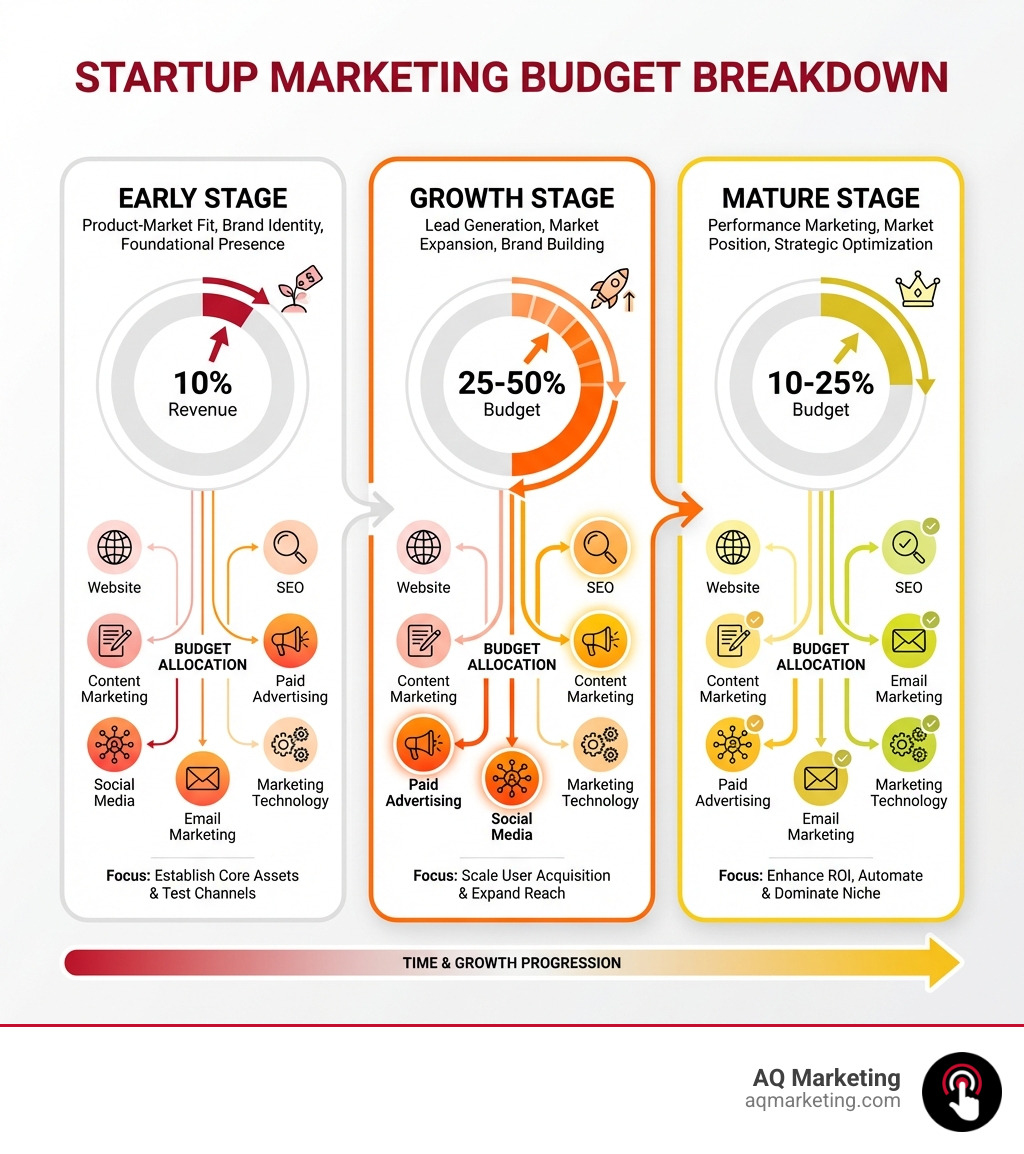
Marketing costs for a startup typically range from 10% to 20% of planned annual revenue. Here is a quick breakdown:
Early-Stage: $5,000-$10,000 monthly (~10% of revenue)
Growth-Stage: 25%-50% of total budget
SaaS Companies: 80%-120% of annual revenue (marketing + sales)
Industry Average: 9.4% of total revenue (2024 CMO Survey)
Core Budget Categories:
Website development and hosting
Search engine optimization (SEO)
Digital advertising (PPC, social media)
Content creation and email marketing
Marketing technology (MarTech)
Startups face unique challenges: limited revenue, uncertain market fit, and the need to build brand awareness from scratch. Research shows that underfunding marketing leads to stagnation, while overspending without strategy burns capital. The average marketing budget is around 9.5% of revenue, but startups often invest 10% to 20% to break through market noise.
As President and CEO of AQ Marketing, I have guided many startups through the complexities of marketing costs for a startup. My goal is to help you allocate your budget for maximum impact, from initial brand development to scaled growth.
Why a Strategic Marketing Budget is Essential for Growth
Starting a business in Massachusetts requires a clear understanding of your marketing costs for a startup. A budget is a strategic blueprint for reaching your audience and driving revenue. Here is why it is essential:
Resource Allocation: For startups with limited capital, a budget ensures you invest in the most effective channels rather than just spending.
Performance Measurement: By tracking spending against metrics like customer acquisition cost (CAC) and ROI, marketing becomes a data-driven science.
Brand Building & Research: Consistent messaging and market research provide insights that inform product development and market positioning, especially in competitive areas like Boston.
Scalability & Investor Attraction: A well-planned budget signals strategic growth, making your business more appealing to potential investors.
Customer Retention: Retaining customers is more cost-effective than acquiring new ones. Your budget should include loyalty strategies.
In the nascent phase, the focus is on proving your concept. Early-stage startups typically spend around 10% of planned annual revenue, or $5,000 to $10,000 monthly. This funds product-market fit research, core brand identity, and a foundational online presence to establish a foothold in local markets like Woburn, MA.
Scaling Marketing Costs for a Startup in the Growth Phase
Once you secure funding, it is time to accelerate. Companies often dedicate 25%-50% of their budget to marketing. For SaaS businesses, marketing and sales expenses can range from 80% to 120% of annual revenue. This investment fuels aggressive lead generation, market expansion, and widespread brand recognition.
Essential Components of a Startup Marketing Budget
Building a budget requires understanding the core components of marketing costs for a startup. Pricing listed is based on average online data and does not represent AQ Marketing’s actual pricing. Industry ranges vary widely; for example, while basic branding might average $500, high-end agency packages can exceed $1,500, or even $15,000 for comprehensive initiatives.
Website Development & Hosting: Your digital storefront.
Cost: Builders cost $15-$59/mo. Custom development ranges from $3,000 to $30,000+, depending on complexity. Hosting is $10-$100+/mo. AQ Marketing specializes in website design and development for small businesses.
Search Engine Optimization (SEO): Getting found organically.
Cost: Professional SEO services can cost $500 to $5,000+ per month. Our search engine optimization services focus on visibility for Massachusetts customers.
Social Media Marketing: Engaging your audience.
Cost: Organic is free; paid ads start at $100-$500/mo and can scale to $1,500+. We offer social media marketing services to craft engaging content.
Content Creation: Building authority.
Cost: Blog posts range from $50 to $500+; video production from $500 to $10,000+ per minute.
Email Marketing: Direct communication.
Cost: Platforms range from $15 to $150+ per month for paid plans.
Digital Advertising (PPC): Immediate visibility.
Cost: Ad spend often starts at $1,000/mo and can scale to $10,000+. Agency management fees are typically 10-20% of spend.
Marketing Technology (MarTech): Tools for efficiency.
Cost: CRM and automation tools range from $50 to $1,000+ per month.
Branding & Design: Visual identity.
Cost: Logo design ranges from $100 to $1,000+ for comprehensive packages.
Strategic Factors Influencing Your Marketing Costs for a Startup
Several factors influence the ideal marketing costs for a startup:
Sales Cycle Length: Long cycles (B2B) require more funds for lead nurturing and content. Short cycles (B2C) allow for direct-response ads.
Competitor Behavior & Market Saturation: Saturated markets like Boston demand higher budgets to cut through noise. Niche markets may allow for more modest spending.
Customer Acquisition Cost (CAC):Understanding your CAC helps determine profitable spend. If CAC is too high relative to lifetime value, the model is unsustainable.
Customer Lifetime Value (CLV): A high customer lifetime value justifies a higher upfront acquisition investment.
Retention & Switching Costs: High retention reduces acquisition pressure. High switching costs mean marketing must focus on superior value to overcome customer inertia.
Entry Barriers: High barriers offer stability once established, while low barriers require constant investment to defend market share.
By considering these factors, you can build a custom budget that supports your startup’s unique path.
Managing and Optimizing Your Marketing Spend
Effective management ensures every dollar spent on marketing costs for a startup contributes to growth.
Calculating and Managing Customer Acquisition Cost (CAC)
CAC is total marketing/sales expenses divided by new customers. If you spend $5,000 to get 50 customers, your CAC is $100. The goal is to keep CAC low relative to CLV. A 5:1 ratio is excellent. Making $5 for every $1 spent is generally considered a good ROI.
Marketing Team Structure
In-House: Offers deep product knowledge but can be expensive due to salaries and benefits.
Agency: Provides specialized expertise and tried-and-true tactics. Agencies like AQ Marketing deliver long-term results for industries like home services.
Set SMART Goals: Tie every activity to measurable outcomes.
Track Everything: Use analytics to monitor spend, traffic, and ROI.
Regular Reviews:Evaluate the results monthly. Reallocate funds from underperforming channels to successful ones.
Contingency Planning: Set aside 10-15% for unexpected opportunities or algorithm changes.
Leverage SEO & Content: These provide compounding returns over time, reducing long-term acquisition costs.
Frequently Asked Questions about Startup Marketing Costs
What percentage of revenue should a startup spend on marketing?
Most businesses allocate 5% to 10% of revenue. However, startups in a growth phase, especially in competitive areas like Boston, often spend 10% to 20%. SaaS companies may spend 80% to 120% of revenue on marketing and sales combined to fuel rapid expansion.
How do I calculate Customer Acquisition Cost (CAC)?
CAC = (Total Marketing & Sales Expenses) / (Number of New Customers Acquired)
Include ad spend, salaries, software, and agency fees. Aim for a Customer Lifetime Value (CLV) that is at least 3x your CAC for a sustainable business model.
What are the most cost-effective marketing channels for new businesses?
SEO: Provides long-term organic traffic and compounds in value.
Content Marketing: Establishes authority and can be repurposed across channels.
Email Marketing: High ROI because you own the audience.
Google Business Profile: Essential for local visibility in areas like Woburn, MA.
Referral Programs: Low-cost acquisition that leverages existing customer trust.
Conclusion
Navigating marketing costs for a startup can seem complex, but with a strategic approach, it becomes a powerful engine for growth. We’ve explored why a well-defined budget is essential, how it shifts across startup stages, the key components to include, and the strategic factors that influence our spending decisions.
Marketing isn’t just an expense; it’s an investment in our future. By carefully planning, diligently monitoring, and continuously optimizing our marketing efforts, we can ensure every dollar works hard to build our brand, attract customers, and drive sustainable growth.
At AQ Marketing, we understand the unique challenges faced by startups and small to medium-sized businesses in Massachusetts. Since 2003, we’ve specialized in helping companies improve their online presence and achieve long-term, impactful results. Whether you need a new website, robust SEO, engaging social media management, or targeted digital advertising, we’re here to help you make the most of your marketing budget.
Ready to transform your digital presence and achieve your business goals? Learn more about our comprehensive digital marketing services and let us help you build a marketing strategy that delivers.