Why Email Marketing Delivers the Highest ROI for Small Businesses
Effective email marketing for small businesses on a budget consistently outperforms nearly every other digital marketing channel. By focusing on strategic foundations rather than high-cost tools, businesses can achieve remarkable growth.
Strategic Foundations:
- Platform Selection: Use affordable platforms that offer robust features for growing subscriber lists.
- Organic List Growth: Focus on capturing leads through website integration and social media touchpoints.
- Audience Segmentation: Group subscribers by interests or purchase history to ensure relevance.
- Workflow Automation: Implement essential sequences like welcome series and follow-ups to save time.
- Performance Tracking: Monitor key metrics to refine your strategy and maximize results.
Why Email Marketing Works:
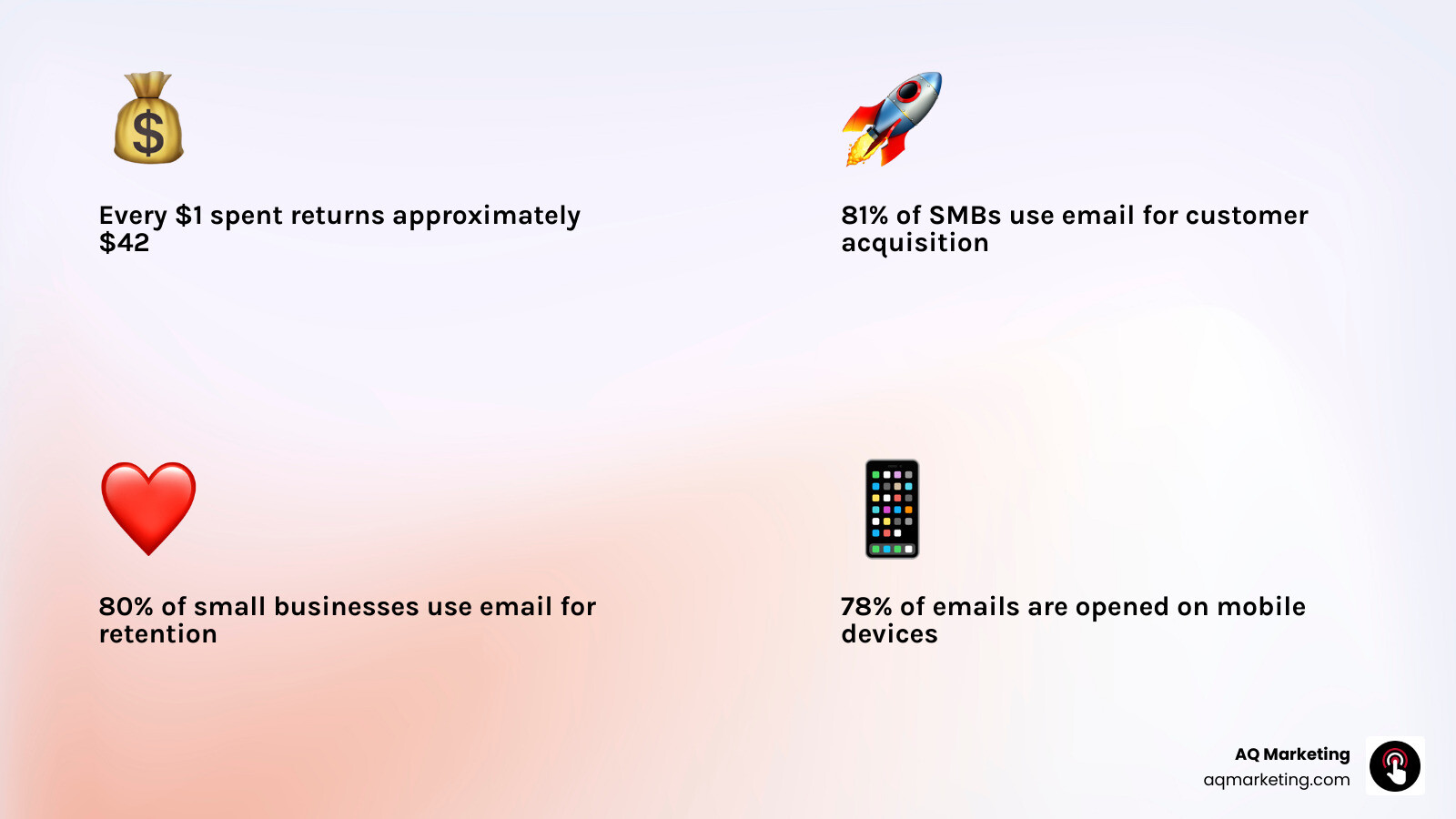
- Exceptional ROI: Every $1 spent returns approximately $42
- Direct Access: Your message lands in subscribers’ inboxes without algorithms blocking visibility.
- Customer Retention: 80% of small businesses use email to retain customers.
- Mobile-Friendly: 78% of people check email on their phones daily.
I’m Robert P. Dickey, President and CEO of AQ Marketing. Over my 20+ years in digital marketing, I’ve helped countless small businesses implement effective email marketing for small businesses on a budget that drives real revenue growth. Whether you’re managing a home services company, an insurance agency, or a fitness studio, these strategies will help you compete effectively.
Quick effective email marketing for small businesses on a budget definitions:
- how to create marketing budget
- cost effective marketing strategies
- digital marketing cost for small business
Why Effective Email Marketing for Small Businesses on a Budget is a Growth Engine
Email marketing is a foundational strategy for sustainable growth, offering unparalleled cost-effectiveness and direct access to your audience. For small businesses in Massachusetts, from Acton to Yarmouth, it provides a way to drive measurable results without a hefty upfront investment.
With a return on investment (ROI) close to $42 for every dollar spent, email is a powerhouse for customer acquisition and retention. In fact, 81% of small to medium-sized businesses rely on email as their primary acquisition channel. Unlike social media, where shifting algorithms can limit visibility, email ensures your message lands directly in the inbox of interested individuals. For more insights on leveraging digital tools, explore our guide on How Digital Marketing Helps Small Business.
To harness this power, businesses must set clear objectives:
- Audience Definition: Identify who you are sending to, such as first-time visitors or loyal customers.
- Actionable CTAs: Define exactly what action recipients should take.
- Value Proposition: Clearly articulate the benefits subscribers receive for engaging.
Core Benefits of Strategic Email Marketing
- Universal Reach: 99% of consumers check their email daily, providing a massive opportunity for visibility.
- Relationship Building: Email fosters a personal connection that builds long-term loyalty and trust.
- Ownership: You own your email list, meaning you aren’t at the mercy of third-party platform changes.
- High Retention: Strengthening relationships through email reduces churn and encourages repeat purchases.
- Sales Impact: Transactional emails can generate significantly more revenue than standard messages.
Strategic List Building and Audience Segmentation
Building a robust email list is about gathering contact information from people genuinely interested in your services. For effective email marketing for small businesses on a budget, understanding your audience is the first step toward sending relevant messages.
Identifying Your Target Audience
- Problem Solving: Pinpoint the specific problems your business solves and who experiences them.
- Competitive Analysis: Identify which segments are being targeted in your industry to find untapped opportunities.
For example, a law firm in Salem, MA, might target local residents for estate planning while focusing on contract review for business owners. Our guide on Email Marketing for Small Law Firms offers specific insights into these distinctions.
Essential List Building Strategies
- Optimized Sign-Up Forms: Place forms prominently in website headers and footers. Experiment with exit-intent triggers to capture visitors before they leave.
- Social Media Integration: Use your organic social channels to drive sign-ups by offering exclusive insights or rewards.
- Event Lead Capture: Use digital tools like QR codes at local events or trade shows to integrate registration with your mailing list.
- Value Exchange: Offer educational resources, such as a local guide or checklist, in exchange for an email address.

The Power of Segmentation
Segmentation allows you to deliver the right message to the right person. You can segment based on:
- Demographics: Location (e.g., Plymouth vs. Peabody, MA) or age.
- Purchase History: Distinguishing between first-time buyers and loyal customers.
- Engagement Level: Identifying active subscribers versus those who haven’t engaged recently.
Personalization goes beyond using a name; it involves tailoring content to these specific segments. This strategy is a key part of how we help clients ensure The Early Bird Gets the Leads.
Automation, Drip Campaigns, and Mobile Optimization
Efficiency is vital for small businesses. Email automation allows you to set up sequences that send automatically based on triggers, ensuring consistent communication without manual effort. This is a core component of our Digital Marketing Services for Small Businesses.
Scaling Results with Automation
Automated emails often see significantly higher open and click-through rates than standard messages. Key automated sequences include:
- Welcome Emails: Make a great first impression the moment someone joins your list.
- Promotional Emails: Drive sales through timed offers and value-driven announcements.
- Transactional Emails: Use order confirmations and shipping notifications to showcase brand personality and cross-sell.
- Abandoned Cart Reminders: Gently nudge customers back to complete their purchases.
- Re-engagement Campaigns: Reach out to inactive subscribers with special offers before they churn.
Mobile Optimization is Essential
With up to 78% of email opens occurring on mobile, your design must be responsive.
- Responsive Templates: Use layouts that adjust automatically to screen size.
- Scannable Design: Use single-column designs, large fonts, and plenty of white space.
- Concise Content: Get straight to the point with clear subheadings and bullet points.
Crafting Engaging Content
Your subject line is your first impression. Create urgency, offer value, and keep it concise to encourage opens. For the body content, focus on a singular, clear Call-to-Action (CTA). Reducing the number of choices can significantly increase your click-through rates. Finally, experiment with frequency to find the balance that keeps you top-of-mind without overwhelming your audience.
Measuring Success and Choosing Affordable Platforms
To ensure effective email marketing for small businesses on a budget, you must track performance and adapt. Key metrics include:
- Open Rate (OR): Measures the effectiveness of your subject lines.
- Click-Through Rate (CTR): Indicates how engaging your content and CTAs are.
- Conversion Rate: The ultimate measure of ROI for your campaigns.
- Bounce and Unsubscribe Rates: Help monitor list health and content relevance.
Regularly cleaning your list and implementing authentication protocols like DMARC and DKIM will improve deliverability. Analyzing these results allows for continuous improvement through A/B testing of subject lines and layouts.
Leveraging Strategic Partnerships
Partnerships are a budget-friendly way to expand reach. For example, a florist in Concord, MA, might partner with a local wedding planner to cross-promote to each other’s lists, exposing both brands to relevant new audiences without high advertising costs.
Comparing Affordable Email Marketing Platforms
When choosing a platform, look for user-friendly interfaces, basic automation, and clear reporting.
Please note: Pricing listed below is based on average online data at the time of research and does not represent AQ Marketing’s actual pricing. Actual costs can vary widely depending on features, subscriber count, and email volume.
| Platform Tier | Typical Free Offering | Starting Price (approx.)* | Key Features |
|---|---|---|---|
| Starter | Up to 500 contacts | $15 – $65 per month | Drag-and-drop editor, basic templates, standard reporting. |
| Growth | Up to 1,500 contacts | $40 – $180 per month | Advanced automation, A/B testing, multi-step journeys. |
| Professional | Up to 5,000 contacts | $95 – $450 per month | CRM integration, AI-driven insights, dedicated support. |
Upgrading to a paid plan is typically necessary when your subscriber count grows or when you require advanced features like deeper analytics and removed third-party branding.
Frequently Asked Questions about Small Business Email Marketing
How often should a small business send marketing emails?
Finding the right cadence is a strategic balance. While some industries thrive on weekly updates, others find success with bi-weekly or monthly newsletters. The key is consistency and value. If you have meaningful updates, promotions, or insights to share, your audience will welcome the communication. Monitoring engagement metrics like unsubscribe rates will help you fine-tune the frequency for your specific Massachusetts audience.
What are the best times to send emails for high engagement?
Engagement patterns often vary by industry and target demographic. Generally, mid-week mornings (Tuesday through Thursday) see higher open rates as professionals settle into their routines. However, for B2C businesses in areas like Cape Cod or the Berkshires, weekend mornings might capture more attention. We recommend testing different send times to identify when your unique subscriber base is most active.
Automation, Drip Campaigns, and Mobile Optimization
For small businesses, efficiency is key, and that’s where email automation and drip campaigns truly shine. We understand that our clients, from Agawam to Woburn, are busy running their businesses, not spending all day sending emails. Email automation helps free up time so you can focus on higher-impact growth initiatives while still keeping communication consistent. This is a core part of our Digital Marketing Services for Small Businesses.
Scaling Results with Effective Email Marketing for Small Businesses on a Budget
Email automation and drip campaigns work like an always-on communication system. They help you send timely, relevant messages based on customer behavior so your outreach stays consistent without requiring constant manual effort. Automated emails have a 70.5% higher open rate than standard marketing messages, along with a 152% higher click-through rate.
Here are some of the most effective email types for small businesses, many of which can be automated within common email platforms:
- Welcome Emails: When someone subscribes, a welcome email should arrive quickly. Welcome emails often earn strong engagement, making them ideal for setting expectations, introducing your brand, and guiding subscribers to the next step.
- Promotional Emails: These support sales and awareness by highlighting offers, seasonal services, or new products. Promotional cadence varies by industry, so it is best to align frequency with subscriber preferences and engagement data.
- Transactional Emails: These are triggered by customer actions like order confirmations, appointment confirmations, or shipping notifications. They are among the most opened email types and are a strong opportunity to reinforce trust, provide helpful next steps, and add relevant cross-sell context.
- Abandoned Cart Emails: For ecommerce, these reminders help recover lost revenue by nudging customers to complete checkout.
- Re-engagement Campaigns: For subscribers who have not opened emails recently, a short sequence can help you win back attention with a strong value offer or updated preferences before you consider suppressing or removing them.
Mobile Optimization is Non-Negotiable:
Up to 78% of email opens occurred on mobile in 2023. If your emails are not mobile-friendly, you risk losing engagement from a large share of your list. Achieving this on a budget is usually straightforward:
- Responsive Templates: Most email platforms provide responsive templates that adjust to different screen sizes.
- Clean and Scannable Design: Keep layouts simple (often single-column), use readable font sizes, and leave sufficient white space.
- Optimized Images: Use high-quality, royalty-free images and compress them so emails load quickly.
- Concise Content: Mobile readers prefer short sections with clear headings and bullet points.
Crafting Compelling Subject Lines and Engaging Content:
Your subject line is the first gate to performance. Strong subject lines typically communicate clear value, spark curiosity, or reflect relevance to the recipient.
- Focus on relevance and value: Make the benefit clear.
- Use personalization thoughtfully: Reference interests or past engagement when appropriate.
- Keep it concise: Shorter subject lines display better on mobile screens.
For the email body, clarity wins.
- Be scannable: Short paragraphs, bullet lists, and clear subheadings.
- Use a single primary CTA: Fewer choices often improve clicks.
- Match the message to the segment: Segmentation should influence both the offer and the wording.
Finding the right email frequency:
The goal is to stay top-of-mind without overwhelming subscribers. Rather than following a one-size-fits-all number, set a consistent schedule you can maintain, then refine using engagement metrics like opens, clicks, conversions, and unsubscribes.
Conclusion
At AQ Marketing, we’ve spent over two decades helping businesses in Woburn, MA, and across the state steer the complexities of digital growth. Implementing effective email marketing for small businesses on a budget is not just about sending messages; it’s about building lasting relationships and driving measurable results. By focusing on strategic list building, personalized segmentation, and automated workflows, you can compete effectively in today’s digital landscape.
Whether you are looking to improve your SEO, redesign your website, or implement advanced lead generation workflows, our team is dedicated to delivering long-term, impactful results. Ready to transform your digital strategy? More info about digital marketing for small business can help you take the next step toward sustainable growth.