
Web Design for Contractors: 7 Powerful Tips for Success 2025
Building a Digital Foundation: Why Contractor Websites Matter
Web design for contractors is essential for establishing credibility and generating qualified leads in today’s digital-first marketplace. Here’s what makes an effective contractor website:
- Mobile-responsive design – 63% of organic search visits come from mobile devices
- Fast loading speed – 40% of visitors abandon sites that take over 3 seconds to load
- Clear calls-to-action – Guide potential clients to contact you
- High-quality project photos – Showcase your craftsmanship
- Customer testimonials – Display reviews to boost sales by up to 380%
- Service-specific pages – Establish authority in your specialty areas
Contrary to popular belief, word-of-mouth alone doesn’t cut it anymore. With 97% of consumers searching online to find local businesses, your website serves as your 24/7 digital salesperson. A professionally designed contractor website builds trust through personal storytelling while showcasing your unique value and craftsmanship.
When potential clients visit your site, they form an impression in just 50 milliseconds. That first impression can be the difference between securing a new project or losing business to a competitor with a more polished online presence.
The stakes are high: A well-designed contractor website can increase conversions by an average of 358% compared to outdated sites, while also generating 35% more online traffic.
I’m Robert P. Dickey, President and CEO of AQ Marketing, and I’ve spent over two decades helping contractors develop effective web design for contractors that drive measurable results and business growth. Let me show you how to hammer out a website that works as hard as you do.
Why Every Contractor Needs a Professional Website
Your reputation in the construction industry is everything. But these days, that reputation begins online long before you ever set foot on a job site. At AQ Marketing, we’ve watched countless contractors transform from local businesses into recognized authorities in their field—all because they invested in professional web design for contractors.
Think of your website as your hardest-working employee—a tireless salesperson who never sleeps, takes vacations, or calls in sick. While you’re hanging drywall, rewiring a kitchen, or installing new plumbing, your website is simultaneously educating potential clients, showcasing your craftsmanship, and collecting leads that turn into real projects.
The numbers tell the story: 3 out of 4 people now use the internet to find local services, and a whopping 91% of that traffic goes to businesses on the first page of search results. Without a strong online presence, you’re essentially invisible to these potential customers—like having a truck with no signage parked behind a building where nobody can see it.
For our contractor clients across Massachusetts and Southern New Hampshire, we’ve seen dramatic increases in conversion rates when upgrading from outdated websites to professionally designed platforms that truly reflect the quality of their work.
The Cost of Neglecting Your Site
What does a neglected website say to potential clients? The same thing that showing up to an estimate in a messy truck would—you don’t pay attention to details.
The real cost goes far beyond bad first impressions. A one-second delay in your website’s loading time can reduce conversions by 7%. Even more alarming, 40% of visitors will abandon a site that takes more than three seconds to load. For a contractor generating $50,000 per day in business, that one-second delay could cost $1.28 million in lost opportunities annually.
Many contractors try DIY website builders thinking they’ll save money. The truth is, these cookie-cutter solutions often create generic sites that blend in rather than stand out. It’s like building a deck with the cheapest lumber from the big box store—it might function, but nobody’s going to be impressed by it.
One contractor told us after switching from their DIY site: “If ours was not a regional business, I’m not sure I’d be writing this review… I wouldn’t want the local competition to get the same results!” That’s how dramatic the difference was.
The Trust Factor: Storytelling that Sells
When services and pricing are similar (and let’s be honest, clients often think they are), what makes someone choose one contractor over another? Trust.
Effective web design for contractors weaves your personal story throughout the site, building the same level of confidence that comes from a personal referral. Your website should tell visitors who you are—how you started in the business, what drives your commitment to quality, and why you’re different from every other contractor in your service area.

This storytelling approach creates an emotional connection that generic “on time and on budget” messaging simply can’t match. When we redesigned a roofing contractor’s website in Woburn, MA, we highlighted the owner’s three-generation family history in the business and their deep roots in the local community. The result? Qualified leads increased by 42% in just three months.
Your website should work like a trusted friend making a recommendation—conveying your values, showcasing your craftsmanship, and demonstrating your reliability before the prospect ever picks up the phone to call you.
Essential Elements: Web Design for Contractors That Convert
Let’s talk about what actually turns website visitors into clients who call you for jobs. After nearly two decades of building contractor websites at AQ Marketing, we’ve finded what truly works to fill your calendar with quality leads.
Speed matters more than you might think. When your site takes more than three seconds to load, you’re literally watching 40% of your potential customers click away. We make sure every contractor website we build loads lightning-fast by optimizing images, streamlining code, and selecting hosting that won’t slow you down when traffic spikes.
Mobile responsiveness isn’t just a nice-to-have anymore—it’s absolutely critical. Think about how you use your own phone on job sites. With 63% of organic search visits now coming from mobile devices, your website needs to work flawlessly on everything from iPhones to tablets. This means buttons large enough to tap with work-calloused fingers, text you can read without squinting, and forms that don’t make people throw their phone in frustration.
We’ve found that strategic white space dramatically improves how people interact with your site. It’s not empty space—it’s breathing room that makes your content easier to digest and can boost readability by up to 20%. Just like you wouldn’t cram too many fixtures in a small bathroom, we don’t overcrowd your web pages.
Hero images are the digital equivalent of your showroom. These large, impressive photos of your best work need to be front and center—visible before anyone has to scroll. They instantly communicate the quality of your craftsmanship in a way words simply can’t.
Clear calls-to-action guide visitors toward becoming leads. Whether it’s “Get Your Free Estimate,” “Schedule a Consultation,” or “View Our Recent Projects,” these buttons should stand out and make the next step crystal clear. Think of them as signposts guiding potential clients through your website.
Want to learn more about making your website work perfectly across all devices? Check out our Responsive Web Design Services.
Must-Have Visuals & Social Proof
In the contracting business, seeing really is believing. High-quality project photos aren’t optional—they’re essential. They’re the digital handshake that builds initial trust. Professional photography is ideal, but even smartphone photos can work wonders if they’re well-lit and showcase your attention to detail.
A thoughtfully organized project gallery helps potential clients quickly find examples relevant to their specific needs. For remodelers, before-and-after comparisons are gold—they visually tell the story of the change you can deliver.
Nothing builds confidence like social proof. When a prospective client sees that others have trusted you with their homes and been delighted with the results, it dramatically reduces their perceived risk. Here’s what works best:
- Client testimonials with full names and locations (photos of happy clients are even better)
- Trust badges showing your insurance coverage, certifications, and professional memberships
- Embedded Google reviews that update automatically as new ones come in
- Detailed case studies that walk through challenging projects you’ve completed
The numbers don’t lie—displaying reviews can boost your conversion rates by an impressive 380%. Today’s homeowners trust online reviews almost as much as recommendations from their neighbors.
Web design for contractors should incorporate white space strategically around these elements to make them pop. Scientific research on whitespace readability confirms what we’ve seen in practice—proper spacing improves how well visitors understand and engage with your content.
Web Design for Contractors on Mobile
Let’s be honest—your potential customers are probably scrolling through their phones while sitting on their couch, thinking about that kitchen remodel or roof repair they need. With 63% of organic search visits now happening on mobile devices, your website needs to shine on smartphones.
Web design for contractors should start with mobile users in mind from day one. This “mobile-first” approach ensures that the most critical elements—your phone number, service descriptions, and contact forms—are immediately accessible to someone browsing on a smaller screen.
Think about how you actually hold and use your own phone. Your website needs thumb-friendly design, which means:
Navigation buttons large enough to tap without zooming in. Phone numbers that call you instantly when tapped (no copying and pasting required). Forms with minimal fields and plenty of space to type. And enough room between clickable elements so visitors don’t accidentally tap the wrong thing with their thumb.
Speed becomes even more crucial on mobile. Many of your potential clients in Middlesex County, Essex County, and throughout the Merrimack Valley are searching for contractors while on cellular connections, not high-speed wifi. Tools like Pingdom can help you measure your site’s loading time and identify what’s slowing things down.
A mobile-friendly contractor website isn’t just about looking good—it’s about making it ridiculously easy for homeowners to contact you before they move on to the next contractor in their search results.
SEO, Speed & Content: Turning Clicks into Qualified Leads
Even the most beautiful contractor website won’t generate business if nobody can find it. That’s where search engine optimization comes in—especially local SEO for contractors serving specific communities.
We’ve seen how proper SEO transforms business for contractors in Boston, Woburn, and throughout New England. Our comprehensive approach includes local keyword optimization targeting your specific service areas, complete Google My Business setup, and schema markup that helps search engines understand exactly what services you offer and where you provide them.
“My phone started ringing within two weeks of the site launch,” one of our roofing clients told us. “And these weren’t just any calls—they were from my exact target customer in my preferred service area.”
Creating individual, detailed pages for each service you offer serves two critical purposes. First, it allows you to target specific keywords related to that service. Second, it gives potential clients the in-depth information they need about your expertise in that particular area. A general contractor with a single “Services” page simply can’t compete with one who has dedicated pages for kitchen remodels, bathroom renovations, and home additions.
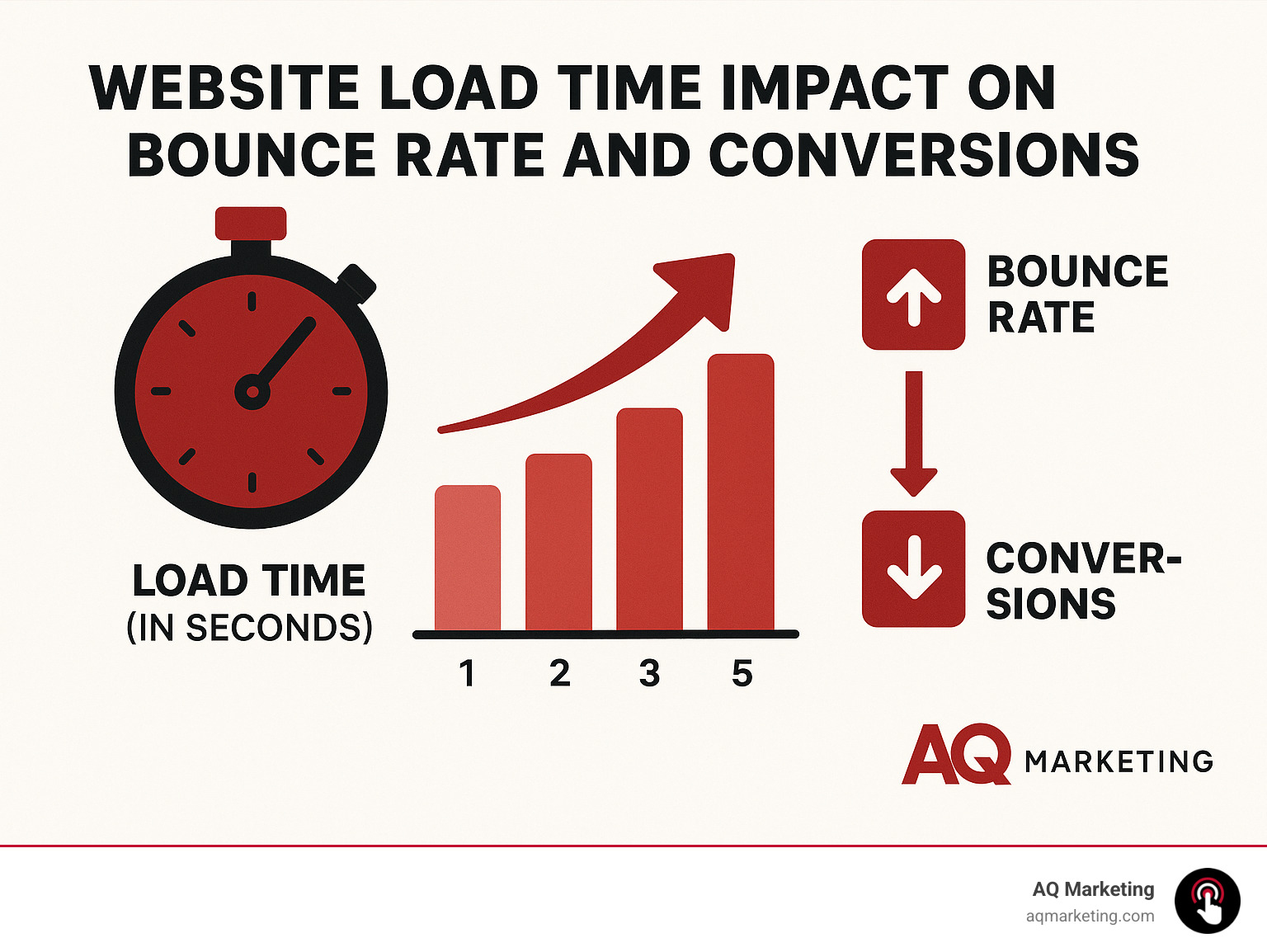
When it comes to page speed, every second counts—literally. Google’s research shows that as page load time increases from one to three seconds, the probability of bounce increases by 32%. That’s why we target a maximum two-second load time for all web design for contractors projects.
For more information about how we integrate custom website design with powerful SEO strategies, visit our Custom Website Design and SEO page. You can also check out these eye-opening website load-time statistics to understand just how critical speed is to your online success.
Structuring Pages to Pre-Qualify Leads
Not all leads are created equal. The best contractor websites do more than just generate inquiries—they pre-qualify potential clients, saving you precious time and resources by filtering out projects that aren’t a good fit.
We design pages that clearly communicate your specialties and parameters. This includes clear service area maps showing exactly where you work, minimum project thresholds stated upfront (like “We specialize in kitchen remodels starting at $25,000”), and detailed project galleries that set realistic expectations for quality and style.
A well-crafted FAQ section addressing common questions about timing, process, and payment terms can also help visitors self-qualify before reaching out.
When it comes to estimate forms, there’s a delicate balance to strike:
| Short-Form Approach | Long-Form Approach |
|---|---|
| Quick to complete | More detailed information |
| Higher completion rate | Better lead qualification |
| Less insight into project scope | Clear budget expectations |
| May require follow-up to qualify | Saves time on initial consultation |
| Good for high-volume services | Better for complex projects |
For most contractors in Massachusetts and Southern New Hampshire, we’ve found that a balanced approach works best—a simple initial contact form followed by a more detailed project questionnaire sent after the first touch. This gives you enough information to prepare for a productive first conversation without scaring off potential clients with an intimidating form.
Content Refresh & Blog Strategy
Fresh, relevant content signals to both search engines and potential clients that your business is active and current. For contractors, this means regularly updating your project portfolios, team information, service offerings, and client testimonials.
“Think of your website like your truck,” I often tell clients. “You wouldn’t drive a vehicle that hasn’t been serviced in years, so why would you expect your website to perform without regular maintenance?”
The most successful web design for contractors includes a blog strategy custom to the seasonal nature of contracting work. This approach drives significant traffic and leads by addressing timely concerns. A roofing contractor might focus on spring inspection tips after winter weather, energy-efficient options during summer, preparation advice in fall, and emergency repair information during winter.
Creating an editorial calendar ensures consistent posting, while internal linking between related content helps visitors steer to your service pages where conversions happen. One electrical contractor we work with saw a 27% increase in service page visits after implementing a strategic blog plan with seasonal content that naturally led readers to relevant service offerings.
By refreshing your content regularly and maintaining a strategic blog, you’ll not only improve your search rankings but also position yourself as the helpful expert that homeowners turn to when they need a contractor they can trust.
Maintenance, Analytics & ROI Tracking
Your contractor website isn’t a “set it and forget it” project—it’s a living, breathing business asset that requires ongoing care. Think of website maintenance like you would regular equipment maintenance: neglect it, and you’ll eventually face costly breakdowns when you least expect them.
At AQ Marketing, we’ve seen how proper maintenance transforms a good contractor website into a great one that consistently delivers leads year after year. Our comprehensive maintenance approach includes regular security updates, data backups, performance monitoring, and fresh content updates that keep your site relevant to both search engines and potential customers.
The numbers tell the compelling story of well-maintained contractor websites. Our clients typically experience an impressive 358% increase in conversions compared to their previous outdated sites. This dramatic improvement isn’t magic—it’s the result of strategic design paired with consistent optimization based on real user data.

When a roofing contractor in Middlesex County came to us with an outdated site, they were skeptical about investing in ongoing maintenance. Six months later, their lead volume had doubled, with the quality of those leads significantly improved. “I’m not just getting more calls,” they told us, “I’m getting the right calls.”
For more details about our comprehensive approach to website development and ongoing care, check out our Web Design and Development Services page.
Tools & Processes for Ongoing Success
Behind every successful contractor website is a robust set of tools and processes that keep things running smoothly. Think of these as the scaffolding that supports your digital presence.
Regular CMS updates are non-negotiable in today’s security-conscious world. When platforms like WordPress release updates, we implement them promptly to protect your site from vulnerabilities that hackers love to exploit. For contractors handling sensitive client information, this protection is particularly crucial.
Uptime monitoring serves as your digital watchdog, alerting us immediately if your site goes down for any reason. This quick response capability means potential leads won’t encounter a “site not found” message when they’re ready to request your services at 9 PM on a Sunday.
Heatmap analysis gives us fascinating insights into how visitors actually use your site. By visualizing where users click, how far they scroll, and which elements catch their attention, we can continually refine your site for better performance. One electrical contractor finded through heatmap analysis that visitors were repeatedly clicking on non-clickable images of completed projects—we quickly transformed these into an interactive portfolio that increased engagement by 43%.
Monthly reporting keeps you in the loop without overwhelming you with data. We distill complex analytics into actionable insights, showing exactly how your website is contributing to business growth. For busy contractors focused on running their business, this clarity is invaluable.
Measuring Success of Web Design for Contractors
How do you know if your investment in web design for contractors is actually paying off? It’s all about tracking the right metrics and understanding what they mean for your bottom line.
Traffic metrics tell you who’s finding your site and how they’re getting there. We track organic search traffic (people finding you through Google), direct traffic (people typing your URL directly), referral traffic (visitors from other websites), and social media traffic to build a complete picture of your online visibility.
But traffic alone doesn’t pay the bills—leads do. That’s why we focus on lead metrics: form submissions, phone calls generated from the website, average project value, and overall conversion rates. A Boston-area general contractor was thrilled to find that while his total lead count remained similar after his website redesign, the average project value had increased by 22% because the new site better communicated his high-end capabilities.
Calculating ROI for your contractor website is straightforward but powerful:
ROI = (Value of Leads - Cost of Website) / Cost of Website × 100
Speed matters tremendously in this equation. A mere one-second delay in page loading can reduce conversions by 7%—potentially costing thousands in lost revenue for busy contractors. This makes regular performance optimization not just a technical concern but a direct profit driver.
For contractors serving communities throughout Massachusetts and Southern New Hampshire, we provide these analytics as part of our ongoing service relationship, ensuring you always know exactly how your digital investment is performing in real dollars and cents.
Frequently Asked Questions about Contractor Websites
Why do contractors need a website?
Remember when a business card and a Yellow Pages listing were enough to keep your schedule full? Those days are long gone. Today’s homeowners start their contractor search online, making a website your most powerful business tool.
Your website serves as your tireless digital employee—working 24/7 to showcase your craftsmanship while you’re busy on job sites or enjoying time with family. It’s always ready to impress potential clients, even at 2 AM when inspiration strikes and they’re browsing renovation ideas.
Web design for contractors builds the credibility that today’s cautious consumers demand. Think about it—would you hire someone to remodel your kitchen if they didn’t have a professional online presence? Neither would 97% of consumers who search online for local businesses.
Unlike a brochure or business card with limited space, your website provides unlimited real estate to display your best work. Those kitchen renovations, bathroom remodels, and custom decks tell your story in vivid detail, showing (not just telling) what sets your craftsmanship apart.
One of our roofing contractors in Merrimack Valley put it perfectly: “My website has become my best salesperson—it educates clients before I even meet them and sets the right expectations for our working relationship.”
Perhaps most valuable is how a strategic website pre-qualifies leads, saving you from wasting time on projects that aren’t a good fit. When your minimum project thresholds and service areas are clearly communicated, the phone calls and form submissions you receive are more likely to become profitable jobs.
How important is mobile responsiveness?
If your contractor website isn’t mobile-friendly in 2023, you might as well be invisible to most potential customers. That sounds harsh, but the numbers don’t lie.
A whopping 63% of organic search visits now come from smartphones and tablets. Think about how you use your own phone—checking reviews while waiting for coffee, browsing service providers during lunch breaks, or searching for emergency repair help when disaster strikes at home.
Google now uses mobile-first indexing, which means they primarily look at the mobile version of your site when deciding how to rank you in search results. A clunky, hard-to-steer mobile experience doesn’t just frustrate users—it actively hurts your visibility online.
Web design for contractors must prioritize the mobile experience because that’s where your customers are. When someone has to pinch and zoom just to tap your phone number or fill out your contact form, you’ve likely lost them to a competitor whose site works seamlessly on their device.
The impact goes beyond just lost leads. About 57% of users say they won’t recommend a business with a poorly designed mobile site, turning potential word-of-mouth opportunities into negative impressions.
At AQ Marketing, we build every contractor website with a mobile-first mindset. This isn’t just about shrinking your desktop site—it requires fundamentally rethinking navigation, content presentation, and user interaction for smaller screens and touch interfaces.
What is the typical web design process for contractors?
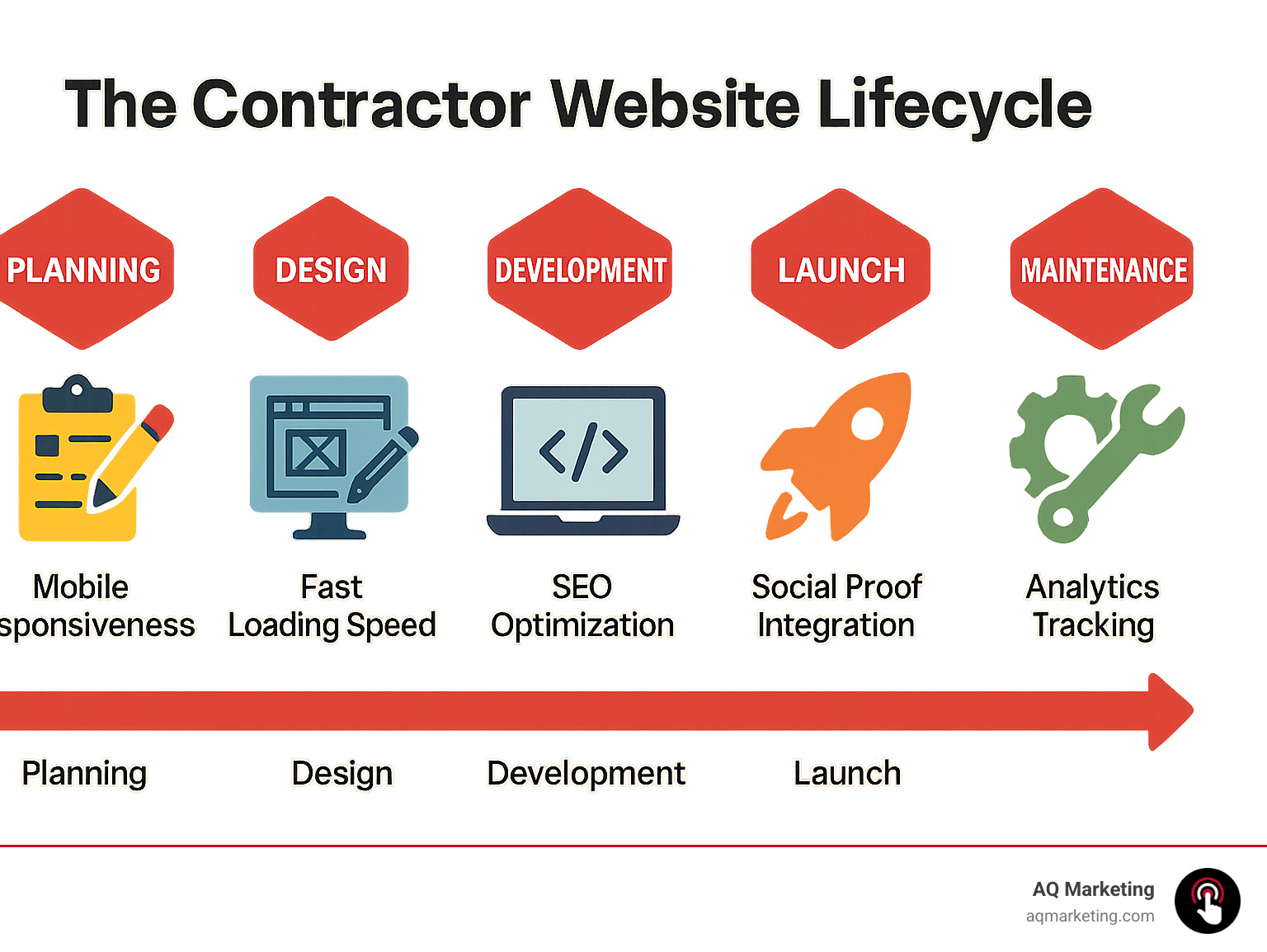
Creating a website that actually generates leads for your contracting business isn’t a weekend project—it’s a structured process that typically unfolds over 4-6 weeks. Here’s what to expect when working with professionals:
We start with a thorough findy and planning phase. This is where we get to know your business inside and out—your services, ideal customers, geographic reach, and what makes your work special. It’s like measuring twice before cutting once on a construction project.
Next comes sitemap and wireframing, where we outline the structure of your site and create basic layouts focused on guiding visitors toward contacting you. Think of this as the blueprint stage of your digital home.
The visual design phase is where your site starts coming to life. Our designers develop custom mockups incorporating your branding and showcasing your craftsmanship through carefully selected images and color schemes that resonate with your target audience.
Content development happens concurrently—either working with material you provide or creating fresh copy that tells your story, explains your services, and includes relevant keywords for better search visibility.
During development, our team builds your responsive website with careful attention to performance, security, and functionality—making sure everything works flawlessly across all devices.
Thorough testing and review follows, where we check your site on multiple devices and browsers, making adjustments based on your feedback until everything is perfect.
The launch and training stage is when your new site goes live, and we show you how to handle basic updates like adding new project photos or testimonials as you complete more jobs.
Finally, we provide ongoing support with maintenance, analytics reporting, and optimization to ensure your site continues performing at its best year after year.
This process ensures that your website isn’t just a digital brochure but a hardworking lead generation tool that reflects the same quality and attention to detail you bring to your contracting work.
Conclusion & Next Steps
Creating an effective website for your contracting business isn’t just about having an online presence—it’s about building a powerful lead generation tool that works around the clock to attract and pre-qualify potential clients. As we’ve seen, web design for contractors requires strategic planning, thoughtful execution, and ongoing optimization to deliver the best possible return on investment.
At AQ Marketing, we’ve spent over 20 years helping contractors throughout Boston, Woburn, Middlesex County, Essex County, Merrimack Valley, and Southern New Hampshire develop websites that not only look professional but actually drive business growth. Our approach combines aesthetic design with practical functionality, ensuring your site reflects the quality of your craftsmanship while converting visitors into qualified leads.
Remember these key takeaways:
- Mobile responsiveness is non-negotiable with 63% of searches coming from mobile devices
- Page speed directly impacts conversions—aim for under two seconds
- Social proof in the form of testimonials and reviews can boost sales by up to 380%
- Strategic content and service pages help establish authority and pre-qualify leads
- Regular maintenance and analytics tracking protect your investment and maximize ROI
Ready to hammer out a website that works as hard as you do? Here’s your action plan:
- Schedule a free website audit to identify opportunities for improvement
- Define your unique value proposition that sets you apart from competitors
- Gather high-quality project photos that showcase your best work
- Collect testimonials from satisfied clients
- Partner with AQ Marketing for a website designed to generate qualified leads
Contact us today to schedule a no-obligation consultation and website review. We’ll show you exactly how our proven approach to web design for contractors can help you build a stronger online presence and grow your business.
For more information about our comprehensive digital marketing services, visit our digital marketing services page.