Why Now Is the Right Time to Open a Marketing Agency
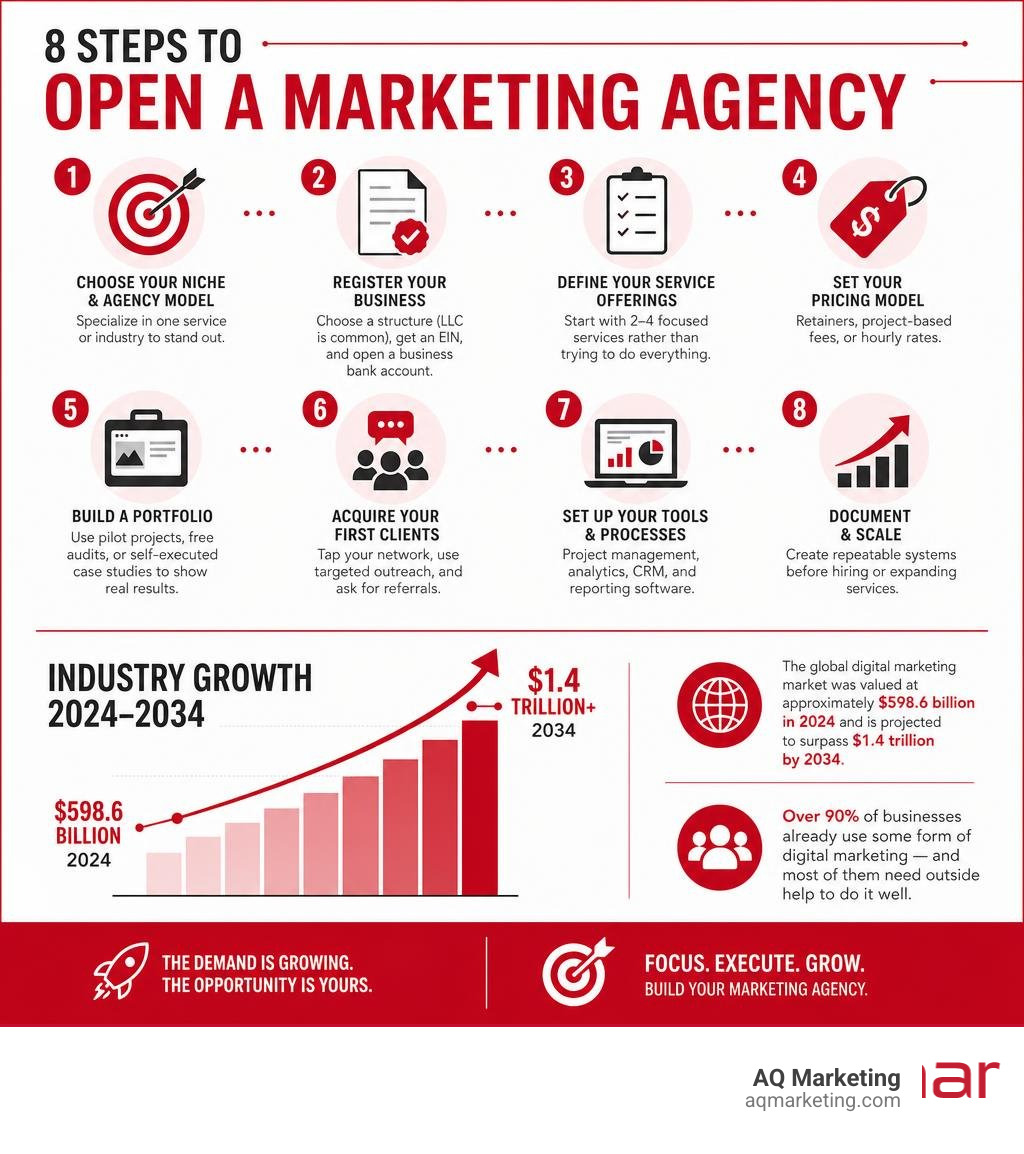
Knowing how to open a marketing agency is one of the most valuable skills an entrepreneur can develop right now. The global digital marketing market was valued at approximately $598.6 billion in 2024 and is projected to surpass $1.4 trillion by 2034. Over 90% of businesses already use some form of digital marketing — and most of them need outside help to do it well.
Here is a quick overview of the core steps to open a marketing agency:
- Choose your niche and agency model — specialize in one service or industry to stand out
- Register your business — choose a legal structure (LLC is common), get an EIN, and open a business bank account
- Define your service offerings — start with 2-4 focused services rather than trying to do everything
- Set your pricing model — retainers, project-based fees, or hourly rates
- Build a portfolio — use pilot projects, free audits, or self-executed case studies to demonstrate results
- Acquire your first clients — tap your existing network, use targeted outreach, and ask for referrals
- Set up your tools and processes — project management, analytics, CRM, and reporting software
- Document and scale — create repeatable systems before hiring or expanding services
The barrier to entry has never been lower. Many agencies launch from a home office with a laptop, a few software subscriptions, and a focused service offering.
I’m Robert P. Dickey, President and CEO of AQ Marketing, Inc., and I’ve spent over 20 years helping small and medium-sized businesses grow through digital marketing — experience that taught me what it really takes to build and sustain a successful agency. Understanding how to open a marketing agency the right way, from legal setup to client acquisition, is exactly what this guide is designed to help you do.
Basic how to open a marketing agency terms:
Strategic Phases: How to Open a Marketing Agency

Building a sustainable business requires moving through deliberate strategic phases. Many aspiring agency owners make the mistake of jumping straight into client outreach without laying a solid operational foundation. By treating your agency as a serious business from day one, you establish the credibility required to win long-term accounts.
The initial phase revolves around detailed business planning, rigorous market research, and identifying a clear niche. You must understand the specific pain points of your target audience. Are you serving local brick-and-mortar companies in Middlesex County, or are you targeting regional B2B brands across Massachusetts?
To understand how to position your company for long-term viability, reviewing comprehensive guides like Stripe’s Guide on Starting an Agency can provide excellent foundational advice on corporate structuring and global payment setups. From there, you must decide whether you want to build a specialized boutique or eventually grow into a full-service digital marketing agency that handles everything from web development to organic search campaigns.
Choosing Your Agency Model and Niche
When figuring out how to open a marketing agency, choosing your positioning is one of your most critical decisions. Trying to be everything to everyone is a fast track to obscurity. In a saturated market, generalists compete on price, while specialists command premium rates.
You can structure your agency under several models:
- Specialized Digital Agency: Focusing deeply on one or two core channels—such as SEO, PPC, or organic social media posting.
- Traditional Marketing Agency: Handling print campaigns, local radio, and physical signage.
- Branding Agency: Specializing in brand identity, logo creation, and voice guidelines.
We highly recommend starting as a specialized boutique. This allows you to develop a highly defined ideal client profile (ICP). For example, rather than offering “marketing for businesses,” you might position your business as a specialized growth marketing agency that helps local home service providers or insurance offices in the Boston area acquire qualified leads. This level of specialization simplifies your operations, makes your cold outreach highly relevant, and allows you to build a reputation as the go-to expert in your vertical.
Key Operational Steps on How to Open a Marketing Agency
Once you have identified your niche, you must tackle the legal and structural setup. Operating a business in Massachusetts requires complying with state and local regulations.
- Select Your Legal Structure: Most new agency owners choose a Limited Liability Company (LLC) because it protects personal assets while remaining simple to manage. You can register your LLC through the Secretary of the Commonwealth of Massachusetts.
- Acquire an EIN: File for an Employer Identification Number (EIN) with the IRS. This is required to open a business bank account and handle taxes.
- Secure Business Insurance: Protect your venture with General Liability and Professional Liability (Errors & Omissions) insurance. E&O insurance is highly recommended for marketing agencies to protect against claims of missed deadlines or underperforming campaigns.
- Establish Your Brand Identity: Design a professional logo, select your brand colors, and secure a matching domain name.
- Build Your Digital Storefront: Your website is your primary asset. Investing in professional website design and marketing for your own brand is essential. If your website looks amateurish, prospective clients will not trust you to manage their digital presence.
Common Pitfalls to Avoid When Learning How to Open a Marketing Agency
Many new agency owners fail within their first year due to predictable, avoidable mistakes. Recognizing these hazards early will help you keep your business stable and profitable.
- Overpromising Results: It is tempting to promise “first-page Google rankings in 30 days” or “doubled revenue overnight” to close a deal. However, setting unrealistic expectations destroys client trust. Be honest about timelines; SEO and organic brand building take time to deliver sustainable returns.
- Scope Creep: This occurs when you agree to perform additional tasks outside the original contract without charging extra. Prevent this by writing clear Statements of Work (SOWs) that outline exactly what is included and what requires an additional fee.
- Neglecting Cash Flow: Chasing revenue is meaningless if your expenses outpace your collections. Always require upfront deposits or retainers before starting any work.
- Ignoring Client Retention: Acquiring a new client is five to ten times more expensive than keeping an existing one. If you struggle to deliver consistent communication, clients will churn.
For many solo founders, managing fulfillment while handling sales, billing, and administrative tasks becomes overwhelming. In these scenarios, learning when to partner with established players or how to ethically outsource digital marketing fulfillment can keep your operations running smoothly without sacrificing quality.
Financial Realities and Essential Agency Tools

Starting a marketing agency is highly attractive because it requires very little upfront capital compared to brick-and-mortar retail or manufacturing. However, launching without a clear financial plan is a recipe for cash flow struggles. You must understand your fixed overhead, variable expenses, and the software investments required to deliver high-quality client work.
To help you visualize the baseline investments required, we have compiled a realistic breakdown of startup costs for a modern agency operating in 2026.
| Cost Category | Low-End (Lean Bootstrap) | High-End (Professional Launch) |
|---|---|---|
| Legal Registration & LLC Filing | $100 | $500 |
| Business Insurance (Annual) | $500 | $1,500 |
| Website Design & Hosting | $100 | $3,000 |
| Essential Software Stack (Monthly) | $200 | $1,000 |
| Marketing & Client Acquisition | $100 | $2,000 |
| Professional Certifications & Training | $0 | $1,000 |
| Total Initial Investment | $1,000 | $9,000 |
Note: The pricing listed above is based on average online data and does not represent AQ Marketing’s actual pricing or internal operational costs.
Before committing your savings, it is wise to research digital marketing costs for small businesses to understand what local companies expect to invest in marketing services. This helps you align your pricing with local market expectations.
Real-World Startup Costs in 2026
If you are launching a lean agency from a home office in Woburn, Burlington, or Lexington, your initial startup costs can realistically sit between $1,000 and $3,000. Your primary ongoing expenses will be software subscriptions (project management tools, SEO platforms, and CRM software), legal fees for contract drafting, and a modest self-promotion marketing budget.
Always maintain at least three to six months of personal runway before transitioning to your agency full-time. This financial cushion allows you to make calm, strategic decisions rather than taking on bad clients out of financial desperation.
Pricing Models for Sustainable Growth
To build a profitable agency, you must move away from trading time for money. Hourly billing penalizes efficiency; the faster and better you get at your job, the less you get paid. Instead, consider these sustainable pricing models:
- Monthly Retainers: The gold standard for agencies. Clients pay a flat monthly fee (e.g., $1,500 to $5,000+ per month) for ongoing services like SEO, content creation, or social media management. This provides predictable, recurring revenue.
- Project-Based Fees: Best for clear, one-time deliverables like website design or brand strategy. Ensure you calculate the estimated hours carefully and add a 20% buffer for unexpected revisions.
- Value-Based Pricing: Charging based on the financial impact you deliver. For example, if your lead generation campaign is projected to bring a local contractor $100,000 in new business, charging a $15,000 fee is highly justifiable, regardless of the hours spent.
Note: Industry pricing ranges vary widely depending on agency experience and location. Average retainer rates online range from $1,000 to over $10,000 per month for enterprise-level accounts. These ranges are based on average online data and do not represent AQ Marketing’s pricing.
Essential Tools for Modern Agencies
To run your business efficiently, you need a robust software stack. Trying to manage multiple clients using basic spreadsheets and emails will quickly lead to missed deadlines and unhappy accounts.
For a detailed visual guide on setting up your operational infrastructure, you can watch this helpful Step-by-Step Agency Setup Video. At a minimum, your agency should implement:
- Project Management: Platforms like Notion, Asana, or ClickUp to track deliverables, assign tasks, and manage project timelines.
- Analytics & Reporting: Google Analytics, Google Search Console, and specialized reporting dashboards to translate complex data into clear, visual reports that prove your ROI.
- CRM & Lead Generation: Tools to track sales conversations, manage pipelines, and automate follow-ups.
- Social Media Schedulers: Utilizing professional platforms to streamline social media management services for clients, ensuring consistent postings without manual daily updates.
Client Acquisition and Ethical Portfolio Development
The hardest part of learning how to open a marketing agency is not setting up the LLC or buying the software—it is landing your first paying clients. Without a proven track record, convincing business owners to trust you with their marketing budget requires creativity, persistence, and an ethical approach to building credibility.
To stand out, you must offer clear, high-impact digital marketing solutions that directly address a business owner’s primary goal: generating high-quality leads and growing their bottom line.
Building a Portfolio with No Prior Experience
How do you get your first client if you don’t have a portfolio, and how do you build a portfolio if you don’t have any clients? You can break this loop ethically using several strategies:
- Execute Pilot Projects: Offer your services at a heavily discounted rate (or even for free for a limited time) to a local business or non-profit in exchange for a detailed case study and a video testimonial. Be completely transparent: tell them you are launching a new agency and looking for a foundational partner to build a success story.
- Self-Execution Case Studies: Build your own digital assets. If you want to sell SEO services, build a niche website, optimize it, and document how you grew its organic traffic. Showing a prospect the backend of a live website you personally ranked is incredibly persuasive.
- Perform Value-First Audits: Instead of pitching your services, send a personalized, 5-minute video audit pointing out specific, easy-to-fix errors on a prospect’s website or Google Business Profile. Showing them exactly where they are losing leads builds instant trust and positions you as a helpful expert.
Strategic Outreach to Land Your First Clients
Once you have a couple of case studies or audit templates ready, it is time to build your client acquisition engine. Do not rely on a single channel. Instead, combine inbound and outbound strategies to keep your pipeline full.
- Tap Your Professional Network: Let your existing contacts know you are launching an agency. Many of your first opportunities will come from former colleagues, local business acquaintances, or friends-of-friends.
- Targeted Cold Outreach: Identify 50 to 100 local businesses in your niche (such as local contractors, plumbers, or insurance agents in Woburn, Stoneham, or Wakefield). Reach out with a highly personalized email or video audit. Keep your message short, focus on their specific challenges, and offer a free, no-pressure consultation.
- Strategic Referral Partnerships: Connect with complementary, non-competing service providers. For example, a local IT support firm or commercial printing company frequently works with business owners who also need digital marketing. Setting up a mutual referral partnership can provide a steady stream of warm leads.
As you refine your outreach, make sure your core business marketing services are clearly defined so prospects understand exactly what they are buying and how it will help their business grow.
Scaling Your Agency Without Heavy Upfront Investment
As your client roster grows, you will quickly hit a personal ceiling. A solo founder can realistically manage 5 to 8 retainer clients before fulfillment quality begins to slip. To scale past this point without taking on heavy financial risks, you must build systems.
- Document Every Process: Create standard operating procedures (SOPs) for every repetitive task in your business—from how you onboard a new client to how you perform keyword research or schedule social media posts.
- Leverage Freelance Talent: Instead of hiring full-time employees immediately, build a network of trusted, specialized freelancers. This allows you to scale your labor costs up or down based on your current client load.
- Form Strategic Alliances: Partner with established agencies that have specialized capabilities. If your strength is website design but your client needs advanced SEO, collaborating with a dedicated partner ensures your client gets elite results while you retain the account.
Frequently Asked Questions about Agency Ownership
Is starting a digital marketing agency expensive?
No, starting a digital marketing agency is one of the most cost-effective businesses you can launch. Because you do not need physical inventory, retail space, or expensive equipment, you can easily bootstrap your operation from a home office. Your primary initial expenses will be business registration, basic insurance, a professional website, and essential software subscriptions.
Note: While typical startup costs range from $1,000 to $9,000 depending on your setup, these figures are based on average online data and do not represent AQ Marketing’s actual costs.
How long does it take for a new agency to become profitable?
Many disciplined agency owners achieve profitability within their first 3 to 6 months. Because overhead is low, signing just two or three clients on monthly retainers can cover your software expenses and generate a healthy profit margin. Long-term profitability relies on client retention; focusing on delivering consistent, measurable results ensures your clients stay with you for years rather than months.
Should a new agency owner specialize or offer full-service marketing?
We highly recommend specializing when starting out. Niche specialists command higher rates, close sales faster, and have much simpler operations than generalists. Once you have established a strong reputation, documented your processes, and built a reliable team, you can gradually expand your service offerings.
Understanding how digital marketing helps small businesses succeed locally will guide you in choosing the most impactful services to offer first.
Conclusion
Learning how to open a marketing agency is an exciting, highly rewarding entrepreneurial journey. By selecting a clear niche, setting up your business legally, investing in professional tools, and focusing on delivering real, measurable value, you can build a highly profitable business that stands the test of time.
At AQ Marketing, we have spent more than two decades helping small and medium-sized businesses across Massachusetts achieve sustainable, long-term growth. We specialize in creating high-performing websites, driving organic traffic through strategic SEO, and helping local brands navigate their digital transformation.
If you want to see how a seasoned agency delivers impactful results, or if you are a local business owner looking to strengthen your online presence, we are here to help. Book a 15-Minute Phone Call with our team in Woburn, MA today, and let’s discuss how we can support your strategic growth.