
responsive web design benefits: 6 Powerful Ways to Boost ROI
Why Responsive Web Design Benefits Your Business
If you’re looking for responsive web design benefits, here’s a quick summary:
- Better user experience across all devices
- Improved SEO rankings through Google’s mobile-first indexing
- Lower development and maintenance costs with a single codebase
- Faster loading times leading to higher conversion rates
- Improved accessibility for all users
- Future-proofing against new devices and screen sizes
In today’s digital landscape, responsive web design benefits are more critical than ever. With over 60% of web traffic coming from mobile devices and 92.3% of internet users accessing websites through their phones, having a website that adapts seamlessly to any screen size isn’t just nice to haveit’s essential for business success.
Responsive web design uses fluid grids, flexible images, and CSS media queries to create layouts that automatically adjust to fit any devicefrom smartphones and tablets to desktop computers and even larger screens. This approach eliminates the need for separate mobile and desktop versions of your website, making maintenance simpler and providing visitors with a consistent experience no matter how they access your content.
As businesses compete for attention in an increasingly mobile world, those with responsive websites gain a significant edge. Users stay longer on sites that are easy to steer, and Google rewards mobile-friendly websites with better search rankings.
I’m Robert P. Dickey, President and CEO of AQ Marketing, and I’ve seen how implementing responsive web design benefits has transformed businesses’ online presence and improved their bottom line over my 20+ years in digital marketing.
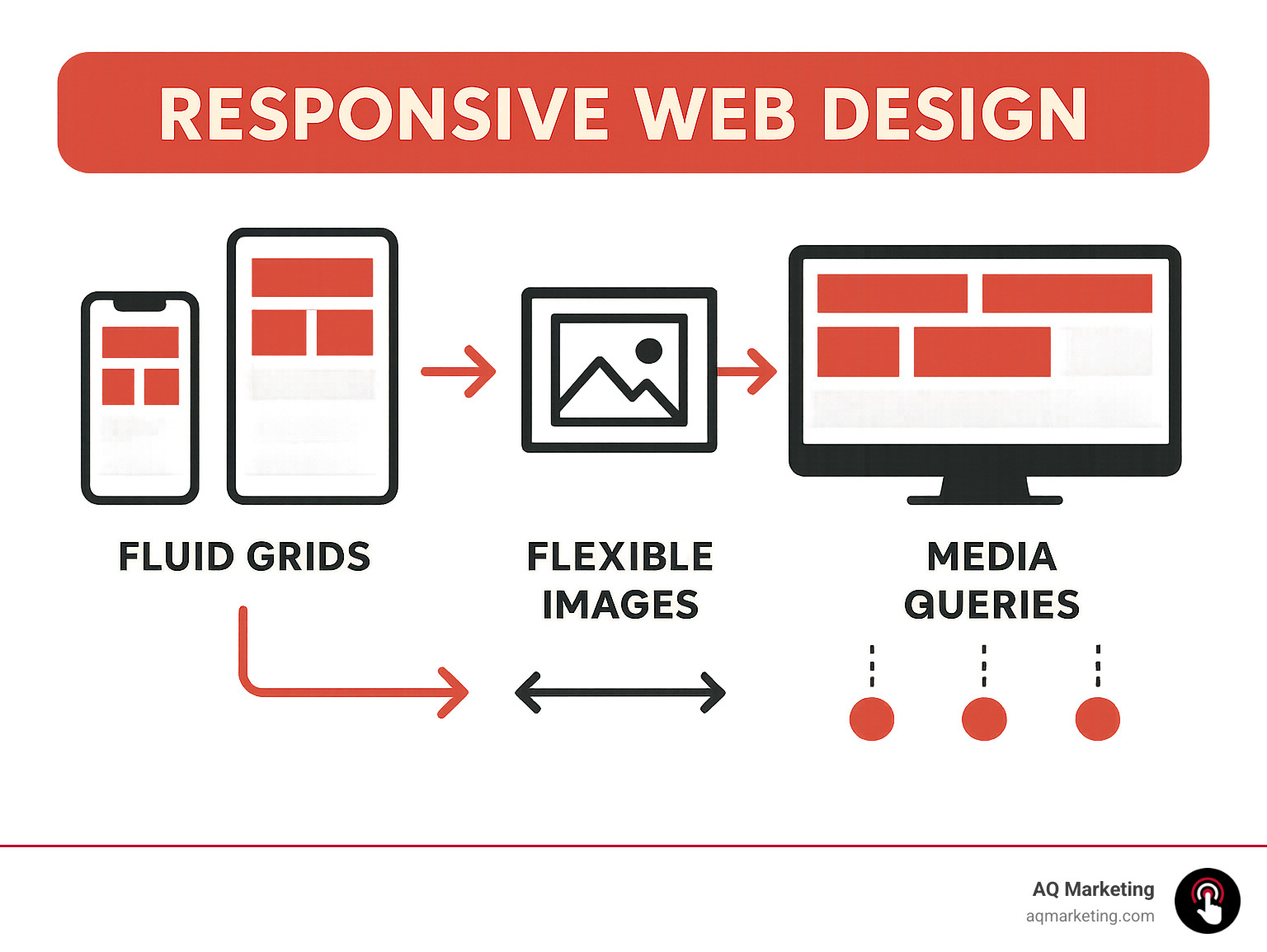
Simple responsive web design benefits glossary:
#1 Improved User Experience Across Devices
The most immediate and tangible of all responsive web design benefits is the dramatically improved user experience it delivers across all devices. At AQ Marketing, we’ve seen how responsive websites transform engagement metrics for our clients across Massachusetts and Southern New Hampshire.
Think about your own browsing habits for a moment. When you visit a website on your phone and have to pinch, zoom, and endlessly scroll sideways just to read the content, how long do you stick around? If you’re like most people, you’re gone in seconds.
A responsive website solves this frustration by automatically adjusting to fit whatever screen your customers are using. No more squinting at tiny text or accidentally clicking the wrong button with your finger. Everything just works, whether they’re on a phone during their commute, a tablet on the couch, or a desktop at work.
When we implemented responsive design for a home services client in Middlesex County, their mobile bounce rate dropped by 38% in just three months. Why? Because users were finally staying to explore their services instead of immediately leaving out of frustration.
This improved experience directly impacts your bottom line. About 57% of internet users won’t recommend a business with a poorly designed mobile site. Even worse, 61% won’t return to a site they struggled with, and 40% will simply visit your competitor instead. Ouch!
A truly responsive site ensures that text remains readable without zooming, buttons are properly sized for fingers (not just mouse pointers), images scale beautifully without distortion, and forms work smoothly no matter the device. The content hierarchy stays logical, guiding visitors naturally through your most important information.
Smoother Navigation on Any Screen
Navigation might seem simple, but it’s actually one of the trickiest parts of responsive design. What works on a wide desktop screen often fails completely on mobile.
That horizontal menu bar that looks so clean on your computer? It’s a nightmare on phones. This is where responsive design really shines by adapting navigation patterns to each device.
The now-familiar hamburger menu (those three little lines) has become the universal symbol for “tap here for menu options” on mobile devices. It’s a simple solution that keeps your navigation tidy until needed. We also implement thumb-friendly zones that position important buttons where they’re easy to reach with one hand – a small detail that makes a huge difference in user comfort.
An insurance broker from Essex County told us, “Quote requests from mobile users increased by 27% after you redesigned our site. The form was finally easy to find and complete on phones!”
These navigation improvements aren’t just nice-to-have features – they’re essential in a world where most people browse primarily on mobile devices. By creating an experience that feels natural regardless of screen size, responsive design keeps your visitors engaged and moving toward conversion.
At AQ Marketing, we’ve seen how these thoughtful touches in responsive design create websites that don’t just look good on any device – they actually work better for your business by keeping customers engaged longer and guiding them smoothly toward becoming clients.
#2 Better SEO & Search Visibility: Responsive Web Design Benefits for Rankings
When it comes to search engine optimization, responsive web design isn’t just recommendedit’s practically mandatory. Since 2015, Google has used mobile-friendliness as a ranking signal, and in 2018, they officially switched to mobile-first indexing, meaning they primarily use the mobile version of a site’s content for indexing and ranking.
This fundamental shift in how Google evaluates websites makes the SEO advantages of responsive design some of the most compelling responsive web design benefits for businesses of all sizes.
I’ve seen this play out with our clients time and again. The numbers don’t lie websites that adopt responsive design typically experience an organic search traffic boost of 15-35% within just six months of implementation. That’s a significant return that directly impacts your bottom line!
What makes responsive design such an SEO powerhouse? For starters, you get to maintain a single URL structure rather than juggling separate addresses for mobile and desktop versions. This concentrates all your SEO efforts and link equity in one place, making every backlink work harder for you.
Your visitors stick around longer too. When people find your site easy to use on their phones, those reduced bounce rates send powerful positive signals to search engines about your content quality. Google notices when visitors aren’t immediately hitting the back button!
Speed matters enormously in today’s impatient world. Well-implemented responsive sites often load faster, which Google has explicitly confirmed is a direct ranking factor. This ties directly into better Core Web Vitals scores Google’s page experience metrics that increasingly influence where you appear in search results.
There’s also a social benefit: users are much more likely to share content from sites that work well on their devices. After all, nobody wants to share a link that will frustrate their friends!
As Google themselves state in their official recommendations for smartphone-optimized websites: “Google recommends webmasters follow the industry best practice of using responsive web design, namely serving the same HTML for all devices.”
How Responsive Web Design Benefits Your Search Rankings
Responsive design creates a unified SEO strategy by consolidating what would otherwise be divided signals between separate mobile and desktop versions of your site.
I often explain it to clients like this: imagine your website’s SEO power as water flowing through pipes. With separate mobile and desktop sites, you’re splitting that flow between multiple pipes, weakening the pressure in each one. Responsive design keeps all that SEO power flowing through a single, stronger channel.
When you maintain separate sites, your backlinks get split between different URLs. Your social shares get divided. Every content update must be duplicated (which, let’s be honest, often leads to inconsistencies). Google’s crawl budget gets divided between multiple versions. And you’ll need canonical tags to prevent duplicate content issues another layer of technical complexity that can go wrong.
I remember working with an insurance agency in Merrimack Valley that was stubbornly maintaining separate desktop and mobile sites. Their team was constantly frustrated by the double work required for every update. After we convinced them to consolidate to a single responsive site, their organic traffic increased by a whopping 42% in just four months! Even better, they started ranking for competitive terms they’d never been able to capture before.
Responsive design also eliminates the risk of duplicate content penalties that can occur when you have similar content on separate mobile and desktop sites. This streamlined approach ensures that all canonical signals point to a single URL, maximizing your ranking potential and eliminating confusion for search engines.
The SEO benefits of responsive design aren’t just theory they translate directly into better visibility, more traffic, and ultimately more customers for your business. If you’re ready to improve your website’s search performance, check out our comprehensive Website Design Services to learn how we can help your business thrive online.
#3 Lower Costs & Easier Maintenance
When it comes to stretching your marketing dollars, few investments deliver better value than responsive web design. One of the most practical responsive web design benefits is the substantial cost savings compared to juggling separate mobile and desktop sites—something our Massachusetts and New Hampshire clients appreciate most.
Think about it: with responsive design, you’re essentially getting multiple websites while only paying for one. The math makes a compelling case:
| Aspect | Responsive Website | Separate Mobile Site |
|---|---|---|
| Initial Development Cost | $5,000-15,000 (one site) | $8,000-25,000 (two sites) |
| Content Updates | Update once | Update twice |
| Maintenance Hours | ~5 hours/month | ~10 hours/month |
| SEO Campaign Management | One site | Two sites |
| Analytics Setup & Monitoring | Single implementation | Dual implementation |
| Testing Requirements | One codebase | Two codebases |
The savings go well beyond just the upfront build costs. The day-to-day management becomes dramatically simpler too.
When you update your service offerings or add a seasonal promotion, you make the change once and it appears perfectly across all devices. Your team no longer needs to remember the dreaded “did we update the mobile site too?” question that inevitably leads to inconsistencies.
“We saved approximately $7,500 in annual maintenance costs after switching to a responsive design,” a plumbing business owner in Boston told us recently. “Plus, we no longer waste time double-checking everything on multiple versions of our website.”
Your analytics become cleaner and more insightful with a unified approach. Instead of piecing together data from separate sites to understand customer behavior, you get a complete picture in one dashboard. This means better decisions based on better data.
The testing process gets streamlined too. Your QA team only needs to verify one codebase instead of hunting down bugs across multiple versions. This means fewer headaches, faster updates, and lower ongoing development costs.
Even your marketing campaigns work harder for you. Every link you share—whether in an email newsletter, Facebook post, or Google ad—works beautifully regardless of how your customer opens it. No more creating separate landing pages for different devices or worrying about mobile users landing on desktop-optimized pages.
For small business owners wearing multiple hats, these efficiency gains are particularly valuable. The time saved on website maintenance can be redirected to what really matters: serving your customers and growing your business.
Want to learn more about how our responsive solutions can help streamline your digital presence? Visit our Responsive Web Design Services page for details on how we’ve helped businesses just like yours simplify their online presence while reducing costs.
#4 Faster Load Times & Higher Conversions
Speed matters—a lot. In fact, it might be the most underappreciated of all responsive web design benefits. Think about your own experience browsing the web on your phone. When a site takes forever to load, do you stick around? Probably not. And you’re not alone. According to Google, 53% of mobile users abandon sites that take longer than three seconds to load. Just three seconds before losing more than half your potential customers!
When we build responsive websites for our clients across Massachusetts and New Hampshire, we consistently see them outperform non-responsive sites in loading speed. There’s a simple reason for this: when you’re working with a single, unified codebase, everything becomes more efficient. Your developers can focus on optimizing one set of resources instead of juggling multiple versions. Images and media get delivered at just the right size for each device, and browsers can cache resources more effectively. Plus, you eliminate all those pesky redirects that happen when sites try to detect which version to show you.

I remember working with a roofing contractor in Woburn who was frustrated with their website performance. Potential customers would click on their ads but abandon the site before even seeing their services. After we rebuilt their site with responsive techniques, their mobile page load time dropped from a sluggish 6.2 seconds to a snappy 2.4 seconds. The difference was night and day – not just in numbers but in actual business results.
These performance improvements directly impact your bottom line. Faster sites keep visitors engaged instead of bouncing away. They create a positive first impression, encouraging users to explore more of your content and spend more time with your brand. Most importantly, they remove friction from the purchase process, making it easier for visitors to become customers.
Speed Drives Sales
The connection between how fast your site loads and how many sales you make isn’t just theoretical – it’s backed by hard data. Research shows that even a one-second delay in page load time can reduce conversions by 7%. To put that in perspective, if you’re running an e-commerce site making $100,000 per day, that tiny one-second delay could cost you $2.5 million in lost sales over a year.
I saw this with one of our clients in Southern New Hampshire. After implementing a responsive design with careful performance optimization, their lead conversion rate jumped by 24%. The site not only looked great on phones and tablets but loaded in a flash, even on spotty mobile connections.
This speed advantage is particularly crucial for local businesses here in the Greater Boston area. Imagine someone’s water heater just burst, and they’re frantically searching for a plumber on their phone. Or perhaps they’re comparing insurance quotes while sitting in a coffee shop. In these scenarios, the business whose site loads fastest often wins the customer – it’s that simple.
When we build responsive sites at AQ Marketing, we incorporate several key performance techniques to ensure lightning-fast experiences. We properly size and compress images for each viewport. We implement lazy loading so off-screen content doesn’t slow down the initial page load. We minimize HTTP requests, optimize the critical CSS rendering path, use efficient font loading strategies, and selectively load features based on device capabilities.
All these technical optimizations have one purpose: ensuring that users on any device—whether they’re browsing on a high-end desktop or a budget smartphone with a spotty connection—get the fastest possible experience. And ultimately, that means more conversions and more business for you.
#5 Accessibility & Inclusivity Boost
When we talk about responsive web design benefits, improved accessibility might not be the first thing that comes to mind but it should be! It’s a game-changer that makes your website more welcoming to everyone while keeping you on the right side of regulations.
A well-designed responsive website naturally supports accessibility best practices. Think about it: when your site adjusts smoothly to different screen sizes, it’s also becoming more adaptable for people with various needs and abilities.
We’ve seen how responsive design creates more inclusive experiences. Text that resizes without breaking layouts means visitors can adjust their view to whatever works best for their vision. Proper semantic HTML makes your content play nicely with screen readers. And those larger touch targets that work so well on mobile? They’re also perfect for folks with motor challenges.
“Before our responsive redesign, I couldn’t steer the site with my screen reader,” one user told our client, a financial services firm in Middlesex County. “Now I can access everything independently it’s life-changing.”
The beauty of these accessibility improvements is that they help everyone. That larger text option? Perfect for someone browsing on their phone in bright sunlight. Those keyboard-friendly navigation features? A lifesaver for someone with a temporary wrist injury. Good accessibility is simply good design.
There’s also a serious legal component here. The 21st Century Communications and Video Accessibility Act (CVAA) and various state laws require websites to be accessible. According to FCC guidelines on CVAA, digital content must be usable by people with disabilities.
“We helped a retail client in Salem avoid what could have been a costly lawsuit,” shares our accessibility specialist. “They received a demand letter about their inaccessible website, and our responsive redesign not only brought them into compliance but also improved their mobile conversion rate by 18%.”
The Web Content Accessibility Guidelines (WCAG) 2.1 Level AA has become the standard benchmark for accessibility. Many of its requirements responsive layouts, proper text sizing, and adequate touch targets align perfectly with responsive design principles. It’s a wonderful example of how doing the right thing also happens to be good business.
For businesses wanting to reach the widest possible audience while minimizing legal exposure, the accessibility advantages of responsive design offer tremendous value. Want to learn more about implementing accessible typography? Check out our guide to Responsive Web Design Font Size.
#6 Future-Proof: One Site for All Screens
Perhaps the most forward-looking of all responsive web design benefits is how it future-proofs your online presence. Technology evolves rapidly, with new devices and screen sizes emerging constantly. A responsive website is inherently adaptable to these changes without requiring complete redesigns.
Remember when everyone browsed the web on nearly identical desktop monitors? Those days are long gone! Just look at the evolution of devices in the past decade alone:
The smartphone in your pocket has likely grown from a modest 3.5″ screen to a massive 6.7″ display. Tablets popped up in every size imaginable, from 7″ to nearly 13″. Laptops now sport high-DPI displays with all sorts of unusual aspect ratios. And let’s not forget ultra-wide monitors, foldable phones, smart watches, and even web browsers on your TV and game console!
With responsive design, your website gracefully adapts to this zoo of screens without needing separate versions for each device. This magic happens through fluid grid layouts that scale proportionally based on screen size, flexible breakpoints that adjust at logical content breaks (not specific device widths), and resolution-independent graphics that stay crisp on any display.
“When we first built a client’s responsive site in 2015, neither of us imagined users would be viewing it on foldable phones or through AR glasses,” recalls our creative director. “Yet their site continues to function beautifully on these newer devices because the responsive foundation was solid.”
Responsive Web Design Benefits Upcoming Devices and Technologies
The tech world never stands still, and responsive design will continue to serve your business well as new technologies emerge. Think about browsing the web through augmented reality glasses, exploring virtual reality spaces, or asking your smart mirror to show you today’s weather while you brush your teeth.
These aren’t science fiction scenarios—they’re already beginning to happen. Your responsive website will be ready to adapt to AR browsers overlaying content on the real world, VR experiences that transition to spatial interfaces, voice-activated displays that work with or without screens, IoT interfaces on household items, and even automotive displays safely viewable while driving.
For businesses in competitive markets like Boston and Woburn, this future-proofing represents significant long-term value. Rather than ripping everything down and starting over every few years, a well-implemented responsive site can evolve incrementally.
“We estimate that our responsive approach has saved clients an average of $15,000-25,000 in redesign costs over a five-year period,” notes our account director. “Instead of rebuilding from scratch when new devices emerge, we can make targeted improvements to the existing responsive framework.”
This flexibility isn’t just convenient—it’s a smart business investment. Your website continues working beautifully on whatever device your customers prefer, both today and tomorrow. In the always-changing digital landscape, that kind of adaptability is truly priceless.
Frequently Asked Questions about Responsive Web Design
What is responsive web design and how does it work?
Responsive web design is an approach that makes websites render effectively across various devices and window sizes. It works through three key technical components:
- Fluid grids: Layouts use relative units (percentages, ems, rems) instead of fixed pixels, allowing content to scale proportionally
- Flexible images: Media scales within its containing elements to prevent overflow or distortion
- CSS media queries: Conditional styles apply based on device characteristics like screen width, height, or orientation
As a user switches from laptop to tablet to smartphone, the website automatically adjusts to accommodate resolution, image size, and scripting abilities. This eliminates the need for different designs and development for each device.
“Think of responsive design like water,” explains our lead developer. “It takes the shape of whatever container it’s in, while maintaining its essential properties. Your content flows naturally into any screen size while remaining readable and usable.”
Since implementing this approach for our clients across Massachusetts and Southern New Hampshire, we’ve seen dramatic improvements in engagement metrics across all device types.
Is responsive design suitable for every type of website?
While responsive design offers significant responsive web design benefits for most websites, there are certain situations where alternative approaches might be considered:
Ideal for responsive design:
- Business websites
- Blogs and content sites
- E-commerce stores
- Service-based businesses
- Local business sites
- Portfolios and showcases
- Educational resources
May require additional considerations:
- Complex web applications with dense interfaces
- Data-heavy dashboards
- Interactive games
- Legacy systems with specialized requirements
- Sites requiring fundamentally different experiences per device
Even in these more complex cases, responsive design principles often still apply, but might be supplemented with additional techniques. For example, a data dashboard might use responsive design but also offer device-specific views for certain complex visualizations.
“We worked with a financial services client in Boston who initially thought their complex calculators couldn’t work responsively,” shares our project manager. “By thoughtfully reimagining the interface for different screen sizes—rather than just shrinking it—we created an even better user experience on mobile than they had on desktop.”
In our 20+ years of experience, we’ve found that with proper planning and expertise, responsive design can be successfully applied to virtually any website type. The key is approaching it as a fundamental design philosophy rather than a mere technical implementation.
How can I test if my site is truly responsive?
Testing responsive design thoroughly is essential to ensure your website delivers a consistent experience across all devices. Here are the methods we use at AQ Marketing for comprehensive responsive testing:
- Browser developer tools: Chrome, Firefox, and Safari all include device emulation modes that simulate various screen sizes and devices
- Real device testing: Nothing beats checking your site on actual physical devices—we maintain a testing lab with various phones, tablets, and computers
- Online testing tools: Services like BrowserStack or Responsinator allow you to view your site across multiple virtual devices
- Google’s Mobile-Friendly Test: This free tool evaluates if your site meets Google’s mobile usability standards
- Analytics review: Examine user behavior by device type to identify potential issues

Key elements to verify during testing include:
- Readability: Text should be legible without zooming
- Navigation: Menus should be accessible and usable on all devices
- Interactivity: Buttons, forms, and interactive elements should work properly
- Content parity: All important content should be available regardless of device
- Performance: The site should load quickly on mobile networks
- Functionality: All features should work across devices
“We found a critical form submission issue on iOS devices for a client in Middlesex County that wasn’t apparent in emulators,” notes our QA specialist. “This highlights why we always include real device testing in our process—some issues only appear on actual hardware.”
For businesses without access to extensive testing resources, we recommend at minimum using browser developer tools and Google’s Mobile-Friendly Test, plus checking your site on your own smartphone and tablet in both portrait and landscape orientations.
Conclusion
The responsive web design benefits we’ve explored aren’t just technical jargon—they represent real opportunities to grow your business. From delighting users across all devices to climbing search rankings, saving money on maintenance, and future-proofing your digital presence, responsive design delivers genuine returns that impact your bottom line.
Let’s face it—mobile isn’t the future anymore, it’s the present. With 92.3% of internet users browsing on their phones, having a website that shines on every screen size isn’t optional—stay competitive. The numbers tell a compelling story: when 61% of visitors abandon sites that aren’t mobile-friendly, you simply can’t afford to ignore responsive design.
Here at AQ Marketing, we’ve helped hundreds of local businesses throughout Boston, Woburn, Middlesex County, Essex County, Merrimack Valley, and Southern New Hampshire transform their online presence. Our approach blends technical know-how with practical business sense to create websites that not only adapt beautifully to any screen but actually drive meaningful results.
The good news? Implementing responsive design doesn’t have to be overwhelming. Whether you’re building from scratch or upgrading what you already have, our team will guide you through the process with clear communication and proven methods that take the mystery out of the transition.
Remember these key takeaways: responsive design creates happier users across all devices. Google rewards mobile-friendly sites with better search visibility. Maintaining one responsive site costs less than juggling multiple versions. Faster loading times directly boost your conversion rates. Accessibility improvements help everyone while reducing legal risks. And perhaps most importantly, your responsive site will continue working beautifully on whatever devices emerge in the coming years.
Ready to experience these responsive web design benefits for yourself? Visit our responsive website design company page to learn more about our approach and how we can create a website that works beautifully everywhere your customers are.
With the right responsive strategy, your website won’t just adapt to different screens—it will adapt to the future of your business, growing with you as technology evolves and new opportunities emerge. After all, that’s what good design should do: solve today’s problems while preparing you for tomorrow’s possibilities.