

Why Startup Marketing Challenges Stop Great Businesses Before They Start
Startup marketing challenges are the hidden obstacles that prevent even well-built businesses from reaching the customers who need them most. Here is a quick look at the most common ones:
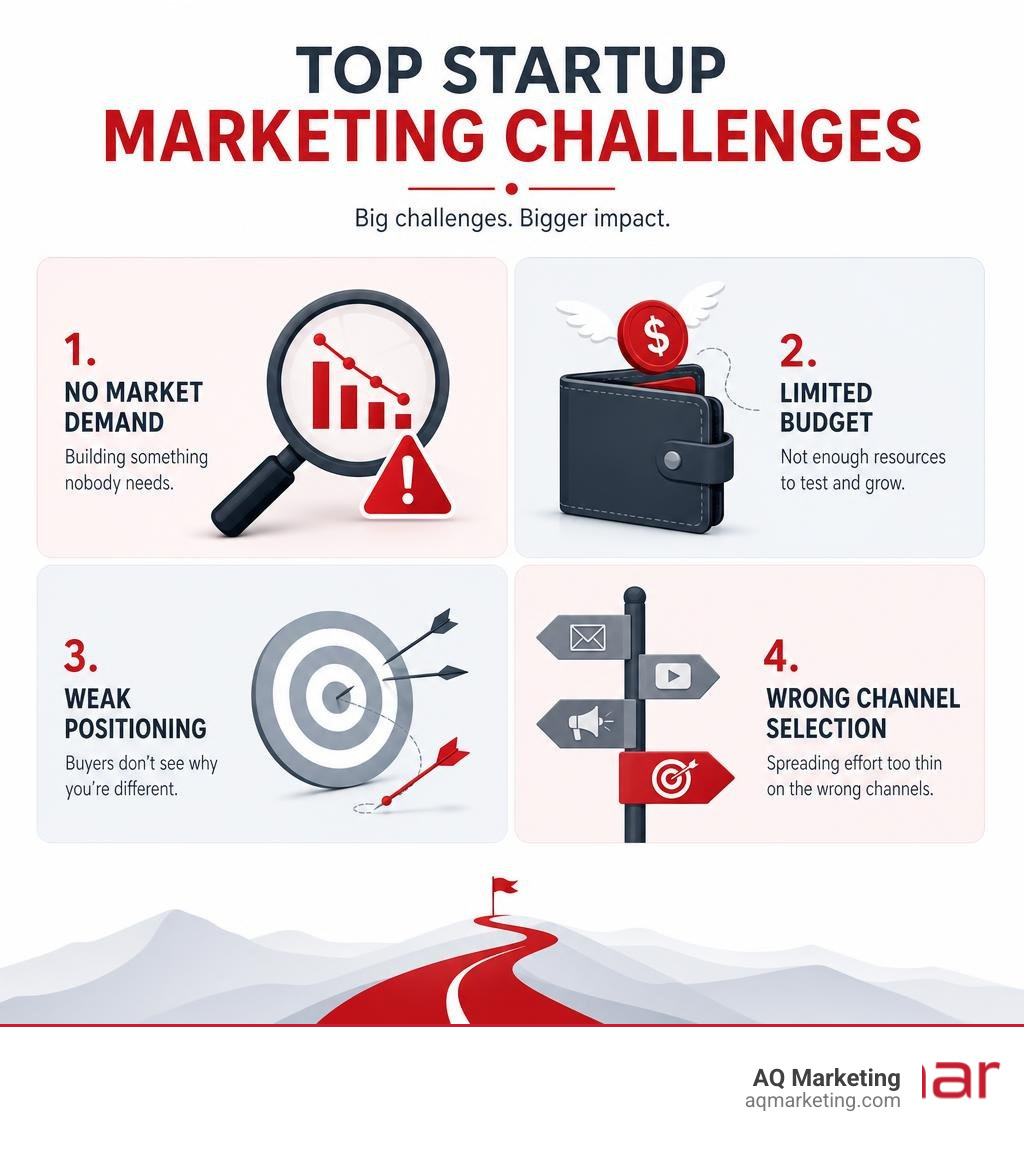
Top Startup Marketing Challenges at a Glance:
- No clear value proposition — buyers can’t understand what makes you different
- Limited budget — not enough resources to test and scale channels
- Wrong audience targeting — messaging reaches the wrong people
- No product-market fit validation — building before confirming demand
- Founder-led marketing hitting a ceiling — one person can’t do it all forever
- Weak online presence — low visibility in search and social
- Lack of trust and social proof — no testimonials, case studies, or track record
- Choosing the wrong channels — spreading effort too thin across too many platforms
The hard truth? 42% of startups fail because of a lack of market demand. Another 35% fail because they solved problems that interested them rather than problems the market actually needed. Most of the time, the product isn’t the problem — the marketing is.
Starting a business is one thing. Getting the right people to notice it, trust it, and buy from it is something else entirely. In 2026, the competition for buyer attention is fiercer than ever. Content is everywhere. Ad costs keep climbing. And most startup founders are juggling product development, customer service, and sales — all at the same time as trying to market their business.
It’s a lot. And most early-stage businesses don’t have a dedicated marketing team to help.
That’s exactly why understanding these challenges — and having a clear plan to address them — matters so much.
I’m Robert P. Dickey, President and CEO of AQ Marketing, and over my 20+ years in digital marketing I’ve worked with countless small and medium-sized businesses navigating the same startup marketing challenges covered in this guide. My goal here is to cut through the noise and give you a practical, honest look at what actually works.
Glossary for startup marketing challenges:
Navigating the Most Common Startup Marketing Challenges in 2026

The landscape of digital marketing in June 2026 is vastly different from even just a few years ago. Today, attention is the ultimate bottleneck. With an infinite supply of online content and the rapid rise of AI-generated material, buyers are suffering from digital fatigue. The internet has become a warehouse of competent-looking but ultimately forgettable information.
For early-stage and growth-stage startups in Massachusetts, from the bustling tech hubs of Boston and Cambridge to local service businesses in Woburn and Worcester, the struggle is no longer just about publishing content—it is about being remembered. This shift is why many founders find that Why Startup Marketing Feels Harder Than Ever is a sentiment they live every single day.
When we look at New Venture Marketing, the most common hurdle is the “sea of sameness.” AI has made content incredibly cheap to produce, but it has made genuine trust far more expensive. Furthermore, search engines are evolving rapidly; with the rise of zero-click search results, featured snippets, and AI overviews, a large portion of searches now end without a single click to an external website.
To survive, startups cannot rely on generic category claims. You must speak the specific “field language” of your target audience, addressing real, lived pain points rather than broad industry topics.
Another massive challenge is platform dependency. Relying solely on rented land—like third-party social media algorithms—makes your growth feel volatile. When algorithms shift overnight, your organic reach can plummet. That is why building owned channels (like your website and email list) and focusing on long-term customer retention are non-negotiable strategies for sustainable growth.
Why Technical Founders Struggle with Startup Marketing Challenges
Technical founders are brilliant at building. They can write elegant code, design complex databases, and optimize infrastructure. However, this product-first mentality often leads to a major blind spot: treating customer acquisition as an optional, secondary activity rather than a core engineering constraint.
According to the Marketing Challenges for Technical Founders: 2026 Guide, many developers fall into the “stealth mode delusion.” They spend months, sometimes years, building a product in complete isolation, believing that if they build it, customers will magically appear.
This build-first inversion is comfortable because discussing software architecture is far easier than picking up the phone to validate market demand. To overcome this, technical founders need to apply the same rigor to their marketing funnel that they apply to a database schema:
- Kill stealth mode immediately: Share your building progress publicly on platforms like LinkedIn or niche communities to gather real-time feedback.
- Do manual validation first: Spend your first few weeks doing direct, manual sales outreach before writing a single line of code. If you cannot get prospective buyers to agree to a conversation about their pain points, you do not have a marketing problem—you have a market demand problem.
- Audit your acquisition funnel: Track where users drop off. If you are getting 100 visitors a day but zero sign-ups, your landing page messaging and value proposition are out of alignment.
The Shift from Founder-Led Sales to Scalable Systems
In the earliest days of a startup, founder-led sales are your greatest unfair advantage. Your passion, deep industry knowledge, and personal network are incredibly powerful tools for landing those first 10 to 20 customers. But eventually, every successful founder hits a structural ceiling: the bandwidth ceiling.
There are only so many hours in a day, and when the founder is the sole marketing engine, marketing becomes reactive. You market when lead flow is dry, stop marketing when you are busy onboarding clients, and repeat this exhausting, unpredictable cycle.
This reactivity trap prevents the accumulation of compounding marketing assets. To break free, you must transition from founder-led marketing to a repeatable marketing system. As outlined in the Startup Marketing Playbook: Your First 90 Days, this shift requires bridging the “documentation gap.”
Because the strategic vision and customer insights usually live entirely inside the founder’s head, any downstream marketing hire or agency is set up to fail. You must externalize this institutional knowledge into documented systems—such as clear messaging architectures, ideal customer profiles, and step-by-step workflows.
A great marketer inside a broken system will underperform, but an average marketer working within a well-built, automated system will surprise you. Do not rush to hire expensive specialists too early. Build the foundational system first, prove that at least one organic or paid channel works predictably, and only then bring in team members or partners to scale it.
Strategic Solutions for Early-Stage Growth

To stand out in a saturated market, startups must move away from generic messaging and embrace precision. This starts with defining a highly specific target audience and building a defensible market position. If your product or service is designed for “everyone,” your marketing will resonate with no one.
Understanding The Secret Sauce: Building a Winning Brand Strategy for New Ventures is about learning how to translate what your product does into what your customer achieves.
Overcoming Startup Marketing Challenges with Limited Budgets
“We don’t have the budget for that” is the anthem of almost every early-stage venture. But a limited budget does not mean you cannot compete; it simply means you must be highly strategic about where you invest your resources.
When navigating Penny Pinching Promotion: Affordable Marketing Hacks for New Ventures, startups should focus heavily on high-ROI, cost-effective channels like organic search engine optimization (SEO) and highly targeted social media campaigns.
To give you an idea of the landscape, typical outsourced digital marketing setup and management costs across the country range from about $1,800 to over $7,500 per month on average. (Please note: this pricing is based on average online data and does not represent AQ Marketing’s actual pricing, which is customized to your specific business goals and scope).
Instead of burning thousands of dollars on broad, expensive paid ad campaigns before validating your message, startups should:
- Focus on niche targeting: If you run Google Ads, build campaigns around highly specific, long-tail search terms that indicate high buying intent, rather than broad, expensive industry terms.
- Prioritize owned content: Invest time in producing high-quality, educational website content that answers the exact questions your prospects are typing into search engines.
- Build an email list from day one: Email marketing remains one of the highest-ROI channels available, allowing you to nurture leads over time without paying to reach them repeatedly.
Mastering Competitive Analysis and Market Positioning
You cannot differentiate your business if you do not know exactly what your competitors are saying. Mastering The Spy Game: Mastering Competitive Analysis for Startup Success is not about copying what the industry leaders are doing; it is about finding the gaps they have left wide open.
Start by auditing the digital footprints of your direct and indirect competitors. Read their customer reviews, pay attention to common complaints, and analyze their website messaging. Are they focusing purely on technical features? If so, you can differentiate by focusing heavily on the emotional and practical benefits of your solution.
When crafting your unique value proposition (UVP), remember to distinguish features from benefits. A feature is what your product has (e.g., “24/7 automated scheduling software”). A benefit is what that feature does for the customer (e.g., “Saves you 5 hours of administrative work every week so you can focus on growing your business”).
Building a Compounding Digital Marketing Engine
To build a business that scales sustainably, you need to transition away from short-term, transactional marketing tactics and focus on building a compounding digital marketing engine. This means creating assets—like your website’s SEO authority and a library of educational content—that continue to attract, engage, and convert leads long after they are created.
Establishing a Strong Online Presence and Social Proof
Your website is your digital storefront. In 2026, it must not look like “the new kid on the block.” It needs to match or exceed the design standards of your most established competitors. To learn how to make your brand unforgettable, check out Startup Marketing Magic: 5 Strategies to Ignite Your Brand.
One of the fastest ways to build trust as an unknown brand is through social proof. Skeptical buyers want to see that others have used your product or service successfully. Startups should prioritize:
- Case studies: Develop deep, narrative-style customer success stories that showcase the exact problem your client faced, how you solved it, and the measurable results they achieved.
- Testimonials: Place authentic client quotes strategically across your high-traffic website pages.
- LinkedIn networking: Encourage your leadership team to share domain-specific insights, behind-the-scenes stories, and industry lessons on LinkedIn to build personal credibility.
For local startups in Massachusetts, leveraging professional Startup SEO Services is a highly effective way to build local domain authority and ensure your business shows up in search results when local prospects are looking for your services.
Leveraging Content Marketing and Automated Lead Generation
Content marketing is not about writing generic blog posts to meet a monthly quota. It is about creating highly valuable resources that guide prospects through their buying journey. When designing your strategy, refer to Storytelling for Success: Building a Powerful Startup Content Strategy to learn how to weave real-world data and engaging stories into your educational content.
Once you have high-quality content driving traffic to your website, you need automated systems to capture and nurture those leads. An automated lead generation engine works 24/7 to scale your business, reducing founder burnout and creating a predictable pipeline.
This is achieved by setting up automated workflows: when a visitor downloads an educational guide or interacts with an AI webchat tool on your site, they are automatically segmented in your CRM and entered into a highly personalized email nurturing sequence that builds trust over time.
Frequently Asked Questions about Startup Marketing
To help you decide where to focus your resources, here is a breakdown of how organic marketing compares to paid advertising channels:
| Marketing Channel | Typical Time to Results | Cost Structure | Best Suited For | Long-Term Value |
|---|---|---|---|---|
| Organic Marketing (SEO, Content, Organic Social) | 3 to 6 months | Low direct cost; high time investment | Building trust, long-term brand equity, and compounding leads | High (Assets continue to drive traffic indefinitely) |
| Paid Advertising (Google Ads, Social PPC) | Immediate (1 to 2 weeks) | High direct cost; ongoing budget required | Validating messaging, driving immediate pipeline, and targeted promotions | Low (Traffic stops the moment you stop paying) |
What are the top reasons for startup failure related to marketing?
The top marketing-related reason startups fail is a lack of market demand, which accounts for 42% of startup failures. This happens when founders build a product based on what they think is interesting rather than validating what the market actually needs.
The second most common reason is poor go-to-market execution (cited in 35% of cases), which includes failing to communicate a clear value proposition, choosing the wrong marketing channels, and spreading limited budgets too thin.
How do startups balance marketing automation with personalized customer connections?
The key to balancing automation with personalization is audience segmentation. Instead of sending generic bulk emails to your entire list, use your CRM to group leads based on their specific industry, pain points, or how they interacted with your website.
Use automation to handle repetitive tasks—like sending a welcome email or scheduling a call—but ensure the actual messaging is highly tailored, referencing the specific challenges your prospect is trying to solve.
What are the trade-offs between paid ads and organic marketing tactics?
Paid ads offer immediate visibility and quick traffic, making them excellent for testing new messaging or driving short-term leads. However, they require a continuous financial investment, and your customer acquisition cost (CAC) can quickly become unsustainable.
Organic marketing (like SEO and content creation) takes longer to show results—typically three to six months—but it builds compounding assets that drive highly qualified, zero-cost traffic to your website for years to come.
Conclusion
Overcoming startup marketing challenges in 2026 requires moving away from fragmented, reactive tactics and embracing a structured, systems-first approach. By clearly defining your unique value proposition, building a professional online presence, and establishing automated lead generation systems, you can build a predictable engine for long-term growth.
Whether you are a home service business in Woburn, an insurance agency in Worcester, or a growing venture anywhere in Massachusetts, you do not have to navigate these challenges alone.
At AQ Marketing, we specialize in helping small to medium-sized businesses strengthen their online presence and achieve sustainable growth through professional website design, custom SEO, content writing, and automated lead generation workflows.
Ready to turn your marketing challenges into measurable growth? Contact us today to learn more about our digital marketing services for small business and let’s build a system that scales your business together.
