
Why Startup Growth Marketing Is the Engine Behind Scalable Traction
Startup growth marketing is the practice of using data, rapid experimentation, and full-funnel thinking to build scalable, repeatable customer acquisition — and it may be the single most important discipline a founder can invest in early.
Here is a quick overview of what it covers:
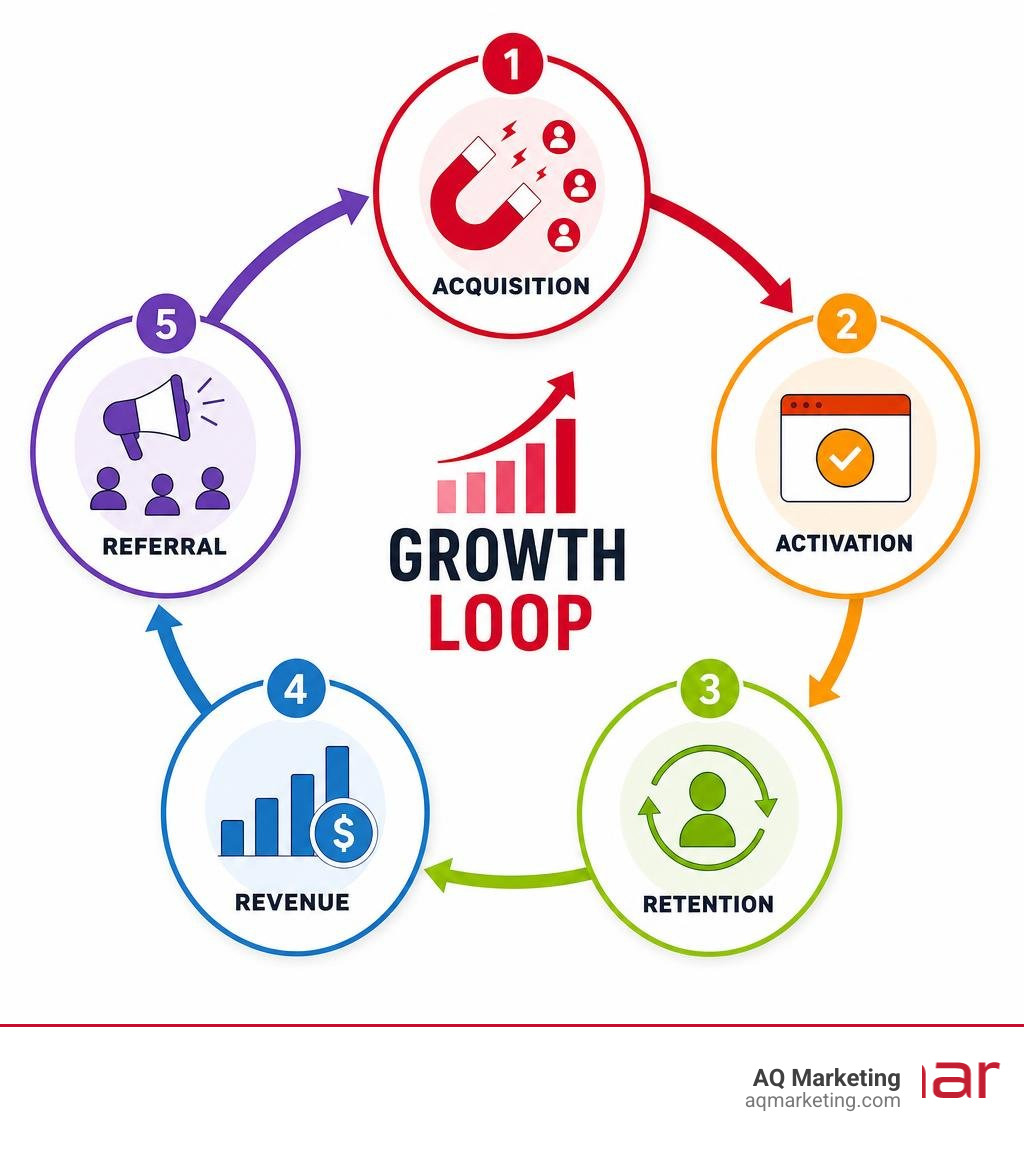
| Growth Marketing Element | What It Means for Startups |
|---|---|
| Acquisition | Finding the right channels to attract qualified prospects |
| Activation | Turning new users into engaged, active customers |
| Retention | Keeping customers long enough to generate real value |
| Revenue | Expanding customer value through upsell, cross-sell, and pricing |
| Referral | Creating loops where happy customers bring in new ones |
| Experimentation | Running small, fast tests to learn what works before scaling |
Most founders assume great products sell themselves. They rarely do. What separates fast-growing startups from ones that stall is usually not the product — it is the system used to find, convert, and keep customers.
Growth marketing replaces guesswork with a structured, test-and-learn approach. It connects every stage of the customer journey, from the first click to long-term loyalty, and ties every decision back to measurable business outcomes.
As the MaRS Startup Toolkit puts it well: successful startups spend more on marketing than product development — and this shift happens sooner than most founders expect.
I am Robert P. Dickey, President and CEO of AQ Marketing, Inc., and with over 20 years of experience helping small and medium-sized businesses grow through digital strategy, I have seen how a disciplined startup growth marketing approach transforms early-stage traction into sustainable revenue. In this guide, I will walk you through the frameworks, channels, and tools that actually move the needle — starting with the fundamentals.
Startup growth marketing terms to remember:
What Growth Marketing Means for Startups
Growth marketing is not just “more marketing.” It is a system for learning how customers discover, evaluate, buy, use, and recommend your product or service.
Traditional marketing often focuses on awareness. Digital marketing focuses on online channels like SEO, PPC, email, and social media. Performance marketing focuses on measurable paid results like clicks, leads, and conversions.
Growth marketing uses all of those tools, but it connects them across the full customer lifecycle:
- Awareness: Who knows you exist?
- Acquisition: Which channels bring qualified prospects?
- Activation: Do people take the first meaningful action?
- Retention: Do they keep coming back or stay engaged?
- Revenue: Do they become profitable customers?
- Referral: Do they recommend you to others?
For startups, this matters because early teams usually do not know enough yet. They may not know which customer segment is best, which message converts, which channel produces quality leads, or which part of the funnel is leaking. Growth marketing creates a disciplined way to find out.
Growth Marketing vs. Traditional Marketing
Traditional marketing usually asks, “How do we get more people to know about us?”
Growth marketing asks, “How do we create a repeatable path from first touch to loyal customer?”
That difference changes everything.
| Area | Traditional Marketing | Growth Marketing |
|---|---|---|
| Main focus | Awareness and campaigns | Full-funnel growth |
| Timeframe | Campaign-based | Continuous testing |
| Measurement | Reach, impressions, traffic | CAC, LTV, activation, retention, revenue |
| Mindset | Promote the brand | Learn, optimize, and scale |
| Funnel role | Often top-of-funnel | Acquisition through referral |
| Accountability | Visibility | Business outcomes |
A traditional campaign may generate attention, but a growth marketing program asks whether that attention turns into qualified leads, sales conversations, repeat purchases, reviews, or referrals.
This is where metrics like CAC, or customer acquisition cost, and LTV, or customer lifetime value, become important. A startup can generate cheap leads and still lose money if those leads never convert or churn quickly. Growth marketing looks at conversion quality, not just volume.
Growth Marketing vs. Go-To-Market Strategy
A go-to-market strategy, or GTM strategy, is the plan for launching a product into a market. Growth marketing is the ongoing process of improving and scaling customer acquisition after launch signals begin to appear.
Both matter. They are not enemies. Think of GTM as setting the table and growth marketing as learning which meals people actually order, reorder, and tell their friends about.
| Category | Go-To-Market Strategy | Growth Marketing |
|---|---|---|
| Best used for | Launching a product or entering a market | Scaling and optimizing growth |
| Core questions | Who are we selling to? Why now? How do we launch? | What works, what scales, and what retains customers? |
| Focus | ICP, positioning, pricing, launch plan, channels | AARRR funnel, testing, attribution, retention, revenue |
| Timeline | Often 3 to 6 months for a complete launch plan | Ongoing |
| Success signal | Product validation and early demand | Repeatable acquisition and profitable growth |
| Common outputs | Personas, messaging, launch assets, sales enablement | Experiment backlog, dashboards, channel roadmap, growth loops |
If you are preparing for launch, start with strong positioning, a clear website, and a focused campaign. Our guide to product launch marketing ideas can help you think through the basics.
Once you have real market signals, growth marketing helps you refine the engine.
How startup growth marketing validates product-market fit
Product-market fit is not a slogan. It shows up in behavior.
Growth marketing helps validate it by measuring how real people respond:
- Do early adopters understand the value quickly?
- Which search queries or ads attract serious prospects?
- Which landing page messages produce qualified leads?
- Do customers reach the “aha moment” during onboarding?
- Are people staying, upgrading, reviewing, or referring?
- What objections come up in sales calls?
- What patterns appear in customer interviews?
For startups, qualitative feedback and quantitative data should work together. A customer interview may reveal why people care. Analytics may show where they drop off. Sales conversations may uncover objections. Search intent may show how buyers describe the problem in their own words.
That combination is gold. Not “buried pirate treasure” gold, but close enough for a marketing guide.
Why Growth Marketing Matters Before and After Product-Market Fit
Before product-market fit, growth marketing reduces uncertainty. After product-market fit, it builds scale.
In the early stage, the goal is not to spend aggressively. The goal is to learn quickly and responsibly. Startups need to understand customer behavior, channel risk, message clarity, and conversion friction before pouring budget into growth.
After product-market fit, the challenge changes. Channels that worked early may saturate. A founder-led sales motion may not scale. Referrals may be strong but inconsistent. Companies growing beyond the $5 million to $50 million range often need new acquisition channels, stronger systems, and better attribution to keep momentum.
Growth marketing turns random activity into a compounding system.
When to Transition from GTM to Growth Marketing
You are ready to move from GTM into a more formal growth marketing approach when you have some of these signals:
- A clearly defined ICP
- Paying customers, not just interested prospects
- Repeatable sales or lead patterns
- A working onboarding process
- Known objections and buying triggers
- Baseline conversion benchmarks
- Early channel data
- A roadmap for expansion
This does not mean everything is perfect. If startups waited for perfect, nobody would launch anything except another spreadsheet.
It means you have enough evidence to stop guessing blindly and start testing systematically. For a broader planning view, see our article on building a small business growth strategy.
Balancing Fast Experiments with Brand Trust

Fast testing should never mean careless marketing. A startup brand is fragile in the beginning. Every ad, landing page, email, chatbot response, review request, and social post shapes trust.
The best growth marketing programs balance speed with consistency:
- Keep your brand promise clear.
- Use the same core message across channels.
- Make sure ads match landing pages.
- Avoid overpromising features or results.
- Use social proof honestly.
- Invest in reputation and reviews.
- Treat retention as part of brand building.
Growth marketing and brand strategy should support each other. Experiments help you learn what resonates. Brand strategy keeps those experiments from becoming a pile of disconnected tactics. For more on this foundation, read our guide to startup brand strategy.
The Role of Content, SEO, and Video in Early Growth
Content and SEO are especially powerful for startups because they compound over time. Paid ads stop when the budget stops. Strong organic content can keep attracting qualified visitors month after month.
Effective early-stage content includes:
- Educational blog posts
- Problem-aware landing pages
- Comparison pages
- FAQs
- Case-study-style stories
- Local SEO pages, when geography matters
- Short videos explaining the problem and solution
- Email nurture content
Video also deserves attention. Research cited in the industry shows that 84% of consumers say watching a brand’s video convinced them to make a purchase. That does not mean every startup needs a Hollywood production budget. It means clear, helpful video can reduce friction and build trust.
For stronger content planning, see our guides on lead generation content pillars and startup content strategy.
Core Frameworks That Make Startup Growth Repeatable
Frameworks help startups avoid chaos. They give your team a shared language for deciding what to test, what to measure, and what to fix first.
The most useful growth marketing frameworks include:
- AARRR, also called Pirate Metrics
- High-tempo testing
- ICE scoring
- North Star Metric planning
- Growth loops
- Product-led growth models
- Customer journey mapping
- Experiment backlogs and sprint cadences
AARRR: Acquisition, Activation, Retention, Revenue, Referral
AARRR breaks growth into five stages:
| Stage | Key Question | Example Metrics |
|---|---|---|
| Acquisition | How do people find us? | Traffic, leads, source quality, cost per lead |
| Activation | Do they experience value? | Signup rate, demo booked, first action completed |
| Retention | Do they stay engaged? | Repeat use, churn, renewal, return visits |
| Revenue | Do they pay and expand? | Sales, ARPU, LTV, close rate |
| Referral | Do they bring others? | Reviews, referrals, shares, K-factor |
This framework is useful because it prevents the classic startup mistake: obsessing over traffic while ignoring retention. If users arrive but never activate, more traffic just creates a bigger leak.
High-Tempo Testing Without Random Tactics
High-tempo testing means running small, structured experiments quickly. It does not mean throwing spaghetti at the wall, although we appreciate the enthusiasm.
A good experiment includes:
- A clear hypothesis
- A defined audience
- A specific channel or funnel stage
- A success metric
- A time limit
- Documentation of the result
Many growth teams work in 2 to 4 week sprints. They collect ideas, prioritize them, test, analyze, and decide what to do next.
ICE scoring is a simple prioritization method:
| Factor | Meaning |
|---|---|
| Impact | How much could this move the business? |
| Confidence | How sure are we based on data or experience? |
| Ease | How quickly and affordably can we test it? |
The key is learning velocity. Even a failed test can be useful if it tells you what not to scale.
Choosing a North Star Metric
A North Star Metric is the main measure that reflects customer value and business growth. It should connect usage, satisfaction, and revenue potential.
Examples might include:
- Qualified leads generated
- Active accounts
- Booked appointments
- Repeat purchases
- Retained customers
- Revenue from a specific customer segment
Avoid choosing a vanity metric as your North Star. Impressions, likes, and raw traffic can be useful diagnostic numbers, but they do not always indicate real growth.
Your North Star should answer: “If this number increases for the right reasons, does the business become healthier?” For more help, read our guide on digital marketing goal setting.
Planning Your Startup Growth Marketing Engine
A growth engine is the system that turns audience attention into measurable business growth. It includes channels, messaging, website experience, analytics, CRM workflows, follow-up, retention, and reporting.
A useful case study from Bessemer Venture Partners shows how one operator built a measurable growth engine by starting with customer data, improving positioning, and then building channel and attribution systems. The key lesson for startups is simple: do not skip customer understanding and rush straight into ads. You can read the full example here: AI-powered growth engine case study.
Startup growth marketing channel prioritization
Use these criteria to choose your first channels:
- Audience fit: Does your ICP spend time there?
- Intent level: Are prospects actively searching or passively browsing?
- Speed to signal: How quickly can you learn?
- Cost efficiency: Can you test without overcommitting?
- Conversion path: Is there a clear next step?
- Sales cycle: Does the channel match how buyers decide?
- Organic vs. paid balance: Are you building short-term and long-term demand?
- Search demand: Are people already looking for your solution?
- Local visibility: Does geography matter, such as in Boston, Woburn, Cambridge, Worcester, Lowell, or other Massachusetts markets?
- Competitive pressure: Can you realistically win attention?
Channel Before Message, Then Message Before Scale
One useful principle for startups: find the right channel before obsessing over tiny message changes.
If your audience is not there, the perfect headline will not save you.
Once you find a promising channel, then refine the message:
- Clarify the offer.
- Match copy to customer pain.
- Build landing pages for specific intent.
- Use real customer language.
- Test calls to action.
- Strengthen credibility.
Your website is central here. It is usually where paid traffic, search traffic, referrals, email clicks, and social visitors go to decide whether you are trustworthy. Our guide to professional website credibility explains why this foundation matters.
Funnel Prioritization: Fix the Biggest Constraint First
Do not optimize everything at once. Find the biggest constraint.
If you have no traffic, work on acquisition. If you have traffic but no leads, work on landing pages and calls to action. If you have leads but no sales, improve qualification, follow-up, and sales handoff. If you have customers but poor retention, focus on onboarding and customer success.
Common funnel constraints include:
- Weak traffic quality
- Unclear landing page messaging
- Low lead capture rate
- Slow follow-up
- Poor CRM tracking
- No automated nurturing
- Weak onboarding
- Low review or referral generation
At AQ Marketing, we often see small and mid-sized businesses improve results by connecting website visitor identification, CRM workflows, email outreach, AI webchat, and structured follow-up. Growth is rarely one magic button. It is usually several practical systems working together.
Budgeting Experiments Responsibly
Growth experiments need budget discipline. You do not need to bet the company on one campaign.
Based on average online industry data, not AQ Marketing’s actual pricing, broad monthly digital marketing costs can vary widely:
| Marketing Area | Typical Online Industry Range |
|---|---|
| SEO and content | $1,000 to $10,000+ per month |
| PPC management and ad spend | $1,500 to $15,000+ per month |
| Website design projects | $3,000 to $30,000+ |
| Social media management | $750 to $7,500+ per month |
| CRM and automation setup | $1,500 to $15,000+ |
These ranges are only general online averages and do not represent AQ Marketing pricing. Actual investment depends on goals, competition, geography, services, and timeline.
For practical planning, review our article on sample marketing budgets.
Channels, Tactics, Tools, and Team Structure by Startup Stage

Different startup stages need different growth motions. A pre-launch startup should not behave like a scale-up with validated channels. A scale-up should not rely only on founder referrals.
Pre-Launch and Launch-Stage Growth Channels
At this stage, focus on credibility, learning, and early demand.
Useful channels and assets include:
- Website foundation
- Launch landing pages
- ICP research
- Waitlists
- Email capture
- Basic SEO setup
- Google Business Profile, when local visibility matters
- Citation building and listings
- Organic social posting
- Founder-led content
- Product launch campaigns
- Early review and reputation planning
The goal is not maximum volume. The goal is quality signal.
Post-PMF and Scale-Up Growth Channels
Once product-market fit is clearer, startups can expand into more scalable channels:
- Google Ads and paid search
- Paid social advertising
- Retargeting
- SEO topic clusters
- Backlink building
- Review generation
- Referral programs
- Email automation
- Lead nurturing
- Conversion rate optimization
- CRM workflows
- Sales pipeline reporting
Paid channels can create faster feedback. Organic channels can create compounding value. The best growth engines usually use both.
If paid media becomes part of your roadmap, explore our digital advertising services. For ongoing visibility and community building, see our social media marketing services.
Tools and Tech Stack for a Scalable Growth Engine
A startup growth stack should be useful, not bloated. The goal is to make better decisions faster.
Key tools include:
- Website analytics
- CRM
- Attribution tracking
- Call tracking
- Email automation
- A/B testing tools
- Heatmaps or session recordings
- Dashboard reporting
- Visitor identification
- AI webchat
- AI voice receptionist
- Lead routing workflows
- Reputation management tools
A good stack answers basic questions:
- Where did this lead come from?
- What did they do before converting?
- How quickly did we follow up?
- Which campaigns produce revenue, not just clicks?
- Which leads need nurturing?
- Which pages create friction?
AI chat can help answer visitor questions, capture leads, and improve response speed. Learn more about website chat services.
Team Structure: Founder-Led, Fractional, Agency, or In-House
Early growth often starts founder-led because founders understand the customer best. Over time, responsibilities may expand to include:
- Growth owner
- Product marketer
- Content writer
- SEO specialist
- Paid media specialist
- Designer
- Developer
- Analyst
- Sales or customer success lead
Hiring too early can be expensive. Hiring too late can slow learning. The startup marketing hiring market is active, especially in the Greater Boston area, as shown by startup marketing hiring landscape.
Many startups and growing businesses use outsourced support before building a full internal team. This can help them access SEO, website design, PPC, content, social media, CRM, and automation skills without hiring every role immediately. For more context, read our guide to outsourcing digital marketing.
Frequently Asked Questions about Startup Growth Marketing
What metrics matter most in startup growth marketing?
The most important metrics depend on your stage, but these are the core ones:
- CAC: Cost to acquire a customer
- LTV: Lifetime value of a customer
- Activation rate: Percent of users who reach the first value moment
- Retention rate: Percent who stay active or continue buying
- Churn: Percent who leave
- Conversion rate: Percent who take a desired action
- Qualified leads: Leads that match your ICP
- Pipeline: Potential revenue in active sales opportunities
- Revenue: Actual sales or recurring revenue
- ROAS: Return on ad spend
- Referral rate: Customers who bring in others
- Attribution quality: Confidence in source and channel data
Avoid judging success by vanity metrics alone. Traffic, likes, and impressions can be helpful, but only when tied to business outcomes.
What are the most common startup growth marketing mistakes?
The most common mistakes include:
- Scaling paid ads before validating the message
- Measuring clicks instead of customers
- Copying tactics without understanding context
- Targeting too many audiences
- Running too many channels at once
- Ignoring retention
- Underinvesting in the website
- Having weak tracking or no attribution
- Failing to follow up with leads quickly
- Using an inconsistent brand voice
- Treating content as a one-off task instead of a compounding asset
The biggest mistake is usually impatience. Startups want scale, but scale magnifies whatever is already happening. If the funnel is broken, more traffic creates more waste.
How can startups use AI without losing strategic control?
AI can be extremely useful in growth marketing, but it should support human strategy, not replace it.
Startups can use AI for:
- Customer research summaries
- Campaign planning
- Content drafts
- Keyword clustering
- Lead routing
- Chat automation
- CRM workflow suggestions
- Sales follow-up reminders
- Reporting summaries
- Attribution support
Keep humans in control of:
- Brand voice
- Customer promises
- Strategy
- Budget decisions
- Privacy standards
- Final creative approval
- Sales and customer relationships
Enterprise growth teams increasingly use structured systems, data, and AI-assisted workflows to improve speed and decision-making. For a broader look at how sophisticated growth teams operate, see this enterprise growth team example.
Conclusion: Build a Growth Engine That Compounds
Startup growth marketing is not about chasing hacks. It is about building a system that learns, improves, and compounds.
The strongest growth engines combine:
- Clear positioning
- A credible website
- SEO and content
- Paid advertising
- Social media visibility
- CRM and automated workflows
- Fast follow-up
- Reputation management
- Review generation
- Strong analytics
- Continuous experimentation
- Long-term brand trust
At AQ Marketing, we help small and medium-sized businesses strengthen their online presence through website design, SEO, PPC, social media, content, lead generation workflows, reputation management, and digital strategy. Since 2003, our focus has been long-term, impactful results for businesses that want growth they can measure and sustain.
If you are ready to turn scattered marketing activity into a stronger growth system, explore our digital marketing services for small businesses.