

What Is the Healthcare Insurance Market — and Why Does It Matter?
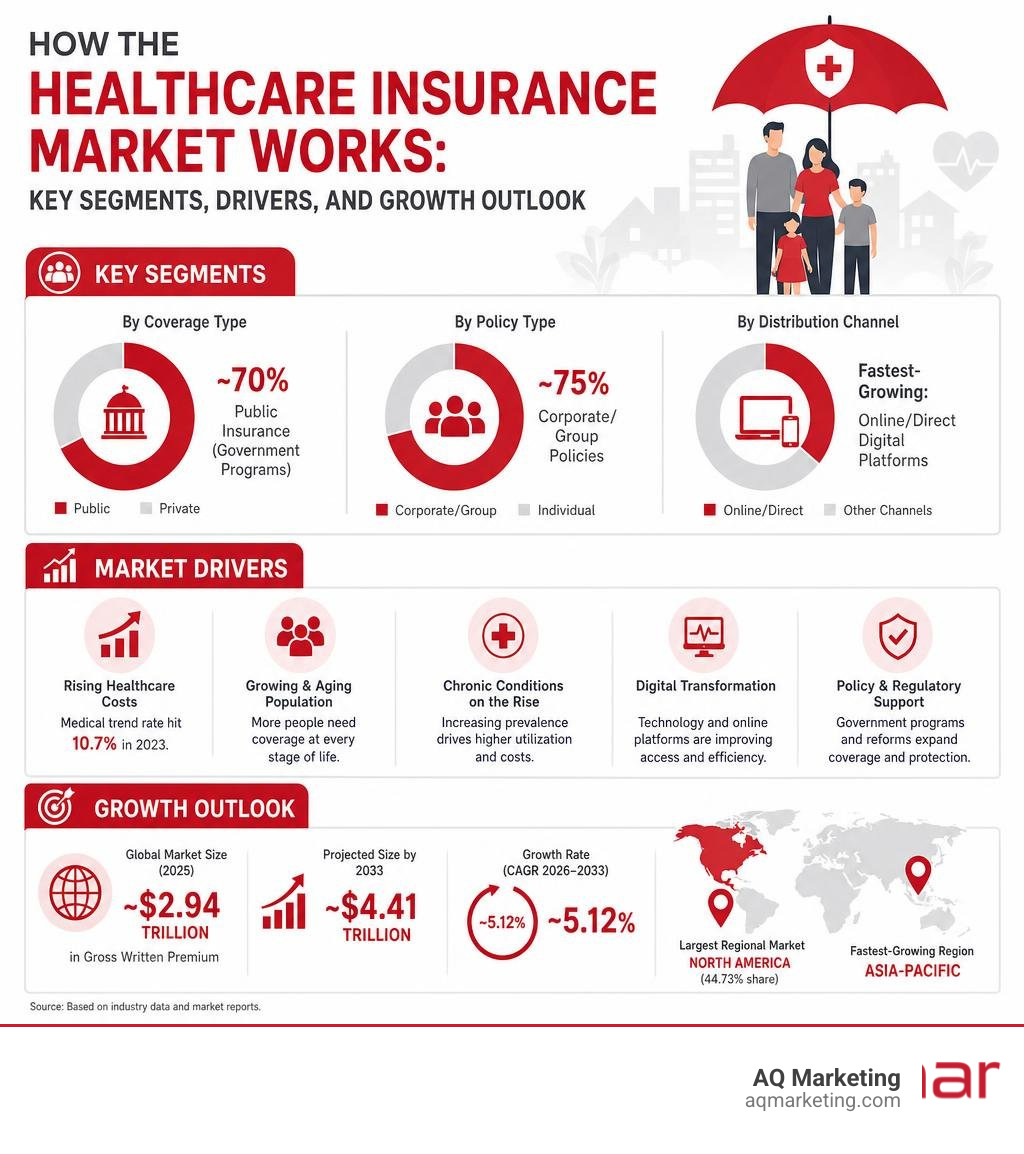
The healthcare insurance market is one of the largest and fastest-growing financial sectors in the world. Here’s a quick snapshot of what you need to know:
| Key Fact | Detail |
|---|---|
| Global market size (2025) | ~$2.94 trillion in Gross Written Premium |
| Projected size by 2033 | ~$4.41 trillion |
| Growth rate (CAGR 2026–2033) | ~5.12% |
| Largest regional market | North America (44.73% share) |
| Fastest-growing region | Asia-Pacific |
| Dominant segment | Public insurance (~70% share) |
| Largest policy type | Corporate/group policies (~75% share) |
| Fastest-growing channel | Online/direct digital platforms |
The market covers everything from employer-sponsored group plans and government programs like Medicare and Medicaid, to individual marketplace plans and private supplemental coverage. It touches nearly every person, business, and economy on the planet.
Why does this matter right now? Because costs are rising fast. The global medical trend rate hit 10.7% in 2023 — the first time it reached double digits. The average annual family premium in the U.S. reached $26,993 in 2025. And in 97% of U.S. metro areas, health insurance markets are considered highly concentrated, meaning consumers often have very few real choices.
Whether you’re a small business owner trying to offer competitive benefits, an insurance agent growing your book of business, or simply someone trying to make sense of your coverage options — understanding how this market works gives you a real advantage.
I’m Robert P. Dickey, President and CEO of AQ Marketing, Inc., and over my 20+ years helping small and mid-sized businesses grow their digital presence, I’ve worked closely with professionals navigating the healthcare insurance market — from independent agents to regional brokers building their brands online. In the sections ahead, I’ll break down the market’s size, structure, key trends, and what it all means in plain language.
Similar topics to healthcare insurance market:
Global Healthcare Insurance Market Size and Growth Projections
When we look at the global landscape, the sheer scale of the healthcare insurance market is staggering. In 2025, the global market size in terms of Gross Written Premium (GWP) was estimated at USD 2.94 trillion. Driven by demographic shifts, rising medical costs, and expanding employer benefits, the market is projected to reach USD 4.41 trillion by 2033. This represents a steady Compound Annual Growth Rate (CAGR) of 5.12% from 2026 to 2033.
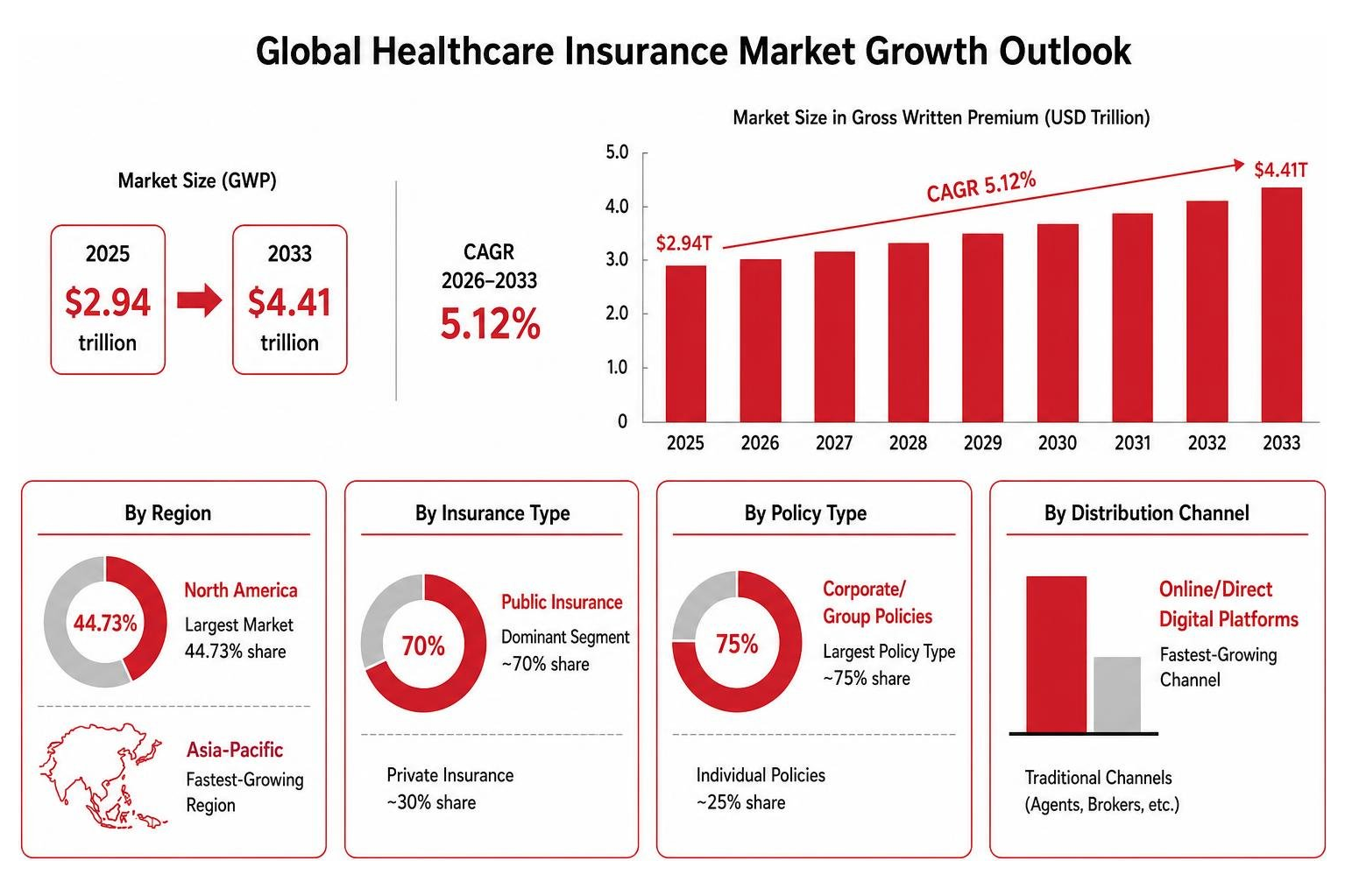
Historically, North America has dominated this space, accounting for a massive 44.73% of the global revenue share in 2025. This dominance is largely due to the highly privatized nature of the U.S. healthcare system, the widespread adoption of employer-sponsored plans, and high per-capita healthcare spending. However, while North America holds the largest slice of the pie, the Asia-Pacific region is emerging as the fastest-growing market. Rapid urbanization, an expanding middle class, and government-led initiatives to increase healthcare coverage are fueling double-digit growth in several Eastern markets.
To explore these macro trends in greater depth, you can read the comprehensive Healthcare Insurance Market Size | Industry Report, 2033.
Analyzing Public vs. Private Insurance Segments
The global healthcare insurance market is fundamentally split into two primary funding models: public (government-funded) and private (commercial) programs. Understanding the interplay between these two segments is crucial for any business, broker, or consumer looking to navigate the market successfully. You can find a detailed breakdown of these structural dynamics in the Health Insurance Market Size, Share & 2031 Growth Trends Report.
Public Programs and the Global Healthcare Insurance Market
Public healthcare insurance remains the largest segment globally, holding approximately 69.93% of the market share in 2025. These programs are funded by taxpayer dollars and administered by government bodies to provide universal or targeted coverage. In the United States, public programs are primarily represented by:
- Medicare: Federal health insurance for individuals aged 65 or older, as well as younger people with specific disabilities.
- Medicaid: A joint state and federal program that provides health coverage to low-income individuals and families.
While public programs provide an essential safety net, they face severe fiscal constraints. Aging populations and rising medical inflation are putting immense pressure on government budgets, leading many public administrators to collaborate with private insurers to manage care more efficiently. For residents looking for official state-level resources and public options right here in Massachusetts, you can access the official Health Care portal.
Private Providers and the Commercial Healthcare Insurance Market
Private or commercial health insurance is voluntary, typically funded through employer-sponsored group plans or purchased directly by individuals. While public programs cover more lives globally, private providers are growing at a rapid pace as consumers seek faster access to care, broader provider networks, and supplemental benefits that public plans do not offer.
In the U.S., private coverage is highly integrated with employment. However, state and local programs play an important role in how these benefits are organized. For example, many municipal employees in Massachusetts obtain their commercial coverage through local trusts, such as the Health Insurance Trust in Acton, MA. Similarly, towns like Acushnet, MA and Agawam, MA manage dedicated health benefits programs to ensure their local workforces have stable, high-quality commercial coverage.
Key Drivers and Restraints Shaping the Industry
Several powerful forces are pushing the healthcare insurance market forward, while others act as significant speed bumps.
Major Growth Drivers
- The Rise of Chronic Diseases: Non-communicable and chronic diseases (such as diabetes, heart disease, and mental health conditions) account for a vast majority of global healthcare spending. In the U.S., nearly 58% of commercially insured patients live with at least one chronic condition, driving continuous demand for comprehensive, long-term insurance policies.
- An Aging Population: As baby boomers age, the demand for geriatric care, long-term care, and Medicare Advantage plans is skyrocketing.
- Medical Innovation and Specialty Drugs: The rapid uptake of high-cost specialty medications, including GLP-1 weight-loss drugs, has dramatically increased the clinical efficacy of modern medicine—but it has also driven up the cost of care, making insurance coverage even more vital for the average consumer.
Market Restraints and Affordability Pressures
On the flip side, medical inflation is putting severe pressure on premium affordability. Global medical costs reached unprecedented levels recently, marking a transition into double-digit medical trend rates (rising to 10.7%).
This inflation has translated directly into higher out-of-pocket costs for businesses and individuals. The average annual premium reached $9,325 for single coverage and $26,993 for family coverage. Over a five-year period, family premiums have surged by 26%, which closely tracks wage growth but places a heavy burden on household budgets.
(Note: These premium figures are based on average national online data and do not represent any pricing or services offered by AQ Marketing. We specialize in digital marketing and SEO solutions to help insurance professionals grow their businesses!)
To cope with these rising costs, employers and consumers are increasingly opting for flexible, cost-saving plan designs. The table below outlines the primary commercial insurance networks utilized in the market today:
| Plan Type | Network Flexibility | Primary Care Physician (PCP) Required? | Out-of-Network Coverage? | Cost Structure |
|---|---|---|---|---|
| PPO (Preferred Provider Organization) | High | No | Yes | Higher premiums, lower out-of-pocket tracking |
| HMO (Health Maintenance Organization) | Low | Yes | No (except emergencies) | Lower premiums, predictable copays |
| HDHP (High-Deductible Health Plan with HSA) | Variable | No | Typically No | Lowest premiums, high deductible paired with tax-free savings |
Market Concentration and Competitive Landscape
For independent insurance agencies and regional brokers, competing in the commercial health insurance space can feel like a classic David vs. Goliath story. The market is highly consolidated, leaving smaller players to navigate a landscape dominated by a handful of massive corporate giants.
According to the American Medical Association (AMA), health insurance markets are experiencing historically high levels of concentration. Under federal guidelines, 97% of metropolitan area markets were classified as highly concentrated. This lack of competition is a growing concern for both healthcare providers and patients. In 91% of metro areas, a single commercial insurer holds a market share of 30% or greater, and in 47% of those areas, one insurer controls over 50% of the commercial market.
Nationally, the commercial health insurance market share is heavily dominated by these top players:
- UnitedHealth Group (16%)
- Elevance Health (12%)
- CVS (Aetna) (12%)
- Cigna (9%)
- Health Care Service Corp. (8%)
- Kaiser Permanente (6%)
The story is very similar in the rapidly growing Medicare Advantage segment, where UnitedHealth Group commands a 30% national market share, followed closely by Humana at 19%. UnitedHealth holds the largest Medicare Advantage share in 44% of all U.S. metro areas.
To read the full breakdown of how consolidation is reshaping choices and costs for consumers across the country, explore the AMA: 97% of health insurance markets are highly concentrated report.
For independent brokers and local agencies in Massachusetts, competing on broad national terms is nearly impossible. However, we have found that local agencies can successfully carve out a highly profitable niche by focusing on local SEO and hyper-targeted digital marketing. By establishing strong local authority online, independent agents can connect directly with local families and businesses looking for a personalized, human touch.
Digital Transformation, AI, and Distribution Channels
To protect their profit margins and improve customer retention in this highly competitive environment, insurance carriers are investing heavily in digital transformation. The traditional model of buying insurance exclusively through face-to-face meetings with local brokers is evolving into a hybrid ecosystem where digital platforms, AI, and direct-to-consumer channels take center stage.
The Rise of Insurtech and Digital Platforms
Online enrollment platforms and digital distribution channels are projected to grow at a rapid 13.7% CAGR. This shift is driven by a consumer demand for “one-click” simplicity. Insurers are partnering with technology firms to embed health insurance products directly into other consumer platforms. A prime example of this trend is Munich Re’s landmark acquisition of Next Insurance for $2.6 billion, which highlights the massive financial backing flowing into digital-first insurance models.
AI and Automation in Action
Artificial intelligence is no longer a futuristic concept—it is actively reshaping how claims are processed and how risk is assessed:
- Claims Adjudication: Major carriers are deploying AI models to automatically review and approve simple claims, reducing administrative overhead and speeding up payouts.
- Remote Health Assessments: In 2024, Star Health launched an innovative tool called Star Health Face Scan. This AI-driven tool allows users to perform a comprehensive health check-up in under a minute using a smartphone camera, analyzing 18 vital health parameters to assist in real-time risk assessment.
- Predictive Underwriting: Machine learning algorithms can analyze vast datasets to identify high-risk patients early, allowing insurers to introduce preventive care programs that keep overall treatment costs down.
To see how these shifting digital trends are translating to real-world coverage numbers locally, you can review the latest Health Insurance Enrollment Trends – CHIA report, which tracks how Massachusetts residents are enrolling in various public and private plans over time.
Frequently Asked Questions about the Healthcare Insurance Market
What is the projected growth of the global healthcare insurance market?
The global market is expected to grow from an estimated USD 2.94 trillion in 2025 to USD 4.41 trillion by 2033, representing a Compound Annual Growth Rate (CAGR) of 5.12% from 2026 to 2033. This growth is driven by medical inflation, aging global demographics, and an increased prevalence of chronic illnesses requiring long-term managed care.
How do employer-sponsored plans compare to individual policies?
Employer-sponsored (group) plans represent the largest share of the private market, covering roughly 75% of commercially insured individuals. Group plans offer the advantage of shared premium costs between the employer and employee, as well as more stable renewal cycles. Individual/family policies (often purchased through state or federal marketplaces) offer greater plan customization and portability, but they can be more expensive unless the buyer qualifies for federal premium subsidies.
What role does AI play in modern health insurance?
AI is primarily used to streamline administrative processes, automate claims processing, and improve risk underwriting. From virtual assistant chatbots that guide users through enrollment to advanced predictive algorithms that detect billing fraud and analyze health risks, AI is helping carriers lower operational costs and deliver faster customer service.
Conclusion: Growing Your Insurance Business in a Consolidated Market
The healthcare insurance market is undergoing a massive transformation. Between rising premium costs, heavy corporate consolidation, and rapid digital disruption, navigating this space requires a clear strategy.
If you are an independent insurance agent, a local brokerage, or a small business owner in Massachusetts, you don’t need a multi-billion-dollar corporate budget to stand out. What you do need is a strong, highly visible online presence.
At AQ Marketing, based in Woburn, MA, we have spent over two decades helping local businesses and insurance professionals outshine the corporate giants. We specialize in building high-performing, search-engine-optimized websites, managing local search visibility, and generating high-quality leads that help you grow your book of business. Whether you are looking to refine your local SEO or build a modern website that converts visitors into clients, we are here to help you deliver long-term, impactful results.
Ready to take your business to the next level? Explore our expert guide on Insurance Selling Strategies or contact us today to see how we can help you dominate your local market.
