
Why Insurance Facebook Marketing Is a Game-Changer for Agents
Insurance Facebook marketing is one of the most cost-effective ways for agents and agencies to generate qualified leads, build brand trust, and grow their book of business in 2026.
Here’s a quick overview of how it works:
- Set up a Facebook Business Page optimized with your license info, contact details, and professional imagery
- Declare your campaigns under Meta’s Special Ad Category for financial products to stay compliant
- Build audiences using first-party data, lookalike audiences, and broad interest targeting
- Create value-driven ad creative that speaks to universal needs like family protection and financial security
- Launch lead form or landing page ads to capture prospect information
- Follow up fast — ideally within five minutes — using automated SMS and CRM workflows
- Track key metrics like cost per lead, lead-to-appointment rate, and cost per acquisition to optimize and scale
The numbers back this up. Facebook has over 3.07 billion monthly active users, and remarkably, 57% of adults age 65 and older are active on the platform — a critical demographic for products like Medicare supplement and final expense insurance. Yet many agents are still leaving this opportunity on the table, either stuck boosting posts or running campaigns without a clear system behind them.
The challenge isn’t whether Facebook works for insurance. It does. The challenge is knowing how to use it correctly — especially given Meta’s strict compliance rules around insurance advertising.
I’m Robert P. Dickey, President and CEO of AQ Marketing, and with over 20 years of experience helping small and medium-sized businesses build effective digital marketing strategies, I’ve seen how a well-structured insurance facebook marketing approach can transform an agency’s lead pipeline. In this guide, we’ll walk you through every step — from setup and compliance to creative, targeting, and follow-up systems that actually convert.
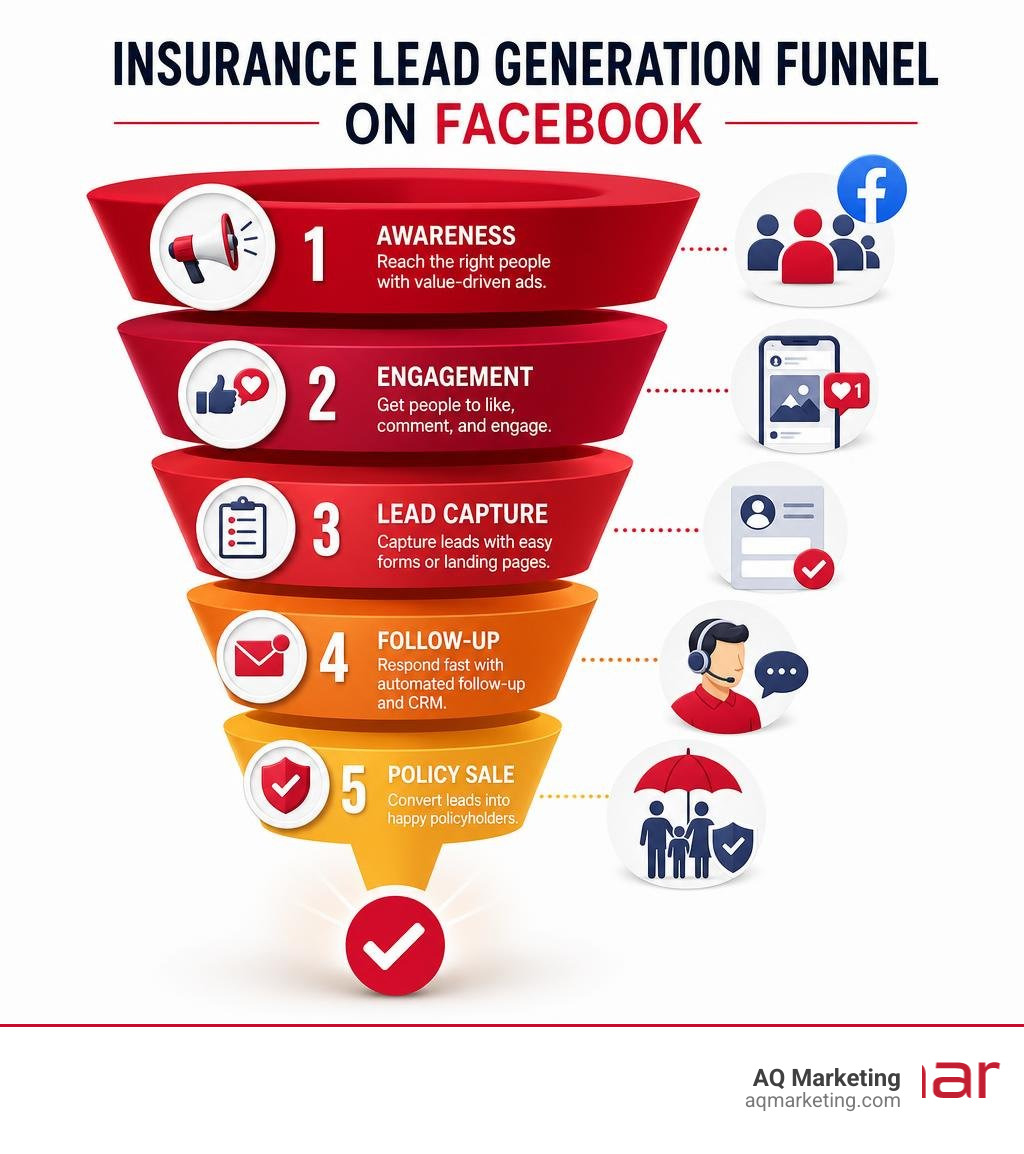
Insurance facebook marketing terms made easy:
Why Insurance Facebook Marketing is Essential for Modern Agencies
Historically, insurance agents from Boston to Worcester built their businesses on direct mailers, cold calls, and local networking events. While those traditional methods still have a place, consumer behavior has shifted dramatically. Today, when a homeowner in Newton or a business owner in Woburn needs coverage, they do their research online.
This is where social media comes in. Implementing a robust strategy for insurance facebook marketing allows local agencies to meet prospects where they already spend hours of their day. It transitions your agency from a cold-calling operation to a modern brand practicing “social selling.”
By leveraging Facebook, you can:
- Establish Local Authority: Share helpful updates, such as severe weather alerts for Eastern Massachusetts, safety tips for winter driving, or guides on commercial liability for local business owners. This positions your agency as a proactive community resource rather than a faceless corporation.
- Build Direct Relationships: Social media is a two-way street. It allows you to answer questions in real-time, reply to comments, and humanize your brand with team photos and community involvement highlights.
- Achieve Unmatched Cost-Efficiency: Compared to expensive direct mail campaigns or buying low-intent, shared web leads that are sold to five other agents simultaneously, Facebook ads allow you to build an exclusive pipeline of leads.
To fully capitalize on this platform, agencies must look beyond organic posts alone. Combining a polished organic presence with paid advertising is the ultimate recipe for growth. To understand how social media fits into your broader growth plan, explore our guides on Digital Marketing For Insurance Agents, the general Benefits Of Social Media Marketing, and our complete playbook on How To Market On Social Media.
Overcoming the Special Ad Category in Insurance Facebook Marketing
One of the most common pitfalls for insurance agents launching Meta campaigns is having their ad accounts restricted or suspended. This almost always happens because they failed to declare their ads under the Special Ad Category (SAC).
Meta classifies insurance products—including auto, home, life, health, and commercial policies—under the “Financial Services” or “Housing” Special Ad Categories. This classification is designed to prevent discriminatory advertising practices, but it introduces strict limitations that you must design your campaigns around:
- No Age or Gender Targeting: You cannot target specific age brackets (e.g., seniors turning 65 for Medicare) or restrict ads to a single gender.
- Limited Geographic Targeting: You cannot target by ZIP codes or use a radius smaller than 15 miles around a city or town.
- Restricted Interest Targeting: Many detailed demographic and interest-based targeting options are completely unavailable.
While these restrictions sound daunting, they actually level the playing field. When you partner with an experienced Fb Advertising Agency, you learn that success under these rules requires shifting your focus from hyper-segmented targeting to high-quality, value-driven ad creatives. Meta’s algorithm is incredibly smart; when given a broad audience, it uses your ad creative to find the right prospects. For a deeper look at navigating these setup rules, read Facebook Marketing Tips for Insurance Agents | EZLynx.
Building Trust with Compliant Insurance Facebook Marketing Creatives
Because you cannot rely on narrow targeting parameters, your ad creative (your images, videos, headlines, and copy) must do the heavy lifting of qualifying your audience. In the insurance industry, trust is your most valuable currency. People do not buy insurance policies; they buy peace of mind and financial security.
To build that trust compliantly while stopping the scroll:
- Use Authentic, Local Visuals: Swap out clinical, generic stock photos of umbrellas, car crashes, or handshakes. Instead, feature real images of your local team, your Woburn office, or recognizable local landmarks. If you are targeting homeowners, show a classic New England colonial home. Authentic visuals dramatically improve engagement.
- Keep Video Ads Short and Captioned: Video is the highest-performing format on Meta. Keep your video ads under 45 seconds, deliver a compelling hook in the first three seconds, and always include accurate captions. Up to 85% of users scroll with their sound off, so your message must be clear visually.
- Incorporate Specific Social Proof: Instead of writing “We have great customer service,” use a specific, compliant quote from a client: “I saved $480 a year by bundling my home and auto policies with a 10-minute phone call.”
- Structure Your Copy with the Problem-Question-Education Framework: Lead with a relatable question rather than a direct sales pitch. For example: “Tired of seeing your auto insurance premium rise every year without explanation? Here are three simple adjustments that can lower your rate without sacrificing your coverage.”
For more design inspiration and frameworks that convert, read our resource on Facebook Ad Design. To see real-world campaign layouts, check out 5 Insurance Facebook Ad Examples in 2026 and learn How to Use Facebook to Market Your Life Insurance….
Strategic Audience Targeting Under Meta Restrictions
With the Special Ad Category limitations in place, how do you get your ads in front of the right Massachusetts prospects? The secret lies in a combination of broad geographic targeting, life-event triggers, and creative-led audience filtering.

Instead of trying to force narrow demographics, successful agencies use these three compliant targeting strategies:
- Broad Geographic Targeting with Creative Qualification: Target the entire state of Massachusetts or a wide 15+ mile radius around major hubs like Boston, Worcester, or Springfield. In your ad copy, call out your target audience immediately: “Massachusetts Homeowners: Are you sure your policy covers coastal windstorm limits?” The copy filters out renters and out-of-state users, while Meta’s algorithm optimizes delivery to those who engage with the ad.
- Life-Event and Behavior Layering: While you cannot target by age, you can target users experiencing major life transitions that trigger insurance needs. Look for targeting options like:
- Newlyweds or Parents with newborns (ideal for life insurance)
- Likely to move or New home buyers (ideal for home and auto bundles)
- Small business owners (ideal for commercial lines, general liability, and workers’ comp)
- Proxy Interest Layering: If you are looking to connect with high-net-worth individuals for umbrella policies or high-value home insurance, layer interests associated with financial planning, estate planning, or luxury automotive brands rather than income levels.
Using these strategies allows you to remain 100% compliant while keeping your lead quality exceptionally high. For more tactical ideas, explore our Insurance Agency Marketing Tips and our list of 12 Easy Social Media Marketing Tips For Local Businesses.
Leveraging First-Party Data and Lookalike Audiences
The absolute most powerful tool at your disposal under Special Ad Category rules is your own first-party data. Your current policyholders, past quote requests, and email lists are marketing gold.
By securely uploading your customer database to Meta’s Business Manager, you can create Custom Audiences. Facebook matches your offline contact list (emails and phone numbers) to active profiles with a typical match rate of 60% to 70%.
Once built, you can leverage these audiences in two game-changing ways:
- Exclusion Audiences: Exclude your current clients from seeing your lead generation ads. This prevents you from wasting your ad budget showing “get a quote” ads to people who are already on your books.
- Lookalike Audiences (1% to 5%): Instruct Meta’s algorithm to analyze your best, most profitable policyholders and find millions of other users who share similar online behaviors, interests, and patterns. Lookalike audiences built from high-value customer lists consistently deliver the highest conversion rates and lowest cost per lead.
- Retargeting Campaigns: Set up dedicated Facebook Retargeting Ads to display ads to individuals who visited your website’s quote pages but left without completing the form. This keeps your agency top-of-mind during their decision-making process.
To see step-by-step instructions on setting up lookalike structures under current guidelines, check out Facebook Marketing For Insurance: Lead Gen Guide 2026.
Lead Form Ads vs. Landing Page Conversions
When setting up your campaign objective, you will face a critical choice: should you use Facebook Lead Ads (Instant Forms) or direct traffic to an external Landing Page on your website?
Each approach has distinct advantages and trade-offs.
| Feature | Lead Form Ads (Instant Forms) | Landing Page Conversions |
|---|---|---|
| User Experience | Seamless; forms auto-populate and open directly inside the Facebook app. | Requires user to click out of Facebook, waiting for an external website to load. |
| Lead Volume | Extremely high; very low friction means more users submit their info. | Moderate to low; higher friction filters out casual clickers. |
| Lead Quality | Variable; can include accidental submissions or outdated contact info. | Higher; users must manually type their details, demonstrating higher intent. |
| Customization | Limited to Meta’s standard fields and a few custom qualifying questions. | Unlimited; you can build multi-step quiz funnels and integrate calendar booking tools. |
| Technical Setup | Simple; built entirely within Meta Ads Manager. | Complex; requires a fast mobile site, custom landing page design, and Pixel/CAPI setup. |
To maximize your ROI, we often recommend starting with Lead Form Ads, but with a critical modification: add 2 to 3 custom qualifying questions. Instead of relying purely on auto-populated name and email fields, ask questions like: “When does your current policy expire?” or “Are you currently insured?” This minor friction filters out accidental submissions and significantly boosts lead quality.
If you choose the landing page route, ensure your website is optimized for mobile speeds (loading in under 3 seconds) and features clear, prominent call-to-actions. To dive deeper into optimization, read How To Get Conversions With Facebook Ads and learn more from Unlock High-Quality Leads: Facebook Ads for Insurance Agents.
Budgeting, Bidding, and Measuring Campaign ROI
Launching a successful campaign requires a strategic approach to budgeting and bidding. Too many local businesses make the mistake of spending $5 a day on a “boosted post” and wondering why they aren’t closing policies. To build a predictable lead machine, you must treat your ad spend as an investment in data.
- Choose the Right Budget Type: We recommend using Campaign Budget Optimization (CBO) with a daily budget rather than a lifetime budget. A daily budget of $20 to $50 per campaign is a healthy starting point to gather enough data for Meta’s algorithm to optimize.
- Allow Time for the Learning Phase: Do not make major changes to your campaigns within the first 7 to 10 days. Meta’s system requires roughly 50 conversion events per ad set to exit the “learning phase” and stabilize performance.
- Focus on Metrics That Matter: Avoid getting distracted by vanity metrics like “likes,” “shares,” or “clicks.” Instead, focus your attention on:
- Cost Per Lead (CPL): How much does it cost to acquire a prospect’s contact details?
- Lead-to-Appointment Rate: What percentage of leads actually pick up the phone or schedule a consultation?
- Cost Per Acquisition (CPA): What is the total ad spend divided by the number of bound, paid policies?
- Customer Lifetime Value (LTV): Compare your CPA against the long-term value (including renewals and multi-policy bundles) of your clients.
Understanding these financial metrics is what separates profitable agencies from those that lose money on digital ads. To learn more about how social advertising budgets compare to search engine marketing, read Social Media Ads Vs Search Ads Whats The Difference 2. For a fascinating look at how major national brands optimize their digital ad spend, see Insurance is Boring. Their Social Spend Isn’t. – Browsi.
Frequently Asked Questions About Insurance Facebook Ads
How much do insurance Facebook ads typically cost?
The cost of insurance facebook marketing campaigns varies widely depending on your specific location, target demographic, and the type of insurance product you are promoting. Highly competitive lines like commercial general liability or Medicare supplements in dense metropolitan areas generally command higher costs than local renters or auto insurance campaigns.
Based on average online marketing industry data, the typical cost per lead (CPL) for insurance campaigns on Meta platforms ranges from $15 to $55 per lead.
Please note: This pricing is based on average online data and does not represent AQ Marketing’s actual service pricing. In highly competitive markets or for complex commercial insurance products, lead costs can scale significantly higher, with a wide spread reaching up to $165+ per lead on the high end.
When evaluating these costs, always calculate your conversion rates. If you close 20% of your leads, and your average first-year commission on a bundled policy is $800, spending $30 per lead is incredibly profitable.
What is the Special Ad Category for insurance?
The Special Ad Category (SAC) is a compliance framework mandated by Meta to prevent discriminatory practices in housing, employment, credit, and financial services. Because insurance is classified as a financial service, all insurance ads must be declared under this category during campaign creation.
Failing to select this category will result in your ads being rejected, and repeated violations will lead to your Facebook Business Manager and personal ad accounts being permanently disabled. Under the SAC, you cannot target by age, gender, ZIP code, or use specific demographic exclusions. Compliance is non-negotiable, and designing your creative strategy around these rules is the only way to achieve long-term success. For specialized insights on compliance in senior markets, read Advertising Medicare Through Facebook – Ritter Insurance Marketing.
How do I follow up with leads generated from Facebook?
The quality of your follow-up system is just as important as the quality of your ad creative. Facebook leads are often “top-of-funnel”—meaning they may have submitted their information while scrolling through their feed, but they aren’t necessarily sitting by the phone waiting for a call.
To maximize your conversion rates:
- The 5-Minute Rule: You must contact a new lead within the first five minutes of submission. Your chances of connecting drop by over 80% after those first five minutes.
- Automate the Initial Touch: Use integration tools like Zapier to instantly connect Facebook Lead Forms to your agency’s CRM. Set up an automated workflow to send an immediate, personalized SMS and email the second they submit.
- Implement a Multi-Touch Nurture Sequence: If they don’t answer the first call, don’t give up. A standard sequence should include a mix of phone calls, text messages, and educational emails spread over 7 to 14 days.
To learn more about converting cold prospects into loyal, long-term clients, read our guide on From Prospect To Policy Effective Insurance Broker Marketing Tactics.
Conclusion
Mastering insurance facebook marketing is one of the most powerful moves your agency can make to build a predictable, scalable lead generation system. While Meta’s compliance rules and Special Ad Category restrictions require a strategic shift, they also present a massive opportunity. By focusing on authentic, local creatives, leveraging your first-party data, and establishing a lightning-fast follow-up workflow, you can outpace your competitors and keep your pipeline full.
At AQ Marketing, we have been helping small and medium-sized businesses in Woburn, MA, and across the state build robust online presences since 2003. We specialize in taking the complexity out of digital marketing, delivering customized website designs, powerful SEO, and high-performing social media campaigns that drive long-term, impactful results.
Ready to stop guessing with your marketing budget and start generating high-quality, exclusive insurance leads? Partner with AQ Marketing for Social Media Advertising Services or book a 15-minute phone call with our team today to discuss your agency’s growth goals!