

Why Insurance Defense Marketing Is Different — And Why It Matters
Insurance defense marketing is a specialized form of B2B legal marketing where law firms promote their services directly to insurance carriers, third-party administrators (TPAs), and corporate legal departments — not to individual consumers.
If you’re a law firm looking to grow your insurance defense practice, here’s what you need to know right away:
What insurance defense marketing involves:
- Getting appointed as panel counsel for insurance carriers
- Building relationships with claims adjusters, examiners, and risk managers
- Demonstrating value through results, cost efficiency, and responsiveness
- Maintaining a professional digital presence that signals carrier-readiness
- Competing in a market where carriers hold significant leverage — there are over one million lawyers in the U.S. but only a few thousand insurance companies
Why it’s hard to get right:
- Carriers use formalized application processes, not just personal connections
- Selection criteria include technology compliance (like LEDES billing), trial capabilities, and diversity
- COVID accelerated the shift away from traditional in-person rainmaking toward structured digital outreach
- Panel openings are affected by carrier consolidations and evolving performance metrics
Being named panel counsel is not easy. But with the right strategy, it’s absolutely achievable — and the payoff is a steady, high-volume stream of defense files across multiple lines of property and casualty (P&C) insurance.
I’m Robert P. Dickey, President and CEO of AQ Marketing, with over 20 years of experience helping small and mid-sized businesses build their digital presence — including navigating the unique demands of insurance defense marketing. In the sections ahead, I’ll walk you through exactly how to position your firm to win and keep panel counsel appointments.
Relevant articles related to insurance defense marketing:
- insurance agency marketing tips
- digital marketing for insurance agents
- insurance customer retention strategies
The Fundamentals of Insurance Defense Marketing
At its core, insurance defense marketing is purely a business-to-business (B2B) endeavor. Unlike personal injury or family law practices that market directly to the public, defense firms must appeal to highly sophisticated buyers: insurance carrier claims professionals, corporate risk managers, and third-party administrators (TPAs).
In this ecosystem, the ultimate prize is securing a spot on a carrier’s approved list, commonly known as “panel counsel.” When an insured policyholder gets sued, the carrier selects a firm from this pre-approved panel to handle the defense.
Because carriers manage massive volumes of litigation across various property and casualty (P&C) lines—such as auto liability, construction defect, general liability, professional liability, and workers’ compensation—getting on these panels ensures a consistent docket of cases. However, this is a volume-based business. Carriers leverage their massive purchasing power to negotiate lower hourly rates in exchange for steady file flow.
To stand out in this competitive landscape, firms must align their messaging with the strategic priorities of the carriers. This is where modern digital strategies come into play. By utilizing targeted B2B strategies, such as Digital Marketing for Insurance Companies, firms can position themselves as efficient, compliant partners rather than just legal technicians.
How to Become Panel Counsel for Insurance Carriers
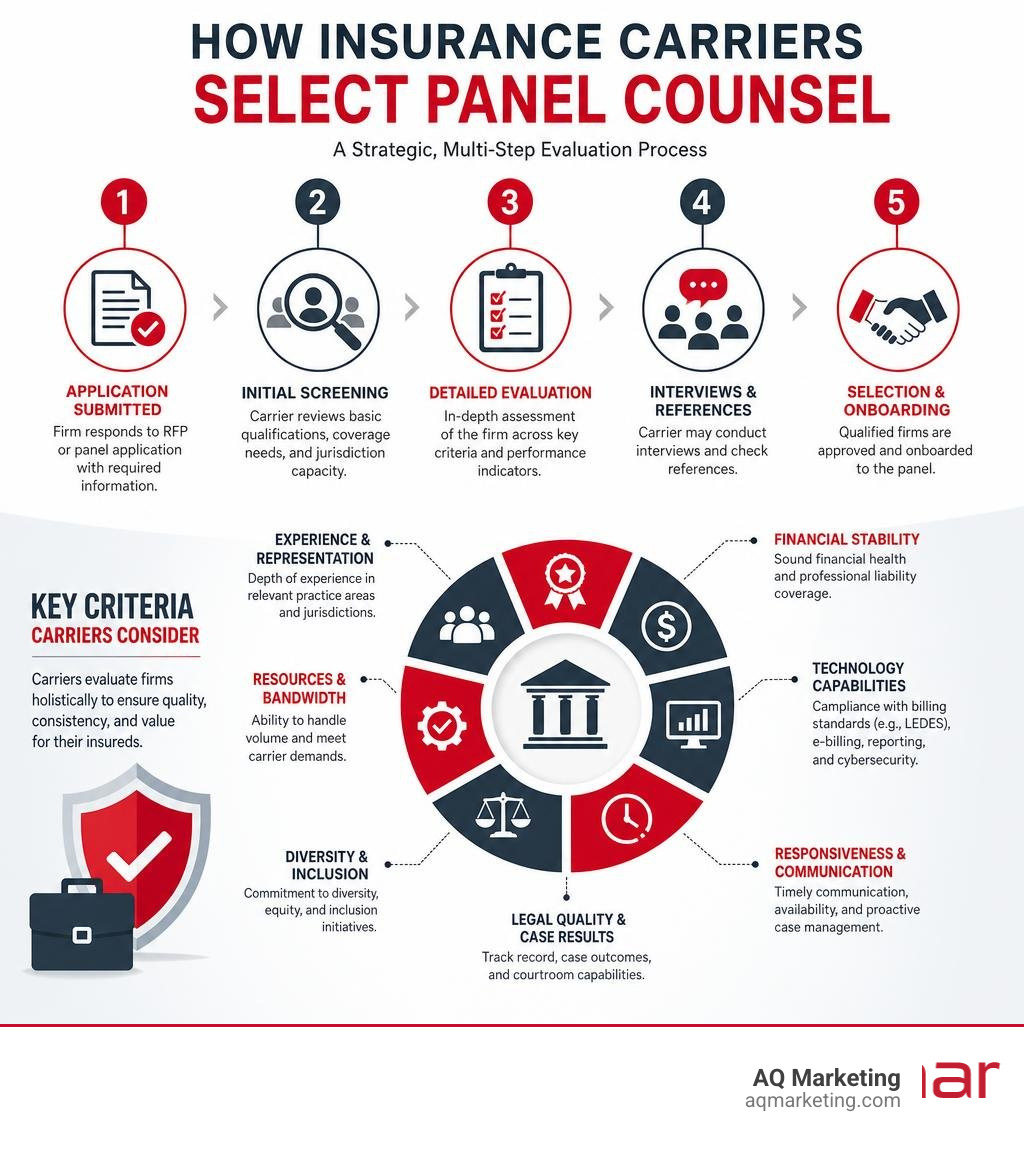
Securing a spot on an insurance panel requires a disciplined, structured business development process. It is no longer as simple as taking a claims manager out to lunch; today’s carriers rely on formalized procurement and legal operations departments to vet outside counsel.

The typical application process involves several key steps:
- The Initial Inquiry and Application: Firms must submit a formal panel counsel application. This document details the firm’s practice areas, geographic coverage, attorney rosters, and trial history.
- Review of Litigation Guidelines: Carriers have strict, non-negotiable litigation management guidelines. These rules dictate everything from how often you must provide status updates to which tasks are billable.
- Billing and Tech Audits: To even be considered, your firm must support LEDES (Legal Electronic Data Exchange Standard) electronic billing and be compatible with legal spend management platforms like TyMetrix or CounselLink.
Many firms look to established national standards and regional leaders to model their proposals. For instance, studying how prominent regional firms structure their service offerings—such as the approach outlined by Insurance Defense Attorneys & Legal Services | Adams & Reese —can provide valuable insights into what national carriers expect from their outside counsel.
Key Selection Criteria for Insurance Defense Marketing Success
When claims executives and legal operations teams evaluate panel applications, they look at several operational and technical criteria:
- Cost Efficiency and Billing Compliance: Carriers have zero tolerance for block billing or excessive associate hours. Firms must demonstrate that they can resolve cases efficiently without padding the bill.
- Trial Capabilities: While most cases settle, carriers want panel attorneys who are not afraid to go to trial. A proven track record of defense verdicts gives the carrier leverage during settlement negotiations.
- Responsiveness: The primary reason carriers terminate relationships with law firms is not a lost case—it is poor communication. Next-business-day response times and proactive reporting are mandatory.
- Geographic and Local Court Experience: Carriers want attorneys who know the local judges, opposing counsel, and jury pools. If you are targeting panels in Massachusetts, you must highlight your deep roots in specific venues. For example, local credibility is highly valued, whether you are positioning your firm among the Best Insurance Defense Lawyers in Massachusetts – Justia or highlighting local trial experience in specific municipal courts.
- Technology Requirements: Your firm must have robust cybersecurity protocols to protect sensitive claimant data, alongside seamless case management systems.
Overcoming Challenges in Modern Insurance Defense Marketing
The landscape of insurance defense marketing has shifted dramatically. In the post-COVID era, the traditional “old boys’ club” of legal marketing has largely vanished. In-person networking has been replaced by formalized online portals, structured RFPs, and digital vetting.
Furthermore, carriers are increasingly consolidating, meaning there are fewer panels available, and those that exist are highly competitive. To overcome these hurdles, defense firms must adapt to:
- Formalized Digital Applications: Applications are increasingly managed through vendor portals where algorithms screen for key terms, technology compliance, and diversity metrics.
- Cybersecurity Standards: Law firms are prime targets for hackers. Carriers now require outside counsel to pass rigorous security audits.
- AI Integration: Forward-thinking carriers are starting to use AI tools to audit legal bills and even predict case outcomes. Defense firms that leverage AI for legal research and administrative efficiency can offer lower costs and quicker resolutions, making them highly attractive to tech-enabled carriers.
Designing a High-Performance Website for Insurance Defense Firms
Your website is your firm’s digital dossier. When a panel coordinator or claims manager receives your application, the very first thing they will do is search your firm online to verify your credentials.
If your website looks like a consumer-facing personal injury site with flashing “Free Consultation” buttons, you will be rejected immediately. Carriers expect a polished, corporate-grade online experience.
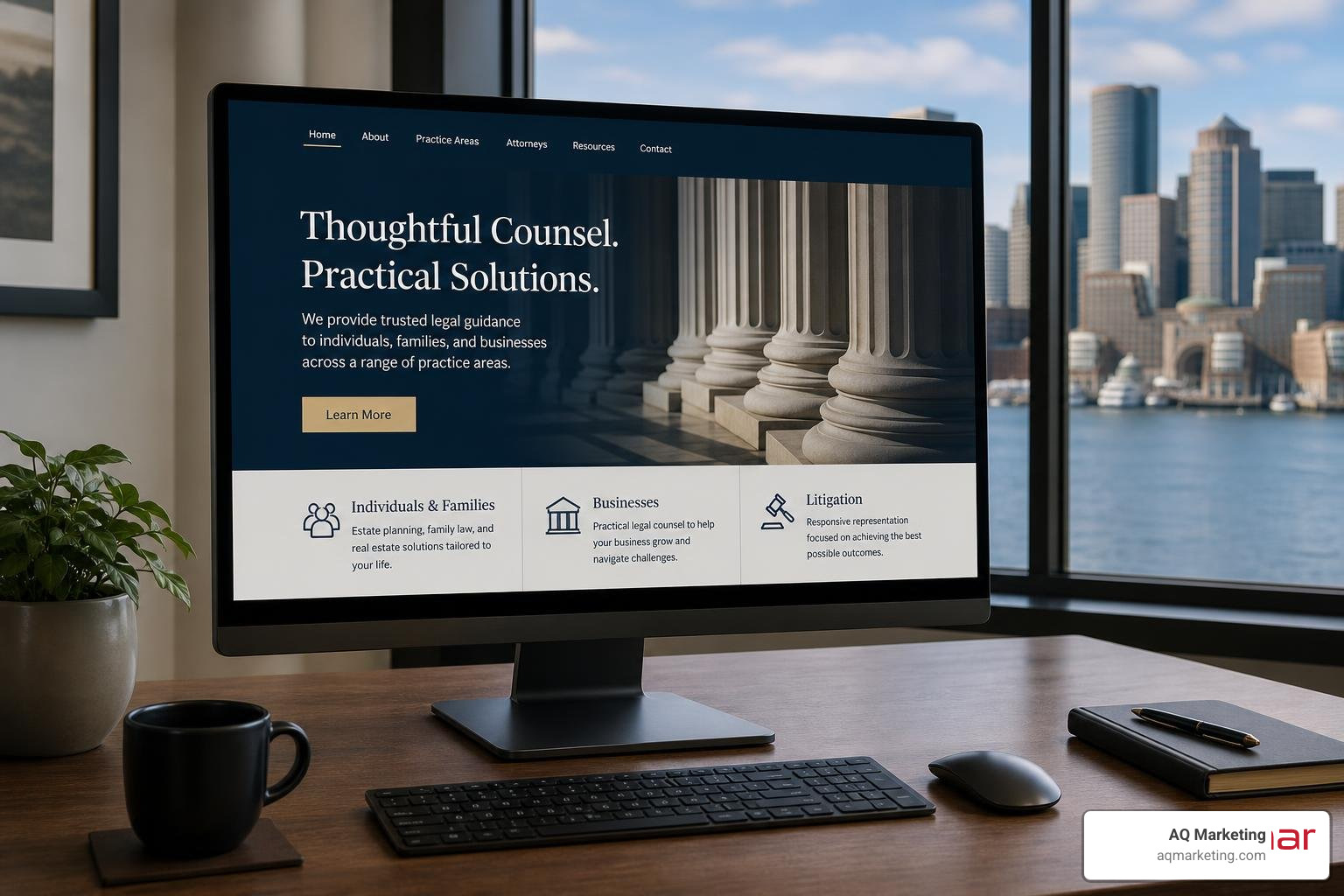
To build credibility with sophisticated B2B buyers, your website design must focus on several core elements:
- Practice Area Pages: Clearly define your expertise across specific P&C lines. Instead of generic “litigation” pages, create dedicated sections for auto liability, construction defects, and professional lines.
- Substantive Attorney Bios: Claims professionals buy the attorney, not just the firm. Bios should feature verifiable credentials, jurisdictional admissions, representative defense verdicts, and clear headshots.
- Geographic Coverage: Make it easy for a claims manager to see exactly where you can handle files. If you practice in Massachusetts, explicitly list your coverage areas. A carrier looking for representation in Bristol County will actively search for the Best Lawyers in Acushnet, MA – Justia , while a carrier in Hampden County will look for the Best Insurance Defense Lawyers in Springfield, MA – Justia .
- Corporate Standards and Compliance: Ensure your site is fast, mobile-friendly, secure (HTTPS), and fully ADA-compliant.
To understand how to align your digital presence with corporate expectations, you can explore our guide on Beyond the Brochure: Essential Website Design Management for Insurance Agents. While written for agents, the principles of building institutional trust and professional brand standards apply perfectly to defense firms.
Content Marketing and Thought Leadership for Claims Professionals
Claims professionals and risk managers are constantly navigating changing statutes, landmark appellate decisions, and evolving venue dynamics. You can position your firm as an indispensable resource by producing high-value, educational content.
Rather than publishing generic legal updates, focus on producing highly specialized thought leadership:
- Jurisdictional and Legislative Analyses: Write detailed breakdowns of how new state laws or court rulings will affect claims evaluation and litigation exposure in your specific markets.
- Educational Seminars and CLEs: Offering free, virtual Continuing Legal Education (CLE) webinars to carrier claims teams is one of the most effective, compliant ways to get your attorneys in front of key decision-makers.
- E-Newsletters: Keep your firm top-of-mind by sending monthly or quarterly newsletters summarizing recent defense verdicts and legal trends.
By shifting your focus from self-promotion to educational value, you build “topical authority” that search engines and AI tools recognize. For more tactical ideas on structuring your content, check out our insights on Content Marketing for Insurance Companies.
For a deeper dive into structured business development campaigns tailored specifically for defense practices, you can also review the specialized resources provided by Insurance Defense Marketing | How to Be Panel Counsel .
Balancing Panel Work with Direct-Pay and SIR Clients
While insurance panels provide a steady, reliable volume of files, relying solely on low-rate carrier work introduces significant client concentration risk. If a major carrier consolidates or changes its panel strategy, your firm could lose a massive portion of its revenue overnight.
To mitigate this risk, successful defense firms use their panel credentials as leverage to secure higher-rate “direct-pay” or Self-Insured Retention (SIR) work directly from corporate clients and commercial insureds.
| Feature | Panel Counsel Work | Direct-Pay / SIR Work |
|---|---|---|
| Primary Client | Insurance Carrier (on behalf of insured) | Corporate Insured / Commercial Client |
| Hourly Rates | Lower, pre-negotiated volume rates | Higher, standard corporate rates |
| Billing Guidelines | Extremely strict (LEDES, audit software) | Standard corporate billing protocols |
| Case Volume | High, steady, and automated | Lower volume, relationship-dependent |
| Decision Maker | Claims Adjuster / Legal Ops | Corporate General Counsel / Risk Manager |
To successfully transition a carrier-assigned matter into subsequent direct-pay business, firms must be methodical:
- Establish a Business Development Committee: Do not leave direct-client acquisition to chance. Create an internal committee to review every new commercial insured assigned by a carrier.
- Identify Decision-Makers Early: During the initial phases of a defense file, identify the corporate general counsel or risk manager at the insured business.
- Over-Deliver on Service: Treat the insured client with the highest level of care. Demonstrate your deep understanding of their industry and business operations.
- Make the Pitch: Before the case wraps up, present a strategic plan outlining how your firm can assist them directly with non-carrier matters, corporate compliance, or direct-pay litigation.
For broader strategies on transitioning relationships into direct business, our guide on From Prospect to Policy: Effective Insurance Broker Marketing Tactics provides excellent frameworks for B2B relationship building.
Frequently Asked Questions
How do firms measure success in insurance defense marketing?
Firms should track both business development and operational key performance indicators (KPIs), including:
- Panel Appointments: The number of new carrier panels joined per year.
- File Volume and Allocation: The total number of active files assigned by each carrier.
- Billing Realization Rates: The percentage of billed hours actually paid after carrier audits and write-downs.
- Carrier Satisfaction and Retention: Average lifespan of a panel relationship and qualitative feedback from claims managers.
What are the key industry associations for networking?
Building relationships with claims professionals requires active participation in industry-specific organizations. The most important associations include:
- Defense Research Institute (DRI): The leading international organization of defense attorneys.
- Claims and Litigation Management Alliance (CLM): A massive network of claims professionals and defense counsel.
- Federation of Defense & Corporate Counsel (FDCC): An elite, invitation-only organization for defense trials.
Participating in these events and studying the positioning of established local leaders—such as the regional defense strategies showcased by Insurance Defense – Boston, Massachusetts Litigation Law Firm —will help you align your networking efforts with local industry standards.
How should firms handle relationship-building given gift restrictions?
Today, almost every major insurance carrier has strict compliance guidelines prohibiting adjusters and claims managers from accepting expensive dinners, sporting event tickets, or physical gifts.
To build strong relationships ethically and compliantly:
- Offer Non-Billable Advice: Let claims adjusters know they can call you for quick, informal, non-billable advice on a tough file or jurisdictional question. This builds immense goodwill.
- Provide Educational Value: Host complimentary on-site or virtual educational seminars for their claims departments.
- Focus on Professional Respect: The best relationship-builder is consistently delivering excellent results, meeting deadlines, and making the adjuster’s job easier.
Conclusion
Mastering insurance defense marketing in 2026 requires a shift from old-school networking to a modern, digitally driven B2B strategy. To win and keep lucrative panel counsel appointments, your firm must present a highly professional, tech-compliant, and authoritative digital presence.
At AQ Marketing, we have spent over two decades helping businesses across Massachusetts—from our home base in Woburn to clients in Boston, Springfield, and beyond—enhance their online presence and drive sustainable growth. Whether you need a corporate-grade website redesign, a targeted SEO program to build topical authority, or content marketing that appeals to claims professionals, we have the expertise to help your firm stand out.
Ready to take your firm’s business development to the next level? Book a 15-Minute Phone Call with us today, and let’s discuss how we can build a compliant, high-performance marketing system tailored to your practice.
