Why Most Startups Fail Before They Find Their First 100 Customers
Startup customer acquisition is the single biggest challenge standing between a great idea and a real business. You can have a solid product, a sharp brand, and a well-designed website — and still struggle to find paying customers.
Here is a quick answer if that is what you need right now:
How to acquire customers as a startup (without going broke):
- Define your Ideal Customer Profile (ICP) before spending a dollar on marketing
- Start with manual outreach — personalized emails, cold DMs, community engagement
- Pick 1-2 channels and validate them before scaling
- Track your Customer Acquisition Cost (CAC) against Customer Lifetime Value (LTV)
- Aim for a 3:1 LTV:CAC ratio as your profitability benchmark
- Double down on what works — then build repeatable systems around it
- Don’t ignore retention — a 5% improvement in retention can boost profits by up to 95%
The hard truth? Most early-stage founders spend money before they understand who they are selling to or why those people should buy. According to CB Insights, the top reasons startups fail include no market need and running out of cash — both of which trace back directly to poor acquisition strategy.
The good news is that building a smart, budget-conscious customer acquisition plan is entirely possible. It just requires the right sequencing.
I’m Robert P. Dickey, President and CEO of AQ Marketing, and with over 20 years of experience helping small and medium-sized businesses grow through digital marketing, I have seen what separates startups that scale from those that stall on startup customer acquisition. In the sections ahead, I will walk you through a practical, phase-by-phase plan to attract and convert customers — without draining your budget.
Startup customer acquisition glossary:
The Economics of Startup Customer Acquisition: CAC vs. LTV

Before you choose channels, write ads, publish content, or hire help, you need to understand the basic math of customer acquisition.
Customer Acquisition Cost (CAC) is the total amount you spend to win one new customer. That includes marketing, sales, software, advertising, outsourced support, and the time your team spends converting prospects.
Customer Lifetime Value (LTV) is the total revenue or gross profit a customer is expected to generate while they remain a customer.
A simple way to think about it:
- CAC answers: “What did it cost us to get this customer?”
- LTV answers: “What is this customer worth over time?”
The relationship between the two determines whether your growth is healthy or whether you are buying revenue at a loss.
A common benchmark for a strong business model is a 3:1 LTV:CAC ratio. In plain English, if it costs $100 to acquire a customer, that customer should eventually produce about $300 in value.
That said, startups are not established companies. Established businesses usually have stronger brand recognition, better conversion data, proven sales scripts, customer reviews, search visibility, and referral momentum. Startups are often still testing the offer, the audience, the pricing, and the message. That means early CAC can be higher and messier.
The danger is not having a high CAC while learning. The danger is scaling before you know why your CAC is high.
For a deeper look at why acquisition cost can make or break a young company, the classic article Startup Killer: the Cost of Customer Acquisition – For Entrepreneurs is worth reading. We also recommend reviewing New Business, New Budget: Navigating Startup Marketing Costs if you are planning your first serious marketing budget.
Defining the Ideal Customer Profile (ICP) and Product-Market Fit
Your Ideal Customer Profile, or ICP, is not “anyone who might buy.” That is not a customer profile. That is a panic attack wearing a marketing hat.
A useful ICP identifies the people or businesses most likely to:
- Feel the problem strongly
- Have budget or authority to act
- Understand your value quickly
- Convert without excessive education
- Stay long enough to become profitable
- Refer others or expand over time
For B2B startups, your ICP may include company size, industry, location, role, budget, tech stack, buying trigger, and pain point. For B2C startups, it may include demographics, behavior, intent, lifestyle, urgency, and preferred buying channel.
But your ICP should not be built from guesses alone. Use:
- Customer interviews
- Sales call notes
- Website analytics
- Search query data
- Competitor review patterns
- Social media comments
- CRM data
- Local market research
- Feedback from early users
Product-market fit comes next. You have product-market fit when a clear group of customers repeatedly chooses your solution because it solves a real problem better, faster, cheaper, or more conveniently than their alternatives.
Signs you are getting close include:
- Customers describe the value in their own words
- People refer others without being pushed
- Trial users activate quickly
- Churn starts to decline
- Sales conversations become easier
- Support questions become more predictable
- Customers would be disappointed if the product disappeared
Before you pour money into paid acquisition, make sure you have enough evidence that your product, message, and audience are aligned. Our guide on The Early Bird Gets the Leads: Essential Marketing for New Ventures explains why early marketing should focus on learning as much as leads.
Calculating the True Cost of Customer Acquisition
Many startups undercount CAC. They include ad spend but forget the sales tools. Or they include software but ignore founder time. Or they celebrate “free” organic leads without recognizing the cost of content, website work, SEO, and follow-up.
A better approach is blended CAC:
Blended CAC = Total sales and marketing costs / Number of new customers acquired
Costs may include:
- Paid ad spend
- Website design and landing pages
- SEO and content creation
- Email marketing tools
- CRM software
- Sales salaries or commissions
- Founder sales time
- Marketing contractors or agencies
- Events, sponsorships, or printed materials
- Lead data tools
- Onboarding and sales support costs
Industry benchmarks vary widely. Research cited in startup CAC benchmark studies shows an average CAC of around $273 for B2B SaaS startups and $68 for B2C eCommerce startups. These are broad benchmarks, not targets. A local service business, insurance startup, SaaS platform, or consumer product may see very different numbers.
Important pricing note: any cost ranges mentioned in this article are based on average online data and general industry research. They do not represent AQ Marketing’s actual pricing. Typical acquisition-related costs can range broadly from $50 to $1,500+ per customer, and in some industries far higher, depending on market, sales cycle, competition, and channel mix.
| Business Type | Typical CAC Pattern | Why It Differs | Watch Closely |
|---|---|---|---|
| B2B SaaS | Higher, often longer payback | More sales touches, demos, onboarding | CAC payback, trial conversion, churn |
| B2C eCommerce | Lower per customer, lower LTV | Faster purchase decisions, more price sensitivity | Repeat purchase rate, ROAS, email revenue |
| Local service startups | Varies by location and urgency | Search intent and reviews matter heavily | Cost per lead, booking rate, review quality |
| Professional services | Higher but potentially strong LTV | Trust, expertise, and referrals drive sales | Lead quality, close rate, referral source |
The goal is not to have the lowest CAC possible. The goal is to have a CAC that makes sense relative to LTV, cash flow, and growth stage.
The Three Phases of a Sustainable Growth Strategy
The biggest acquisition mistake we see is trying to act like a mature company before you have startup-level evidence.
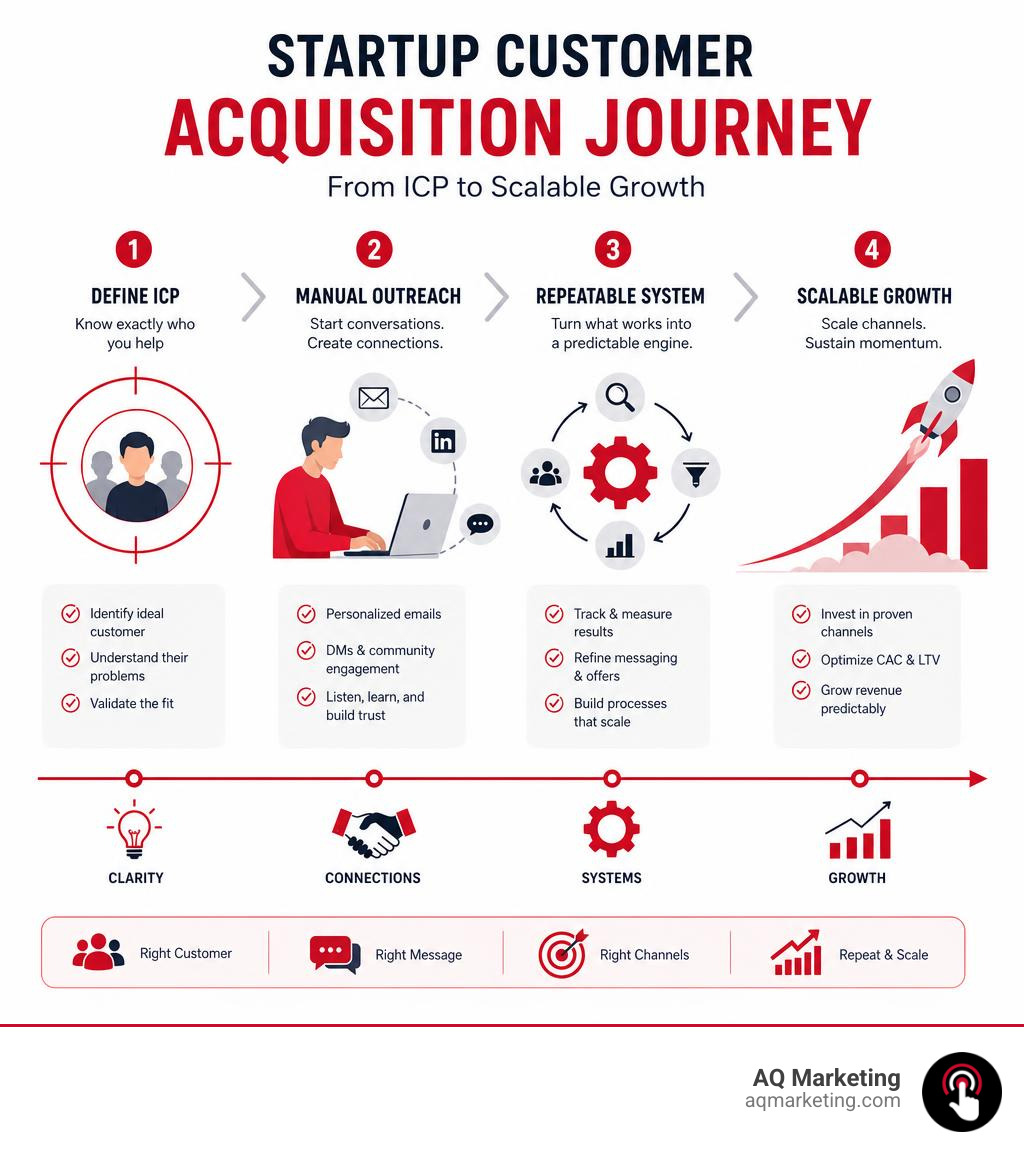
A startup customer acquisition plan should evolve in phases:
- Manual hustle
- Repeatable process
- Scalable growth engine
Each phase has a different job. If you skip ahead, you risk spending money to amplify confusion.
The best growth systems are sequenced. First, know the customer. Then refine the message. Then build the machine. Case studies like Building a growth engine from zero: How one COO boosted ARR 38% using Claude Code – Bessemer Venture Partners show how important it is to understand customer segments and attribution before scaling channels.
For brand-building basics, see Startup Marketing Magic: 5 Strategies to Ignite Your Brand.
Phase 1: Manual Hustle and Early Startup Customer Acquisition
In the beginning, the best acquisition strategy is usually not automation. It is conversation.
Your first 10 customers often come from tactics that do not scale:
- Personalized emails
- Thoughtful cold DMs
- Founder-led sales calls
- Local networking
- Community participation
- Asking for introductions
- Commenting helpfully in niche forums
- Direct outreach to people already showing pain
- Early user interviews that turn into sales conversations
This is not glamorous. There are no dashboards with hockey-stick graphs. There may be coffee. There may be awkward follow-ups. There may be a spreadsheet named “leadsfinalFINALreallyfinal.xlsx.”
But manual outreach teaches you what no ad platform can: the real language of your customers.
Useful early-stage outreach is specific, short, and customer-centered. It should show that you understand the person’s problem and offer a low-friction next step. Research on early acquisition playbooks consistently points to one theme: the first customers usually come from personal, unscalable effort, not broad broadcasting.
Helpful resources on this stage include First 100 Customers With Zero Budget: A Brutally Honest Playbook — Foundry Blog and First 100 Customers With No Network: A Solo Founder Playbook — PADEZHNOV.
At this phase, track:
- Reply rate
- Call booking rate
- Objections
- Close rate
- Time to close
- Activation rate
- Why people say yes
- Why people say no
Do not obsess over scale yet. Your goal is signal.
Phase 2: Building a Repeatable Sales Machine
Once you have 10 to 100 customers, patterns should start to appear.
You may notice that certain industries convert faster. Or that one landing page message beats another. Or that customers from referrals stay longer. Or that prospects who ask one specific question are more likely to buy.
Now your job is to turn scattered wins into a repeatable system.
This usually includes:
- A clear landing page
- A simple offer
- Lead capture forms
- CRM tracking
- Email follow-up
- Sales scripts or call outlines
- Basic attribution
- Review and testimonial collection
- Content that answers buyer questions
- A defined handoff from lead to customer
This is also the right time to strengthen your website. A startup website should not just “look nice.” It should explain who you help, what problem you solve, why you are credible, and what the visitor should do next.
Our article The Big Reveal: Mastering Your Startup’s Launch Marketing covers how launch messaging and acquisition systems should work together.
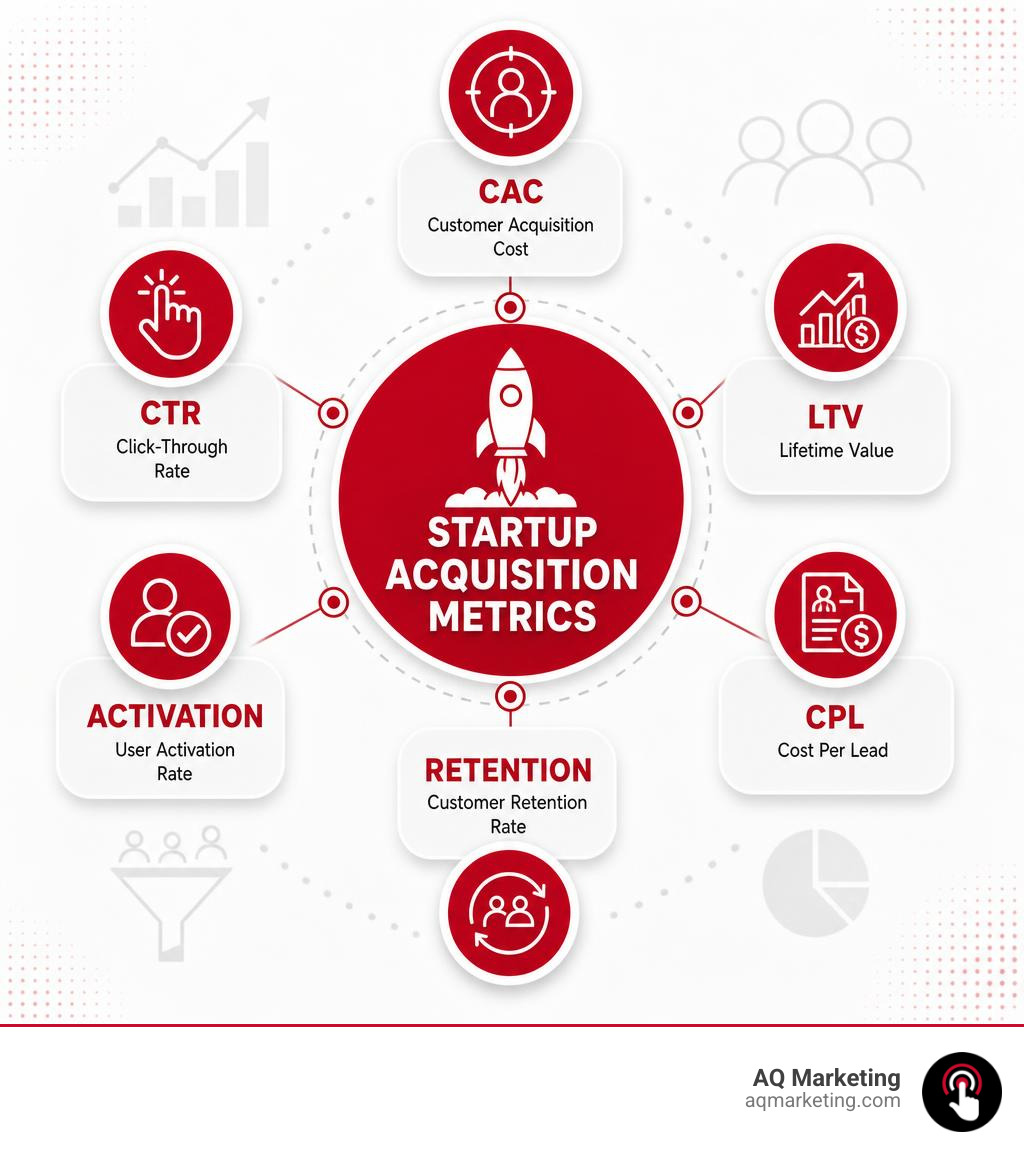
Key metrics in this phase include:
- CTR: Click-through rate from ads, emails, or search results
- CPL: Cost per lead
- Conversion rate: Percentage of visitors who become leads or customers
- Activation rate: Percentage of users who reach a meaningful first success
- Trial conversion rate: Percentage of trial users who become paying customers
- CAC: Cost to acquire a customer
- LTV: Lifetime value
- Churn: Percentage of customers who leave
If a metric does not help you make a decision, it is probably a vanity metric. Followers are nice. Revenue is nicer.
Phase 3: Designing a Scalable Engine for Startup Customer Acquisition
Only after you have proof should you build for scale.
Scalable acquisition may include:
- SEO content systems
- Paid search campaigns
- Paid social campaigns
- Retargeting
- Referral programs
- Partner campaigns
- Automated email nurturing
- AI webchat
- CRM workflows
- Website visitor identification
- Sales enablement content
- Review generation systems
- Google Business Profile optimization
- Multi-location local SEO, where relevant
At this point, you are not just trying random tactics. You are investing in channels that already show promise.
A scalable engine answers three questions:
- Which channel brought this customer in?
- What did it cost?
- How valuable was that customer over time?
The growth story covered in Cursor’s Growth Playbook: $4M to $2B ARR in 18 Months reinforces an important principle: product experience, word of mouth, and the right success metrics can become powerful acquisition assets. Not every company will have that kind of product-led motion, but every startup can learn from the idea of tracking meaningful users instead of empty activity.
For many small and mid-sized businesses in Massachusetts, scalable acquisition often means combining local SEO, website conversion improvements, Google Ads, social media content, review generation, and automated follow-up.
High-Impact, Low-Cost Channels for Early-Stage Growth

Low-cost does not mean low-effort. In fact, many of the best early acquisition channels are affordable because they require consistency, insight, and patience instead of huge media budgets.
Strong early-stage channels often include:
- Organic search
- Website content
- Email marketing
- Local SEO
- Community engagement
- Referral programs
- Partnerships
- Events
- Social media posting
- Review generation
- Targeted outreach
For more ideas, see Penny Pinching Promotion: Affordable Marketing Hacks for New Ventures.
Organic Search and Content Marketing
SEO is one of the strongest long-term acquisition channels because it compounds. A paid ad stops when the budget stops. A useful article, optimized service page, or local landing page can keep attracting qualified visitors for months or years.
Research on startup marketing benchmarks frequently points to SEO as one of the highest-ROI channels for startups. The reason is simple: search captures intent. Someone searching “emergency plumber near me,” “business insurance for contractors,” or “best CRM for small teams” is already showing a problem or desire.
For startups, content marketing should focus on:
- Long-tail keywords
- Specific customer pain points
- Comparison and decision-stage content
- Local search intent
- Educational blog posts
- Case-study-style pages
- FAQ content
- Clear calls to action
- Strong internal linking
A good startup content strategy does not mean publishing random posts because “the blog looked lonely.” Every page should have a job.
Examples:
- Awareness content answers early questions
- Consideration content explains options
- Conversion content supports buying decisions
- Retention content helps customers succeed
For more on this, read Storytelling for Success: Building a Powerful Startup Content Strategy and Website for Start-Up Small Business.
At AQ Marketing, we often help businesses connect SEO, content writing, website design, and conversion strategy so traffic has a clear path to becoming leads.
Community Building and Strategic Partnerships
Community is not just a social media buzzword. For startups, it can be a practical acquisition and retention advantage.
Communities help you:
- Learn customer language
- Build trust before selling
- Encourage referrals
- Collect feedback
- Create repeat engagement
- Turn customers into advocates
Good community-building may happen through LinkedIn, Facebook Groups, local business organizations, niche forums, events, webinars, email newsletters, or customer education sessions.
The key is to contribute before asking. A helpful rule of thumb is to provide value many times before making a direct offer.
Strategic partnerships can also lower CAC. Look for businesses that serve the same audience but do not compete with you. A home services startup might partner with real estate professionals. An insurance business might build referral relationships with contractors or local professional groups. A software startup might partner with consultants who already advise the target customer.
Partnership ideas include:
- Co-hosted webinars
- Referral agreements
- Guest content
- Shared educational guides
- Local events
- Bundled offers
- Co-branded resources
- Newsletter swaps
Events and incentives can also help. Local workshops, trade shows, demos, and networking events create trust faster than cold digital impressions. Incentives such as referral credits, loyalty rewards, or limited-time offers can encourage action, but they should support value rather than replace it. If people only buy because of the discount, retention may suffer.
Your website must be ready to convert this attention. See New Business Website Design Best Practices for practical guidance.
Common Pitfalls to Avoid When Scaling Your Funnel
Scaling is exciting. It is also where many startups turn small leaks into expensive floods.
Avoid these common mistakes:
1. Scaling before product-market fit
If customers are not converting, activating, staying, or referring, more traffic will not fix the problem. It will just reveal the problem faster.
2. Chasing vanity metrics
Impressions, likes, and followers can be useful signals, but they are not the same as qualified leads, sales, retention, or profit.
3. Spending too early on paid ads
Paid ads can work very well, especially when paired with strong landing pages and clear intent. But if your message, audience, and offer are untested, ad platforms become expensive research tools.
4. Ignoring retention
Acquisition and retention are partners. A 5% improvement in customer retention has been associated with profit increases of 25% to 95%. That is because retained customers can buy again, upgrade, refer others, and reduce the pressure to constantly replace churn.
5. Underestimating follow-up
Many leads are lost because businesses respond too slowly or inconsistently. Persistent, thoughtful follow-up often makes the difference between a lost lead and a sale. This is where CRM workflows, email automation, AI webchat, and AI voice receptionist solutions can support the sales process.
6. Not measuring by channel
If you do not know where your best customers come from, you cannot scale intelligently. Track channel, campaign, landing page, lead quality, close rate, CAC, and LTV.
7. Hiring or outsourcing before defining the job
Before adding tools, staff, or vendors, define the bottleneck. Do you need more traffic? Better conversion? Faster follow-up? Stronger reviews? Better sales materials? The answer determines the right investment.
The case study How a 5-person team built a $1M ad engine on one hour a day | SaaS Club highlights an important lesson: choose acquisition channels based on real capacity, not wishful thinking. A channel only works if your team can execute it well.
Frequently Asked Questions About Startup Growth
What is a good LTV:CAC ratio for early-stage startups?
A common benchmark is 3:1, meaning a customer generates three times the value it costs to acquire them.
If your ratio is below 1:1, you are spending more to acquire customers than they are worth. If it is around 1:1 or 2:1, you may still be learning, but you need to watch cash flow carefully. If it is much higher than 3:1, you may have room to invest more aggressively in growth.
However, context matters. A startup entering a new market may tolerate lower efficiency temporarily while learning. But long term, your acquisition economics need to support profitability.
Also consider CAC payback period. If it takes 18 months to recover CAC but you only have 6 months of runway, the math may not work even if LTV looks good on paper.
How do startups achieve product-market fit before scaling?
Startups achieve product-market fit through focused learning, not broad spending.
The process usually includes:
- Defining a narrow ICP
- Interviewing prospects and customers
- Testing the offer manually
- Watching how users behave
- Improving onboarding
- Studying objections
- Tracking activation and retention
- Adjusting pricing and positioning
- Asking what customers would miss if the product disappeared
You are looking for repeated evidence that a specific group urgently values what you offer.
Do not rely only on compliments. Compliments are nice. Payments are better. Renewals are even better. Referrals are the standing ovation.
Which marketing channels offer the lowest customer acquisition cost?
The lowest-CAC channels often include:
- SEO
- Email marketing
- Organic social media
- Referrals
- Community engagement
- Partnerships
- Customer reviews
- Local SEO
- Educational content
For early-stage startups, manual outreach can also be low-cost, although it requires time and effort.
Paid channels such as Google Ads and social media advertising can be effective once you have a tested message and conversion path. They are usually better for scaling proven demand than discovering your entire strategy from scratch.
The best channel is not always the cheapest lead source. It is the channel that brings customers who convert, stay, and generate profitable LTV.
Conclusion
A smart startup customer acquisition plan is not about doing everything at once. It is about doing the right things in the right order.
Start with your ICP. Validate product-market fit. Win early customers through personal, thoughtful outreach. Build repeatable systems. Track CAC against LTV. Invest in organic channels that compound. Then scale what the data proves.
And never forget retention. The cheapest customer to acquire is often the one you already earned.
At AQ Marketing, we help small and medium-sized businesses build long-term digital growth systems through website design, SEO, content writing, social media, Google Business Profile marketing, paid advertising, reputation management, lead generation workflows, and more. Based in Woburn, MA, and serving businesses throughout Massachusetts, we focus on strategies built for lasting results, not quick flashes.
If you are ready to build a stronger acquisition engine without wasting budget, learn more about our digital marketing services for small business.