

Why Early Stage Marketing Matters More Than Your Product
Early stage marketing is the strategic foundation that determines whether your new venture will thrive or become another statistic. Here’s what you need to focus on:
Essential Components of Early Stage Marketing:
- Customer Validation – Talk to real customers before building anything expensive
- Brand Foundation – Define your story, values, and unique promise
- Lean Testing – Run small experiments to find what works before scaling
- Product-Led Growth – Let your product drive awareness and adoption
- Key Metrics – Track CAC, LTV, and conversion rates that matter
The hard truth? Twenty-two percent of startups fail because of marketing problems—not product problems. The most common cause is premature scaling, where founders hire marketing teams and buy ads before they’ve proven anyone actually wants what they’re selling. It takes seven to twelve interactions for people to remember who you are, let alone take action, so consistency matters more than big budgets in your early days.
I’m Robert P. Dickey, and over my 20+ years helping businesses grow, I’ve seen countless founders waste money on early stage marketing tactics that looked impressive but delivered nothing. The ventures that succeed focus on validation first, then build sustainable growth engines.
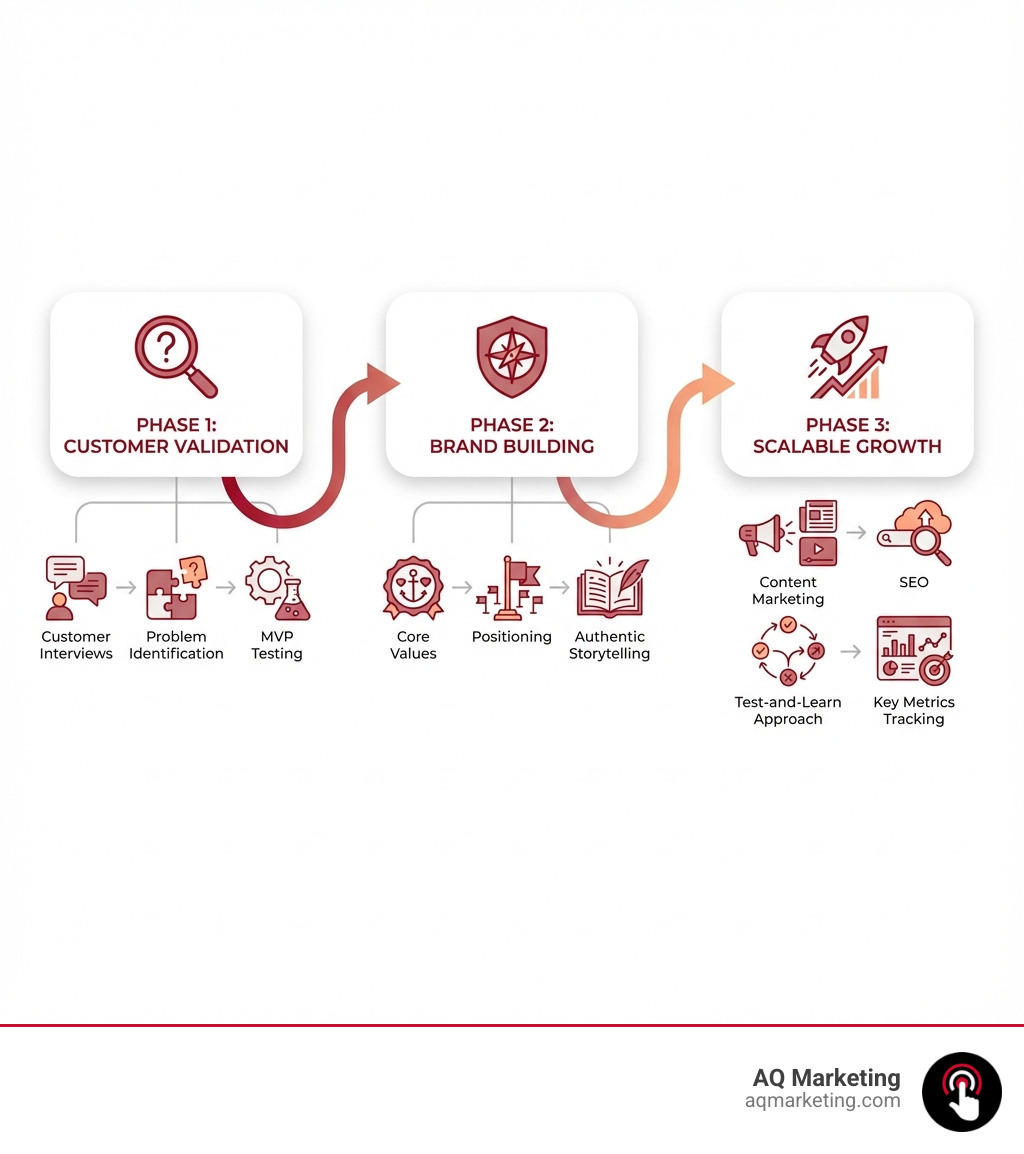
Basic early stage marketing glossary:
Laying the Foundation: Before You Market, You Must Validate
Before we even think about launching a campaign or designing an ad, the most crucial step in early stage marketing is deeply understanding our potential customers and validating our core idea. This phase is often called “customer development,” and it’s where we focus on learning, not just selling. The goal is to avoid the pitfall of premature scaling, which is adding human resources and infrastructure costs before customer validation, and is the most common cause of startup failure. We want to ensure we’re building something people genuinely need and want.

The Dangers of Premature Scaling
Imagine pouring resources into creating a beautiful website or running expensive ad campaigns, only to find that your product doesn’t resonate with anyone. That’s premature scaling in action. It leads to wasted resources, burnout, and ultimately, failure. Our focus in the very early stages should be on validating our product-market fit. This means aligning our product with a genuine market need before investing heavily in marketing.
In fact, early-stage startups do not need a traditional marketing team. Instead, they should use a single Customer Development team. This team’s primary focus is understanding customer problems and building solutions, rather than approaching sales, marketing, or business development as separate tasks. The ideal early-stage startup team often consists of a “hacker, hustler, and designer,” each contributing to this holistic customer development process.
Adopting the Customer Development Model
We accept Steve Blank’s Customer Development Model, a proven framework that guides startups through four critical stages:
- Customer Findy: This is where we identify our target customers, their problems, and how our proposed solution might address those problems. This involves extensive customer interviews. We ask open-ended questions, listen intently, and avoid pitching our solution too early. A great resource for this is “The Mom Test,” which teaches us how to have effective customer conversations that yield honest insights, not just polite affirmations.
- Customer Validation: Here, we test if our solution actually solves the identified problems and if customers are willing to pay for it. This might involve building a minimum viable product (MVP) and getting early users to try it out.
- Customer Creation: Once our product is validated, we move into actively acquiring and converting customers. This is when we start thinking about broader marketing strategies.
- Company Building: Finally, with a proven business model and a growing customer base, we focus on scaling the company.
This framework ensures we have a proven business model before we attempt to scale our marketing efforts. It’s about being strategic and methodical, rather than rushing into costly marketing activities. For more information on how a well-structured process can benefit your venture, consider exploring our insights into our custom website design process.
Building Your Brand Identity from Day One
Our brand is far more than just a logo or a catchy slogan; it’s the very essence of who we are, what we stand for, and the promise we make to our customers. It’s the story we tell, the values we embody, and the unique personality that sets us apart. In the competitive landscape of early-stage ventures, building a strong, authentic brand from day one is paramount. It’s the foundation upon which all successful early stage marketing is built, fostering trust and loyalty long before significant sales begin.
A clear brand strategy provides internal alignment, guiding every decision we make—from product development to customer service. Externally, it shapes how the market perceives us, influencing choices over competitors and even customers’ willingness to pay a premium. If we want our performance marketing efforts to truly work, we need that brand foundation. To dig deeper into how we help shape unique identities, you can find more info about our brand identity & logo design services.
Defining Your Core Brand Elements
To build a robust brand, we must first define its core elements:
- Company Purpose and “Why”: What is our mission? Why do we exist beyond making a profit? This “why” should be aspirational and potentially even “scary” in its ambition, not merely descriptive of our function.
- Brand Story: What is our origin story? What challenges did we overcome? How does this narrative resonate with our customers’ own journeys?
- Value Proposition: What unique value do we offer? How are we a leader at delivering something a well-defined set of customers cares deeply about?
- Tone of Voice: How do we communicate? Are we formal, playful, authoritative, empathetic? Consistency in tone helps build a recognizable brand personality.
Running a brand workshop is an excellent way to align our team on these elements. For example, the three-hour brand sprint offers a structured framework to quickly and effectively define our brand’s identity, ensuring everyone is on the same page.
Building Trust and Authenticity
In today’s market, consumers are savvy; they seek more than just flashy ads. They want to understand the people behind the brand, the mission driving the company, and the reasons to invest their trust and dollars. For early stage marketing, building trust and authenticity is crucial.
- Storytelling: We convey our vision compellingly, share our journey, and invite customers to be part of that story. This creates a deeper connection than simply listing features.
- Transparency: Openness about our processes, challenges, and successes builds credibility. This includes being honest about what our product can and cannot do.
- Personalized Connections: As a startup, we have the advantage of being agile enough to foster personalized connections early on. Engaging directly with early adopters, listening to their feedback, and treating them like royalty can turn them into powerful brand champions.
- Showcasing the People and Mission: Highlighting our team, their expertise, and our shared passion for the company’s mission humanizes the brand and deepens audience trust and loyalty.
This deep engagement helps us adapt our messaging and product positioning in a way that feels relevant and authentic. Building a strong reputation is a continuous process, and we understand its importance. For more information on managing how your brand is perceived and interacting with customers, explore What is Reputation Management in Customer Service?.
Core Strategies for Early Stage Marketing
With our customer validation complete and a strong brand identity in place, we’re ready to explore the most effective strategies for early stage marketing. Our approach is always agile, resourceful, and focused on maximizing impact with limited budgets. This section covers the most effective, budget-friendly strategies to gain traction and build momentum for our new venture.
Leveraging Content and SEO for Organic Growth
Content marketing and Search Engine Optimization (SEO) are powerful allies for early-stage startups. They allow us to build thought leadership and authority, driving organic traffic without the immediate costs associated with paid advertising. In 2022, 61% of marketers said improving SEO to grow their organic presence online was their top inbound marketing priority, highlighting its long-term value.
- Creating Valuable Content: We focus on producing high-quality, educational content—blogs, guides, case studies, videos—that addresses our audience’s pain points and provides genuine solutions. This establishes us as an expert in our field. For insights into developing compelling content, visit What is Content Marketing?.
- Strategic SEO: Our SEO strategy begins with thorough keyword research, focusing on long-tail keywords. These specific, often longer phrases attract highly-qualified visitors who are actively searching for solutions we provide. We optimize our website content, meta descriptions, and technical aspects to rank higher in search results. This ensures that when potential customers in Woburn, MA, or any of our service areas search for solutions, they find us. To understand the broader impact of SEO, read How SEO Helps Your Company Grow.
Adopting a “Test-and-Learn” Approach to Early Stage Marketing
In the dynamic world of early-stage startups, a “test-and-learn” approach is crucial for refining marketing strategies. Instead of committing large budgets to unproven channels, we use small-scale tests to see what resonates with our audience and double down on what works. This minimizes risk and ensures our marketing spend is as efficient as possible.
- Experimentation: We continuously experiment with different messages, channels, and content formats. This could involve A/B testing headlines on a landing page, trying various social media posts, or experimenting with different calls-to-action.
- Data-Driven Decisions: Every experiment generates data. We carefully track engagement, conversions, and customer feedback to understand what’s working and what isn’t. This data informs our next steps, allowing us to pivot quickly if a strategy isn’t yielding results.
- Iterative Optimization: Marketing is never “done.” We continuously optimize our campaigns based on the insights gained from our tests. This iterative process ensures we’re always improving and adapting to our audience’s evolving needs and market changes. This agile approach is key to success, and you can learn more about it in our guide to digital marketing strategies for small business.
The Role of Product-Led Growth in Your Early Stage Marketing Strategy
Product-Led Growth (PLG) is a powerful paradigm for early stage marketing, particularly for SaaS and tech startups. It places the product itself at the center of the customer experience, using it as the primary driver for awareness, acquisition, and retention. This strategy blurs the lines between product and marketing, creating a seamless user experience that encourages adoption and upgrades.
- Freemium Models and Free Trials: Offering a valuable free version of our product or a time-limited free trial allows potential customers to experience the product’s benefits firsthand. This “try before you buy” approach builds trust and demonstrates value, often leading to higher conversion rates than traditional sales pitches.
- Product as the Marketing Channel: In a PLG model, the product is designed to be inherently shareable, easy to use, and provide immediate value. Features like integrated sharing options, intuitive onboarding, and in-app messaging become key marketing tools. The product itself becomes our best salesperson.
- Customer-Centricity: PLG is deeply rooted in customer-centricity. We constantly gather user feedback, analyze product usage data, and iterate to improve the product experience. This ensures that the product continues to solve customer problems effectively, leading to organic growth through word-of-mouth and satisfied users.
Measuring What Matters: Key Metrics for Startups
In the world of startups, it’s easy to get caught up in “vanity metrics”—numbers that look good on paper but don’t truly reflect business health. For early stage marketing, we must focus on metrics that directly impact growth and profitability. This means moving beyond likes and followers to understand the true return on our marketing efforts.
Data analytics is our compass, guiding us through the murky waters of early growth. Tools like Google Analytics are essential and, best of all, free for tracking website performance, user behavior, and conversion funnels. This allows us to make informed decisions and optimize our strategies continuously.
Essential KPIs to Track
To truly understand our business health and the effectiveness of our marketing, we focus on a few key performance indicators (KPIs):
- Customer Acquisition Cost (CAC): How much does it cost us to acquire a new customer? This includes all marketing and sales expenses divided by the number of new customers acquired over a given period. A low CAC is crucial for early-stage profitability.
- Lifetime Value (LTV): How much revenue can we expect a customer to generate over their relationship with our company? LTV helps us understand the long-term value of our customer base.
- LTV:CAC Ratio: This ratio tells us if our business model is sustainable. Ideally, our LTV should be significantly higher than our CAC (e.g., 3:1 or more) to ensure we’re profitably acquiring customers.
- Conversion Rate: The percentage of visitors who complete a desired action, such as signing up for a trial, downloading a resource, or making a purchase. Optimizing this metric can significantly improve our marketing ROI.
- Churn Rate: The rate at which customers stop using our product or service. High churn can quickly negate growth, so retaining customers is often more cost-effective than acquiring new ones. In fact, retention can be 5x cheaper than acquisition.
- Monthly Recurring Revenue (MRR): For subscription-based businesses, MRR is a critical indicator of predictable revenue and growth.
These metrics provide a clear picture of our business’s health and the effectiveness of our marketing efforts. By setting clear objectives and regularly tracking these KPIs, we can make data-driven decisions that propel our startup forward. To understand how to define these and other goals, explore How to Set Digital Marketing Goals.
Frequently Asked Questions about Early Stage Marketing
When should a startup hire a dedicated marketing team or agency?
A startup should only consider hiring a dedicated marketing team or marketing agency after it has completed the customer validation stage. This means we have a proven product, a defined target market, and a repeatable sales process. At this point, we are ready to scale our marketing efforts. Hiring too early, before achieving product-market fit, can lead to wasted resources and premature scaling—a common cause of startup failure. Until then, the initial team, often comprising a “hacker, hustler, and designer,” should integrate marketing activities within their broader customer development efforts.
What are the most effective, low-budget marketing strategies for startups?
For startups with limited resources, the most effective low-budget strategies focus on organic growth and building a community. These include:
- Content Marketing: Creating valuable blog posts, guides, case studies, and videos that address our audience’s pain points. This establishes thought leadership and attracts organic traffic.
- Search Engine Optimization (SEO): Optimizing our website and content for search engines helps potential customers find us when they’re actively searching for solutions. We focus on long-tail keywords relevant to our services in areas like Woburn, MA, and surrounding communities. For deeper insights, explore our Search Engine Optimization (SEO) services.
- Building an Email List: Capturing email addresses allows us to nurture leads with valuable content and build direct relationships, independent of social media algorithms.
- Engaging on Relevant Social Media Platforms: Instead of trying to be everywhere, we identify where our target audience spends their time (e.g., LinkedIn for B2B, Instagram for certain B2C niches) and focus our efforts there. Consistency across two to three channels is essential, as it takes seven to twelve interactions for people to remember who we are.
- Seeking Strategic Partnerships: Collaborating with complementary businesses or influencers can expand our reach to new audiences cost-effectively.
The key is to provide consistent value and build trust over time, rather than spending heavily on immediate, but unsustainable, paid campaigns.
How is marketing for a startup different from a large company?
Marketing for a startup is fundamentally different from marketing for a larger, established company in several key ways:
- Agility and Experimentation: Startups operate with extreme agility, constantly experimenting with a “test-and-learn” mindset. This contrasts with larger companies that often rely on well-defined playbooks and established brand recognition.
- Resource Constraints: Startups almost always have limited budgets and human resources. This necessitates creativity, resourcefulness, and a heavy reliance on organic, cost-effective strategies. Larger companies typically have significant marketing budgets and dedicated teams for various functions.
- Focus on Validation vs. Optimization: Startup marketing is primarily focused on validating assumptions, finding product-market fit, and achieving initial traction. The goal is to find a scalable growth model. Larger companies, on the other hand, often focus on defending market share, optimizing existing channels, and refining established campaigns.
- Brand Building from Scratch: Startups must build their brand trust and authenticity from the ground up, often through direct customer engagement and compelling storytelling. Larger companies leverage decades of brand equity and recognition.
- Integrated Roles: In early-stage startups, roles often blur. The founders and early team members are deeply involved in customer findy, product development, and initial marketing efforts. In larger companies, marketing is a specialized department with distinct functions.
While both aim for growth, the journey and the tools used in early stage marketing are uniquely custom to the startup environment’s inherent challenges and opportunities.
Conclusion: Planting the Seeds for Long-Term Growth
Early stage marketing is a journey of findy, validation, and strategic execution. It demands a unique mindset—one that prioritizes learning over immediate sales, authenticity over superficial campaigns, and agility over rigid plans. By focusing on understanding your customer, building an authentic brand, and leveraging agile strategies like content and SEO, you can create a strong foundation for sustainable growth.
Consistency and patience are key—it takes time to build momentum and for people to remember who you are. As you move from validation to growth, partnering with an experienced team can help you scale effectively. At AQ Marketing, we specialize in helping businesses like yours steer these crucial early stages to achieve long-term success. We understand the local landscape, from Boston to Worcester, and are committed to delivering impactful digital marketing solutions custom to your unique needs.
Learn more about our digital marketing services for small business.
