Paid search marketing campaigns: Boost 2025 ROI!
Why Paid Search Marketing Campaigns Are Essential for Your Business
Paid search marketing campaigns are digital advertising strategies where businesses pay to display their ads in search engine results when people search for specific keywords. Here’s what you need to know:
Key Components:
- Pay-per-click (PPC) model – You only pay when someone clicks your ad
- Keyword targeting – Your ads appear for relevant search terms
- Immediate visibility – Ads show at the top of search results
- Budget control – Set daily or monthly spending limits
- Measurable results – Track clicks, conversions, and ROI
Main Benefits:
- Generate leads and sales quickly
- Target customers actively searching for your services
- Control costs with flexible budgeting
- Outrank competitors in search results
With over 3.5 billion searches happening on Google every day, paid search campaigns offer businesses a direct path to reach potential customers at the exact moment they’re looking for products or services. The statistics are compelling: 65% of all high-intent searches result in an ad click, and businesses make an average of $2 for every $1 they spend with Google Ads.
Whether you’re a home services contractor trying to get more service calls, an insurance agent looking for new clients, or a fitness business wanting to fill classes, paid search campaigns can deliver the targeted traffic your business needs to grow.
I’m Robert P. Dickey, President and CEO of AQ Marketing, and I’ve been helping small and medium-sized businesses succeed with paid search marketing campaigns for over 20 years. My experience managing corporate accounts and developing direct marketing strategies has given me deep insights into what makes these campaigns profitable and effective.
What Are Paid Search Ads and Why Do They Matter?
Imagine you’re a plumber and someone’s kitchen sink just started flooding. They grab their phone and search “emergency plumber near me.” Paid search marketing campaigns make sure your business shows up right at the top of those search results, exactly when that person needs you most.
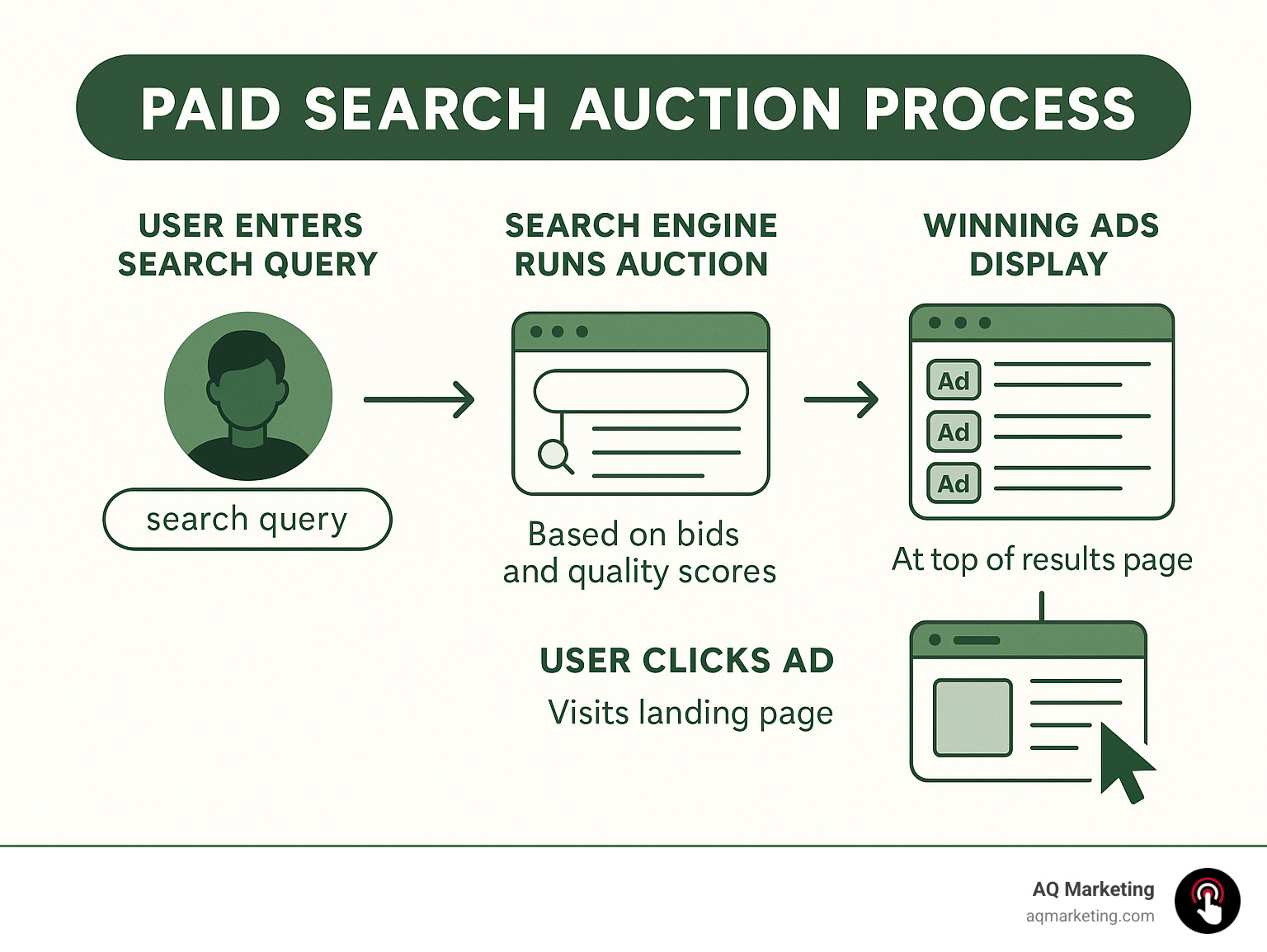
That’s the magic of paid search advertising. It’s a digital marketing strategy where you bid on specific keywords to get your ads displayed in search engine results pages. When potential customers search for terms related to your business, your ad appears at the top of the results, giving you prime real estate in the digital world.
Think of it like renting a billboard on the busiest highway in town – except this highway is made up of people actively looking for exactly what you offer. The best part? You only pay when someone actually clicks on your ad and visits your website.
The numbers tell an impressive story: about 65% of all high-intent searches result in an ad click, which means when people are ready to buy, they’re clicking on ads. Even better, businesses make an average of $2 for every $1 they spend with Google Ads. That’s the kind of return on investment that makes business owners smile.
The Main Benefits for Your Business
Targeted audience reach is where paid search really shines. Unlike throwing a newspaper ad out there and hoping someone notices, you’re reaching people who are actively searching for your products or services. It’s like having a conversation with someone who’s already raised their hand and said “I need help with this.”
Cost-effectiveness means you’re not wasting money on people who aren’t interested. You can start with as little as $10 per day and scale up as you see what works. The pay-per-click model ensures you’re only paying for actual engagement, not just people scrolling past your ad.
Budget control puts you in the driver’s seat. Set daily or monthly spending limits that fit your comfort zone. If you need to pause campaigns for any reason, you can do it instantly. No long-term contracts or surprise bills at the end of the month.
Immediate results separate paid search from other marketing strategies. While organic SEO can take months to show results, paid search marketing campaigns can start driving traffic to your website within hours of launch. This makes it perfect when you need leads quickly or you’re launching something new.
Measurable performance means you’ll know exactly what’s working and what isn’t. You can track how many people saw your ad, how many clicked, and how many became customers. This data-driven approach lets you continuously improve your campaigns and get better results over time.
Here’s a statistic that might surprise you: paid visitors are 2 times more likely to make a purchase than organic visitors. That means the people clicking on your ads are more ready to buy than those finding you through other means. For more insights on how digital marketing drives revenue, check out our guide on 4 Ways Digital Marketing Contributes to Revenue.
Different Types of Paid Search Ads
Not all paid search ads look the same, and understanding your options helps you choose what works best for your business.
Text Ads are the workhorses of paid search. These appear directly in search results with a headline, description, and URL. They’re marked with a small “Ad” label so people know they’re sponsored. Text ads work great for service-based businesses and are perfect for driving traffic to specific landing pages on your website.
Shopping Ads (also called Product Listing Ads) are visual powerhouses for e-commerce businesses. They show product images, prices, and store names right in the search results. People can see exactly what they’re getting before they click, which means you get higher-quality traffic and better conversion rates.
Local Services Ads are designed specifically for service-based businesses like plumbers, electricians, and contractors. These ads appear at the very top of search results and are particularly valuable because you only pay when someone actually calls or messages you directly through the ad – not just when they click.
Responsive Search Ads are the newest type of text ad that uses machine learning to automatically adjust content for each search. You provide multiple headlines and descriptions, and the system figures out the best combination for each person’s search query. These typically perform better than traditional text ads because they’re more personalized.
Each type serves different business goals, and the right choice depends on what you’re selling and how your customers prefer to engage with your business.
Paid Search vs. Organic SEO: Which Is Right for You?
If you’re wondering whether to invest in paid search marketing campaigns or focus on organic SEO, you’re asking the right question. But here’s the thing – it’s not really an either-or decision for most businesses.
Think of it this way: paid search is like taking a taxi to get somewhere fast, while organic SEO is like planting a tree that will provide shade for years to come. Both have their place, and the best approach depends on your immediate needs and long-term goals.
Paid search gives you speed and control. Once your campaign launches, you can start seeing visitors within hours. Your ads appear at the top of search results, right where people look first. You control exactly what your ad says, where it sends people, and who sees it. If you need leads this month or you’re launching a new service, paid search is your best friend.
Organic SEO builds lasting value. When you rank well organically, you earn trust and credibility that paid ads can’t match. People often trust organic results more than ads. Plus, once you achieve good rankings, that “free” traffic can continue flowing for months or years. But patience is key – SEO results typically take three to six months to really show up.
The placement difference matters too. Paid ads sit at the very top of search results, but they’re clearly marked as ads. Organic results appear below the ads, but they often get more clicks overall because people spend more time browsing through them.
When it comes to user intent, both capture people actively searching for your services. However, paid search lets you target very specific searches and adjust your message instantly based on what’s working. With organic SEO, you’re somewhat at the mercy of how search engines interpret your content.
For a detailed breakdown of these strategies, check out our guide on SEO vs PPC What’s the Difference.
Key Differences at a Glance
| Feature | Paid Search (PPC) | Organic Search (SEO) |
|---|---|---|
| Cost | Pay per click/impression | “Free” (requires investment in time, content, and expertise) |
| Speed | Immediate results | Takes months to see significant results |
| Placement | Top of the page (Ad section) | Below the ads |
| ROI | Easier to measure directly | More difficult to attribute and measure |
| Control | High control over ad copy, landing pages, and targeting | Less direct control over rankings |
Here’s what we’ve learned after 20 years in this business: the most successful companies use both strategies together. Paid search marketing campaigns provide immediate results and valuable data about what keywords and messages work best. Then you can use that insight to inform your SEO strategy.
When customers see your business in both the paid and organic results for the same search, it builds incredible credibility. You’re not just another company – you’re the company for that service in their mind.
The bottom line? If you need results now and have a marketing budget, start with paid search. If you’re building for the long term and want to reduce your dependence on paid advertising, invest in SEO. But if you really want to dominate your market, do both.
The Core Components of Successful Paid Search Marketing Campaigns
Think of a successful paid search marketing campaign like building a house – you need a solid foundation, quality materials, and skilled craftsmanship. Each component needs to work together seamlessly, or the whole structure can fall apart.
The foundation starts with your campaign structure. This means organizing your campaigns logically – perhaps by product lines, services, or geographic areas. Within each campaign, you’ll create ad groups that contain closely related keywords and ads. It’s like organizing your toolbox – when everything has its place, you can find what you need quickly and work more efficiently.
Keywords are the heart that pumps life into your campaigns. They determine when and where your ads appear. Ad copy is your salesperson – it needs to convince people to choose you over your competitors in just a few seconds. Landing pages are where the magic happens, converting those clicks into actual customers.
When these components work together harmoniously, you create campaigns that don’t just drive traffic – they drive the right traffic that converts. For businesses looking to develop a comprehensive approach, our Digital Marketing Strategy guide shows how paid search fits into your overall marketing picture.
Step-by-Step: Setting Up Your First Paid Search Marketing Campaigns
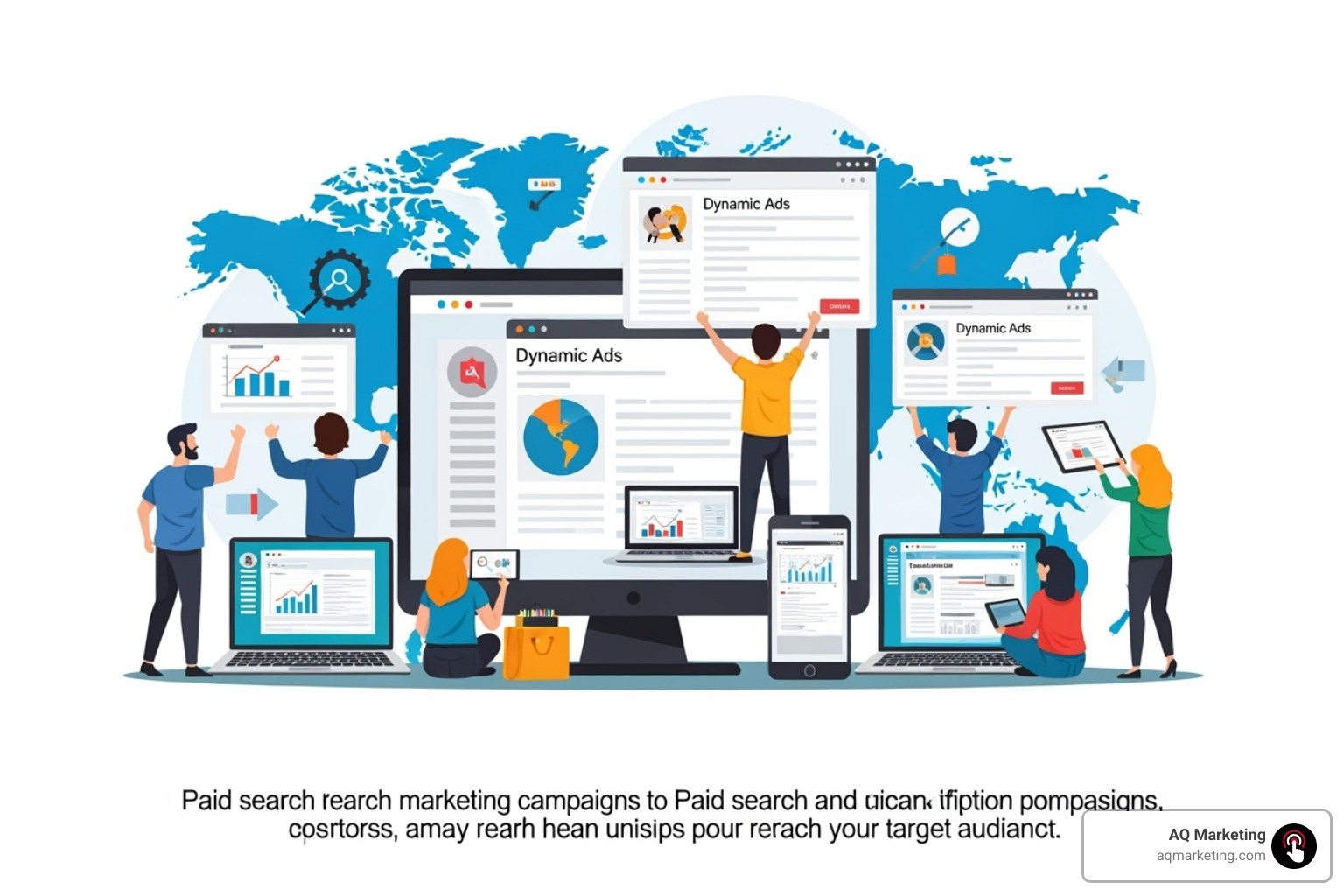
Setting up your first paid search marketing campaign doesn’t have to feel overwhelming. I’ve walked hundreds of business owners through this process, and once you break it down into manageable steps, it becomes much more approachable.
Keyword Research is where everything begins. You need to understand what your customers actually type into Google when they’re looking for businesses like yours. Start by putting yourself in their shoes. If you needed your service, what would you search for?
Use tools like Google Keyword Planner to find search volumes and see how competitive different terms are. Here’s a pro tip: focus on long-tail keywords – those longer, more specific phrases that show real intent. Instead of competing for “plumber” (which is expensive and vague), try “emergency plumber Boston” or “water heater repair near me.”
Don’t forget about negative keywords – these prevent your ads from showing for irrelevant searches. If you’re a premium service provider, you might add “cheap” or “free” as negatives to avoid attracting bargain hunters who aren’t your ideal customers.
Bidding and Budgeting is where you take control of your costs. Start with a daily advertising budget that feels comfortable – you can always increase it as you see results. I always tell clients it’s better to start small and scale up than to blow your budget on day one.
Cost-Per-Click (CPC) bidding is usually the best place to start. You set the maximum you’re willing to pay for each click. Manual bidding gives you more control initially, while automated bidding lets Google’s algorithms optimize for your goals. We typically recommend starting manually to learn your market, then gradually transitioning to automated strategies.
Crafting Compelling Ad Copy is both an art and a science. You have just a few seconds to grab attention and convince someone to click your ad instead of your competitor’s. Include your primary keyword in the headline when possible, highlight what makes you different, and always include a strong Call-to-Action like “Call Now,” “Get Quote,” or “Schedule Today.”
A/B testing different ad variations is crucial. Test different headlines, descriptions, and CTAs to see what resonates with your audience. Sometimes changing just one word can dramatically improve your results.
How Ad Rankings Are Determined
Here’s something that surprises many business owners: Google doesn’t just give the top spot to whoever bids the highest. The ad auction is much more sophisticated than that, and understanding how it works can save you money while improving your results.
Every time someone searches, Google runs an auction in milliseconds. Your Ad Rank is calculated by multiplying your bid amount by your Quality Score. Think of Quality Score as Google’s report card for your ads – it rates the quality and relevance of your keywords, ads, and landing pages on a scale of 1-10.
Your Quality Score has enormous influence over the cost and effectiveness of your paid search ads. A higher Quality Score can help you achieve better ad positions while paying less per click. It’s Google’s way of rewarding advertisers who create genuinely helpful, relevant experiences for users.
Quality Score has three main components: Expected Click-Through Rate (CTR) measures how likely people are to click your ad based on historical performance. Ad relevance looks at how closely your ad matches what people are searching for. Landing page experience evaluates how relevant and useful your landing page is to visitors.
This system rewards businesses that create relevant, high-quality ads and landing pages. It’s not just about having the biggest budget – it’s about providing value to searchers. When you focus on relevance and quality, you often find you can outrank competitors who are bidding more than you.
Beyond the Launch: Optimizing and Measuring Your Campaigns
Launching your paid search marketing campaigns is just the beginning. Real success comes from what you do next—using the data you collect to make steady, informed tweaks that improve results.
Think of it like tending a garden: you plant, observe, and adjust. In paid search, that means reviewing reports, trimming wasted spend, and feeding the winners with more budget. Continuous improvement is what separates campaigns that thrive from those that merely survive.
ROI tracking is your guiding star. It’s not enough to celebrate clicks; you need to know which clicks turn into leads or sales so every dollar spent can be traced back to revenue.
For additional optimization ideas, see our guide on 4 PPC Campaign Best Practices.
Best Practices for Optimizing Your Paid Search Marketing Campaigns
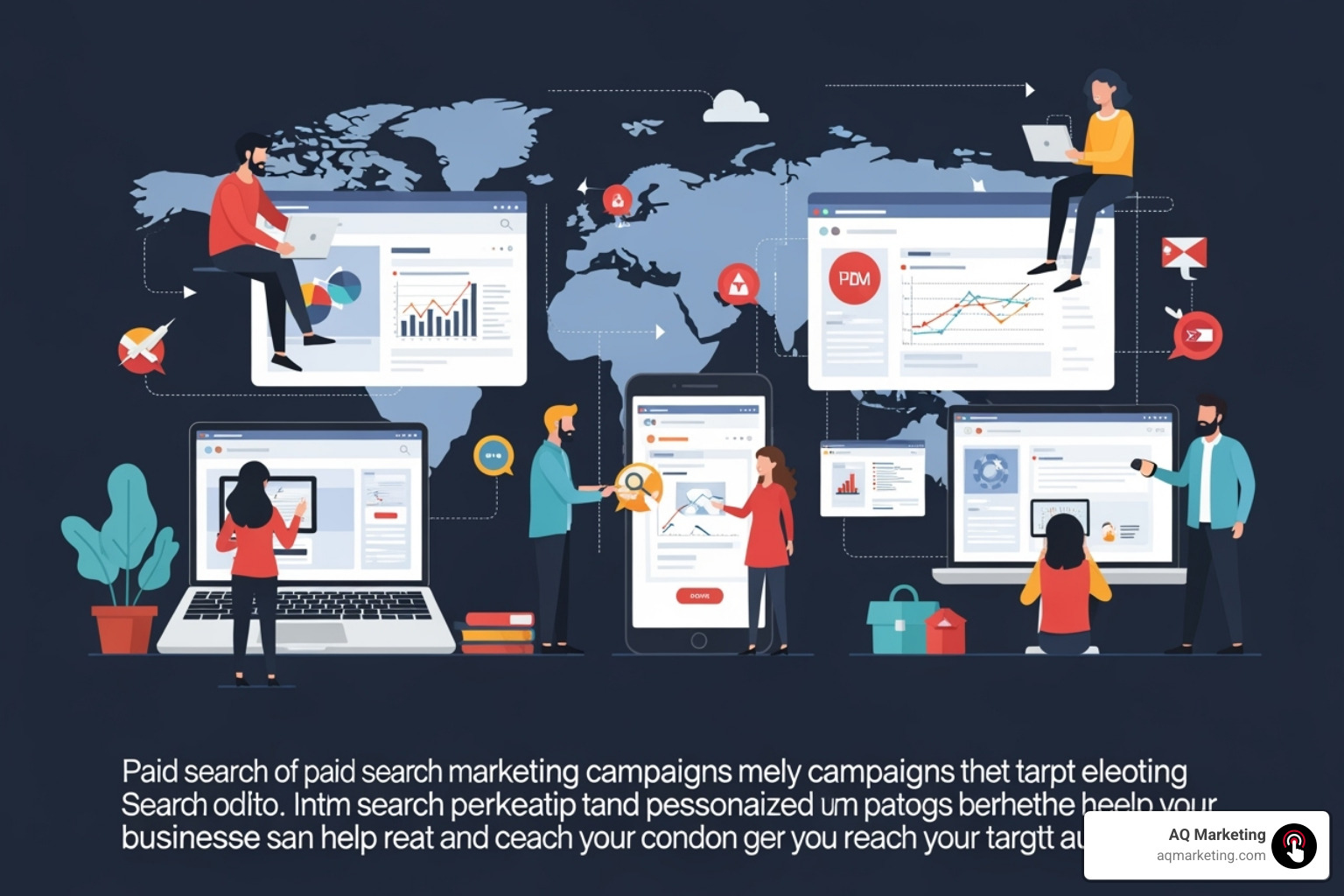
- Refine your keyword lists weekly. Use the search terms report to add fresh, relevant phrases and to block budget-draining queries with negative keywords.
- Pause underperforming ads. If an ad shows low click-through rates or high costs per conversion for two weeks in a row, turn it off and focus on better performers.
- Optimize for mobile first. More than half of searches happen on phones, so make sure ads and landing pages load quickly and display correctly on small screens.
- Use ad scheduling. Show ads only during the hours or days that historically bring the highest conversion rates for your business.
- Match message to landing page. If your ad promises “free estimates,” the landing page must highlight that same offer—consistency boosts conversions. For more on creating effective pages, read Why Your Business Should Use Landing Pages for Lead Generation.
How to Monitor and Analyze Performance
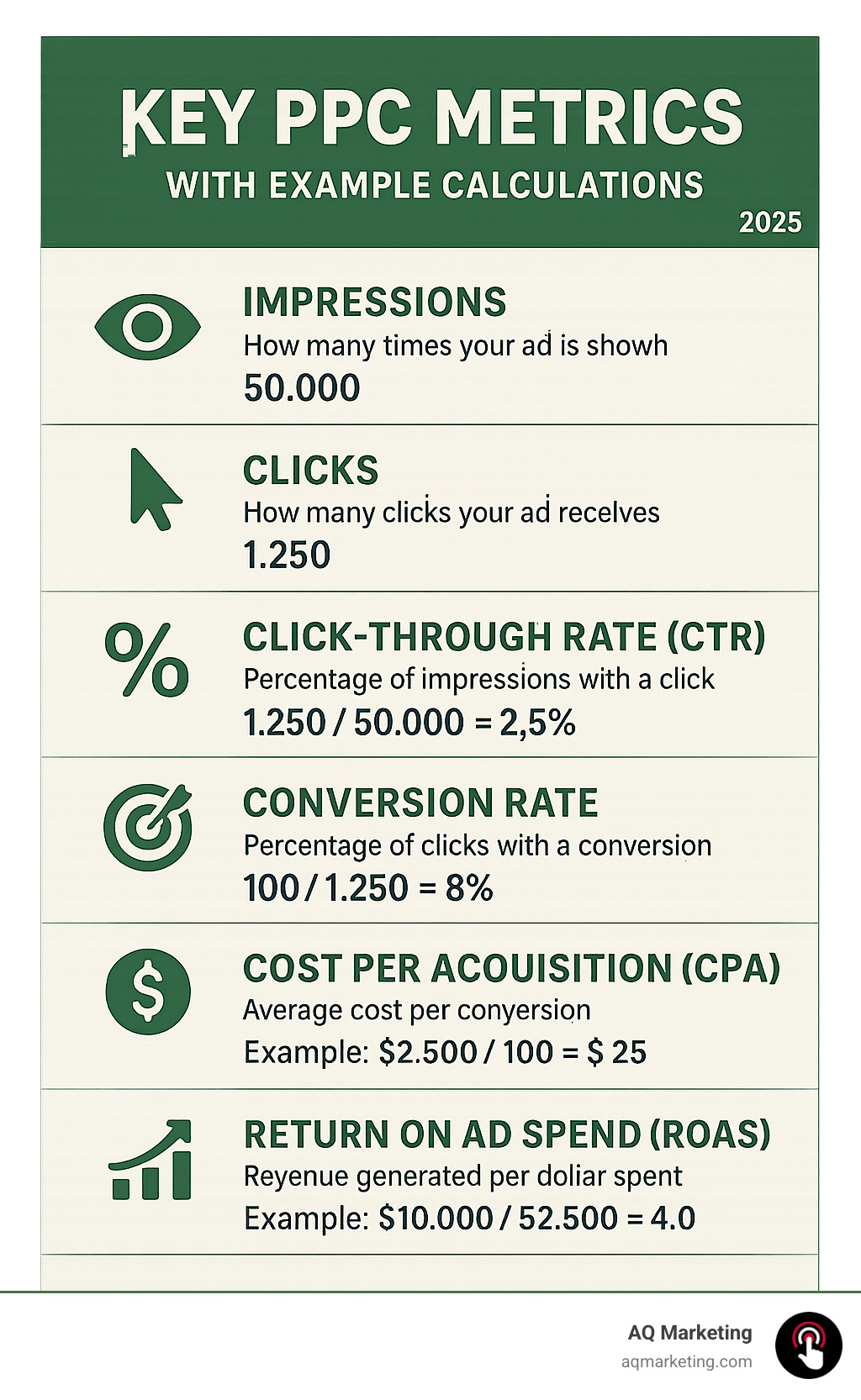
Focus on the metrics that map directly to your goals:
- Impressions – how often your ads appear.
- Clicks and Click-Through Rate (CTR) – show how enticing your ads are.
- Conversion Rate – reveals what percentage of visitors become leads or customers.
- Cost Per Acquisition (CPA) – the amount you spend to win each new customer.
- Return on Ad Spend (ROAS) – revenue generated for every advertising dollar.
Most ad platforms provide dashboards that let you track these numbers at a glance. Look at trends over weeks, not days, to avoid knee-jerk reactions and to make smarter optimization decisions.
Frequently Asked Questions about Paid Search
How long does it take to see results from paid search?
Paid search marketing campaigns can start driving traffic to your website within hours of going live. It’s one of the few marketing strategies where you can literally see results the same day you launch.
But here’s the reality check – seeing traffic and seeing profitable results are two different things. While your ads can start generating clicks almost immediately after approval, optimizing for profitability takes time. Think of it like learning to drive: you can get behind the wheel on day one, but becoming a skilled driver takes practice.
We typically tell our clients to expect 2-4 weeks of data collection before making significant optimization decisions. This gives you enough information to understand what’s working and what needs adjustment. Achieving a strong ROI usually takes several weeks or months of testing and refinement, but the immediate visibility makes it worth the wait.
Can a small business with a limited budget use paid search?
Absolutely. Unlike traditional advertising where you might need thousands of dollars for a single radio or TV spot, paid search marketing campaigns let you start small and grow at your own pace.
Budget control is one of the biggest advantages of paid search. You can set daily spending caps as low as $10-20 per day, test what works, and gradually increase your investment as you see results. We’ve helped businesses succeed with monthly budgets as small as $500 – it’s all about being strategic.
The secret sauce for small budgets is focusing on highly specific, long-tail keywords that are less competitive but have higher conversion potential. Instead of competing with big corporations on expensive broad terms, you target the specific phrases your ideal customers actually use when they’re ready to buy.
For example, rather than bidding on “insurance” (which could cost $50+ per click), a local agent might target “car insurance quotes Woburn MA” – much more affordable and much more likely to convert.
Do paid ads help my organic SEO ranking?
The short answer is that paid ads don’t directly increase organic traffic in terms of search engine algorithms – Google keeps these systems separate.
However, there are some really valuable indirect benefits that can boost your overall online presence. When your paid ads increase brand visibility, more people start searching for your business by name. These branded searches are positive signals that can help your SEO efforts.
Plus, the keyword data from successful paid search marketing campaigns becomes pure gold for your content strategy. When you find which keywords convert well in your paid campaigns, you can create content around those same terms to improve your organic rankings.
The real magic happens when you use both strategies together. Paid search provides immediate visibility while you’re building organic rankings, and SEO provides long-term, sustainable traffic growth. It’s like having both a sprint and a marathon runner on your team – each serves a different purpose, but together they’re unstoppable.
Conclusion: Take the Next Step in Your Digital Marketing
Paid search marketing campaigns have proven themselves as one of the most effective ways to grow your business online. Throughout this guide, we’ve explored how these campaigns can deliver immediate visibility, give you complete cost control, help you reach your targeted audience, and provide measurable results that you can track and optimize.
The numbers don’t lie. When businesses make an average of $2 for every $1 spent on Google Ads, and 65% of high-intent searches result in ad clicks, it’s clear that paid search isn’t just another marketing channel – it’s a powerful revenue driver.
The beauty of paid search lies in its precision. Unlike traditional advertising where you’re casting a wide net and hoping for the best, paid search puts your business in front of people who are actively searching for what you offer. They’re not just browsing – they’re ready to take action.
For businesses in competitive industries like home services and insurance, this precision becomes even more valuable. When someone’s water heater breaks at 2 AM or they need insurance quotes before their policy expires, they’re not looking for general information. They need solutions, and they need them now. A well-managed paid search marketing campaign ensures your business is there when these high-intent customers are searching.
But here’s what we’ve learned after helping hundreds of businesses: Success with paid search isn’t about luck or guesswork. It requires understanding your audience, crafting compelling ads, choosing the right keywords, and continuously optimizing based on real data. The difference between campaigns that generate profitable leads and those that drain your budget often comes down to expertise and attention to detail.
The ongoing nature of optimization is crucial. Your first campaign setup is just the beginning. The real magic happens in the weeks and months that follow, as you refine your targeting, test new ad copy, and find which keywords drive the most valuable traffic for your business.
If you’re feeling overwhelmed by the complexity of paid search marketing campaigns, you’re not alone. Many business owners recognize the potential but struggle with the technical aspects and ongoing management required for success.
That’s where we come in. At AQ Marketing, we’ve been helping businesses in the Boston area and beyond steer paid search since 2003. We understand that every business is unique, and we take the time to understand your specific goals, challenges, and target audience before crafting campaigns that deliver real results.
Ready to see what paid search can do for your business? Our team of experts is here to help you build and manage effective campaigns that not only drive traffic but convert that traffic into customers. We’ll handle the technical details, ongoing optimization, and performance monitoring so you can focus on running your business.
Learn more about how we can help your business grow through our Pay Per Click Advertising Firm services. Let’s work together to create paid search marketing campaigns that deliver the results your business deserves.