

Digital marketing cost for small business: Smart Guide 2025
Understanding What Small Businesses Really Pay for Digital Marketing
If you’re a small business owner in the Boston area, you’ve probably asked: How much should I actually be spending on digital marketing? The answer isn’t simple, as a contractor in Woburn faces different challenges than a fitness studio in Southern New Hampshire.
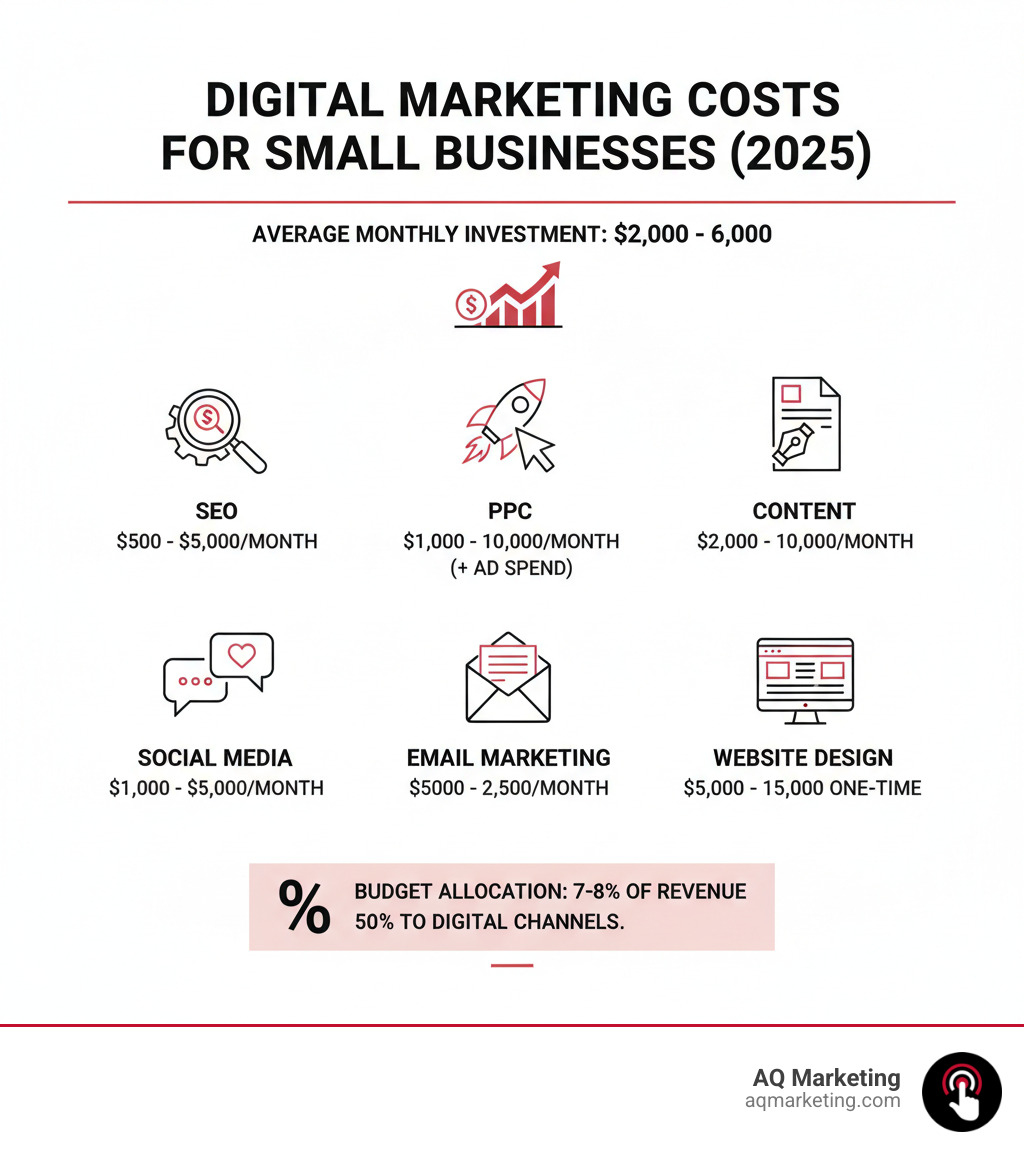
The typical digital marketing cost for small business ranges from $2,000 to $6,000 per month, but this varies by goals and industry. Most businesses should allocate 7-8% of their total revenue to marketing, with about half dedicated to digital channels.
Average Monthly Costs by Service:
- SEO: $500 – $5,000/month
- PPC: $1,000 – $10,000/month (plus ad spend)
- Content Marketing: $2,000 – $10,000/month
- Social Media Marketing: $1,000 – $5,000/month
- Email Marketing: $500 – $2,500/month
- Website Design (One-Time): $5,000 – $15,000+
The challenge is knowing where to start. Should you hire an agency, build an in-house team, or focus on SEO versus paid ads? This guide will break down the real costs and help you build a budget that makes sense for your business.
I’m Robert P. Dickey, President and CEO of AQ Marketing. With over 20 years of experience helping businesses in the Boston area grow their online presence, I’ll help you cut through the confusion and get the answers you need.
The Average Digital Marketing Cost for Small Business: A Service-by-Service Breakdown
To budget effectively, you need to understand what you’re paying for. Each digital marketing service offers unique value. Let’s break down the real numbers behind each one.

Search Engine Optimization (SEO)
SEO is the process of helping customers find you through search engines. For a local business in Woburn or Middlesex County, local SEO is the most cost-effective starting point. This involves optimizing your Google Business Profile and website to appear in local searches like “plumber near me.” Broader national SEO requires more extensive work to compete on a larger scale. The process includes technical site improvements, on-page content optimization, and building links from other reputable sites.
The average digital marketing cost for small business for SEO is $500 to $5,000 per month. A contractor focusing on local SEO for small business might spend $500-$1,500 monthly, while a company competing nationally could invest $3,000 or more. SEO takes three to six months to show significant results but builds lasting value. Learn more about our SEO services.
Pay-Per-Click (PPC) Advertising
PPC advertising places your business at the top of search results immediately, offering instant visibility. It’s ideal for generating leads quickly or testing a market. The costs include ad spend (paid directly to platforms like Google) and management fees (paid to an agency to run the campaigns). Management fees are typically 10-20% of ad spend or a flat fee of $500-$5,000.
The cost-per-click (CPC) varies by industry and location. A click for “lawyer Boston” is highly competitive and expensive, while “landscaper Southern NH” will cost less. Most small businesses spend $1,000 to $10,000 per month on PPC management, plus ad spend. PPC offers great control, as you can adjust budgets daily and track results precisely. Learn about our digital advertising services to see how we maximize every dollar.
Website Design and Development
Your website is your digital storefront. It must be professional, mobile-friendly, and easy for customers to use. A custom website project focuses on user experience (UX), mobile responsiveness, and any special features you need, like e-commerce functionality for online sales.
For small businesses in the Boston area, expect to invest $5,000 to $15,000+ for a professional custom website. After launch, plan for ongoing website maintenance ($50-$2,000 monthly) for updates, security, and support. A website is not a one-time purchase; it requires regular care. Explore our small business website development services.
Content & Social Media Marketing
Content marketing builds trust by providing valuable information, while social media marketing connects you with your community. This includes blog posts, video creation, and social media management on platforms like Facebook, Instagram, or LinkedIn, all guided by a cohesive content strategy. The right mix depends on where your customers spend their time.
Budget $1,000 to $10,000 per month for combined content and social media efforts. The investment is worthwhile, as content marketing generates 3x more leads than traditional marketing at a lower cost. The digital marketing cost for small business here scales with content volume and the number of platforms used. See our social media management for SMBs.
Email Marketing
Email marketing is a powerful tool for nurturing leads and staying in touch with existing customers. It requires an email marketing platform (like Constant Contact), list management, campaign creation (design and copywriting), and automation to send timely messages.
Professional email marketing services typically cost $500 to $2,500 per month, plus platform fees. While it may seem like a significant cost, email marketing delivers an unparalleled ROI of $36 for every $1 invested. It’s a direct line to people already interested in your business. Find email marketing solutions for SMBs.
What Factors Influence Your Digital Marketing Spend?
The cost of digital marketing isn’t a fixed price; it’s a dynamic figure influenced by several key variables. Understanding these factors will help you set a realistic budget.

Business Goals, Industry, and Competition
Your ambitions, industry, and competition heavily shape your digital marketing cost for small business. A startup in Middlesex County aiming for rapid growth will need a larger budget (10-15% of revenue) than an established business focused on maintenance.
Highly competitive industries like legal, finance, and home services in areas like Boston drive up advertising costs (especially for PPC) and require more intensive SEO. When more businesses compete for the same customers, prices rise. Your specific niche also matters. An insurance agency in Essex County targeting broad terms will spend more than a niche boutique targeting specific, less expensive keywords.
Geographic Location
Where you operate and target customers impacts your costs. Targeting a local town like Woburn, MA, is less expensive than a national campaign due to a smaller audience and less competition.
The cost of living also affects agency rates. Agencies in major metro areas like Boston have higher overhead, which can translate to higher fees. Understanding the digital marketing cost for small business in the Boston area means acknowledging these local market dynamics. For example, ad costs are higher in metro Boston than in the Merrimack Valley because of greater population density and competition.
Scope of Services & Agency Pricing Models
The breadth of services you need and an agency’s pricing structure will impact your spend. A comprehensive package covering SEO, PPC, and social media will cost more than focusing on a single service. Full digital marketing packages can range from $2,500 to $40,000+ per month.
Experienced agencies may charge more, but their expertise often leads to a better ROI. Common pricing models include:
- Hourly Rate: $75-$249 per hour for specific tasks or consulting.
- Monthly Retainer: A fixed monthly fee ($2,000-$10,000 for SMBs) for ongoing services. This is the most common model.
- Project-Based Fee: A flat fee for a defined project, like a website redesign.
- Performance-Based: Fees tied to specific outcomes, like leads or sales.
The key is to find a model that aligns with your goals and budget. A monthly retainer offers predictability, while project-based fees are great for one-time initiatives.
How to Build a Realistic Digital Marketing Budget
Creating a digital marketing budget doesn’t have to feel overwhelming. The truth is, most small business owners I work with in the Boston area start with the same question: “How much should I actually be spending?” The answer lies in combining smart industry benchmarks with what makes sense for your business specifically.
Let me walk you through a straightforward approach that’s helped countless businesses in Woburn, Middlesex County, and beyond build budgets that actually work.

Start with Your Revenue and Goals
The most practical starting point is looking at what you can realistically afford and what you’re trying to accomplish. These two pieces should work together, not against each other.
The U.S. Small Business Administration offers a helpful rule of thumb: most small businesses should allocate 7-8% of their total revenue to marketing. So if your Essex County insurance agency brings in $500,000 annually, you’re looking at roughly $35,000-$40,000 for your entire marketing budget. You can read more about this recommendation from the SBA.
But here’s where it gets interesting—this percentage isn’t one-size-fits-all. If you’re a newer business (under five years old) trying to establish yourself in competitive areas like Boston or Southern New Hampshire, you’ll likely need to invest more aggressively, typically 10-15% of revenue. You’re not just maintaining market share; you’re fighting to gain it. Similarly, businesses in highly competitive sectors like consumer services often spend closer to 19% of revenue on marketing.
I encourage my clients to think beyond just past revenue. Consider your goal-based budgeting instead. If you want to double your revenue next year, you might need to market like a business that’s already at that higher revenue level. Set SMART goals—Specific, Measurable, Achievable, Relevant, and Time-bound. For example, “increase qualified website leads by 30% in the next six months” gives you something concrete to budget toward.
Understanding your Customer Acquisition Cost (CAC) and Customer Lifetime Value (LTV) is equally important. How much does it cost you to acquire a new customer through your digital marketing efforts? And how much revenue does that customer generate over their entire relationship with your business? Your digital marketing cost for small business should keep CAC significantly lower than LTV—that’s where profitability lives.
Allocate Funds Across Key Channels
Once you know your overall budget, the next question is how to divide it up. This is where strategy really matters.
Start by identifying your primary channels—the 2-3 platforms where your target audience actually spends time and where you’ll get the most bang for your buck. For a home services contractor in the Merrimack Valley, this might be local SEO for small business, targeted Google Ads for emergency services, and consistent Facebook engagement to build community trust.
Here’s something important: you need to balance long-term strategies with short-term wins. SEO and content marketing are marathon runners—they build sustainable organic traffic and establish your authority, but they take time to show results. PPC advertising and social media ads are sprinters—they can deliver immediate visibility and leads. Most successful small businesses I work with dedicate resources to both approaches.
I always recommend reserving 10-15% of your budget for testing and experimentation. The digital landscape changes constantly. Maybe there’s a new social platform gaining traction in your area, or a different ad format that could work better for your Woburn business. This flexibility keeps you competitive and helps you find new growth opportunities.
A realistic budget for growth depends on your goals and margins. Your digital marketing cost for small business should align with your specific growth targets while maintaining profitability. A useful framework many agencies use is the 70/20/10 rule: 70% of your budget on proven tactics that are already working, 20% on newer strategies showing promise, and 10% on experimental efforts.
Measure, Track, and Optimize for ROI
This is where digital marketing truly shines—everything is measurable. You’re not throwing money into the void and hoping something sticks.
Define your Key Performance Indicators (KPIs) for each channel you’re investing in. For your website, this might be monthly traffic growth and conversion rates. For email marketing, it could be open rates and click-through rates. For Google Ads, you’re probably watching cost-per-lead and total leads generated. These metrics tell you what’s actually working.
The ultimate measure of success is your Return on Investment. Here’s the simple formula: ((Revenue Generated – Marketing Costs) / Marketing Costs) x 100%. If you spend $5,000 on digital marketing in a month and it generates $20,000 in new revenue, you’ve achieved a 300% ROI. That’s the kind of clarity traditional marketing could never provide.
Use tools like Google Analytics to review your campaign performance regularly—I recommend at least monthly. If a particular channel isn’t delivering the expected results, don’t just keep throwing money at it out of habit. Reallocate those funds to strategies that are working. This iterative process of measuring, learning, and optimizing is what separates businesses that grow online from those that spin their wheels.
For context, email marketing consistently delivers an impressive ROI of $36 for every $1 invested, making it one of the most cost-effective channels available. When you see numbers like that in your own analytics, you know exactly where to invest more.
The key is staying nimble. Your budget shouldn’t be carved in stone—it should evolve as you learn what resonates with your audience in Middlesex County, Southern New Hampshire, or wherever your customers are.
Choosing Your Path: Agency, In-House, or DIY?
Once you’ve determined your budget, the next critical decision is who will handle your digital marketing. This choice depends on your budget, timeline, internal expertise, and how hands-on you want to be. Let’s review each option.
Working with a Digital Marketing Agency
Partnering with an agency gives you immediate access to a team of specialists—SEO experts, content writers, and ad managers. For most small businesses in the Boston area, this is the fastest path to professional results, as you get expertise without the overhead of full-time hires.
A good agency has seen what works across hundreds of clients and has the tools and time to execute proven strategies. Typical costs for a full-service agency range from $2,000 to $10,000 per month for small businesses. This investment frees you to run your business while professionals handle your marketing. The main downside is less direct control, which is why clear communication is vital.
Building an In-House Marketing Team
Some businesses prefer hiring dedicated staff for maximum control and cultural immersion. However, this is expensive. A single digital marketing manager in the Boston area can cost $60,000 to $90,000 per year in salary, plus benefits that add another 20-30%. Needing multiple specialists multiplies these costs quickly.
You’ll also need to budget $500 to $2,000 per month for essential software and tools. The in-house approach works best for larger small businesses (over $2 million in revenue) with the budget to support full-time salaries.
The DIY Approach
If you’re on a tight budget, handling marketing yourself might seem practical. The benefit is low out-of-pocket costs, perhaps $100 to $500 per month for basic tools.
But the catch is the time investment. Every hour you spend learning Google Ads is an hour not spent on your core business. For many owners in competitive markets like Essex County, this trade-off isn’t worth it. Digital marketing has a steep learning curve, and mistakes can be costly. DIY makes sense only if you have the time and interest to learn, but most owners find that outsourcing to an expert delivers better results faster.
| Approach | Pros | Cons | Typical Costs |
|---|---|---|---|
| Digital Marketing Agency | Access to full team of specialists; proven strategies; tools included; scalable; faster results | Less direct control; requires trust and communication; ongoing monthly investment | $2,000-$10,000/month (varies by scope) |
| In-House Team | Maximum control; deep brand knowledge; dedicated focus; team is always available | High salary and benefits costs; need multiple hires for full coverage; software/tool expenses; longer ramp-up time | $60,000-$90,000/year per employee + 20-30% benefits + $500-$2,000/month for tools |
| DIY (Do It Yourself) | Lowest out-of-pocket cost; full control; learn valuable skills | Extremely time-consuming; steep learning curve; risk of costly mistakes; limited bandwidth for execution | $100-$500/month for tools/software (but significant time investment) |
Evaluating and Partnering with an Agency
If you’re leaning toward an agency, look for case studies and testimonials from businesses similar to yours. A good proposal should include clear deliverables, outlining what they’ll do each month and how success will be measured. Vague promises aren’t enough; demand specifics on tasks, reporting, and ROI.
Communication standards are also critical. Know your point of contact and how often you’ll meet. The best agency relationships are built on transparency. If you’re considering this path, we’ve outlined 5 reasons to outsource digital marketing that can help clarify your decision.
The In-House and DIY Approach
If you choose to go in-house or DIY, be realistic. When hiring, salaries are just the beginning—benefits, taxes, and training add up. A $50,000 salary can easily cost your business $65,000 or more.
You’ll also need to invest in software subscriptions for email, social media, SEO, and analytics. For the DIY route, be honest about the time investment, which can easily be 10-20 hours per week. This approach works for very early-stage startups, but as soon as you can, professional support is recommended. The digital marketing cost for small business with experts is often far less than the cost of missed opportunities from going it alone.
