Email Marketing Solutions for SMBs: 7 Powerful Proven Tips 2025
Why Email Marketing Solutions for SMBs Drive Business Growth
Email Marketing Solutions for SMBs remain one of the most powerful tools for small and medium-sized businesses to connect with customers and drive revenue. Despite the rise of social media and other digital channels, email marketing consistently delivers an impressive $44 return for every $1 spent – making it a cornerstone strategy for budget-conscious business owners.
The challenge isn’t whether email marketing works – it clearly does. The challenge is choosing the right platform that fits your business size, budget, and growth plans. With 4 billion email users worldwide and 49% of consumers preferring weekly promotional emails from brands they love, the opportunity is massive.
But here’s the reality: 64% of consumers feel overwhelmed by brand communications. This means your email strategy needs to be smart, targeted, and valuable – not just frequent.
As Robert P. Dickey, President and CEO of AQ Marketing with over 20 years of digital marketing experience, I’ve helped countless SMBs steer the complex world of Email Marketing Solutions for SMBs to build stronger customer relationships and drive measurable growth. My background in direct mail and digital marketing gives me unique insight into what actually works for small businesses with limited budgets and resources.
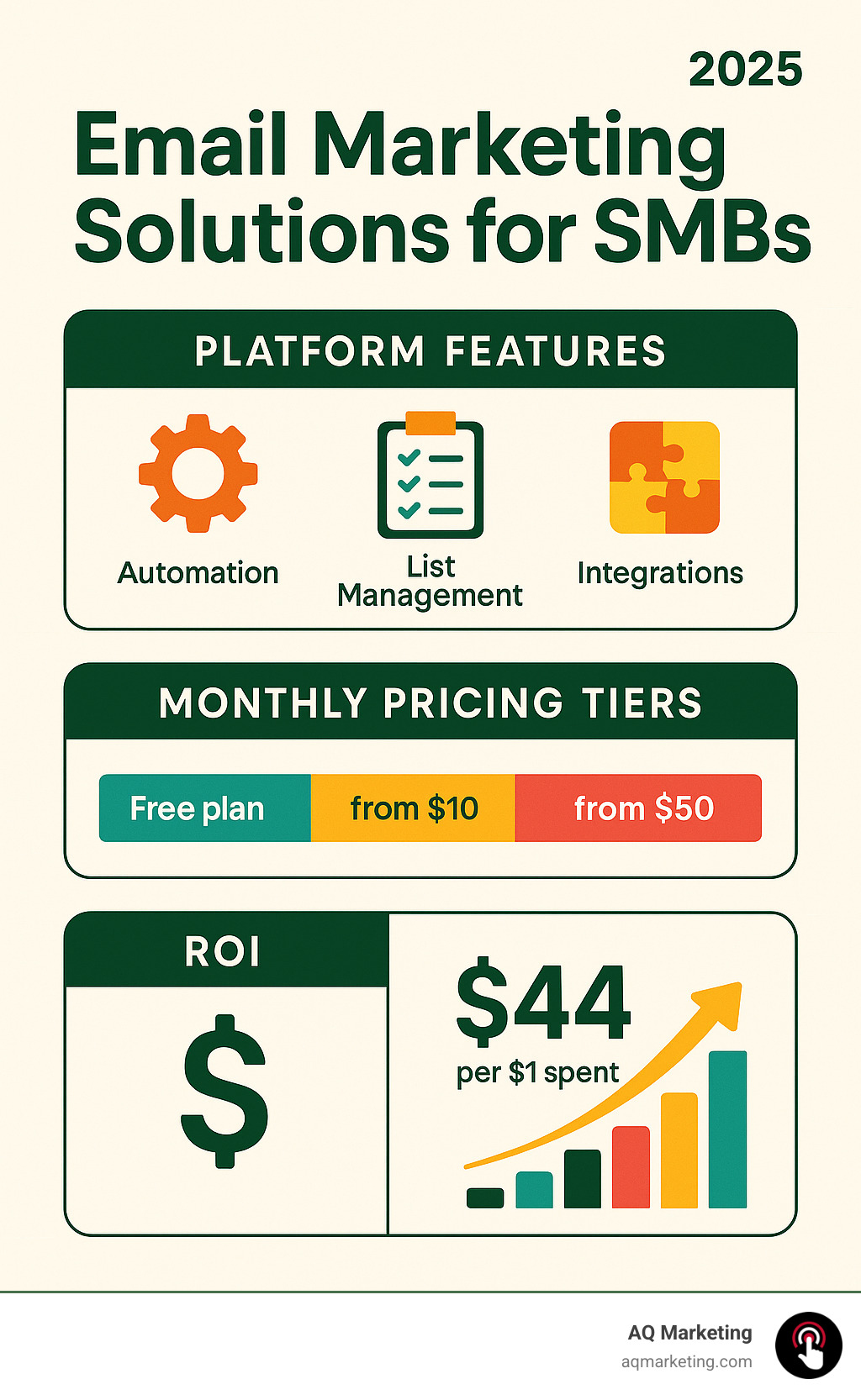
Email Marketing Solutions for SMBs terms to learn:
Email Marketing 101 for Small & Medium Businesses
Let’s be honest – email marketing has come a long way from those spammy newsletters your uncle used to send. Today’s Email Marketing Solutions for SMBs are about building genuine relationships with your customers, not just filling up their inboxes.
Think of email as your direct hotline to customers. While social media platforms can change their rules overnight, your email list belongs to you. It’s like having your customers’ phone numbers – nobody can take that away.
The proof is in the numbers, and they’re pretty impressive. 83% of customers spend more on brands that send email communications, and email marketing is 40 times more effective than social media for bringing in new customers. That $44 return for every $1 spent we mentioned earlier? That’s not just marketing fluff – it’s backed by solid data.
But here’s where it gets interesting. Scientific research on consumer-overwhelm shows that people are drowning in messages. The solution isn’t sending fewer emails – it’s sending better ones. Quality beats quantity every single time.
For small and medium businesses, email plays multiple roles in your marketing strategy. It’s your welcome wagon for new customers, your retention tool for existing ones, and your comeback kid for re-engaging customers who’ve gone quiet. With 72% of people checking their email more than six times daily, you’re meeting customers where they already are.
Why SMBs Still Rely on Email
Despite all the flashy new marketing channels popping up, email remains the reliable workhorse for small businesses. There are three big reasons why: cost-efficiency, list ownership, and first-party data control.
Cost-efficiency is where email really shines. While paid advertising keeps getting more expensive and social media organic reach keeps shrinking, email marketing costs stay predictable. You can reach thousands of customers for what you’d spend on a handful of paid clicks.
List ownership is your insurance policy against platform changes. When you build an email list, you’re building a real business asset. Your subscribers chose to hear from you – that permission is incredibly valuable.
First-party data is becoming gold as privacy laws tighten and third-party cookies disappear. Every email interaction tells you something about your customers – what they like, when they shop, what makes them click.
Benefits that Move the Needle
The real magic happens when email marketing drives actual business results. We’ve seen small businesses achieve 133% revenue increases through smart automation sequences and generate 325 additional orders from simple abandoned cart emails.
Sales lift comes from email’s superpower: nurturing relationships over time. Unlike a single ad that someone sees once, email lets you tell your story across multiple touchpoints. You build trust, demonstrate value, and then ask for the sale when the timing is right.
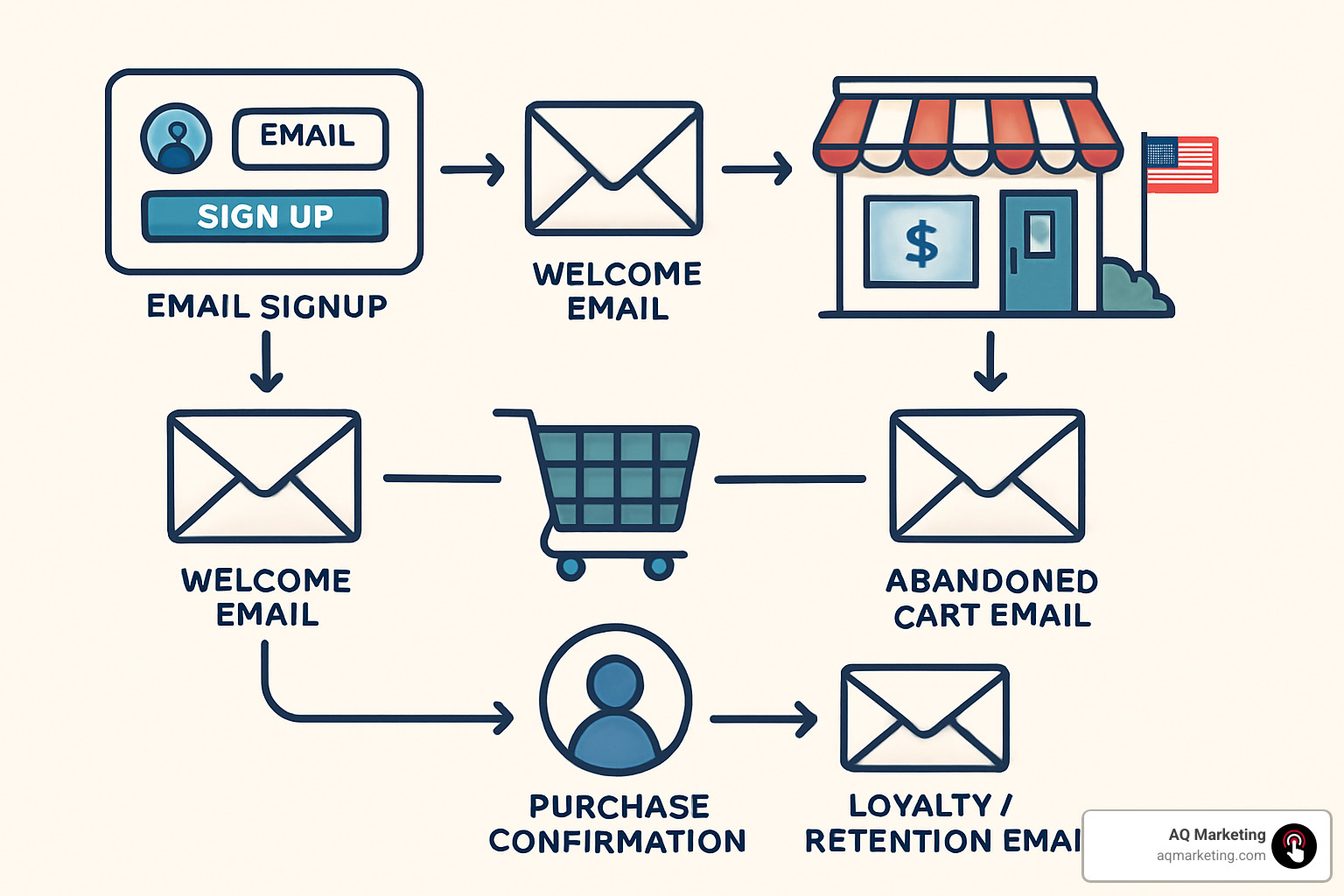
Email Marketing Solutions for SMBs: Core Criteria
Picking the right Email Marketing Solutions for SMBs feels a bit like choosing a car – you don’t need the fanciest model with every bell and whistle, but you absolutely need one that gets you where you’re going reliably. After helping hundreds of small businesses steer this decision, I’ve learned that the platforms with the most features aren’t always the best fit for growing companies.
Automation capabilities should be your first priority. In 2025, manually sending every email is like using a flip phone – technically possible, but why would you? Your platform needs to handle the basics like welcome sequences, abandoned cart recovery, and re-engagement campaigns without requiring a computer science degree.
AI-powered copy assistance is becoming a real game-changer for small teams wearing multiple hats. When platforms offer subject line suggestions, content optimization, and send-time prediction, they’re essentially giving you a marketing assistant that never takes coffee breaks.
Segmentation tools determine how precisely you can target your messages, and precision matters more than volume. The ability to segment by purchase history, engagement level, location, or custom fields lets you send more relevant content that actually drives results.
Deliverability rates directly impact your ROI in ways that might surprise you. Platforms with strong sender reputations ensure your emails reach inboxes instead of spam folders. Poor deliverability can kill even the most brilliant campaigns.
GDPR compliance isn’t optional if you serve customers in Europe or plan to expand internationally. Your platform should handle consent management, data portability, and deletion requests automatically.
Scalability planning prevents expensive platform migrations later. Choose solutions that can grow from hundreds to thousands of subscribers without breaking your budget or requiring complete strategy overhauls.
For more specific guidance on local implementation, check out our Local Business Email Marketing strategies that work particularly well for businesses in our service area.
Must-Have Features in “Email Marketing Solutions for SMBs”
Drag-and-drop builders are essential for teams without design resources or the budget to hire them. The best platforms offer professionally designed templates that you can customize with your brand colors, fonts, and imagery without touching a single line of code.
Template libraries should include options for different industries and campaign types. Look for welcome sequences, promotional campaigns, newsletters, and event invitations that actually match your business model.
Journey mapping capabilities let you visualize and optimize customer experiences across multiple touchpoints. This feature helps you understand how email fits into your broader marketing strategy.
Behavioral triggers enable sophisticated automation based on customer actions. When someone abandons their cart, downloads a resource, or clicks a specific link, your platform should automatically send relevant follow-up messages.
Nice-to-Have Upgrades for Growing SMBs
SMS integration is becoming increasingly valuable as customers expect multi-channel communication. Platforms that combine email and SMS under unified analytics provide better customer experiences.
Predictive send-time optimization uses AI to determine when individual subscribers are most likely to engage with your emails. This can significantly improve open rates without any extra effort on your part.
Ecommerce integration connects your email platform directly to your online store, enabling product recommendations, inventory-based campaigns, and revenue tracking.

Evaluating Platform Categories & Pricing
Let’s talk money – because choosing the right Email Marketing Solutions for SMBs isn’t just about features, it’s about finding something that fits your budget today and won’t break the bank tomorrow.
Most email platforms use subscriber-based pricing, which sounds straightforward until you dig into the details. The differences between platforms can add up to thousands of dollars annually, so it’s worth understanding how this works.
Subscription tiers typically start with generous free plans that work well for new businesses. Many platforms let you send thousands of emails monthly without paying a dime, while others cap free users at lower limits. These limits feel comfortable when you’re starting out, but they can become restrictive faster than you might expect.
Pay-as-you-grow models sound fair in theory – your costs scale with your subscriber count, which should align with your business growth. But here’s where it gets tricky: some platforms double their monthly cost when you cross certain subscriber thresholds.
Free plans are fantastic for testing the waters, but they come with trade-offs. Most include platform branding on your emails and limit access to advanced features. While they’re perfect for experimenting, professional businesses usually need paid plans for custom branding and sophisticated automation.
Support levels vary dramatically between free and paid tiers. Free users might wait days for email responses, while premium subscribers get phone support and dedicated account managers.
Watch out for hidden fees that can blindside you later. Some platforms charge setup costs, overage fees when you exceed limits, or premium template fees.
Product Roundup Without the Jargon
Entry-level tools focus on doing email marketing really well without overwhelming you with features you don’t need. They’re perfect for businesses that want reliable email marketing at affordable prices without complex integrations.
All-in-one suites combine email marketing with CRM, sales automation, and analytics. They cost more upfront but can actually save money by eliminating the need for multiple tools.
Specialized ecommerce platforms offer deep integrations with online stores, sophisticated product recommendation engines, and detailed revenue tracking. They’re worth the premium if email directly drives sales for your business.
Email Marketing Solutions for SMBs and Budget Planning
Total cost of ownership includes more than the monthly subscription fee that gets advertised. Factor in setup time, training costs, integration expenses, and potential migration costs if you need to switch platforms later.
Scalability planning helps avoid expensive surprises down the road. A platform that costs $20 per month for 1,000 subscribers might jump to $200 per month for 10,000 subscribers. Model your growth projections against different pricing structures.
With Scientific research on email-volume showing 360 billion emails sent daily in 2024, growing to 400 billion by 2027, the email marketing landscape will continue evolving rapidly. Choose platforms that invest in innovation and can adapt to changing requirements.
Implementation, Testing & Optimization
Here’s where the rubber meets the road with Email Marketing Solutions for SMBs. You can have the fanciest platform in the world, but if you’re sending boring emails to people who didn’t ask for them, you’re just contributing to inbox clutter.
Successful email marketing is less about the tool and more about understanding your customers. When you know what makes them tick, what problems keep them up at night, and what solutions they’re desperately seeking, your emails become helpful rather than annoying.
Building your email list ethically should be your foundation. Think of it like dating – you wouldn’t propose on the first meeting, right? The same logic applies to email marketing. Offer something valuable first, whether that’s a helpful guide, exclusive discount, or insider tips that genuinely solve a problem.
Lead magnets work because they create a fair exchange. Your prospect gets immediate value, and you get permission to continue the conversation. The key is making sure your lead magnet attracts the right people – those who are actually interested in what you sell.
Personalization has evolved far beyond “Hi [First Name].” Today’s customers expect you to remember their preferences, purchase history, and where they are in their journey with your business.
The beauty of A/B testing is that it takes the guesswork out of email marketing. Instead of wondering whether your subject line is compelling or your call-to-action button should be red or blue, you can test different versions and let your audience tell you what works.
Mobile accessibility isn’t optional anymore – it’s survival. With most people checking email on their phones, your emails need to look great and function perfectly on small screens.
For businesses looking to integrate AI into their email strategy, our guide on How to Use AI in Email Marketing shows you how to leverage artificial intelligence for better results without losing the human touch.
Building & Growing Your List
Growing your email list feels like a chicken-and-egg problem. You need subscribers to send emails to, but you need great content to attract subscribers. The solution starts with ethical opt-ins that set clear expectations from day one.
Double opt-in confirmation might seem like an extra step, but it’s actually your friend. When someone confirms their subscription, you know they really want to hear from you. This leads to better engagement rates and fewer spam complaints down the road.
Pop-ups get a bad rap, but they work when used thoughtfully. Exit-intent pop-ups catch people just as they’re about to leave your website – it’s like saying “wait, before you go…” The timing feels natural rather than pushy.
Content upgrades are the secret weapon many businesses overlook. Instead of using the same lead magnet for everyone, create specific resources for different pages or blog posts.
Crafting Campaigns That Convert
Your subject line has about three seconds to grab attention in a crowded inbox. Keep it under 50 characters so it doesn’t get cut off on mobile devices. Create curiosity without being clickbait-y, and test different approaches to see what resonates with your specific audience.
Great email copywriting feels like a conversation with a friend who happens to know a lot about your industry. Skip the corporate jargon and write like you’re explaining something to your neighbor over the fence. Focus on benefits over features – instead of listing what your product does, explain how it makes life easier.
Your call-to-action buttons deserve more attention than they usually get. The color should contrast with your email design, the text should be action-oriented, and the placement should feel natural within your content flow.
Data-Driven Improvements
Open rates tell you whether your subject lines are working and whether your sender reputation is healthy. Industry averages hover around 20-25% for most SMBs, but don’t get too hung up on benchmarks. Focus on your own trends over time.
Click-through rates reveal whether your content is engaging and relevant. Typical rates fall between 2-5% depending on your industry. Low click-through rates might mean your content isn’t compelling or your calls-to-action aren’t clear enough.
Conversion rates matter more than any other metric because they track actual business outcomes. Someone might open and click your email, but if they don’t take the desired action on your website, the email didn’t achieve its goal.
Revenue per email gives you the clearest picture of your email marketing’s financial impact. Calculate total revenue generated divided by emails sent to understand which campaigns actually move the needle for your business.
Frequently Asked Questions about Email Marketing Solutions for SMBs
How do I start if I have zero subscribers?
Starting from scratch is actually a blessing in disguise. You get to build your list the right way from day one, without any bad habits or inherited problems from previous campaigns.
Your first step is creating something valuable that people actually want. This could be a free guide that solves a common problem in your industry, a discount code for first-time customers, or an exclusive checklist that makes their life easier. The key is making sure it’s genuinely helpful, not just a thinly veiled sales pitch.
Once you have your lead magnet ready, put signup forms everywhere your potential customers might see them. Add them to your website homepage, blog posts, and social media profiles. Include a simple call-to-action on your business cards and email signature.
Quality beats quantity every time. It’s better to have 50 engaged subscribers who open and click your emails than 500 people who ignore everything you send. Focus on attracting people who genuinely care about what you offer.
Which metrics really signal success?
Here’s where many small business owners get confused. Yes, open rates and click-through rates are important, but they don’t pay your bills. The metrics that actually matter are the ones that directly impact your bottom line.
Conversion rates tell you how many people take action after reading your emails. Whether that’s making a purchase, booking a consultation, or downloading a resource, this metric shows if your content is actually persuasive.
Revenue per email is even more telling. Calculate the total revenue generated from each campaign divided by the number of emails sent. This helps you understand which types of emails are most profitable for your business.
Customer lifetime value shows the long-term impact of your email marketing. Customers who engage with your emails typically spend more and stay loyal longer than those who don’t.
How do I stay compliant with GDPR & CAN-SPAM?
Compliance isn’t as scary as it sounds, especially when you choose the right Email Marketing Solutions for SMBs that handle most of the technical requirements automatically.
For GDPR compliance, the main rule is simple: only email people who explicitly agreed to hear from you. This means using double opt-in confirmation for EU subscribers, maintaining clear privacy policies, and being able to delete customer data when requested.
CAN-SPAM compliance is more straightforward but equally important. Include your physical business address in every email footer, provide clear unsubscribe links, and honor unsubscribe requests within 10 business days. Never buy email lists or add people without their permission.
The golden rule for both regulations is transparency. Be clear about what you’re sending, how often you’ll send it, and make it easy for people to opt out if they change their minds.
Conclusion
Email Marketing Solutions for SMBs aren’t just another marketing tool – they’re your direct line to building lasting customer relationships that actually drive business growth. With that impressive $44 return for every $1 spent and access to 4 billion email users worldwide, email marketing remains the most reliable way for small businesses to compete with bigger competitors.
The truth is, choosing the right platform matters less than you might think. Whether you’re starting with a free plan or investing in advanced automation, your success comes down to understanding your customers and consistently delivering value. We’ve seen businesses transform their revenue with simple welcome sequences, while others struggle despite having the fanciest tools.
Email marketing works best when you think of it as customer service, not just sales. The businesses that thrive are those that use email to solve problems, share useful information, and make their customers’ lives easier. When you focus on being helpful first, the sales naturally follow.
At AQ Marketing, we’ve been helping businesses in Boston, Woburn, and throughout Middlesex County since 2003. We’ve watched email marketing evolve from simple newsletters to sophisticated automation systems. What hasn’t changed is this: people want to hear from businesses they trust.
Building that trust takes time. Your first email campaign might not break records, and that’s perfectly normal. The SMBs that succeed with email marketing are the ones that stick with it, learn from their results, and keep improving. Every email is a chance to strengthen relationships with your customers.
The future belongs to businesses that master permission-based marketing. When consumers are bombarded with ads, email gives you the chance to communicate with people who actually want to hear from you. That’s incredibly powerful.
Ready to get started? Check out our Digital Marketing Services for Small Business to see how email fits into your overall marketing strategy. Or dive deeper into Local Business Email Marketing tactics that work specifically for businesses in our area.
Email Marketing Solutions for SMBs aren’t about sending more emails – they’re about sending better ones. Focus on your customers, provide real value, and measure what matters for your business. The relationships you build today through email will fuel your growth for years to come.