

PPC for Start Ups: Master Growth in 2025
Why PPC for Start Ups Is Your Fastest Path to Market Validation
PPC for start ups is a paid advertising model where you only pay when someone clicks your ad. It offers immediate visibility, rapid market testing, and precise budget control—essential for new businesses in fast-moving markets like Boston and the Merrimack Valley.
Quick Answer: What Makes PPC Essential for Startups?
- Speed: Generate traffic and leads within hours of launch.
- Control: Set exact budgets and pause campaigns anytime.
- Testing: Validate your offer and messaging with real customer data in days, not months.
- Targeting: Reach high-intent customers in specific locations like Woburn, Middlesex County, or Southern New Hampshire.
- Measurability: Track every dollar spent and conversion earned.
Starting a business in competitive markets like Boston means you can’t wait months for organic traffic. You need to know if your offer resonates and prove your business model works—fast. That’s where PPC shines.
Unlike SEO, which takes 3-6 months to gain traction, PPC puts your startup at the top of search results immediately. It’s not just about traffic—it’s about learning. Every click tells you something critical about your market, messaging, and product-market fit.
The challenge is that most startups waste limited budgets on poorly structured campaigns. This guide will show you how to avoid those pitfalls and build PPC campaigns that drive growth, even on a lean budget.
I’m Robert P. Dickey, President and CEO of AQ Marketing. For over 20 years, I’ve helped businesses in Boston, Woburn, and the Merrimack Valley succeed with digital marketing. I’ve seen how strategic PPC for start ups can transform early-stage companies from invisible to indispensable.
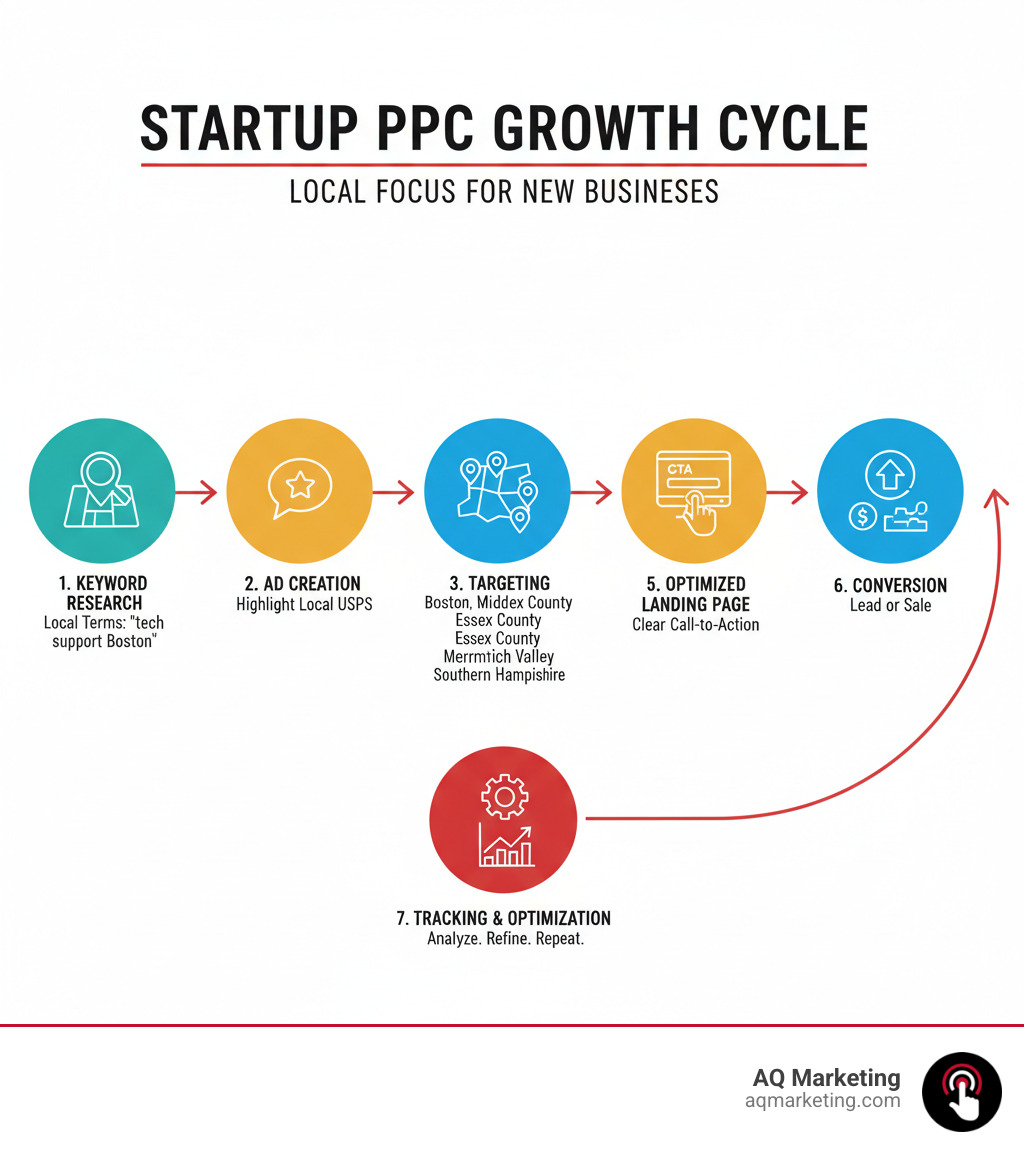
Why PPC is a Startup’s Growth Engine: Speed, Data, and Control
For a startup in Boston or the Merrimack Valley, breaking through the noise is a major challenge. PPC for start ups is your most powerful ally, an express lane to market validation and a direct connection to customers actively searching for your services.
The magic of PPC is its immediacy. Unlike SEO, which takes months to build momentum, a well-crafted PPC campaign can put your business in front of potential customers in hours. A new software startup in Woburn can appear at the top of Google for “tech support Boston” on its first day.
This speed is about survival and learning. PPC provides answers to critical questions—Does our messaging resonate? Is there demand in Middlesex County?—using real customer behavior, not guesswork. It’s a market research tool with a built-in revenue stream, allowing you to make sales while you learn. This agility lets you out-learn, not just out-spend, your competition.
Brand awareness and lead generation happen simultaneously. Your ads appear where ideal customers are looking, and each click is a potential customer raising their hand. In fact, paid search visits are 35% more likely to convert because they often have higher commercial intent.
For a deeper dive into how these strategies work together, see our guide on SEO vs. PPC: What’s the Difference?
The PPC vs. SEO Dilemma for Startups

Founders often ask, “PPC or SEO?” The real answer is you need both, but timing is key.
- PPC is your sprint: It’s immediate and controllable. You generate traffic within hours, which is vital for a new home services company in Woburn. The downside? Traffic stops when you stop paying.
- SEO is your marathon: It requires patience (3-6 months) but builds long-term, sustainable traffic without a per-click cost. The value compounds over time.
These two strategies make each other better. Data from your PPC campaigns in Southern New Hampshire—which keywords convert, what ad copy works—becomes rocket fuel for your SEO strategy. For example, if “emergency plumbing Middlesex County” converts well in PPC, you know to focus your SEO efforts there.
As SEO gains traction, you can reduce PPC spend on those keywords, freeing up budget. Seeing your business in both paid and organic results for a search in Essex County also boosts credibility and trust. While PPC requires ongoing investment, the cost of invisibility for a startup is far higher. The smart approach is to start with PPC for immediate revenue and data, then use that information to build a strong SEO foundation.
For more insights, check out our article on How Digital Marketing Helps Small Business.
Building Your First Campaign: A Step-by-Step Guide to PPC for Start Ups

Ready to dive into PPC for start ups? A successful campaign starts with a solid foundation. It’s about structure and strategy, not just spending money.
Campaign structure is where it all begins. Align campaigns with specific business goals, like generating leads for a home service company in Essex County or booking appointments for an agency in the Merrimack Valley. Within campaigns, create tightly organized ad groups. For instance, a Woburn plumber should separate “emergency plumbing repair” from “bathroom remodeling” because they have different customer intents.
We often use Single Keyword Ad Groups (SKAGs) to match ads perfectly to a searcher’s intent. This precision leads to higher Quality Scores and lower costs—a huge advantage for a startup. Also, separate brand campaigns (e.g., searches for “AQ Marketing”) from non-brand campaigns (e.g., “digital marketing agency Boston”) to manage costs and target new customers effectively.
Defining Your Goals and KPIs
Before launching, define what success looks like. Forget vanity metrics like impressions; focus on what moves the needle for your startup.
- Target Audience: Who are you trying to reach in Southern New Hampshire? What problems do they have? The more specific you are, the less money you waste.
- Cost Per Acquisition (CPA): How much can you afford to pay for a new customer? Define a target CPA that makes sense for your business model.
- Return On Ad Spend (ROAS): For e-commerce, this is your north star. It measures the revenue generated for every dollar spent on ads.
- Customer Lifetime Value (CLV): Understanding the long-term value of a customer can justify a higher initial acquisition cost. We track conversions obsessively, because conversions pay the bills.
Choosing the Right Platforms for Your Startup
Choosing the right platform is like picking the right fishing spot. You need to know where your customers are.
- Google Ads: This is the starting point for most local startups. When someone in Woburn needs an “emergency plumber near me,” they’re on Google. It captures high-intent, immediate needs.
- Microsoft Advertising (Bing): Often overlooked, Bing has less competition and lower costs. It’s great for B2B startups targeting professionals, as many corporate environments default to Microsoft products.
- Meta (Facebook & Instagram): A goldmine for B2C startups serving consumers in Southern New Hampshire. Its demographic and interest-based targeting is perfect for creating demand.
- LinkedIn Ads: Powerful for B2B startups, despite higher costs. You can target by job title, company size, and industry to reach decision-makers in the Boston business community.
Mastering Keyword Research and Ad Copy
This is where you turn clicks into customers. We focus on high-intent keywords that show someone is ready to act. The secret for startups is using long-tail keywords like “emergency plumber Woburn MA” instead of broad, expensive terms like “plumber.” These specific phrases are cheaper and convert at higher rates.
We use tools like Google Keyword Planner and our two decades of local expertise in Boston and the Merrimack Valley to find the terms your customers actually use.
For ad copy, your message must stand out. We focus on:
- Compelling Headlines: Weave in keywords, highlight benefits, and use action words.
- Unique Selling Proposition (USP): Immediately communicate what makes you different. Are you faster, more affordable, or more specialized in Essex County?
- Strong Call-to-Action (CTA): Tell people exactly what to do next, like “Call Now for Same-Day Service” or “Get Your Free Quote Today.”
The goal is to make your ad so relevant to a local searcher that clicking is the obvious choice. This is how PPC for start ups becomes a powerful growth engine.
Smart Spending: Maximizing ROI with a Lean Startup Budget
For most startups in Boston or Woburn, the budget is tight. With PPC for start ups, maximizing ROI isn’t optional—it’s essential for survival. Smart spending isn’t about having the biggest budget; it’s about making every dollar work harder.
We often use a “70-20-10 rule” for budget allocation: 70-80% goes to core, high-intent campaigns, and the rest is for experimenting with new keywords or targeting in areas like Southern New Hampshire. This balances growth with manageable risk.
For bidding, we typically start with Manual CPC (Cost-Per-Click) to gain full control and understand costs. As we gather conversion data, we can transition to automated bidding strategies like “Maximize Conversions,” which use machine learning to optimize bids. However, automation needs data to be effective, so we start manually and graduate later.
Continuous monitoring is critical. We set daily budget limits and review performance regularly. For a Woburn home service startup, we found that focusing their modest budget on high-performing weekday mornings stretched their ad spend 40% further without spending an extra penny.
Budgeting Strategies and Bidding for Lean Startups
How much should you budget? It’s not about how much you have, but how smart you are with it. We recommend a test budget of $500 to $2,000 per month for most local startups. This isn’t just ad spend; it’s an investment in data acquisition.
We’ll calculate your break-even CPC (Cost Per Click)—the maximum you can afford to pay for a click while remaining profitable. This keeps spending grounded in reality. We can also reference industry data like Wordstream benchmarks for context.
Start small and scale up. Focus on a few high-intent keywords in your core geographic area, like Woburn and nearby towns in Middlesex County. As we see positive results, we gradually increase the budget. This iterative approach minimizes risk and maximizes learning. For more on this, explore our insights on Targeted PPC Advertising.
The Power of A/B Testing and Negative Keywords in PPC for Start Ups
Two of the most effective optimization tools are A/B testing and negative keywords.
A/B testing is how we improve campaigns without guessing. We test different ad headlines, calls-to-action, or landing page elements to see what your audience in Essex County responds to. The data tells us what works, allowing for methodical improvement.
Negative keywords are a budget-saving powerhouse. They tell Google which search terms not to show your ads for. For a premium landscaping client in the Merrimack Valley, we added terms like “cheap,” “free,” and “jobs” as negatives. This cut wasted spend by 30% and increased their conversion rate by filtering out irrelevant searches. Building a comprehensive negative keyword list is one of the smartest investments in PPC for start ups.
Landing Page Optimization: Turning Clicks into Conversions
A great ad is useless if the landing page doesn’t convert. This is where clicks become customers.
- Message Match: The landing page must match the ad’s promise. If your ad says “Emergency Plumber Boston,” the page must reflect that immediately.
- Clear Value Proposition: Visitors should understand what you offer and why it matters within three seconds.
- Singular Call-to-Action (CTA): Guide visitors to one clear action, like “Get a Free Quote.”
- Mobile Optimization: Your page must be flawless and fast on smartphones, where most local searches happen.
- Fast Load Times: Conversion rates drop by 20% for every extra second of load time. We aim for under three seconds.
- Trust Signals: Include local testimonials, certifications, and security badges to build confidence, especially for new startups.
Optimizing these elements ensures your PPC investment translates into real business growth. For more, see our guide on 5 Local Business SEM Best Practices.
Scaling and Advanced Tactics: From Initial Traction to Market Leadership
Once your PPC for start ups campaigns are consistently profitable, it’s time to scale. But scaling isn’t just increasing the budget; it’s about strategic, measured growth. Many startups in Woburn and the Merrimack Valley stumble here by scaling too quickly, chasing vanity metrics, or ignoring mobile users.
Let’s explore advanced strategies to take your campaigns to the next level.
Retargeting is one of the most powerful tools. It allows us to show ads to people who have already visited your website but didn’t convert. By reminding them of their interest as they browse other sites or social media, we can bring them back to convert, often at a lower cost.
Audience layering combines multiple signals to find your ideal customers. For instance, we can target people searching for “home renovation Essex County” who are also in Google’s in-market audience for home improvement. We can also create custom audiences based on specific behaviors, like visiting your pricing page. With Customer Match, we can upload your customer email list to target them with special offers or create lookalike audiences—new users who share characteristics with your best customers in Southern New Hampshire.
Integrating PPC into Your Broader Digital Marketing Strategy
PPC for start ups works best as part of a cohesive digital marketing strategy. The insights from your PPC campaigns are gold for your other marketing efforts.
- Content Marketing: PPC search term reports show what your customers in Middlesex County are asking. This data should guide your blog content, answering their questions directly.
- Email Marketing: If a user clicks an ad for “insurance quotes Boston” but doesn’t convert, a follow-up email sequence can reinforce the message and build trust.
- Cohesive Messaging: Your brand’s message should be consistent across your Google ads, website, and social media. This alignment builds confidence and makes your brand memorable.
For local businesses, this integration is powerful. A customer might see a PPC ad, check your Google Business Profile, read reviews, and then call. Each touchpoint reinforces the others. Learn more in our guide to Digital Marketing Strategy.
Advanced Retargeting and Audience Layering
Advanced targeting feels like a superpower. It starts with proper tracking setup using pixels from Google and Meta to monitor user behavior on your site. This data allows us to create highly specific custom audiences.
We segment visitors intelligently. Someone who spent ten minutes on your services page is more valuable than someone who bounced in five seconds. We create separate audiences for general visitors, high-intent page viewers, cart abandoners, and existing customers. This allows us to create custom ad sequences that speak directly to where they are in their journey.
Lookalike audiences are especially powerful for scaling. We can take a list of your best customers in Southern New Hampshire and ask platforms like Google or Meta to find new users with similar digital profiles. For a deeper dive, see our PPC Advertising Services: Complete Guide.
Best Practices for Scaling PPC for Start Ups Profitably
Scaling profitably requires discipline. Think of it like expanding a successful restaurant—replicate what works and grow strategically.
- Scale the Winners First: Double down on the campaigns, ad groups, and keywords that deliver the best ROI before expanding.
- Increase Budgets Gradually: Use 20-30% increments to give algorithms time to adjust and to spot problems before they become expensive.
- Expand Match Types Carefully: As campaigns mature, you can test broader match types to increase volume, but monitor search term reports vigilantly to add new negative keywords.
- Test New Geographic Areas: Once you’ve succeeded in Woburn, test neighboring towns in Middlesex County or markets like Southern New Hampshire with smaller, dedicated campaigns.
- Refresh Ad Creative: Combat ad fatigue by updating your ad copy seasonally and referencing local events or landmarks to maintain relevance.
Startups that win at PPC combine data-driven agility with the discipline to scale sustainably. That’s how you achieve market leadership.
Frequently Asked Questions about PPC for Startups
Navigating PPC for start ups brings up plenty of questions, especially when you’re watching every dollar. Here are some of the most common questions we hear from founders in Boston, Woburn, and our other service areas.
How much should a startup spend on PPC?
There’s no magic number, as your ideal budget depends on your industry, customer lifetime value (CLV), and goals. However, a solid starting point for most local startups in the Merrimack Valley or Southern New Hampshire is a test budget of $500 to $1,000 per month. Think of this as your “learning budget” to gather data.
Your focus should be on achieving a positive Return On Ad Spend (ROAS) or a profitable Cost Per Acquisition (CPA) before scaling. The key principle is to start small, learn fast, and scale strategically based on data.
How long does it take to see results from PPC?
This is one of the best parts about PPC for start ups—the speed. Your ads can be live and generating traffic within hours of launch. A new home services company in Essex County could get calls the next day.
However, gathering enough meaningful data to optimize your campaigns typically takes 2-4 weeks. Achieving consistent, profitable results—where your campaigns reliably hit your target CPA or ROAS—usually takes 1-3 months of active management and continuous testing.
For a startup that needs to validate its market and generate revenue quickly, PPC’s speed is invaluable compared to the 6+ months often required for SEO.
Is PPC or SEO better for a new startup?
Asking whether PPC or SEO is “better” is the wrong question. The answer is you need both, as they serve different purposes.
- PPC offers immediate speed and testing capabilities, which are crucial for market validation. You can test offers and messaging in your Boston market within days.
- SEO builds long-term, sustainable traffic and establishes your authority. The organic traffic you build continues to deliver value over time.
A combined strategy is most powerful. Use PPC to fill the traffic gap while your SEO builds momentum. The keyword data from your paid campaigns directly informs your SEO strategy. Appearing in both paid and organic results for a search in Woburn or Middlesex County also significantly boosts credibility and trust. The real question isn’t which is better, but how to use both to accelerate your startup’s growth.
Conclusion: Partnering for Sustainable Growth
You’ve journeyed through PPC for start ups. If you’re still here, you’re serious about growing your business in competitive markets like Boston, Woburn, and the Merrimack Valley.
To recap, PPC is your fastest path to market validation. It’s how you test ideas with real customers and real data, avoiding months of guesswork. We’ve covered setting up precise campaigns, choosing the right platforms, crafting ads that convert, and using advanced tactics to scale profitably.
But knowing what to do and doing it are two different things. Profitable PPC requires constant attention and refinement. It’s not a “set it and forget it” task.
That’s where local expertise makes all the difference. At AQ Marketing, we’ve been helping businesses in our community since 2003. We understand the unique challenges of marketing a startup in Boston’s landscape, from Middlesex County to Southern New Hampshire. When you work with us, you get a partner invested in your long-term success.
Successful startups treat marketing as a data-driven process. They test, learn, adjust, and scale strategically. Your startup has potential; now it’s time to get your solution in front of the right audience. That’s what PPC for start ups does—and that’s what we help you master.
Ready to stop guessing and start growing? Learn more about our digital marketing services for small businesses and let’s discuss how we can help you get there faster.
