

Facebook ad campaign optimization: Top 10 Essential Tips
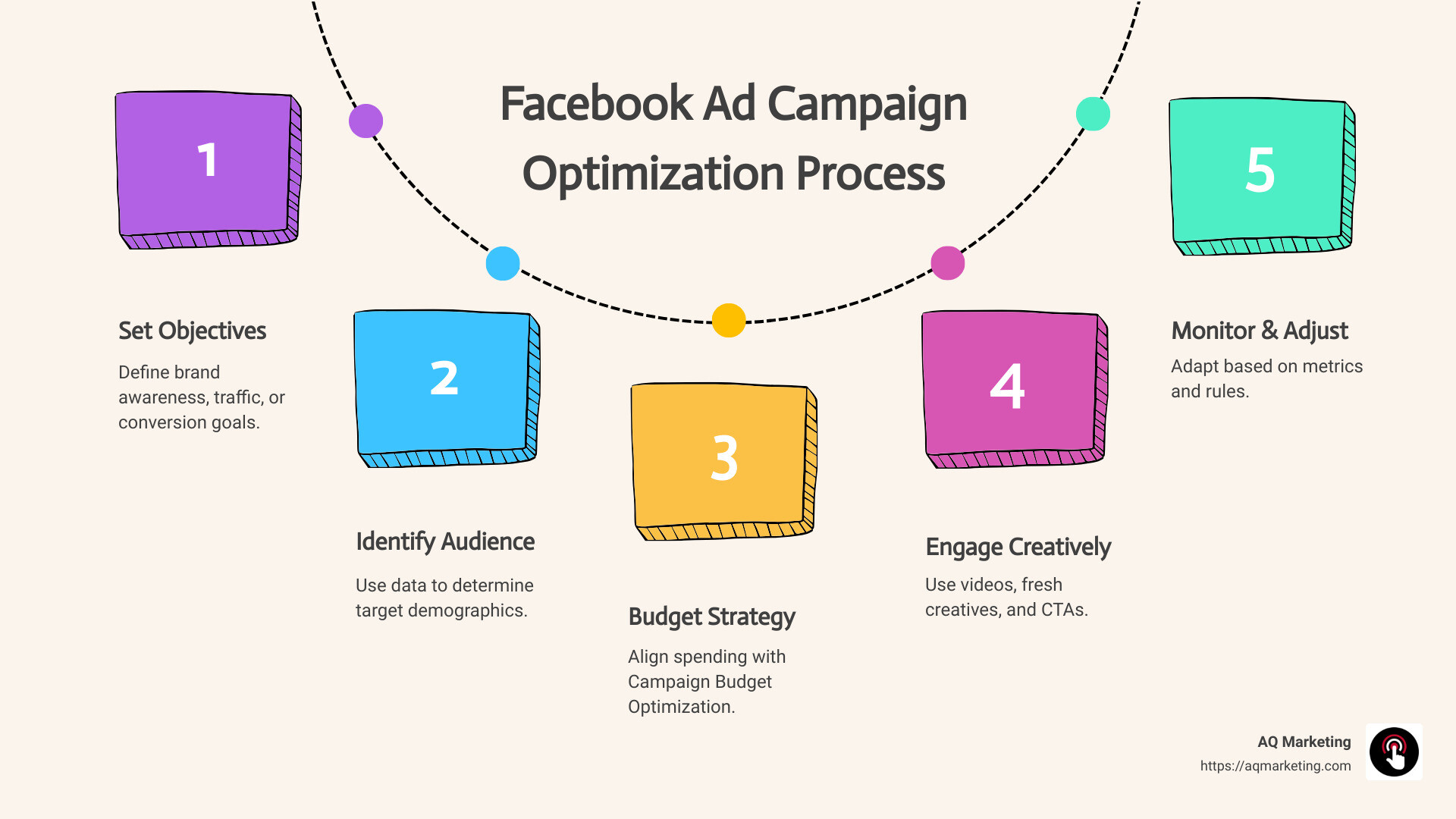
Facebook ad campaign optimization has become a crucial strategy for businesses looking to maximize their marketing efforts. If you’re aiming to improve your ad performance, here are the key steps you need to focus on:
- Set Clear Objectives: Define what you want to achieve with each campaign, whether it’s brand awareness, traffic, or conversions.
- Identify Your Audience: Use Facebook’s tools to gather data and insights about your target demographic.
- Budget Wisely: Use tools like Campaign Budget Optimization to ensure your spending aligns with your goals.
- Create Engaging Ads: Use video, fresh creatives, and strong CTAs to keep your audience engaged.
- Monitor and Adjust: Be ready to adapt based on performance metrics and automated rules to continually improve results.
Optimizing Facebook ad campaigns is not just about increasing spend but ensuring that every dollar works harder for you. By embracing automation, focusing on creative storytelling, and understanding your audience, you can convert clicks into loyal customers.
I’m Robert P. Dickey, President and CEO of AQ Marketing. With over 20 years in digital marketing, I specialize in helping businesses thrive through effective Facebook ad campaign optimization. My experience includes running PPC campaigns and managing client strategies to improve visibility and ROI. Let’s explore more about how to refine your Facebook advertising efforts.
Facebook ad campaign optimization terms to know:
– Facebook ad campaign analysis
– Local Facebook advertising
– how to setup a marketing agency in facebook business manager
Choose the Right Goals and Objectives
Setting the right goals and objectives is the foundation of successful Facebook ad campaign optimization. The clearer your objectives, the better Facebook can tailor its algorithms to achieve your desired outcomes. Here’s how to align your campaign goals with Facebook’s objectives chart:
Awareness Goals
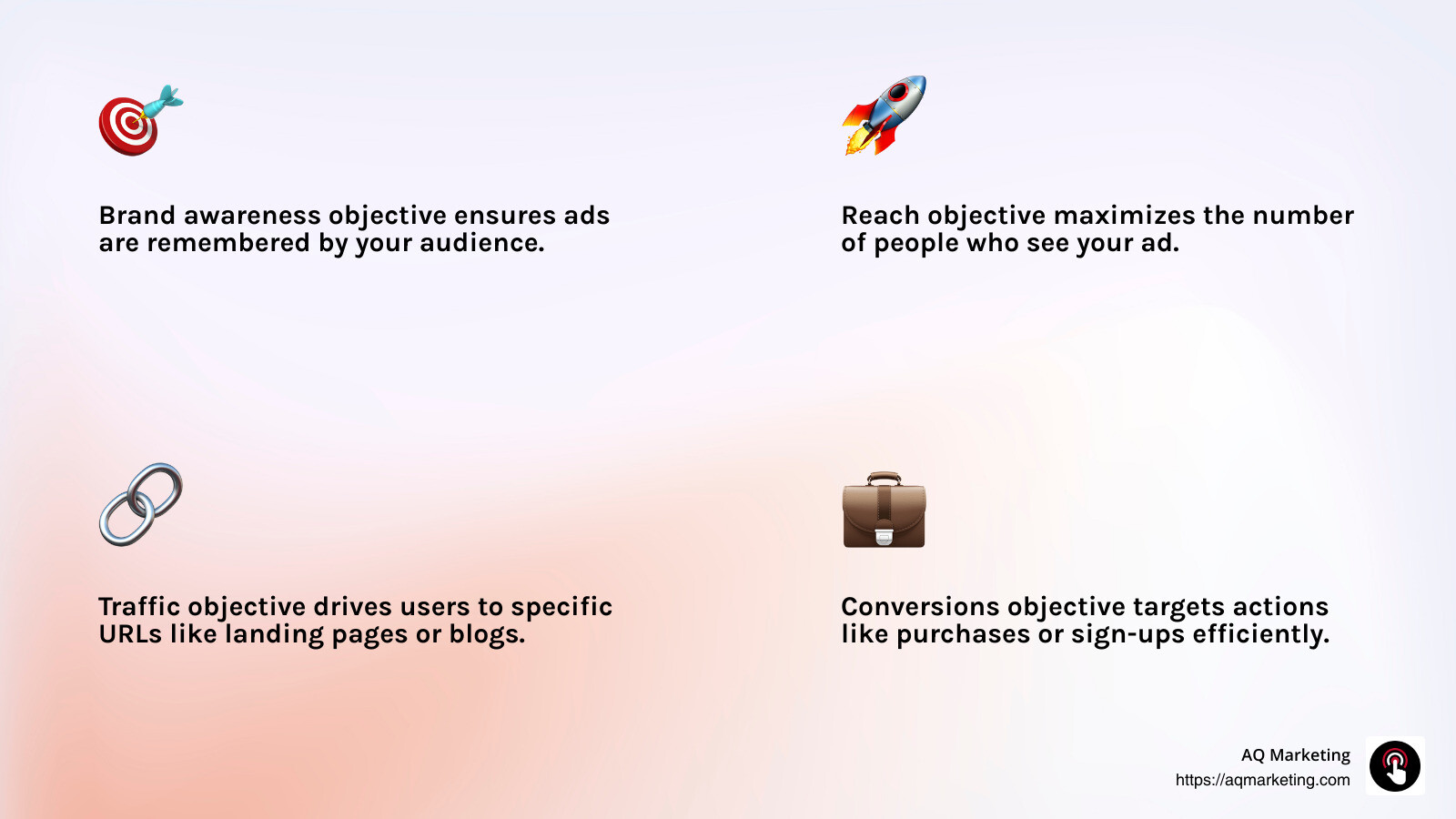
If your aim is to increase brand awareness, Facebook offers specific objectives to help you reach a wider audience. The Brand Awareness objective is designed to reach people more likely to remember your ads, effectively boosting your brand’s visibility. Alternatively, the Reach objective ensures your ad is shown to the maximum number of people in your target audience.
For example, a local bakery wanting to introduce a new product line might use these objectives to ensure that as many people as possible in their area see their ads.
Consideration Goals
When you’re looking to drive engagement and interaction, focus on the Consideration objectives. These are perfect for campaigns aimed at increasing website traffic or social media engagement. The Traffic objective sends users to a specific URL, like a blog post or landing page. Meanwhile, the Engagement objective encourages more likes, comments, and shares on your posts.
Consider a tech startup launching a new app. By using the App Installs objective, they can direct users to download their app from the app store, effectively increasing user adoption.
Conversion Goals
For campaigns focused on driving specific actions, such as purchases or sign-ups, Conversion objectives are key. The Conversions objective encourages users to complete actions like signing up for a newsletter or purchasing a product. For e-commerce businesses, the Catalog Sales objective showcases products to users who are more likely to buy, based on their past behavior and interests.
An online retailer could use these objectives to promote a seasonal sale, ensuring that their ads reach users who are most likely to make a purchase.
By choosing the right objectives, you align your campaign strategy with your business goals, ensuring each ad is purpose-driven and measurable. This strategic alignment not only improves your ad’s effectiveness but also maximizes your return on investment, making every dollar spent on Facebook advertising work harder for you.
Identify and Expand Your Audience
Understanding who your audience is and how to reach them effectively is crucial for successful Facebook ad campaigns. This is where Facebook Audience Insights becomes an invaluable tool.
Using Facebook Audience Insights
Facebook Audience Insights provides a wealth of aggregated data about your audience. This tool helps you dig deep into the demographics, interests, and behaviors of both your current followers and potential new audiences. By leveraging this data, you can craft more targeted and effective ad campaigns.
Data Gathering and Personas
Start by gathering key information about your existing audience. Audience Insights allows you to see details like age, gender, location, and even the pages they like. This data is not just numbers—it’s the foundation for creating detailed personas. Personas are fictional characters that represent segments of your audience, helping you tailor your messaging to meet their specific needs and preferences.
For instance, if you find that a large portion of your audience is interested in eco-friendly products, you can create a persona like “Eco-Conscious Emily.” This persona can guide your ad content and product offerings to better resonate with this segment.
Audience Targeting
With your personas in mind, use Audience Insights to refine your audience targeting. You can target users based on demographics, interests, and behaviors that align with your personas. Suppose you run a fitness brand; you might target users interested in health and wellness or those who follow fitness influencers.
Additionally, consider expanding your audience by targeting “lookalike audiences.” These are users who share characteristics with your best customers but haven’t interacted with your brand yet. This approach can significantly broaden your reach without sacrificing relevance, as it focuses on users most likely to be interested in your offerings.
By effectively identifying and expanding your audience through Facebook Audience Insights, you can ensure your ads are seen by the right people. This strategic targeting not only increases engagement but also boosts conversion rates, making your Facebook ad campaign optimization efforts more impactful.
Lean into Facebook’s Ads Manager
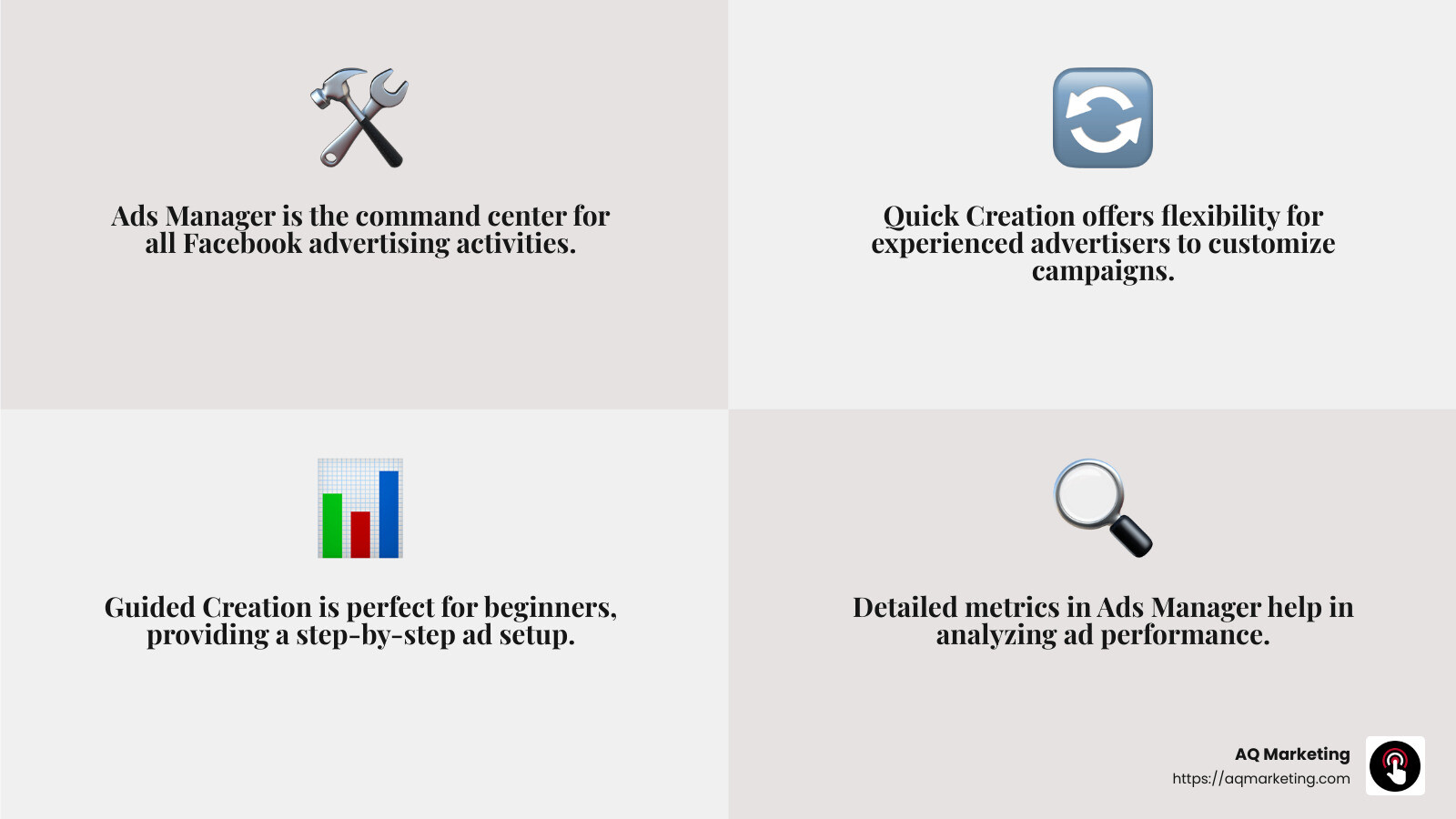
When it comes to managing your Facebook ad campaigns, Ads Manager is your go-to tool. Think of it as the command center for all your advertising activities. Whether you’re setting up campaigns, monitoring their performance, or tweaking them for better results, Ads Manager has got you covered.
Quick Creation vs. Guided Creation
Ads Manager offers two distinct methods for creating ads: Quick Creation and Guided Creation.
- Quick Creation: This option is perfect for seasoned advertisers who like to have full control over the ad creation process. It allows you to set up campaigns, ad sets, and ads in any order you prefer. This flexibility lets you quickly adjust elements like targeting or budget without following a strict sequence.
- Guided Creation: Ideal for beginners, this step-by-step wizard walks you through the entire ad creation process. It ensures you don’t miss any critical steps, making it an excellent choice for those new to Facebook advertising.
Key Features of Ads Manager
Once you’ve chosen your creation method, Ads Manager offers a suite of features to improve your ad campaigns:
- Duplicate Ads: Save time by duplicating successful ads or ad sets. This is especially useful for testing variations or scaling your campaigns.
- Edit Ads: Make changes to your ads all in one place. Whether it’s tweaking the copy, changing the image, or adjusting the budget, Ads Manager allows you to edit your ads seamlessly.
- View Metrics: Ads Manager provides detailed insights into your ad performance. You can track important metrics like reach, engagement, and conversion rates to see how your campaigns are doing.
- Analyze Performance: Dive deeper into your ad data to understand what’s working and what isn’t. Use these insights to refine your strategies and improve your return on investment.
- Automated Rules: Set up automated rules to manage your campaigns efficiently. For example, you can create a rule to pause ads that aren’t performing well or to increase the budget for ads that are exceeding expectations.
By leveraging these features, you can optimize your Facebook ad campaigns effectively. Whether you’re a novice or a pro, Ads Manager provides the tools you need to create, manage, and analyze your ads with precision. This level of control and insight is crucial for achieving your advertising goals and maximizing your return on investment.
Get Creative and Increase Engagement
Creating engaging ads is key to capturing your audience’s attention on Facebook. Let’s explore how you can use engaging media, draft compelling ad copy, and choose the right CTAs to boost engagement and drive results.
Use Engaging Media
Facebook is a visual platform, so your ads should be visually appealing. Photos, graphics, and videos are your best friends here.
- Photos and Graphics: Use high-quality images that catch the eye. Choose visuals that are relevant to your product or service and resonate with your audience. For instance, a Calm app ad might use soothing colors and serene landscapes to convey relaxation.
- Videos: Videos can be more engaging than static images. They allow you to tell a story and showcase your product in action. High engagement rates are often linked to videos, making them a powerful tool for increasing brand awareness.
Draft Great Copy
Your ad copy is just as important as your visuals. It should be clear, concise, and compelling.
- Storytelling: Use storytelling to draw your audience in. Share how your product or service can solve a problem or improve their life. Stories make your brand relatable and memorable.
- Testimonials and Statistics: Include testimonials from satisfied customers or impressive statistics about your product. For example, an Asana ad might highlight how much time a user saved by using their tool. This adds credibility and encourages trust.
Choose the Right CTAs
A well-placed call-to-action (CTA) can significantly boost conversions.
- Consistency: Ensure that your CTA matches the ad’s message. If your ad talks about signing up for a newsletter, a “Sign Up” button is appropriate. Avoid mismatches like a “Watch Video” button when you’re promoting a sale.
- Effective CTAs: Choose CTAs that encourage immediate action. Words like “Learn More,” “Shop Now,” or “Get Started” can create a sense of urgency and guide users to take the next step.
Ad Variations
To combat ad fatigue, create multiple versions of your ads. This keeps your content fresh and allows you to test which variations perform best. Facebook’s automatically rotating ads feature can help by rotating different versions and showing the most effective ones more frequently.
By focusing on engaging media, great copy, and the right CTAs, you can create ads that not only capture attention but also drive engagement and conversions. These elements are crucial for successful Facebook ad campaign optimization.
Next, let’s explore how to keep your ads relevant and engaging through automatic rotations and A/B testing.
Automatically Rotate Your Ads
Setting Up Ad Rotation
Ad fatigue and banner blindness are common challenges in digital advertising. When users see the same ad repeatedly, they tend to ignore it. This not only lowers engagement but can also increase your cost-per-click (CPC). To tackle this, it’s crucial to use ad variations and set up automatic rotations.
Ad Variations: Create multiple versions of your ad within an ad group. This could mean changing up images, tweaking ad copy, or testing different CTAs. The goal is to keep your ads fresh and engaging.
Automatic Ad Rotation: Facebook allows you to set up automatic ad rotations. This means your ads will compete against each other, and the platform will prioritize those that perform best. As a result, users see the most effective ad more often, reducing the chance of ad fatigue.
When the winning ad’s performance starts to decline, and CPC rises, it’s time to refresh your strategy. Create a new ad group with the same targeting and add fresh variations. This keeps your campaign dynamic and responsive to audience preferences.
By leveraging automatic ad rotations, you can maintain high engagement levels and optimize your Facebook ad campaign for better results. Next, we’ll dive into the importance of A/B testing to further refine your ads.
A/B Test Your Facebook Ads
Steps to A/B Testing
A/B testing is a powerful tool for Facebook ad campaign optimization. It helps you understand what works best for your audience by comparing two versions of an ad to see which performs better. Here’s how to do it:
1. Formulate a Hypothesis
Start by deciding what you want to test. It could be the ad image, headline, or call-to-action (CTA). Formulate a clear hypothesis, like “Changing the CTA from ‘Learn More’ to ‘Sign Up’ will increase click-through rates.”
2. Use the Ads Manager Toolbar
Steer to Facebook’s Ads Manager. This tool simplifies the process. Select the campaign you want to test. The toolbar will guide you through setting up your A/B test.
3. Select and Duplicate Campaigns
Choose the campaigns or ad sets you want to test. Use the “Duplicate” function to create a copy. This ensures you have a control group and a test group with only one variable changed.
4. Edit Variables
Change the variable you want to test in the duplicated campaign. For example, if you’re testing ad copy, edit the text in the test group while keeping everything else the same.
5. Analyze Results
Once your test runs for a sufficient time, analyze the results. Look for measurable outcomes like click-through rates or conversion rates. The Ads Manager provides detailed metrics to help you determine which version performs better.
By following these steps, you can systematically optimize your ads for better performance. A/B testing allows you to make data-driven decisions, ensuring your ads resonate with your audience and maximize your return on investment.
Next, we’ll explore how to leverage click-to-conversion relevancy to improve user engagement and drive conversions.
Leverage Click-to-Conversion Relevancy
Ensuring Message Consistency
When it comes to Facebook ad campaign optimization, ensuring that your message remains consistent from the ad click to the final conversion is crucial. This is called click-to-conversion relevancy. It involves making sure that what users see in your ad aligns with what they experience on your landing page.
Ad Clicks and Post-Click Engagement
The journey begins when a user clicks on your ad. This click signals interest, but it’s just the first step. Post-click engagement is where the magic happens. If the landing page doesn’t match the expectations set by the ad, users will likely bounce, and you’ll miss out on conversions.
Consistent Messaging and Branding
To maintain consistency, your ad and landing page should communicate the same message. This includes using similar language, colors, and branding elements. For example, if your ad promotes a 20% discount, your landing page should prominently feature this offer. Consistent messaging helps reassure users that they’re in the right place.
Ad Targeting Data
Utilizing ad targeting data is another way to ensure relevancy. By understanding your audience’s interests and behaviors, you can tailor both your ad and landing page to meet their specific needs. This personalized approach not only improves user experience but also boosts conversion rates.
The Role of Branding
Strong branding ties everything together. It builds trust and recognition, making users more likely to engage with your content. When your branding is consistent across all touchpoints—from the ad to the landing page—it reinforces your message and encourages users to take the desired action.
By focusing on these elements, you can create a seamless journey for users, from the moment they click on your ad to the final conversion. This approach not only improves user experience but also maximizes your return on investment.
Next, we will dive into creating highly optimized landing pages that align with your ads to further boost your conversion rates.
Create Highly Optimized Landing Pages
Key Elements of Optimized Landing Pages
When it comes to Facebook ad campaign optimization, your landing page is just as important as your ad. A well-designed landing page can significantly boost your conversion rates by providing a seamless and engaging user experience that aligns with your ad’s message.
Ad Relevancy and Conversion Rates
The key to a successful landing page is relevancy. Your landing page should directly reflect the promises made in your ad. If your ad highlights a special offer or promotion, ensure it’s prominently displayed on your landing page. This consistency helps maintain user trust and encourages conversions. When users find what they expect, they are more likely to complete the desired action.
Design and User Experience
Design plays a crucial role in the effectiveness of a landing page. A clean, simple layout with clear navigation can help keep users focused on the main goal—conversion. Avoid clutter and distractions like unnecessary navigation links. Instead, use bold headlines, bullet points, and whitespace to draw attention to key information.
Make sure your landing page is mobile-friendly. With more users browsing on mobile devices, a responsive design ensures that your page looks great on any screen size, reducing bounce rates and improving user experience.
Compelling Content
Your landing page content should be concise and compelling. Use storytelling, testimonials, and statistics to engage users and build credibility. Highlight the benefits of your offer and use strong, clear calls-to-action (CTAs) to guide users toward conversion. For example, if you’re offering a free trial, a CTA like “Start Your Free Trial Now” can be very effective.
User Experience Improvements
Enhancing the user experience goes beyond just design and content. Speed is a critical factor. Ensure your landing page loads quickly to keep users engaged. Slow-loading pages can lead to high bounce rates, costing you potential conversions.
Incorporating social proof, like customer reviews and testimonials, can also improve user experience by building trust and credibility. People are more likely to convert when they see others have had positive experiences.
By integrating these elements, you can create landing pages that not only match the relevancy of your ads but also provide an engaging user experience that drives conversions.
Next, we will explore frequently asked questions about Facebook ad campaign optimization to address common concerns and provide further insights.
Frequently Asked Questions about Facebook Ad Campaign Optimization
How to optimize a Facebook ads campaign?
Optimizing a Facebook ads campaign involves a few key steps to ensure you’re getting the best results possible.
- Business Verification: Start by verifying your business on Facebook. This step builds trust with your audience and ensures that your ads are compliant with Facebook’s policies.
- Facebook Pixel: Install the Facebook Pixel on your website. This small piece of code tracks user interactions and helps you measure the effectiveness of your ads. It provides valuable insights into how users engage with your website after clicking on your ad.
- Conversion Tracking: Set up conversion tracking to monitor specific actions users take on your website, like purchases or sign-ups. This data is crucial for understanding which ads are driving results and allows you to optimize your campaign accordingly.
How do I make my Facebook ad campaign successful?
A successful Facebook ad campaign hinges on several important factors:
- Campaign Objective: Clearly define your campaign objective. Whether it’s brand awareness, traffic, or conversions, your objective will guide the structure and content of your ads.
- Budget: Set a realistic budget that aligns with your campaign goals. Facebook offers options like daily or lifetime budgets to help manage your spending effectively.
- Audience: Use Facebook’s targeting tools to reach the right audience. Use data from Facebook Audience Insights to refine your targeting and ensure your ads are shown to users who are most likely to engage.
- Ad Copy: Craft compelling ad copy that resonates with your target audience. Use engaging language, highlight key benefits, and include a strong call-to-action (CTA) to encourage users to take the desired action.
What is Facebook campaign budget optimization?
Campaign Budget Optimization (CBO) is a powerful tool for managing how your budget is distributed across different ad sets within a campaign.
- Central Campaign Budget: With CBO, you set a central budget at the campaign level instead of allocating budgets to individual ad sets. Facebook then automatically allocates your budget to the best-performing ad sets, maximizing your campaign’s effectiveness.
- Efficiency: This approach allows you to optimize your budget efficiently, ensuring that the best-performing ads receive more funding. It minimizes manual adjustments and helps you achieve your campaign objectives more effectively.
By understanding these key components and strategies, you can improve your Facebook ad campaigns and drive better results. Next, we’ll dig into how to leverage click-to-conversion relevancy to further boost your campaign performance.
Conclusion
In summary, optimizing your Facebook ad campaign is crucial for maximizing your return on investment. By setting clear objectives, leveraging data-driven insights, and continuously testing and refining your strategies, you can ensure your ads reach the right audience and drive meaningful engagement.
At AQ Marketing, we specialize in helping small to medium-sized businesses improve their online presence through impactful strategies. Our team is dedicated to delivering long-term results by crafting custom campaigns that resonate with your target audience. From setting up your Facebook Pixel to implementing conversion tracking and budget optimization, we guide you every step of the way to ensure your campaigns are successful.
By partnering with us, you gain access to a wealth of expertise in social media marketing, allowing you to focus on what you do best—running your business. Our approach is designed to not only meet your immediate goals but also to build a sustainable strategy that supports your growth over time.
Ready to take your Facebook advertising to the next level? Explore our social media marketing services and find how we can help you achieve your business objectives.
