

Why Your Small Business Needs a Website Today
Affordable website solutions are the foundation of your digital presence—whether you’re a home services contractor, insurance agent, or fitness studio owner. The right website doesn’t have to cost a fortune, but it does need to work hard for your business.
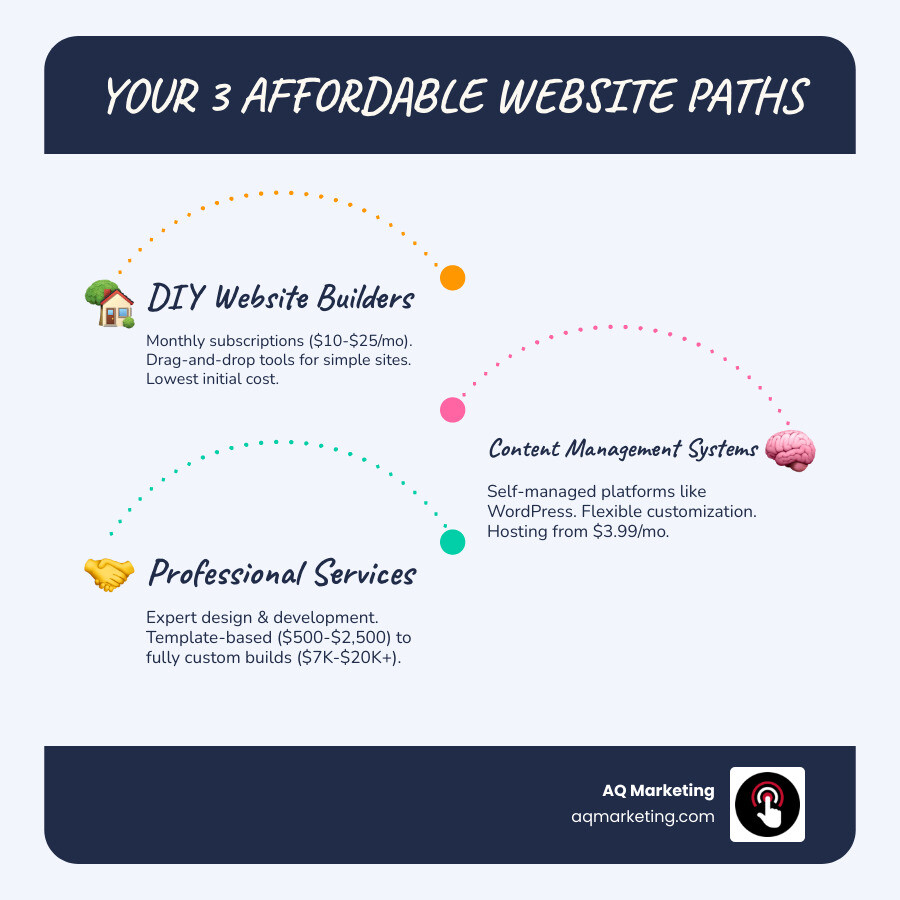
Here are your three main paths to getting online affordably:
- DIY Website Builders – Monthly subscription services ($10-$25/month) with drag-and-drop tools like Wix, Squarespace, or Weebly
- Content Management Systems – Self-managed platforms like WordPress with flexible customization and hosting starting at $3.99/month
- Professional Website Services – Template-based sites ($500-$2,500), semi-custom designs ($2,500-$7,000), or fully custom builds ($7,000-$20,000+)
Your website is your digital storefront. It’s often the first impression potential customers get of your business. A professional, easy-to-steer website builds credibility, connects you with customers 24/7, and serves as the hub for all your online marketing efforts.
The good news? You don’t need to spend thousands upfront to get started. The key is understanding what you’re paying for and choosing the solution that matches your technical skills, budget, and growth plans.
I’m Robert P. Dickey, President and CEO of AQ Marketing, and over the past 20+ years I’ve helped hundreds of small businesses steer their options for affordable website solutions that actually generate leads. The businesses that succeed online aren’t necessarily the ones that spend the most—they’re the ones that invest smartly in the right foundation for their needs.
Understanding Website Costs: What Are You Really Paying For?
When we talk about affordable website solutions, it’s crucial to understand that “affordable” doesn’t mean “free” (though some basic options come close!). It means getting the most value for your investment. The cost of a website can vary dramatically based on its complexity, features, and how it’s built.
Pricing Disclaimer: The pricing listed below is based on average online data from various sources and does not represent AQ Marketing’s actual pricing. Website costs can fluctuate widely, and the high end of some services can exceed three times the average price depending on specific requirements and market conditions.
Beyond the initial build, there are ongoing costs to consider:
- Domain Name Registration: This is your website’s address (e.g., yourbusiness.com). It’s a relatively small annual fee, typically around $10-$20.
- Web Hosting Fees: This is where your website’s files live, making it accessible on the internet. Hosting costs can range from a few dollars a month for basic shared hosting to hundreds for dedicated servers. We’ll dive deeper into hosting options shortly.
Let’s break down the typical cost considerations for different types of websites:

Template-Based Websites
Template websites are often the most budget-friendly option for small businesses looking to establish an online presence quickly. These sites use pre-designed layouts that you can customize with your own content, images, and branding elements. They are excellent for those with limited budgets or who need to launch fast.
- Cost Range: Template websites typically range from $500 to $2,500.
- Pros: Very quick to launch, significantly lower upfront cost, often user-friendly for basic content updates.
- Cons: Limited customization options, your site might look similar to others using the same template, can sometimes feel generic.
- Best For: Startups, small local businesses (like a new plumbing service in Woburn, MA, or a boutique shop in Essex County) that need a professional online brochure without complex features.
Semi-Custom Websites
A semi-custom website offers a middle ground between off-the-shelf templates and fully bespoke designs. With this approach, we start with a high-quality template or framework and then tailor it significantly to match your brand’s unique identity and specific functional needs. This allows for more distinct branding and added features without the full expense of a custom build.
- Cost Range: Semi-custom websites fall in the mid-range, with prices typically between $2,500 and $7,000.
- Pros: More unique design than a pure template, better brand alignment, ability to integrate specific features, good balance of cost and customization.
- Cons: Takes longer to develop than a template site, still has some underlying structural limitations of the base template.
- Best For: Growing businesses (such as a real estate agency in Boston, MA, or a consulting firm in Southern New Hampshire) that need a professional, branded site with specific functionalities like online booking or a detailed service catalog.
Fully Custom Websites
For businesses with unique requirements, complex functionalities, or a strong desire for a completely distinctive online presence, a fully custom website is the ultimate solution. Every element, from the design to the code, is built from the ground up to meet your exact specifications. This ensures a truly unique site that perfectly reflects your brand and supports highly specialized business processes.
- Cost Range: Fully custom websites can cost anywhere from $7,000 to $20,000 or more, with some enterprise-level projects reaching much higher figures.
- Pros: Unparalleled uniqueness and brand reflection, complete control over design and functionality, optimized for performance and scalability, built for specific business goals.
- Cons: Highest upfront investment, longest development time, requires a clear vision and detailed planning.
- Best For: Established businesses, e-commerce platforms with extensive product catalogs, or companies needing bespoke integrations and advanced user experiences. If you’re looking for custom solutions, we offer more information about our custom web design services.
Exploring Your Top 3 Affordable Website Solutions
Choosing the right path for your business’s online presence involves weighing several factors: your technical skill level, your budget, and your long-term growth aspirations. There’s no one-size-fits-all answer, but we can help you steer the options.

Option 1: DIY Website Builders as Affordable Website Solutions
For many small businesses, especially those just starting out or with very limited budgets, DIY website builders offer the most accessible entry point to the web. These platforms are designed for ease of use, allowing you to create a professional-looking site without any coding knowledge.
- How They Work: Website builders typically feature drag-and-drop interfaces where you can position text, images, and videos. They come with pre-designed templates that you can customize. Many now leverage AI-powered tools to assist with design and content generation, making the process even faster.
- Cost: For about $10 per month (or around $25 if you’re selling products), and a few hours of your time, DIY website builders can help you create a unique, eye-catching website. Many also offer free tiers, such as Wix, GoDaddy Websites + Marketing, Strikingly, Weebly, and Ucraft, which provides a good option for trying out building a website or an online store without a full commitment.
- Pros:
- Lowest initial cost: Free tiers or low monthly subscriptions make them highly affordable.
- User-friendly: No coding required, intuitive drag-and-drop editors.
- Quick to launch: You can often have a basic site up in a few hours or days.
- Integrated features: Many include basic SEO tools, marketing features, and even e-commerce capabilities.
- AI assistance: Tools from Hostinger, Squarespace, and GoDaddy can help with design and content.
- Cons:
- Limited customization: While templates are flexible, you’re usually restricted to the platform’s ecosystem.
- Scalability issues: May not be suitable for complex sites or high traffic volumes in the long run.
- Vendor lock-in: Moving your site to another platform can be difficult due to proprietary code.
- Branding: Free plans often include the builder’s branding (e.g.,
mysite.wixsite.com), which can look less professional. A custom domain name, which boosts credibility, is often free for the first year with an annual premium plan purchase.
- Examples:
- Wix Website Builder: Best overall for its extensive features and 99.9% uptime.
- Squarespace Website Builder: Excellent for website customization and visually appealing templates, especially for service-based businesses like photographers or consultants.
- Weebly Website Builder: Good for easy page editing and integrates well with Square for e-commerce.
- GoDaddy Websites + Marketing Website Builder: Strong for marketing and SEO tools.
- Hostinger Website Builder: Noted for its AI-powered tools.
Option 2: Content Management Systems (CMS) for Flexible, Affordable Website Solutions
Content Management Systems (CMS) like WordPress offer a powerful blend of flexibility, control, and affordability. They are the backbone of a vast portion of the internet and provide a robust platform for businesses of all sizes.
- What is a CMS? A CMS is software that allows you to create, manage, and modify content on a website without specialized technical knowledge. If you can use a Word document, you can update a WordPress website!
- WordPress Dominance: WordPress is the undisputed leader, powering more than 40% of the internet and over 30,000,000 websites worldwide. Its open-source nature means it’s free to use, and a massive community contributes to its development.
- WordPress.com vs. WordPress.org: This can be a point of confusion!
- WordPress.org (Self-Hosted): This is the free, open-source software you download and install on your own web hosting. It offers maximum control and flexibility, allowing you to use any theme or plugin. This is what we typically recommend for businesses seeking long-term growth and customization. You’ll need to arrange your own hosting (starter plans often begin around $3.99/month).
- WordPress.com (Managed Service): This is a commercial service that hosts your WordPress site for you, acting more like a website builder. It’s simpler to set up but offers less control and flexibility than a self-hosted WordPress.org site, with features and customization often limited by your chosen plan.
- Cost: The software itself is free. Your main costs will be web hosting (starter plans from $3.99/mo), a domain name, and potentially premium themes or plugins. Custom WordPress websites, if professionally built, can range from $5,000 to $50,000 depending on complexity.
- Pros:
- Best flexibility: Thousands of free and premium themes and plugins for almost any functionality imaginable.
- Scalability: Can grow with your business from a simple blog to a complex e-commerce site.
- Ownership and control: You own your data and have complete control over your site’s code and design (with WordPress.org).
- Strong SEO capabilities: Excellent for search engine optimization with the right setup and plugins.
- Community support: A vast global community offers extensive resources and help.
- Cons:
- Steeper learning curve: More complex than drag-and-drop builders, especially for beginners.
- Maintenance responsibility: You’re responsible for updates, security, and backups (though managed WordPress hosting can help).
- Security concerns: While robust, WordPress can be vulnerable to hacking if not kept updated and secured with proper precautions.
- Plugin dependency: Too many plugins can slow down your site.
- Other CMS Options: While WordPress is dominant, other CMS platforms like Joomla and Drupal exist. Drupal is known for high flexibility and security, often favored by developers. Joomla sits in the middle, offering dynamic sites with some developer ease. However, for most small to medium-sized businesses in New England, WordPress offers the best balance of power and user-friendliness.
Option 3: Hiring a Professional
For many business owners, their time is best spent running their business, not building websites. This is where hiring a professional web design agency or freelancer comes in. While it might seem like a higher upfront cost, it can be a highly affordable website solution in the long run by saving you time, ensuring quality, and providing strategic guidance.
- Freelancers vs. Agencies:
- Freelancers: Often more budget-friendly for simpler projects, offering personalized attention.
- Agencies (like us at AQ Marketing): Provide a full team of experts (designers, developers, SEO specialists, marketers), offering comprehensive solutions, strategic insights, and ongoing support. We bring over 20 years of experience to every project.
- Cost: As discussed, professional services can range from $500 for a template-based site to $20,000+ for a fully custom solution.
- Pros:
- Expertise and experience: Access to professional design, development, and marketing knowledge.
- Custom solutions: Custom websites that perfectly align with your brand and business goals.
- Strategic guidance: Professionals can advise on best practices for SEO, user experience, and conversion.
- Time-saving: You can focus on your core business while experts handle the website.
- Quality and reliability: A professionally built site is typically more robust, secure, and performant.
- Ongoing support: Many agencies offer maintenance, updates, and marketing services post-launch.
- Cons:
- Higher upfront cost: Requires a more significant initial investment than DIY builders.
- Communication: Requires clear communication and collaboration to ensure the final product meets expectations.
- Dependency: You may rely on the professional for future updates or changes if you don’t have access to the CMS.
- Business Process with a Professional (e.g., AQ Marketing):
- Free Consultation: We start with a discussion to understand your business, goals, and target audience.
- Planning & Strategy: We develop a detailed plan, outlining features, functionality, and user experience.
- Design & Development: Our team crafts a visually appealing and functional website, often creating custom WordPress themes for optimal performance and ease of use for you.
- Content Integration: We help ensure your content is optimized for search engines and presented beautifully.
- Quality Assurance & Launch: Rigorous testing is performed before your site goes live.
- Ongoing Support & Marketing: We provide continued support, maintenance, and can integrate digital marketing strategies like Search Engine Optimization (SEO) to help your new site get finded.
7 Non-Negotiable Features Your Business Website Must Have
Regardless of whether you choose a DIY builder, a CMS, or a professional agency, certain elements are non-negotiable for any business website aiming for success. These core functionalities ensure a positive user experience, strong search engine visibility, and future-proof your investment. Skimping on these can turn an “affordable” solution into a costly headache down the road.
- ### Mobile-First Responsive Design
Mobile traffic dominates internet usage. Your website must display perfectly on all devices—smartphones, tablets, and desktops. Google prioritizes mobile-friendly sites in its rankings, making responsive design crucial for SEO and user experience. If your site isn’t mobile-friendly, you’re effectively turning away a significant portion of your potential customers. - ### Rock-Solid Security (SSL)
Security is paramount. An SSL certificate (Secure Sockets Layer) encrypts data transferred between your website and visitors, protecting sensitive information. You’ll see it as “https://” in your browser bar. Without it, browsers will flag your site as “not secure,” deterring visitors and harming your credibility. This is a must-have for trust and SEO. - ### Fast Loading Speed
Patience is a virtue, but not for internet users! Slow websites frustrate visitors and lead to higher bounce rates. Search engines also penalize slow sites. Optimize images, leverage caching, and choose reliable hosting to ensure your site loads quickly. A fast site keeps visitors happy and engaged. - ### Foundational Search Engine Optimization (SEO)
What good is a beautiful website if no one can find it? Foundational SEO ensures your site is structured in a way that search engines can understand and rank. This includes proper meta tags, descriptive URLs, and relevant keywords. While advanced SEO is an ongoing process, the basics must be baked into your site from day one to get finded online. - ### Clear Calls-to-Action (CTAs)
Every page on your website should have a purpose. Clear Calls-to-Action (CTAs) guide visitors towards that purpose, whether it’s “Call Us Today,” “Request a Quote,” “Book an Appointment,” or “Learn More.” Without clear direction, visitors might get lost and leave your site without taking the desired action. - ### Professional Business Email
Using a professional email address (e.g., info@yourbusiness.com) rather than a generic Gmail or Yahoo account instantly boosts credibility. Most web hosting packages include professional email services, making this an easy and affordable way to improve your business’s image. - ### Integrated Tools (e.g., online scheduling tools)
For many service-based businesses, efficiency means integrating tools that streamline operations. This could include online scheduling, payment processing, or customer relationship management (CRM). For example, tools like Acuity Scheduling allow clients to book appointments directly through your site, complete with service descriptions and pricing. Squarespace Payments enables streamlined checkout and secure payment processing. These integrations improve customer experience and reduce administrative burden.
How to Choose the Right Web Design Partner (and Avoid Red Flags)
Selecting a web design partner is a critical decision for your business. You want a team that understands your vision, delivers quality work, and helps you achieve your online goals. Here’s what we recommend looking for:
- Proven Portfolio: Review their past projects. Do they have experience in your industry or with similar types of websites? A strong portfolio demonstrates their capabilities and aesthetic.
- Client Testimonials & Reviews: What do their previous clients say? Look for feedback on communication, quality of work, and post-launch support.
- Transparent Process: A reputable agency will clearly outline their development process, from initial consultation to launch and ongoing support.
- Clear Communication: The ability to communicate effectively throughout the project is vital. You should feel heard and informed at every stage.
Red Flags to Watch Out For
Just as important as knowing what to look for is knowing what to avoid. Here are some red flags that should make you cautious when choosing a web design agency:
- Unclear or Vague Pricing: If an agency is hesitant to provide a detailed breakdown of expenses or offers only vague pricing structures, proceed with caution. Transparency in pricing is essential.
- No Portfolio or Case Studies: A lack of visible past work is a significant red flag. How can you assess their quality or style if they can’t show you what they’ve done?
- Poor Communication: If they’re slow to respond, unclear in their explanations, or difficult to reach during the initial stages, imagine how challenging communication will be during the project.
- Overpromising Results: Be wary of agencies that promise instant results or guarantee #1 rankings on Google. SEO and digital marketing take time, effort, and strategic planning. Realistic expectations are key.
- High-Pressure Sales Tactics: A trustworthy partner will educate you and help you make an informed decision, not pressure you into a quick commitment.
Frequently Asked Questions About Affordable Websites
We often hear similar questions from small business owners in the Boston, MA area and across New England who are looking for affordable website solutions. Here are some of the most common:
How much should a new small business website cost?
As we’ve discussed, the cost can vary widely based on your needs and the chosen solution.
- DIY Website Builders: Monthly subscriptions typically range from $10-$25, plus domain and potentially premium features.
- Template-Based Professional Builds: If you opt for a professional to customize a template, expect to pay between $500 and $2,500.
- Semi-Custom Professional Builds: For a more unique, branded site, the range is typically $2,500 to $7,000.
- Fully Custom Professional Builds: For bespoke designs and complex functionality, costs start at $7,000 and can go upwards of $20,000.
Your website is an investment in your business’s future. The “cheapest” option isn’t always the most cost-effective if it doesn’t meet your needs or requires constant fixes.
How long does it take to build a business website?
The timeline for building a business website depends significantly on its complexity and your chosen approach.
- DIY Website Builders: You could launch a basic site in a few hours to a few days.
- Professional Builds (Template to Semi-Custom): Typically, a well-executed professional website project takes anywhere from 4 to 12 weeks. This includes findy, design, development, content integration, and quality assurance.
- Fully Custom Websites: These can take several months, or even longer, due to the intricate planning and development involved.
A major factor influencing the timeline is content creation. Having your text, images, and other assets ready can significantly speed up the process.
Can I update my own website after it’s built?
Yes, absolutely! The ability to update your own website is a key feature of many affordable website solutions.
- DIY Website Builders: These platforms are specifically designed for users to manage and update their content easily through their intuitive interfaces.
- Content Management Systems (CMS) like WordPress: We typically build our client sites on WordPress because it’s user-friendly. Once your site is built, we can train you on how to add new pages, update text, swap images, and manage blog posts without needing to know code. This empowers you to keep your site fresh and relevant.
- Custom-Coded Sites: If your site is built with custom code outside of a CMS, you might need a developer for updates, unless specific content areas are built with an editable interface. This is why we lean towards CMS solutions for most of our clients.
Conclusion: Building Your Digital Foundation for Growth
Creating a website for your small business doesn’t have to be an overwhelming or expensive endeavor. With the right approach and understanding of your options, you can establish a powerful online presence that drives growth and connects you with your customers in Boston, Woburn, Middlesex County, Essex County, Merrimack Valley, and Southern New Hampshire.
Whether you choose a DIY builder for its low entry cost, leverage the flexibility of a CMS like WordPress, or partner with a professional agency for a custom solution, the key is to focus on value and strategic investment. A website is not just a digital brochure; it’s a dynamic tool for lead generation, customer service, and brand building.
At AQ Marketing, we’ve spent over two decades helping businesses like yours steer the digital landscape. We pride ourselves on delivering long-term, impactful results, from expert website design and development to comprehensive SEO strategies. We believe in empowering our clients with solutions that fit their budget and fuel their success.
Ready to explore the affordable website solutions that are right for your business? We’re here to help you lay a strong digital foundation for growth. Book your free consultation to discuss your web design project today.
