

New Venture Marketing 2025: Unlocking Growth
Why New Venture Marketing Demands a Different Approach
New venture marketing is the process of building awareness, acquiring customers, and driving growth for startups, often with limited resources and no market presence. Unlike traditional marketing that optimizes existing strategies, it focuses on findy, experimentation, and rapid adaptation to find what works.
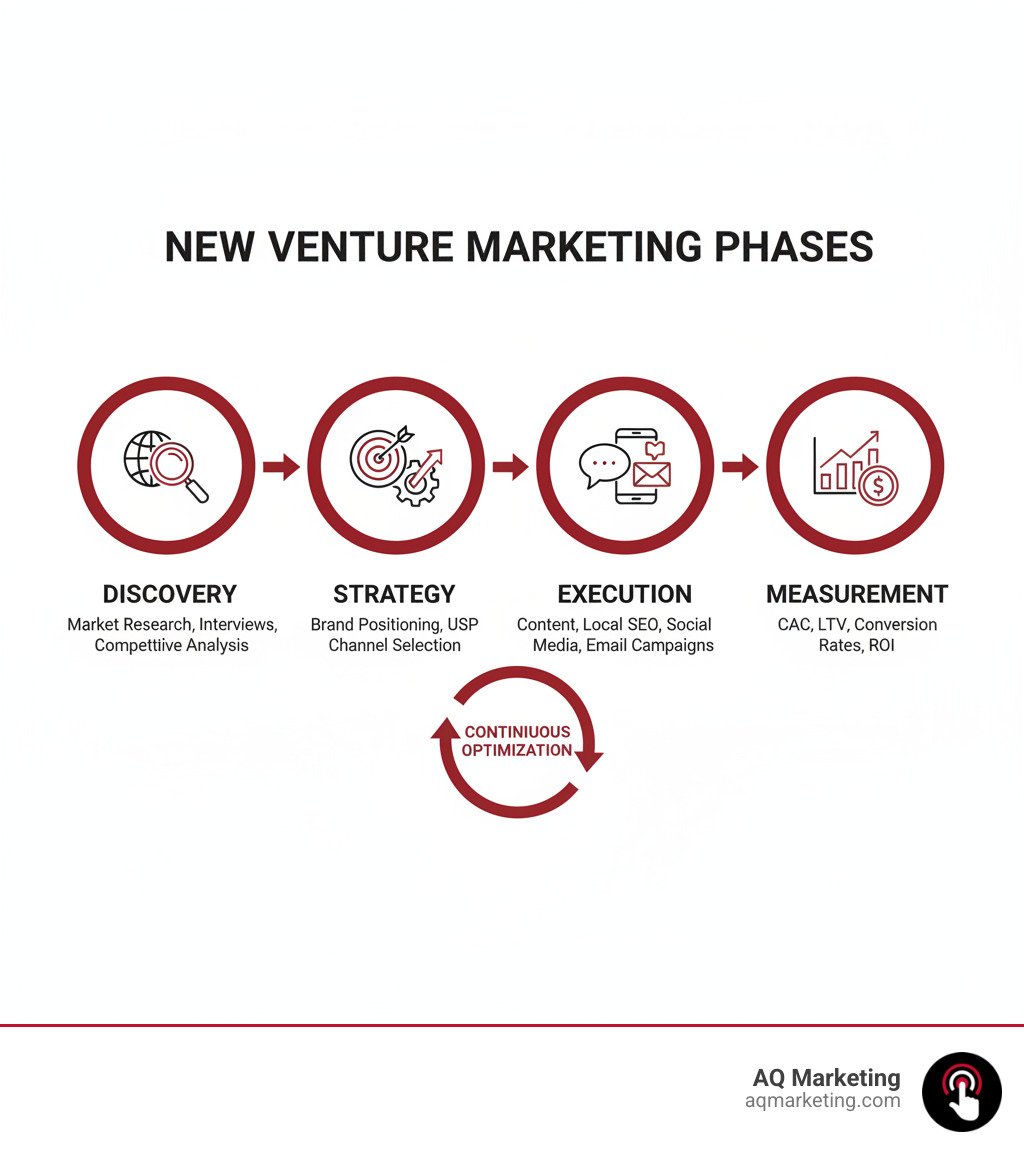
Key phases of successful new venture marketing include:
- Findy – Identify your target market and validate customer needs.
- Strategy – Develop your brand positioning, unique selling proposition (USP), and go-to-market plan.
- Execution – Implement low-cost tactics like content marketing, local SEO, and social media.
- Measurement – Track key metrics like customer acquisition cost (CAC) and conversion rates to refine your approach.
The stakes are high, as most startups fail, often due to poor marketing. For new ventures in the Greater Boston area—from Woburn to Southern New Hampshire—the challenge is competing against established brands on a fraction of their budget.
However, modern marketing has leveled the playing field. You don’t need a massive budget to succeed. With a solid product, a dedicated team, and strategic marketing, you can win. This approach, known as entrepreneurial marketing, values agility over rigid planning, customer relationships over broadcasting, and resourcefulness over large budgets. It’s about testing, learning, and pivoting based on real market feedback.
I’m Robert P. Dickey, President and CEO of AQ Marketing. With over 20 years of experience helping businesses in the Boston area, I’ve seen how this approach can mean the difference between success and failure. Whether you’re in Middlesex County or Boston, the principles are the same, but the tactics must be custom to your market.
The Entrepreneurial Mindset: Why New Venture Marketing is Different

New venture marketing isn’t just traditional marketing on a smaller budget; it’s a different game. When launching a business in Woburn or Boston, you can’t simply copy what big brands do. The ventures that succeed aren’t the ones with the biggest budgets, but those with a different mindset.
This mindset prioritizes agility and resourcefulness. While corporations spend months on planning, new ventures in fast-moving markets like Southern New Hampshire or Middlesex County must move quickly—testing, learning, and pivoting in a matter of days. When you can’t outspend the competition, you must outsmart them. Every dollar and hour must drive results.
Traditional marketing optimizes what’s known, while entrepreneurial marketing is about findy. As What Is Entrepreneurial Marketing? | HBS Online notes, your job is to find what to sell, how, to whom, and with what message. You’re not just executing a plan; you’re finding what the plan should be.
| Traditional Marketing | Entrepreneurial Marketing |
|---|---|
| Large budgets | Limited resources |
| Established brands | New brands |
| Optimization | Findy |
| Risk-averse | Risk-tolerant |
| Focus on market share | Focus on market entry |
| Long-term planning | Agile, iterative planning |
| Broad campaigns | Niche targeting |
| One-way communication | Two-way relationships |
The Core Principles of Entrepreneurial Marketing
Successful new venture marketing is built on these core principles:
- Customer-Centricity: Deeply understand customer problems so your solution becomes the obvious choice. Listening beats clever messaging.
- Value Creation: Focus on benefits, not features. Explain how you make a customer’s life better.
- Proactiveness: Seize opportunities and trends first. Businesses in Woburn or Essex County that act on shifts early win.
- Innovation Focus: Creativity is essential when budgets are tight. Experiment with new approaches to stand out.
- Two-Way Communication: Start conversations and build relationships instead of broadcasting messages.
- Building Relationships: Create “raving fans” who become your unpaid marketing team through word-of-mouth.
- Maximizing Impact: Make every marketing dollar work harder through strategic thinking and creative execution.
Avoiding the Pitfalls of Traditional Thinking
Many new ventures in Middlesex County stumble by marketing like established businesses. Avoid these common mistakes:
- Overspending on unproven channels: Test small, learn fast, and then scale what actually drives results.
- Ignoring early customer feedback: Your initial ideas are rarely perfect. Listen to early adopters and adapt.
- Rigid annual plans: The market moves too fast. Your strategy must be flexible enough to adapt to new information.
- Focusing on features over benefits: Customers have problems they need solved, not a desire for your product’s features.
- Fear of pivoting: If your initial strategy isn’t working, change it. This is smart business, not failure.
- Assuming you know the customer: Without direct customer interaction and market research, you’re just guessing.
Building Your Foundation: Market Research and Audience Findy

Before launching a single campaign, you must understand who you’re talking to and the landscape you’re entering. This is where new venture marketing separates the survivors from the statistics. Market research is your GPS, especially in a varied landscape like the one from Boston to Southern New Hampshire.
We start with market opportunity analysis to find gaps where your venture can thrive, followed by a viability assessment to ask if the business can succeed profitably. This involves both primary research (interviews, surveys) for fresh insights and secondary research (existing data, competitor analysis) for context. For a new business in Woburn, MA, we might analyze Middlesex County census data while also interviewing local business owners.
Identifying Your Target Audience and Market
“Everyone” is not your target market. Trying to reach everyone means reaching no one effectively. The solution is creating buyer personas—detailed profiles of your ideal customers based on real data. We build these through customer interviews for deep insights and surveys to validate findings on a larger scale.
The jobs-to-be-done framework is also powerful. Instead of focusing on your product, think about the “job” the customer is hiring it to do. A homeowner in Middlesex County isn’t just buying pipe repair; they’re hiring you to restore their peace of mind. This reframes your entire marketing message.
For example, a home renovation service in Middlesex County might target “Busy Brian,” a 45-year-old professional in Woburn with no time for DIY. His pain points are finding reliable contractors and staying on schedule. Our marketing to him would emphasize reliability, communication, and respect for his time.
Competitive Analysis and Differentiation for New Ventures
Your competitors aren’t always who you think they are. A Boston restaurant competes not just with other restaurants, but also with meal kits and Netflix. Identify both direct competitors (offering the same solution) and indirect competitors (solving the same problem differently).
A SWOT analysis helps reveal competitors’ strengths and weaknesses. Analyzing their websites, reviews, and pricing in a local market like Essex County can uncover opportunities. This research leads to your Unique Selling Proposition (USP)—the clear, compelling reason customers should choose you. For example, you might be the only HVAC company in Southern New Hampshire offering same-day emergency service with transparent pricing. Your USP drives your positioning strategy, helping you stand out in customers’ minds and in local search results, which is where our search engine optimization services can make a critical difference.
Developing and Validating Your Minimum Viable Product (MVP)
Don’t spend years building the “perfect” product in isolation. The Minimum Viable Product (MVP) approach involves building the simplest version of your product that delivers core value. The goal isn’t perfection; it’s to start a customer feedback loop.
Get the MVP into the hands of early adopters, listen to their feedback, and refine your product through iterative development. This validates your concept with minimal risk and helps secure early commitments. For instance, a Boston tech startup could launch a simple landing page to test demand for a freelancer marketplace before building a complex platform. This lean approach reduces risk and ensures you’re building something people actually want.
The New Venture Marketing Blueprint: From Strategy to Execution
You’ve done your research and validated your idea. Now it’s time to put your new venture marketing plan into action. This blueprint is a living guide that transforms your groundwork into tangible growth for your business, whether it’s a tech startup in Boston or a home services company in Woburn.
Start by setting SMART goals (Specific, Measurable, Attainable, Relevant, Time-bound), like “acquire 75 qualified leads from Middlesex County homeowners by the end of Q2.” Then, create a budget where every dollar is justified. Select channels based on where your target audience spends their time, and build a tactical plan outlining your actions. For businesses across our service areas, from Southern New Hampshire to Essex County, this clarity is crucial. If you need guidance, we have More info about digital marketing for small business.
Developing Your Brand Identity
Your brand is more than a logo; it’s the promise you make and keep. For new ventures building trust in communities like Merrimack Valley, a strong brand is a key asset.
- Brand Story: Why does your business exist? Your story should resonate emotionally with your audience.
- Mission and Vision: Your mission is what you do daily; your vision is the future you’re building. They guide your decisions.
- Logo and Visual Identity: Your visuals should professionally reflect your brand’s personality—be it modern, traditional, or something else.
- Brand Voice: Are you the friendly neighbor or the expert authority? Maintain a consistent voice across all platforms.
When someone in Woburn sees your brand, they should instantly know what you stand for. AQ Marketing offers More info about brand identity and logo design services to help craft this foundation.
Effective Low-Cost Marketing Strategies for New Ventures
New venture marketing thrives on creativity and agility. These strategies deliver results without a massive budget:
- Content Marketing: Create helpful blog posts, guides, or videos to establish expertise and attract customers searching for solutions.
- Local SEO: Optimize your Google Business Profile and website with local keywords (e.g., “Woburn,” “Middlesex County”) to appear in local searches.
- Email Marketing: Build your email list from day one. Nurture relationships by providing value, following a 4:1 ratio of helpful content to promotional messages.
- Networking: Join local chambers of commerce and business groups in areas like the Merrimack Valley to build connections that lead to referrals and partnerships.
- Strategic Partnerships: Partner with non-competing businesses that serve the same audience to amplify your reach.
- Guerrilla Marketing: Use unconventional, high-impact tactics in urban areas like Boston to generate buzz and word-of-mouth.
Leveraging Digital and Social Media
Don’t try to be everywhere on social media. Focus on choosing the right platforms where your specific audience is active. A B2B service in Boston will thrive on LinkedIn, while a consumer brand in Southern New Hampshire might focus on Instagram and Facebook.
Once you’ve chosen your platforms, focus on social media engagement. Have real conversations, respond to comments, and show the humans behind your business. This helps build an online community, turning customers into advocates. You can also leverage local micro-influencers in areas like Essex County, whose smaller, engaged followings can provide credibility.
Even with a small budget, paid social advertising is powerful due to its precise targeting capabilities. Start small, test messages, and scale what works. For expert help with campaigns that convert, we provide More info about social media marketing services.
Measuring, Scaling, and Sustaining Growth
Execution is only half the story in new venture marketing. The real magic happens when you measure what’s working, scale what succeeds, and build systems for sustained growth. For startups in Boston and Woburn, tracking results is non-negotiable.
At AQ Marketing, we believe if you can’t measure it, you can’t improve it. We track key Key Performance Indicators (KPIs) to turn data into actionable insights:
- Customer Acquisition Cost (CAC): How much you spend to acquire each new customer.
- Lifetime Value (LTV): The total revenue expected from a customer. A healthy business aims for an LTV at least 3x its CAC.
- Conversion Rate: The percentage of visitors who take a desired action.
- Marketing ROI: The overall profitability of your marketing investments.
This data-driven approach allows for agility. When a channel underperforms in Essex County, we pivot. When another exceeds expectations in Merrimack Valley, we double down.
Critical Success Factors and Common Pitfalls
After two decades in the Greater Boston area, we’ve seen what works. Research in the Journal of the Academy of Marketing Science on The role of marketing in new ventures suggests that in a venture’s infancy, spreading marketing duties across the team (marketing dispersion) improves profitability. This creates a company-wide customer focus. Founder involvement is also crucial for its authenticity.
However, avoid these common pitfalls:
- Lack of Focus: Don’t try to serve everyone. Dominate a niche before expanding.
- Scaling Too Quickly: Solidify your marketing foundation before pouring fuel on the fire.
- Ignoring Customer Service: In today’s connected world, your reputation is everything. Proactive reputation management is essential.
Building Customer Relationships and Community
Your most powerful marketing strategy is delighted customers. This is especially true in tight-knit communities like Middlesex County.
- Customer Feedback Systems: Make it easy for customers to share their experiences, showing their voice matters.
- Loyalty & Referral Programs: Turn satisfied customers into active promoters of your brand.
- User-Generated Content: Encourage customers to share photos or reviews. This authentic social proof is more powerful than any ad.
- Community Events: Host local events or webinars to build goodwill and brand awareness in your community.
The goal is to create brand advocates who organically promote your business. To facilitate immediate interaction, consider tools like website chat services to convert visitors into customers.
Ethical Considerations in New Venture Marketing
Embed ethical practices into your business from day one. This builds the trust needed for long-term success.
- Transparency in Advertising: Be honest and upfront about what you deliver.
- Data Privacy: Safeguarding customer data is a legal and ethical imperative.
- Authentic Testimonials: Never fabricate reviews. Your credibility is your most valuable asset.
- Social Responsibility: Weave ethical and social considerations into your business model, such as sourcing locally in Middlesex County or supporting community initiatives.
- Avoid Hype: Under-promise and over-deliver. It’s the formula for sustainable growth.
Frequently Asked Questions about New Venture Marketing
How much should a new venture budget for marketing?
There’s no single answer, but we can provide a framework. While established businesses often budget 7-12% of revenue for marketing, new ventures, especially pre-revenue, must think differently. Here, marketing is an investment in findy and future growth.
Prioritize channels with the highest ROI. A home services company in Woburn might focus on local SEO, while a Boston tech startup might use targeted content marketing. The key is to stay laser-focused on what works and be ready to shift gears based on data. As you generate revenue, you can transition to a percentage-based model, but the focus should always remain on performance, not just hitting a number.
What is the most important first step in marketing a new business?
The single most important first step is deeply understanding your target customer’s pain points. Before you design a logo, write a social media post, or spend a dollar on ads, you must know who you’re serving and what problem they desperately need to solve.
This goes beyond basic demographics. You need to know why a homeowner in Middlesex County needs your solution. This requires real market research: talking to potential customers, running surveys, and creating detailed buyer personas based on real data. Without validating that you solve a real problem for a specific group, all your marketing is guesswork. Get this right, and your entire strategy falls into place.
How do I create an investor-ready marketing pitch?
Investors need to see a clear, realistic plan for acquiring customers and generating revenue. Your marketing pitch must be compelling and data-backed.
- Market Size: Define your Total Addressable Market (TAM), Serviceable Available Market (SAM), and Serviceable Obtainable Market (SOM) to show you understand the opportunity.
- Go-to-Market Strategy: Explain how and why you will reach your target customers, whether through local SEO in Southern New Hampshire or partnerships in Essex County.
- Acquisition Plan & Costs: Detail your projected Customer Acquisition Cost (CAC) and Lifetime Value (LTV). These numbers prove your business model is sustainable.
- Competitive Advantages: Clearly state your Unique Selling Proposition (USP) and why customers will choose you.
- Early Traction: Show any validation you have—pilot programs, early sales, positive MVP feedback, or growing engagement. This proof is gold to investors.
- Financial Projections: Connect your marketing spend directly to customer growth and revenue, showing investors how you’ll generate returns.
Conclusion
We’ve covered the path of new venture marketing, showing it’s a navigable and exciting journey with the right mindset. The key difference is a shift in thinking: prioritizing agility, customer relationships, and creative resourcefulness over large budgets and rigid plans. From initial research and brand development to low-cost execution and data-driven refinement, each phase builds on the last.
The Greater Boston area offers unique opportunities. Whether you’re in Boston, Woburn, Middlesex County, or Southern New Hampshire, you’re in a dynamic market. Competition is fierce, but there’s a real appetite for local businesses that understand community needs.
At AQ Marketing, we’ve helped businesses like yours steer these local markets for over 20 years. Our approach to SEO, web design, and social media is rooted in a simple belief: your success is our success. We don’t just want to help you launch; we want to help you build something that lasts.
Starting a new venture takes courage. Marketing it effectively takes strategy and persistence. You don’t have to do it alone.
If you’re ready to turn your idea into a thriving business, let’s talk. We’d love to explore how a custom new venture marketing strategy can help you achieve your goals.
Book a 15-minute call to discuss your digital marketing strategy.
Let’s build something great together.
