

How to Market Your Website Services to Local Businesses: 7 Proven Powerful Ways for 2025
The Essential Guide to Marketing Website Services Locally
How to market your website services to local businesses requires a strategic blend of digital know-how and community connection. Here’s a quick overview of the most effective tactics:
| Strategy | Effectiveness | Difficulty |
|---|---|---|
| Google Business Profile optimization | High | Low |
| Local SEO targeting | Very High | Medium |
| Community networking | High | Medium |
| Referral programs | Very High | Low |
| Geotargeted social ads | Medium | Medium |
| Direct mail campaigns | Medium | Medium |
The landscape of local business has undergone a profound change in recent years. With 8 in 10 U.S. consumers searching for local businesses weekly and 76% of local smartphone searches leading to an in-store visit within 24 hours, the digital storefront has become as crucial as the physical one.
Yet many website service providers struggle to effectively communicate their value to local business owners who may not fully grasp the impact of a strong online presence.
The challenge isn’t just technical—it’s educational. Local business owners need to understand that their customers now form credibility judgments in as little as 15 seconds based on website design and content. With over 50% of website traffic originating from mobile devices, and Google’s shift to mobile-first indexing, an optimized online presence isn’t optional—it’s essential for survival.
I’m Robert P. Dickey, President and CEO of AQ Marketing, and with over 20 years of experience helping small businesses succeed in the digital landscape, I’ve refined proven strategies on how to market your website services to local businesses effectively and build lasting partnerships.
How to market your website services.to local businesses word guide:
– best web marketing services
– home services seo
– create a lead gen website for service businesses
Why Local Businesses Desperately Need Modern Websites
Your website isn’t just a digital brochure—it’s prime digital real estate that works for your business 24/7. Just like a storefront in the busiest part of town attracts foot traffic, a well-designed website pulls in potential customers who are actively looking for your services.
Did you know that visitors form credibility judgments about your business in just 15 seconds based on your website’s design and content? That’s right—you have just moments to make a positive first impression that could make or break a potential sale.
Google now uses mobile-first indexing, meaning they primarily look at how your site performs on phones when deciding where to rank you. With over half of all web traffic coming from mobile devices, local businesses without mobile-optimized sites are essentially hanging a “closed” sign in their digital window.

Speed matters too—a lot. For every extra second your site takes to load, conversion rates drop by 4.42%. If your website takes more than 3 seconds to load (which many do), you’re losing about a third of your visitors before they even see what you offer. For a local business, those are customers walking straight to your competitors.
Accessibility is another overlooked opportunity. Only about 5% of websites are fully accessible to people with disabilities. Making your site work for everyone isn’t just the right thing to do—it opens your business to an additional market segment that your competitors might be ignoring.
According to research from Google, nearly 8 in 10 consumers read online reviews before deciding where to spend their money. A well-designed website that effectively showcases your positive reviews can significantly influence buying decisions in your favor.
The Cost of Staying Invisible
The reality of today’s market is stark: if customers can’t find you online, you might as well not exist to them. One in four consumers simply won’t visit a business they can’t find online. Why would they risk it when competitors are just a click away?
A staggering 97% of consumers use the internet when researching local products and services. When someone needs a local plumber, dentist, or salon, they’re not opening the Yellow Pages—they’re opening Google. And if your business doesn’t show up in those results, you’re handing customers directly to competitors who invested in their online presence.
Even businesses thriving on word-of-mouth referrals are leaving money on the table without a strong website. When someone recommends your business, what’s the first thing most people do? They look you up online. Without a professional website, that warm referral quickly cools as potential customers question your legitimacy or commitment to quality.
Proof Points You Can Share in Sales Meetings
When talking to potential clients about how to market your website services to local businesses, concrete data makes your case compelling. Here are some powerful statistics that demonstrate the return on investment:
Businesses with professionally optimized websites typically see visitor dwell time increase by 84% after a redesign. This extra engagement translates directly to better conversion rates. Even more impressive, annual revenue may rise by 132% following a professional website redesign—a number that gets any business owner’s attention.
WordPress powers 65.3% of websites using content management systems and over 455 million websites globally. This widespread adoption means your clients benefit from a platform with robust support, countless extensions, and proven reliability.
For clients weighing DIY options against professional services, this comparison table clearly illustrates the true differences:
| Feature | DIY Website Builders | Professional Web Development |
|---|---|---|
| Initial Cost | Low ($0-$30/month) | Higher ($1,000-$10,000+) |
| Time Investment | High (40+ hours for non-experts) | Low (client input only) |
| Technical Support | Limited or self-service | Dedicated support |
| SEO Optimization | Basic | Comprehensive |
| Custom Functionality | Limited | Unlimited |
| Mobile Optimization | Template-dependent | Custom-designed |
| Ongoing Maintenance | Self-managed | Professional management available |
| Security | Basic | Advanced |
| Long-term Value | Depreciating | Appreciating with updates |
The initial sticker price often blinds business owners to the hidden costs of DIY solutions—their valuable time, limited functionality, and missed opportunities. A professional website isn’t an expense; it’s an investment that pays dividends through increased visibility, credibility, and conversions.
How to Market Your Website Services to Local Businesses
Now that we understand why local businesses need professional websites, let’s explore effective strategies for marketing your services to them.
How to market your website services to local businesses requires a thoughtful blend of digital savvy and good old-fashioned relationship building. Think of it as planting seeds in your local business community—some will sprout quickly, while others need nurturing over time.

Identify & Segment Prospects: How to market your website services.to local businesses efficiently
Finding the right prospects is a bit like fishing—you need to know where the fish are and what bait they prefer. Not all local businesses have the same needs or budgets, so smart segmentation will save you time and increase your success rate.
Start by conducting website audits using tools like MyWebAudit or Screaming Frog. These audits are gold mines of information, revealing issues like slow loading times or poor mobile experiences that you can address in your pitch. When I show a business owner that their site takes 8 seconds to load (while their competitor’s loads in 2), their eyes widen with understanding.
Tools like Whitespark Local Citation Finder can help you identify businesses in your geographic area. I’ve found it particularly effective to look for the “gap” businesses—those whose competitors have strong websites while they’re lagging behind. This competitive disadvantage often motivates action faster than general appeals.
Rather than casting too wide a net, consider targeting specific niches where you have expertise. At AQ Marketing, we’ve seen much higher conversion rates when focusing on industries we know inside and out, like home services and insurance companies in the Boston area. Your familiarity with industry-specific needs builds immediate credibility.
When segmenting prospects, consider factors beyond just size—look at their current website status (none, outdated, or adequate), growth ambitions, and marketing sophistication. A small business with ambitious growth plans might be a better prospect than a larger one content with the status quo.
Craft Irresistible Offers & Messaging
Once you’ve identified promising prospects, you need messaging that speaks directly to their business concerns—not your technical expertise.
Focus on business outcomes, not features. Business owners don’t lie awake at night worrying about responsive design; they worry about getting more customers. Frame your conversations around how your websites drive more leads, increase conversions, and build customer trust. When I tell a client “this design change typically increases form submissions by 25%,” their interest perks up immediately.
Concrete ROI metrics are your best friends. Instead of vague promises, share specific results: “Our websites typically increase time-on-page by 84% and conversion rates by 20-30% compared to outdated sites.” These tangible benefits help justify the investment.
Many local businesses fear the “build it and abandon it” approach, so offering maintenance packages addresses a major concern. Our most successful client relationships at AQ Marketing include regular updates, security monitoring, and content refreshes—services that provide ongoing value and steady revenue for your business.
With only about 5% of websites being fully accessible, positioning your services as creating ADA-compliant sites can be a powerful differentiator. This isn’t just good business—it’s the right thing to do, opening doors to all potential customers.
Consider creating bundled services that combine website design with complementary offerings like hosting, SEO, or content creation. Our Website Design for Small Business packages that include ongoing SEO support consistently show higher retention rates because they deliver more comprehensive value.
Optimize Your Own Local Presence First
Before selling website services to others, make sure your own online presence shines brightly. Your website isn’t just a portfolio—it’s your most powerful demonstration of what you can deliver.
Start with a fully optimized Google Business Profile. This means accurate information, high-quality photos, regular posts, and a healthy collection of positive reviews. When prospects search for “web design near me,” your profile should stand out as a model of what they can expect.
Implement local business schema markup on your website to improve how search engines understand and display your business information. This technical detail makes a real difference in local search visibility.
Create content that speaks directly to your service areas. At AQ Marketing, we develop resources specifically for Boston, Woburn, and Middlesex County businesses. This localized approach helps us connect more authentically with nearby prospects.
Prominently display your success stories with before-and-after examples of websites you’ve improved. Real results from local businesses similar to your prospect’s are incredibly persuasive—they help potential clients envision what you could do for them.
Make sure you’re practicing what you preach by implementing Local SEO for Small Business tactics on your own site. If your website isn’t mobile-friendly, fast-loading, and well-designed, why would anyone trust you with theirs? Your online presence is your living portfolio, so make it count.
Winning Outreach Channels: Online & Offline
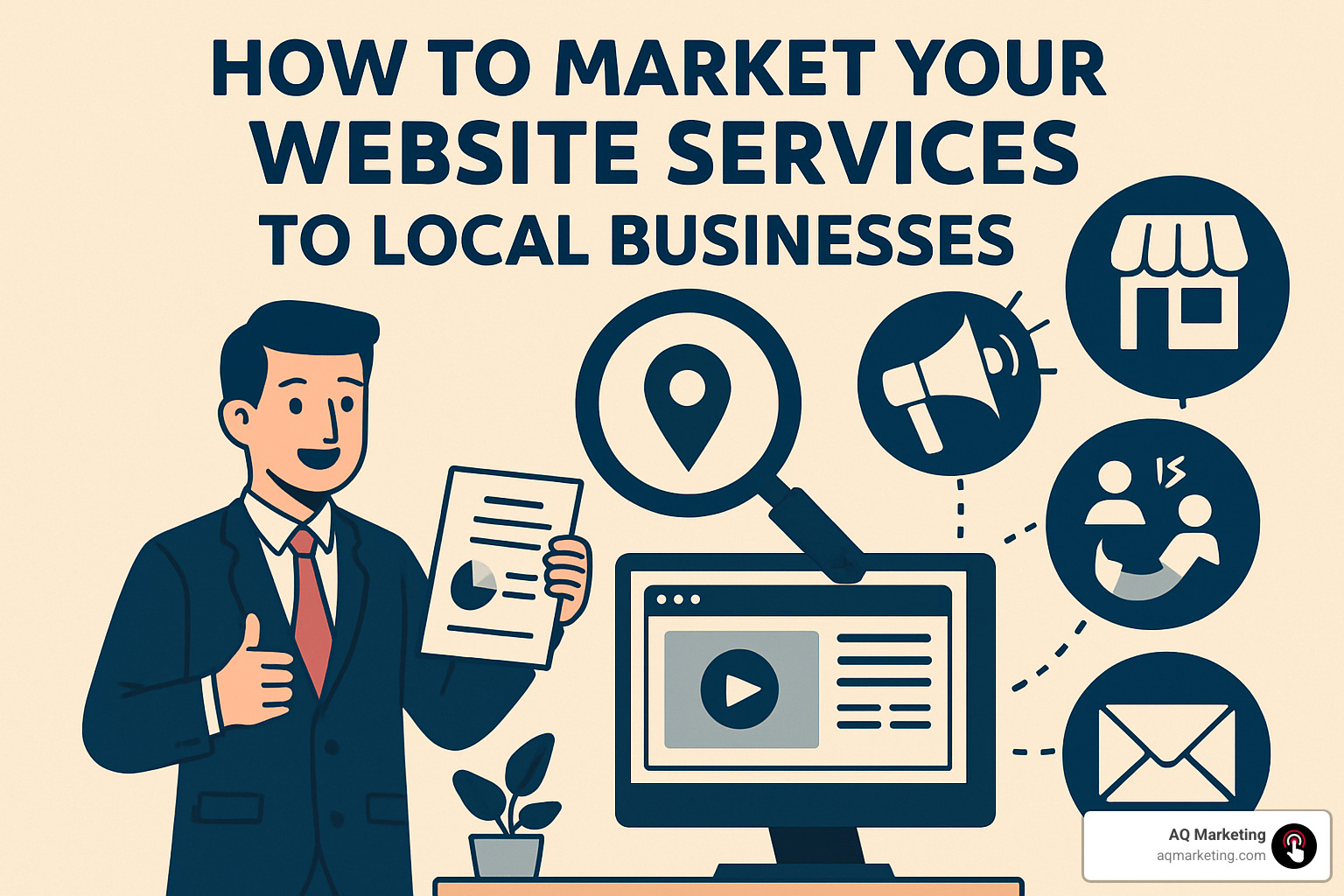
Finding the sweet spot between digital strategies and good old-fashioned handshakes is the secret sauce when how to market your website services to local businesses is your goal. I’ve found that combining both worlds creates the most powerful connections with potential clients.
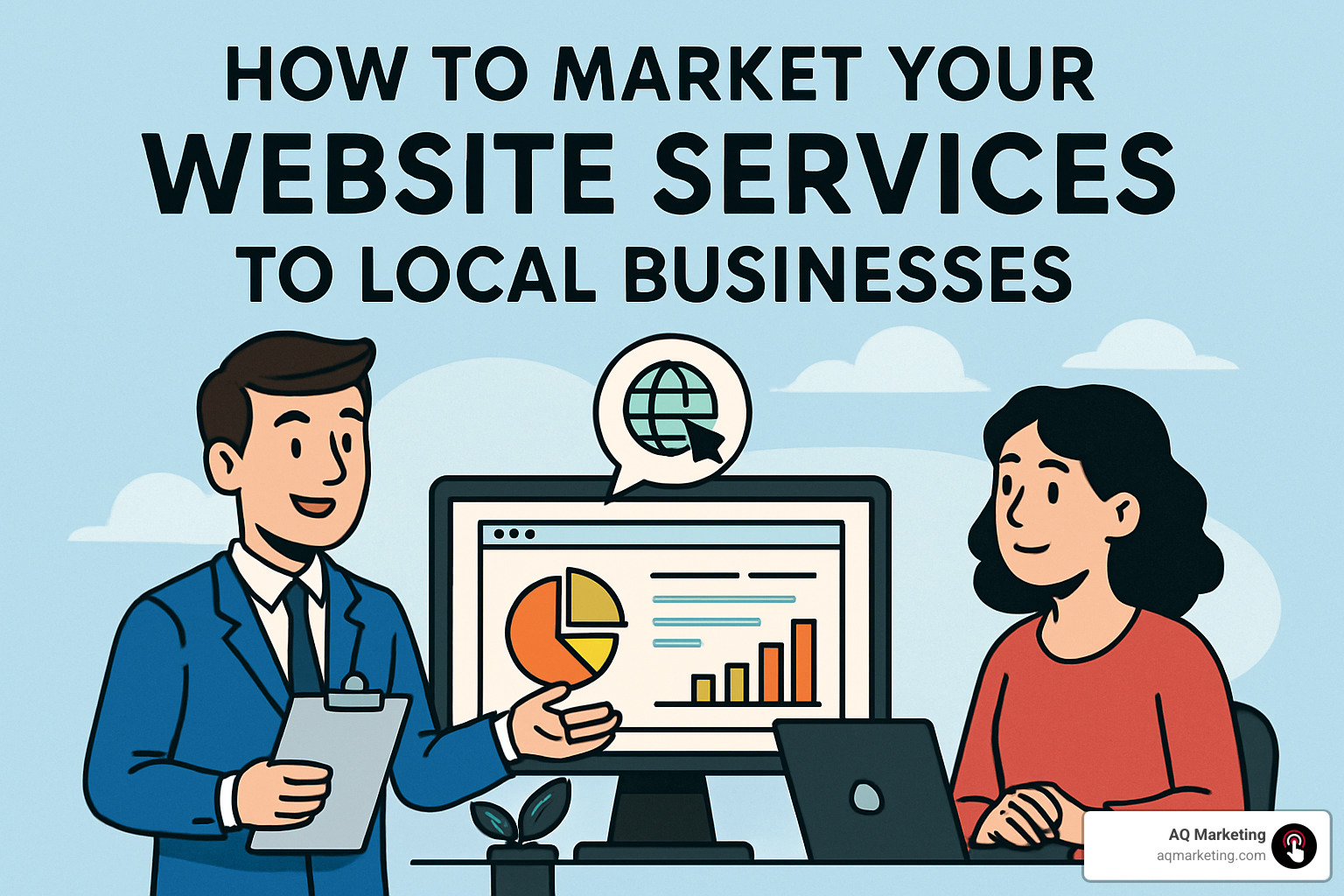
In the digital field, email sequences remain surprisingly effective despite predictions of their demise. When done right, they’re personal conversations that build relationships over time. Did you know 87% of companies report email marketing as critical to their success? The key is creating value-focused sequences that educate prospects about modern websites before making your pitch. Think of it as planting seeds rather than demanding an immediate harvest.
Social media direct messages offer another personal touch point. LinkedIn and Facebook can be goldmines for connecting with local business owners, but remember – nobody likes being sold to immediately. I always start by genuinely engaging with their content and asking thoughtful questions about their business challenges before mentioning how I might help.
For broader reach, geo-targeted ads on Facebook, Instagram, and Google can put you in front of local business owners who match your ideal client profile. Creating lookalike audiences based on your existing happy clients often yields the best results.
Don’t underestimate the power of offline connections though! Direct mail campaigns might seem like relics from another era, but they cut through digital noise beautifully. With 74% of marketers reporting direct mail delivers their best ROI of any channel, a well-designed postcard highlighting specific website problems you solve can generate impressive response rates.
Nothing beats face-to-face relationship building through local networking groups. Chambers of commerce, BNI chapters, and industry associations in your service area put you directly in front of decision-makers. The trust developed over coffee and conversation is hard to replicate digitally.
One of my favorite approaches is community volunteering. Offering website expertise to local nonprofits or community events not only feels good but connects you with business owners in a natural, non-salesy environment. These relationships often blossom into your most loyal clients and referral sources.
At AQ Marketing, we’ve seen that combining these channels creates a “surround sound” effect that dramatically increases conversion rates. A prospect might notice your Facebook ad, then receive your thoughtful direct mail piece, and finally meet you at a chamber event—creating multiple touchpoints that build familiarity and trust.
Step-by-Step: How to market your website services.to local businesses via Local SEO & Ads
Local SEO and targeted advertising work especially well for catching businesses actively searching for website help. Here’s my proven approach:
Start with geo-targeted Google Ads focusing on “web design [city name]” keywords with location targeting for your service areas. Create dedicated landing pages for each location, featuring testimonials from local businesses you’ve helped. This local relevance significantly boosts conversion rates.
Yelp Ads often outperform expectations for local service providers. Begin by claiming and optimizing your Yelp business listing, then run targeted ads for web design and development searches. Quick responses to Yelp inquiries are essential – potential clients expect near-immediate attention.
Geofencing for retargeting lets you target devices that have been in specific locations like business districts or networking events. This technology helps you stay top-of-mind with business owners you may have met briefly or who work in areas you’re targeting.
If available in your category, Google Local Service Ads appear at the very top of search results with that coveted “Google Screened” badge that instantly builds trust. These typically have higher conversion rates than traditional PPC ads for local services.
Don’t forget remarketing campaigns to reconnect with website visitors who showed interest but weren’t ready to commit. Create ads addressing common objections and use sequential remarketing to tell a compelling story across multiple impressions.
According to research on local advertising ROI, local SEO campaigns frequently deliver 500%+ ROI compared to PPC campaigns alone. However, I’ve found that combining both approaches typically yields the most consistent results.
Email Templates: how to market your website services.to local businesses at scale
Email remains my go-to channel for reaching local businesses efficiently. The secret is making each message feel personally crafted, even when you’re scaling your outreach.
Personalization goes far beyond just using their name. Reference their specific business, actual website issues you’ve noticed, or industry challenges you know they face. Emails with this deeper personalization deliver 90% better results than generic messages, making the extra research time well worth it.
A value-first approach means giving before asking. I like to include a mini website audit or relevant industry benchmark data that immediately demonstrates expertise and goodwill. This positions you as a helpful advisor rather than just another vendor.
Your call-to-action should be crystal clear and low-commitment. Instead of asking for a sale, invite them to a 15-minute consultation call. The lower the perceived risk, the higher your response rate will be.
Including relevant social proof from similar businesses helps prospects imagine their own success. A brief testimonial from another local business owner in their industry can be the tipping point that prompts a response.
For email automation, platforms like MailChimp help you scale without losing the personal touch. Create different sequences for different business types, A/B test subject lines and content, and track open and click-through rates to continuously refine your approach.
A simple three-email sequence might look like this:
First, send a value-focused introduction with specific observations about their current website. Three days later, share an educational email featuring a relevant case study of a similar business. Five days after that, present a custom offer based on their specific needs with a time-limited incentive.
This gradual approach respects the business owner’s time while building credibility at each step. When done with genuine care for their business outcomes, email outreach becomes less about selling and more about starting valuable conversations about how to market your website services to local businesses in a way that truly helps them grow.
Pricing, Packaging & Objection Handling
Let’s talk about money—because that’s often where the rubber meets the road with local businesses. When it comes to how to market your website services to local businesses, your pricing structure can make or break your success.
Most local business owners aren’t web experts (that’s why they need you!), so they crave clarity, simplicity, and predictability in your offerings. They want to know exactly what they’re getting and how much it’s going to cost them.
We’ve found that tiered service options work wonderfully for most local clients. Think of it as the good-better-best approach that gives clients choice without overwhelming them. For instance, you might offer a Basic package with a simple informational website, a Professional package that focuses on lead generation with SEO foundations, and a Premium package that delivers a complete digital presence with ongoing optimization.
One strategy that’s worked exceptionally well for us at AQ Marketing is creating productized services. Instead of custom-quoting everything (which can feel unpredictable to clients), we package our offerings as clear products with defined deliverables, timelines, and fixed prices. This approach simplifies the buying decision and actually speeds up the sales process.
Transparency builds trust. When possible, publish your pricing openly. Yes, this might scare away some prospects—but those are likely the ones who couldn’t afford your services anyway. Being upfront about costs pre-qualifies leads and saves everyone time.
Many local businesses struggle to understand the potential return on their website investment. Creating simple ROI calculators can be a game-changer in your sales process. Show them in concrete terms how a $5,000 website investment might generate $25,000 in new business over the next year.
For budget-conscious clients (and let’s be honest, that’s most small businesses), offering financing options can remove a significant barrier to purchase. Consider partnering with financing providers to offer monthly payment plans that make professional websites more accessible.
At AQ Marketing, our Custom Website Design and SEO packages are carefully structured to provide clear value at each price point while making the benefits of upgrading obvious without being pushy.
Addressing “We Can Do It Ourselves”
You’ve probably heard this objection a hundred times: “Why should I hire you when I can just use Wix/Squarespace/WordPress myself?” Here’s how to handle it with grace and effectiveness.
First, acknowledge that they’re right—there are DIY options available. This validation shows you’re honest and not dismissive of their concerns. Then, gently highlight the hidden costs: “While the monthly fee might be low, most business owners spend 40+ hours building their first website—time that’s probably better spent running your business and serving customers.”
Talk about performance gaps in conversational terms: “DIY sites often miss crucial elements like proper SEO structure and conversion optimization. It’s like the difference between a backyard mechanic and a certified technician—both can change your oil, but one is better equipped to keep your engine running smoothly long-term.”
Security is another powerful talking point. Professional websites include ongoing security measures and regular updates that protect businesses from increasingly sophisticated hackers and data breaches. Most business owners don’t have the time or expertise to stay on top of these threats.
The key isn’t to dismiss DIY options but to help businesses understand the true cost-benefit analysis beyond just the sticker price. When clients understand that professionally designed websites typically convert 2-3 times better than DIY sites, they quickly realize they’d need only a few additional customers to cover the cost difference.
Bundles That Convert
Bundling services is a win-win—clients get better results and you increase your average sale value. Some of our most successful bundles include:
Website + Hosting + Maintenance packages that combine design services with ongoing hosting, security updates, and content changes for a predictable monthly fee. Clients love the peace of mind that comes with knowing their digital storefront is always taken care of.
Website + SEO combinations ensure the beautiful site you build actually generates leads. After all, what good is a gorgeous website if no one ever finds it? This bundle addresses the common problem of “build it and forget it” websites that fail to deliver business results.
For service businesses that rely on visual appeal, Seasonal Photo Packages that offer quarterly professional photography keep website imagery fresh and engaging year-round. This is especially valuable for restaurants, landscapers, and retail businesses where seasonal changes affect their offerings.
Technology Add-ons like chatbots, appointment scheduling tools, or CRM integrations can dramatically improve website functionality and lead capture. Bundling these with your website services provides additional value while increasing your revenue.
When presenting these bundles, be sure to clearly articulate both the cost savings compared to purchasing services separately and the improved results clients can expect from the integrated approach. It’s not just about saving money—it’s about getting better outcomes for their business.
From Lead to Long-Term Partnership
The most profitable client relationships are long-term partnerships, not one-time website builds. Here’s how to transform leads into lasting, mutually beneficial relationships:
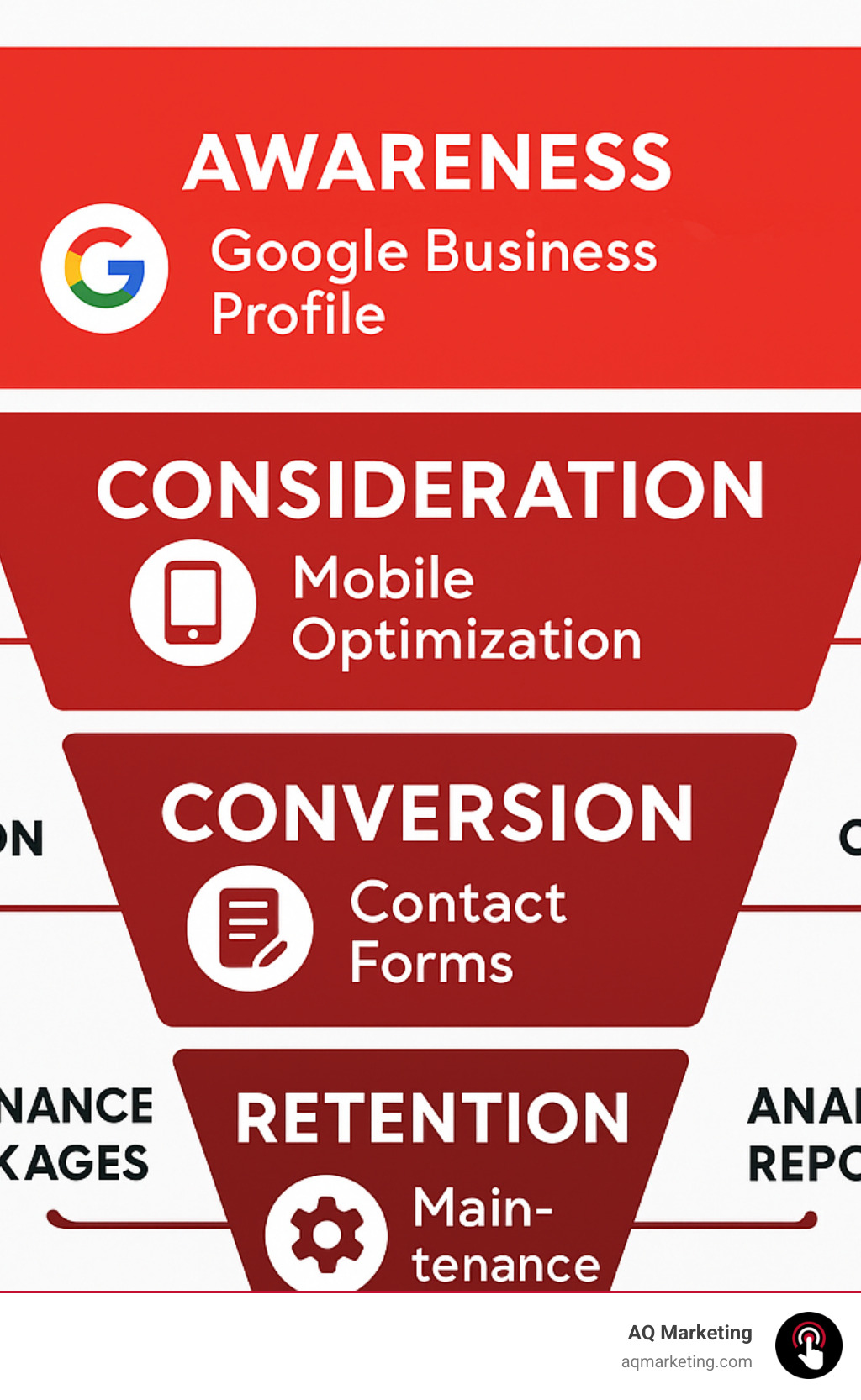
Building a sustainable business means viewing every new website client as the beginning of a journey, not a one-off transaction. At AQ Marketing, we’ve finded that the magic happens after the initial website launch—that’s when the real partnership begins to flourish.
Think of your client relationships like tending a garden. The initial website build is simply planting the seeds. The real growth comes from nurturing that relationship with care, attention, and expertise over time.
Detailed onboarding checklists create a smooth start to your partnership. Rather than a chaotic back-and-forth of emails, a systematic process helps clients feel confident they’re in capable hands. We’ve found that clients appreciate knowing exactly what information we need, when we need it, and how we’ll use it to create their digital presence.
“The way you begin sets the tone for the entire relationship,” says Robert Dickey, President of AQ Marketing. “A structured onboarding process demonstrates professionalism and builds trust from day one.”
Quarterly review meetings transform what could be a distant vendor relationship into a true partnership. These check-ins aren’t just about reviewing stats—they’re opportunities to understand evolving business challenges, celebrate wins together, and strategize for the future. When a client sees you proactively bringing ideas to the table, they stop seeing you as an expense and start seeing you as an investment.
Creating clear upsell pathways benefits both you and your clients. Map out a natural progression of services that builds on previous successes. For example, after a website redesign shows positive results, conversations about local SEO feel like a natural next step rather than a sales pitch. The key is timing these conversations around demonstrated wins.
Perhaps nothing builds a business faster than a robust referral program. With 88% of consumers trusting personal recommendations above all other marketing forms, happy clients can become your most powerful sales force. We’ve seen remarkable success with simple incentives like service credits or complementary quarterly content refreshes for successful referrals.
KPI dashboards that translate complex website metrics into business outcomes help clients see the tangible value you provide. Don’t just report on pageviews—show how those views translated to leads, appointments, or sales. At AQ Marketing, we’ve found that clients who receive regular performance updates are three times more likely to remain clients beyond the initial website project.
Retention Tactics That Scale
As your client roster grows, you need systematic approaches to maintain quality relationships without burning out. The good news? Many retention tactics can be systematized while still feeling personal.
Maintenance plans provide peace of mind for clients while creating predictable recurring revenue for your business. Structure these plans with clear deliverables—monthly security updates, content refreshes, performance monitoring—so clients understand exactly what they’re getting. Offering tiered options lets businesses choose the level of support that fits their needs and budget.
Continuous optimization keeps websites performing at their best while demonstrating your ongoing value. Small, data-driven improvements to page layouts, calls-to-action, or content can yield significant improvements in conversion rates over time. Document these wins clearly in client reports to reinforce the value of your partnership.
Implementing review generation tools helps clients build their online reputation while creating a virtuous cycle of social proof. When you help a client collect glowing reviews from their customers, you’re not just improving their marketing—you’re creating tangible proof of your impact on their business.
Loyalty discounts acknowledge the value of long-term relationships and incentivize continued partnership. These might include preferred pricing on additional services, complimentary annual photo shoots, or priority support. The specific perks matter less than the message they send: we value your continued business.
Providing educational resources positions you as a trusted advisor rather than just a service provider. Regular tips, industry updates, or website best practices delivered via email or a client portal demonstrate your expertise while keeping your services top-of-mind.
The heart of retention is proving your value consistently through both results and relationship. Local businesses particularly value partners who understand their unique challenges and proactively help them grow. When you become an extension of their team rather than just another vendor, you create a partnership that’s difficult to replace—no matter what price a competitor might offer.
As one of our long-term clients recently told us, “I don’t just pay for website services—I pay for the peace of mind knowing my digital presence is in good hands.” That’s the kind of relationship that creates sustainable growth for both your business and theirs.
Frequently Asked Questions about Marketing Website Services Locally
What’s the fastest way to get a local business interested?
Nothing grabs a business owner’s attention faster than showing them exactly what they’re missing. The secret weapon in your arsenal? A quick, targeted website audit that reveals specific issues costing them real customers.
Instead of generic sales pitches, show them that their mobile site takes 8 seconds to load when their competitors load in 2 seconds. Then explain that 73% of users will abandon a site that takes more than 3 seconds to load. This isn’t just tech talk—it’s lost revenue they can visualize.
The magic formula is simple: identify 2-3 specific problems + translate those issues into potential lost revenue = a business owner who suddenly sees the value in what you offer.
I’ve found that business owners respond best when you make it personal to their specific situation rather than quoting industry statistics alone. Show them their actual website on your phone and let them experience the frustration their customers feel.
How do I prove ROI on a new website?
The million-dollar question! Business owners need to see websites as investments, not expenses. The key is establishing clear before-and-after metrics that directly connect to their bottom line.
Before you even begin the project, make sure proper tracking is in place. Google Analytics is your foundation, but also set up conversion tracking for forms, calls, and other key actions. Document the baseline performance so you have comparison points later.
Focus on metrics that translate directly to revenue—conversion rates, time on site, bounce rates, and local search rankings are all valuable, but different businesses care about different outcomes. A restaurant owner might be fixated on reservation bookings while a plumber wants phone calls.
Create a simple ROI calculation they can understand:
ROI = (Value of Conversions – Website Investment) / Website Investment × 100%
Back this up with real case studies from similar businesses. At AQ Marketing, we maintain a library of anonymized results from various industries that help prospects understand realistic expectations.
ROI isn’t just about new customers—it’s also about efficiency. A website that reduces phone time answering basic questions creates real value that should be factored into your calculations.
What if a prospect has a tight budget?
Budget concerns are part of nearly every sales conversation with local businesses. Instead of seeing this as an obstacle, view it as an opportunity to demonstrate your flexibility and commitment to their success.
Start by understanding their priorities. What’s the one thing their website absolutely must accomplish? For some, it’s generating leads. For others, it’s showcasing their work or reducing customer service calls. Build your solution around that core need first.
A phased approach often works beautifully—start with the essentials and add features over time as their budget allows and as they begin seeing returns on the initial investment. This builds trust while respecting their financial constraints.
Consider offering financing options that convert a large upfront cost into manageable monthly payments. When a business owner realizes they can get a professional website for roughly the same monthly cost as their cell phone bill, the decision becomes much easier.
For extremely tight budgets, a hybrid approach can work wonders. Perhaps they provide content and images while you handle the technical setup and SEO fundamentals. This collaboration reduces costs while still delivering professional results.
Above all, keep steering the conversation back to value rather than price. At AQ Marketing, we believe every local business deserves a professional online presence. When you can demonstrate that a $5,000 website will likely generate $15,000 in new business within a year, suddenly that “expensive” website looks like the bargain of the century.
Conclusion & Next Steps
As we’ve explored throughout this guide, how to market your website services to local businesses isn’t just about technical skills—it’s about becoming a trusted partner in your clients’ growth journey. The digital landscape may constantly evolve, but one truth remains: local businesses need websites that work as hard as they do.
The most successful website service providers don’t just build sites—they build relationships. They understand that their success is directly tied to their clients’ success, creating a powerful alignment of interests that benefits everyone involved.
Think of your marketing approach as a conversation rather than a sales pitch. When you genuinely understand the challenges local businesses face and offer solutions that directly impact their bottom line, you’ll find clients naturally gravitating toward your services.
Remember these core principles as you develop your strategy:
Start with value, not features. Local business owners don’t care about the latest WordPress plugins—they care about getting more customers through their doors. Frame all your communication around the outcomes you deliver, not the technical details of how you get there.
Show up where your clients are. This means having a strong digital presence, but also embedding yourself in the community. The most valuable client relationships often begin with a handshake at a chamber event or a referral from another satisfied customer.
Data tells stories that sell. When you can show a restaurant owner that similar businesses increased reservations by 40% after launching a new website, suddenly your services become an investment rather than an expense.
Long-term thinking wins. The real profit comes from ongoing partnerships, not one-time projects. Structure your services to provide continuous value through maintenance, optimization, and strategic guidance.
At AQ Marketing, we’ve been helping small to medium-sized businesses throughout Boston, Woburn, and Middlesex County strengthen their digital presence since 2003. Our approach has always focused on sustainable growth rather than quick fixes that fade.
The strategies we’ve shared in this guide aren’t theoretical—they’re battle-tested approaches we’ve refined through years of helping local businesses thrive online. We’ve seen how a thoughtfully designed website can transform a struggling business into a thriving one.
Ready to take your website services to the next level? Consider exploring our specialized experience with different industries we service for insights on tailoring your approach to specific business types.
In the end, the most powerful marketing tool for your website services will be the success stories you create. When you deliver websites that genuinely help local businesses grow, word spreads. Your portfolio becomes more than a showcase—it becomes proof that you deliver on your promises.
And in a local business community, there’s nothing more valuable than a reputation for keeping your word.
