

Effective digital marketing: 2025 Growth Guide
Why Effective Digital Marketing is Critical for Modern Business Success
Effective digital marketing is the strategic use of digital channels and tactics to connect with your target audience, build relationships, and drive measurable business results. It’s not just about having a website or occasionally posting on social media—it’s about creating a cohesive, data-driven system that turns online visitors into loyal, paying customers.
For a business to thrive, its marketing must be more than just present; it must be effective. This means every action is purposeful and every dollar is accountable. Let’s break down the core pillars that support a truly effective strategy.
Key components of effective digital marketing include:
- Strategy Development – This is the foundational blueprint. It involves setting clear, measurable goals (like increasing qualified leads by 20% in six months) and choosing the right channels to reach your specific audience, whether they’re in downtown Boston or the quieter towns of Southern New Hampshire.
- Audience Understanding – You need to know exactly who your customers are, what they need, and where they spend their time online. This goes beyond basic demographics to understand their motivations, challenges, and the questions they’re typing into Google.
- Content Creation – This is the fuel for your marketing engine. It’s about providing genuinely valuable information—blog posts, videos, guides—that solves your audience’s problems and establishes your business as a trusted local authority.
- Search Optimization (SEO) – In a competitive market, you must be visible. SEO is the technical and creative process of making sure potential customers can find you when they search for your services, whether it’s on Google, Google Maps, or through voice assistants.
- Performance Measurement – An effective strategy is a measured one. This means tracking the key performance indicators (KPIs) that matter to your bottom line—like lead quality and cost per acquisition—and continuously adjusting your approach based on what the data tells you.
For small and medium-sized businesses in the Boston area, Woburn, and throughout the Merrimack Valley, digital marketing has become the primary engine for growth. Consider this: nearly 68 percent of online experiences begin with a search engine, and with 72 percent of the U.S. population using social media, your customers are already online. The critical question is whether they can find you among the noise.
Today’s consumers don’t just pick the closest business anymore. They are empowered researchers. They vet their options, read online reviews, compare services on different websites, and make highly informed decisions before ever picking up the phone. A homeowner in Middlesex County looking for an emergency HVAC repair will likely search on their phone, scrutinize Google reviews, and visit the top three company websites before making a call. An insurance agency in Essex County needs more than a well-placed storefront—they need a robust digital presence to build trust and compete with national brands that have massive advertising budgets.
This guide will walk you through building a digital marketing strategy that actually delivers tangible, lasting results for businesses like yours in our unique local market.
I’m Robert P. Dickey, President and CEO of AQ Marketing, and I’ve spent over 20 years helping small and medium-sized businesses in the Greater Boston area succeed with effective digital marketing strategies. From my early days developing direct mail campaigns to founding AQ Marketing in 2003, I’ve witnessed the profound shift in how businesses connect with customers. I’ve seen how the right digital approach can transform a struggling local business into a thriving, resilient one.
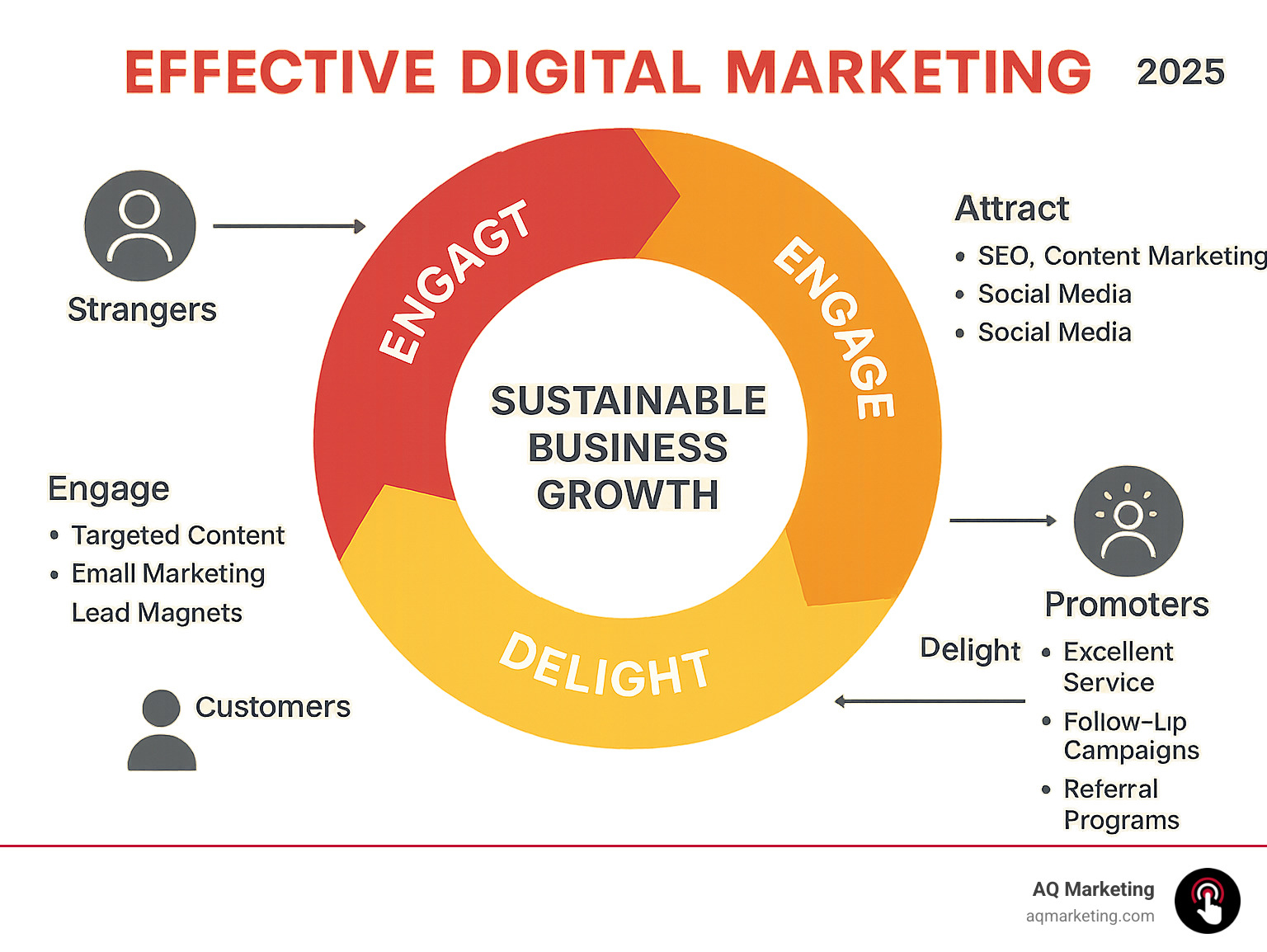
At AQ Marketing, we model our approach on the flywheel concept shown above. Instead of a traditional funnel that treats customers as an afterthought, the flywheel places them at the center. First, you Attract strangers with valuable content, turning them into visitors. Then, you Engage those visitors with personalized solutions and conversations, converting them into leads and customers. Finally, you Delight your customers with exceptional service and support, turning them into promoters who bring you new business. This creates a self-sustaining cycle of growth, which is far more powerful and cost-effective than constantly chasing new leads from scratch.
Strategy vs. Tactics: The Blueprint for Business Growth
Think of effective digital marketing like building a house. You wouldn’t show up to a job site and start hammering nails without a detailed blueprint, right? Yet, countless businesses jump straight into tactics—posting on social media, running a few ads, or writing a blog post—without a clear, overarching plan. This is the equivalent of building a wall without knowing where the room is supposed to go.
To build a marketing machine that generates real growth, it’s crucial to understand the hierarchy of planning. Let’s clear up the confusion between three terms that are often used interchangeably but mean very different things: strategy, campaigns, and tactics.
Your digital marketing strategy is the architect’s blueprint. It’s your high-level, long-term plan that answers the fundamental “why” behind every marketing action you take. It defines your goals, your target audience, and your unique position in the market. For a plumbing company in Woburn, a powerful strategy might be: “To become the most trusted and top-rated emergency plumber for homeowners in Middlesex County within two years.”
Digital marketing campaigns are the individual construction projects guided by that master blueprint. They are focused, time-bound efforts designed to achieve a specific, measurable objective that supports the overall strategy. Following our example, the Woburn plumber might run a “Winter Pipe Protection Campaign” from October to December. The goal? To generate 50 new preventative maintenance leads and increase emergency service calls during the first frost.
Digital marketing tactics are the actual tools and actions you use to execute a campaign—the hammer, nails, and saw of your marketing toolkit. For that winter campaign, the specific tactics might include: creating a series of blog posts on how to insulate pipes, running hyper-targeted Facebook ads to homeowners in Woburn, Burlington, and Winchester, and sending an email sequence to past customers reminding them about seasonal maintenance.
Here’s what makes this structure so powerful: each level logically supports the next. Your tactics fuel your campaigns, and your campaigns systematically move you toward achieving your strategic goals. Without this alignment, you’re just throwing marketing spaghetti at the wall and hoping something sticks—a costly and frustrating exercise.
As renowned strategy expert Richard Rumelt explains in this insightful video, every solid strategy contains a “kernel” of three essential parts:
- A Clear Diagnosis: A straightforward assessment of the core challenge. For our plumber, the diagnosis might be, “Our brand has low recognition, and we’re being outranked on Google for ’emergency plumber Middlesex County’ by larger, non-local aggregators.”
- A Guiding Policy: The overall approach you’ll take to overcome the challenge. The plumber’s guiding policy would be, “We will focus our marketing on highlighting our local expertise, rapid response time, and community trust to differentiate ourselves from faceless national brands.”
- Coherent Actions: A set of targeted, coordinated actions designed to carry out the guiding policy. These are the campaigns and tactics, such as optimizing their Google Business Profile for local search, gathering customer testimonials, and running ads that promise a 60-minute response time.
The Three Layers Explained
Let’s make this even simpler with another real-world example. Imagine an independent insurance agency in Essex County that’s struggling to compete with the massive advertising budgets of the big national companies.
Strategy is the “why”: Their long-term vision is to become the go-to local insurance expert that families and small businesses turn to for personalized service and deep knowledge of the Massachusetts market. This is their North Star, guiding every decision.
Campaigns are the “what”: To support this strategy, they could run a “New Homeowner Welcome Campaign” during the busy spring and fall moving seasons. This campaign has a clear start and end date, a defined budget, and a specific goal: to write 50 new home insurance policies for recent buyers in towns like Andover, North Andover, and Haverhill.
Tactics are the “how”: Within that campaign, they’ll execute a series of coordinated actions. They might create “New Mover” welcome packets with local resources and an insurance checklist, partner with local real estate agents for referrals, run targeted Google Ads for keywords like “home insurance Essex County,” and host free, educational first-time homebuyer workshops at a local library or community center.
| Strategy | Long-term plan to achieve business goals | Become the most trusted local insurance agency in Essex County within 3 years |
|---|---|---|
| Campaign | Time-bound initiative supporting the strategy | “New Homeowner Welcome Campaign” – Spring 2024 outreach to recent movers |
| Tactics | Specific actions within campaigns | Google ads for “Essex County home insurance,” real estate agent partnerships, welcome packets, educational workshops |
Notice how everything connects? The tactics are not random; they directly support the campaign’s goal. The campaign, in turn, is a deliberate step toward achieving the agency’s long-term strategic vision. This alignment is the absolute difference between effective digital marketing and simply being busy.
Most small businesses in the Merrimack Valley and Southern New Hampshire make the honest mistake of jumping straight to tactics. They boost a post on Instagram because they think they should, or they run a Google ad because a friend said it worked for them. But without a clear strategy and focused campaigns, these actions are isolated, unmeasurable, and often a drain on precious time and money. The magic, and the ROI, happens when all three layers work in perfect harmony toward the same well-defined goal.
