Digital Marketing Insurance Industry: 10 Powerful 2025 Success Secrets
Why Digital Marketing Is Changing the Insurance Industry
The digital marketing insurance industry has undergone a massive shift as customers now expect personalized, transparent, and efficient interactions from insurance brands. Here’s what insurance companies need to know:
Key Digital Marketing Strategies for Insurance:
– Personalization with data insights – 89% of marketers see positive ROI from personalized campaigns
– Mobile and voice search optimization – 64% of searches happen on mobile devices
– Video marketing and educational content – Simplifies complex insurance products
– Marketing automation for lead nurturing – Essential for long sales cycles
– Social proof and customer reviews – 83% of customers willing to refer products they trust
The numbers tell the story. Nearly 70% of insurance shoppers now research and compare policies online before contacting an agent. Yet only 10% of customers complete the entire purchase journey digitally. This gap represents both a challenge and an opportunity.
Traditional marketing approaches no longer suffice for modern insurance customers. The industry employs nearly 3 million people in the U.S. alone, but many companies still struggle with digital change. Meanwhile, the Canadian insurance market exceeds $77.6 billion in gross written premium with a projected 6% growth rate through 2027.
As someone who has spent over 20 years helping businesses steer digital marketing challenges, I’m Robert P. Dickey, President and CEO of AQ Marketing. My experience working with financial services companies has shown me how the digital marketing insurance industry requires specialized approaches that balance compliance, trust-building, and conversion optimization. The strategies that work for other industries often fall short when applied to insurance without proper adaptation.
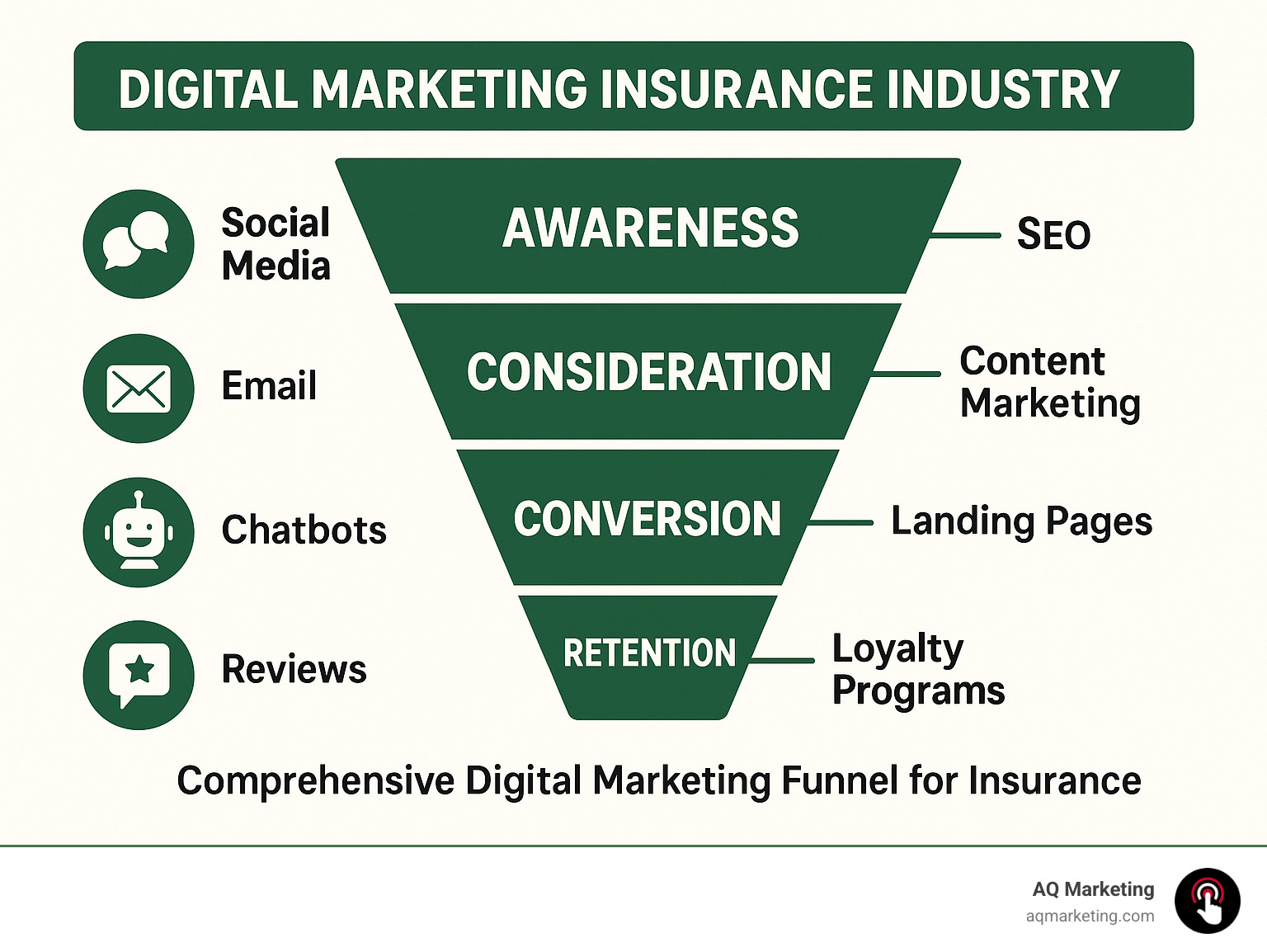
The Digital Marketing Insurance Industry Landscape in 2025
The insurance world is buzzing with change, and frankly, it’s about time. With a 6% compound annual growth rate expected through 2027, insurance companies are finally waking up to what their customers have been asking for all along: better digital experiences.
Here’s what’s really interesting—we’re not seeing a complete abandonment of traditional methods. Instead, a hybrid distribution model is emerging where your friendly neighborhood agent works alongside sleek digital tools. It’s like having the best of both worlds, though many companies are still figuring out how to make this dance work smoothly.
Generational shifts are driving much of this change. Millennials and Gen Z customers aren’t just comfortable researching complex insurance products online—they expect it. They want to compare coverage options at 2 AM in their pajamas, and they want transparent pricing without having to sit through a sales pitch first.
The rise of insurance aggregators has certainly shaken things up. These platforms offer the kind of simple, comparison-friendly experiences that make traditional insurance websites look clunky by comparison. The pressure is real, and companies that don’t adapt risk being left behind.
Personalization is delivering serious results—89% of marketers see positive ROI when they use data analytics to create personalized campaigns. This isn’t just about slapping someone’s name on an email. It’s about understanding whether they’re a new parent who needs life insurance or a retiree looking to adjust their coverage.
Mobile and voice search have become unavoidable realities. With 64% of searches happening on mobile devices, your website better work perfectly on a smartphone. Voice-activated searches are changing how people ask questions too, making queries more conversational and specific to their location.
Despite all this digital progress, here’s a surprising fact: only 10% of customers complete their entire insurance purchase journey digitally. That gap between research and purchase represents a massive opportunity for companies that can bridge it effectively.
| Traditional Touchpoints | Digital Touchpoints |
|---|---|
| In-person agent meetings | Website self-service portals |
| Phone calls for quotes | Online quote calculators |
| Paper policy documents | Digital policy management apps |
| Mail-based renewals | Email and SMS notifications |
| Referral programs | Social media engagement |
| Local newspaper ads | Targeted digital advertising |
How digital change reshaped the “digital marketing insurance industry” conversation
The digital marketing insurance industry conversation has completely flipped from “What products can we sell?” to “What do our customers actually need?” It’s a refreshing change that’s long overdue.
Customer centricity means recognizing that people don’t buy insurance because it’s fun—they buy it for peace of mind. This shift requires companies to think beyond traditional sales tactics and create experiences that actually help people understand their options and make confident decisions.
Data analytics has become the secret weapon for smart insurance marketers. When someone moves to a new city or buys their first home, automated systems can send helpful information about relevant coverage options. Done right, these touchpoints feel like helpful reminders rather than pushy sales pitches.
The emergence of specialized marketing technology roles tells the whole story. Companies are hiring positions like Digital Marketing Analytics Specialists because they finally understand that effective insurance marketing requires both industry expertise and digital savvy.
All this innovation happens within strict compliance requirements, of course. Insurance marketing must balance personalization with privacy protection, ensuring every email and ad meets regulatory standards while still feeling human and helpful.
Regional benchmarks & online adoption gaps
The numbers vary dramatically depending on where you look. In the UK and Ireland, more than 25% of customers have purchased insurance policies online recently. These markets show what’s possible when companies invest in truly streamlined digital experiences.
The United States employs nearly 3 million people in the insurance industry, which explains why traditional sales channels remain so strong. This infrastructure isn’t going anywhere, but it creates opportunities for companies that can blend digital efficiency with personal service.
Canada’s insurance market is worth $77.6 billion in gross written premium, demonstrating the massive opportunity available to companies that master digital marketing. With that projected 6% growth rate, early adopters of effective digital strategies will likely capture disproportionate market share.
The main obstacles preventing higher online adoption are complexity and price concerns. Customers consistently cite these as the top barriers to completing online purchases. This feedback provides a clear roadmap: simplify the buying process and provide transparent, easy-to-understand pricing information.
Winning Digital Strategies Across the Policy Lifecycle
Successful insurance marketing requires a comprehensive approach that addresses every stage of the customer journey. We’ve found that the most effective strategies combine traditional relationship-building with modern digital tools to create seamless experiences.
Customer personas form the foundation of effective insurance marketing. Rather than broad demographic categories, we recommend developing detailed personas that include life stage, risk tolerance, communication preferences, and decision-making patterns.
Micro-segmentation takes persona development further by using behavioral data to create highly specific audience groups. For example, customers who abandon quote forms might receive different follow-up messaging than those who complete applications but don’t finalize purchases.
Interactive content has proven particularly effective for insurance marketing. Quizzes that help customers determine appropriate coverage levels, calculators that estimate premiums, and assessment tools that identify risk factors all provide value while generating qualified leads.
Long-tail SEO strategies help insurance companies capture high-intent searches. Instead of competing for broad terms like “car insurance,” companies can target specific queries like “best car insurance for new drivers in Massachusetts.”
Email and SMS nurture campaigns are essential for insurance’s typically long sales cycles. Automated sequences can provide educational content, policy reminders, and relevant offers based on customer behavior and preferences.
Social proof remains incredibly powerful in insurance marketing. With 78% of consumers more willing to buy after positive social media experiences and 83% willing to refer products they trust, building and showcasing customer satisfaction should be a priority for every insurance company.
Attract: Search, Social & Content That Rank for the “digital marketing insurance industry”
Attracting the right prospects requires a multi-channel approach that combines search engine optimization, social media engagement, and valuable content creation. Our Insurance SEO Agency services have shown that insurance companies often underuse SEO, making it easier to rank for high-potential keywords.
Keyword research forms the foundation of effective insurance SEO. We recommend focusing on long-tail keywords that reflect how people actually search for insurance information. Voice search has made queries more conversational, so optimize for questions like “What’s the best health insurance for families?”
Blogging remains one of the most effective ways to attract organic traffic. Companies that blog receive 97% more inbound links to their websites. For insurance companies, we recommend publishing comprehensive guides of at least 1,000 words that address common customer questions and concerns.
Local SEO is particularly important for insurance agents and regional companies. Optimizing Google My Business profiles, maintaining consistent NAP (Name, Address, Phone) information across directories, and creating location-specific content can significantly improve local search visibility.
Creating FAQ content that directly answers voice search queries helps capture the growing number of voice-activated searches. Structure your content to provide clear, concise answers that search engines can easily extract and present to users.

Engage: Video, Webinars & Interactive Tools
Video marketing has become arguably the most engaging form of content for insurance companies. Complex policy details and coverage options become much more accessible when explained through animated videos or live demonstrations.
Explainer videos work particularly well for breaking down complicated insurance concepts. Animated explainers can explain policy exclusions, coverage limits, and claims processes for first-time buyers. These videos can be used across websites, social media, email campaigns, and sales presentations.
Webinars offer unique opportunities for insurance companies to demonstrate expertise while generating qualified leads. Educational webinars can convert at rates up to 30%, making them highly effective for companies willing to invest in regular programming.
Interactive tools like calculators and quizzes provide immediate value to prospects while collecting valuable lead information. A life insurance needs calculator or a home insurance coverage estimator can guide customers toward appropriate products while demonstrating the company’s expertise and helpfulness.
Convert: Automation, Chatbots & UX
Converting prospects into customers requires removing friction from the buying process while maintaining the personal touch that insurance customers expect. Marketing automation plays a crucial role in nurturing leads through long sales cycles typical in insurance.
Behavioral triggers can automatically send relevant content based on customer actions. For example, someone who downloads a guide about homeowners insurance might receive a follow-up email series about different coverage options, claim examples, and local agent contact information.
Chatbots have become essential for insurance websites, handling routine questions and qualifying leads outside business hours. AI-powered chatbots can walk users through basic policy questions, help them understand coverage options, and even assist with simple claim filings.
Quote form simplification is critical for conversion optimization. Many insurance companies have digitized paper forms without reducing complexity, leading to high abandonment rates. Streamlining forms to collect only essential information upfront can significantly improve completion rates.
Responsive design and fast loading times are non-negotiable for insurance websites. With more than half of insurance searches happening on mobile devices, websites must provide seamless experiences across all devices. Our SEO Optimization Service includes technical optimization to ensure sites load in under 2 seconds.
Retain: Reviews, Loyalty & Upsell
Customer retention is particularly important in insurance, where the cost of acquiring a new customer is five times higher than retaining an existing one. With an average industry retention rate of 84%, small improvements in retention can have significant financial impacts.
Online review management has become a core marketing function rather than just a reputation concern. Our Online Review Management services help insurance companies systematically collect, monitor, and respond to customer feedback across multiple platforms.
Encouraging satisfied customers to leave reviews should be built into standard operating procedures. Automated email sequences can request reviews at appropriate times, such as after successful claim processing or policy renewal. With 88% of consumers trusting online reviews as much as personal recommendations, positive reviews serve as powerful marketing tools.
Dynamic pricing offers and personalized communications can improve retention rates. Using customer data to identify when policies might be up for renewal or when life changes might create new insurance needs allows for proactive outreach with relevant offers.
Referral programs leverage the fact that 83% of customers are willing to refer products or services they trust. Structured referral incentives that reward both the referrer and the new customer can be highly effective for generating quality leads.

Technology & Compliance: Automation, AI & Data Privacy in Insurance Marketing
The intersection of technology and compliance creates unique challenges for insurance marketers. While advanced tools offer unprecedented opportunities for personalization and efficiency, they must be implemented within strict regulatory frameworks that govern how customer data can be collected, stored, and used.
Predictive analytics allows insurance companies to anticipate customer needs based on historical data and behavioral patterns. For example, analytics might identify when a customer is likely to need additional coverage based on life events, policy changes, or demographic shifts.
Generative AI is changing customer service and content creation. AI-powered chatbots can now handle complex policy questions, generate personalized email content, and even create initial drafts of marketing materials. However, all AI-generated content must be reviewed for accuracy and compliance before publication.
CRM integration ensures that all customer touchpoints are coordinated and personalized. When marketing automation tools connect with customer relationship management systems, agents can see complete interaction histories, enabling more informed and relevant conversations.
GDPR and CCPA compliance requirements have fundamentally changed how insurance companies collect and use customer data. Marketing strategies must include clear consent mechanisms, data minimization practices, and easy opt-out procedures. According to research on personalization statistics, customers who actively consent to marketing communications tend to be more engaged and valuable.
Carrier regulations add another layer of complexity. Insurance companies must ensure that all marketing materials comply with state insurance regulations, which can vary significantly across jurisdictions. This requires careful review processes and often limits the speed at which new campaigns can be launched.
Marketing automation stacks that play nicely with legacy systems
Many insurance companies operate on legacy systems that weren’t designed for modern marketing automation. The key is finding solutions that can integrate with existing infrastructure without requiring complete system overhauls.
Workflow design should start with current processes and gradually introduce automation where it adds the most value. Rather than trying to automate everything at once, focus on high-impact areas like lead nurturing, policy renewal reminders, and customer onboarding sequences.
CRM mapping ensures that customer data flows seamlessly between marketing and sales systems. This integration allows for more sophisticated lead scoring, better sales handoffs, and more personalized customer experiences throughout the entire lifecycle.
Staying on the right side of regulators & customer trust
Compliance isn’t just about avoiding penalties—it’s about building and maintaining customer trust. Insurance customers are particularly sensitive about data privacy because they share detailed personal and financial information with their insurers.
Consent management platforms help ensure that all marketing communications are properly authorized and documented. These systems track when and how customers opted in to different types of communications, making it easy to honor preferences and demonstrate compliance.
Data minimization practices involve collecting only the information necessary for specific purposes and deleting data when it’s no longer needed. This approach reduces risk while often improving the customer experience by simplifying forms and processes.
Our Reputation Management Services for Small Business include guidance on maintaining customer trust through transparent and secure marketing practices.
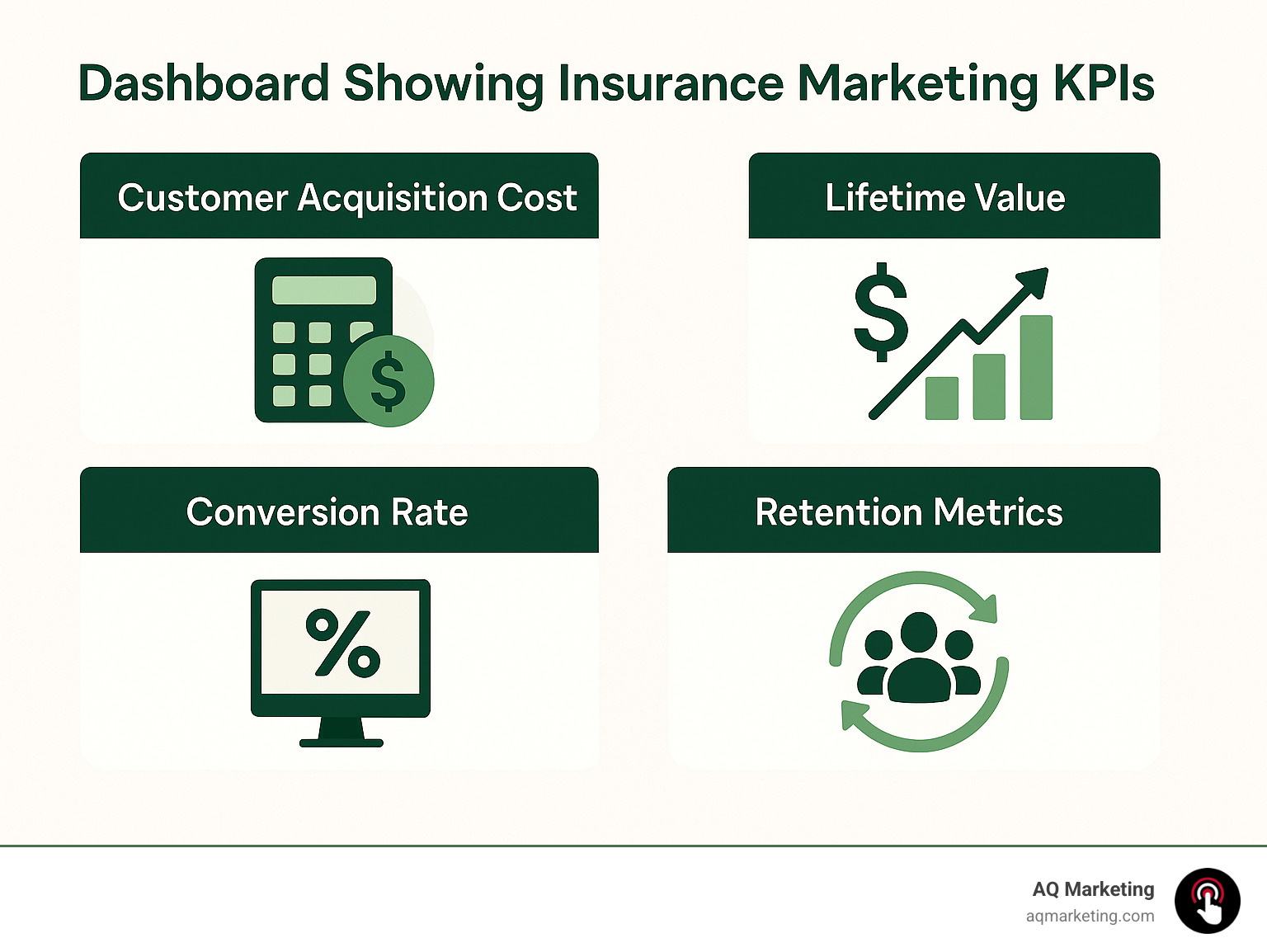
Measuring Success & Continuous Optimization
Effective measurement goes beyond basic metrics like website traffic or email open rates. Insurance marketing requires sophisticated attribution models that account for long sales cycles, multiple touchpoints, and the complex decision-making process typical of insurance purchases.
Key performance indicators for insurance marketing should include cost per lead (CPL), customer acquisition cost (CAC), lifetime value (LTV), and retention rates. With an industry average retention rate of 84%, small improvements in retention can significantly impact profitability.
Attribution models help understand which marketing channels and touchpoints contribute most to conversions. First-touch attribution shows which channels are best at generating initial interest, while last-touch attribution reveals which activities drive final conversions.
Real-time dashboards enable quick decision-making and campaign optimization. When marketers can see which campaigns are performing well and which need adjustment, they can reallocate budget and resources more effectively.
A/B testing should be continuous rather than occasional. Testing different subject lines, call-to-action buttons, landing page layouts, and content formats provides ongoing insights for optimization.
From dashboards to decisions
Data collection is only valuable if it leads to actionable insights and improved results. The most successful insurance marketers we work with have developed systematic processes for turning data into decisions.
Google Analytics 4 provides detailed insights into customer behavior, but the key is knowing which metrics matter most for insurance marketing. Focus on metrics that directly relate to business outcomes: qualified leads, policy applications, customer retention, and lifetime value.
Predictive churn modeling uses historical data to identify customers who are likely to cancel or not renew their policies. This allows for proactive retention efforts, such as personalized offers or additional support, before customers actually leave.
Budget shift case studies from our clients show how data-driven decision making can dramatically improve marketing ROI. One client increased lead quality by 40% by shifting budget from broad-match paid search campaigns to highly targeted social media advertising based on detailed performance analysis.
Our SEO Agency for Small Businesses includes comprehensive KPI tracking and reporting to ensure that all marketing investments are generating measurable returns.
Frequently Asked Questions about Digital Insurance Marketing
What are the most effective 2025 strategies for insurance companies?
The digital marketing insurance industry landscape has evolved dramatically, and the most successful strategies now blend cutting-edge technology with genuine human connection. After working with insurance companies for over two decades, I’ve seen which approaches consistently deliver results.
Personalized video marketing stands out as a game-changer for explaining complex policies. Instead of drowning customers in dense policy documents, animated explainers and authentic customer testimonials build trust while making coverage options crystal clear. One of our clients saw a 40% increase in quote completions after implementing video explanations for their most popular policies.
Behavioral email automation transforms how insurance companies nurture leads through those notoriously long sales cycles. When someone downloads your life insurance guide, they’re not ready to buy immediately. But a thoughtfully crafted email series about policy types, beneficiary considerations, and application processes keeps you top-of-mind when they’re ready to make a decision.
The rise of voice search optimization can’t be ignored. People aren’t searching for “auto insurance Massachusetts” anymore—they’re asking their phones, “What’s the best car insurance for new drivers?” Your content needs to answer these conversational questions naturally.
Interactive content like premium calculators and coverage assessment tools serve double duty. They provide immediate value to prospects while generating qualified leads for your sales team. These tools position your company as helpful and knowledgeable rather than just another insurance provider.
How can insurers personalize marketing without violating privacy laws?
This question keeps many insurance marketers awake at night, but it’s absolutely achievable with the right approach. The secret lies in transparency and creating genuine value exchanges with your customers.
First-party data collection through valuable content and tools is your foundation. When you offer a helpful home insurance calculator or a comprehensive guide to life insurance planning, customers willingly share information because they’re getting something useful in return.
Clear value propositions make all the difference in consent rates. Instead of generic “sign up for our newsletter” requests, explain exactly what subscribers will receive. “Get monthly insurance tips, policy updates, and exclusive discounts” tells people why their email address is worth sharing.
Granular consent options respect customer preferences while maximizing engagement opportunities. Some customers want policy reminders but hate promotional emails. Others love educational content but don’t want renewal notifications. Giving people control over their communication preferences actually increases overall engagement.
Data minimization isn’t just about compliance—it often improves the customer experience. Collect only what you need for specific purposes. This reduces privacy risks while simplifying forms and processes that might otherwise intimidate potential customers.
Why is video content so powerful for complex policy education?
Insurance products present unique marketing challenges that video content solves beautifully. These products are complex, intangible, and often emotionally charged—making them incredibly difficult to explain through text alone.
Visual explanations transform abstract concepts into concrete understanding. When you can show how different coverage options work in real-world scenarios through animation or demonstration, customers finally “get it.” They can visualize how their policy would actually protect them and their families.
The emotional connection that video creates is irreplaceable in insurance marketing. Seeing real customers share their claim experiences or watching agents explain policies in their own voices builds trust in ways that written content simply cannot match. Trust is everything in insurance—people need to believe you’ll be there when disaster strikes.
The shareability factor extends your reach organically. Helpful, engaging videos get shared on social media and through word-of-mouth recommendations far more than text-based content. This organic amplification is particularly valuable in insurance, where personal recommendations carry enormous weight.
Conclusion
The digital marketing insurance industry change isn’t just about adopting new technology—it’s about fundamentally rethinking how we connect with customers who are making some of life’s most important financial decisions.
After two decades of helping businesses steer digital marketing challenges, I’ve seen how the most successful insurance companies approach this evolution. They don’t just digitize their old processes. Instead, they build their entire marketing strategy around what customers actually need: clarity, trust, and confidence in their insurance decisions.
The companies that truly thrive in today’s market share a customer-first mindset that goes beyond surface-level personalization. They understand that someone buying life insurance is thinking about protecting their family’s future. A new homeowner needs more than just a policy—they need peace of mind that their biggest investment is protected.
Technology serves these human needs rather than replacing them. The best insurance marketers use automation to send helpful reminders and educational content, not just sales pitches. They use chatbots to answer basic questions quickly, but ensure complex concerns still reach knowledgeable humans. They leverage data to understand customer preferences, then use that knowledge to provide genuinely helpful experiences.
Continuous testing and optimization separate good marketing from truly exceptional results. The insurance landscape shifts constantly—new regulations emerge, customer expectations evolve, and competitive pressures intensify. Companies that build learning into their marketing processes can adapt quickly while their competitors struggle to keep up.
We’ve found that single-provider partnerships often deliver far better results than juggling multiple specialized vendors. When one experienced team understands your compliance requirements, customer base, and business goals, they can create cohesive strategies that actually work together instead of competing for attention.
At AQ Marketing, our expertise in financial services and insurance comes from understanding both the technical marketing side and the human side of these important decisions. We know that insurance marketing success comes from building trust, providing value, and making complex decisions feel manageable.
The future belongs to insurance companies that can blend digital efficiency with genuine personal service. The strategies we’ve covered in this guide provide your roadmap for that change—from attracting the right prospects to nurturing them through long sales cycles to keeping them satisfied for years to come.
Ready to transform how your insurance marketing connects with customers? Our comprehensive digital marketing services are designed specifically for businesses like yours, combining proven strategies with deep industry knowledge to deliver the long-term, impactful results your company deserves.