

best hosting for ecommerce: Top 5 Powerful Picks 2025
Why the Right Hosting Can Make or Break Your Online Store
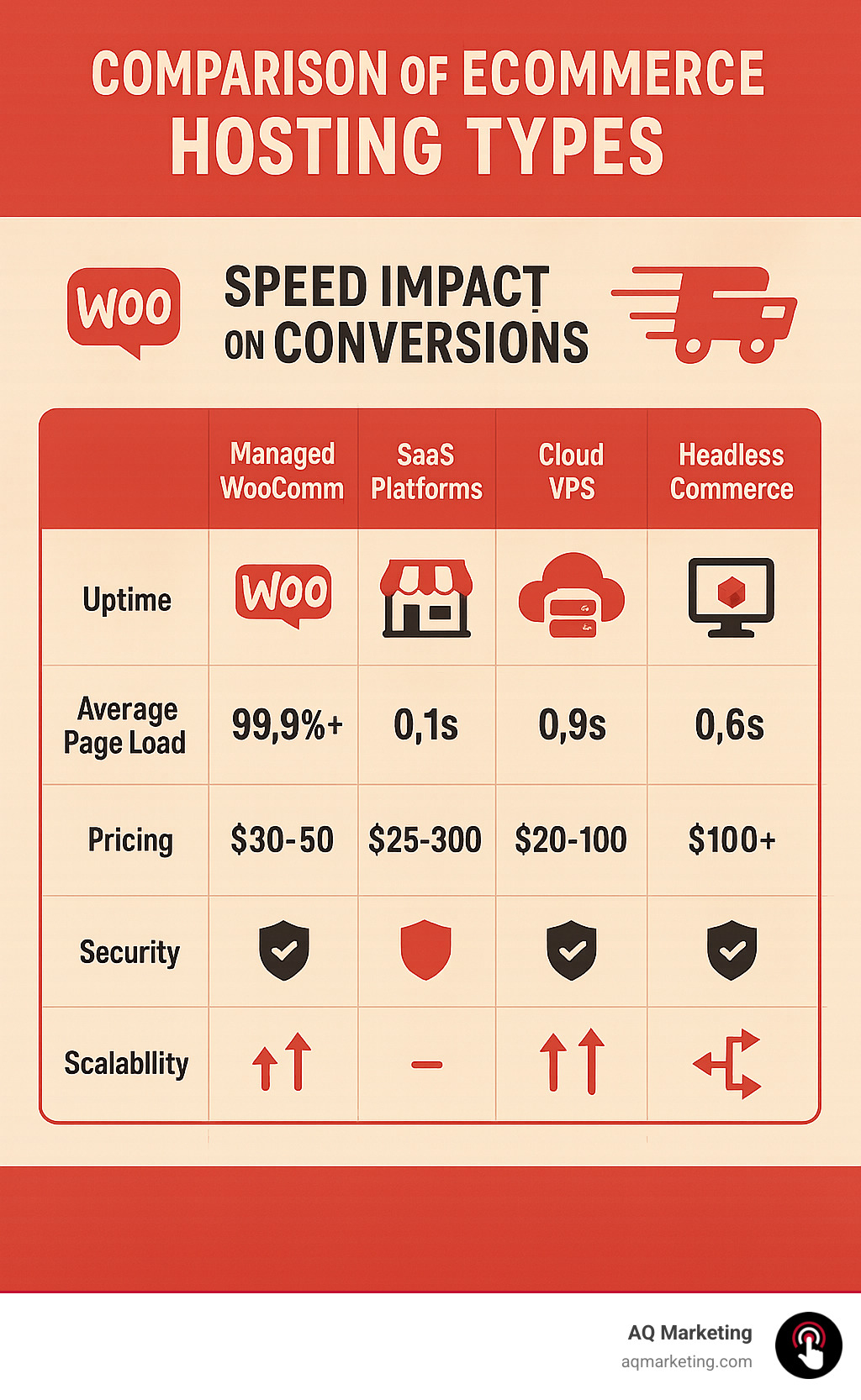
Best hosting for ecommerce options in 2025 at a glance:
- Managed WooCommerce Cloud – Best for customization and full control
- SaaS Platforms (Shopify, BigCommerce) – Best for beginners and maintenance-free operation
- Scalable Cloud VPS – Best for growing mid-sized stores
- Dedicated Enterprise Servers – Best for high-traffic, security-critical stores
- Headless Commerce Hosting – Best for omnichannel and content-heavy stores
Even a 1-second delay in your online store’s load time could drop your conversions by 7%. That’s a potential loss of $2.5 million in annual sales if you’re making $100,000 a day. Your ecommerce hosting isn’t just a technical decision – it’s a business-critical one that directly impacts your bottom line.
When customers expect pages to load in two seconds or less, choosing the right ecommerce hosting becomes essential for maintaining a competitive edge. The best hosting solutions provide more than just storage space; they deliver the speed, security, and scalability needed to handle traffic spikes during sales and promotions while keeping customer data secure.
I’m Robert P. Dickey, President of AQ Marketing with over 20 years of experience helping businesses implement the best hosting for ecommerce solutions that boost sales and improve customer experience.
Terms related to best hosting for ecommerce:
– cloud web hosting services
– web design and hosting services
– free web hosting services
How We Chose the Best Hosting for Ecommerce
Finding the best hosting for ecommerce isn’t just about checking boxes – it’s about understanding what actually drives sales for online stores. After helping hundreds of Massachusetts and New Hampshire retailers boost their online presence since 2003, we’ve developed a keen eye for what truly matters.
We don’t just look at flashy features. Instead, we focus on the metrics that directly impact your bottom line: how quickly your pages load, how often your site stays up, and how secure your customers’ data remains.
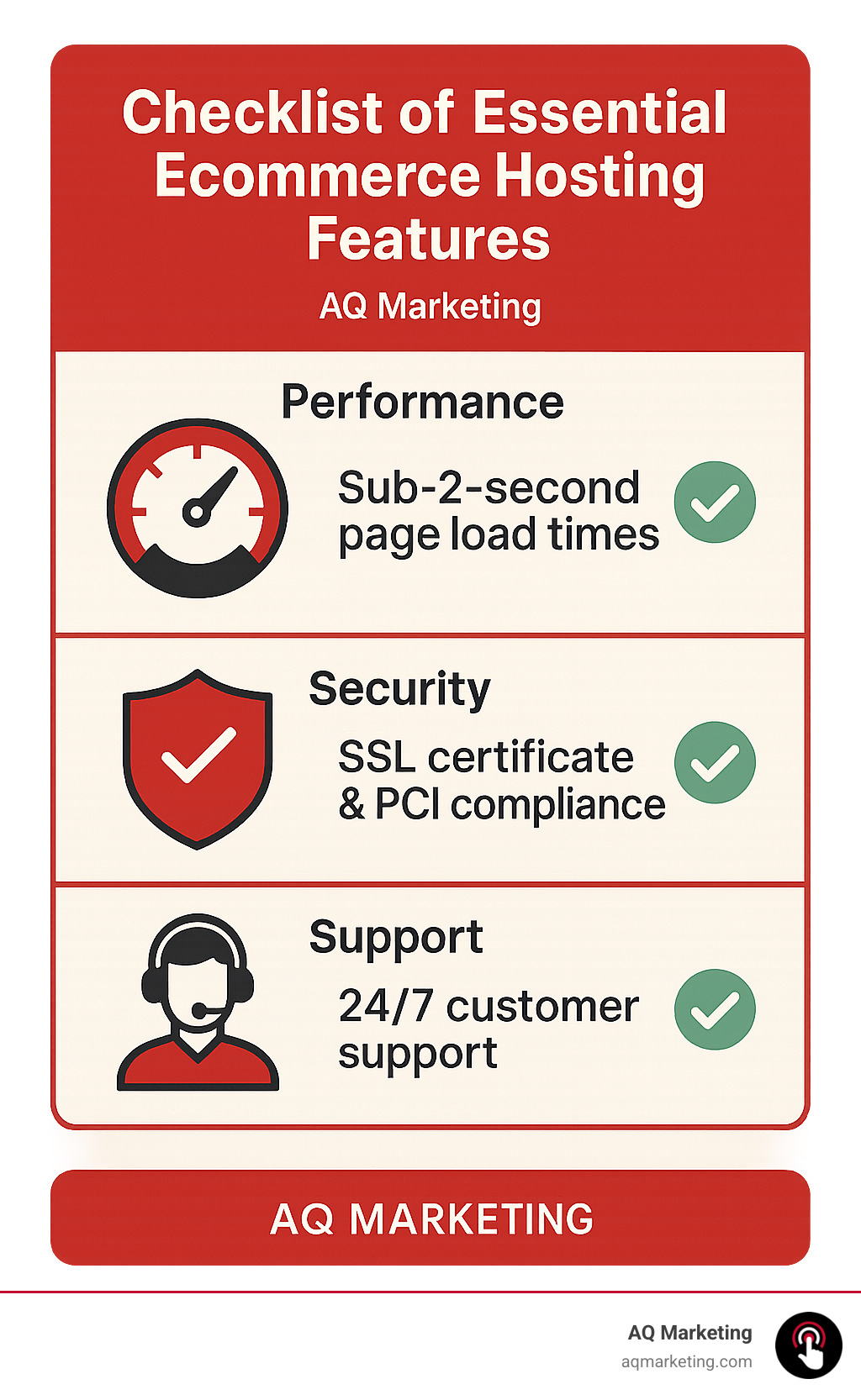
When evaluating hosting options, we prioritize lightning-fast load times (under 2 seconds), rock-solid uptime guarantees (minimum 99.9%), and comprehensive security features like SSL certificates and PCI compliance. We also look at scalability – can your hosting grow with you when that big promotion goes viral? And let’s not forget about support quality – because when things go wrong at 2 AM, you need real humans who know what they’re doing.
The best part? We consider the total cost of ownership, not just the sticker price. Those “too good to be true” $3.99/month hosting plans often end up costing you thousands in lost sales due to poor performance.
Why speed & uptime matter for the best hosting for ecommerce
“But my site seems fast enough to me,” I hear store owners say all the time. Here’s the reality check: 47% of consumers expect pages to load in 2 seconds or less. And when they don’t? They leave – and they rarely come back.
The math is brutal but simple. A one-second delay reduces your conversions by 7%. For a store making $100,000 daily, that single second costs you $2.5 million in lost sales every year. And downtime? During peak holiday shopping, Amazon would lose over $220,000 for every minute their site is down.
I remember working with a boutique clothing store in Boston that was struggling with abandoned carts. Their site looked beautiful, but it was taking nearly 4 seconds to load on mobile. After moving them to properly optimized ecommerce hosting, their load times dropped below 2 seconds, and their conversion rate jumped by 22% almost overnight. As their owner told me, “I had no idea our hosting was costing us so much money.”
Core security checklist for the best hosting for ecommerce
Security isn’t just an IT concern – it’s a customer trust issue. Did you know that up to 90% of login attempts on ecommerce sites can be fraudulent? Or that nearly 1 in 5 shoppers will permanently abandon a retailer after a security breach?
Your best hosting for ecommerce solution must create a fortress around your store, with multiple layers of protection. This means proper SSL certificates that encrypt customer data, PCI DSS compliance for secure payment processing, and robust DDoS protection to keep your site online during attacks.
But security goes beyond just preventing breaches. Daily automated backups with one-click restore options can be a lifesaver when something goes wrong. Regular malware scanning, a web application firewall, and two-factor authentication round out the essential security package.
One of our clients in Merrimack Valley learned this lesson the hard way. After recovering from a security incident, they told me, “The outside world is scary when it comes to ecommerce security. Having proper hosting protection isn’t just nice to have—it saved our business.”
The right hosting isn’t just a technical foundation – it’s your competitive advantage in an increasingly crowded online marketplace.
More info about Web Hosting Services
#1 Managed WooCommerce Cloud Hosting
If you’re running a small to medium-sized business and want that sweet spot between having control and not needing a PhD in server management, Managed WooCommerce Cloud Hosting is our top recommendation for best hosting for ecommerce in 2025.
Think of it as having your cake and eating it too – you get all the flexibility of WordPress’s massive open-source ecosystem, but with hosting that’s specifically tuned to make your online store sing. In our years helping Massachusetts businesses grow online, we’ve seen how the right hosting can transform a struggling store into a conversion machine.
What makes these platforms special is their laser focus on ecommerce performance. Your store will benefit from NVMe SSD storage that loads pages up to 20 times faster than traditional hosting. When Black Friday hits and everyone rushes to your site at once, automatic scaling ensures your store stays up instead of crashing at the worst possible moment.
Peace of mind comes standard with daily automated backups that you can restore with a single click if something goes wrong. And my clients absolutely love having staging environments where they can test new designs or features before showing them to customers.
Why it’s a top pick for 2025
The beauty of Managed WooCommerce hosting is that you’re in the driver’s seat without needing to be a mechanic. You get complete control over your store’s SEO, design, and functionality without sacrificing performance.
I remember working with a small boutique in Essex County that was struggling with a rigid hosted platform. After switching to a Managed WooCommerce solution, the owner told me: “We finally feel like we own our business online. We increased our marketing efforts and integrated with several third-party tools that made our business and our customers happier. We’re breaking our own sales records month after month.”
The open-source foundation of WooCommerce means you truly own your data and can shape every aspect of your customer experience. You’ll have complete SEO control with direct access to your robots.txt, sitemaps, and meta fields – critical for ranking well for those competitive terms. You can create unlimited product options without hitting arbitrary limits on variants or attributes.
Want to reduce cart abandonment? Design custom checkout flows that convert better based on your specific customers’ needs. And unlike some platforms that charge extra fees for certain payment options, you can choose from dozens of payment gateways without paying a premium.
Perhaps most valuable is access to the entire WordPress plugin ecosystem – over 55,000 extensions that can add just about any functionality you can imagine to your store.
Ideal store size & budget
From our experience working with hundreds of online retailers across New England, Managed WooCommerce hosting works best for businesses with about 5-10,000 products and monthly traffic between 10,000-500,000 visitors. It’s particularly valuable for stores that need custom functionality or integrations that off-the-shelf solutions can’t provide.
You don’t need a massive IT department, but having someone comfortable with technology (or a digital agency partner like us) will help you make the most of the platform’s capabilities.
The pricing is refreshingly straightforward, typically ranging from $15-150 per month depending on your traffic and storage needs. When you consider the total cost of ownership compared to more expensive enterprise solutions, it’s one of the most cost-effective best hosting for ecommerce options available.
A retailer in Middlesex County shared with me: “After switching from a shared hosting environment to managed WooCommerce hosting, our page load times dropped from 4.3 seconds to 1.2 seconds, and our conversion rate jumped by 23%. The hosting practically paid for itself in the first month.”
More info about Best Web Hosting Platforms
#2 All-in-One SaaS Ecommerce Platforms

When you’re eager to start selling online without wrestling with technical details, SaaS (Software-as-a-Service) ecommerce platforms are like finding the express lane to launching your business. These all-in-one solutions wrap everything you need – storefront, inventory management, payment processing, and hosting – into one tidy monthly package.
I’ve helped dozens of Massachusetts entrepreneurs get up and running with these platforms, and they consistently deliver impressive results for the right type of business. The infrastructure behind these solutions is seriously robust, offering 99.99% uptime backed by enterprise-grade systems that rarely hiccup. Your store’s content gets distributed through global CDNs (Content Delivery Networks), meaning your pages load quickly whether your customer is in Boston or Bangkok.
The beauty of these platforms is what you don’t have to do – there’s no server management to worry about, automatic updates happen behind the scenes, and payment processing is pre-integrated and ready to go. Most platforms also offer multi-channel selling capabilities, letting you connect your store to Facebook, Instagram, and marketplaces like Amazon with just a few clicks.
Pros & cons for the best hosting for ecommerce beginners
The advantages for newcomers to online selling are substantial. I remember helping a nervous client in Woburn set up her first store – she was amazed when we had her up and running in under 15 minutes. “I thought this would take weeks!” she laughed as we uploaded her first products.
These platforms truly shine if you’re not technically inclined. Their user-friendly interfaces are designed specifically for non-developers, with drag-and-drop tools that make store design feel more like playing with building blocks than coding a website. The all-inclusive nature means you’re not piecing together different services – everything works harmoniously out of the box.
From a business planning perspective, the predictable monthly costs help you budget without surprises. As one Southern New Hampshire client told me, “I love knowing exactly what I’ll pay each month – no sudden server upgrades or technical emergencies to blow my budget.”
But it’s not all roses. Most platforms charge transaction fees (typically 0.5-2%) on top of your regular payment processing fees. Over time, this can add up, especially as your sales volume grows. You’ll also bump into customization limitations – while you can make your store look nice, truly unique functionality often requires workarounds or isn’t possible at all.
The SEO restrictions can frustrate more experienced marketers who want granular control over technical elements like robots.txt or custom URL structures. And while the monthly fees seem reasonable at first, the long-term costs typically exceed what you’d pay for self-hosted solutions if you’re in business for many years.
Perhaps most concerning is the potential for platform lock-in – moving your store elsewhere can be challenging once you’re established, as one client finded after building a 5,000-product catalog on a SaaS platform.
Best-fit scenarios
After helping dozens of businesses choose the right best hosting for ecommerce solution, I’ve found SaaS platforms are perfect matches for specific scenarios.
They’re ideal if you’re a first-time store owner who breaks into a cold sweat at the mention of PHP or server configurations. They’re also fantastic for dropshipping businesses where speed-to-market matters more than deep customization.
Businesses with small, straightforward catalogs tend to be happiest with these platforms. A Boston boutique owner I work with puts it perfectly: “With just six products in different sizes and colors, this platform gives me everything I need without overwhelming me with features I’ll never use.”
If you’re prioritizing speed-to-market over ultimate flexibility, or you simply don’t have technical staff on your team, the built-in support and reliability of SaaS platforms can be a lifesaver.
Monthly costs typically range from $29 for basic plans to $299 for advanced features, scaling with your sales volume. For many businesses, especially those just starting out, this represents the best hosting for ecommerce value in 2025 – combining simplicity, reliability, and professional features without requiring technical expertise.
#3 Scalable Cloud VPS Solutions
For growing mid-sized ecommerce businesses, there’s a sweet spot between basic shared hosting and expensive dedicated servers. That sweet spot? Cloud VPS hosting – the Goldilocks solution that’s “just right” for stores experiencing consistent growth or dealing with those nail-biting seasonal traffic surges.
Think of cloud VPS solutions as your store’s elastic waistband during Thanksgiving dinner – they automatically expand when you need more room! These virtual private servers give your store its own dedicated resources that scale on demand, with some impressive benefits:
Elastic resources flex with your traffic, so whether it’s a random Tuesday or Black Friday madness, your store stays lightning fast. The container technology keeps your store in its own protected environment, away from noisy neighbor sites. With edge caching serving your content from over 200 global locations, customers see your products quickly no matter where they shop from.
One of our Woburn retailers shared this win: “During Black Friday, our traffic shot up 800%, but our site kept humming along with 1.2-second load times thanks to those auto-scaling cloud resources. Our old hosting would have collapsed under that pressure!”
The NVMe storage these solutions offer isn’t just marginally better – it’s up to 10 times faster than traditional SSDs. And with pay-as-you-grow pricing, you’re only paying for what you actually use, rather than overprovisioning “just in case.”
Perhaps best of all, you get root access for complete server control and dedicated resources that aren’t shared with other stores. No more competing for server attention like siblings fighting over the last cookie!
When to upgrade from shared to VPS
You’ll know it’s time to make the leap to cloud VPS when certain signs start appearing. If your store regularly sees more than 20,000 monthly visitors or your page load times creep beyond 3 seconds during busy periods, that’s your cue.
Similarly, if you need custom server configurations or specialized software that shared hosting won’t allow, it’s time to upgrade. Many of our Boston-area clients make the switch when they notice conversion rates dropping during high-traffic periods – a clear signal that performance issues are costing real money.
A store expanding beyond 1,000 products or requiring advanced caching solutions will also benefit from the move. As one client told us after leaving their SaaS platform: “We moved to a cloud VPS because our products varied in size and Shopify’s shipping calculation couldn’t handle it. The flexibility we gained was game-changing, without sacrificing a bit of performance.”
Performance & cost snapshot
For a typical mid-sized ecommerce store, here’s what you can expect from a quality cloud VPS solution:
You’ll typically need 4-8 GB of RAM that scales automatically during traffic spikes, paired with 150-250 GB of NVMe SSD storage. Most providers offer 3-5 TB monthly bandwidth (often unmetered), and you’ll want 10-20 PHP workers to handle multiple shoppers browsing simultaneously.
Cost-wise, expect to invest between $30-150 per month depending on your resource needs. The performance payoff? Lighthouse scores of 90+ on desktop and 60+ on mobile – technical metrics that translate directly to better customer experiences.
The return on investment makes a compelling case: One of our Boston clients pays $99 monthly for cloud VPS hosting that handles up to 20,000 monthly visitors with sub-2-second load times. The result? A 17% increase in conversion rate compared to their previous shared hosting – far more than covering the additional hosting cost.
When you consider that even brief downtime can cost thousands in lost sales, investing in the right level of hosting becomes less of an expense and more of a business-critical decision.
Scientific research on downtime cost
#4 Dedicated Enterprise Servers

When your online store reaches the big leagues—processing millions in annual sales—it’s time to consider the Rolls-Royce of ecommerce hosting: dedicated servers. Think of it as having your own private highway instead of sharing the road with everyone else.
At AQ Marketing, we’ve seen how dedicated servers transform the performance of high-volume stores across Massachusetts. One Newburyport client told me, “It’s like night and day compared to our old shared hosting—we finally sleep well during sales events!”
What makes dedicated servers the best hosting for ecommerce at the enterprise level? You’re getting an entire physical server all to yourself. No neighbors, no resource competition—just raw power configured exactly for your needs.
These enterprise powerhouses offer complete resource isolation, letting you customize everything from CPU and RAM to storage configurations. You’ll benefit from SOC 2 compliance, advanced load balancing across multiple servers, and blazing-fast NVMe storage arrays that make database operations practically instantaneous.
Many of our larger clients particularly value the dedicated IP addresses (which significantly improve email deliverability) and GPU acceleration options for stores with extensive product imagery or AI-powered recommendation engines.
Enterprise-grade security & compliance
For large ecommerce operations—especially those selling products in regulated industries like healthcare or financial services—security isn’t just a feature, it’s an existential necessity.
I remember when a new client came to us after experiencing a data breach with their previous host. “We lost nearly 20% of our customers overnight,” the Essex County healthcare products retailer explained. “It wasn’t just the immediate revenue hit—it was the damage to our brand reputation that really hurt.”
Enterprise-grade dedicated hosting wraps your store in multiple layers of protection. You’ll get PCI DSS Level 1 compliance (the highest standard for payment processing) and SOC 2 Type II certification that independently verifies your security controls.
Most dedicated solutions include custom-configured web application firewalls that learn your traffic patterns, enterprise-grade DDoS mitigation to handle large-scale attacks, and daily off-site backups stored in multiple redundant locations. The real difference-maker, though, is having actual human security experts monitoring your store 24/7, ready to respond to threats in real-time.
Handling Black-Friday-level traffic
The true test of any ecommerce hosting isn’t during normal operations—it’s what happens when everyone rushes your store at once.
“One minute of downtime during our annual sale would cost us over $15,000,” shared a luxury retailer from Woburn. “Our dedicated server setup handled a 2,300% traffic spike with zero performance degradation, maintaining sub-second load times throughout.”
What makes this possible? Dedicated servers designed for high-traffic events feature sophisticated auto-failover systems that instantly switch to backup servers if any issues occur. You’ll also benefit from zero-downtime deployments (update your store without interruption) and horizontal scaling that adds server capacity instantly when traffic surges.
Behind the scenes, database replication distributes load across multiple servers while multi-layered caching strategies maximize performance. And unlike lower-tier hosting, you’ll have actual technical teams watching your server performance 24/7, ready to address issues before they impact customers.
For high-volume stores processing over $1M annually, dedicated servers typically range from $200-1,000/month. Yes, that’s substantially more than shared hosting, but the math makes sense—even a small improvement in conversion rates or preventing a single hour of downtime during a major sale can pay for an entire year of hosting.
When your online store becomes mission-critical to your business, dedicated servers offer the peace of mind that comes from knowing your hosting can handle whatever your marketing team throws at it.
#5 Headless & Composable Commerce Hosting
For cutting-edge ecommerce brands focused on delivering exceptional customer experiences across multiple touchpoints, headless commerce hosting represents the future of best hosting for ecommerce in 2025.
This architecture separates (decouples) the frontend presentation layer from the backend ecommerce functionality, allowing for ultimate flexibility in how and where your products are displayed and sold.
Imagine being able to sell your products anywhere – not just on your website, but through mobile apps, smart mirrors, voice assistants, and whatever new technology emerges next year. That’s the power of headless commerce.
The technology behind this approach is pretty impressive. You’ve got API-first architecture connecting any frontend to your commerce engine, JAMstack technology generating static sites for lightning-fast performance, and microservices design with modular components that can be independently scaled. Plus, there’s support for Progressive Web Apps giving app-like experiences on mobile, omnichannel capabilities ensuring consistent shopping across devices, seamless content and commerce integration, and global CDN distribution delivering sub-second page loads worldwide.
Why headless is trending in the best hosting for ecommerce 2025
The shift toward headless commerce isn’t just a tech fad – it’s driven by real business advantages that forward-thinking retailers are already capitalizing on.
Performance is perhaps the most immediate benefit. With static site generation, pages load in milliseconds rather than seconds. This speed difference isn’t just a nice-to-have; it directly impacts your bottom line.
The flexibility is where things get really exciting. One innovative Boston retailer told us: “Since our launch on a headless platform in 2023, we’ve evolved from a single-product, single-channel business to a multi-product, multi-channel operation. Our previous platform simply couldn’t handle those changes.”
Another client shared their experience: “Within eight months of switching to headless architecture, we launched 10 stores across 15 different markets. The flexibility is best.”
This future-proofing aspect is crucial. When a new sales channel emerges (remember how quickly TikTok Shop became a thing?), headless architecture lets you add it without rebuilding your entire platform. Your content team will also love the ability to blend editorial content with shopping experiences seamlessly.
Is headless right for you?
Headless commerce isn’t for everyone – it’s a bit like driving a high-performance sports car. Amazing capabilities, but requires more skill and investment to operate.
You might be a perfect candidate for headless if you run a content-rich store blending editorial and product experiences. Think of fashion retailers who need to tell stories around their collections, not just list products.
Multi-channel retailers selling across websites, apps, and marketplaces will find headless particularly valuable, as will international brands requiring localized experiences. High-traffic stores needing maximum performance and innovation-focused companies wanting cutting-edge customer experiences are also ideal fits.
However, be aware of what you’re signing up for. Headless typically requires larger development resources (either in-house or agency partners), a higher initial investment (starting at $100-500/month plus development costs), technical expertise for managing the decoupled architecture, and longer implementation times (typically 1-3 months versus days for all-in-one platforms).
A digital director at one of our Middlesex County clients put it perfectly: “Headless commerce isn’t for everyone, but for our content-heavy, multi-market business, it’s been transformative. We’ve increased marketing efficiency and seen a ton of integrations with partners that have made our business and customers happier.”
At AQ Marketing, we’ve helped several forward-thinking Massachusetts businesses make the transition to headless commerce. While it requires more upfront investment, the long-term flexibility and performance gains have consistently delivered impressive returns for the right type of business.
Frequently Asked Questions about Ecommerce Hosting
What differs between regular and ecommerce hosting?
If you’ve ever wondered why you can’t just use any old hosting for your online store, you’re not alone. The difference is actually quite significant – and could be the factor that determines your success.
Regular web hosting is essentially a plot of digital land where your website lives. But best hosting for ecommerce is more like a fully-equipped retail space with all the specialized tools you need to run a successful online store.
Standard hosting lacks the muscle and security features that online stores require. Ecommerce hosting includes critical elements like PCI DSS compliance for secure payment processing, dedicated firewalls to protect customer data, and specialized database configurations that keep your product catalog running smoothly even during sales events.
As one of our Massachusetts clients put it after upgrading: “Regular hosting is like renting an empty retail space, while ecommerce hosting is like moving into a fully-equipped store with security, payment systems, and inventory management already installed.”
The specialized caching alone is worth the investment – regular hosting might cache your entire site, including shopping carts (yikes!), while ecommerce hosting intelligently excludes dynamic elements like carts and checkout pages.
How much should I budget for ecommerce hosting in 2025?
When it comes to hosting costs, I always tell our clients in Woburn and beyond that it should scale proportionally with your business. Think of it as an investment rather than an expense.
For startups and small stores making under $10,000 monthly, you can expect to pay between $15-50 monthly for managed WooCommerce hosting or $29-79 for SaaS platforms like Shopify. At this stage, allocating 2-5% of your revenue toward hosting and related services is reasonable.
As your business grows to the $10,000-$100,000 monthly revenue range, consider upgrading to Cloud VPS ($50-150/month) or advanced managed hosting ($100-300/month). Your hosting budget should now represent about 1-3% of revenue.
Enterprise-level operations bringing in over $100,000 monthly should look at dedicated servers ($300-1,000+/month) or headless commerce solutions ($500-2,000+/month), typically allocating just 0.5-1% of revenue.
I’ll never forget what happened to one of our local Woburn retailers: “We initially chose the cheapest hosting option and lost thousands in sales during our first promotion when the site crashed. Upgrading to proper ecommerce hosting paid for itself in the first week.”
The best hosting for ecommerce is rarely the cheapest option – but it’s almost always the most cost-effective when you consider the impact on your sales and customer experience.
How hard is it to migrate my existing store?
Store migration is one of those things that sounds scarier than it usually is – especially if you choose the right partner. The complexity really depends on your current setup and where you’re headed.
Simple migrations typically take just 1-3 days and include scenarios like upgrading from shared to managed WooCommerce hosting or moving between similar platforms. Many hosts (the good ones, anyway) offer free migration services that make this process nearly painless.
Moderate migrations might take 1-2 weeks and involve moving between different ecommerce platforms or switching from shared hosting to cloud VPS. This is typical for stores with fewer than 5,000 products and straightforward customizations.
Complex migrations can stretch to 2-8 weeks, particularly when moving from SaaS platforms to self-hosted solutions or transitioning to headless architecture. Large product catalogs with complex relationships or custom checkout processes also add time to the process.
One of our clients in Southern New Hampshire was initially terrified about moving their 3,000-product store. Their experience? “Our new host handled the entire migration with zero downtime. They even identified and fixed problems from our old setup that we didn’t know existed!”
At AQ Marketing, we’ve guided dozens of businesses across Massachusetts and New Hampshire through smooth migrations, often completing the process over a weekend to minimize sales disruption. The key is proper planning and working with people who’ve done it many times before.
More info about website services
Conclusion
Choosing the best hosting for ecommerce isn’t just a technical decision—it’s a business strategy that directly impacts your bottom line. After helping hundreds of Massachusetts and New Hampshire businesses find their perfect hosting solution, we’ve seen how the right choice can transform an online store’s performance.
Think of your hosting as the foundation of your digital storefront. Just as you wouldn’t build a brick-and-mortar shop on shaky ground, you shouldn’t build your online business on subpar hosting. The few extra dollars per month for quality hosting could mean thousands in additional revenue through better conversions, higher uptime, and happier customers.
Based on our extensive experience working with businesses throughout New England, here’s what we recommend:
For maximum control and flexibility, Managed WooCommerce hosting gives you complete ownership of your store while handling the technical heavy lifting. One of our Salem clients switched to this option and saw their page speed cut in half while gaining the ability to customize every aspect of their customer journey.
For beginners and ease of use, SaaS ecommerce platforms offer the quickest path to market. As a Boston boutique owner told us, “I went from idea to selling in a weekend—no technical headaches, just focusing on my products and customers.”
For growing mid-sized stores, Cloud VPS hosting provides that perfect balance of performance and cost. When your traffic starts hitting 20,000+ monthly visitors, this upgrade can prevent the dreaded site crashes during your biggest sales opportunities.
For high-volume enterprise needs, dedicated servers deliver the peace of mind that comes with knowing your site can handle anything—from flash sales to Black Friday surges—without breaking a sweat. As one of our high-end clients put it, “Our dedicated server paid for itself in the first hour of our holiday sale.”
For omnichannel and content-rich experiences, headless commerce hosting open ups possibilities that traditional setups simply can’t match. While it requires more technical resources, the flexibility to create truly unique customer experiences across multiple touchpoints can be game-changing for innovative brands.
Your hosting needs will evolve as your business grows. What works perfectly at $10,000 monthly revenue might become a limitation at $100,000. The good news is that with proper planning and expert guidance, migrations can be smooth and minimize disruption to your business.
At AQ Marketing, we’ve been helping businesses across Woburn, Boston, and Southern New Hampshire optimize their ecommerce hosting since 2003. Our team specializes in finding that sweet spot between performance, security, and cost-effectiveness for your specific business needs.
Ready to upgrade your ecommerce hosting or launch a new online store? Contact our team for a personalized recommendation based on your specific business requirements.

