

Average marketing agency budget for small businesses
Decoding Marketing Agency Costs for Your Business
Every small business owner asks: What is the average marketing agency budget for small businesses? It’s a critical decision, balancing real impact with your means. The good news is, there are clear benchmarks to guide you.
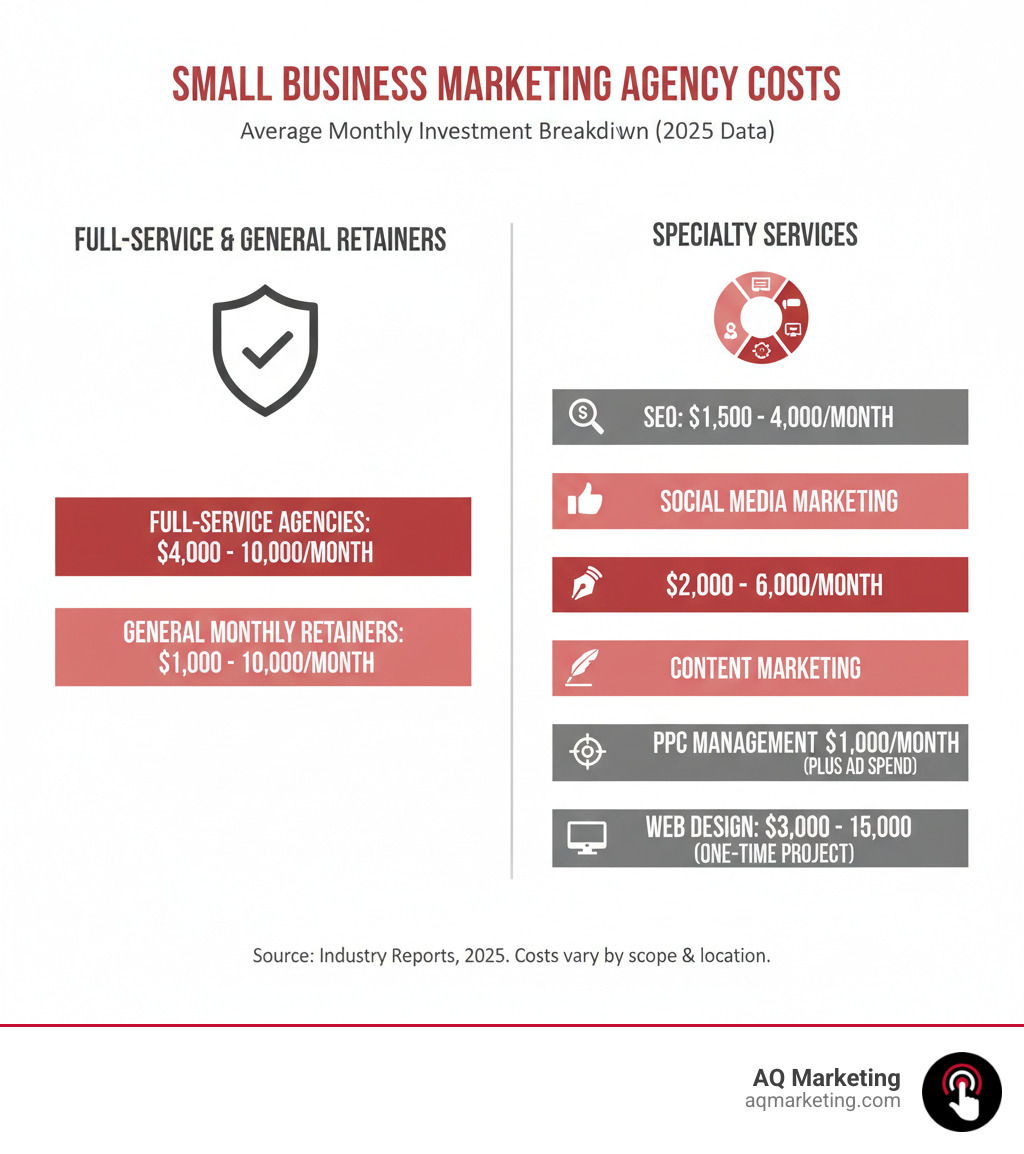
While there’s no single “magic number,” small businesses typically invest the following with marketing agencies:
- Full-Service Marketing Agencies: $4,000 – $10,000 per month
- Monthly Retainers (General Services): $1,000 – $10,000 per month
- Specialty Services (SEO, Social Media, PPC): $1,000 – $6,000 per month
- Web Design: $3,000 – $15,000 (one-time project fee)
Marketing is an investment in your business’s future. For businesses in Woburn, MA, across Middlesex County, or throughout Southern New Hampshire, understanding these costs helps you make informed choices to attract customers and drive growth. It’s about finding the right expertise to translate your goals into measurable results.
Robert P. Dickey, President and CEO of AQ Marketing, Inc., has over 20 years of experience helping small and medium-sized businesses steer the digital landscape, specializing in optimizing the average marketing agency budget for small businesses for maximum impact.
The Big Picture: What Do Small Businesses Typically Spend on Marketing?
To understand the average marketing agency budget for small businesses, it helps to first look at overall marketing spending. This bigger picture clarifies how much of your total budget might go toward an agency.
Most small businesses allocate between 7% and 8% of their gross revenue for marketing, according to the U.S. Small Business Administration. For startups or businesses in growth mode in competitive markets like Boston, this can climb to 10-12%, or even 20% in the first year to build brand awareness. For example, a business in Essex County with $500,000 in revenue might budget $35,000-$40,000 annually. A 2022 CMO Survey found marketing expenses averaged 13.8% of overall business spending, with the average percentage of revenue spent on marketing at 8.7%.
Today, over half of small business marketing dollars go to digital channels like social media, search engine ads, and email marketing, a trend that continues to accelerate.

What Percentage of Revenue Should a Small Business Allocate to Marketing?
While there’s no universal answer, experts suggest small businesses allocate between 5% and 10% of their revenue for marketing. The U.S. Small Business Administration specifically recommends 7-8% for most small businesses. However, startups pushing for rapid growth should aim for 10-12% of gross revenue to build initial brand awareness and capture market share.
Your business type also matters. B2C (Business-to-Consumer) companies often have higher marketing costs (around 9.6% of revenue) to reach a wider audience. B2B (Business-to-Business) companies have more targeted audiences and may spend less (around 6.6% of revenue). According to The CMO Survey data on marketing expenses, the average across all companies is 8.7%. Your specific goals will ultimately determine the right percentage for your business.
How Marketing Budgets Vary by Industry and Business Stage
Marketing budgets vary significantly by industry and business stage. Home Services businesses in Essex County might aim for 7-10% of revenue, focusing on local SEO. Professional Services firms in Boston might allocate 6-8%, emphasizing content that builds trust. Retail and Consumer Services in the busy Merrimack Valley often require higher spending, typically 10-12%.
Tech Startups emerging from Boston’s innovation scene often need to spend more, with some allocating up to 20% of their revenue in their first year to carve out a space in a crowded market, as noted by Forbes on Startup Marketing Budgets. Businesses in the Startup/Growth Phase must invest more upfront to build awareness, while those in the Established/Maintenance Phase may shift focus to retention. If you’re in a Competitive Market, like a service provider in a busy part of Southern New Hampshire, you’ll generally need to allocate more to stand out.
What is the Average Marketing Agency Budget for Small Businesses?
So, what is the average marketing agency budget for small businesses? For business owners in Woburn, Boston, and across Southern New Hampshire, this is a key question. Hiring an agency means investing in specialized skills, powerful tools, and a team dedicated to growing your brand.
For many small businesses, a full-service marketing agency typically costs between $4,000 to $10,000 per month. This partnership includes a wide array of services, from strategy to campaign execution. General marketing monthly retainers can range from $1,000 to $10,000, depending on the scope of work.
Many businesses start with specialized agencies that focus on one or two key areas. It’s also important to budget for potential hidden costs, such as ad spend, software subscriptions, or professional content creation. We believe in being upfront about all potential expenses so there are no surprises. Understanding these costs and the various pricing models helps set clear expectations.
Typical Costs for Specific Agency Services
Here are the average costs for individual marketing services. Prices can vary based on agency experience, location, and project complexity.
- SEO Services: A long-term investment to improve search rankings. Costs typically range from $1,500 to $4,000 per month. In competitive industries, this could increase. Our team offers comprehensive More info about SEO services covering all aspects of search optimization.
- Social Media Management: To keep your social presence fresh and engaging. Expect costs from $2,000 to $5,000 per month for strategy, content creation, and community management. Learn more about our More info about social media services.
- PPC / Digital Advertising: For immediate visibility, agencies often charge a management fee of 15-20% of your ad spend, with monthly agency fees between $1,000 and $3,000. Your ad spend is an additional cost. Find out more about our More info about digital advertising services.
- Content Creation: The backbone of any marketing plan. Ongoing services can cost $2,000 to $6,000 per month for blog posts, videos, and other content.
- Web Design Projects: Your website is your digital storefront. A basic business website might cost $2,000-$8,000, while a more complex e-commerce site could be $5,000-$25,000 or more. Explore our More info about web design services to see how we build impactful online presences.
Understanding Agency Pricing Models
Marketing agencies use several pricing models. Choosing the right one depends on your budget and goals.
- Monthly Retainer Model: The most common model, where you pay a set monthly fee for ongoing services. Retainers for small businesses typically range from $1,000 to $10,000 per month. This provides predictable costs and fosters a long-term partnership.
- Project-Based Fees: For a single, defined task like a new website. Fees range from a few thousand to tens of thousands of dollars, depending on the project’s scope.
- Hourly Rates: Agencies may charge by the hour, often between $150 to $200 per hour. This works well for smaller, less defined tasks but requires careful scope management.
- Performance-Based Pricing: Agency payment is tied to hitting specific, measurable goals like leads or sales. This aligns the agency’s success with yours.
- Value-Based Pricing: Focuses on the overall business value the agency provides, rather than hours or services. It’s often used for high-level strategic consulting.
For most small businesses seeking steady growth, a monthly retainer is often the most effective choice, allowing for continuous strategy development and adaptation.
In-House vs. Agency vs. Freelancer: A Cost-Benefit Analysis
One of the most strategic decisions a small business owner faces is how to handle marketing: build an internal team, partner with an agency, or hire freelancers? Each path has different financial implications.
In-house teams offer control and cultural immersion but come with high costs beyond salary, including benefits, taxes, software, and training. For a small business in Southern New Hampshire or Woburn, a modest team can easily exceed $100,000 annually, and you’re limited by the skills of those you hire.
Marketing agencies provide a full team of specialists—strategists, SEO experts, content creators, and analysts—for a fraction of the cost of hiring them individually. For businesses in Middlesex and Essex Counties, this means access to advanced tools and strategies without the overhead. Monthly retainers of $1,000 to $10,000 often prove to be the most cost-effective option for comprehensive marketing.
Freelancers offer flexibility and specialized skills for specific projects at lower price points. However, managing multiple freelancers can be a logistical challenge for a business in the Merrimack Valley trying to maintain a cohesive brand voice, and they often lack a strategic overview.
Finally, the cost of DIY marketing is the valuable time you and your staff divert from core business operations. This hidden cost can be substantial.
Here’s a quick comparison to help you weigh your options:
| Feature | In-House Team | Marketing Agency | Freelancers |
|---|---|---|---|
| Costs | High (salaries, benefits, tools, training, overhead) | Medium to High (monthly retainers or project fees) | Low to Medium (hourly or project-based) |
| Expertise | Deep understanding of your business, but limited in breadth/specialization | Broad and deep expertise across various marketing disciplines, access to tools | Specialized expertise in a narrow field, varies by individual |
| Control | High (direct oversight, immediate response) | Medium (strategic partnership, regular reporting) | Medium (requires clear directives and management) |
| Scalability | Difficult and expensive to scale up or down quickly | Highly scalable (can add or remove services as needed) | Flexible (can hire multiple for different projects, but coordination needed) |
| Time Investment | Significant time for hiring, training, and management | Less time for management, more for collaboration and review | Significant time for finding, vetting, and managing multiple individuals |
| Tools & Tech | Must purchase and manage all software and subscriptions | Agency provides access to advanced tools | Often use their own tools, or you provide access |
| Pros | Dedicated, immersed in company culture, quick communication | Diverse expertise, cost-effective for full suite, objective perspective, saves time | Cost-effective for specific tasks, flexible, quick to onboard |
| Cons | Expensive, limited skills, high overhead, risk of burnout | Less direct control, may serve multiple clients, can be perceived as expensive | Lack of strategic overview, coordination challenges, inconsistent availability |
Calculating the True Cost of an In-House Marketing Team
When considering an in-house team, look beyond the base salary. In Massachusetts and Southern New Hampshire, a marketing manager’s salary of around $67,000 is just the start. Adding specialists like an SEO expert or content creator can add another $50,000-$100,000+ to your payroll. Then, add 25-40% on top of salaries for benefits and payroll taxes. Your team also needs tools and software, which can cost $500 to $2,000 per month. Factoring in training, development, and overhead, a single in-house marketing hire can easily cost a small business $60,000 to $150,000 annually. For businesses in Woburn or Essex County, this is a substantial commitment.
Determining the Average Marketing Agency Budget for Small Businesses in New England
When we discuss the average marketing agency budget for small businesses in our region, location matters. Marketing services in downtown Boston can cost 30-50% more than in Southern New Hampshire due to higher overhead. An agency in the Merrimack Valley might offer more competitive rates while delivering exceptional results.
The local talent pool also influences pricing. The Greater Boston area attracts top marketing talent, and agencies with specialists in competitive sectors like tech or healthcare often charge more for their sophisticated, data-driven strategies. For a home services business in Middlesex County or a professional practice in Woburn, this specialized knowledge can translate directly into better ROI.
What truly sets a local New England agency apart is regional expertise. We understand the nuances of marketing here—from local events in Woburn to the media outlets that reach homeowners in the Merrimack Valley. This local insight is a strategic advantage that makes every dollar of your marketing budget work harder.
How to Maximize Your Marketing Budget and ROI
Once you’ve set your average marketing agency budget for small businesses, the goal is to make every dollar count. For any business in Essex County or downtown Boston, this means ensuring each investment drives measurable results.
The foundation is setting clear, measurable goals. Are you aiming to increase website traffic by 20% or generate 50 qualified leads per quarter from the Merrimack Valley? Concrete targets allow us to design effective strategies and measure progress accurately.
Tracking the right metrics is crucial. We focus on numbers that impact your bottom line, such as Customer Acquisition Cost (CAC), Customer Lifetime Value (CLV), Return on Ad Spend (ROAS), and Cost Per Lead (CPL). A healthy business should see a CLV:CAC ratio of at least 3:1. These metrics guide our decisions on where to invest. You can see our principles in action in our marketing portfolio, showcasing results for New England businesses.
Not all channels deliver equal returns. Email marketing is a standout, with an average return of $36 for every $1 spent. Search engine optimization (SEO) and an optimized Google Business Profile also offer exceptional ROI by attracting high-intent organic traffic. We recommend investing 80% of your budget in these proven channels and reserving 20% for testing new strategies.
Leveraging Free and Low-Cost Marketing Channels
For small businesses, especially those in Southern New Hampshire or the competitive Boston market, free and low-cost channels can build a strong foundation. These strategies require more time than money but offer substantial returns.
- Google Business Profile: This free tool is essential for local businesses. An optimized profile helps you appear in local search and on Google Maps. We specialize in business profile management to make your listing stand out.
- Local SEO Tactics: Optimize your site with local keywords, build citations in local directories, and encourage online reviews. Free tools like Google Analytics can help you understand what customers in Middlesex County are searching for.
- Community Engagement: Sponsoring a local team, joining the Chamber of Commerce, or partnering with other businesses in the Merrimack Valley builds trust and generates word-of-mouth referrals.
- Social Media Organic Growth: Build a presence for free by consistently sharing valuable content on platforms where your audience spends time, like Facebook or LinkedIn.
- Email Marketing: With one of the best ROIs, email allows you to communicate directly with interested customers. Many platforms offer free tiers for small lists.
- Online Directories: Listing your business on Yelp and other industry-specific sites improves your online visibility and supports your SEO efforts.
How to Determine the Right Digital Marketing Budget for Your Goals
Determining the right budget is a strategic process. We advocate for goal-based budgeting; if you’re aiming to double your revenue, your marketing budget should reflect the investment needed to achieve that target, rather than being based on past performance.
Competitor analysis provides valuable context, revealing market standards and opportunities. Also, consider the cost of inaction—the potential revenue lost by under-investing in marketing often far exceeds the cost of a planned budget.
If you’re hesitant about a large commitment, starting with a pilot project is a smart way to test an agency’s effectiveness and see tangible results. Your budget should never be static. We believe in scaling your investment based on performance, reviewing results monthly and adjusting allocations quarterly to ensure your average marketing agency budget for small businesses is always optimized for maximum impact.
Conclusion: Making a Smart Investment in Your Business’s Growth
Navigating marketing costs is a clear path toward sustainable growth. We’ve learned that the average marketing agency budget for small businesses is a strategic investment, not a mystery. You might look at $4,000 to $10,000 per month for full-service solutions, with your ideal budget often falling between 5% and 10% of your revenue, adjusted for your industry, business stage, and growth goals.
When choosing between in-house, freelancers, or an agency, remember the true cost includes the value of specialized expertise, time saved, and the measurable ROI you gain. An agency brings a team of seasoned pros to your corner, armed with the latest tools and strategies—a true game-changer for your business.
At AQ Marketing, we understand the unique challenges and opportunities for businesses in our New England communities. Whether you’re a startup in Boston, an established provider in Woburn, MA, or growing across Middlesex County, Essex County, the Merrimack Valley, or Southern New Hampshire, our approach is focused on delivering long-term, impactful results.
Ready to clarify your marketing strategy and ensure every dollar works for your business’s future? Let’s chat. We’re here to help you map out how much to spend and where to invest for maximum impact. Get a custom marketing plan for your small business today, and let’s start building that growth together.
