

New business online platform 2025: Crucial Guide
Why Your New Business Needs the Right Online Foundation
A new business online platform is the digital foundation that allows you to sell products or services, manage operations, and connect with customers through the internet. With e-commerce sales expected to reach 25% of global retail by 2030 and over $6 trillion in sales recorded in 2024, choosing the right platform isn’t just about having a website—it’s about building a business that can compete and grow.
Quick Answer: What Makes a Strong New Business Online Platform?
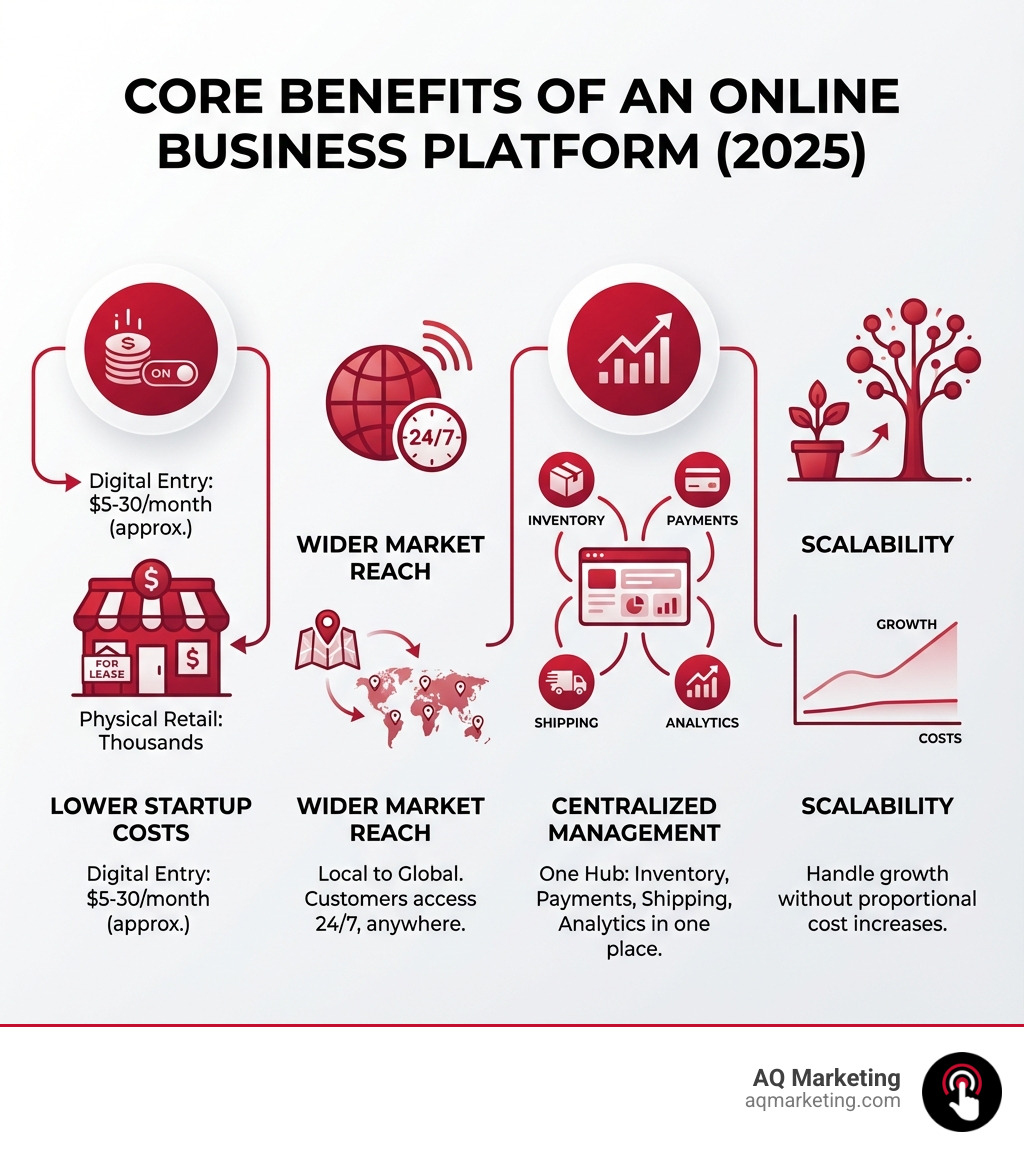
- Lower startup costs compared to brick-and-mortar stores (as low as $5-30/month for basic plans)
- Expanded market reach beyond your local area to regional, national, or global customers
- Built-in business tools for payments, inventory, shipping, and customer management
- 24/7 sales capability without needing physical staff
- Data and analytics to understand customer behavior and optimize your business
For businesses in Middlesex County, Essex County, and the Merrimack Valley, a strong online presence is no longer optional. It’s the primary way customers find you, research your services, and decide whether to buy. Whether you’re a home services provider in Woburn, an insurance agency in Boston, or a fitness studio in Southern New Hampshire, the platform you choose determines how easily you can attract customers, process transactions, and scale your business.
The challenge? There are dozens of platforms—from simple all-in-one builders like Shopify and Wix to powerful open-source solutions like WooCommerce and Magento. Each offers different features, pricing models, and levels of complexity. Some are perfect for beginners launching their first online store. Others are built for businesses planning to scale rapidly or sell across multiple channels.
I’m Robert P. Dickey, President and CEO of AQ Marketing, with over 20 years of experience helping small and medium-sized businesses build effective digital presences. Throughout my career, I’ve guided countless local businesses in selecting and optimizing the right new business online platform to match their goals, budget, and technical capabilities.
Key Features to Compare in a New Business Online Platform
When selecting a new business online platform, businesses from Southern New Hampshire to Boston must evaluate features that support both immediate needs and future growth. Think of it like choosing a storefront: you want it to look good, be easy for customers to steer, and have all the tools you need behind the counter.

Core Functionality and Ease of Use
The first impression of your online business often comes from its platform. It needs to be inviting and efficient, for both you and your customers.
- User-friendly interface: For most small business owners, especially those without a dedicated IT department, a drag-and-drop interface is a lifesaver. Platforms like Shopify and Wix are renowned for their intuitive dashboards, allowing us to build a professional-looking site without writing a single line of code. This means less time wrestling with technology and more time serving our customers in places like Woburn and Merrimack Valley.
- Customizable templates: Your brand is unique, and your online presence should reflect that. Look for platforms offering a variety of free and premium themes that can be customized to match your brand’s aesthetic. WooCommerce, for instance, boasts over 100 pre-built web themes, while Wix offers over 2,000 customizable templates. These allow businesses to create a distinct identity that resonates with their local audience.
- Mobile responsiveness: This isn’t just a “nice-to-have” anymore; it’s essential. Around 59% of web sales come from mobile devices. If your site isn’t perfectly optimized for smartphones, you’re losing sales. All reputable platforms ensure responsive design, adapting your site to any screen size, which is crucial for customers browsing on the go, whether they’re in Boston or a quiet town in Southern New Hampshire.
- Integrated payment processing: Seamless transactions are the backbone of any online business. Your chosen platform should offer integrated payment gateways that accept all major methods, often with lower transaction fees if you use their native processor. Square Online, for example, charges only 2.9% plus 30 cents per transaction with its free plan. It’s also vital to support multiple currencies if you plan to reach beyond Massachusetts or New Hampshire.
- Secure checkout (SSL): Trust is paramount in online commerce. A free SSL certificate, which encrypts customer data during transactions, is a non-negotiable feature offered by most platforms. This ensures that customers in Essex County and beyond feel safe making purchases from your site. Furthermore, platforms should adhere to PCI compliance standards for handling credit card information.
- Data privacy compliance: As we collect customer information, adhering to data privacy laws (like GDPR, if serving international customers, or state-specific regulations) is crucial. While platforms provide tools, we must ensure our privacy statements are clear and accessible. For more in-depth solutions, consider exploring options for web accessibility solutions.
Tools for Growth and Scalability
A great new business online platform doesn’t just get you started; it helps you grow. From your first sale in Middlesex County to expanding across New England, these features are your allies.
- Built-in SEO tools: How will customers find you amidst the vastness of the internet? Search Engine Optimization (SEO) is the answer. Platforms often include tools for keyword research, meta descriptions, alt text for images, and mobile optimization. Wix, for example, offers built-in SEO tools ideal for small businesses. For more advanced strategies, we encourage you to learn more about search engine optimization.
- Marketing integrations: Your online store shouldn’t be an island. It needs to connect with your marketing efforts. Look for platforms that integrate with email marketing services, social media channels, and advertising platforms. Shopify, with its App Store boasting over 16,000 third-party apps, provides extensive integration possibilities.
- Email marketing automation: This is a powerhouse for customer retention. Email marketing offers an impressive return on investment (ROI) of 36:1. Many platforms, like Shopify, include free email marketing software to help us send welcome series, abandoned cart reminders, and promotional campaigns that keep customers coming back.
- Customer analytics: “What gets measured gets managed,” as the saying goes. Analytics dashboards provided by your platform track sales trends, website traffic, and customer behavior. This data is invaluable for understanding what’s working and where we can improve, helping businesses in Boston make data-driven decisions.
- Inventory management: Keeping track of products is key, especially for e-commerce. Good platforms offer tools for tracking stock levels, managing product variants, and even syncing inventory across multiple sales channels. Square Online, for instance, seamlessly integrates with Square Point of Sale, allowing real-time inventory updates for both online and in-person sales.
- Scalability for traffic and sales volume: As your business grows, your platform needs to grow with it. Ensure the platform can handle increased website traffic and an expanding product catalog without performance issues. Platforms like Shopify and BigCommerce are designed to scale from small businesses to enterprise levels.
Cost Structure and Support
Cost is always a factor, but remember, the cheapest option isn’t always the best. We need to consider the total cost of ownership and the quality of support available. For deeper insights into crafting your online storefront, we also offer website design and development services.
- Pricing models: Platforms typically offer tiered subscription plans. Some, like Square Online and Big Cartel, have free tiers with limitations. Shopify plans range from $5 to $299 per month, while WooCommerce, as a WordPress plugin, is technically free but requires payment for WordPress hosting (typically $4 to $45 per month).
- Monthly fees: These are the regular subscription costs. Be sure to understand what each tier includes.
- Transaction fees: Beyond monthly fees, many platforms charge a percentage of each sale, plus a fixed fee. Shopify, for example, charges no transaction fees if you use Shopify Payments. Otherwise, fees can range from 1.5% to 3.5% per sale, plus $0.10 to $0.30.
- Hidden costs: Don’t forget potential costs for premium themes, essential apps, custom development, or advanced hosting (especially for open-source platforms). For WooCommerce users, the total platform and tech stack costs can sometimes be 32% higher than Shopify users due to these add-ons.
- Customer support availability: When things go wrong (and sometimes they do!), reliable support is a lifeline. Look for 24/7 customer support, especially for mission-critical e-commerce operations. Shopify is known for its round-the-clock support.
- Technical assistance: Some platforms offer dedicated customer success managers or specialists who can assist with specific design, setup, or SEO needs. Open-source platforms often rely on community forums or require hiring developers for technical issues.
Comparing Platform Types for Your Business Model
The digital landscape offers a diverse range of platforms, each suited to different business needs. The best platform for a Merrimack Valley service business differs from an Essex County e-commerce brand. Understanding the main types is crucial.

All-in-One Website Builders
Think of these as the “easy button” for getting online. They are ideal for many small businesses across Massachusetts and New Hampshire.
- Best for beginners: Platforms like Shopify, Wix, and Square Online are designed for ease of use. They feature drag-and-drop editors and intuitive interfaces, meaning you don’t need coding skills to get started. A basic store can be launched in as little as 1-2 weeks.
- Hosted solutions: The platform handles all the technical backend stuff—hosting, security, maintenance, and updates. This frees us from worrying about server management or security patches, letting us focus on selling our products or services.
- Limited customization: While templates are customizable, there are often boundaries. If you have highly unique functional requirements, you might hit a wall. For many small businesses, however, the available customization is more than sufficient.
- Ideal for simple e-commerce or service sites: These platforms excel at straightforward online stores, appointment booking for service businesses, or even single ordering pages for restaurants. Square Online is particularly strong for businesses that also have a physical presence, allowing seamless integration with their POS system.
- Predictable monthly costs: Pricing is typically subscription-based, with clear tiers. This makes budgeting easy, as most essential features are included.
Open-Source Platforms
For those who want ultimate control and don’t mind getting their hands a little dirty (or hiring someone who does!), open-source offers unparalleled flexibility.
- Maximum flexibility: Platforms like WooCommerce (a plugin for WordPress) and OpenCart provide the source code, meaning there’s “no ceiling to what you can do, customize, or create.” This allows for highly custom online experiences. In fact, 31% of the top 1 million e-commerce sites use WooCommerce, and 43% of the internet runs on WordPress.
- Self-hosted: Unlike all-in-one builders, you’re responsible for securing your own web hosting. This gives you more control over server performance and data, but also adds a layer of management.
- Requires technical knowledge: While WooCommerce has made strides in user-friendliness, truly leveraging open-source platforms often requires some technical expertise or the hiring of developers. OpenCart, for example, notes that a “fair amount of technical knowledge” is needed.
- Full ownership of data: You own and control all your data and the software itself, which can be a significant advantage for businesses with strict data governance requirements or those planning complex integrations.
- Highly scalable: With the right hosting and development, open-source platforms can scale to handle immense traffic and product catalogs, making them suitable for businesses aiming for significant growth.
- Costs can vary based on hosting and development needs: While the software itself is often free, you’ll incur costs for hosting, premium themes, extensions, and potentially developer fees for custom work.
What to Look for in a New Business Online Platform for E-commerce
When your primary goal is selling products online, whether it’s artisanal crafts from Essex County or specialty foods from Southern New Hampshire, specific e-commerce features are paramount.
- Product management: Look for robust tools that allow you to easily list products, write SEO-friendly descriptions, upload multiple high-quality images and videos, manage variants (size, color), and organize items into categories and collections.
- Multi-channel selling (social media, marketplaces): The modern customer shops everywhere. Your platform should allow you to sync inventory and sell across your own website, social media channels (like Instagram or Facebook Shops), and major marketplaces (like Amazon or Etsy). Square Online excels here, allowing you to create a shopping page directly from your Instagram feed.
- Shipping integrations: Seamless fulfillment is critical. The platform should offer tools to set up shipping rates, print labels, integrate with major carriers, and manage various delivery options like local pickup (great for Boston businesses!) or even local delivery.
- Abandoned cart recovery: Many potential customers add items to their cart but don’t complete the purchase. Features that automatically send reminder emails can significantly boost your conversion rate.
- Customer accounts: Allowing customers to create accounts can improve their shopping experience, simplify repeat purchases, and help you build loyalty programs.
Here’s a quick comparison of All-in-One vs. Open-Source platforms for e-commerce:
| Feature | All-in-One Platforms (e.g., Shopify, Wix, Square Online) | Open-Source Platforms (e.g., WooCommerce, OpenCart) |
|---|---|---|
| Ease of Use | High (drag-and-drop, no coding) | Low to Moderate (requires technical knowledge) |
| Customization | Limited (template-based) | High (full code access) |
| Cost | Predictable monthly subscriptions + transaction fees | Variable (hosting, development, extensions) |
| Technical Skills | Low | High (or need to hire developers) |
| Ownership | Platform-owned (you rent the service) | Full (you own the software and data) |
| Scalability | Good (built-in infrastructure) | Excellent (with proper hosting and development) |
| Security | Included and managed by platform | Self-managed (your responsibility) |
| Maintenance | Included and managed by platform | Self-managed (your responsibility) |
Future-Proofing: Trends and the Business Lifecycle
Technology evolves quickly, and the online marketplace is no exception. Choosing a new business online platform that accepts innovation ensures your business stays competitive and relevant for customers in places like Middlesex County and Southern New Hampshire.
Emerging Trends in Online Platforms
Staying ahead of the curve means embracing new technologies that improve customer experience and streamline operations.
- AI-powered tools: Artificial intelligence is rapidly integrating into online platforms. We’re seeing AI used for content generation (like writing product descriptions), media editing (optimizing product photos), and even personalized product recommendations. Shopify’s AI tools, for instance, can help streamline content creation and store design.
- Voice commerce readiness: Imagine customers in Boston ordering your products simply by speaking to their smart devices. Voice commerce allows for hands-free interaction, and platforms are starting to build in the necessary integrations.
- Augmented Reality (AR) for product visualization: AR allows customers to virtually “try on” products or place furniture in their homes using their smartphone cameras. This immersive experience can significantly reduce returns and boost confidence in online purchases.
- Omnichannel experience: This is about creating a seamless customer journey across all touchpoints—your website, physical store, social media, and even pop-up shops in Merrimack Valley. Platforms are evolving to unify these channels, offering centralized control over inventory, sales, and customer data. Shopify POS, for example, helps businesses like Francis Henri (a baby boutique) optimize inventory management across their e-commerce site and retail shop. For improved customer engagement across these channels, consider integrated website chat services.
Scaling Your New Business Online Platform for Growth
Every business owner dreams of growth, and your new business online platform should be ready for it. From a local startup in Woburn to a regional powerhouse, scaling involves more than just adding products.
- From startup to enterprise: Some platforms offer specific tiers for larger businesses, like Shopify Plus, which provides advanced customization and dedicated support. These enterprise-level solutions are designed to handle high transaction volumes and complex operations.
- Handling increased traffic: As your marketing efforts pay off, your website traffic will surge. Your platform needs robust infrastructure to prevent downtime and maintain fast loading speeds, which are crucial for customer satisfaction and SEO. Square’s free web hosting, for instance, is designed for exceptional speed and performance.
- Expanding product lines: As you diversify your offerings, the platform’s ability to manage a growing product catalog, categories, and inventory efficiently becomes critical.
- Once your business is established, you may need to register it with the government. This ensures legal compliance as you grow and potentially hire employees, a common step for successful businesses in Essex County and beyond.
The Endgame: Platforms for Buying and Selling Businesses
While we’re busy building our businesses, it’s also worth noting that online platforms have created a vibrant marketplace for buying and selling established digital assets. This is a testament to the value a well-built online business can accrue.
- Marketplaces for established businesses: Platforms like Empire Flippers specialize in connecting buyers and sellers of profitable online businesses, including SaaS, e-commerce stores, agencies, and content sites. They report over $560 million worth of online businesses bought and sold, with over 2,542 entrepreneurs having successfully exited their ventures.
- Business valuation tools: These marketplaces often provide tools to help you understand the potential worth of your online business, considering factors like revenue, profit, and growth potential. Empire Flippers offers a free valuation tool.
- Due diligence process: For buyers, these platforms facilitate thorough due diligence, providing access to real data like Google Analytics and Profit & Loss statements, ensuring transparency in the transaction.
- Facilitating transactions: They often handle the complex aspects of the sale, from NDAs and buyer vetting to the actual migration of the business assets, making the process smoother for both parties. This allows entrepreneurs in Boston or Southern New Hampshire to focus on closing “life-changing deals.”
Frequently Asked Questions about Online Business Platforms
We know you’ve got questions, and we’ve got answers! Here are some of the most common inquiries we hear from new business owners in our local communities.
How long does it take to set up an online store?
The timeline can vary quite a bit, depending on your ambition and the platform you choose. A basic store can be launched in 1-2 weeks using a simple builder like Shopify or Square Online. These platforms, with their user-friendly interfaces and customizable templates, allow for a quick setup. However, a more customized site with unique features, especially if built on an open-source platform, can take 4-8 weeks or even longer, depending on the complexity of your product catalog and design needs. For a truly unique and robust online presence, investing more time upfront often pays dividends.
Do I need technical skills to use a new business online platform?
Not necessarily! This is one of the biggest misconceptions. Modern all-in-one website builders are specifically designed for users with no coding skills. They feature intuitive drag-and-drop editors that empower you to build and manage your site confidently. Platforms like Wix and Shopify are perfect examples of this.
However, if you opt for an open-source platform like WooCommerce, while the basics can be managed by a tech-savvy owner, maximizing its potential often requires a developer or a deeper understanding of web development. It’s a trade-off between ease of use and ultimate flexibility.
Can I switch platforms later?
Yes, migrating your business from one platform to another is generally possible. The ease of this process can range from a simple data export/import to a complex, manual transfer, depending on the platforms involved and the size of your store. Some platforms offer automated migration tools, while others may require third-party services or manual data handling.
While it’s good to know you have options, it’s always best to choose a scalable new business online platform from the start. Migrating can be time-consuming and potentially disruptive to your business, so making an informed decision upfront can save you headaches down the road.
Take Your Business From Local to Global
Choosing the right new business online platform is a foundational step that impacts everything from your brand identity to your long-term profitability. By evaluating features, scalability, and costs against your specific business goals, you can build a powerful online presence. For local businesses in Woburn, MA and the greater Boston area, making the right choice sets the stage for sustainable growth. We’ve seen how a well-chosen platform can transform a concept into a thriving online enterprise, reaching customers far beyond local borders.
Ready to build an online presence that drives results? Explore our digital marketing services to see how we can help.
