Local business email marketing: 7 Powerful Proven Wins 2025
The Power of Email Marketing for Local Businesses
Local business email marketing is one of the most effective ways to connect with customers in your community and drive real results for your business. With an average ROI of $38-$52 for every $1 spent, email marketing outperforms social media and paid advertising for most local businesses.
Here’s what makes local email marketing so effective:
- Higher engagement: 73% of consumers prefer email as their marketing channel
- Cost-effectiveness: Much cheaper than direct mail or paid ads
- Targeted reach: Connect directly with people in your specific neighborhood
- Relationship building: 80% of professionals say email is vital for customer retention
- Measurable results: Track opens, clicks, and conversions with precision
Local email marketing differs from generic email campaigns because it focuses specifically on your immediate geographic area. By highlighting neighborhood events, local references, and community-specific offers, you can create a personal connection that national brands simply can’t match.
I’m Robert P. Dickey, President and CEO of AQ Marketing with over 20 years of experience helping small businesses implement effective local business email marketing strategies that drive foot traffic and increase sales.
What You’ll Learn
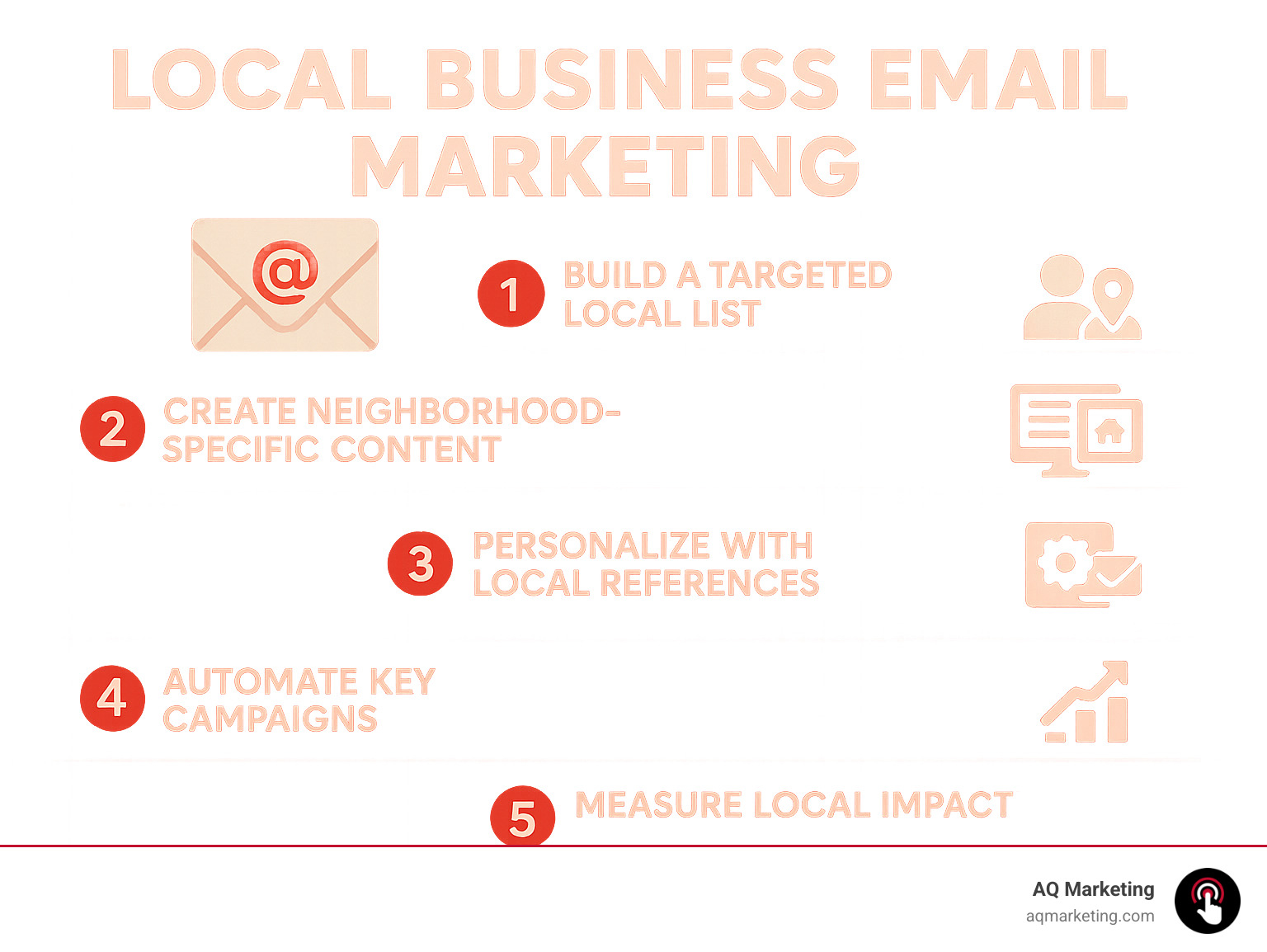
In this comprehensive guide, you’ll find:
- Why email marketing is particularly powerful for local businesses in Boston, Woburn, and surrounding areas
- Step-by-step strategies to build and grow your local email list
- How to craft emails that resonate with your community
- Automation tactics that save time while maintaining the personal touch
- Measurement techniques to track your success
- Common mistakes to avoid that could damage your reputation
Whether you run a restaurant in Middlesex County, a retail shop in Essex County, or a service business in Southern New Hampshire, this guide will provide actionable steps to transform your local business email marketing efforts.
Why Local Businesses Need Email More Than Ever
In today’s digital landscape, local businesses face unique challenges. While social media platforms continuously change their algorithms and reduce organic reach, email provides a direct line to your customers that you completely control.

The Numbers Don’t Lie
Email isn’t just surviving in the digital age—it’s thriving. With approximately 4 billion email users worldwide, this channel remains the backbone of online communication. For local businesses, the stats are particularly compelling: local business email marketing delivers an astonishing 42-52x return on every dollar invested.
What makes email special is the foundation of trust it builds. Unlike social media where you’re competing with countless distractions, email subscribers have invited you into their inbox. They’ve given you permission to connect, creating a relationship based on mutual interest rather than interruption.
I’ve seen how this permission-based marketing transforms customer relationships for our clients in Woburn and throughout the Merrimack Valley. When someone welcomes your messages, they’re significantly more likely to read them, act on them, and visit your store.
That said, maintaining this connection requires ongoing attention. Email lists naturally decay by about 22.5% annually as people change addresses or interests shift. This makes consistent list-building essential for sustainable growth.
Key Benefits for Main-Street Brands
For neighborhood businesses like yours, email offers distinct advantages that national chains can’t match.
Cost efficiency is perhaps the most immediate benefit. Email marketing typically costs 6-12x less than acquiring new customers through paid advertising. For small businesses with tight marketing budgets, this efficiency is game-changing.
Higher conversions are another significant advantage. Local emails regularly achieve open rates of 38-39% in industries like apparel and food & beverage—numbers that make corporate marketers jealous. Why? Because local relevance matters enormously to consumers.
As one cafe owner in Boston told me recently: “When I send an email about our weekend special, I can literally watch people walk through the door holding up their phones with the email open.” That’s the power of local business email marketing at work—turning digital messages into real-world foot traffic.
Email also excels at generating reviews, that precious currency of local business success. A thoughtfully timed follow-up email after a purchase can systematically build your positive review count, enhancing your reputation throughout the community.
Common Misconceptions Debunked
Despite these benefits, I still hear hesitation from local business owners about embracing email marketing.
“Email is dead,” some tell me, especially for reaching younger consumers. The data tells a completely different story. Email remains the preferred communication channel for business interactions across all age groups, with 92% of internet users maintaining at least one email account they check regularly.
Others worry that “building an email list is too hard.” While it does require consistent effort, combining in-store collection methods with digital strategies can build a valuable list faster than most expect. Our clients in Southern New Hampshire typically see list growth of 15-25% monthly using straightforward tactics.
Perhaps the most dangerous misconception is that “social media is enough.” Social platforms are valuable tools, but they’re essentially “rented land” where the rules change constantly. Email, by contrast, is an asset you own completely. When Facebook’s organic reach plummeted below 2%, our email-focused clients barely noticed the change, while businesses relying solely on social media saw their customer engagement collapse overnight.
Building & Growing a Hyper-Targeted Local List
The foundation of successful local business email marketing is a quality list of subscribers who live or work in your service area. Unlike national brands that might purchase lists (a practice we strongly discourage), local businesses have unique advantages in building authentic connections.
Fast Offline Tactics
For brick-and-mortar businesses in areas like Middlesex County or Essex County, offline list-building should be your starting point.
Those in-store tablet sign-ups near your register can work wonders. When I talk with our local clients, they consistently report conversion rates around 70% when their staff personally asks customers to join. It’s that human touch that makes all the difference.
Event collection is another goldmine that many businesses overlook. Whether you’re at a farmers market in Woburn or a community festival in Southern New Hampshire, bringing along a simple clipboard or tablet with an enticing offer can add dozens or even hundreds of local subscribers in just one day.
Receipt opt-ins are incredibly effective. When your cashiers ask if customers would like their receipt emailed (while clearly mentioning future marketing emails), you’re building your list while providing a genuine service.
And yes, the classic fishbowl business card collection with a monthly prize drawing still works beautifully in 2023! Just make sure your messaging clearly states they’re joining your email list when they drop that card.
What we’ve noticed over our 20 years at AQ Marketing is fascinating – those emails collected face-to-face often generate click-through rates more than double those acquired online.
High-Conversion Online Tactics
While those in-person methods work beautifully, your website and social media should also be working hard to grow your list.
Creating optimized landing pages with compelling local offers can be game-changers. Imagine a “Boston Resident Special” page with neighborhood-specific discounts – we regularly see these converting at 3-5% when done right.
Strategic pop-ups genuinely work when done thoughtfully. The data shows well-designed ones convert at an average of 1.06%. The key is timing them to appear after 30+ seconds or upon exit intent so they don’t immediately annoy your visitors.
Chatbots with email capture capabilities are another tool worth considering. Simple bots that offer assistance and then request an email for follow-up can convert at 15-20% of engaged visitors.
Lead magnets work particularly well for local businesses. A restaurant client in Woburn created a “Local Wine Pairing Guide” that converted at an impressive 8%. Think about what specialized local knowledge you could share!
Don’t forget to use your social media as sign-up prompts. Instagram Stories with “swipe up” links to email sign-up forms have been particularly effective for our retail clients in the area.
| List Building Method | Average Conversion Rate | Best For |
|---|---|---|
| In-Store Requests | 60-70% | Retail & Services |
| Event Collection | 40-50% | All Local Businesses |
| Website Pop-Ups | 1-3% | High-Traffic Websites |
| Lead Magnets | 5-10% | Service Businesses |
| Social Media Prompts | 2-5% | Businesses with Active Social |
Keep Your List Healthy
Building your list is just the beginning – maintaining its health is crucial for long-term success.
Implementing double opt-in might seem counterintuitive since it can reduce initial sign-ups by 20-30%, but it ensures higher-quality subscribers and better deliverability long-term.
Every few months, run regular re-engagement campaigns. These are simple emails asking inactive subscribers if they still want to hear from your Woburn business. An engaged smaller list always outperforms a larger disinterested one.
Systematic list cleaning is something we help our clients with regularly. Remove hard bounces immediately and soft bounces after multiple failures. For a local business serving the Merrimack Valley, quality trumps quantity every time.
Create segments based on engagement levels. This allows you to send more frequent emails to your biggest fans and fewer to those who engage less often.
The Local Business Email Marketing Playbook
Now that you have a growing list of local subscribers, it’s time to develop a strategic approach to your local business email marketing campaigns. The secret isn’t just sending emails—it’s creating a balanced mix of promotions and valuable community-focused content that your subscribers actually look forward to receiving.
Must-Have Campaign Types
Every local business should have four fundamental email campaigns in their arsenal. First, your welcome series should roll out the red carpet for new subscribers with 3-5 automated emails. Start with a warm introduction to your business, share your connection to the community, set clear expectations about what they’ll receive, and include a special offer to encourage that first purchase.
Promotional emails are your bread and butter, but they work best when tied to the local community. Reference the upcoming festival in town, celebrate the local team’s big win, or acknowledge that heatwave everyone’s talking about. These local touches transform a generic “25% off” message into a neighborly conversation.
Event invitations follow a simple but effective rhythm: announce 2-3 weeks before, send a friendly reminder a few days prior, and create excitement with a “last chance” email right before it happens. These emails build community while driving foot traffic.
Finally, loyalty updates make your best customers feel valued. Share their points status, give them VIP access to new products, or remember their birthday with a special offer. These personal touches create emotional connections that big-box retailers simply can’t match.
Our most successful clients in Merrimack Valley follow a simple rule: promotional emails never exceed 50% of their total sends. This balance keeps subscribers engaged without feeling constantly sold to.
Writing Emails That Feel Local

The most powerful local emails create an immediate sense of “you’re one of us” connection. Always start with “Hi [FirstName]”—it’s simple but effective, boosting engagement by a surprising 26% compared to generic greetings.
Sprinkle in references to local landmarks and happenings that instantly signal you’re truly part of the community. When that big snowstorm hit Woburn last winter, our clients who mentioned it in their subject lines saw open rates jump by 15%. Why? Because it felt like a message from a neighbor, not a faceless business.
Your tone matters tremendously. Write as if you’re chatting with a regular customer who just walked through your door—warm, friendly, and conversational. Share a quick note about the farmers market opening for the season or the road construction finally ending on Main Street.
Ditch the stock photos whenever possible. Your storefront, your team, and your actual customers (with permission, of course) create an authentic connection that generic images never will. One café in Boston saw engagement double when they switched from stock photos to images of their actual space and baristas.
Don’t forget to highlight how your business contributes to the community. Whether you’re sponsoring the little league team or hosting a food drive, these stories remind subscribers that supporting your business means supporting their community too.
Design & Mobile Best Practices
With nearly half of all emails now opened on smartphones, your beautiful desktop design might look terrible on mobile if you’re not careful. Keep layouts simple with a single column that adapts well to smaller screens.
Make those call-to-action buttons big and tappable—at least 44×44 pixels with plenty of space around them. Nothing frustrates mobile users more than accidentally hitting the wrong link because buttons are too small or crowded together.
Maintain consistent branding with your store’s colors, fonts, and logo placement. This visual consistency builds trust and recognition, especially important for local businesses competing with national chains.
Break up your content into scannable chunks with short paragraphs and clear headings. Most people skim emails first, then decide if they’ll read more deeply.
A/B Testing for Continuous Lift
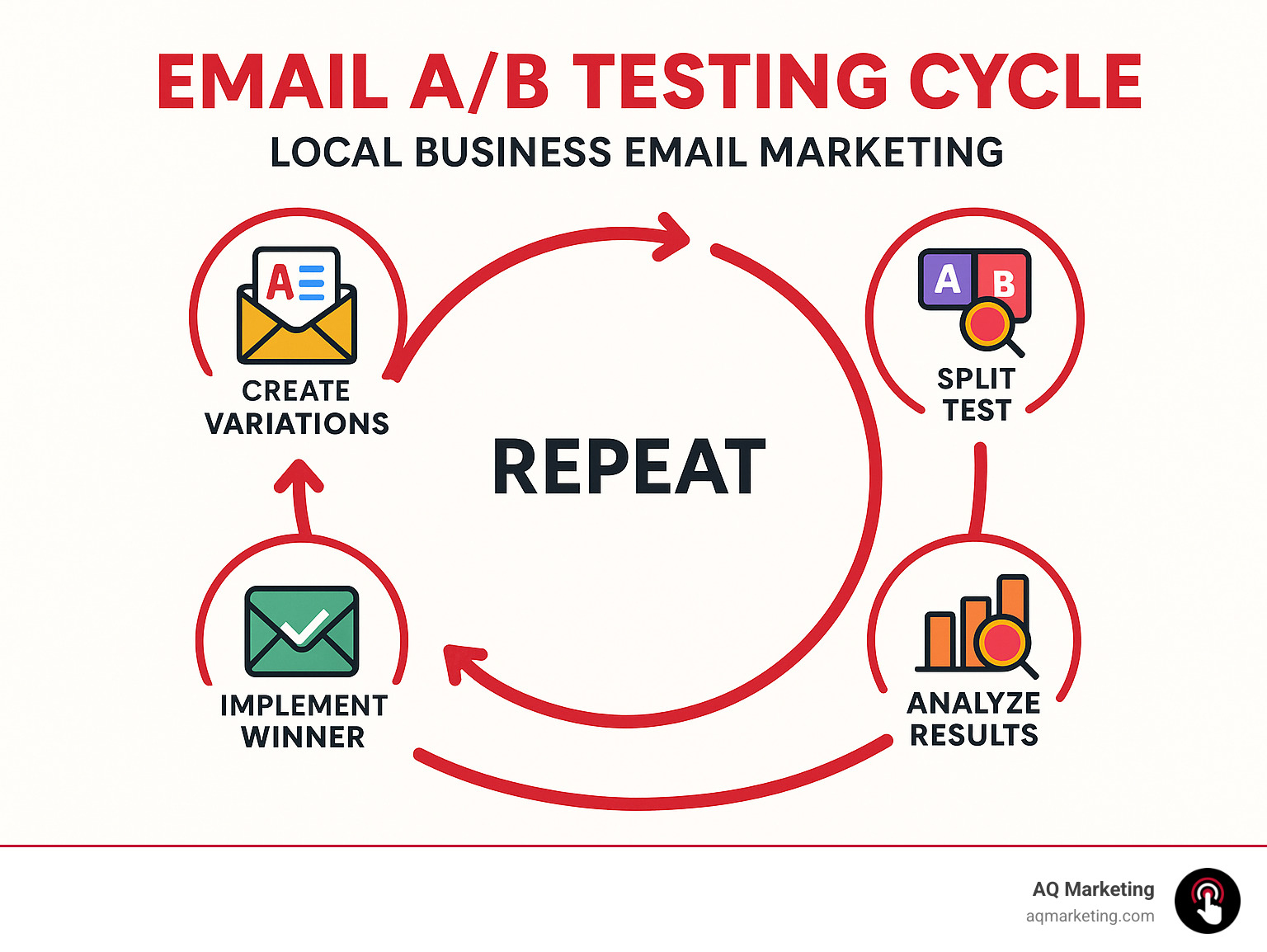
The beauty of email marketing is that you can continuously improve through simple testing. Subject lines are the perfect place to start—create two versions and send each to a small portion of your list before sending the winner to everyone else.
Testing send times can reveal surprising patterns in your local audience’s habits. Our Boston clients have found that Tuesday and Thursday mornings (9-11 AM) typically perform best for B2B services, while Thursday evenings and Saturday mornings drive the most engagement for retail and restaurants.
Don’t stop at testing just when you send—test what you offer too. Compare different discount structures (percentage off vs. dollar amount), free shipping thresholds, or bonus offers to see what motivates your specific audience. One bookstore in Middlesex County found that “buy one, get one half off” consistently outperformed “25% off everything” despite being mathematically similar.
Automate, Measure & Stay Compliant
The secret sauce of effective local business email marketing isn’t just in creating great emails—it’s in setting up systems that work for you while you sleep, understanding what’s working, and making sure you’re playing by the rules.
Time-Saving Automations
Think of email automation as your hardest-working employee who never takes a day off. When done right, automated emails feel even more personal than one-off campaigns because they arrive at exactly the right moment in a customer’s journey:
Birthday emails with special offers create delightful surprises for customers in Woburn and beyond. One local bakery we work with sees a remarkable 68% open rate on their automated birthday messages that include a free cupcake offer.
Abandoned cart reminders gently nudge online shoppers who left items behind. These can recover up to 10% of otherwise lost sales for local e-commerce businesses.
Appointment reminders reduce no-shows dramatically (we’ve seen 30-45% reductions for service businesses in Southern New Hampshire), while follow-up messages requesting feedback help you improve and generate reviews.

Metrics That Matter
Not all email marketing numbers deserve equal attention. Here’s what local business owners should focus on:
Open rate tells you how compelling your subject lines are. While 15-25% is typical for local businesses, we’ve seen segmented campaigns for Middlesex County retailers reach nearly 40% when hyper-relevant to the audience.
Click-through rate (CTR) reveals if your content motivates action. A good CTR for local businesses ranges from 2-5%, with special offers typically performing at the higher end of that range.
Conversion rate shows how many clickers actually do what you wanted—whether that’s making a purchase, booking an appointment, or filling out a form. This typically ranges from 1-5% for local businesses, but can be much higher for well-targeted offers.
Revenue per recipient is perhaps the most important metric of all. This can range from cents to dollars depending on your business, but watching this number climb over time is the clearest sign your email strategy is working.
Keep your unsubscribe rate below 0.5% per send and your spam complaint rate under 0.1% to maintain good deliverability and list health.
Frequently Asked Questions about local business email marketing
How often should I email my local list?
Email frequency depends on your business type. Retail shops and restaurants typically succeed with 1-2 emails weekly, while professional services do better with 2-4 monthly touches. Home service businesses generally find 1-2 times per month is their sweet spot.
The golden rule? Be consistent and set clear expectations during signup. If you promised weekly updates, stick to it. Nothing triggers unsubscribes faster than suddenly bombarding people with daily emails when they expected monthly contact.
Start conservative and gradually test increased frequency while watching your engagement metrics.
How do I avoid the spam folder?
Landing in spam folders is the email marketer’s nightmare. Here’s how to stay in the inbox:
Implement SPF, DKIM, and DMARC records for your sending domain—most email platforms offer step-by-step guidance.
Keep your list clean by regularly removing inactive subscribers and bounced addresses. A smaller, engaged list will always outperform a larger, unresponsive one.
Be thoughtful with your language. While words like “free” and “guarantee” aren’t automatically problematic, excessive use of sales language, ALL CAPS, or exclamation points!!! can trigger spam filters.
Always honor unsubscribe requests immediately—it’s not just good practice, it’s the law.
Which platform is most affordable for very small lists?
For local businesses just starting with email marketing, several platforms offer generous free tiers:
Mailchimp gives you up to 2,000 contacts and 10,000 sends monthly at no cost. Brevo (formerly Sendinblue) allows up to 300 emails daily for free, while MailerLite offers up to 1,000 subscribers and 12,000 emails monthly on their free plan.
As your list grows, look beyond just the price tag. Consider how costs scale with growth, whether the automation features you need are included, and the availability of templates suited to your industry.
Conclusion
Local business email marketing isn’t just another digital tactic—it’s about building genuine relationships with the very people who walk past your storefront every day. Throughout this guide, we’ve explored how this powerful channel can transform your community connections into tangible business growth.
When done right, email marketing creates a direct line to your most valuable customers—those who live and work right in your neighborhood. The beauty of it lies in its simplicity and effectiveness.
Let’s remember what makes local email marketing truly special:
First, there’s nothing quite like collecting emails in person. That brief interaction when someone signs up at your register creates a connection that digital-only businesses simply can’t match. These subscribers often become your most engaged readers because they’ve already met you face-to-face.
Personalizing with neighborhood references makes all the difference. When you mention the local high school’s championship game or the construction on Main Street, you’re signaling that you’re truly part of the community fabric—not just another business sending mass emails.
Finding that sweet spot between promotional content and helpful information keeps subscribers looking forward to your messages. Yes, they want your deals, but they also appreciate when you share insights about the community or useful tips related to your industry.
Basic automation doesn’t mean impersonal—quite the opposite. It ensures your customers receive the right message at exactly the right moment, whether that’s a birthday wish or a thank-you after their first purchase.
Email marketing success doesn’t happen overnight. The local businesses we’ve seen thrive are those that show up in their subscribers’ inboxes consistently, delivering genuine value with every send. This patient approach builds the kind of trust that eventually translates into loyal, repeat customers.
Since 2003, we at AQ Marketing have partnered with hundreds of local businesses throughout Boston, Woburn, Middlesex County, Essex County, Merrimack Valley, and Southern New Hampshire. We’ve seen how effective email strategies can turn occasional customers into devoted fans who tell their friends about your business.

Whether you’re just starting to build your email list or looking to revitalize your current strategy, we’re here to help. From crafting the perfect sign-up strategy to designing campaigns that reflect your local character, our team can support your journey every step of the way.
Ready to make email marketing work harder for your local business? Let’s talk about how we can help you strengthen those community connections and drive the kind of sustainable growth that lasts for years to come.