

Market Landscape Analysis: Top 5 Powerful Insights 2024
Market landscape analysis is a vital tool for small to medium-sized business owners eager to improve their competitive edge. It helps in mapping out the competitors, understanding customer preferences, and identifying market trends. By doing so, businesses can strategically position themselves for success. Whether you’re in home services, insurance, or fitness, knowing your market landscape can guide your growth and lead generation efforts. Here’s why it’s important:
- Overview: Gains a comprehensive view of the competitive environment.
- Importance: Identifies opportunities and potential threats quickly.
- Goals: Helps align business strategies with market demands.
My name is Robert P. Dickey and I am the President and CEO of AQ Marketing, Inc., a digital marketing agency with over 20 years of experience. I specialize in market landscape analysis and have a track record of helping businesses thrive in the digital space. Moving forward, let’s dig into the components of market landscape analysis that are critical to your business success.
Terms related to market landscape analysis:
– what is digital marketing landscape
– landscape marketing agency
– landscaping marketing
Understanding Market Landscape Analysis
What is Market Landscape Analysis?
Market landscape analysis is like a map for your business journey. It paints a clear picture of your competitive environment. This helps you understand not just who your competitors are, but how they operate, what your customers want, and where the market is heading.
Scope: This analysis isn’t just about listing competitors. It’s about diving deep into their strategies, strengths, and weaknesses. It’s also about looking at customer behavior and market trends. By doing so, you can spot opportunities for growth and potential threats to your business.
Importance: In today’s world, industries are becoming more competitive and disruptive. A market landscape analysis helps you stay ahead by providing insights into competitor strategies and market trends. This allows you to anticipate changes and adapt your strategies accordingly.
Key Components of Market Landscape Analysis
- Competitors: Identifying competitors is the first step. This includes not just direct competitors but also indirect ones. For example, if you own a pizza shop, your competitors aren’t just other pizza places but also any food outlet that satisfies a similar customer need.
- Customers: Understanding what customers want is crucial. This involves gathering data on customer preferences, buying habits, and feedback. Knowing your customers helps you tailor your offerings to meet their needs better than your competitors.
- Trends: Keeping an eye on industry trends is vital. Trends can indicate where the market is heading and help you anticipate changes. This could be anything from technological advancements to shifts in consumer behavior.
- Competitive Analysis: This involves a detailed examination of your competitors’ strategies. Look at their pricing, marketing tactics, customer service, and more. It helps you understand what works for them and what doesn’t.
- SWOT Analysis: This framework helps you identify your business’s Strengths, Weaknesses, Opportunities, and Threats. By comparing these factors with those of your competitors, you can find areas where you have an advantage or need improvement.
- PEST Analysis: This looks at Political, Economic, Social, and Technological factors that could impact your business. It’s about understanding the external environment and how it affects your industry.
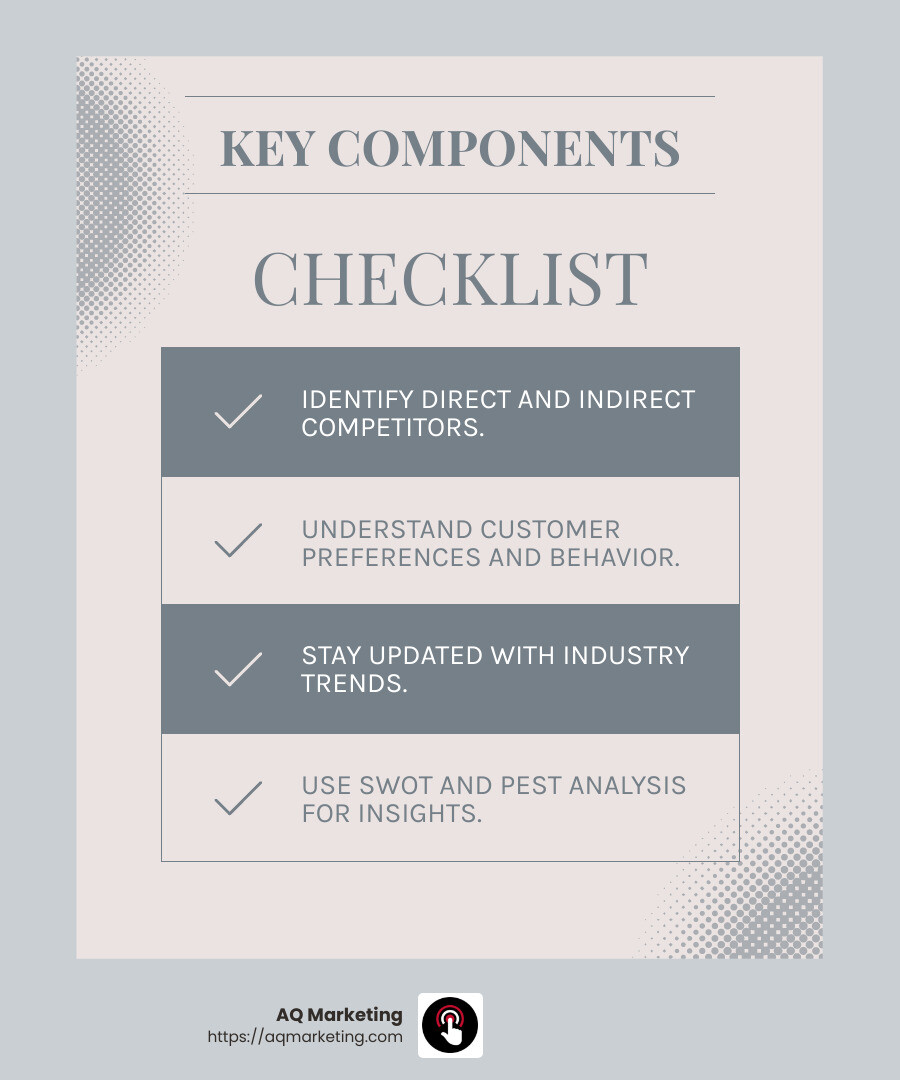
By understanding these components, you can develop strategies that align with market demands and position your business for success. This is just the beginning. Next, we’ll explore the steps to conduct an effective market landscape analysis.
Steps to Conduct Effective Market Landscape Analysis
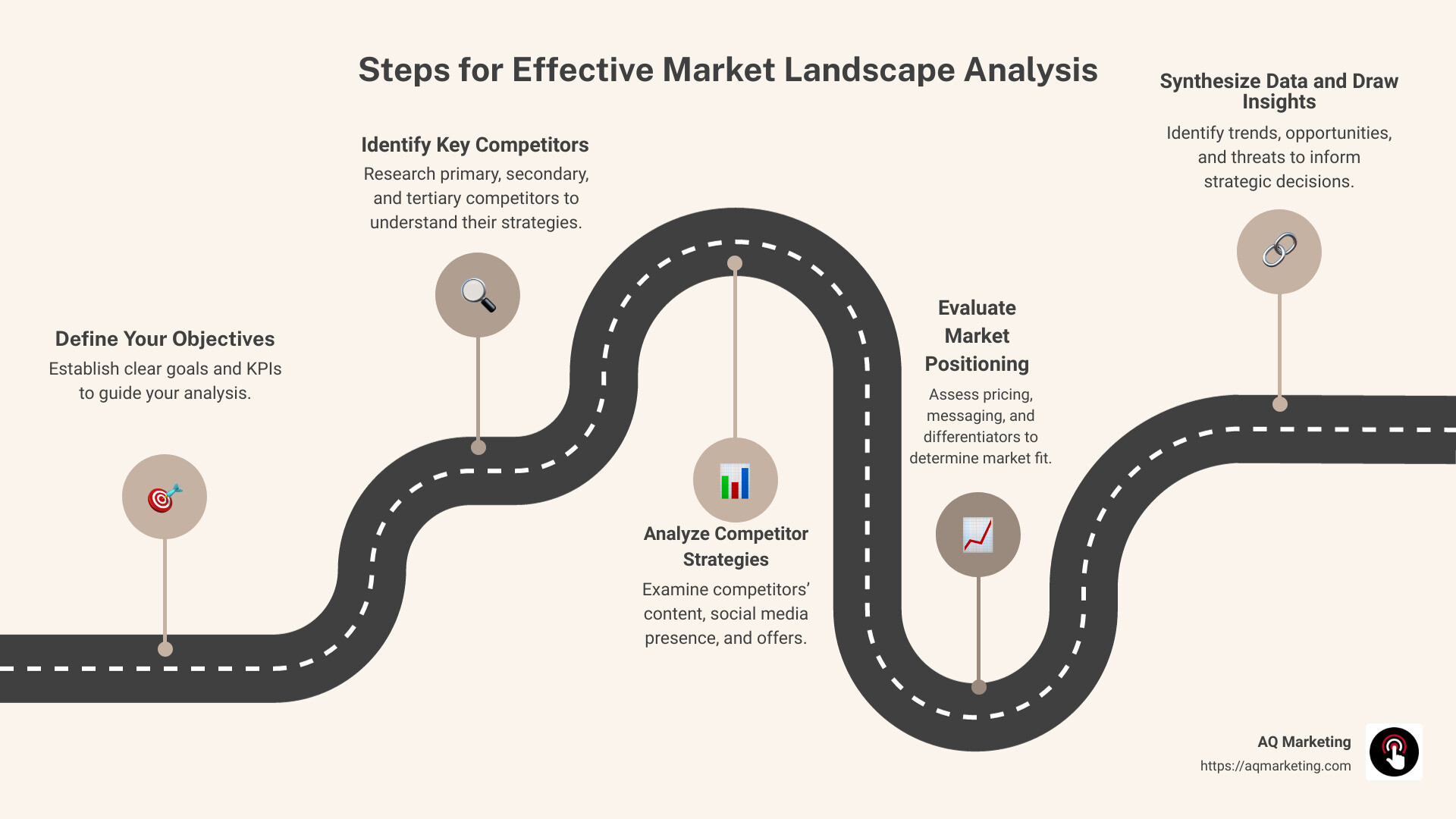
Step 1: Define Your Objectives
Before diving into the sea of data, it’s crucial to set clear objectives. Ask yourself: What do you want to achieve with this analysis? Your goals could include identifying new market opportunities, understanding customer needs, or benchmarking against competitors. Define Key Performance Indicators (KPIs) to measure success. For instance, if your goal is to improve market share, a relevant KPI might be the percentage increase in sales over a specific period.
Step 2: Identify Key Competitors
Next, pinpoint your competition. Categorize them into primary, secondary, and tertiary competitors. Primary competitors offer similar products or services and target the same audience. Secondary competitors might serve a slightly different market segment, while tertiary competitors could indirectly compete by fulfilling a similar customer need.
Example: If you’re a coffee shop, a primary competitor might be another local coffee shop, a secondary competitor could be a nearby café selling tea and snacks, and a tertiary competitor might be a chain bakery offering coffee as a side beverage.
Step 3: Analyze Competitor Strategies
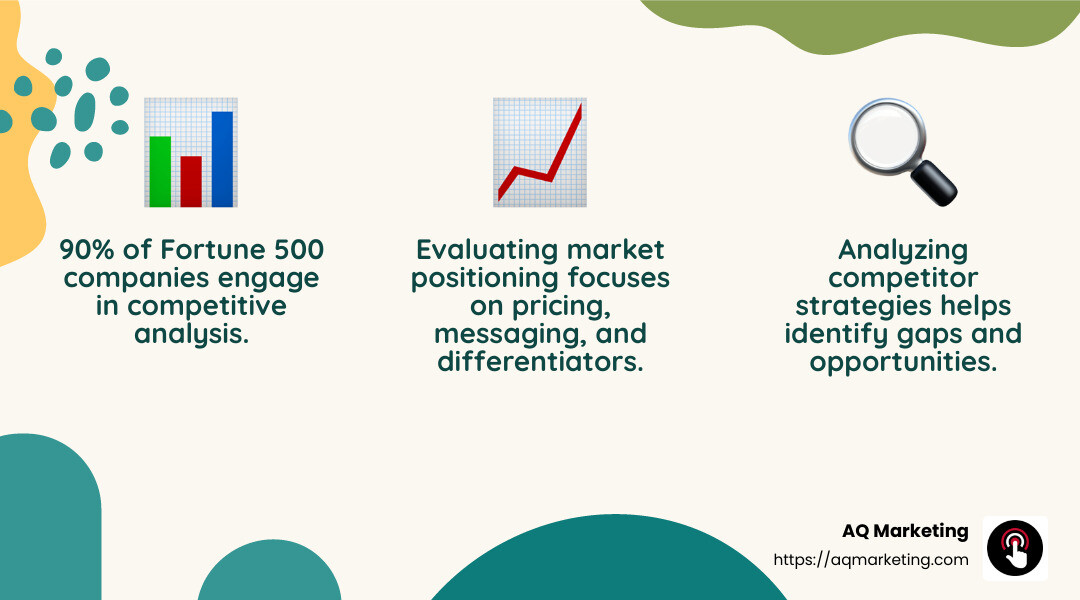
Dive into the nitty-gritty of what your competitors are doing. Examine their content, social media presence, and special offers. Are they using engaging videos on social media? What kind of promotions do they run? Understanding these strategies helps you identify gaps and opportunities in your own approach.
- Content: Look at their blogs, newsletters, and articles. What topics do they cover? How often do they publish?
- Social Media: Analyze their engagement levels, types of posts, and follower growth.
- Offers: Consider discounts, loyalty programs, or limited-time offers they provide.
Step 4: Evaluate Market Positioning
Now, assess how competitors position themselves in the market. Focus on pricing, messaging, and differentiators.
- Pricing: Compare their pricing models with yours. Are they premium, mid-range, or budget?
- Messaging: What key messages do they communicate? How do they connect with their audience?
- Differentiators: Identify what makes them unique. Is it their product features, customer service, or brand reputation?
Step 5: Synthesize Data and Draw Insights
Finally, bring all the data together to uncover trends, opportunities, and threats.
- Trends: Identify emerging patterns in consumer behavior or industry shifts.
- Opportunities: Look for unmet customer needs or market gaps you can exploit.
- Threats: Recognize potential challenges from competitors or external factors.
Using tools like SWOT and PEST analyses can help structure your insights and guide strategic decisions.
By systematically following these steps, you’ll gain a comprehensive view of your market landscape, enabling informed and strategic business decisions. Next, we’ll explore how to use competitive landscape frameworks to further improve your analysis.
Utilizing Competitive Landscape Frameworks
When it comes to understanding your market, frameworks are like maps—they guide you through the complex terrain of competition. Let’s explore three powerful tools: SWOT Analysis, Porter’s Five Forces, and Strategic Group Analysis.
How to Apply SWOT Analysis
A SWOT analysis helps you see your business through a clear lens by examining Strengths, Weaknesses, Opportunities, and Threats.
- Strengths: Identify what your business does well. Maybe you have a loyal customer base or a unique product feature. Highlight these to leverage them further.
- Weaknesses: Be honest about where you fall short. Is there a skill gap in your team? Do you have limited resources? Recognizing these areas helps you improve.
- Opportunities: Look for market gaps or new trends. Is there a rising demand you can tap into? Opportunities are the potential paths to growth.
- Threats: Consider external factors that could harm your business. These could be new competitors entering the market or changing regulations. Knowing threats helps you prepare.
This analysis not only sharpens your strategic planning but also uncovers areas for improvement and growth.
How to Use Porter’s Five Forces
Porter’s Five Forces is like a magnifying glass for your industry. It evaluates competitiveness, profitability, and market entry barriers.
- Rivalry Among Existing Competitors: How fierce is the competition? High rivalry can squeeze profit margins, so understanding this helps you strategize.
- Threat of New Entrants: Are there barriers that keep new players out? If not, be ready for more competition.
- Bargaining Power of Buyers: Do customers have many choices? If yes, they can demand lower prices or better quality.
- Bargaining Power of Suppliers: If few suppliers exist, they can dictate terms. This affects your costs and pricing strategies.
- Threat of Substitutes: Can customers easily switch to other products? If so, you need to differentiate your offerings.
Using this framework provides insight into the dynamics shaping your industry, helping you make informed decisions to stay ahead.
Benefits of Strategic Group Analysis
Strategic Group Analysis helps you see the industry landscape by grouping competitors with similar strategies or characteristics into clusters.
- Clusters: Identify groups based on factors like pricing, product quality, or target market. This helps you understand competitive relationships.
- Relationships: Analyze how these clusters interact. Are there alliances or intense rivalries? This gives you a clearer picture of competitive dynamics.
- Gaps: Look for gaps between clusters. Is there a niche market not being served? These gaps can be opportunities for your business to exploit.
By visualizing the strategic groups, you can pinpoint where your business fits and identify areas for differentiation and growth.
These frameworks are essential tools in any market landscape analysis. They help you uncover insights, spot opportunities, and steer the competitive terrain with confidence. Next, we’ll dig into advanced techniques to further improve your analysis.
Advanced Techniques in Market Landscape Analysis
Leveraging Technology for Data Gathering
Gathering data for your market landscape analysis is more efficient and insightful thanks to technology. Tools like Semrush, Google Analytics, and social listening platforms have transformed the way businesses collect and interpret market data.
Semrush is a robust tool that provides insights into competitor strategies, market trends, and keyword performance. It helps you understand where your competitors are succeeding and where there might be opportunities for your business. For example, by analyzing competitor web traffic, you can identify which channels are driving the most visitors to their sites.
Google Analytics is another essential tool. It tracks website traffic and user behavior, giving you a clear picture of how customers interact with your site. This data is crucial for understanding customer preferences and optimizing your marketing strategies.
Social Listening Tools like Hootsuite or Brandwatch allow you to monitor social media platforms for mentions of your brand or industry. This real-time data can reveal consumer sentiments and emerging trends, helping you adjust your strategies accordingly.
Analyzing and Reporting Findings
Once you’ve gathered the data, the next step is to analyze and present it in a way that informs strategic decisions. Visual data representation is key here. Tools like Tableau or Google Looker Studio (formerly Google Data Studio) help turn complex data into easy-to-understand visuals.
Key Metrics to focus on include market share, growth rates, and customer demographics. These metrics provide a snapshot of your business’s position in the market and highlight areas for improvement or investment.
When reporting findings, aim for clarity and impact. Use charts, graphs, and dashboards to make data more digestible. This approach not only helps stakeholders grasp insights quickly but also supports informed decision-making.
For instance, a well-crafted visual report can highlight a gap in the market that your business can exploit or reveal a trend that could threaten your market position. By synthesizing data effectively, you can uncover these insights and use them to guide your strategic planning.
With these advanced techniques, you can lift your market landscape analysis to a new level, ensuring your business stays competitive and agile in a rapidly changing environment. Next, we’ll tackle some frequently asked questions to further clarify the importance and execution of market landscape analysis.
Frequently Asked Questions about Market Landscape Analysis
What is the importance of market landscape analysis?
Market landscape analysis is crucial because it helps businesses understand their competitive environment. In today’s markets, knowing who your competitors are and how they operate is essential. According to the 2022 State of Competitive Enablement Report, all participants noted increased competition in their industries. By performing a market landscape analysis, you gain insights into competitor strategies and industry trends. This knowledge allows you to anticipate market disruptions and adjust your strategies accordingly, ensuring you stay ahead of the competition.
Moreover, it helps identify your differentiators. Understanding what makes your product or service unique in the eyes of consumers is vital for maintaining a competitive edge. By evaluating the strengths and weaknesses of both your offerings and those of your competitors, you can better position your business and improve your value proposition.
How often should market landscape analysis be conducted?
The frequency of conducting a market landscape analysis largely depends on your industry dynamics and business goals. However, given the rapid changes in today’s markets, it’s advisable to conduct this analysis at least annually. In sectors where technology and consumer preferences evolve quickly, more frequent reviews—quarterly or biannually—are beneficial.
Regular analysis ensures you remain informed about emerging trends, new entrants, and shifts in consumer behavior. It also allows your business to adapt its strategies in response to these changes, maintaining relevance and competitiveness.
What are the common mistakes in market landscape analysis?
One common mistake is failing to define clear objectives. Without specific goals, your analysis may lack focus and fail to provide actionable insights. As highlighted in the research, crystallizing your objectives upfront is critical.
Another mistake is overlooking secondary and tertiary competitors. While primary competitors are the most obvious to track, ignoring others can lead to missed opportunities or threats. For example, a secondary competitor might introduce a disruptive product that could impact your market share.
Additionally, relying solely on outdated data or a single source can skew your analysis. Utilizing multiple tools and data sources, such as Semrush and Google Analytics, ensures a comprehensive view of the market.
Finally, not involving key stakeholders in the analysis process can lead to misalignment in strategic planning. Engaging with senior leadership and other stakeholders helps ensure that the insights gained are aligned with the broader business objectives and that the necessary resources are allocated to act on these insights.
Conclusion
Crafting a market landscape analysis is not just a one-time task—it’s a cornerstone of a long-term strategy. At AQ Marketing, we understand that the digital landscape is ever-changing, and staying ahead requires continuous improvement and adaptation.
Our approach is simple: continuous improvement. By regularly updating our strategies based on fresh insights, we ensure that our clients remain competitive. This means not only keeping an eye on direct competitors but also being aware of market shifts and emerging trends. As highlighted in our research, conducting frequent analyses helps anticipate changes and adjust strategies accordingly.
A robust market landscape analysis allows businesses to spot opportunities and threats early. This proactive stance is crucial for long-term success. By leveraging frameworks like SWOT and Porter’s Five Forces, we can dissect the competitive environment and identify unique differentiators for our clients. This empowers them to create compelling value propositions that resonate with their target audiences.
At AQ Marketing, we specialize in helping small to medium-sized businesses thrive in their respective markets. Our expertise in digital marketing, especially for industries like home services, ensures that our clients not only keep pace with industry changes but lead the way in innovation.
For those in the landscaping industry looking to improve their online presence, our custom strategies in irrigation company website design are designed to deliver impactful results.
In conclusion, a well-executed market landscape analysis is a powerful tool for any business aiming for long-term growth. By continuously refining our strategies and staying informed, we help our clients maintain their competitive edge and achieve their business goals.
