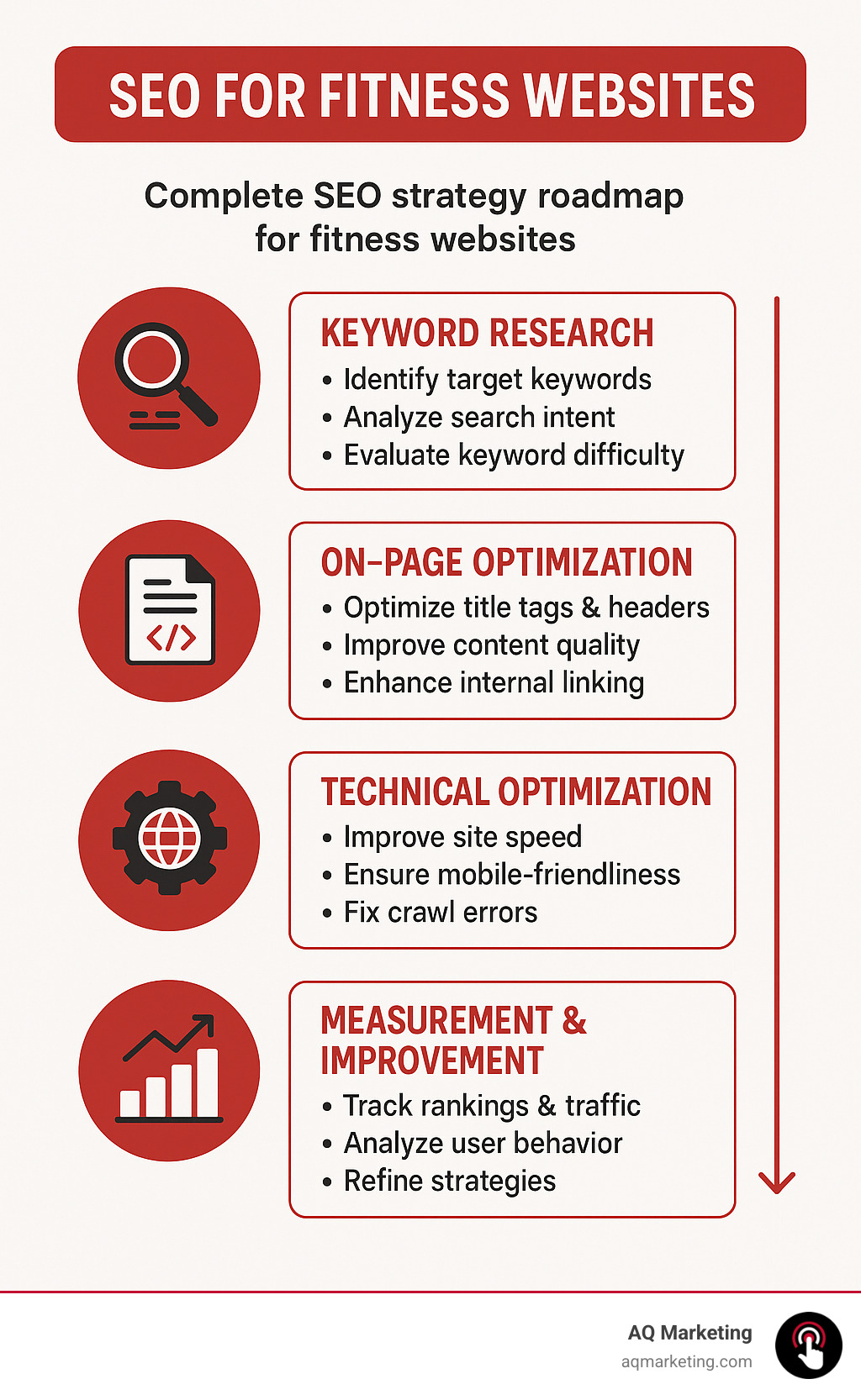
SEO for Fitness Websites: 10 Powerful Tips for Success 2025
Why SEO for Fitness Websites Is Your Secret Weapon for Growth
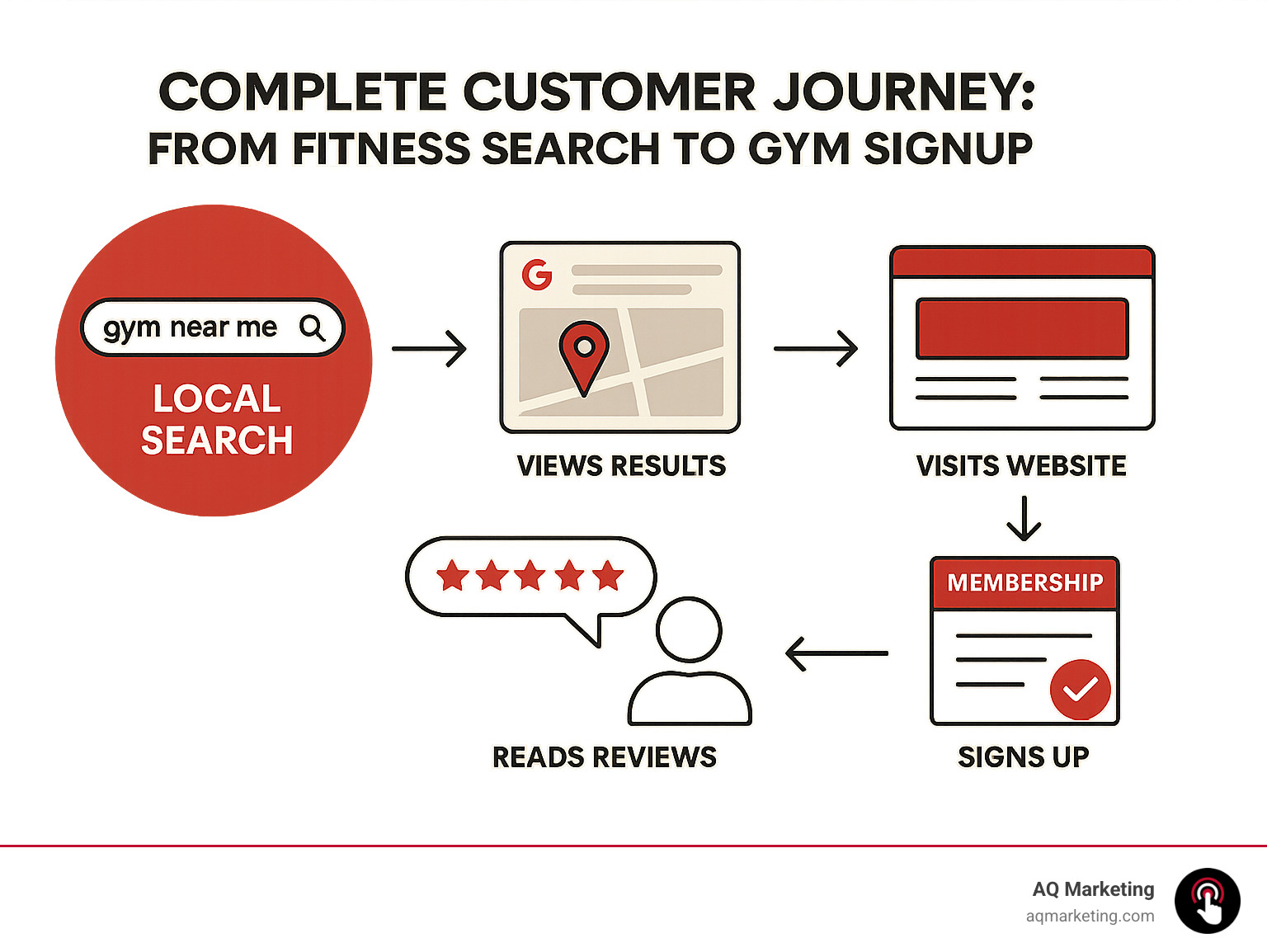
SEO for fitness websites puts your gym, studio, or personal-training service in front of local prospects who are ready to act. When someone searches “gym near me” they’re deciding where to work out – usually within 24 hours. Ranking high at that exact moment often means a full class instead of an empty one.
Key tactics at a glance:
• Local SEO & Google Business Profile
• Location-based keywords (“personal trainer Woburn MA”)
• On-page titles, headers & meta descriptions
• Helpful blog posts and success stories
• Backlinks from local partners
• Fast, mobile-friendly, technically sound site
• Review generation & response strategy
• Schema markup for hours, classes & reviews
• Voice-search-friendly phrases
• Competitor gap analysis
The #1 organic result grabs roughly 34 % of clicks while paid ads manage under 2 %. Add the fact that 88 % of local searches happen on mobile, and it’s clear: strong organic visibility equals real foot traffic.
Most gyms still lean on drive-by visibility and word of mouth. Yet modern members spend weeks comparing prices, schedules, and reviews online before stepping inside. An optimized site guarantees you’re part of that evaluation instead of an after-thought.
I’m Robert P. Dickey, and for two decades I’ve watched studios, CrossFit boxes, and traditional gyms across New England explode in membership simply by showing up first in search. This guide distills the very playbook AQ Marketing uses to turn hidden gems into local fitness landmarks.
Why SEO for Fitness Websites Matters in 2025
The global fitness industry tops $80 billion and competition grows daily. Prospects trust organic listings far more than ads: the first natural result earns 34 % of clicks while paid spots capture under 2 %.
Mobile usage widens that gap. 88 % of people run local searches on their phones; “gym near me” alone attracts about 276 000 U.S. queries every month. If your site isn’t optimized, those clicks (and memberships) go elsewhere.
How Local SEO Turns Searches into Members
• Consistent NAP across site, Google Business Profile, and directories.
• Fresh GBP photos, schedules, and promos keep your listing active.
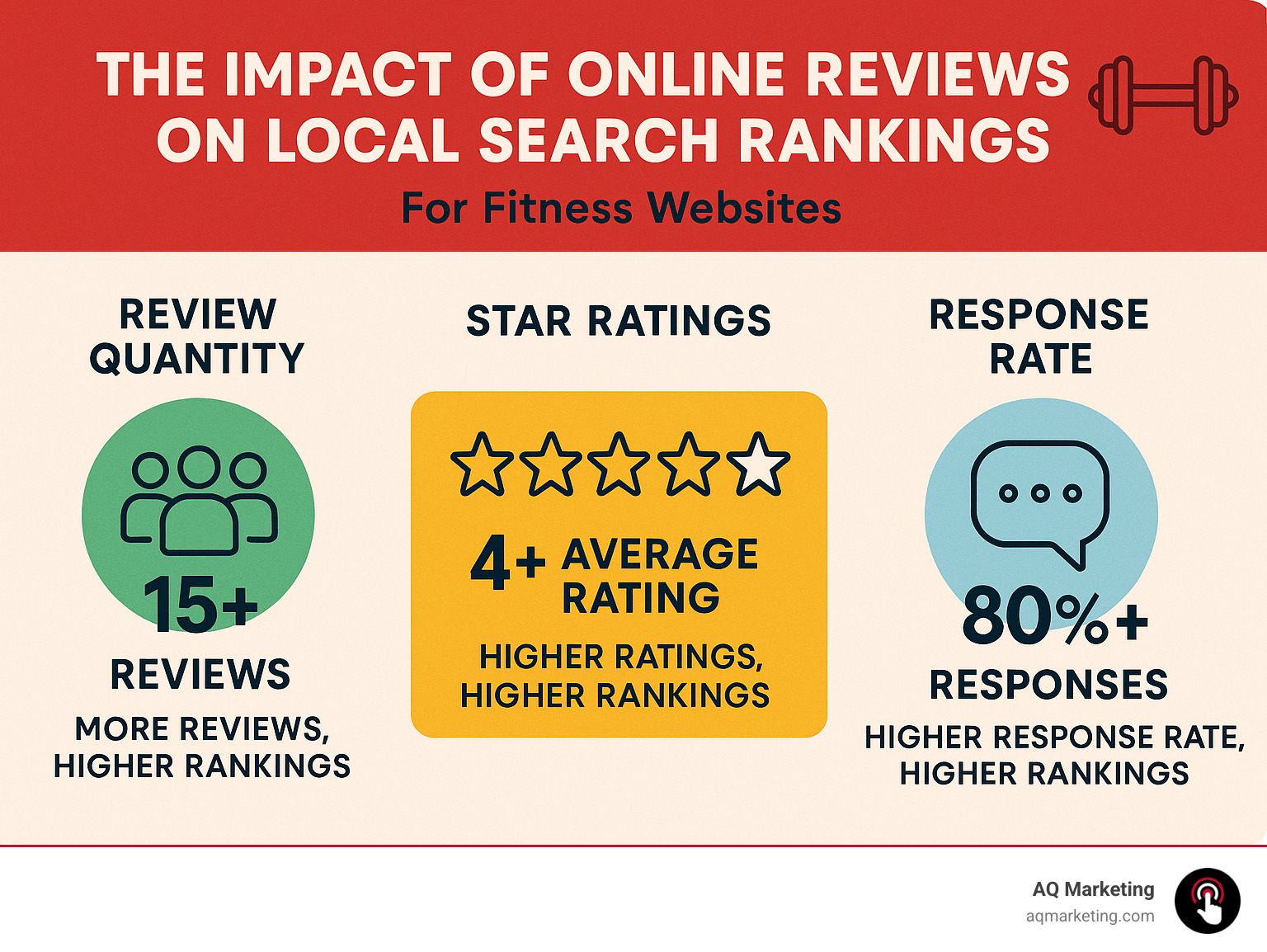
• Encourage reviews and answer each one; quality + quantity influence rankings.
• Publish location-centric content like “Best Running Routes in Woburn.”
• Create pages for nearby towns (Winchester, Burlington, Stoneham) to widen reach.
Organic Results vs. Paid Ads
Organic visibility builds authority, costs nothing per click, and compounds over time. Ads vanish the instant you stop paying. In Neil Patel’s CTR study, natural results received 18 × more clicks than paid placements – an advantage you simply can’t buy.
Building a Muscular Keyword Strategy
Keyword research is your SEO workout plan. Skip vague terms like “workout” and chase phrases that show intent and include geography.
Buyer keywords (high intent)
• “join gym Woburn”
• “personal trainer for weight loss Boston”
Research keywords (top-of-funnel)
• “HIIT benefits”
• “how to lose belly fat”
Long-tail combos face less competition and convert better. Google Keyword Planner or Ubersuggest reveal volume; aim for phrases with 50–100 local searches a month.
Fast 4-Step Keyword Process for Gyms
- List every service – personal training, group classes, nutrition coaching.
- Add location modifiers for each surrounding town.
- Check volume & difficulty; skip phrases with almost no searches.
- Note competitor gaps – if no one ranks for “women-only gym Middlesex County,” own it.
High-Intent Fitness Keywords to Watch in 2025
• “gym near me” – 276 000 searches/mo
• “yoga near me” – 117 000
• “personal trainer near me” – 30 000
• “hot yoga classes” – 46 000
• “HIIT workouts” – 71 000
Combine any of these with your city for faster wins.
For deeper tactics, see our SEO Tools guide.
On-Page Optimization: Tone Your Fitness Site’s Core
On-page SEO is your website’s exercise form. Nail the fundamentals:
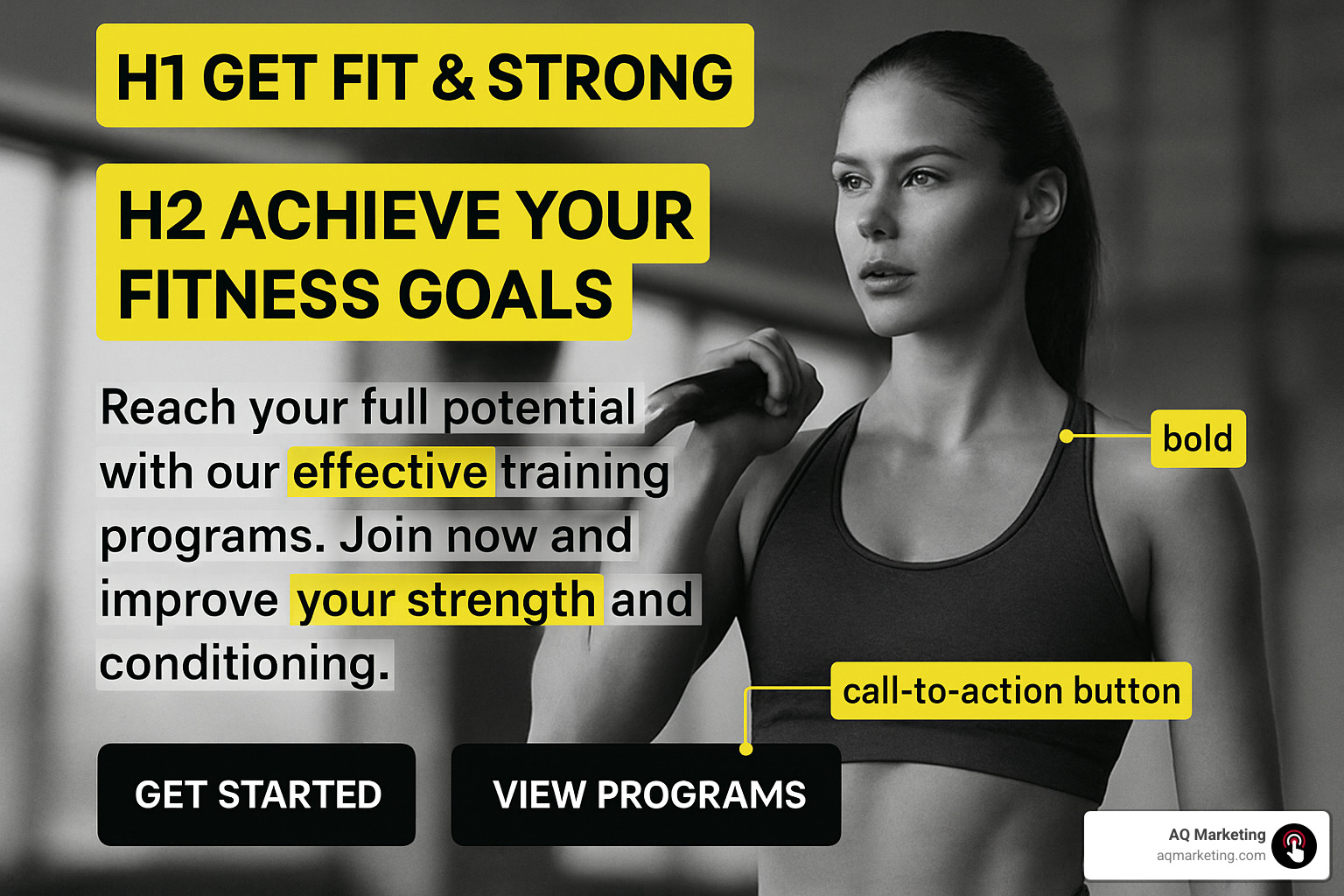
• H1 = primary keyword + location (“Personal Training in Woburn, MA”)
• H2s explain services (“Group Fitness Classes,” “Nutrition Coaching”)
• Meta description <160 characters + clear CTA
• Descriptive image alt text (<125 characters)
• Clean URLs (yourgym.com/hot-yoga-woburn)
• Internal links guiding readers from blog posts to class pages
• Schema markup for hours, prices, and reviews
Our On-Page SEO Services can handle the nitty-gritty, but many tasks are DIY-friendly.
Building a Strong Service Page
Write 700–1 000 words answering what’s offered, cost, schedule, and how to join. Place your main keyword early, once in bold or italics, and again near the end – no stuffing.
Optimized vs. Non-Optimized At a Glance
| Element | Optimized | Non-Optimized |
|---|---|---|
| Title Tag | “Hot Yoga Classes Boston – Heated Vinyasa & Bikram | AQ Yoga” | “Classes – AQ Yoga” |
| Load Time | 2.1 s | 5.8 s |
| Conversion Rate | 4.2 % | 1.1 % |
| Monthly Organic Traffic | 847 | 23 |
| Local Ranking | #3 | #47 |
A few strategic tweaks can multiply traffic and leads without spending another dime on advertising.
Local & Off-Page Gains: From Neighborhood Star to Authority
Google judges your gym by the company you keep online.
• Citations: identical NAP on directories, chamber sites, and local blogs.
• Google Business Profile: real-member photos, accurate hours, complete services.
• Reviews: ask after a win and reply to every review within 24 hours.
• Partnerships: trade backlinks with nutrition stores, PT clinics, wellness blogs.
• HARO & guest posts: a single quote in a health article can secure a powerful backlink.
• Community events: sponsoring a 5K or leading free park bootcamps earns media coverage and local links.
Track citations with WhiteSpark or BrightLocal and explore more ideas in our Small Business SEO Strategies guide.
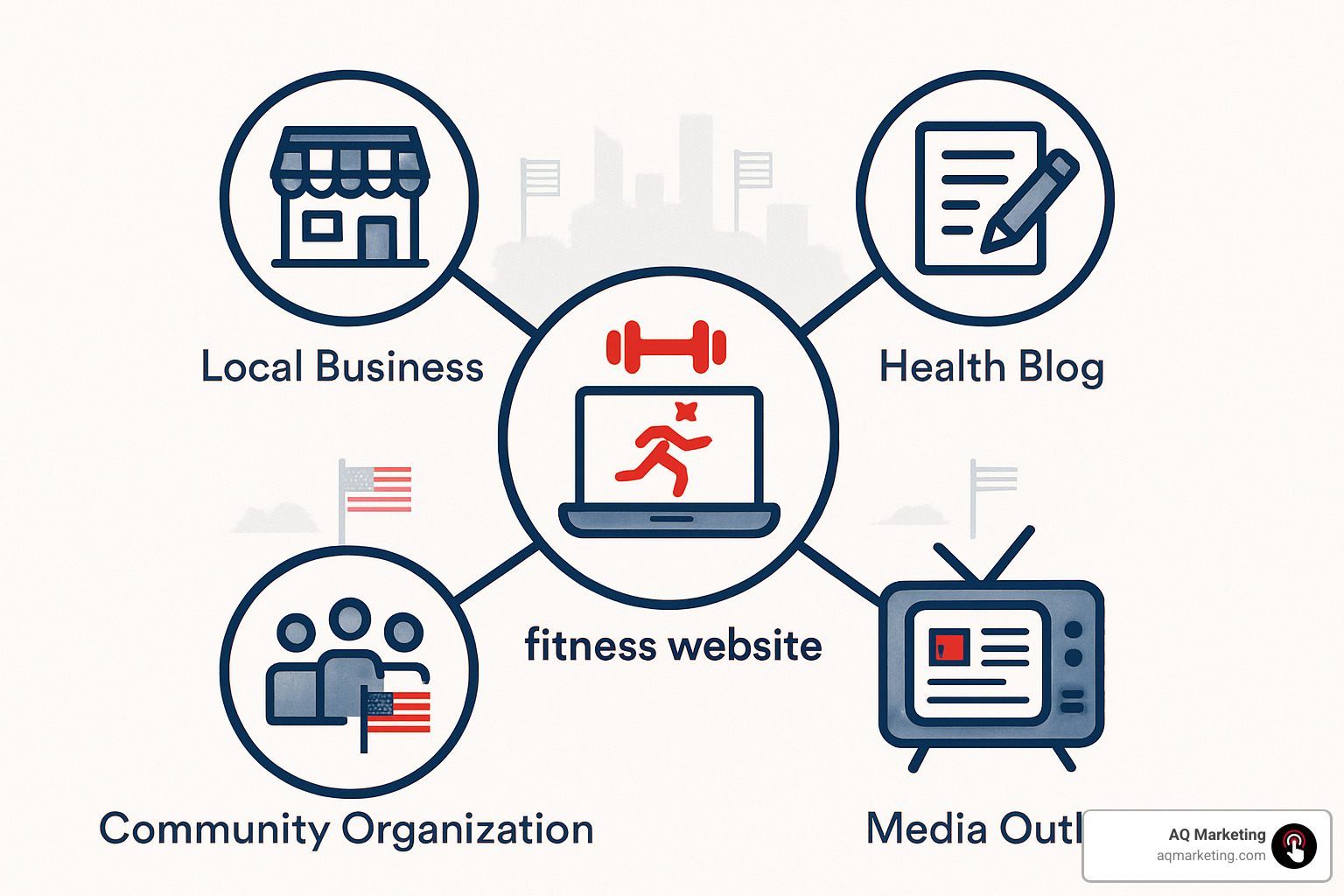
Even a handful of relevant local links can push your site into Google’s coveted three-pack for “gym near me.”
Technical Fitness & Performance Tracking
A stylish front desk won’t matter if the building’s foundation is cracked; technical SEO is that foundation.
Essentials:
• Mobile-friendly design – test on multiple devices.
• Page speed – aim for Google PageSpeed score 60+; compress images, enable caching.
• HTTPS everywhere – users expect the padlock.
• Core Web Vitals – Largest Contentful Paint, First Input Delay, CLS.
• XML sitemap + robots.txt submitted to Google Search Console & Bing.
• Schema for classes, trainers, hours, and reviews.
• Voice-search phrasing (“best fitness center near me with pool”).
Use the tools in our Best SEO Tools for Small Businesses post to monitor progress.
Measure, Adjust, Repeat
- Track organic visits in Google Analytics.
- Set goals for membership enquiries and class bookings.
- Check keyword positions in Search Console, concentrating on local terms.
- Produce monthly reports; double-down on what moves the needle, fix what doesn’t.
Like training, small technical tweaks performed consistently produce big, lasting gains.
Frequently Asked Questions about Fitness SEO
Do I need a blog if my gym is active on social media?
Your social media posts are fantastic for building community, but they won’t help people find your gym through Google searches. SEO for fitness websites requires content that search engines can actually read and rank – and that means having a blog on your own website.
Think about it this way: when someone searches “best HIIT workouts for beginners,” they’re not looking through Instagram posts. They want detailed, helpful articles that answer their questions. A blog post about beginner HIIT routines on your website can attract these searchers and introduce them to your gym.
Your blog also gives you a place to naturally include keywords like “personal training in [your city]” or “yoga classes near me.” Social media platforms limit how you can optimize for search, but your blog gives you complete control.
The real magic happens when blog visitors become members. Someone might find your article about proper deadlift form, then notice you offer personal training sessions. That’s a conversion path social media alone can’t provide.
How long before SEO results show for local gyms?
I wish I could tell you it happens overnight, but SEO for fitness websites is more like strength training – you need consistency to see results. Most gym owners notice small improvements within the first 3-6 months, with more dramatic changes happening after 6-12 months of steady effort.
The good news? Local SEO often works faster than trying to rank nationally. You’re competing against other gyms in your area, not every fitness website in the world.
Some changes show results quickly. Optimizing your Google Business Profile with better photos and encouraging member reviews can boost your visibility within weeks. Fixing technical issues like slow loading times also provides quick wins.
Building real authority takes longer. Creating quality content, earning backlinks from local businesses, and establishing trust with search engines requires patience. But once you build that foundation, your rankings become much more stable and valuable.
Can I handle SEO myself or hire an expert?
You can definitely tackle some SEO for fitness websites tasks yourself. Updating your Google Business Profile, writing blog posts about fitness topics, and optimizing your page titles don’t require technical expertise. Many gym owners successfully handle these basics.
The challenge comes with more complex tasks. Technical SEO audits, building quality backlinks, and developing comprehensive keyword strategies often need professional knowledge. These areas can make or break your SEO success.
Consider your available time honestly. Running a gym is demanding work. If you’re already stretched thin with classes, member management, and business operations, trying to learn SEO might spread you too thin.
Professional SEO help lets you focus on what you do best – helping members achieve their fitness goals – while experts handle your online visibility. At AQ Marketing, we’ve helped fitness businesses in the Woburn area and beyond build strong online presences that drive real membership growth.
The decision often comes down to whether you want to learn a new skill set or invest in proven expertise that delivers results faster.
Conclusion
Your journey with SEO for fitness websites starts today, but the results will keep building for years to come. Think of it like strength training – you won’t see massive changes overnight, but consistent effort creates incredible change.
The roadmap is clear: start with your Google Business Profile and local keywords, then strengthen your website’s technical foundation. Build authority through helpful content and genuine community connections. Most importantly, keep showing up consistently.
Continuous improvement beats perfection every time. Your competitors might launch flashy campaigns or try quick fixes, but steady progress with quality content and authentic member relationships wins the long game. Each blog post you publish, every positive review you earn, and all the local partnerships you build compound into serious online authority.
SEO for fitness websites isn’t just about getting found – it’s about connecting with people who genuinely need what you offer. When someone searches “personal trainer near me” at 2 AM because they’re finally ready to change their life, your optimized website could be the bridge between their decision and their change.
At AQ Marketing, we’ve watched fitness businesses throughout the Merrimack Valley grow from struggling with empty classes to turning away new members. Since 2003, we’ve seen how the right digital strategy transforms not just websites, but entire businesses and the communities they serve.
Your gym has the power to change lives. Our job is making sure the right people can find you when they’re ready to start that journey. Ready to turn your fitness website into a membership magnet? Learn more about our custom website design services and find how we can help your business sweat less and rank more.