

Understanding the Financial Reality of Launching Your Marketing Effort
Marketing costs for a startup typically range from 10% to 20% of planned annual revenue. Here is a quick breakdown:
- Early-Stage: $5,000-$10,000 monthly (~10% of revenue)
- Growth-Stage: 25%-50% of total budget
- SaaS Companies: 80%-120% of annual revenue (marketing + sales)
- Industry Average: 9.4% of total revenue (2024 CMO Survey)
Core Budget Categories:
- Website development and hosting
- Search engine optimization (SEO)
- Digital advertising (PPC, social media)
- Content creation and email marketing
- Marketing technology (MarTech)
Startups face unique challenges: limited revenue, uncertain market fit, and the need to build brand awareness from scratch. Research shows that underfunding marketing leads to stagnation, while overspending without strategy burns capital. The average marketing budget is around 9.5% of revenue, but startups often invest 10% to 20% to break through market noise.
As President and CEO of AQ Marketing, I have guided many startups through the complexities of marketing costs for a startup. My goal is to help you allocate your budget for maximum impact, from initial brand development to scaled growth.
Simple marketing costs for a startup word guide:
- cost effective marketing strategies
- how to create marketing budget
- average marketing agency budget for small businesses
Why a Strategic Marketing Budget is Essential for Growth
Starting a business in Massachusetts requires a clear understanding of your marketing costs for a startup. A budget is a strategic blueprint for reaching your audience and driving revenue. Here is why it is essential:
- Resource Allocation: For startups with limited capital, a budget ensures you invest in the most effective channels rather than just spending.
- Performance Measurement: By tracking spending against metrics like customer acquisition cost (CAC) and ROI, marketing becomes a data-driven science.
- Brand Building & Research: Consistent messaging and market research provide insights that inform product development and market positioning, especially in competitive areas like Boston.
- Scalability & Investor Attraction: A well-planned budget signals strategic growth, making your business more appealing to potential investors.
- Customer Retention: Retaining customers is more cost-effective than acquiring new ones. Your budget should include loyalty strategies.
In 2024, The CMO Survey found that marketing budgets accounted for 9.4% of total revenue. These figures highlight marketing as a vital investment for longevity. For more insights, explore our digital marketing for small business guide.
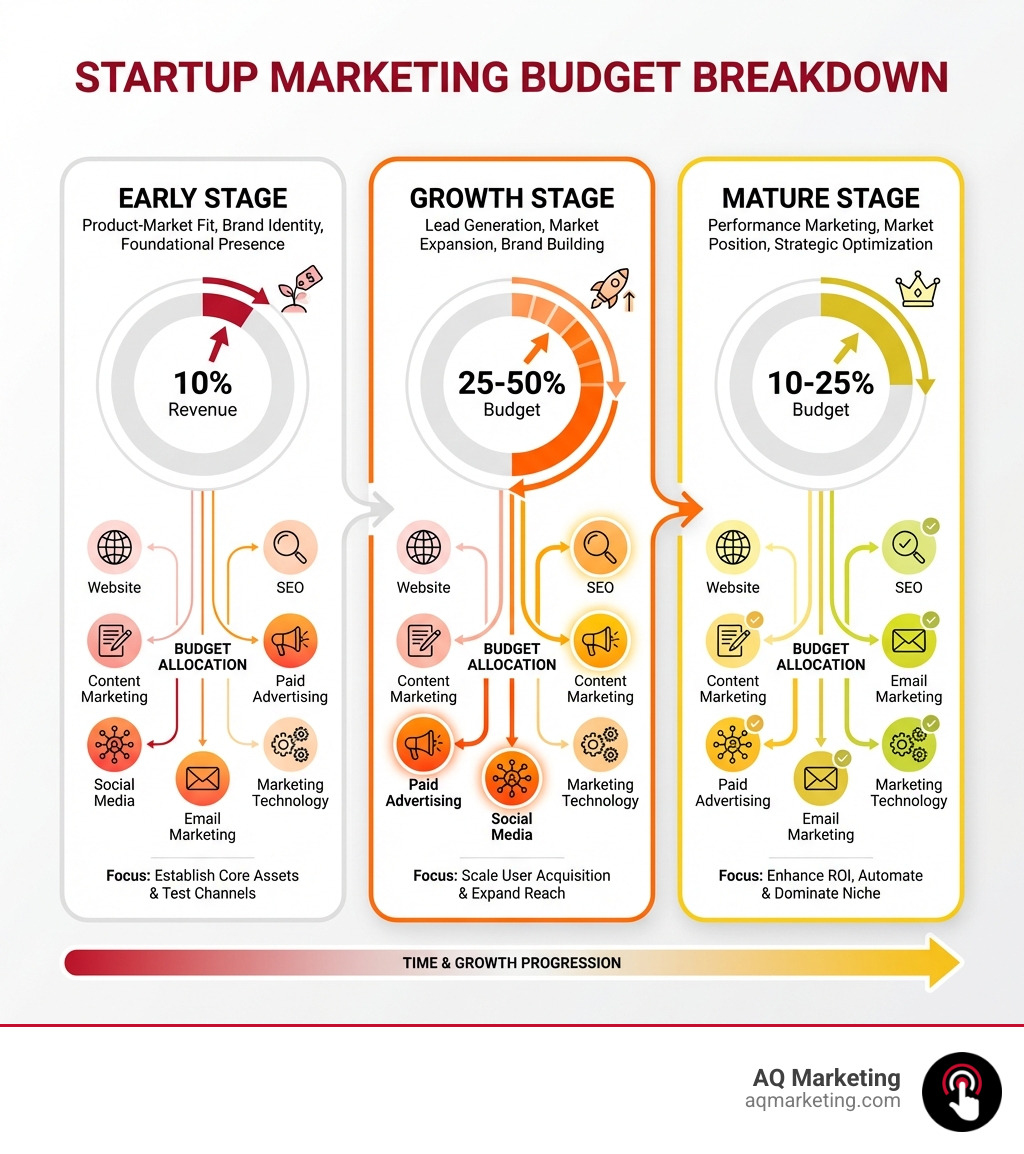
Benchmarking Marketing Costs for a Startup by Growth Stage
The amount you allocate for marketing costs for a startup evolves as your business matures.
| Growth Stage | Marketing Budget Allocation | Primary Focus |
|---|---|---|
| Early-Stage | ~10% of planned revenue | Product-market fit, brand identity, basic presence. |
| Growth-Stage | 25%-50% of total budget | Lead generation, market expansion, scaling. |
| Mature-Stage | 10%-25% of total budget | Performance marketing, retention, optimization. |
Marketing costs for a startup in the Early Stage
In the nascent phase, the focus is on proving your concept. Early-stage startups typically spend around 10% of planned annual revenue, or $5,000 to $10,000 monthly. This funds product-market fit research, core brand identity, and a foundational online presence to establish a foothold in local markets like Woburn, MA.
Scaling Marketing Costs for a Startup in the Growth Phase
Once you secure funding, it is time to accelerate. Companies often dedicate 25%-50% of their budget to marketing. For SaaS businesses, marketing and sales expenses can range from 80% to 120% of annual revenue. This investment fuels aggressive lead generation, market expansion, and widespread brand recognition.
Essential Components of a Startup Marketing Budget
Building a budget requires understanding the core components of marketing costs for a startup. Pricing listed is based on average online data and does not represent AQ Marketing’s actual pricing. Industry ranges vary widely; for example, while basic branding might average $500, high-end agency packages can exceed $1,500, or even $15,000 for comprehensive initiatives.
- Website Development & Hosting: Your digital storefront.
- Cost: Builders cost $15-$59/mo. Custom development ranges from $3,000 to $30,000+, depending on complexity. Hosting is $10-$100+/mo. AQ Marketing specializes in website design and development for small businesses.
- Search Engine Optimization (SEO): Getting found organically.
- Cost: Professional SEO services can cost $500 to $5,000+ per month. Our search engine optimization services focus on visibility for Massachusetts customers.
- Social Media Marketing: Engaging your audience.
- Cost: Organic is free; paid ads start at $100-$500/mo and can scale to $1,500+. We offer social media marketing services to craft engaging content.
- Content Creation: Building authority.
- Cost: Blog posts range from $50 to $500+; video production from $500 to $10,000+ per minute.
- Email Marketing: Direct communication.
- Cost: Platforms range from $15 to $150+ per month for paid plans.
- Digital Advertising (PPC): Immediate visibility.
- Cost: Ad spend often starts at $1,000/mo and can scale to $10,000+. Agency management fees are typically 10-20% of spend.
- Marketing Technology (MarTech): Tools for efficiency.
- Cost: CRM and automation tools range from $50 to $1,000+ per month.
- Branding & Design: Visual identity.
- Cost: Logo design ranges from $100 to $1,000+ for comprehensive packages.
Strategic Factors Influencing Your Marketing Costs for a Startup
Several factors influence the ideal marketing costs for a startup:
- Sales Cycle Length: Long cycles (B2B) require more funds for lead nurturing and content. Short cycles (B2C) allow for direct-response ads.
- Competitor Behavior & Market Saturation: Saturated markets like Boston demand higher budgets to cut through noise. Niche markets may allow for more modest spending.
- Customer Acquisition Cost (CAC): Understanding your CAC helps determine profitable spend. If CAC is too high relative to lifetime value, the model is unsustainable.
- Customer Lifetime Value (CLV): A high customer lifetime value justifies a higher upfront acquisition investment.
- Retention & Switching Costs: High retention reduces acquisition pressure. High switching costs mean marketing must focus on superior value to overcome customer inertia.
- Entry Barriers: High barriers offer stability once established, while low barriers require constant investment to defend market share.
By considering these factors, you can build a custom budget that supports your startup’s unique path.
Managing and Optimizing Your Marketing Spend
Effective management ensures every dollar spent on marketing costs for a startup contributes to growth.
Calculating and Managing Customer Acquisition Cost (CAC)
CAC is total marketing/sales expenses divided by new customers. If you spend $5,000 to get 50 customers, your CAC is $100. The goal is to keep CAC low relative to CLV. A 5:1 ratio is excellent. Making $5 for every $1 spent is generally considered a good ROI.
Marketing Team Structure
- In-House: Offers deep product knowledge but can be expensive due to salaries and benefits.
- Agency: Provides specialized expertise and tried-and-true tactics. Agencies like AQ Marketing deliver long-term results for industries like home services.
- Blended: Combines internal strategy with agency execution for SEO, PPC, or design. This is often the most efficient model for Massachusetts small businesses. BDC suggests small business marketing costs average just over $30,000 annually.
Best Practices for Optimization
- Set SMART Goals: Tie every activity to measurable outcomes.
- Track Everything: Use analytics to monitor spend, traffic, and ROI.
- Regular Reviews: Evaluate the results monthly. Reallocate funds from underperforming channels to successful ones.
- Contingency Planning: Set aside 10-15% for unexpected opportunities or algorithm changes.
- Leverage SEO & Content: These provide compounding returns over time, reducing long-term acquisition costs.
Frequently Asked Questions about Startup Marketing Costs
What percentage of revenue should a startup spend on marketing?
Most businesses allocate 5% to 10% of revenue. However, startups in a growth phase, especially in competitive areas like Boston, often spend 10% to 20%. SaaS companies may spend 80% to 120% of revenue on marketing and sales combined to fuel rapid expansion.
How do I calculate Customer Acquisition Cost (CAC)?
CAC = (Total Marketing & Sales Expenses) / (Number of New Customers Acquired)
Include ad spend, salaries, software, and agency fees. Aim for a Customer Lifetime Value (CLV) that is at least 3x your CAC for a sustainable business model.
What are the most cost-effective marketing channels for new businesses?
- SEO: Provides long-term organic traffic and compounds in value.
- Content Marketing: Establishes authority and can be repurposed across channels.
- Email Marketing: High ROI because you own the audience.
- Google Business Profile: Essential for local visibility in areas like Woburn, MA.
- Referral Programs: Low-cost acquisition that leverages existing customer trust.
Conclusion
Navigating marketing costs for a startup can seem complex, but with a strategic approach, it becomes a powerful engine for growth. We’ve explored why a well-defined budget is essential, how it shifts across startup stages, the key components to include, and the strategic factors that influence our spending decisions.
Marketing isn’t just an expense; it’s an investment in our future. By carefully planning, diligently monitoring, and continuously optimizing our marketing efforts, we can ensure every dollar works hard to build our brand, attract customers, and drive sustainable growth.
At AQ Marketing, we understand the unique challenges faced by startups and small to medium-sized businesses in Massachusetts. Since 2003, we’ve specialized in helping companies improve their online presence and achieve long-term, impactful results. Whether you need a new website, robust SEO, engaging social media management, or targeted digital advertising, we’re here to help you make the most of your marketing budget.
Ready to transform your digital presence and achieve your business goals? Learn more about our comprehensive digital marketing services and let us help you build a marketing strategy that delivers.
