

Why Your Website Data is Your Most Valuable Asset
Insurance website analytics are the tools and metrics that measure how visitors interact with your insurance agency’s website, helping you understand what’s working, what’s not, and where to invest your marketing dollars for the best return.
Key Insurance Website Analytics to Track:
- Traffic Metrics: Total visits, traffic sources, new vs. returning visitors
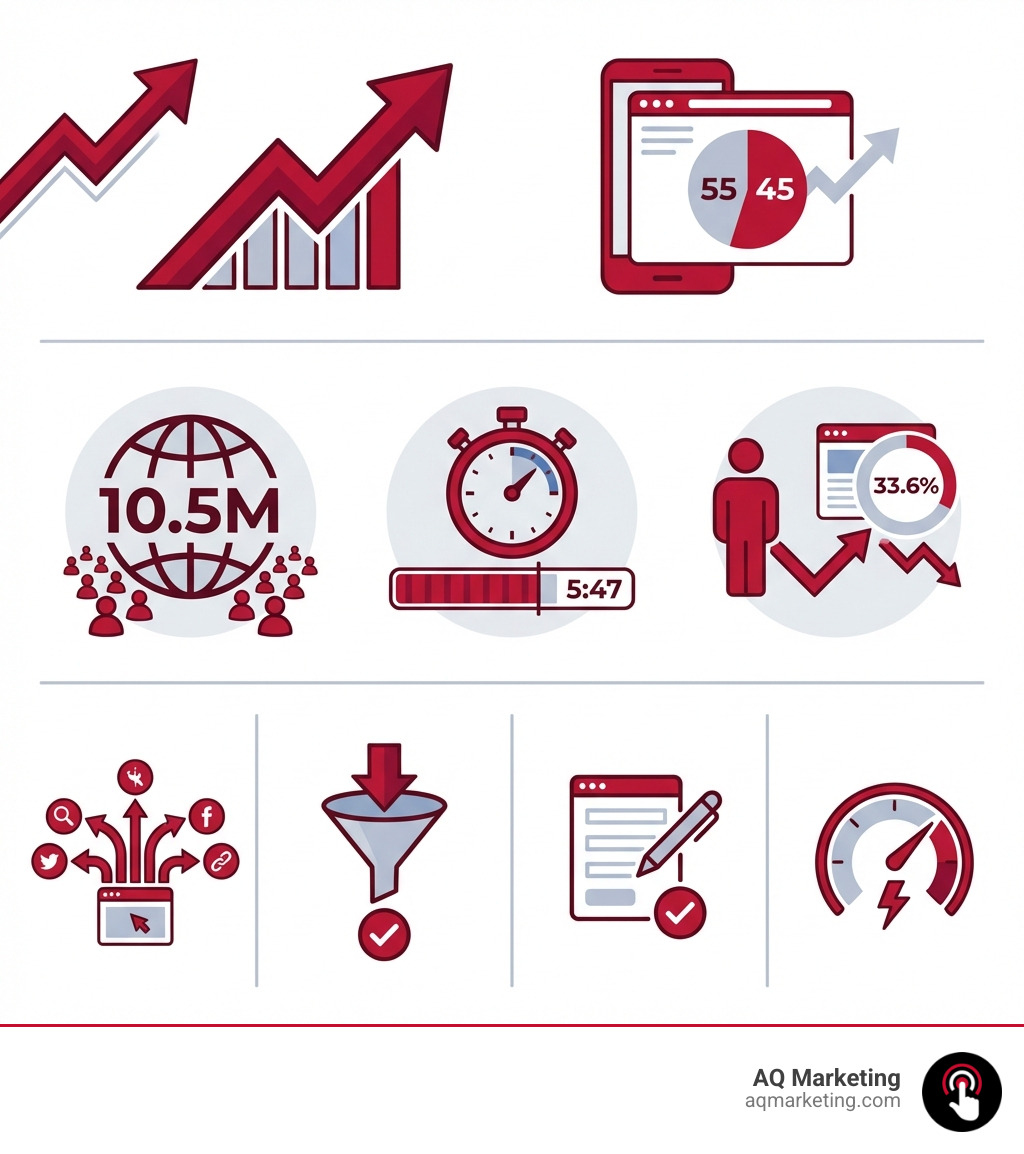
- Engagement Metrics: Bounce rate (33.6% average), session duration (5:47 average), pages per visit
- Conversion Metrics: Quote requests, form completions, phone calls, email sign-ups
- Technical Health: Page load speed, mobile performance, broken links
- User Behavior: Click patterns, scroll depth, drop-off points in forms
Your website is more than a digital brochure. It’s a 24/7 sales team, lead generator, and customer service representative all rolled into one. But without proper analytics, you’re flying blind—making decisions based on gut feeling rather than hard data.
The insurance industry has experienced a 33% year-over-year jump in web traffic, with 55% of visitors now coming from mobile devices. Meanwhile, a 2023 Deloitte survey found that 76% of insurance executives ranked data analytics as critical to modernizing their core business. The message is clear: agencies that master their website data gain a significant competitive advantage.
Yet many insurance agencies still struggle to understand what their numbers really mean. They see traffic counts and bounce rates but don’t know how to turn those metrics into actionable improvements that drive more qualified leads and policy sales.
The good news? You don’t need to be a data scientist to leverage website analytics effectively. You just need to focus on the right metrics and understand what they’re telling you about your customers’ journey.
I’m Robert P. Dickey, President and CEO of AQ Marketing, and over the past 20+ years, I’ve helped insurance agencies transform their digital presence through strategic use of insurance website analytics. In this guide, I’ll show you exactly which metrics matter most and how to use them to grow your agency.
Know your insurance website analytics terms:
The Core Four: Essential Metrics Every Insurance Agency Must Track
To truly understand your insurance agency’s online performance, we need to look beyond surface-level numbers. Just as a well-rounded financial portfolio requires diverse investments, a robust digital strategy demands a comprehensive view of your website’s health. We’ve identified “The Core Four” categories of metrics that every insurance agency, from Boston to the Berkshires, should monitor. These foundational metrics, as highlighted by sources like The Hartford, provide a clear picture of your website’s effectiveness in attracting, engaging, and converting potential clients.
Traffic and User Engagement Metrics
These metrics tell us who is visiting your site and what they do once they arrive. They are crucial for understanding the initial touchpoints of your customer journey.
- Website Traffic: This is the total number of visitors to your site. It’s a fundamental indicator of your online visibility. While the average monthly visits to the top 10 insurance websites stood at an impressive 10.5 million, even smaller, local agencies in places like Woburn or Cambridge can set realistic traffic goals and track their progress.
- Traffic Sources: Where do your visitors come from? Are they finding you through organic search, paid ads, social media, or direct visits? Understanding these sources allows us to pinpoint which marketing efforts are driving the most potential clients to your website. For instance, if organic search traffic is low, we might need to focus on insurance SEO agency strategies.
- Session Duration: This metric indicates how long visitors stay on your website during a single visit. The average session duration on top insurance websites is 5 minutes and 47 seconds. A longer duration generally suggests that visitors are finding your content helpful and engaging. If users are spending very little time on key pages, it might signal a need to improve the content or user experience.
- Bounce Rate: This is the percentage of visitors who leave your website after viewing only one page. The average bounce rate for top insurance websites is 33.6%. While a high bounce rate can sometimes indicate that visitors aren’t finding what they need or that the page isn’t relevant to their search, it’s important to consider context. For example, a contact page or a single-page blog post might naturally have a higher bounce rate. However, on critical landing pages, a high bounce rate often means we need to adjust content, design, or calls to action.
- Top Pages: Knowing which pages are most frequently visited helps us understand what content resonates most with your audience. If a specific insurance product page in Massachusetts is consistently popular, we might want to improve it further or create more related content.
- New vs. Returning Users: This distinction helps us measure brand awareness and customer loyalty. A healthy mix shows you’re attracting new prospects while retaining the interest of existing clients. For a deeper dive into what these numbers truly signify, refer to our guide on what do website analytics really mean?.
Conversion and Lead Generation Metrics
These are the metrics that directly impact your bottom line, showing how effectively your website turns visitors into tangible leads and customers.
- Conversion Rate: Arguably the most critical metric for an insurance agency’s website, the conversion rate measures the percentage of visitors who complete a desired action, such as filling out a quote form or calling your office. For instance, if 100 people visit your “auto insurance” page and 5 request a quote, your conversion rate for that page is 5%. Our goal at AQ Marketing is always to optimize this rate, turning more visitors into qualified leads.
- Quote Form Submissions: This is a direct measure of interest. Tracking the number of completed quote forms is essential. It’s not just about quantity; we also consider the quality of these submissions.
- Click-Through Rate (CTR): For buttons like “Get a Quote” or “Contact Us,” CTR indicates how many visitors click on these vital lead-generating calls to action. A low CTR might suggest that your calls to action aren’t clear, compelling, or well-placed.
- Form Completion Rate: Online forms are often the primary way insurance agencies capture leads. Monitoring this rate helps identify issues with form complexity or length that might cause visitors to abandon the process. If a form is too long or confusing, potential clients in Springfield or Worcester might give up before submitting.
- Cost Per Acquisition (CPA): If you’re running paid campaigns, CPA tells you how much it costs to acquire a new lead or customer through your website. This is vital for evaluating the efficiency of your paid search marketing campaigns.
- Phone Calls from Website: Many insurance clients prefer to speak directly with an agent. Tracking phone calls initiated from your website (especially click-to-call buttons on mobile) is a direct measure of high-intent leads.
- Common Conversion Goals for Insurance Sites:
- Quote Request Submissions (Auto, Home, Life, Business)
- Contact Form Submissions
- Newsletter Sign-ups
- Policy Information Downloads (e.g., “Understanding Your Homeowners Policy”)
- Live Chat Engagements
- “Find an Agent” Tool Usage
- Direct Phone Calls
- Scheduling Consultations
By focusing on these metrics, we can create effective insurance selling strategies that leverage your website’s full potential.
From Data to Decisions: Using Analytics to Drive Growth and ROI
Understanding your website metrics is just the first step. The real magic happens when we translate that data into actionable strategies that improve customer acquisition, boost retention, and optimize your sales funnel. This data-driven approach is fundamental to effective digital marketing for insurance companies.

Optimizing Your Sales Funnel and Form Completion
Your website’s sales funnel is the path visitors take from initial interest to becoming a client. Insurance website analytics provide the insights needed to refine this journey.
- User Flow Analysis: By mapping out how users steer your site, we can identify common paths and, more importantly, where they drop off. Are prospects leaving your “get a quote” page before completion? This is a critical friction point.
- Funnel Visualization: Tools allow us to visualize the steps users take towards a conversion, highlighting bottlenecks. For example, if many users start an application but few finish, we know exactly where to focus our efforts.
- Drop-off Points: Pinpointing where users abandon a process (like a multi-step quote form) is invaluable. Is it a confusing question? Too many fields? A technical glitch?
- Form Analytics: Detailed analytics on your online forms can show which specific fields cause hesitation or abandonment. Online forms are often the main way insurance agencies capture leads, so optimizing them is crucial. Simplifying forms or breaking them into smaller, manageable steps can significantly improve completion rates.
- A/B Testing CTAs: We can test different versions of calls to action (CTAs)—varying text, color, placement—to see which performs best. This iterative process helps maximize clicks and conversions.
- Heatmaps: These visual tools show where users click, move their mouse, and scroll on a page. They reveal areas of interest and neglect, helping us understand user behavior without relying solely on numerical data.
- Improving User Experience: All these efforts are geared towards enhancing the user experience (UX). A seamless, intuitive, and trustworthy website experience is paramount for converting insurance prospects. After all, if your website UX is impacting conversions, we need to address it head-on.
Refining Marketing Strategies with Traffic Analysis
Understanding where your traffic comes from and how different demographics interact with your site allows us to fine-tune your marketing campaigns, ensuring they reach the right audience in the right way.
- Traffic Sources (Organic, Paid, Social, Direct): By analyzing the performance of each traffic source, we can allocate your marketing budget more effectively. If organic search is bringing in high-quality leads, we’ll double down on search engine optimization. If paid ads are delivering a great ROI, we might scale those campaigns.
- Campaign Tracking: Dedicated tracking for each marketing campaign (e.g., a new ad promoting home insurance in Plymouth) allows us to measure its direct impact on website traffic and conversions.
- Keyword Performance: For insurance agencies in Boston or across Massachusetts, knowing which keywords drive traffic and conversions is vital for SEO and content strategy. If “affordable car insurance Newton MA” is a high-performing keyword, we’ll ensure your content is optimized for it.
- Mobile vs. Desktop Usage: With 55% of traffic to top insurance sites coming from mobile, and the 25-34 year-olds (the industry’s largest demographic at 22-24%) preferring mobile devices for purchases, optimizing for mobile is non-negotiable. This insight informs decisions about responsive design and mobile-specific features.
- Demographic Data: Understanding the age, location, and interests of your website visitors helps us tailor marketing messages and product offerings. For instance, if your target audience is primarily in the 25-34 age range, your content and website experience should cater to their digital habits.
Beyond the Numbers: Advanced Insurance Website Analytics
While basic metrics give us a good overview, truly understanding customer behavior and identifying friction points requires a deeper dive. This is where advanced insurance website analytics and website intelligence come into play, helping us see the “why” behind the numbers. Companies excelling in customer experience can even see significant gains in Total Shareholder Return, with life insurers seeing 20% more and P&C insurers 65% more between 2017 and 2022.
Understanding Customer Behavior with Insurance Website Analytics
Traditional analytics tools often provide aggregated data, showing us what happened (e.g., a high bounce rate) but not why. Advanced tools offer qualitative insights that fill this gap.
- Session Replays: Imagine watching a video of a user’s journey on your website—seeing every click, scroll, and form interaction. Session replays provide this invaluable context, showing exactly where users struggle or get confused. This is particularly useful for identifying issues on complex quote forms or policy management portals. The ability to gain such clear visibility into user interactions is critical, especially given the limitations of traditional analytics.
- Click Maps: These visual overlays show where users click on your pages, highlighting popular elements and overlooked areas. If a key CTA isn’t getting clicks, a click map will reveal it.
- Scroll Maps: Scroll maps illustrate how far down a page users scroll. If important information or CTAs are below the fold (not visible without scrolling) and users aren’t reaching them, a scroll map will expose this.
- Identifying User Frustration: By combining session replays, click maps, and other behavioral data, we can spot signs of user frustration, such as repetitive clicking, rage clicks, or frantic scrolling. Addressing these friction points can dramatically improve user experience and conversion rates.
- Understanding the ‘Why’ Behind Metrics: Advanced analytics moves us beyond just reporting numbers. It helps us answer questions like: “Why did 80% of users drop off on the third step of the application?” or “What did the customer experience when they left that negative survey feedback?”
- Real-time Data Benefits: Real-time web analytics allow insurance agencies to make data-driven decisions on the fly. If a new campaign launches and we see unexpected user behavior, we can react immediately, preventing lost leads or revenue. This immediate insight helps us stay ahead of user needs and quickly resolve issues, offering significant benefits for agencies right here in Massachusetts.
Choosing the Right Tools for Insurance Website Analytics
The landscape of insurance website analytics tools is vast, ranging from basic, free options to sophisticated, enterprise-level platforms. Choosing the right one depends on your agency’s needs and goals.
- Traditional Analytics Limitations: Tools like Google Analytics, while powerful for quantitative data, often have limitations. As noted in our research, GA4 can sometimes rely on sampled data, which might not provide a complete or precise picture, especially for websites with high traffic. Extracting and manipulating data can also be complex for those without technical expertise. More importantly, aggregated data (clicks, sessions, time on page) often fails to explain the why behind user drop-offs.
- Sampled vs. Unsampled Data: For insurance and financial services, precision is paramount. Solutions that offer unsampled, raw data provide a complete and accurate picture of user interactions, ensuring no critical behavior is missed.
- Benefits of Integrated Platforms: Modern analytics platforms often integrate various features—from traditional metrics to session replays and heatmaps—into a single, user-friendly interface. This holistic view simplifies data analysis and makes it accessible for agency owners and marketing teams.
Here’s a comparison of features you might find in different types of analytics tools:
| Feature | Basic Analytics (e.g., Google Analytics) | Advanced Intelligence Tools (e.g., Insightech, Quantum Metric) |
|---|---|---|
| Traffic Counts | Yes | Yes |
| Bounce Rate | Yes | Yes |
| Session Duration | Yes | Yes |
| Traffic Sources | Yes | Yes |
| Conversion Goals | Yes | Yes |
| Page Load Speed Reports | Yes (integrated with other tools) | Yes (often with deeper insights) |
| Mobile Usage Data | Yes | Yes |
| Data Sampling | Can occur | Typically unsampled, raw data |
| Session Replay | No | Yes |
| Heatmaps/Click Maps | No | Yes |
| Form Analysis (detailed) | Limited | Yes (identifies specific field issues) |
| User Journey Mapping | Basic | Advanced, visual |
| Friction Point Identification | Inferred | Direct observation (through replays) |
| Real-time User Monitoring | Limited | Yes |
For a comprehensive understanding of which metrics truly matter for your digital strategy, explore our guide on digital marketing metrics that matter.
The Foundation of Performance: Technical Health and User Experience
Even with the best content and marketing strategies, a technically flawed website can derail your efforts. For insurance agencies, a fast, mobile-friendly, and secure website isn’t just a convenience—it’s a necessity that impacts everything from search engine ranking to user satisfaction and, ultimately, conversion rates. This is part of the essential website design & management for insurance agents.
The Critical Role of Page Load Speed
Nobody likes a slow website, and your potential customers are no exception. In the world of digital insurance, a few seconds can make all the difference.
- Impact on Bounce Rate: If your site takes too long to load, visitors, especially those in a hurry to get a quote, will likely leave before it even finishes. This directly contributes to a higher bounce rate.
- Effect on Conversion Rates: A slow website creates a frustrating user experience, eroding trust and patience. This can lead to abandoned forms and lost leads, directly hurting your conversion rate. Our research indicates that page load times above 5 seconds can be tremendously costly.
- SEO Implications: Website speed is a confirmed Google ranking factor. Faster sites tend to rank higher in search results, meaning more organic traffic for your agency.
- Image Optimization: Large, unoptimized images are a common culprit for slow load times. We ensure images are compressed and properly sized without sacrificing quality.
- Browser Caching: Implementing browser caching allows returning visitors’ browsers to store parts of your website, making subsequent visits much faster.
Investing in robust web design and development services can significantly improve your website’s speed and overall performance.
Winning with Mobile Optimization
With more than half of all website traffic to top insurance sites now coming from mobile devices (55%), and with the largest demographic (25-34 year olds) preferring mobile for purchases, mobile optimization is paramount.
- Mobile-First Indexing: Google primarily uses the mobile version of your content for indexing and ranking. If your mobile site isn’t up to par, your search rankings will suffer.
- Responsive Design: This approach ensures your website automatically adapts to any screen size, providing an optimal viewing and interaction experience across desktops, tablets, and smartphones. Our responsive web design services ensure your site looks and functions perfectly on every device.
- Mobile Traffic Trends: The data is clear: mobile is king. Insurance agencies need to ensure their website provides a seamless and efficient experience for users on the go, whether they’re in Boston or the Cape.
- Millennial Preferences: This key demographic expects mobile convenience. Agencies that offer excellent mobile experiences, including easy navigation and quick access to information, will gain an advantage.
- Click-to-Call Functionality: For mobile users, a prominently displayed, clickable phone number is essential. It removes friction and makes it easy for prospects to connect with an agent directly.
Frequently Asked Questions about Insurance Website Analytics
How often should I check my website analytics?
Regular monitoring (weekly or bi-weekly) is ideal for tracking trends, while a deeper monthly analysis helps in strategic planning. The frequency depends on your marketing activities and traffic volume. For agencies running active campaigns, daily checks on key metrics might even be beneficial. The goal is to catch anomalies or opportunities early so we can react quickly.
What is a good bounce rate for an insurance website?
While the average for top insurance sites is around 33.6%, a “good” bounce rate varies by page type. Informational blog posts may have higher rates (as users find their answer and leave), while landing pages (like a quote request page) should aim for much lower rates. Generally, bounce rates between 26% and 40% are often considered excellent, while anything above 55-60% on critical conversion pages warrants investigation. Context is key, and we always analyze bounce rate in conjunction with other engagement metrics.
Can website analytics help with customer retention?
Yes, absolutely! By analyzing the behavior of existing customers within your client portal or specific policyholder-focused sections of your website, you can identify friction points in processes like making payments, submitting claims, or accessing policy documents. If many customers struggle with a particular task, it indicates a poor user experience that could lead to dissatisfaction. Addressing these issues, informed by analytics, allows you to improve the digital experience for current clients, fostering loyalty and increasing retention.
Conclusion: Turn Your Website Data into Your Greatest Asset
In today’s digital-first world, your insurance agency’s website is a powerful engine for growth. But like any engine, it needs regular diagnostics and fine-tuning to perform at its best. Insurance website analytics provide the essential insights to understand your audience, optimize your online presence, and drive tangible business results.
We’ve seen how crucial it is to monitor everything from basic traffic and engagement metrics to sophisticated user behavior insights. We’ve explored the limitations of traditional tools and the power of advanced platforms that offer raw data, session replays, and heatmaps to reveal the “why” behind user actions. And we’ve highlighted the foundational importance of technical health, including page load speed and mobile optimization, for a superior user experience.
The insurance industry is undergoing a technological change, with data analytics at its core. Agencies that accept a data-driven approach gain a significant competitive advantage, improving customer acquisition, boosting retention, and enhancing their overall profitability. By continuously measuring, analyzing, and optimizing your website based on these insights, you can transform your digital presence from a mere brochure into your agency’s greatest asset.
To effectively implement these strategies and transform your data into measurable growth, explore our comprehensive Digital Marketing for Insurance Companies services. Our team at AQ Marketing, based in Woburn, MA, specializes in helping businesses across Massachusetts, from Nantucket to the Berkshires, leverage their online presence to achieve long-term, impactful results. We’re here to help you make sense of your data and turn it into success.
