

Why Your Insurance Agency Website Matters More Than Ever
Your insurance agent website design is the foundation of your digital presence and the first impression for most potential clients. An effective site includes:
- Professional, trustworthy design to establish credibility
- Mobile-responsive layout for all devices
- Clear calls-to-action to guide visitors toward quotes or contact
- Fast loading times (under 2 seconds) to retain visitors
- Search engine optimization to help local prospects find you
- Integration with key tools like CRMs and quoting engines
- Social proof like testimonials and reviews to build trust
The insurance landscape has shifted online. With 94% of first impressions relating to web design and 71% of consumers researching insurance online, your website is your most important sales tool. Many agents still use their site as a digital brochure, missing its potential to generate leads and nurture client relationships.
The stakes are high. Over 60% of web traffic is mobile, and Google’s mobile-first indexing dictates search rankings. A poor website doesn’t just fail to attract clients; it sends them to your competitors. In contrast, agencies with optimized sites see better results with less marketing effort.
I’m Robert P. Dickey, President and CEO of AQ Marketing, and I’ve spent over 20 years helping businesses succeed online, including extensive work with insurance agent website design and digital strategy. This guide will show you how to transform your website from a static presence into a powerful engine for growth.
Insurance agent website design basics:
- digital marketing for insurance agents
- insurance agency branding
- insurance agency local seo
Building Trust and Credibility Through Design
First impressions happen online. A professional, trustworthy design is the foundation for building client relationships, communicating your agency’s credibility and making prospects feel confident. A potential client’s first impression is formed instantly, and 94% of it relates to your website’s design. A poor design can lose a visitor before they read a word. A simple layout, readable fonts, a cohesive color scheme, and quality images are key to a favorable impression.
A strong user experience (UX) is paramount. Your website should guide visitors, answer their questions, and facilitate their journey from prospect to client. Your unique selling proposition (USP) must be immediately clear. What makes your agency in Woburn, MA, stand out? Whether it’s local expertise or personalized service, your site must communicate it clearly. Branding consistency reinforces your identity and builds recognition. To learn more about projecting your agency’s unique identity, explore more info about our brand identity services.
Essential Elements of a High-Converting Website
A high-converting website seamlessly guides visitors to take action. For an insurance agency, this means catering to clients who want to compare policies, find discounts, request a quote, or schedule a consultation. Your site needs:
- Clear Value Proposition: Visitors should immediately understand what you offer and why they should choose you.
- High-Quality Imagery: Use professional, relevant images. Personalized, local imagery creates a stronger connection for our Massachusetts clients.
- Easy Navigation: A clear, intuitive menu helps visitors find information in a few clicks.
- Prominent Contact Info: Your phone number, email, and address should be easy to find. “Click to Call” buttons are essential for mobile users.
- About Us Page: Tell your story, introduce your team, and highlight your agency’s mission to build rapport.
- Team Photos: Professional photos of your team help humanize your agency and build a personal connection.
Design Principles That Foster Trust
Trust is the currency of the insurance industry. Your website’s design must be secure, professional, and transparent to build a prospect’s confidence.
- Professional Color Scheme: Choose colors that align with your brand and evoke security and trustworthiness.
- Readable Fonts: Select clear fonts that are easy to read on all devices.
- Clean Layout: A clutter-free design helps important information stand out.
- Social Proof: Displaying positive feedback from satisfied clients is incredibly powerful.
- Carrier Logos: Showcasing logos from reputable insurance carriers adds credibility.
- SSL Security: An SSL certificate (HTTPS) is non-negotiable for protecting client data and building trust.
Showcasing Your Unique Value Proposition
In a crowded market, your website must quickly answer: “Why should I choose you?” Highlighting what makes your agency different is key to attracting ideal clients.
Your insurance agent website design needs to articulate what makes your agency special. For example:
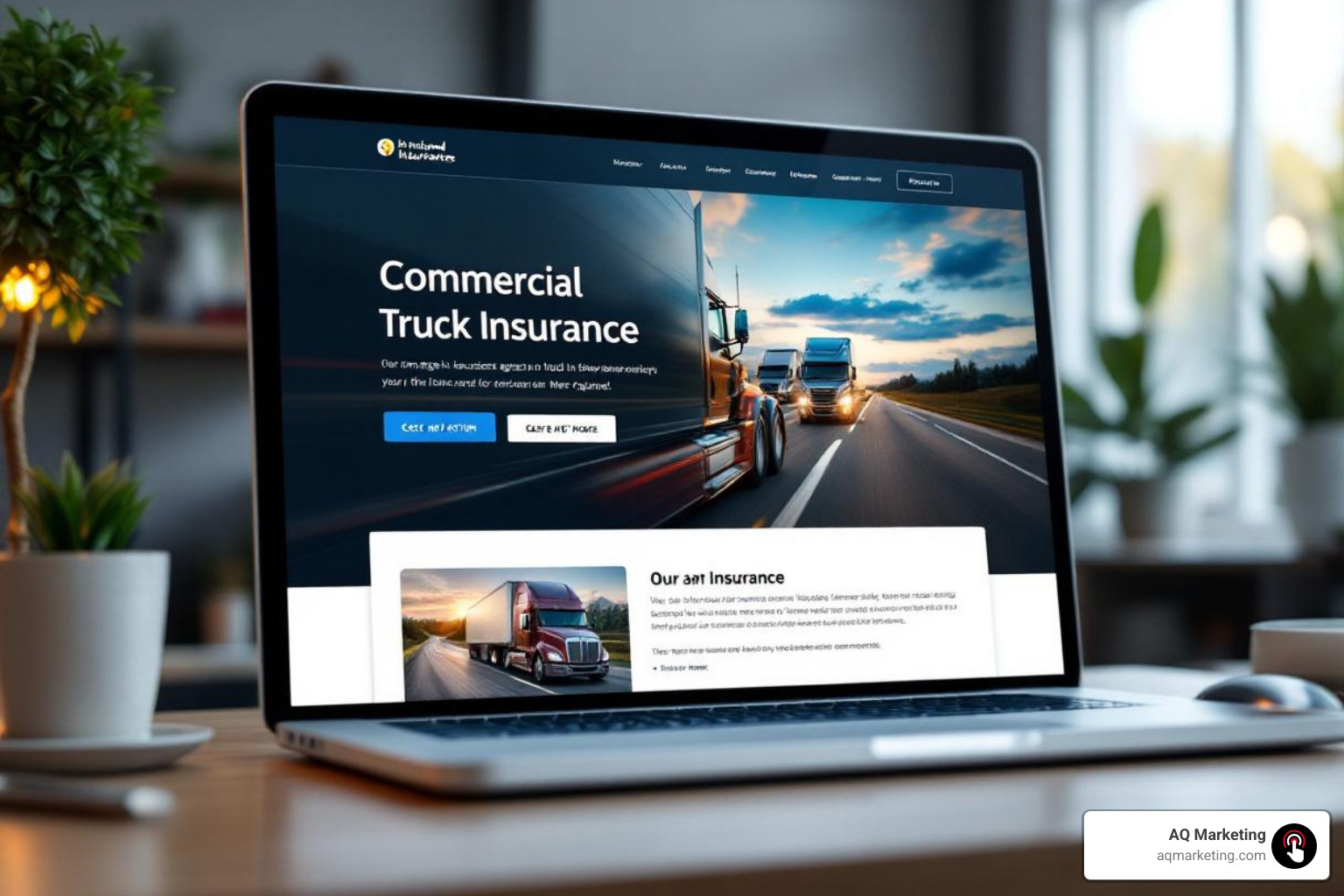
- Niche specialization: If you focus on a specific insurance type (e.g., commercial truck insurance), make this a central theme.
- Local expertise: For agencies serving specific towns like Framingham or Lowell, emphasize your understanding of local needs.
- Independent agent advantage: Explain the benefit of comparing multiple carriers to find the best policy.
- Client-first philosophy: Showcase your commitment to personalized service and support.
Turning Your Website into a Lead Generation Engine
An effective website must contribute to business growth. A smart content strategy and compelling calls-to-action (CTAs) can turn your site into a powerful engine for attracting and nurturing qualified leads.
Your website is your 24/7 salesperson and a key part of your inbound marketing. It attracts prospects by providing valuable content, which is highly effective—businesses that blog regularly attract around 55% more traffic. Combining a strong content strategy with clear CTAs and lead capture forms will consistently fill your sales pipeline. For more on this, learn more about digital marketing for insurance companies.
Leveraging Content to Attract and Engage Prospects
Valuable content positions your agency as an authority, attracting prospects through search engines and building trust. Answering common questions demonstrates your expertise and commitment to educating clients.
- Blog posts: Regularly write on relevant topics (e.g., “Understanding Home Insurance in New England”) to attract organic traffic.
- Educational articles: Create in-depth resources on complex insurance topics for prospects researching their options.
- FAQs: A well-organized FAQ section answers common questions and builds confidence.
- Video resources: Explanatory videos can be highly engaging and easier to digest than text.
- Niche-specific content: If you specialize in a niche, like liability insurance for contractors in Boston, create content addressing their unique needs.
This content strategy attracts new visitors and keeps existing clients engaged. If writing isn’t your strength, we offer comprehensive website content writing services to keep your site fresh.
Crafting Effective Calls-to-Action (CTAs)
Every page on your website should guide visitors toward a specific purpose, whether it’s requesting a quote or scheduling a meeting. Clear, action-oriented language is essential for converting visitors into leads.
A CTA is an invitation for your visitor to take the next step. Without clear CTAs, visitors may leave without engaging. Effective CTAs are:
- Prominent: They should stand out visually through color, size, or placement.
- Clear and concise: Use action-oriented language like “Get a Free Quote.”
- Benefit-driven: Hint at the value the user will receive, such as peace of mind or potential savings.
Examples of effective CTAs for an insurance website include:
- “Get a Free Quote”
- “Schedule a Consultation”
- “Download Our Guide to MA Home Insurance”
- “Contact Us for Personalized Advice”
Ensure CTAs are strategically placed at natural points in the user’s journey, such as after an article about auto insurance.
The Technical Pillars of Insurance Agent Website Design
A strong technical foundation is crucial for any website. For insurance agents, this means prioritizing mobile responsiveness, fast page speed, and search engine optimization (SEO) to ensure your site is visible, accessible, and performs flawlessly.
A beautiful design fails if the site is slow, buggy, or invisible to search engines. Key technical aspects include a mobile-first approach, fast load times (under 2 seconds), and robust SEO, especially for local search. With over 60% of search traffic from mobile devices, these elements are essential.
The Critical Importance of Mobile-Responsive Design
With most web traffic coming from mobile devices, a responsive design is non-negotiable. Google’s mobile-first indexing means your site’s mobile version is the primary factor in its search rankings, making a seamless mobile experience crucial for visibility and user satisfaction.
People expect your website to work perfectly on their small screens. A mobile-responsive design automatically adjusts its layout and content to fit any device. Since Google primarily uses your mobile site for ranking, a clunky or slow mobile experience will hurt your overall search visibility. Best practices for mobile design include:
- Large, tappable buttons
- Concise, scannable content
- Click-to-call functionality
- Optimized images for fast loading
Integrating SEO into your insurance agent website design
Search Engine Optimization (SEO) makes your website more visible to people searching for the solutions you offer. For an insurance agent, this means optimizing for keywords related to your products and location, so you appear when local prospects need you.
When someone in Newton, MA, searches for “car insurance Newton MA,” your agency should appear at the top. This involves several key SEO strategies:
- Keyword research: Identifying the terms potential clients use.
- On-page SEO: Optimizing content, titles, and meta descriptions with those keywords.
- Local SEO: Optimizing your Google Business Profile, building local citations, and getting positive online reviews are vital for ranking in local search.
- Schema markup for insurance: This technical element helps search engines understand your content, potentially leading to richer search results.
Integrating SEO into your insurance agent website design turns your site into a powerful lead generation tool. To boost your visibility, learn more about our SEO services.
Optimizing for Speed and Performance
A slow website deters potential clients. Google recommends a page load time of under two seconds, as 40% of consumers will wait no more than three seconds before abandoning a site. If your site is slow, you’re losing clients before they even see your offerings.
Key strategies for optimizing speed include:
- Image optimization: Compress images to reduce file sizes.
- Caching: Store parts of your site on a user’s browser for faster loading on return visits.
- Fast hosting: Invest in reliable, high-performance web hosting.
A fast-loading site provides a better user experience, reduces bounce rates, and is favored by search engines, all of which contribute to more leads.
Enhancing Efficiency and the Customer Experience
A great website attracts new clients and serves existing ones. Integrating smart tools and self-service options improves customer experience, boosts retention, and frees up your team’s time.
Your website can be a hub for efficiency and customer service. Through automation, self-service options, and tool integration, you can streamline operations and reduce administrative tasks. This lets your team focus on building relationships. For example, an AI chatbot can answer questions and schedule appointments automatically. Explore how our AI webchat solutions can help.
The Power of Website Integrations
Modern websites can connect with the tools you use daily, automating workflows and creating a more efficient sales process.
- CRM integration: Automatically send new leads from your website forms to your Customer Relationship Management (CRM) system for immediate follow-up.
- Quoting engines: Allow prospects to get instant estimates, capturing their interest at peak engagement.
- Appointment scheduling tools: Enable clients to book meetings directly from your site, eliminating phone tag.
- Live chat & AI chatbots: Provide instant answers and capture lead information 24/7.
- Client portals: Offer clients self-service options, reducing your team’s administrative workload.
Using Your Website for Customer Retention
Your website is a valuable resource for current policyholders. Providing a secure client portal for accessing documents or making payments offers convenience that builds loyalty.
- Policy access: A secure client portal allows policyholders to view their policy and billing information anytime.
- Online claim filing: Streamline the claims process with an easy-to-use online form.
- Resource center for existing clients: Provide exclusive content or helpful guides to address post-purchase questions.
- Newsletters: Allow clients to sign up for email newsletters with important updates and advice.
Offering these self-service options empowers your clients and strengthens their relationship with your agency.
The Role of Social Proof: Reviews and Testimonials
Positive reviews are one of the most powerful tools for building trust. Displaying testimonials from satisfied clients provides credible, third-party validation of your agency’s quality.
People trust other people more than they trust a business. Social proof is essential for converting prospects.
- Displaying Google reviews: Integrate snippets of your positive Google reviews directly onto your website.
- Video testimonials: Hearing and seeing a happy client share their experience is incredibly impactful and authentic.
- Case studies: For commercial insurance, detailed case studies showing how you helped a local business can be highly persuasive.
- Trust signals: Displaying awards, industry affiliations, or community involvement further builds trust.
Showcasing social proof on your insurance agent website design is a powerful way to turn hesitant visitors into confident clients. If you need help managing your online reputation, we can help you manage your online reputation effectively.
Strategic Decisions and Avoiding Common Pitfalls
A successful website requires key strategic choices, from the platform to your development partner. Understanding the options and avoiding common mistakes is crucial for long-term online success.
Custom vs. Template-Based Insurance Agent Website Design
The choice between a custom-built site and a pre-made template depends on your budget, brand identity, and long-term goals. While templates are faster and have lower initial costs, a custom design offers unparalleled flexibility, unique branding, and scalability.
Here’s a breakdown of your options:
| Factor | Template-Based Design | Custom Design |
|---|---|---|
| Branding | Limited customization, may look generic | Reflects unique agency personality, stands out from competitors |
| Scalability | Can be restrictive, difficult to add complex features | Built to grow with your business, easily integrates new features and functionalities |
| Cost | Lower initial investment, often subscription-based | Higher initial investment, but often more cost-effective long-term due to flexibility and reduced need for frequent overhauls |
| SEO | Basic SEO often included, but advanced optimization limited | Built with SEO best practices from the ground up, custom for specific keyword and local search strategies, including for Massachusetts |
| Flexibility | “What you see is what you get,” limited unique features | Design and functionality are custom to your exact needs and unique selling propositions |
| Speed | Faster to launch | Longer development time, but results in a highly optimized, fast-loading site |
For agencies looking to differentiate themselves and build a long-term digital asset, a custom insurance agent website design is almost always the superior choice.
Common Website Mistakes and How to Avoid Them
Many insurance websites suffer from the same preventable mistakes that drive potential clients away. A strategic, user-centric approach to design avoids these pitfalls.
- Poor navigation: If visitors can’t find what they’re looking for, they’ll leave. Ensure a clear, logical menu.
- No clear CTA: Every page needs a purpose. Guide visitors with a prominent call-to-action.
- Outdated information: Stale content or incorrect contact details erode trust. Keep your site fresh.
- Ignoring mobile users: A non-mobile-friendly site is a non-starter. Ensure your site is fully responsive.
- Slow load times: Optimize for speed to keep visitors engaged.
- Generic stock photos: Use authentic photos of your team and local area when possible to feel more approachable.
Using Website Analytics for Continuous Improvement
Your website is a source of valuable data. Tools like Google Analytics let you track traffic, understand user behavior, and measure conversions. Analyzing this data helps you make informed decisions to continuously improve your site’s performance and ROI.
- Google Analytics: This free tool shows how many people visit, where they come from, and what pages they view.
- Tracking key metrics: Monitor metrics like bounce rate, conversion rate, and traffic sources.
- Understanding user behavior: See which pages are popular and where users drop off to find areas for improvement in your insurance agent website design.
- A/B testing: Experiment with different headlines, CTAs, or page layouts to see what performs best.
- Data-driven decisions: Use analytics insights to make informed choices about content, design, and SEO strategies.
Frequently Asked Questions about Insurance Agent Websites
How much does an insurance agent website typically cost?
The investment can vary widely. Template-based sites may start in the low thousands, while fully custom websites with advanced integrations can range from $10,000 to $25,000 or more. Pricing depends on factors like design complexity, custom features, and content creation. Please note: These figures are based on general industry data and do not represent specific agency pricing.
How long does it take to build a new insurance agency website?
The timeline depends on the scope of the project. A website built from a template can often be launched in a matter of weeks. A custom design project typically takes several months from initial strategy and design to development, content integration, and final launch.
What is the single most important feature for an insurance website?
While many features are important, the most critical is a clear and easy path for a visitor to become a lead. This is usually a combination of two things: a prominent, compelling call-to-action (like “Get a Free Quote”) and a simple, user-friendly form to capture their information.
Conclusion: Your Digital Front Door to Growth
An effective insurance agent website is a dynamic asset that builds trust, generates leads, and improves client relationships. By moving beyond the static online brochure and embracing a strategic approach focused on user experience, technical excellence, and clear calls-to-action, you create a powerful engine for sustainable growth. Choosing the right partner to guide your digital strategy is essential to open uping your agency’s full potential online. As specialists in digital marketing for service-based businesses, we at AQ Marketing understand how to build websites that deliver tangible results.
Ready to transform your online presence? Explore our website design and development services to build a site that works as hard as you do.
