

Facebook Retargeting Ads: 7 Powerful Strategies for Amazing Results
Why Facebook Retargeting Ads Are a Game-Changer for Your Business
Facebook retargeting ads are paid advertisements shown specifically to people who’ve previously visited your website or interacted with your brand. They’re extremely effective at bringing back visitors and turning them into customers.
If you’re looking for a quick summary, here’s how Facebook retargeting ads work:
- Visitor Interaction: A user visits your website.
- Tracking: Facebook Pixel tracks their activity.
- Ad Display: Personalized ads show up on the user’s Facebook or Instagram feed.
- Conversion: Users who interact again are much more likely to buy.
My name is Robert P. Dickey, and as the President and CEO of AQ Marketing, I’ve spent over 20 years helping small to medium-sized businesses thrive online, utilizing digital strategies like Facebook retargeting ads to generate more leads and boost conversions. In this guide, I’ll show you exactly how to use them to grow your own business.

Key terms for Facebook retargeting ads:
What Are Facebook Retargeting Ads?
Ever felt like an ad was following you around the internet? Maybe you browsed some cozy slippers online, and suddenly they’re popping up all over your Facebook feed. Nope, you’re not being stalked—you’re experiencing the magic of Facebook retargeting ads.
Simply put, Facebook retargeting ads are ads that reconnect your business with people who’ve already shown interest in what you offer. Instead of blindly targeting strangers, retargeting focuses on visitors who have previously visited your website, checked out specific products, or interacted with your content on Facebook or Instagram.
At the heart of this strategy is a handy tool called the Facebook Pixel. Think of it like a friendly digital spy (totally harmless, we promise!)—a small snippet of code that lives on your website. When visitors come to your site, the pixel tracks their behavior using cookies. It notes the pages they’ve visited, the products they looked at, and even whether they’ve left something in their shopping cart.
Later, when these same people hop onto Facebook or Instagram, Facebook recognizes them and serves up personalized ads directly custom to their interests and recent behaviors.
Why does this matter? Well, let’s face it: most website visitors aren’t ready to buy on their first visit. Research shows that only about 2% of visitors actually convert immediately. Facebook retargeting ads give you a second chance (or third, or fourth—hey, we’re not judging!) to gently remind people about the great stuff your business offers.
In fact, retargeting ads typically generate a much higher return on investment than standard display ads. That makes sense—you’re targeting people who’ve already shown interest. They’re already warmed up, making them far more likely to convert into paying customers.
How Do Facebook Retargeting Ads Work?
Wondering exactly how all this digital magic happens? Let’s break it down step-by-step, without getting too nerdy:
When someone visits your website, the Facebook Pixel quietly tracks their actions—like which pages they viewed, what products caught their eye, or if they signed up for your newsletter.
This pixel then collects that data and matches it to the user’s Facebook account (if they’re logged in to Facebook on the same browser). No worries—privacy remains intact. You won’t ever see individual user data; instead, Facebook uses this information to group visitors based on their behavior.
Next, Facebook lets you create Custom Audiences using this collected data. For example, you might create an audience segment specifically for people who abandoned their shopping carts or for folks who viewed your pricing page. (We’ll talk more about segmenting your audience in a bit.)
Once you’ve set up your custom audiences, it’s time to get creative! You design personalized ads specifically custom to each audience segment—highlighting products they considered but didn’t buy, or gently reminding them why your service is exactly what they need.
Facebook then delivers these personalized ads directly in the user’s newsfeed, on Instagram, or any other placement within Facebook’s advertising network. Pretty neat, huh?
Jake Newbould, Head of Digital Marketing at a thriving ecommerce brand, explains their strategy this way:
“In our middle-of-the-funnel retargeting, our copy showcases our unique selling propositions or brand origin story in a succinct, easy-to-digest way. We’re persuading already-engaged customers why they should buy our products over our competitors.”
Here’s a helpful visual to show exactly how this process works:
To sum it up: With Facebook retargeting ads, you’re not blindly throwing ads into the void. You’re thoughtfully reconnecting with visitors who already know your brand, improving your chances of turning them into happy customers.
Check out our related guides on Facebook ad campaign analysis, Facebook ad campaign optimization, and Facebook ad design.
Why Facebook Retargeting Ads Are Crucial for Your Business
Let’s be honest – getting people to your website is only half the battle. What happens to all those visitors who browse around but don’t buy anything? Without Facebook retargeting ads, they simply disappear, probably forever. But with retargeting, you get a second chance to win them over – and that’s why these ads are absolute gold for your business.
Dramatically Higher Conversion Rates
The numbers behind Facebook retargeting ads are pretty mind-blowing. People who’ve already visited your website are 70% more likely to convert when they see your retargeting ads compared to completely new visitors. Think about that – a 70% boost just by staying in front of people who already showed interest!
If you run an online store, you’re probably all too familiar with cart abandonment. The good news? Retargeting can reduce those abandoned carts by 6.5%. That might not sound huge, but when you consider how many sales that represents over a year, it adds up fast.
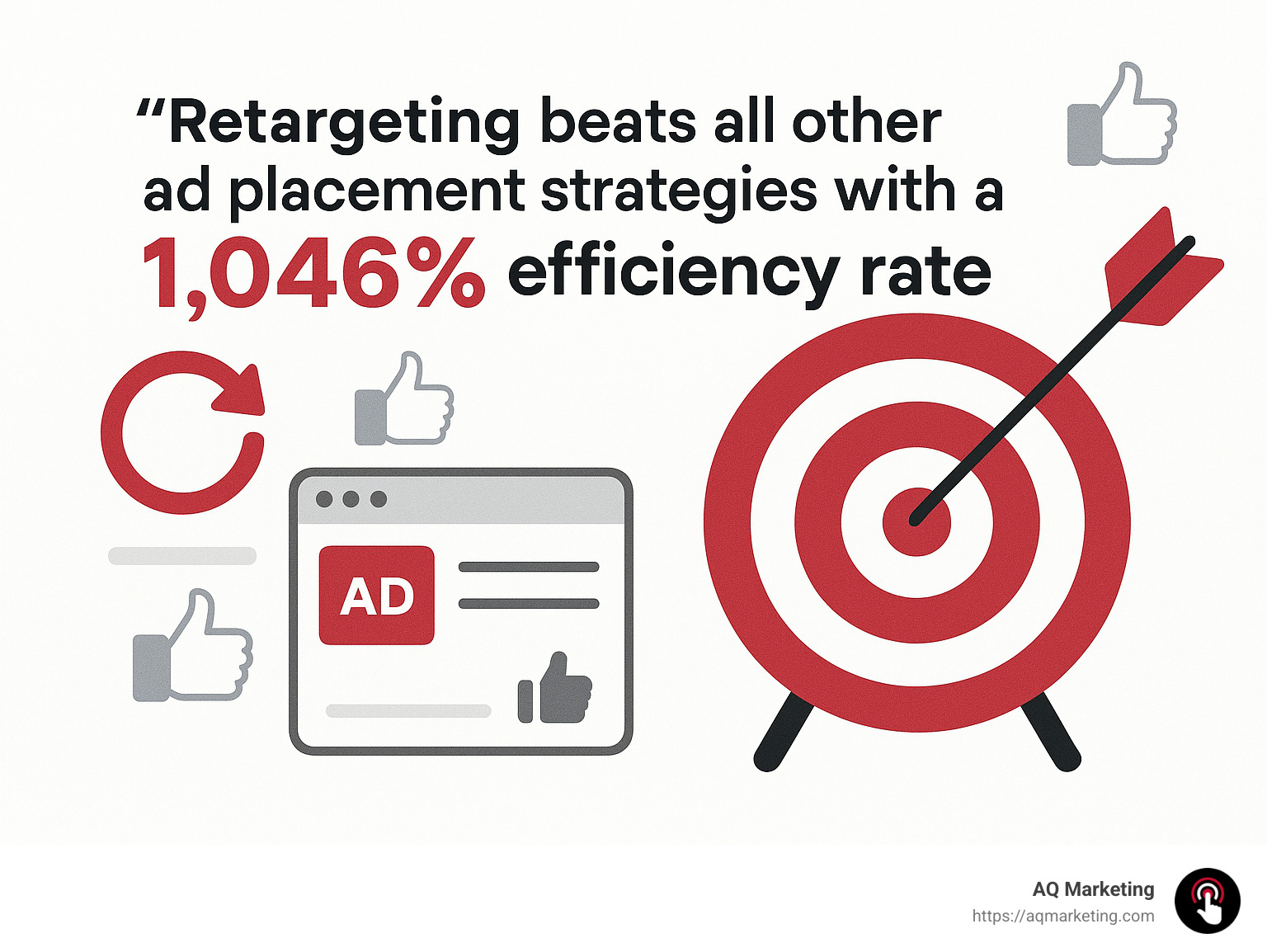
“Retargeting beats all other ad placement strategies with a 1,046% efficiency rate”
This isn’t just marketing hype – it’s backed by scientific research on retargeting effectiveness. When someone has already shown interest in what you offer, a gentle reminder can be all it takes to turn that interest into action.
Cost-Effective Marketing
For our local Massachusetts businesses in Boston, Woburn, and surrounding areas, every marketing dollar needs to work hard. That’s another area where Facebook retargeting ads shine – they deliver exceptional bang for your buck.
With retargeting, you’ll typically see lower costs per acquisition because you’re not wasting budget on people who have zero interest in your business. Your click-through rates tend to be higher since the ads are relevant to the viewer’s recent browsing. And overall engagement improves because the content resonates with what they’ve already shown interest in.
I’ve seen this with our clients at AQ Marketing. One local home services company we work with in Middlesex County was struggling with high customer acquisition costs. After implementing our Facebook retargeting strategy, they saw their conversions jump by 31% while their cost per new customer dropped by 20%. That’s real money back in their pocket!
Building Customer Relationships
Facebook retargeting ads do more than just drive immediate sales – they help nurture relationships with potential customers over time.
By staying visible throughout the customer journey, you remain top-of-mind when they’re ready to make a decision. Your ads can address specific concerns that might be holding them back (“Still wondering about our warranty? Here’s how it works!”). And once someone becomes a customer, retargeting opens up opportunities to cross-sell related products or upsell to premium offerings.
This relationship-building aspect is particularly valuable for businesses here in Merrimack Valley and Essex County, where repeat business and word-of-mouth referrals are so important to sustained growth.
The beauty of retargeting is that it transforms your advertising from a shot in the dark to a conversation with people who already know you. And in today’s crowded digital landscape, that familiar connection makes all the difference.
How to Set Up Facebook Retargeting Ads: A Step-by-Step Guide
By now, you know that Facebook retargeting ads can be a major growth driver for your business. But how exactly do you set them up? Don’t worry—I’ve got you covered! I’ll walk you through each step clearly and simply, so even if you’re not a tech wizard, you’ll be running your first retargeting campaign in no time.
Step 1: Install the Facebook Pixel
Your Facebook retargeting ads journey starts with the Facebook Pixel. Think of it as the foundation that makes your retargeting possible. Here’s how to get it set up:
First, log into your Facebook Ads Manager and head over to the Events Manager. Next, click on the “+” button to connect a new data source, and select “Web” as your source. Facebook will walk you through creating your Pixel step-by-step—it’s pretty straightforward!
Once created, you’ll need to install the Pixel on your website. Don’t panic! You have three easy options:
- Manual installation: Simply copy and paste the Pixel code into your website’s header.
- Partner integration: Platforms like Shopify, WordPress, Wix, or Squarespace have built-in integrations that set up your Pixel in a few clicks. (This option is perfect for most small businesses in Massachusetts and Southern New Hampshire.)
- Email instructions: Let your website developer handle it for you by simply emailing them the step-by-step instructions from Facebook.
After adding the Pixel, be sure to verify it’s working correctly. The easiest way is by using the Facebook Pixel Helper Chrome extension. It instantly shows whether your Pixel is tracking data properly.
Pro Tip: Install the Pixel on every page of your website—not just your homepage. This ensures you capture as much visitor data as possible, allowing for more effective Facebook retargeting ads down the road.
Step 2: Create a Custom Audience for Facebook Retargeting Ads
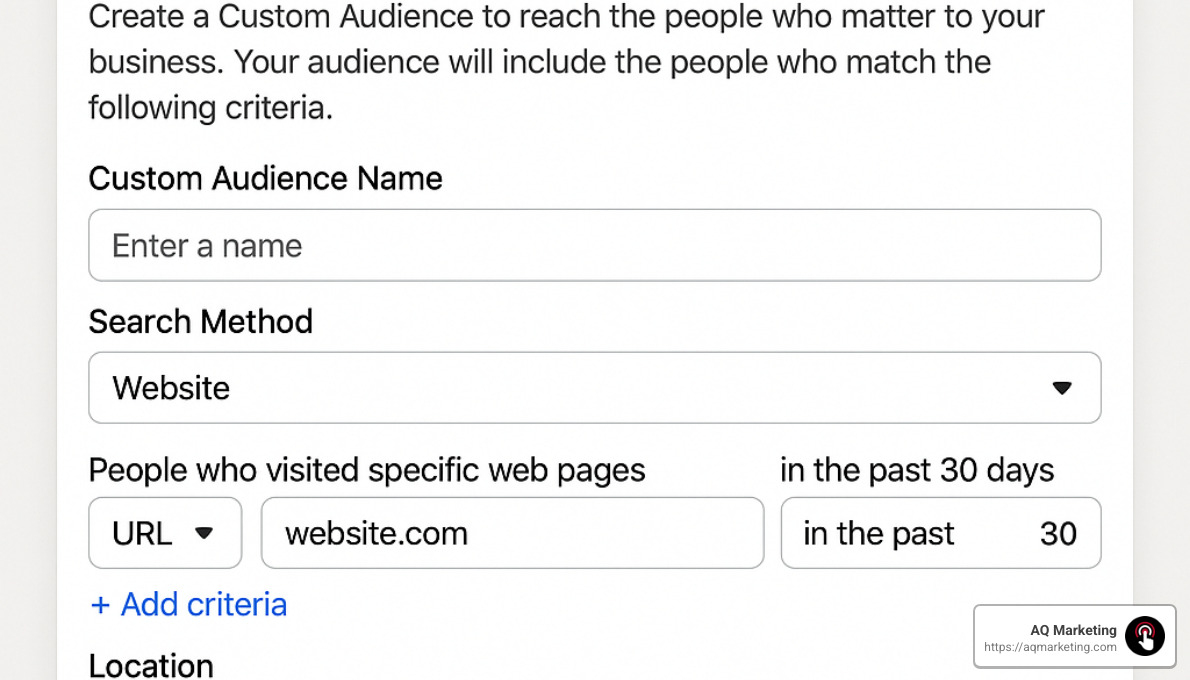
Now that your Pixel is up and running, it’s time to build your audience. Head to the “Audiences” section in your Ads Manager and click “Create Audience”, followed by “Custom Audience.”
Choose “Website” as the source, and you’ll see several options to define who you want to retarget. You can target:
- Everyone who visited your site (this catches all visitors)
- People who visited specific pages (perfect for product-specific ads)
- Visitors who spent a certain amount of time on your site (great for highly engaged visitors)
- People who completed specific actions (like adding a product to the cart, but didn’t purchase)
You’ll also choose how far back you want to track visitors—usually 30, 60, or 90 days works well. For most small to medium-sized businesses here in Woburn, Boston, or anywhere around Massachusetts, creating multiple segmented audiences makes sense. For instance:
- Recent visitors (last 30 days)
- People who viewed products but didn’t buy
- Cart abandoners
- Previous customers for upselling opportunities
Segmentation helps you personalize your ads and deliver relevant messages, boosting your conversions.
Step 3: Set Up Your Retargeting Campaign
You’ve got your Pixel and your audience—now comes the fun part: setting up your campaign!
In Ads Manager, create a new campaign by clicking “Create”. Now select the objective that matches your goal:
- Conversions (if you’re selling products or services)
- Traffic (for visits back to your website)
- Catalog sales (if you’re promoting specific products directly from your online store)
Give your campaign a clear name so you can easily track your retargeting efforts later. In your ad set, select the custom audience you created earlier. For placements, Facebook offers automatic placements (usually recommended for simplicity and good results), but you can also choose if your ads appear on Facebook, Instagram, Audience Network, or Messenger specifically.
Set your budget and schedule next. For most of our small-business clients throughout Middlesex County, Essex County, and Merrimack Valley, a modest daily budget of $10-20 is a comfortable starting point. Retargeting audiences are smaller but highly qualified, so a little investment can go a long way.
Step 4: Design Your Facebook Retargeting Ads
Now, let’s create ads your audience can’t ignore!
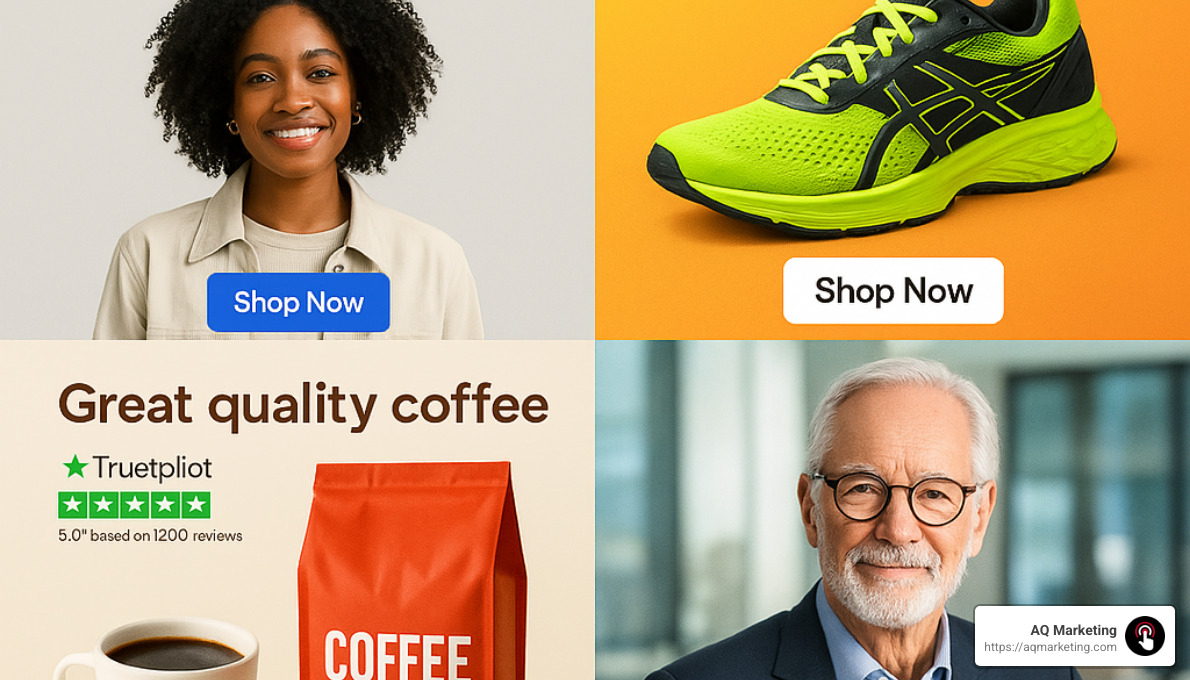
Start with some eye-catching visuals—use high-quality images or short, engaging videos that clearly showcase your product or service. Pair these visuals with persuasive, personalized messaging that speaks directly to your audience. Since they’re familiar with you (after all, that’s the whole point of retargeting!), acknowledge their previous interest and remind them why they clicked in the first place.
Always include a clear call-to-action (CTA)—for example, “Shop Now,” “Book Your Consultation,” or “Claim Your Discount.”
Tailor your ads to match your audience segments. For example, cart abandoners respond well to discounts or urgency (“Your cart misses you!”), while past customers may appreciate seeing complementary products for an upsell.
Here’s an example: One of our local insurance clients in Middlesex County ran retargeting ads that featured the exact insurance packages visitors viewed before leaving the site, along with testimonials from satisfied local customers. This personalized approach boosted their conversion rate by 24% compared to their previous generic ads.
And there you have it—your first Facebook retargeting ads campaign is ready to launch!
For more details specific to ad creation, check out our in-depth guides on Facebook ad design and Facebook ad campaign optimization.
Feeling stuck or short on time? Don’t hesitate to get in touch with us at AQ Marketing for expert help. We’ve been helping local businesses from Woburn to Boston successfully leverage Facebook retargeting since 2003, and we’d love to help you too!
Best Practices for Effective Facebook Retargeting Ads
Now that you’re excited about the power of Facebook retargeting ads, let’s talk about how to use them effectively. Over the years, we’ve fine-tuned some best practices that have helped businesses in Woburn, Boston, and throughout Massachusetts achieve phenomenal results. Without further ado, let’s dive into these tried-and-true strategies for making the most of your retargeting efforts.
1. Segment Your Audience Strategically
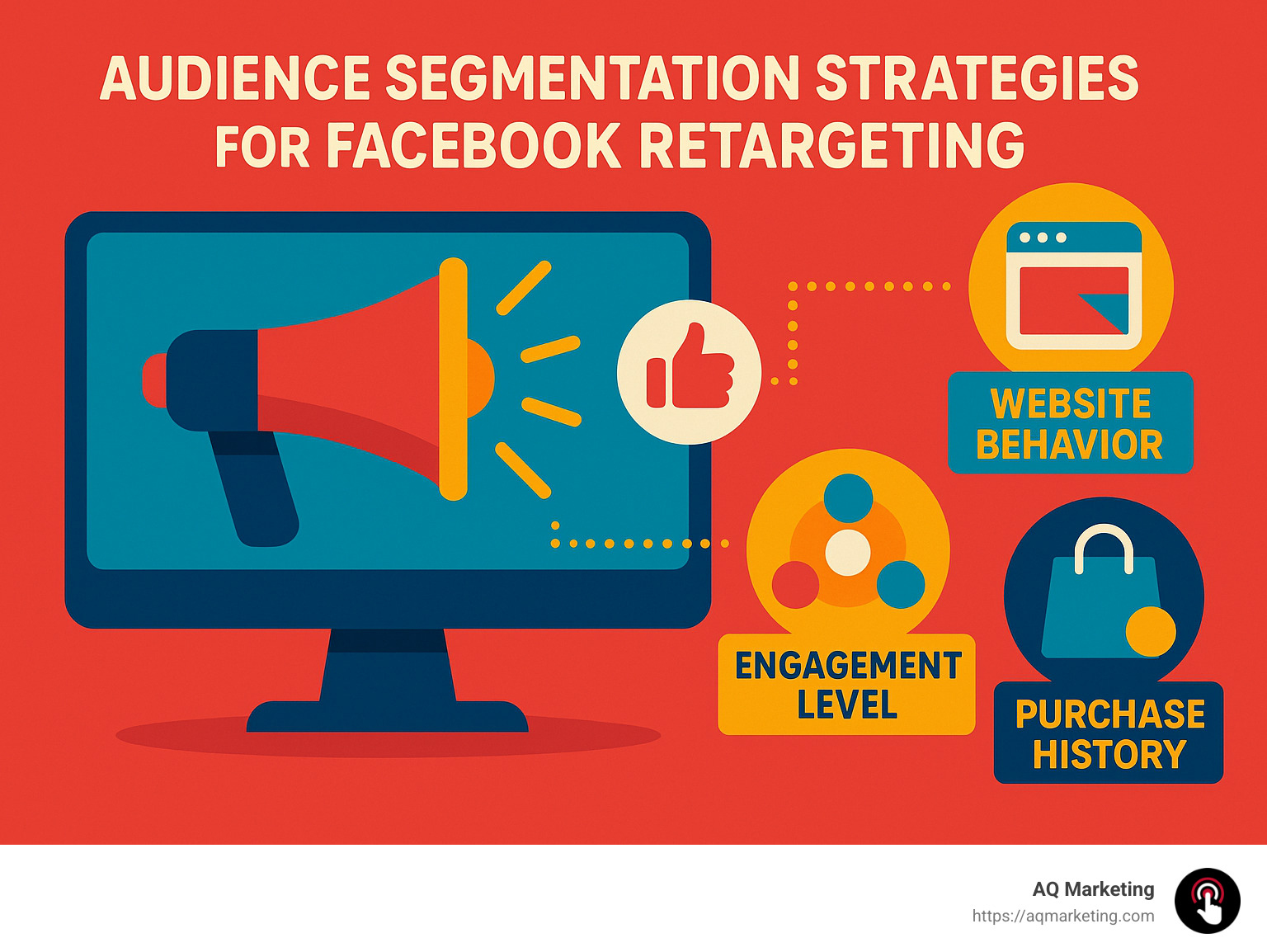
Treating all your website visitors the same way is like offering everyone at your dinner party the same meal, regardless of their tastes or dietary needs. Instead, segment your audience based on their behavior and interests. For example, you might create distinct groups like first-time visitors, visitors who browsed specific product pages, or even visitors who got all the way to checkout and then bounced (those pesky cart abandoners!).
Specifically, consider segmenting audiences by level of engagement (casual browsers vs. highly engaged prospects), time since their last visit (recent visitors within the last week versus visitors from a few weeks ago), and specific actions like viewing products, abandoning carts, or filling out forms. You can even segment by previous purchase history, distinguishing between first-timers and repeat customers.
By doing this, you’re ensuring your Facebook retargeting ads aren’t just generic sales pitches—they can speak directly to each audience’s unique situation and needs.
2. Control Ad Frequency
Ever hear the same song on the radio too many times and end up disliking it? That’s exactly what happens if your ads pop up too often. This phenomenon, called ad fatigue, can lead to lower engagement and even annoyance.
To avoid this common pitfall, we recommend setting frequency caps for your ads. Aim to show each ad just 2-3 times per week per user. Studies show that after about five views, an ad’s effectiveness tends to decline sharply. Keep a close eye on your analytics: if engagement starts to dip, it might be time to adjust how frequently your ads appear.
3. Exclude Converted Users
This might seem obvious, but you’d be surprised how many businesses accidentally continue showing ads to customers who’ve already converted. It’s the digital equivalent of asking someone if they’d like a cookie right after they’ve already eaten one—nice gesture, but unnecessary (and maybe a bit annoying).
Make sure you consistently exclude users who’ve already completed the action you’re encouraging, whether that’s making a purchase, signing up for a webinar, or downloading an ebook. Regularly update your exclusion lists, and consider crafting a separate, customer-focused campaign to nurture repeat buyers instead.
4. Refresh Your Creative Regularly
All ads (yes, even the really good ones!) eventually get stale. Users start scrolling right past ads they’ve seen too many times, which hurts click-through and conversion rates.
To keep your Facebook retargeting ads fresh and engaging, we recommend rotating multiple ad variations and updating your creative every 2-3 weeks. Experiment with different formats—like single images, carousel ads, or even video—and adjust your messaging based on what resonates most strongly with your audience. Trust us, your customers (and your bottom line!) will thank you.
5. Align Ad Content with User Intent
Your retargeting ads should feel like a friendly conversation—personal, relevant, and helpful. For every segment of your audience, try to match your ad messaging directly to their current mindset or action.
For example, if someone recently viewed a product without purchasing, your messaging could say, “Still thinking about this? Here’s why customers love it.” Cart abandoners, meanwhile, might appreciate a gentle nudge, like “Wait—you left something behind. Seal the deal now and take 10% off!” For customers who’ve already purchased, consider ads that encourage additional engagement (“Loved your new gear? Check out these complementary products.”).
Whatever their stage in the journey, your ads should always reflect where your customers actually are—not where you wish they were!
By following these best practices, businesses throughout Middlesex County, Essex County, and beyond typically see a dramatic improvement—often around 30-40%—in their retargeting campaign performance compared to simply launching generic ads.
Implementing these strategies may take a bit more effort, but at AQ Marketing, we’ve seen how transformative thoughtful, strategic Facebook retargeting ads can be. And trust us, the results are worth it!
Segmenting Your Audience for Maximum Impact
If there’s one secret to making Facebook retargeting ads truly shine, it’s proper audience segmentation. Think of it like fishing – you wouldn’t use the same bait for every type of fish, right? The same principle applies here. Let’s explore how to slice and dice your audience for ads that really connect.
Website Visitors Segmentation
Your website visitors aren’t all the same – they have different intentions and interest levels. Some are just browsing, while others are seriously considering your services.
When we work with small businesses across Merrimack Valley, we typically start by creating these essential visitor segments:
All Website Visitors (30 days) works well as a broad catch-all audience for general brand awareness messages. This keeps your business top-of-mind even for casual browsers.
Specific Page Visitors is where things get interesting. Someone who spent time on your plumbing services page has very different needs than someone browsing your HVAC solutions.
I remember working with a home services company in Essex County where we created distinct segments for different service pages. The plumbing visitors saw ads featuring testimonials from satisfied plumbing customers, while HVAC browsers saw content about energy efficiency. The personalized approach doubled their click-through rates almost overnight.
Time-Based Segments help you identify your most engaged visitors. Someone who spent more than 2 minutes on your site is showing serious interest compared to a 10-second bounce.
Frequency-Based Segments target those who’ve visited multiple times – these folks are practically raising their hands for attention!
Cart Abandoners
Oh, the abandoned cart – so close to conversion, yet so far! This segment represents one of your biggest opportunities for recovery.
Time Since Abandonment matters tremendously. Recent abandoners (1-3 days) need a gentle, helpful reminder, while older abandoners (4-14 days) might need a stronger incentive to return.
Cart Value segmentation lets you tailor your approach based on potential revenue. For high-value carts, offering free shipping might be the perfect nudge, while smaller carts might respond better to percentage discounts.
I’m reminded of a retail client in Boston who implemented a tiered approach based on cart value. They offered 10% off for carts under $50, free shipping for carts between $50-100, and both for carts over $100. This smart segmentation strategy boosted their recovery rate by 31%!
Product Category segmentation acknowledges that different products have different purchase considerations. Fashion items might need style reassurance, while electronics might need warranty information.
First-Time vs. Returning Abandoners helps you distinguish between shoppers who regularly abandon (serial abandoners) and those who rarely do it. The former might need a stronger incentive to finally convert.
Past Purchasers
Your existing customers are gold – they already trust you! But even here, segmentation matters.
Recent vs. Older Customers need different approaches. Recent buyers might appreciate complementary product suggestions, while reactivating dormant customers might require a “we miss you” message with a special offer.
Purchase Value segmentation lets you create VIP experiences for your best customers. We’ve seen businesses in Woburn create exclusive “insider” messaging for their high-value customers with great results.
Product Category segmentation enables smart cross-selling. If someone bought a printer, they’ll eventually need ink cartridges!
Purchase Frequency helps you distinguish between one-time buyers and loyal repeat customers. The former might need more convincing to return, while the latter deserves recognition for their loyalty.
Engagement-Based Retargeting
Don’t limit yourself to website behavior! Facebook offers powerful engagement-based retargeting options that many businesses overlook.
Video Viewers segmentation lets you target people based on how much of your video they watched (25%, 50%, 75%, or 95% completion). Someone who watched your entire 3-minute product demo is seriously interested!
Lead Form Engagers helps you reconnect with people who started but didn’t complete your forms – they were interested enough to start, so a gentle reminder might be all they need.
Post Engagers and Page Visitors segments help you target people who’ve interacted with your Facebook content but haven’t made it to your website yet.
I’m particularly proud of a campaign we ran for a local insurance agency in Southern New Hampshire. Rather than jumping straight to conversion-focused ads, we created an educational video series about insurance basics. We then retargeted viewers who watched at least 75% of these videos with more specific, conversion-oriented messages. This approach yielded a 44% higher conversion rate than standard retargeting because we met people where they were in their journey.
The goal of segmentation isn’t just to chop your audience into smaller pieces – it’s to create more relevant, personalized experiences that acknowledge where people are in their customer journey. When done right, your Facebook retargeting ads won’t feel like ads at all – they’ll feel like helpful reminders from a business that understands exactly what the customer needs.
Measuring Success: Metrics to Track in Your Facebook Retargeting Campaigns
When running Facebook retargeting ads, knowing what works—and what doesn’t—is crucial. Tracking the right metrics gives you clear insight into your campaign’s performance, helping you fine-tune your strategy and maximize efficiency. Here at AQ Marketing, we encourage our clients across Boston, Woburn, and Massachusetts to focus their attention on a few key performance indicators (KPIs).
Click-Through Rate (CTR)
The Click-Through Rate measures how effectively your ads are capturing a viewer’s attention and inspiring them to click through. For retargeting campaigns, CTR is typically higher than standard display ads. While typical display ads hover around just 0.07%, retargeted ads usually achieve around 0.7% to 1.0% CTR.
A healthy CTR shows that your ad creative is resonating with your audience—you’re showcasing messages and visuals that truly connect. If your CTR is below that benchmark, it’s worth experimenting with different images, headlines, or offers. Even small tweaks can lead to significant improvements.
Conversion Rate
After the click, we want people to take action—buying a product, filling out a form, or scheduling a consultation. This is your Conversion Rate. For retargeting, we generally see conversion rates in the range of 5% to 6%, compared to just 2.5% to 4% for cold audiences.
Tracking your conversion rate helps you understand how effectively you’re turning interested visitors into paying customers. If your conversion rate is lower than expected, consider optimizing your landing pages, adjusting your offers, or speeding up your site. Remember: Visitors don’t like waiting around—so don’t let a slow-loading page affect your conversions!
Return on Ad Spend (ROAS)
It’s all about the return you’re getting from each dollar spent. Your Return on Ad Spend (ROAS) tells you exactly this—how many dollars of revenue you’re generating per dollar invested in your Facebook retargeting ads.
With a good retargeting campaign, a solid benchmark to aim for is typically a ROAS of 3x to 5x or higher. If you’re below this, it’s time to revisit your strategy—consider refining your audience targeting, improving your creatives, or looking deeper into your pricing and offers.
Ad Relevance Diagnostics
Facebook provides Ad Relevance Diagnostics, giving you insights into how well your ads are performing compared to competitors targeting the same audience. These diagnostics include:
- Quality Ranking: This shows how your ad’s perceived quality stacks up. Low quality rankings might mean the visuals or messaging need a refresh.
- Engagement Rate Ranking: Measures how likely your audience is to interact with your ads compared to competitors. If this is low, adjust your creative or messaging to prompt more engagement.
- Conversion Rate Ranking: Indicates how likely your ads are to convert compared to similar ads. A lower ranking here means you might need to sharpen your landing page or offer.
Ideally, aim to achieve “Above Average” rankings in all three categories to ensure your ads perform at their best.
Frequency
While it’s important to stay in front of your audience, appearing too often can lead to ad fatigue—when your audience starts feeling “Oh no, not this ad again!” The ideal Frequency for retargeting ads is generally around 2 to 3 times per week per person.
If frequency creeps too high (5 or more impressions), engagement often drops. To avoid this, keep your creative fresh by swapping in new visuals, offers, or messaging regularly. One of our Middlesex County clients noticed their frequency had risen above 5 within a week. By quickly introducing new ads into their rotation, we were able to boost engagement again—and their ROAS jumped by 27%!
By tracking these key metrics—CTR, conversion rate, ROAS, ad relevance diagnostics, and frequency—you’ll have a clear view into your retargeting campaign’s health. Keep an eye on them, adjust as needed, and you’ll make sure your Facebook retargeting ads remain effective, engaging, and profitable.
Common Mistakes to Avoid in Facebook Retargeting
Facebook retargeting ads are a powerful way to reconnect with website visitors and boost conversions. But even experienced marketers can stumble into common pitfalls. At AQ Marketing, we’ve helped businesses across Massachusetts and Southern New Hampshire steer clear of these mistakes to ensure the best possible results from their retargeting efforts.
1. Overexposure to Ads
Imagine going to the same coffee shop every day and hearing the same song on repeat. Annoying, right? The same happens when your audience sees your ad too frequently. Overexposure to ads can irritate potential customers, leading them to tune out your message (something marketers call “banner blindness”).
To avoid this, we recommend setting frequency caps in your Facebook Ads Manager, limiting exposure to 2-3 impressions per week per user. Regularly rotating your ads also helps keep things fresh and engaging.
2. Ignoring Ad Fatigue
Even if you manage ad frequency well, running the same creative month after month leads to ad fatigue. Your audience becomes bored seeing identical visuals and messaging, and your click-through and conversion rates will gradually decline.
To keep your ads performing, create multiple versions of your retargeting creatives. At AQ Marketing, we typically design 3-4 ad variations per campaign, rotating new visuals and copy every 2-3 weeks. This ensures your ads stay interesting and engaging for your audience.
3. Not Updating Ad Creatives
“Set it and forget it” might make sense for a slow cooker, but it’s not the best approach for Facebook retargeting ads. Many businesses create their ads initially, then rarely (or never) update them.
The result? Performance gradually slips as ads become outdated. To keep your campaigns effective, schedule regular updates and A/B tests on your creatives. At AQ Marketing, we create a clear, structured calendar ensuring new creatives and messaging run regularly, so your ads always feel fresh and relevant.
4. Poor Audience Targeting
Not everyone who visits your website has the same interests or intentions. Treating them all the same results in generic messaging that fails to resonate. Poor audience targeting means less relevance, lower engagement, and fewer conversions.
A smarter approach is segmenting your audience into meaningful groups. We generally recommend 4-5 distinct audience segments for most retargeting campaigns. Consider groups like recent visitors, cart abandoners, specific product-page viewers, or previous purchasers. Custom messaging for each segment leads to a deeper connection—and more conversions.
5. Retargeting Converters with the Same Ads
Few things waste advertising dollars faster than showing the same conversion-focused ads to users who just completed a purchase. It can even annoy your customers (and trust me, annoyed customers aren’t eager repeat buyers).
Instead, create exclusion audiences for users who’ve already converted. You can do this easily within Facebook Ads Manager by setting rules to automatically exclude converted customers from seeing your retargeting ads. Additionally, consider creating separate retention-focused campaigns to nurture repeat purchases or upsells.
6. Setting and Forgetting
Perhaps the biggest mistake of all is assuming your retargeting campaign will run smoothly on autopilot forever. Unfortunately, digital marketing is never that simple.
Active management is essential to success. Regular monitoring allows you to spot issues early, adjust your messaging, and optimize your campaigns. At AQ Marketing, we conduct weekly performance reviews for our clients, making sure each campaign continues achieving optimal results.
We once worked with a home services company in Woburn that unknowingly made several of these mistakes. They had generic targeting, outdated creatives, and frequency issues. After addressing these issues by segmenting their audience, rotating creative regularly, and managing ad frequency, we were able to improve their retargeting return on ad spend (ROAS) by 67% within just one month.
Avoiding these common pitfalls is exactly how you’ll get the most out of your Facebook retargeting ads. The goal is to stay relevant, engaging, and considerate of your audience’s experience—because great marketing isn’t just about reaching people; it’s about connecting with them.
Adjusting Your Facebook Retargeting Strategy Post-iOS14 Update
Apple’s iOS14 update in early 2021 significantly shook things up in the digital advertising world – especially for Facebook retargeting ads. Even as we move into 2025, businesses in Boston, Woburn, and across Massachusetts still need to adapt to these changes to maintain strong performance in their retargeting campaigns. If you’re feeling a bit frazzled by it all, you’re not alone!
Let’s break down what changed, why it matters, and—most importantly—how to adapt your retargeting strategy to keep seeing great results well beyond 2025.
Understanding the Impact
First things first: What exactly changed with the iOS14 update?
Apple introduced something called App Tracking Transparency (ATT). Now, apps like Facebook must ask users for permission to track their activities across other apps and websites. And—spoiler alert—not everyone said yes.
This means fewer data points are available to Facebook, resulting in several challenges:
- Smaller retargeting audience sizes, because fewer users are being tracked.
- Less precise attribution, meaning it’s harder to know exactly what’s driving conversions.
- Delayed reporting, making real-time optimization trickier than before.
In short: It’s no small thing. But fear not—there’s still plenty you can (and should) do to adjust your strategy for success as we continue through 2025.
Key Adaptation Strategies
At AQ Marketing, we’ve helped businesses all over Middlesex County, Essex County, and Southern New Hampshire successfully steer these changes. Here’s how you can adapt your Facebook retargeting strategy, too.
Implement Conversions API
First up, let’s talk about the Conversions API (CAPI). Think of this as your Facebook Pixel’s more dependable older sibling.
Unlike the Facebook Pixel, which works through browsers and can now be blocked or limited by privacy settings, the Conversions API sends data directly from your server to Facebook’s servers. This server-side solution isn’t as heavily impacted by iOS14 restrictions, which means you can still capture valuable insights about your visitors and performance.
Setting it up is a bit more technical than the Pixel, but once it’s done, you’ll have more accurate tracking and better data to guide your campaigns.
Prioritize First-Party Data
With third-party tracking becoming less reliable, the value of first-party data (data you collect directly from your customers) has skyrocketed.
Instead of relying solely on Facebook’s pixel tracking, we encourage our clients to actively collect customer information like email addresses and phone numbers. Not only does this build a stronger direct relationship with your audience, but you can also upload these customer lists directly into Facebook to create highly accurate Custom Audiences.
How do you get users to share their info willingly? Offer attractive incentives like useful lead magnets, exclusive discounts, or helpful downloadable guides. Customers in Merrimack Valley and throughout Massachusetts love getting great content in exchange for their email—and it helps keep your retargeting campaigns precise and effective.
Broaden Your Audience Targeting
Before iOS14, ultra-specific audience segments were fantastic because they allowed hyper-targeted ads. But now, overly narrow audiences can become too small and ineffective due to limited tracking.
The solution? Widen your audience targeting slightly, while still keeping relevance in mind. This helps ensure your retargeting campaigns reach enough people to remain impactful. At AQ Marketing, we typically experiment with multiple audience sizes to find the sweet spot between broad enough reach and specific enough messaging.
Extend Your Attribution Window
Due to iOS14, Facebook drastically narrowed its default attribution window (the timeframe it uses to track conversions from ads). Before, marketers had a longer click window to measure conversion effectiveness. Now, it’s typically a 7-day click and 1-day view window.
This means your campaign performance numbers might look worse at first glance. Don’t panic—just keep this shorter attribution window in mind when reviewing results. You may need to adjust your expectations and optimize your campaigns more frequently based on shorter-term data.
Diversify Your Ad Platforms
“Never put all your eggs in one basket”—your grandma’s advice applies here too. The iOS14 update reminded us all of the importance of diversifying marketing channels.
While Facebook retargeting ads should remain a key part of your strategy, consider supplementing your efforts with other channels:
- Google Ads retargeting (great for search-based intent)
- Email marketing (leverages your new treasure trove of first-party data)
- Organic social media and website content (for nurturing relationships and driving long-term engagement)
By creating a holistic, multi-channel approach, you reduce dependency on Facebook alone. Plus, this provides more comprehensive data and insights to measure overall marketing effectiveness.
These strategies aren’t just theory—we’ve seen real results. For example, a retail client we work with here in Massachusetts was initially worried they’d lose significant retargeting performance after the iOS14 update. But by implementing the Conversions API and doubling down on first-party data collection, they actually managed to maintain an impressive 83% of their pre-update retargeting effectiveness.
The bottom line: Yes, iOS14 changed the game, but it certainly didn’t end it. Even as we look ahead in 2025, with smart adjustments and a bit of know-how, your Facebook retargeting ads can continue to deliver strong, measurable results.
The Benefits of Using Dynamic Ads in Facebook Retargeting Campaigns
Dynamic ads are one of the most powerful tools you can add to your Facebook retargeting ads strategy. At AQ Marketing, we’ve seen how these automated, personalized ads help businesses in Boston, Woburn, and throughout Massachusetts dramatically boost their retargeting results.
But what exactly are dynamic ads, and why do they work so well for retargeting?
What Are Dynamic Ads?
Dynamic ads are Facebook advertisements that automatically showcase relevant products to users who’ve already interacted with your brand. For example, if someone visits your site and looks at a specific product (but doesn’t buy), dynamic ads will show them that exact product when they log into Facebook.
These ads tap directly into your online store’s product catalog, pulling images, prices, and availability in real-time. They automatically update whenever your inventory or pricing changes, making sure everything stays accurate and relevant.
Even better? They scale up effortlessly. Whether you have 10 products or thousands, dynamic ads instantly adapt to show the right items to the right people—no manual updates or tedious tasks needed!
Key Benefits of Dynamic Ads
Hyper-Personalization: Dynamic ads take personalization to a whole new level. Instead of showing generic ads, they present the exact products your audience has shown interest in. Users see items they’ve viewed, with accurate pricing and real-time availability—creating an instantly relevant experience that feels custom just for them.
Higher Engagement and Conversion Rates: Because they’re so personalized, dynamic ads grab attention and inspire action. Studies show dynamic ads deliver click-through rates up to 5 times higher, and conversion rates that can triple compared to standard retargeting ads. As a result, businesses typically see a 20-30% better return on ad spend (ROAS) with dynamic ads.
Time and Resource Efficiency: If you’re busy running a small or medium-sized business in Massachusetts, you don’t have hours to spend manually updating ads every time your products or prices change. Dynamic ads handle all that for you. Once set up, they automatically reflect your current inventory and pricing—freeing up your time to focus on other important areas of your business.
Advanced Cross-Selling Opportunities: Dynamic ads aren’t limited to simply showing products users have already viewed—they can also intelligently recommend complementary items and upsells. For example, if someone views a camera, dynamic ads might automatically suggest compatible lenses, memory cards, or tripods. This helps increase average order value without any extra effort on your part.
“Brands using Dynamic Product Ads see significant increases in CTR and conversions,” notes a recent industry report. “The ability to automatically show the most relevant products at the right time creates a shopping experience that feels custom to each individual user.”
Implementation Strategy
At AQ Marketing, we help businesses in Essex County, Merrimack Valley, and beyond get the most from dynamic ads by guiding them step-by-step through a straightforward setup process:
- Set Up Your Product Catalog: First, we help you create and upload a comprehensive product catalog directly into Facebook. This catalog includes all essential information about each product (name, description, price, images, etc.).
- Configure Your Pixel: Next, we make sure your Facebook Pixel accurately tracks product views, adds-to-cart, and purchases. This step ensures Facebook knows exactly what your customers are doing, so it can serve up perfectly personalized ads.
- Create a Product Feed: A product feed connects your website inventory with Facebook, automatically updating changes in pricing, availability, and more. We set this up to sync seamlessly behind the scenes.
- Set Up Dynamic Ad Templates: Then, we’ll design attractive, effective ad templates that highlight your products and encourage clicks. These templates dynamically insert relevant product details to make sure your ads look polished and professional.
- Configure Targeting Parameters: Finally, we put the finishing touches by carefully defining the targeting criteria, ensuring the right people receive the perfect product recommendations at exactly the right moment.
For example, we recently helped a retail client in Southern New Hampshire implement dynamic ads in their retargeting strategy. Within just one month, their return on ad spend jumped an impressive 44% compared to their more traditional retargeting ads. Customers loved seeing ads custom specifically to items they’d browsed, and as a result, the business enjoyed increased conversions and revenue.
If you’re serious about making your Facebook retargeting ads work harder for your Massachusetts business (while saving yourself valuable time), dynamic ads are a no-brainer.
For more details on how dynamic ads work, check out Facebook’s official guide on Dynamic Ads.
Frequently Asked Questions about Facebook Retargeting Ads
At AQ Marketing, we’ve helped countless businesses from Boston to Woburn—and all across Massachusetts—implement successful Facebook retargeting ads. Along the way, we’ve answered a lot (and we mean a lot) of questions about how retargeting works. Here we’ve gathered some of the most common ones we hear, along with clear, practical answers that you can put into use right away.
How Do Facebook Retargeting Ads Work?
Facebook retargeting ads use something called the Facebook Pixel. Think of the pixel like a friendly digital helper that remembers visitors who stop by your website. When someone visits, the pixel leaves a tiny cookie in their browser, tracking what they’ve viewed, added to their cart, or interacted with.
Later, when these visitors check their Facebook or Instagram feeds, Facebook recognizes them thanks to that pixel and shows them your customized ads. This gives you a powerful second chance to reconnect with people who’ve shown interest but haven’t yet taken action.
Is Facebook Retargeting Still Effective After iOS14?
Yes, absolutely! While it’s true the iOS14 update from Apple has impacted how effectively Facebook can track some users, Facebook retargeting ads remain highly valuable. The secret is adapting your strategy just a bit:
We’ve been helping businesses steer these changes with a few key adjustments—like using Facebook’s Conversions API alongside the pixel for more reliable data, emphasizing first-party data collection (like emails and customer lists), and slightly broadening audience segments to ensure they remain effective. It’s also a smart move to diversify your digital marketing channels as well.
With these tweaks, businesses like yours throughout Middlesex County, Essex County, and beyond continue seeing impressive results from their retargeting campaigns.
How Often Should I Update My Facebook Retargeting Ads?
Just like you wouldn’t wear the same outfit every day (we hope!), your ads also need a regular refresh to keep things engaging and prevent “ad fatigue.”
We generally recommend updating your ad creatives every 2–3 weeks. It’s best practice to have 3–4 different ad variations running simultaneously, so your audience doesn’t see the exact same ad too frequently.
Pay attention to your frequency metrics and engagement rates—if you notice your ads aren’t performing as well, it’s probably time for some fresh creatives. For smaller audience groups, rotate ads even more frequently. Don’t forget to tailor your updates around seasonal promotions or special events.
For example, we recently worked with a service-based business in Merrimack Valley that was only updating ads monthly. By switching to a creative rotation every 10 days, we boosted their click-through rates by 23%. Pretty nice boost, right?
What Budget Should I Allocate to Facebook Retargeting?
Every business is different, but as a general rule of thumb, we suggest dedicating 10–20% of your total Facebook advertising budget specifically to Facebook retargeting ads. Because retargeting audiences are smaller—but highly qualified—they generally require less budget compared to broader cold-audience campaigns.
For most small to medium-sized businesses here in Massachusetts or Southern New Hampshire, starting around $10–20 per day is plenty to get results. As you start seeing positive returns from your retargeting efforts, you can confidently scale up your budget from there.
How Do I Measure the Success of My Retargeting Campaigns?
Tracking the right metrics is key to understanding if your retargeting ads are working. Important metrics include:
- Return on Ad Spend (ROAS) — This is your top indicator of profitability.
- Conversion Rate — The percentage of clicks that turn into sales.
- Click-Through Rate (CTR) — A measure of how engaging your ads are.
- Cost Per Acquisition (CPA) — How much you’re paying for each new customer or sale.
- Ad Relevance Diagnostics — Facebook’s own scores that help you see how relevant your ads are to your audience.
We especially recommend focusing on ROAS and conversion rates, as these tend to be the clearest indicators of real-world success.
Can I Retarget People Who Haven’t Visited My Website?
Absolutely! Facebook offers several great ways to retarget folks even before they’ve visited your website.
For example, you can reach people who’ve already engaged with your brand on Facebook or Instagram—whether they’ve liked your posts, watched your videos, or interacted with your lead forms. Additionally, uploading customer lists lets you target existing customers or newsletter subscribers directly.
These engagement-based retargeting methods are especially effective for businesses looking to re-engage warm audiences who haven’t yet landed on your website.
At AQ Marketing, we’ve seen businesses across Woburn, Boston, and beyond successfully use these strategies to deepen customer relationships and drive conversions.
Conclusion
By now, it’s probably clear that Facebook retargeting ads aren’t just another marketing buzzword. They’re a genuinely powerful way to reconnect with visitors who’ve already shown interest in what you offer—making them far more likely to convert than cold traffic. For businesses across Massachusetts and Southern New Hampshire, these ads can mean the difference between losing potential customers forever and turning them into loyal buyers.
What makes Facebook retargeting ads so effective is simple: they remind your audience about something they already liked. Whether someone visited your website, added products to their cart, or watched your videos, retargeting keeps your brand fresh in their minds—and brings them back to finish what they started.
Throughout this guide, we’ve covered the essentials of a successful retargeting strategy. We’ve discussed how retargeting ads leverage the Facebook Pixel to track visitor behavior and deliver personalized ads directly into their newsfeeds. We’ve highlighted the impressive statistic that retargeted visitors are 70% more likely to convert than cold audiences, and how properly segmenting those audiences can boost your retargeting effectiveness even further.
We’ve also explored how dynamic ads, with their highly personalized approach, show visitors the exact products they’ve viewed, significantly improving ad engagement and overall performance. And even though Apple’s iOS14 update has shaken things up a bit, we’ve shown you how to adjust your strategy accordingly—by implementing Facebook’s Conversions API, focusing on first-party data, and broadening your retargeting audiences slightly.
To keep your retargeting campaigns humming, we’ve stressed the importance of regularly refreshing ad creative and managing ad frequency to prevent ad fatigue—a common pitfall that can turn interested prospects into annoyed browsers.
At AQ Marketing, we’ve been guiding small to medium-sized businesses in Boston, Woburn, Middlesex County, Essex County, Merrimack Valley, and Southern New Hampshire toward digital marketing success since 2003. We combine technical know-how, strategic planning, and a healthy dose of creativity to craft retargeting campaigns that drive real, measurable results.
Effective retargeting isn’t a “set it and forget it” strategy. It requires ongoing attention, regular optimization, and constant fine-tuning. But when done right, the payoff can be huge.
So, are you ready to reconnect with your warmest leads and turn interested visitors into happy customers? Let’s make it happen together. Learn more about our Digital Marketing Services or reach out today. The AQ Marketing team is here to help you master the art of Facebook retargeting ads and take your business to new heights.
