Why Enterprise Local SEO Is One of the Highest-ROI Channels for Multi-Location Brands
Enterprise local SEO is the practice of managing and optimizing local search visibility across dozens, hundreds, or even thousands of business locations — all at once, with consistency, and at scale.
Here’s a quick breakdown of what that means in practice:
| Factor | What It Means for Enterprise Brands |
|---|---|
| What it is | Coordinated local search optimization across multiple locations |
| Who it’s for | Brands with 20+ locations, franchise networks, regional chains |
| Core goal | Appear in Google’s local results (Map Pack) for every location |
| Key challenges | NAP consistency, review management, content at scale, governance |
| Typical results | More foot traffic, calls, direction requests, and local conversions |
If your brand has multiple locations, every single one of those locations is a potential revenue engine — or a missed opportunity.
Consider this: 46% of all internet searches have local intent. And 50% of smartphone users visit a business within a day of running a local search. That’s not a small, niche audience. That’s a massive, high-intent buying pool showing up every single day.
Yet most large organizations treat local SEO like a small-business afterthought. They push a national SEO strategy across every market and wonder why individual locations underperform.
The reality is simple. A customer in Worcester, MA searching “insurance agency near me” doesn’t care about your national brand campaign. They want the closest, most trusted, most visible option — right now.
That’s the gap enterprise local SEO is built to close.
I’m Robert P. Dickey, President and CEO of AQ Marketing, and with over 20 years helping businesses grow their digital presence, I’ve seen how a structured enterprise local SEO strategy can transform multi-location brands from invisible to dominant in their local markets. In this guide, I’ll walk you through exactly how it works — and how to build a system that scales.
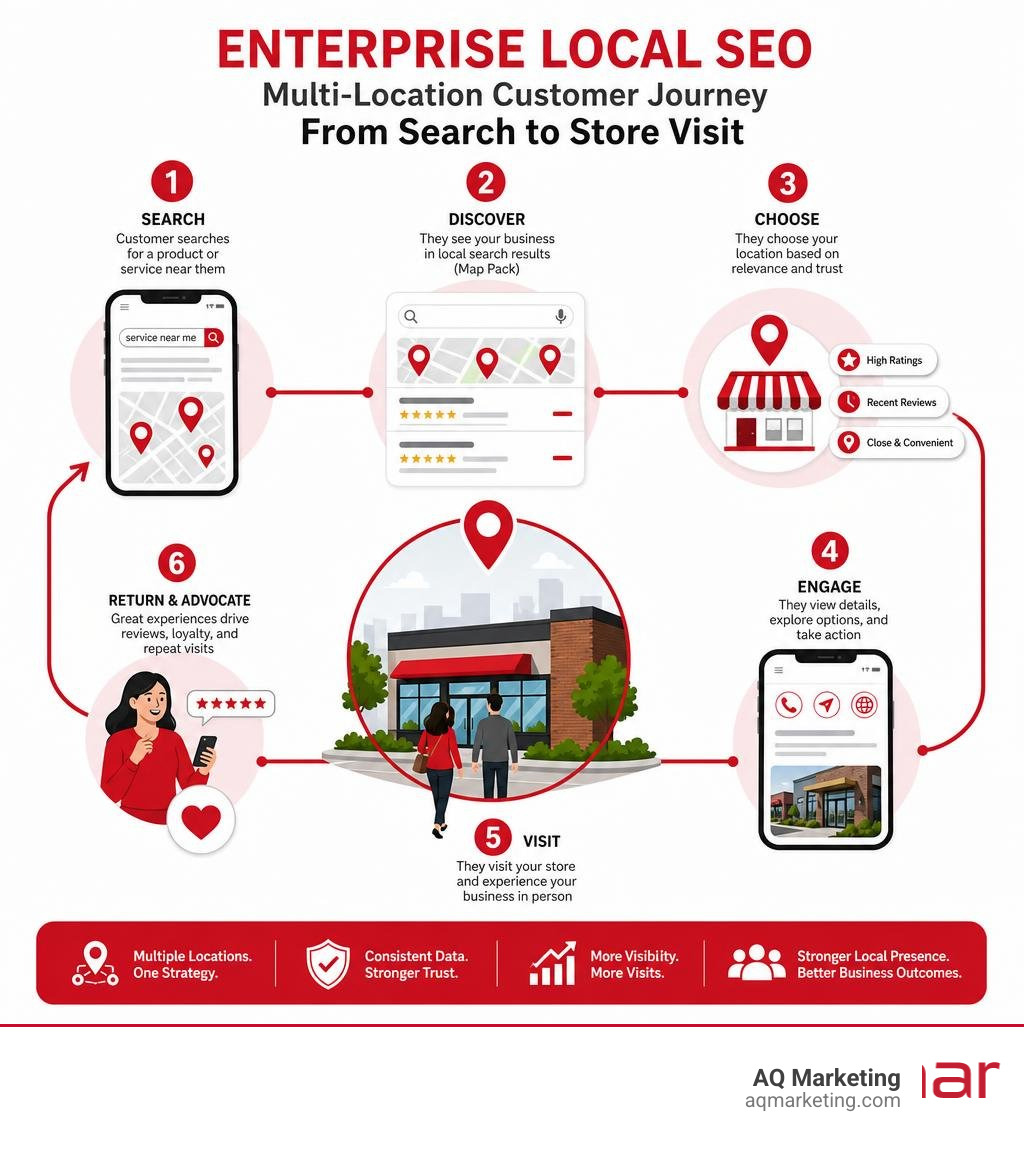
Enterprise local seo terms simplified:
Defining Enterprise Local SEO: Scale, Complexity, and Authority

At its core, enterprise local SEO is about taking the foundational principles of local search and scaling them across a massive corporate footprint. While a single-location storefront in Woburn, MA can manually update its operating hours or respond to reviews on a Friday afternoon, a brand with fifty locations across New England faces an entirely different mountain of complexity.
When we talk about enterprise-level optimization, we are looking at a multi-layered digital ecosystem. This involves aligning brand authority, managing complex site architectures, and executing hyper-targeted geographic campaigns across various municipal boundaries.
For large organizations, local search isn’t just a marketing tactic; it is a critical piece of business infrastructure. Implementing comprehensive Search Engine Optimization Services at this scale requires a deep understanding of how national brand authority can be channeled down to individual, neighborhood-level pages.
Unlike standard Local SEO for Small Business, which focuses on a single geographic node, enterprise brands must signal to search engines that they are both globally authoritative and locally relevant in every single market they touch.
Why Enterprise Local SEO Demands a Different Playbook than SMB Campaigns
If you try to run an enterprise campaign using a small-business playbook, your system will break. Traditional local search campaigns are highly manual. Enterprise local search optimization, however, requires rigid automation, strict governance, and deep technical integration.
Large websites often consist of thousands of pages, multiple subdomains, or even distinct regional brand names. This complexity introduces significant risks: crawl budget waste, duplicate content penalties, fragmented domain authority, and brand compliance issues.
To illustrate how these two approaches differ, let’s look at how tasks scale when moving from a single shop to an enterprise-level brand:
| Operational Dimension | Traditional Local SEO (SMB) | Enterprise Local SEO |
|---|---|---|
| Location Management | 1 to 5 physical storefronts | 20 to 1,000+ physical sites or service areas |
| Data Management | Manual entry on Google Business Profile | API-driven data syndication & automated feeds |
| Content Strategy | Individually written pages for a single city | Scalable, localized templates with dynamic database injection |
| Review Management | Business owner responds directly to reviews | Centralized escalation paths, approval workflows, and AI sentiment analysis |
| Site Architecture | Simple, flat hierarchy (e.g., 5–10 pages) | Deep, complex taxonomies with dedicated state, city, and neighborhood pages |
| Brand Compliance | Complete freedom of local messaging | Strict corporate brand guidelines and compliance reviews |
Managing this level of complexity is why many large organizations partner with an Enterprise SEO Agency: SEO for Large Businesses | Orbit Media to ensure their corporate site structure remains technically sound while serving dozens of local markets.
The Multi-Location Revenue Opportunity
Why go through all this trouble? Because the financial payoff is massive. Local search is one of the highest-intent marketing channels available. When someone searches for a service followed by a specific town name—like “home service providers in Lawrence, MA”—they are not looking for a research paper. They are looking to buy.
Across the digital marketing landscape, structured enterprise campaigns consistently deliver eye-opening metrics:
- Multi-location brands have demonstrated up to a 347% ROI from local search optimization investments in just 90 days (for example, generating $127K in tracked revenue from a modest $9.6K initial investment).
- Franchise networks and branch systems report an average 49% increase in organic leads after deploying structured local search programs.
- Targeted on-page fixes and schema updates for multi-location brands have triggered organic traffic increases of 300% or more.
When you optimize your system-wide presence, you unlock a compounding effect. Each local page that gains visibility feeds authority back to your primary domain, creating a rising tide that lifts all your locations. To capture this high-intent traffic, brands rely on specialized Local Search Optimization Services to turn search engine visibility into physical foot traffic and local phone calls.
Core Ranking Factors and the Entity-Anchor Framework

In 2026, search engines do not merely match strings of text on a page. Google operates as an “identity engine” powered by its Knowledge Graph—a massive database of real-world entities (people, places, organizations) and the relationships between them.
To win at enterprise local SEO, your brand must transition from basic keyword optimization to Entity SEO. This means establishing your business, and each of its physical locations, as a verified, trusted entity in Google’s database. This is achieved through the Entity-Anchor Framework, which treats your Google Business Profile (GBP) and your local landing pages as verified nodes in the underlying entity graph.
By anchoring your digital presence to verified public registries, professional associations, and structured data, you build a shield of trust that stabilizes your local rankings against algorithm updates. We always design our Top Search Ranking Factors in 2022 and beyond strategies around these semantic signals, ensuring that search engines can easily connect the dots between your brand and the physical neighborhoods you serve.
Integrating Enterprise Local SEO with Google Business Profile Management
Your Google Business Profile is the absolute anchor of your local entity. For enterprise brands, keeping these profiles updated cannot be an ad-hoc task. It requires a systematic approach to profile completeness.
Search engines reward profiles that maintain 95% or more field completion. This means your team must systematically address:
- Primary and Secondary Categories: Choosing the exact primary category (e.g., “Insurance Agency” rather than a broad “Corporate Office”) and layering highly relevant secondary categories.
- Factual Attribute Mapping: Filling out every business attribute, from wheelchair accessibility to online appointment options, and auditing them monthly as Google releases new industry-specific tags.
- Optimized Service Menus: Writing detailed, 300-character factual descriptions for every service offered at that specific location to improve eligibility for conversational search.
At AQ Marketing, we emphasize that consistent Google My Business Marketing is the foundation of local pack visibility. Without complete and identical data across your website and your GBP, search engine algorithms will experience “data doubt,” which suppresses your visibility in the local Map Pack.
Review Velocity and Reputation Management
Online reviews are no longer just a conversion booster; they are a critical ranking signal. In fact, 97% of consumers check online reviews before making a purchase decision. But from an SEO perspective, search engines analyze reviews for two primary signals: velocity and unstructured semantic data.
Review velocity refers to how consistently your locations receive new feedback. Having 500 reviews from three years ago is far less valuable than receiving 10 to 15 high-quality reviews every single month. Additionally, Google’s natural language processing (NLP) models read the actual text of these reviews. When a customer in Boston writes, “The team helped me set up my business policy in Downtown Boston,” they are feeding Google high-signal, unstructured data that confirms both your service offering and your geographic proximity.
To manage this across hundreds of locations, enterprises must implement structured review workflows. This includes using pre-approved, compliant response templates, setting up immediate alerts for negative feedback, and training local staff to request reviews containing specific service names and neighborhood terms. Consistent Google Business Marketing ensures that your reputation remains spotless and highly visible across every market.
Technical Architecture and Hyperlocal Content at Scale
A beautiful website is useless if search engine crawlers get lost in a labyrinth of poor site architecture. For multi-location brands, technical SEO is the gatekeeper of organic visibility. If your site structure is messy, search engines will quickly exhaust their crawl budget on duplicate or low-value pages, leaving your critical local landing pages unindexed.
To prevent this, enterprises must design a clean, logical taxonomy. The gold standard for multi-location site architecture is a hierarchical structure:
brand.com/locations/ (The main directory hub)
brand.com/locations/massachusetts/ (The state-level directory)
brand.com/locations/massachusetts/boston/ (The city or neighborhood landing page)
This clean hierarchy allows search engine crawlers to easily discover and pass domain authority down to individual local pages. Our experienced Search Engine Optimization Experts specialize in building these scalable technical frameworks, ensuring that your site remains lightning-fast, mobile-first, and highly crawlable.
Scalable Location Pages and Schema Markup
Every physical location must have its own dedicated landing page on your main website. This page acts as the digital counterpart to your physical storefront. To make these pages highly readable to search engine spiders, you must implement advanced, nested schema markup.
Your local pages should utilize LocalBusiness or industry-specific schema (like InsuranceAgency or HomeAndConstructionBusiness). Within this schema, you must define:
- The @id Property: A unique URI that establishes the page as a distinct entity.
- The sameAs Property: Links to verified external profiles, such as the corresponding Google Business Profile, local chamber of commerce listings, or state licensing registries.
- The areaServed Property: Explicitly defining the geographic boundaries, postal codes, or cities that the specific branch services.
By implementing these structured data types, you turn raw HTML into clear, machine-readable facts. This structured approach is a core element of the Search Engine Optimization Services we provide to help multi-location brands secure prominent real estate in both traditional and AI search results.
Creating Unique Local Content Without Doorway Penalties
One of the biggest traps in enterprise local SEO is the use of thin, templated location pages. If you simply copy and paste the exact same text across 100 city pages, merely changing the city name, search engines will flag these as “doorway pages” and filter them out of search results.
To build real local authority without triggering duplicate content penalties, you must create unique, hyperlocal content. This can be achieved at scale by combining structural templates with localized data blocks:
- Incorporate Neighborhood Vernacular: Instead of just targeting generic city names, reference local landmarks, historic districts, and neighborhood nicknames (e.g., mentioning proximity to the Common in Boston, or service areas in the Merrimack Valley).
- Display Local Reviews and Testimonials: Dynamically pull reviews left by customers in that specific zip code directly onto the corresponding location page.
- Highlight Community Involvement: Feature local event sponsorships, charity partnerships, or profiles of the local branch staff.
For example, a brand operating in the Merrimack Valley might feature localized service guides for areas like Lawrence, MA, or highlight community projects in Wakefield, MA. If you are targeting western Massachusetts, collaborating with an Award Winning Amherst, MA SEO Agency – Baystate Marketing or optimizing pages for an SEO Marketing Company in Adams, MA can provide the hyper-local context needed to win those specific regional searches.
Using smart, database-driven Small Business SEO Strategies allows you to keep your content fresh, deeply relevant, and entirely unique to each community.
Navigating AI-Driven Search and Zero-Click Visibility
The search landscape in June 2026 is fundamentally different than it was just a few years ago. With the rapid rise of AI Overviews, Gemini, ChatGPT Search, and Perplexity, the way consumers find local businesses has shifted. We are now firmly in the era of “zero-click search,” where users get their answers directly on the search engine results page without ever clicking through to a website.
For enterprise brands, this means your content must be structured in a way that AI crawlers can easily digest, synthesize, and recommend. If your website lacks the clear, structured data that AI systems need, your brand will become virtually invisible to conversational search engines. Our Search Engine Optimization Experts are constantly adapting our strategies to ensure our clients’ websites remain the primary “source of truth” for these advanced AI systems.
AI Search Engines and the 1.2% Selection Challenge
AI-driven search is incredibly selective. While traditional Google searches present users with pages of blue links, AI search engines are roughly 30x more selective, with some platforms, like ChatGPT, surfacing only 1.2% of total search results in their final recommendations.
Furthermore, 45% of retail and service leaders are missing critical AI recommendations simply because their websites lack the structured data that AI crawlers require to verify business information. To survive in this environment, enterprise brands must implement an active “source of truth” strategy:
- Publish an llms.txt File: Provide a clean, markdown-formatted directory of your site’s key pages specifically designed for LLM crawlers to read.
- Ensure AI Crawler Accessibility: Verify that your robots.txt file does not accidentally block critical AI agents like GPTBot, PerplexityBot, or ClaudeBot.
- Maintain Citation Parity: Ensure your business details (NAP) are identical across all major data aggregators, as AI systems cross-reference multiple web sources to verify your business’s legitimacy before recommending you.
Preparing for Conversational Queries and AI Overviews
Conversational search queries are much longer and more natural than traditional keyword searches. Instead of typing “plumber Woburn MA,” a user might ask their AI assistant, “Who is a highly-rated commercial plumber near Woburn that is open on Sundays and handles emergency pipe leaks?”
To capture these long-tail, conversational queries, your local pages must be optimized for semantic search:
- Leverage FAQ Schema: Include robust FAQ sections on every location page that answer actual customer questions, marked up with clean FAQPage schema.
- Write Factual, Direct Answers: Structure your content in a clear “question-and-answer” format that AI engines can easily extract and display in AI Overviews.
- Focus on Natural Language: Use conversational, authoritative language that addresses actual user intent.
By working with an experienced Search Engine Optimization Consultant, your brand can build a content framework that aligns perfectly with these advanced conversational algorithms, securing your place as the recommended local option.
Operational Challenges and Governance Frameworks
The greatest obstacle to successful enterprise local SEO is rarely a lack of budget; it is operational friction. Managing hundreds of local profiles, keeping operating hours accurate, responding to reviews, and maintaining brand compliance across a massive corporate network is an administrative nightmare.
Without a clear governance framework, data fragmentation quickly sets in. Local managers might change their store hours on a whim, upload low-quality photos, or respond to negative reviews in a way that violates corporate policy. To prevent this, enterprises must establish clear systems that define who owns what. Partnering with one of the Best SEO Companies can help you establish these critical operational guardrails, ensuring brand consistency while allowing for local flexibility.
Centralized Control vs. Local Flexibility
To scale successfully, we recommend a “hybrid” governance model that balances corporate oversight with local insights:
In this model, the Corporate HQ maintains strict control over the core business data—such as legal names, website URLs, and structured schema markup. This prevents accidental data corruption and ensures strict brand compliance.
Meanwhile, Local Managers are given restricted, role-based access to handle tasks that require local knowledge, such as uploading real-time photos of their local team, updating special holiday hours, and flagging spam reviews. This hybrid workflow ensures your brand speaks with one cohesive voice while remaining deeply connected to each local community.
API Syndication and Cohort Management
Manually updating hundreds of Google Business Profiles is a recipe for disaster. To maintain absolute data accuracy, enterprise brands must utilize API data syndication tools (such as Yext, Uberall, or Rio SEO) to sync their core location data from a single, centralized database out to all major directories and search engines simultaneously.
Additionally, managing large networks is much easier when you segment your locations into cohorts. Instead of treating all 500 locations as a single block, you can group them by:
- Performance Tier: Allocating more optimization resources to underperforming locations.
- Regional Cohorts: Grouping locations by state or county to run localized promotion campaigns.
- Service Type: Segmenting locations by the specific services or products they offer.
This systematic approach allows corporate marketing teams to push bulk updates to specific groups of locations instantly, ensuring your entire digital footprint remains accurate, consistent, and highly optimized.
Frequently Asked Questions About Enterprise Local SEO
How long does it take to see results from an enterprise local SEO campaign?
While standard SEO campaigns often require 6 to 12 months to show national traction, local SEO optimization typically delivers faster results. Initial ranking lifts in Google’s Map Pack and cleanups of major citation directories can show measurable improvements in 4 to 8 weeks.
However, building deep, sustainable organic authority for newly launched city landing pages is a longer-term process. You can expect these local pages to build consistent, top-tier rankings over 3 to 6 months of ongoing optimization, review generation, and local link building.
What are the most common mistakes enterprises make with local search?
The three most common mistakes we see enterprises make are:
- Relying on Thin, Templated Location Pages: Using identical copy across dozens of local pages, which search engines treat as low-value doorway pages and suppress from search results.
- Allowing Inconsistent NAP Data: Having slight variations in your business Name, Address, or Phone number across different directories, which creates algorithmic doubt and lowers your rankings.
- Ignoring Review Velocity: Focusing solely on total review count while neglecting the consistent, monthly flow of new, high-quality reviews that search engines require in 2026.
How do you measure the ROI of multi-location local search optimization?
Measuring success goes far beyond tracking generic keyword positions. To calculate true ROI, enterprises should focus on high-intent conversion actions, including:
- Google Business Profile Insights: Tracking direct phone calls, map direction requests, and website clicks originating directly from the Map Pack.
- Geographic Traffic Analysis: Monitoring organic website traffic coming specifically from the target zip codes of your physical locations.
- Local Conversion Actions: Tracking online appointment bookings, contact form submissions, and localized lead generation.
For large organizations looking to scale their digital footprint, collaborating with experienced Best SEO Companies or top-tier Boston SEO Agencies is the best way to build custom reporting dashboards that clearly attribute revenue back to your local search investments.
Regarding the cost of managing these campaigns, typical enterprise local SEO engagements based on average online data range from $1,500 to over $12,000 per month, depending on the total number of locations and the competitive landscape of your markets. Please note that this pricing is based on average industry data and does not represent AQ Marketing’s actual pricing.
Conclusion
Enterprise local SEO is no longer an optional marketing tactic; it is a vital revenue infrastructure for multi-location brands. In an era where AI search engines are highly selective and consumers demand instant, localized answers, the brands that build scalable, structured, and authentic local search systems are the ones that will dominate their markets.
Since 2003, AQ Marketing has been helping businesses across New England navigate the complexities of the digital landscape. From our headquarters in Woburn, MA, we specialize in delivering long-term, impactful results through website design, structured SEO, and proactive reputation management.
Whether you operate home services, insurance agencies, or multi-location retail branches, we have the experience and the systems to help you scale your online presence and turn local search visibility into measurable business growth.
Ready to dominate your local markets and drive real revenue across all your locations? Partner with AQ Marketing for Enterprise SEO Optimization Services and let’s start building a local search engine strategy that scales.